
“The paradox of modern dating is that online platforms provide more opportunities to find a romantic partner than ever before, but people are nevertheless more likely to be single.”
Tila Pronk and Jaap Denissen, Social Psychological and Personality Science, 2020
It is Sunday, 9:40 p.m., and Friday’s date went well, which you know because you have replayed it three times, and yet your thumb is still moving through profiles on an app you told yourself you would close, while a half-written text to the person you liked sits in another tab, edited four times, unsent, because the second sentence sounds either too keen or not keen enough depending on which way you read it. You are not short of options. You are short of a decision.
There is a famous name for this. The paradox of choice: more options, more paralysis, a phrase that turns up on page after page about dating apps, gets repeated by relationship columns, matchmakers and friends who have had two glasses of wine, and feels so obviously true that nobody stops to ask what the research behind it found. It found a mess. The mess is the useful part.
This page is about what dating apps, endless options and texting do to the way you choose, and what to change about how you use them. If your question is the bigger one, whether to stay, leave or take the next step with someone, our guide to analysis paralysis in relationships is the place for that. Here, we stay with the phone.
The short version
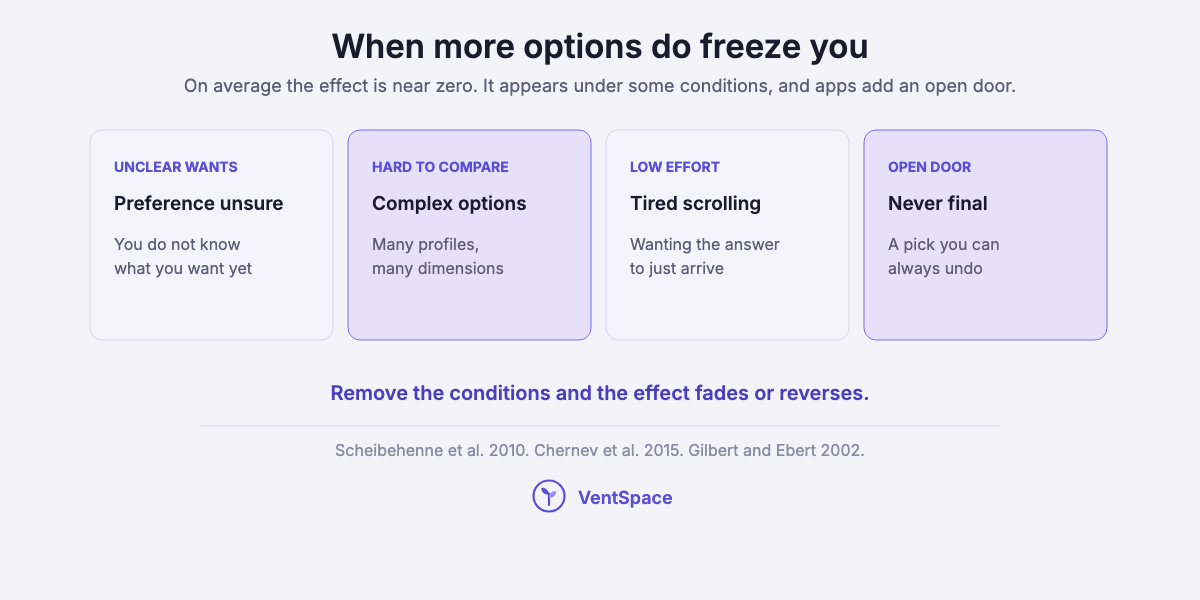
More options do not reliably freeze people. Across 50 experiments, the average effect of a bigger choice set was virtually zero. It shows up under specific conditions: when you do not know what you want, the options are hard to compare, and you are trying to choose with as little effort as possible.
Dating apps create those conditions. In three studies, people grew more rejecting as they moved through profiles, and daters who picked from 24 options were less satisfied a week later than those who picked from 6.
A choice that never closes is harder to enjoy. People like a decision less when they can still change it.
Text strips out tone, and people overrate how well it carries.
Five changes: decide what you are choosing for before you open the app, shrink the pool on purpose, let a choice be final for a while, move hard conversations off the screen, and keep some time together with the phones away.
Does having more options freeze you?
“In a meta-analysis of 63 conditions from 50 published and unpublished experiments (N=5,036), we found a mean effect size of virtually zero but considerable variance between studies.”
Benjamin Scheibehenne, Rainer Greifeneder and Peter Todd, Journal of Consumer Research, 2010
On average, no. The idea comes from a 2000 study by Sheena Iyengar and Mark Lepper, the one with the jam, in which shoppers at a grocery store who saw 6 jams were far more likely to buy one than shoppers who saw 24, nearly 30% against 3%, a result that has been retold in so many books, talks and blog posts that it now sounds like a law of nature rather than a jam display at one store. It was small. The purchase figures rest on 249 shoppers and 35 jars of jam. A later jam study by Benjamin Scheibehenne, about twice that size, in a German supermarket, found essentially nothing.
Then the researchers did the thing that settles arguments, which is to stop arguing about one study and pool all of them: Scheibehenne and his colleagues gathered 50 experiments, published and unpublished, with more than five thousand people between them, and found an average effect of virtually zero, with wide differences from one study to the next. Some found overload. Some found nothing. Some found more options helped.
So is the paradox of choice a myth? Not quite. A second meta-analysis, by Alexander Chernev, Ulf Böckenholt and Joseph Goodman, went looking for when overload shows up, and found four conditions: the options are complex, the task is hard, you are unsure what you prefer, and you are trying to choose with as little effort as you can. Take those away and the effect vanishes, or reverses. The authors coded those conditions themselves after the fact, which is a real limit. Still, read that list again. Now picture 11 p.m.
That is the turn. The number of options is not the villain on its own. The villain is a large number of options, plus no clear idea of what you are looking for, plus a tired mood that wants the right person to arrive without effort, the way a show arrives when you hit play, which, if we are honest with ourselves for a second, sounds a lot like lying in bed swiping at 11 p.m. Options are fine. Fog is not.
Quick Summary
Q: Is the paradox of choice real in dating?
A: Not as a general rule. A meta-analysis of 50 experiments found the average effect of more options was virtually zero. A later meta-analysis found overload does appear when options are complex, the choice is hard, preferences are unclear and people want to decide with little effort, conditions a swiping session often meets.
Insight: when more options do hurt
“We further show that each of these four factors has a reliable and significant impact on choice overload, whereby higher levels of decision task difficulty, greater choice set complexity, higher preference uncertainty, and a more prominent, effort-minimizing goal facilitate choice overload.” Alexander Chernev, Ulf Böckenholt and Joseph Goodman, Journal of Consumer Psychology, 2015.
What dating apps do to the way you choose
“Our findings suggest that people gradually ‘close off’ from mating opportunities when online dating.”
Tila Pronk and Jaap Denissen, Social Psychological and Personality Science, 2020
The apps change how picky you get, and how sure you feel, while you are using them. Tila Pronk and Jaap Denissen ran three studies on online dating and found what they called a rejection mind-set. People started rejecting more profiles almost as soon as they began, and by the end of a session the chance of accepting someone had dropped by 27% on average from the first option to the last, a drop that tracked a steady decline in how satisfied people were with the pictures in front of them and how successful they felt at dating at all, and that, for women, also meant fewer matches. Same people. One session. They got harder to please the longer they scrolled.
Then there is what happens after you choose, which is where Jonathan D’Angelo and Catalina Toma come in: they had online daters pick a partner from either 6 or 24 profiles, let some of them know they could change their pick later and told others it was final, and then checked back a week later to see how everyone felt. The people who chose from 24 were less satisfied with their pick, and more likely to switch. The least satisfied of all were the ones who chose from the big pool and were told they could change their minds.
That last detail matters more than it looks. In a classic set of experiments, Daniel Gilbert and Jane Ebert let photography students choose which of their prints to keep, and the students who could swap their choice later liked their print less than the students whose choice was final, even though most of them, asked in advance, wanted the option to swap. We think an open door protects us. It mostly keeps us in the hallway.
A dating app is a door that never closes. You can match, talk, meet, fall a little, and the app is still sitting there on your home screen, holding everyone else you have not met yet, so the question “is there someone better?” never gets a final answer, because nothing about the app ever tells you to stop looking. It just waits.
This is not only a singles problem, either. A 2024 survey of 804 Greek-speaking adults by Menelaos Apostolou and colleagues found two things at once: people who felt they had more romantic options were less likely to be single, and those options were also linked to more choice overload, which in turn went with being single. Among people in relationships, more perceived options went with more regret about the current relationship and less satisfaction, a path that held only for men. It is one survey, in one culture, at one point in time, and some of its questionnaires were new. Options cut both ways.
And the experience itself is split. In a Pew Research Center survey of 6,034 US adults in 2022, three in ten had used a dating site or app, and users were divided almost down the middle on whether it had gone well: 53% positive, 46% negative. Among recent users, 54% of women said they had felt overwhelmed by the number of messages they got, against a quarter of men, while 64% of men said they had felt insecure about a lack of messages.
Quick Summary
Q: How do dating apps affect decision-making?
A: In three studies, people grew more rejecting as they moved through profiles, with the chance of accepting someone falling 27% on average from first to last. In an experiment, daters who chose from 24 profiles were less satisfied a week later than those who chose from 6, especially when they could still change their pick. Choices that stay open tend to feel less satisfying.
Insight: big pools, open doors
“Drawing on the choice overload and decision reversibility theoretical frameworks, we show that, a week after making their selection, online daters who chose from a large set of potential partners (i.e., 24) were less satisfied with their choice than those who selected from a small set (i.e., 6), and were more likely to change their selection. While choice reversibility did not affect daters’ satisfaction, those who selected from a large pool and had the ability to reverse their choice were the least satisfied with their selected partner after one week.” Jonathan D’Angelo and Catalina Toma, Media Psychology, 2017.
Why texting turns a relationship into a puzzle
“Five experiments suggest that this limitation is often underappreciated, such that people tend to believe that they can communicate over e-mail more effectively than they actually can.”
Justin Kruger, Nicholas Epley, Jason Parker and Zhi-Wen Ng, Journal of Personality and Social Psychology, 2005
Text strips out the cues that tell you how someone meant something, and both of you underestimate what is missing. Justin Kruger and his colleagues tested this with email in 2005, across five experiments, and found that people believed their tone came through better than it did, and that the reason was egocentrism: when you write a line as a joke, you hear the joke in your own head, with your own timing and your own raised eyebrow, and it is hard to imagine a reader on the other end who hears none of it. They hear words.
Now put that inside a relationship that is still deciding what it is. The old version of this page listed what happens next. Every item still lands. You overanalyze the word choice and the punctuation. You play the waiting game, where every minute without a reply becomes a verdict. You write the perfect text, edit it, re-edit it, and send something stiffer than you are. And somewhere underneath sits the fear of being ghosted, which makes it safer to say nothing real at all.
None of that is a character flaw, and none of it means you are bad at relationships, because it is what happens when two people who like each other try to read tone, interest and intention through a channel that carries words and drops the voice, the face and the pause before an answer. The text did not say what you think it said. It said less.
From Sai, who writes this site
Have you ever wondered how we get more “cute couple reels” when we are in love and “breakup and motivational” videos when we are heartbroken? It has happened to me quite often, and it makes sense.
If your feed seems to hand your own question back to you all evening, that is one more reason to make the decision somewhere other than on the phone. Put it down.
Quick Summary
Q: Why do I overthink texts in a relationship?
A: Because text strips out tone, pauses and facial expression, and research on email found people overestimate how well their meaning comes through. Without those cues, a short reply or a slow one gets filled in with the worst reading. Asking, or talking in person, gives back what the text left out.
Insight: you hear your own tone
“Studies 4 and 5 further suggest that this overconfidence is born of egocentrism, the inherent difficulty of detaching oneself from one’s own perspective when evaluating the perspective of someone else. Because e-mail communicators “hear” a statement differently depending on whether they intend to be, say, sarcastic or funny, it can be difficult to appreciate that their electronic audience may not.” Justin Kruger and colleagues, Journal of Personality and Social Psychology, 2005.
So what do you change?
Before the changes: a safety note. If thinking about a relationship has left you feeling hopeless or unsafe, please contact the 988 Suicide & Crisis Lifeline now (US, call or text 988), or find a line in your country at findahelpline.com. And if a partner checks your phone, demands your passwords or controls who you can message, that is not a technology habit to manage. You can call The National Domestic Violence Hotline at 1-800-799-7233, or text START to 88788.
Five changes to make this week
“People prefer to make changeable decisions rather than unchangeable decisions because they do not realize that they may be more satisfied with the latter.”
Daniel Gilbert and Jane Ebert, Journal of Personality and Social Psychology, 2002
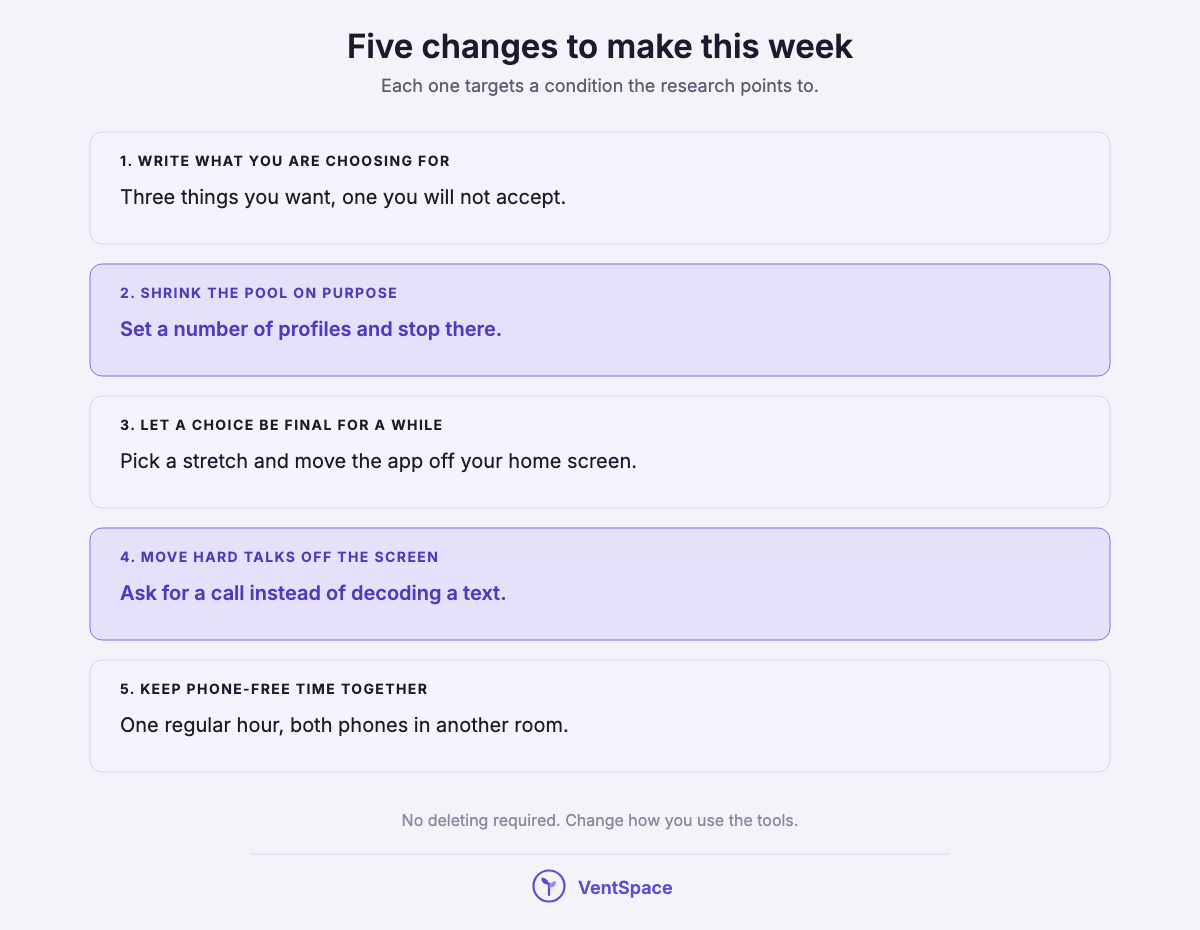
Each change goes after one of the conditions the research points to. Unclear preferences. A pool too big to compare. A door that never shuts. A channel that drops tone. None of them asks you to delete anything or leave anyone.
1. Write down what you are choosing for before you open the app
Before your next session, write three things you are looking for and one thing you will not accept. The old version of this page called this your relationship compass. It goes straight at the condition the research names as preference uncertainty, the one that makes a big pool hard to handle.
- What do I want this to feel like six months in?
- What have I liked about the people I enjoyed spending time with?
- What is the one thing I keep overlooking and regretting?
Keep the list short. Three lines you believe beat ten you copied from somewhere.
2. Shrink the pool on purpose
Set a number before you open the app, say ten profiles, and close it when you hit it. Pronk and Denissen found the rejection mind-set builds over a session, so a short session catches you before it sets in. The old page put the principle well: quality over quantity.
- How many profiles did I look at last time, and how did I feel at the end?
- Would I rather talk properly to two people this week, or skim forty?
- What time of day do I swipe on autopilot?
If the whole thing has stopped being fun, a pause is allowed. Taking a dating break is a choice, not a failure.
3. Let a choice be final for a while
When you decide to see where something goes, give it a set stretch, say a month, and take the apps off your home screen for that time. You are not promising forever. You are closing the door long enough for the room to feel like a room. That is what the reversibility research suggests: a choice you can still undo tends to feel worse, even when it is a good one.
- What would I need to see in the next month to keep going?
- Am I comparing this real person with a profile I have never met?
- If “perfect” does not exist, what does good enough look like here?
You are allowed to change your mind at the end of the month. You are just not deciding again every night.
4. Move the hard conversations off the screen
The next time a text sends you spinning, do not draft a reply. Ask for a call, or say it in person. Questions like “Where is this going?”, “Did that upset you?” or “Are we OK?” are exactly the kind that text handles worst. The Kruger research is a reason to assume your tone did not land and theirs may not have either.
- Am I reading meaning into the timing, the punctuation or the length?
- What would I say if they were sitting across from me?
- Could I just ask what they meant?
Ask, do not decode. You do not have to get the wording perfect when your voice can carry the rest.
5. Keep some time together with the phones away
Pick one regular stretch, dinner or the first hour of Saturday, when both phones go in another room. The old page suggested tech-free times and app timers, and both are fine tools. There is some evidence that stepping back from one platform changes how people spend their time. In a randomized experiment by Hunt Allcott and colleagues, people who deactivated Facebook for the four weeks before the 2018 US midterm election spent more time on offline activities, including socializing with family and friends, and reported higher subjective well-being. That was one platform for one month, not a verdict on phones.
- When are we both on our phones while technically together?
- Which hour would be easiest to protect?
- What would we do with that hour instead?
Do not turn this into a rule you police. It is an experiment, and you can adjust it.
Quick Summary
Q: How do you stop technology from feeding relationship overthinking?
A: Write down what you are looking for before opening a dating app, set a limit on how many profiles you view, give a promising connection a set stretch with the apps out of sight, move hard conversations to a call or in person, and keep a regular phone-free hour together.
Insight: why the open door costs you
“Photography students believed that having the opportunity to change their minds about which prints to keep would not influence their liking of the prints. However, those who had the opportunity to change their minds liked their prints less than those who did not (Study 1). Although the opportunity to change their minds impaired the postdecisional processes that normally promote satisfaction (Study 2a), most participants wanted to have that opportunity (Study 2b).” Daniel Gilbert and Jane Ebert, Journal of Personality and Social Psychology, 2002.
Pulling it all together
The five changes add up to one habit: make fewer decisions, and let each one count.
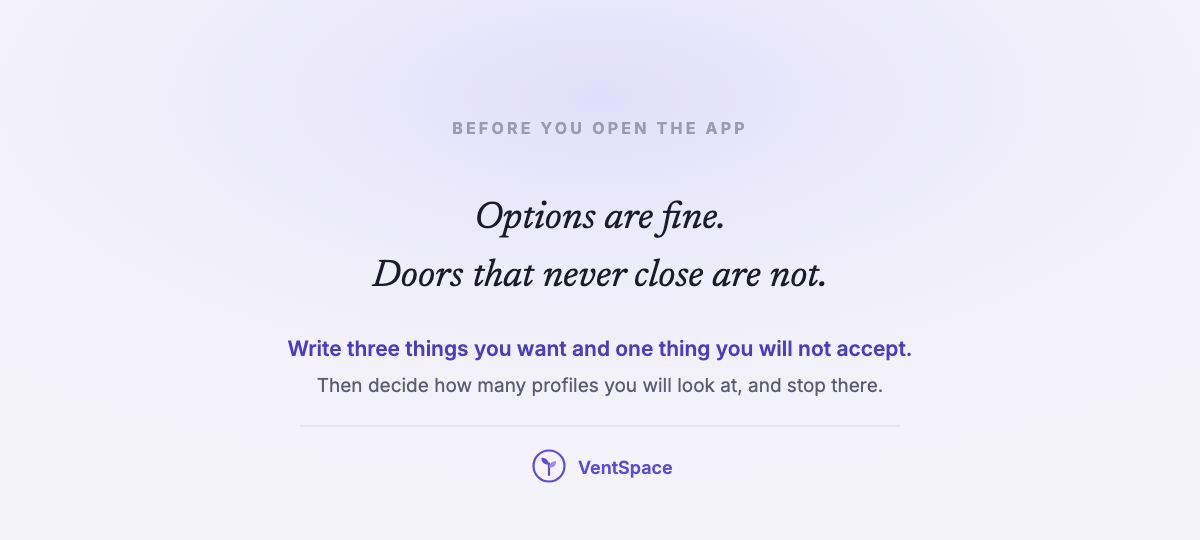
Before the next session, write your three lines and your one dealbreaker.
When you open the app, set the number and stop at it.
When something looks promising, pick a stretch, a month say, and move the app off your home screen.
When a text sends you spinning, ask for a call instead of drafting a reply.
Each week, protect one phone-free hour together and notice what fills it.
If writing your three lines helps you think, VentSpace is a journaling app that turns what you write into a clear read on your life balance, plus small, doable next steps. It is ours, so treat that as a declared interest. It is Android only and free to start as of October 2026, it has no published evidence on outcomes, and it is not therapy. Not on Android, or at a desk? VentSpace Live runs in your browser, free, with nothing to install. The notes app on your phone works too.
Questions people ask
Is the paradox of choice real?
Partly. The famous jam study found a big effect, but a larger replication found almost none, and a meta-analysis of 50 experiments found an average effect of virtually zero. A later analysis found more options do cause trouble when choices are complex, preferences are unclear and people want to decide with little effort.
Is the “Tinder effect” a real thing?
The phrase is popular shorthand, not a research term. What the research does show is a rejection mind-set: in three studies, people became more rejecting as they moved through dating profiles. And daters who chose from a larger pool were less satisfied with their pick a week later.
Should I delete my dating apps?
That is your call, and we will not make it for you. A smaller step is to change how you use them: a set number of profiles per session, a written list of what you want, and a pause from the app while you see where something promising goes.
How long should I wait before replying to a text?
There is no research-backed number, and anyone who gives you one is guessing. If the wait is making you anxious, treat that as a sign the conversation needs a call or an in-person question, not a better text.
Is this the same as analysis paralysis in relationships generally?
It is one part of it. This page covers what the technology adds. If you are stuck on a bigger decision, staying, leaving, moving in or defining things, our guide to analysis paralysis in relationships works through it step by step. If the anxiety around dating does not lift, talking to a therapist is a reasonable next step, and our page on overthinking vs problem-solving can help you tell which one you are doing.
In a nutshell
More options are not the problem by themselves. Options plus an unclear sense of what you want, plus a door that never closes, plus a channel that drops tone, is the problem. Change those, and the options become what they were supposed to be: a way to meet people.
Nobody can tell you how long this takes, and it is not one good evening. The urge to check “just one more” profile, or reread one more text, will come back. That is normal. Each time it does, you get to decide again whether to open the door or stay in the room.
Write your three lines and your one dealbreaker before you next open the app.
About this article

Written by
Sai Subramaniam
Founder, VentSpace
I write these guides because I have been where you are. I am working through my own hard seasons, and I share the things that actually helped me, so that anyone going through it has a steady companion close by instead of facing it alone. VentSpace is the app I built for exactly that: a journaling app that turns what you write into a clear read on your life balance, plus small, doable next steps toward feeling more like yourself.
This writing is honest and every claim is sourced, and it is not a substitute for professional care. If you are struggling, reaching out to a professional is a strong move, not a failure.
Explore VentSpaceTry VentSpace LiveHow this one was checked. Every factual claim traces to a named source, and the source is printed next to the claim rather than kept in a footnote. Quotes are pinned to the work they come from, with the year, the letter or the chapter where one exists. Where a widely repeated claim could not be traced, it was left out and the omission recorded. Where a figure is contested, both sides are printed.
No affiliate links, no paid placements, and nobody paid to appear here. Where we mention our own app, we say that it is ours, we state its limits, and we never position it as a substitute for care.
Reviewed: October 2026. Prices, platforms and product availability move quickly, and anything we could not verify at the time of writing is marked as unverified rather than turned into a number.
Corrections. If something here is wrong, we would rather know. Corrections are made in place, with a note saying what changed.