
“It is perfectly true, as the philosophers say, that life must be understood backwards. But they forget the other proposition, that it must be lived forwards.”
Søren Kierkegaard, Journals IV A 164 (1843)
It usually starts with one question about the two of you. Should we move in? Should I say it first? Should I stay? Then the question grows. You make the list, then the list of what the list left out, you ask three friends and get four answers, you replay what your partner said on Sunday and what they did not say on Tuesday. Weeks pass. Nothing is decided, and you are more tired than if you had decided anything at all. Sound familiar?
This has a name, analysis paralysis, and it is one of the most common shapes overthinking takes when the subject is a relationship. It is not a diagnosis and it does not mean something is wrong with you. Researchers who asked people contemplating a breakup why they wanted to stay or go found that many wanted both at once, and concluded that this kind of ambivalence is a common experience.
So this guide does two things. It explains what keeps you standing at the fork, re-reading the signposts, and then gives you five small steps to either decide or choose to wait on purpose. Neither one is a failure. Staying at the fork indefinitely is the only option that costs you everything and gives you nothing back.
From Sai, who writes this blog
Being in your shoes, I could not wait for all the overthinking, anxiety, procrastination, paralysis and lack of motivation to end.
Quick Digest
– Analysis paralysis in a relationship is being stuck on a decision about the two of you, going round it without choosing.
– It is common. Many people thinking about a breakup want to stay and to leave at the same time.
– What keeps you stuck: fear of regret, thinking that stays abstract, worry about your partner’s feelings, and drifting instead of deciding.
– The regret you fear may not be what you think. In a 2,600-person replication, long-term regrets were split almost evenly between things people did and things they did not do.
– Five steps: write the decision as one sentence with a date, swap why for what, name the fear and check it, separate your decision from their feelings, and set a deadline and a stopping time.
– If you are deciding whether to leave someone you are afraid of, this page is not the right tool. The help is listed before the steps.
What is analysis paralysis in a relationship?
“be patient toward all that is unsolved in your heart and to try to love the questions themselves like locked rooms and like books that are written in a very foreign tongue.”
Rainer Maria Rilke, Letters to a Young Poet, Letter Four
Analysis paralysis in a relationship is when thinking about a decision has replaced making it. You have gathered what you need, more or less, and you keep gathering anyway. The decisions vary. Whether to define the relationship, move in, move cities, get engaged, have children, go to couples therapy, or end it. Some are small, like whether to text first. If the decision is whether you are even in a relationship yet, our guide on dating vs relationship covers that one. The pattern is the same: the thinking keeps going and the choice does not arrive.
It helps to know what this is not. It is not a condition, and nobody can diagnose you with it from a page. “Overthinking” is an everyday word for a pattern, and the research on indecision measures it as a tendency people have more or less of. It is also not proof that the relationship is wrong. Some decisions are hard because both options cost something real.
Wanting two opposite things is normal. In a set of studies, Samantha Joel, Geoff MacDonald and Elizabeth Page-Gould asked people for their reasons to stay in a relationship or leave it and found 27 distinct reasons for staying, such as emotional intimacy and investment, and 23 for leaving, such as conflict and a breach of trust. Among people who were contemplating a breakup or divorce, many were motivated to stay and to leave at the same time. If part of you wants to stay and part of you wants to go, you are describing something researchers see often.
Is there a version of this that is not paralysis? Yes. Taking time over a big decision is not the same as being stuck. The difference is whether the thinking is moving you toward something, or circling the same three points every night.
Quick Summary
Q: What is analysis paralysis in a relationship?
A: It is being stuck on a decision about a relationship, thinking about it so much that the decision does not get made. It is common and it is not a diagnosis. Research on people considering a breakup finds that many want to stay and leave at the same time.
Insight: Samantha Joel, Geoff MacDonald and Elizabeth Page-Gould, Social Psychological and Personality Science: “Further, many participants were simultaneously motivated to both stay in their relationships and leave, suggesting that ambivalence is a common experience for those who are thinking about ending their relationships.”
Why relationship decisions freeze us
“There are more things, Lucilius, likely to frighten us than there are to crush us; we suffer more often in imagination than in reality.”
Seneca, Moral Letters to Lucilius 13.4, translated by Richard M. Gummere
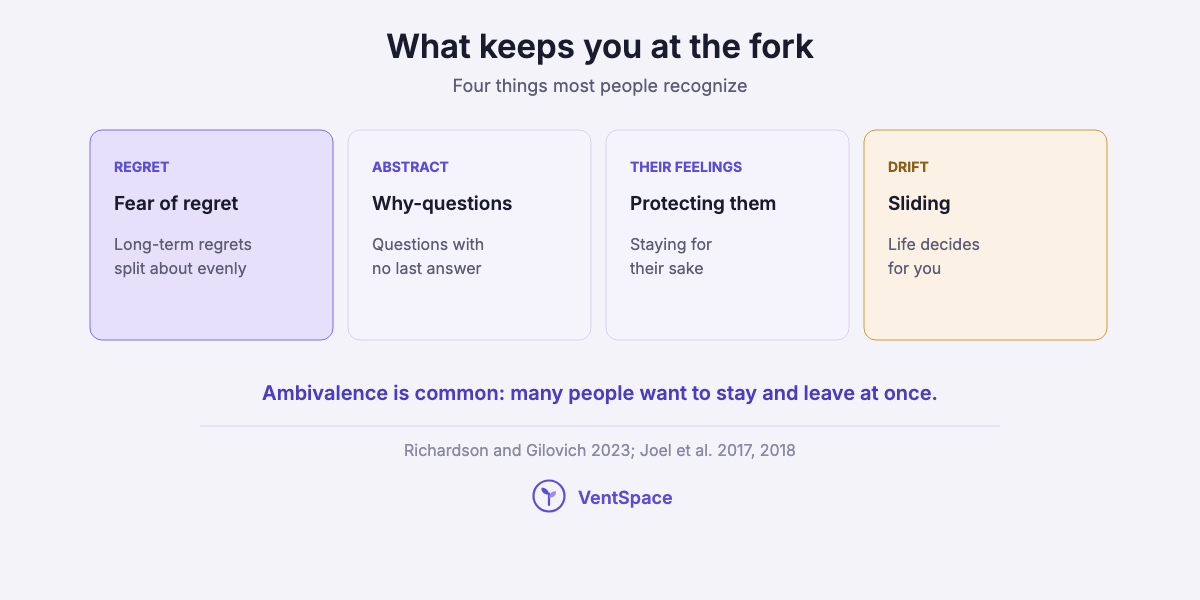
Four things keep most people at the fork: fear of regret, thinking that stays abstract, the other person’s feelings, and the pull of drifting on. You may recognize one, or all four.
The first is fear of regret. It is often the loudest, and it was for Sai too.
From Sai, who writes this blog
This was the biggest problem in my case, especially because I have lived all my life with the fear of regret.
Popular decision advice, including the first version of this page, often repeats a finding from 1994: that over time we regret the things we did not do more than the things we did. That finding came from 32 people. In 2023, Jerry Richardson and Thomas Gilovich ran a registered replication with 2,600 people. Part of it held: in the short term, more people were troubled by something they did than by something they did not do, 58% against 42%. But for the biggest regret of their lives so far, the split was 51% against 49%, statistically no different from a coin flip. So the regret you are bracing for is not reliably on one side. Neither choice comes with a guarantee against it.
The second is thinking that stays abstract. “What does this say about us?” “Am I the kind of person who leaves?” “What if I am wrong about everything?” Questions like these have no last answer, so they never finish. In two studies with 639 people in total, the psychologists Cheek and Buttrick found that finding decisions hard is close to the same thing as indecisiveness, and in their second study it was strongly linked to regret and to intolerance of uncertainty, at correlations of .69 and .63, while being unrelated to a perfectionism measure. In a 2025 study of two further samples, indecisiveness tracked abstract repetitive thinking closely and concrete thinking slightly in the opposite direction. A 2008 review by Edward Watkins proposed that whether repeated thinking helps or hurts depends partly on exactly this: abstract versus concrete. It is a review proposing principles, not a test you can score yourself on, but it points to something useful. Concrete questions end. Abstract ones do not.
The third is your partner’s feelings. Many of us do not only weigh what we want. We weigh what the decision will do to the other person. In a study that followed 1,348 people for ten weeks, and a preregistered replication with 500 people contemplating a breakup, Joel and colleagues found that the more dependent people believed their partner was on the relationship, the less likely they were to initiate a breakup. Caring about someone is not a flaw. But it can keep a decision frozen for reasons that have little to do with what you want.
The fourth is the drift. When we do not decide, life tends to decide for us. Scott Stanley, Galena Rhoades and Howard Markman described couples who move through big transitions, like moving in together, by sliding rather than deciding, and argued that the inertia of a shared home can carry some couples into marriages they might not otherwise have chosen. Paralysis often feels like keeping every option open. In practice it can be a slow way of choosing whatever happens next.
Quick Summary
Q: Why is it so hard to make decisions in a relationship?
A: Usually because of fear of regret, abstract questions that never resolve, worry about how the decision will affect a partner, and the ease of drifting instead of deciding. Research finds indecision is linked to regret and intolerance of uncertainty, and that people are less likely to end a relationship when they believe their partner depends on it.
Insight: Jerry Richardson and Thomas Gilovich, Royal Society Open Science (2023), on their 2,600-person replication: a successful replication “in the sense that action regrets loom larger in people’s minds in the short term than with the passage of time”, but “the present effort should be viewed as a partial replication”.
So how do you step off the fork?
Before the steps: when this page is not the right tool
If the decision you are stuck on is whether to leave someone who frightens you, controls you or hurts you, this page is not the right tool. No list of steps, regret exercise or coin toss belongs anywhere near that decision, and the people best placed to help you plan it are specialists. In the United States, the National Domestic Violence Hotline is free, confidential and open 24/7: call 1-800-799-7233 or text START to 88788. If you are in immediate danger, call 911.
If the weight of this decision has left you thinking about harming yourself, please talk to someone now. In the United States, call or text 988 to reach the 988 Suicide & Crisis Lifeline, which is free, confidential and available 24/7. Elsewhere, findahelpline.com lists free, confidential helplines near you.
Quick Summary
Q: Should I use decision techniques to decide whether to leave an abusive relationship?
A: No. Techniques for indecision are not built for decisions about safety. The National Domestic Violence Hotline (1-800-799-7233, or text START to 88788) can help, and 988 is there if you are thinking about harming yourself.
How to stop analysis paralysis in a relationship: five steps
“Every relationship is unique, with its dynamics, love languages, and feelings. So there’s no one clear solution that you can just read and adopt.”
Sai Subramaniam, in the first version of this page (2024)
The way off the fork is to make the decision smaller, more concrete and finite. Not easier, because some of these choices are hard by nature, but concrete enough that thinking about it can end. Each step below starts with something you can do in the next ten minutes with a pen and paper. Every question in them is a what, when or which question, on purpose.
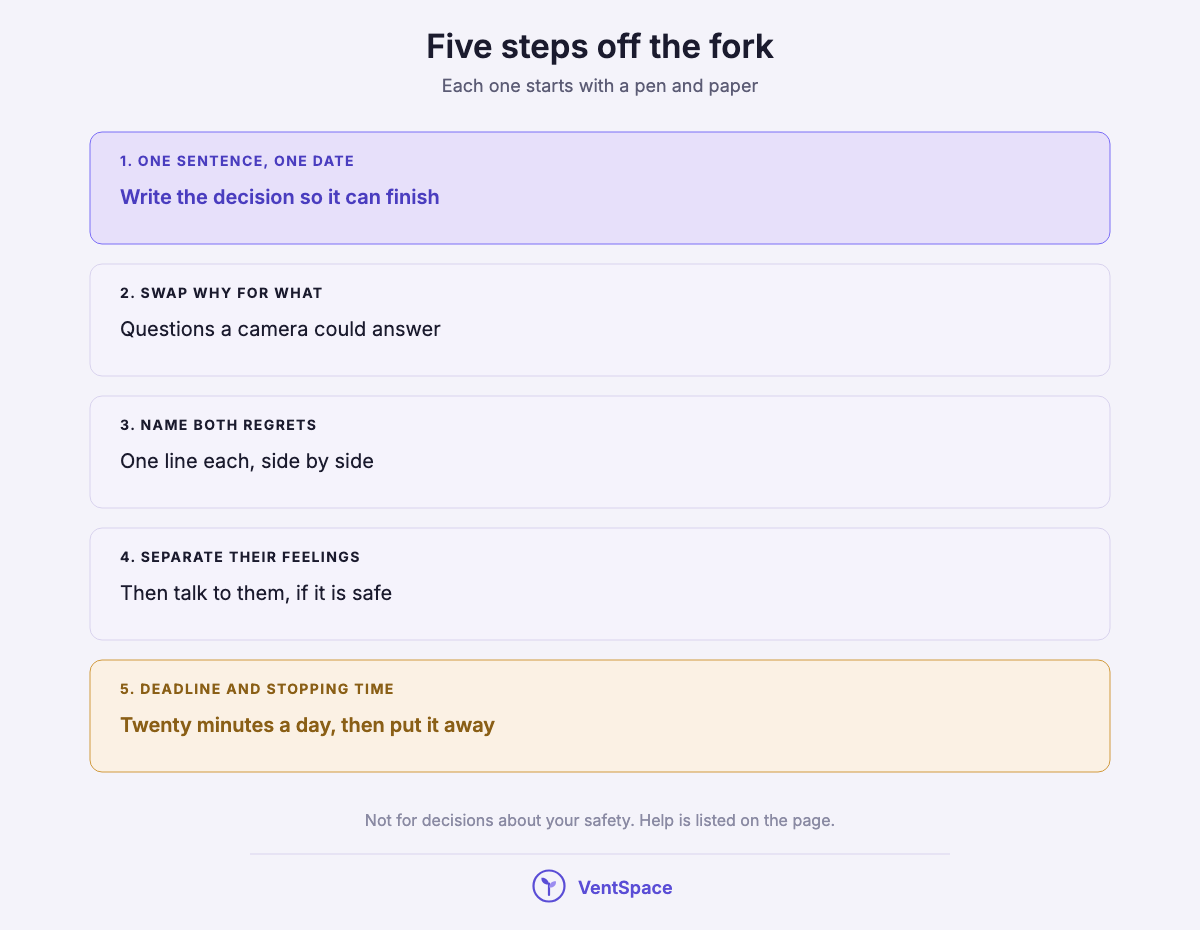
1. Write the decision as one sentence, with a date
Grab a sheet of paper and write the decision as a single sentence that ends with a date. Not “what should I do about us”, but “By the end of November, I will decide whether to tell her I want us to move in together.” A decision with a sentence and a date is something you can finish. A decision without one is a mood.
- What, exactly, am I deciding?
- What are the two or three real options, written as actions?
- By what date do I need an answer, and what happens on that date if I have none?
- What would I tell a close friend to do if they handed me this sentence?
Do not worry if the first sentence is clumsy. Rewrite it until it is plain enough to read aloud.
2. Swap every why for a what
Read back the questions you have been asking yourself, and rewrite each “why” as a “what”. “Why do I feel like this?” becomes “What happened on Sunday, and what did I feel right after?” “Why can’t I commit?” becomes “What, specifically, am I afraid would happen if I said yes?” What-questions point at things a camera could have seen. They have answers, which means they can end.
- What happened, in order, the last time I felt sure?
- What happened the last time I felt sure of the opposite?
- Which part of this decision do I already know the answer to?
- What information am I still waiting for, and who has it?
From Sai, who writes this blog
For me, meditation allows me to just observe my thoughts and emotions from a higher perspective without any judgment.
You do not need to answer every question. One honest what is worth ten more whys.
3. Name what you are afraid of regretting, and check it
Write down the regret you are most afraid of on each side, in one line each. “I left and she was the one.” “I stayed and wasted five more years.” Then look at them side by side. The replication above suggests that over the long run, people’s biggest regrets are split almost evenly between actions and inactions. Both of your lines are possible, and so is living with either one.
- What exactly would I regret on each side?
- Which of those could I recover from, and how?
- What would I do in the first month after each choice?
- Which regret belongs to me, and which belongs to what other people expect?
Feeling afraid of both does not mean you cannot choose. It means both options matter to you.
4. Separate your decision from their feelings, then talk to them
On the same sheet, draw a line down the middle. On one side, write what you want. On the other, write what you are afraid the decision would do to your partner. Seeing them apart shows you how much of the paralysis is about you and how much is about protecting them. Then, if it is safe to, talk to your partner about the decision itself, not only around it. Many relationship decisions are not yours alone to make.
From Sai, who writes this blog
Establishing shared goals and values was my relationship saver. At one point my partner took a break from me to introspect and re-analyze the relationship. Then we communicated with each other and decided to establish some shared goals and values that we can both work on throughout our lives, which bonded us on a deeper level.
- What do I want, if I set their feelings aside for one minute?
- What am I afraid this would do to them?
- What have I assumed about what they want, without asking?
- What is one sentence I could say to start this conversation?
It is okay if their feelings still matter to your choice. They should. The point is to see them clearly instead of letting them decide in the dark.
5. Give it a deadline and a stopping time
Put two things in your calendar now: the date from step 1, and a short daily stopping time for thinking about it, for example twenty minutes, after which you put the sheet away until tomorrow. No research gives a right number of minutes or days for this, so treat the limit as a decision you make, not a rule you were given. When the date arrives, you have two good options: decide, or decide to wait on purpose until a named later date, with a reason you have written down. What you are giving up is the third option, the one where nothing is decided and the weeks keep passing.
- What is my date, and is it in the calendar?
- When and where will I do my twenty minutes, and when do they stop?
- If I choose to wait, what am I waiting for, and until when?
- Who will I tell about the date, so it is real?
Choosing to wait is a decision. Drifting is not, and the difference is the date.
Quick Summary
Q: How do you stop analysis paralysis in a relationship?
A: Write the decision as one sentence with a date. Rewrite why-questions as what-questions so they can be answered. Name the regret you fear on each side. Separate what you want from your worry about your partner’s feelings, then talk to them if it is safe. Set a deadline and a daily stopping time, then decide or choose to wait on purpose.
Insight: Samantha Joel, Emily Impett, Stephanie Spielmann and Geoff MacDonald, Journal of Personality and Social Psychology (2018): “Both studies showed that the more dependent people believed their partner was on the relationship, the less likely they were to initiate a breakup. These findings held above and beyond a variety of self-focused variables (e.g., investment model components; Rusbult, Martz, & Agnew, 1998). These results suggest that people can be motivated to stay in relatively unfulfilling relationships for the sake of their romantic partner.”
Pulling it all together
Start with the sentence. Write the decision in one line with a date at the end, and put the date in your calendar today.
Then change the questions. Take every why you have been circling and rewrite it as a what. Keep the ones you can answer.
Name both regrets. One line each, side by side. Write down what you would do in the first month after each choice.
Draw the line down the page. What you want on one side, what you fear for your partner on the other. Write the first sentence of the conversation you need to have.
Then stop. Twenty minutes a day, then the sheet goes away. On the date, decide, or decide to wait until a named later date.
If writing this down helps, a notebook is enough. If you want somewhere that does a little more with it, VentSpace is a journaling app that turns what you write into a clear read on your life balance, plus small, doable next steps. Prefer to try it on your laptop first? VentSpace Live runs in your browser, free, with nothing to install. It is ours, and it is free to start on Google Play. One honest caution, whichever you use: writing helps some people more than others. A review by Karen Baikie and Kay Wilhelm reported effects of roughly 0.47 in healthy samples, 0.19 in clinical samples and 0.07, not statistically significant, in psychiatric samples, and a detrimental result for adult survivors of childhood abuse and a small group of veterans. That is why the stopping time matters. If the writing leaves you more stuck, stop, and talk to someone instead. Our piece on why journaling doesn’t always stop overthinking explains when writing helps and when it does not.
When to get help
If you have been stuck for a long time, or the decision involves both of you and you keep failing to talk about it, a professional can help. Therapy is one option, and for a lot of people it is the right one.
- Couples therapy suits decisions you are making together, when every conversation about it ends in the same place.
- Discernment counseling is an approach designed for couples where one partner is leaning toward divorce and the other wants to preserve the relationship. In the developers’ own analysis of 100 consecutive cases, about half of couples chose to start couples therapy to reconcile, and most of the rest chose divorce.
- Individual therapy is worth considering if the paralysis has spread beyond this decision, so that every choice, large or small, feels impossible. At that point it is no longer only a relationship question.
It is also worth knowing the difference between ordinary thinking and the stuck kind. Our guide on overthinking vs problem solving covers how to tell them apart.
Quick Summary
Q: When should I get professional help for analysis paralysis in my relationship?
A: When you have been stuck for a long time, when every conversation with your partner about the decision goes nowhere, or when indecision has spread to most of your choices. Couples therapy, discernment counseling for couples where one partner leans toward leaving, and individual therapy are all reasonable options.
Insight: William Doherty, Steven Harris and Jason Wilde, Journal of Marital and Family Therapy (2015): “The goal of discernment counseling is clarity and confidence regarding the next steps for the relationship, based on a deeper understanding of each partner’s contributions. Sessions emphasize individual conversations with each partner.”
Questions people ask
Is analysis paralysis a mental health condition?
No. It is an everyday name for a pattern of getting stuck on a decision, and nothing on a page can assess you. If indecision has spread to most of your life, or it sits alongside low mood or anxiety that is not lifting, a doctor or therapist is the right person to talk to.
How long is too long to think about a relationship decision?
There is no research-based number, and we would be wary of anyone who gives you one. A better test is whether your thinking is moving. If you are circling the same points, set your own date, as in step 1.
Will I regret it more if I do not act?
Not reliably. A 2,600-person replication found that in the short term people were more troubled by things they did, while their biggest life regrets were split almost evenly between actions and inactions. Either choice can bring regret, and people live with both.
Should I flip a coin to decide?
Only for decisions that are not about safety, and with care. In an experiment by the economist Steven Levitt, being told by a coin to make a change made people more likely to make it, but the estimated effect of the change on happiness at two months was close to zero, and he noted that his participants were far from representative.
What about the 10-10-10 rule, or decision fatigue?
The 10-10-10 rule, asking how you will feel in ten minutes, ten months and ten years, is a popular heuristic with no research behind it. It can help some people zoom out, and that is all we would claim for it. Decision fatigue, the idea that willpower runs out over a day, is disputed and has had well-publicized replication problems, so we do not build advice on it.
Is it normal to want to stay and leave at the same time?
Yes. Researchers who studied people considering a breakup or divorce found that many were motivated to stay and to leave at the same time. Wanting both does not tell you which to choose, but it does mean you are not unusual for feeling it.
In a nutshell
First, paralysis is not a sign that you are broken or that the relationship is doomed. It is what usually happens when a hard decision stays abstract, open-ended and private. Make it one sentence, give it a date, and talk to the person it involves.
Second, this will not feel resolved overnight. Even with a date in the calendar, the weeks before it are usually uncomfortable, and the feeling of certainty often arrives after the decision rather than before it. Deciding with some doubt left over is still deciding.
About this article

Written by
Sai Subramaniam
Founder, VentSpace
I write these guides because I have been where you are. I am working through my own hard seasons, and I share the things that actually helped me, so that anyone going through it has a steady companion close by instead of facing it alone. VentSpace is the app I built for exactly that: a journaling app that turns what you write into a clear read on your life balance, plus small, doable next steps toward feeling more like yourself.
This writing is honest and every claim is sourced, and it is not a substitute for professional care. If you are struggling, reaching out to a professional is a strong move, not a failure.
Explore VentSpaceTry VentSpace LiveHow this one was checked. Every factual claim traces to a named source, and the source is printed next to the claim rather than kept in a footnote. Quotes are pinned to the work they come from, with the year, the letter or the chapter where one exists. Where a widely repeated claim could not be traced, it was left out and the omission recorded. Where a figure is contested, both sides are printed.
No affiliate links, no paid placements, and nobody paid to appear here. Where we mention our own app, we say that it is ours, we state its limits, and we never position it as a substitute for care.
Reviewed: October 2026. Prices, platforms and product availability move quickly, and anything we could not verify at the time of writing is marked as unverified rather than turned into a number.
Corrections. If something here is wrong, we would rather know. Corrections are made in place, with a note saying what changed.