
“Love is something we have to learn and we can make progress with, and that it’s not just an enthusiasm, it’s a skill.”
Alain de Botton, speaking to Krista Tippett on On Being, 2017
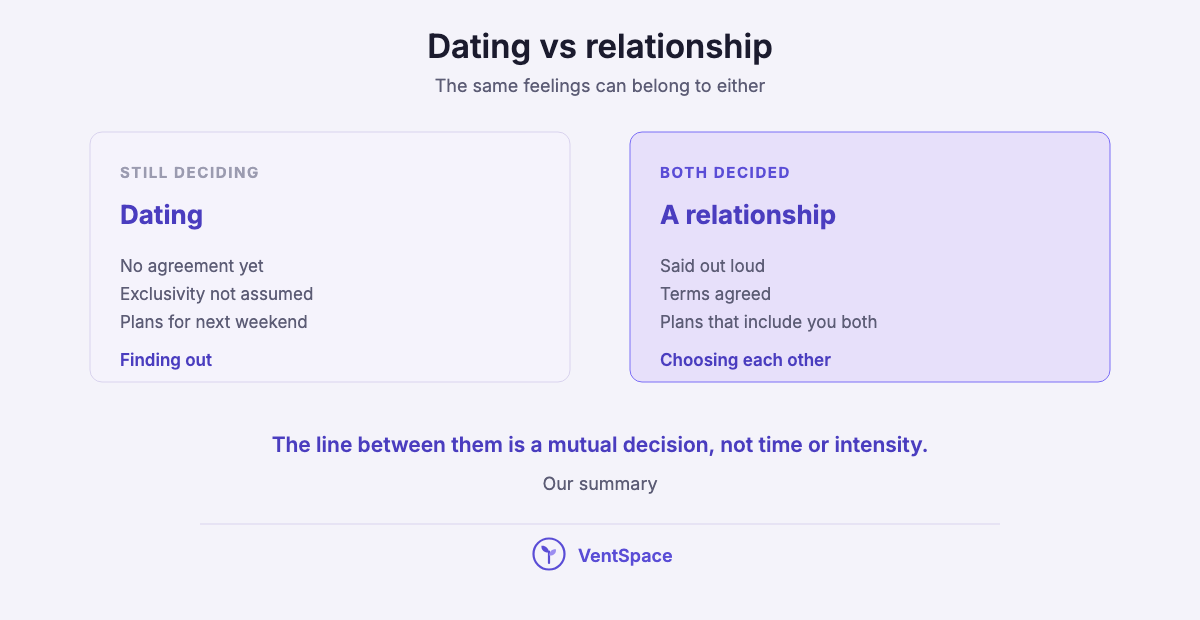
Dating is getting to know someone while either of you is still free to decide. A relationship begins when you have both decided, out loud, to commit to each other. That is the whole difference between dating and a relationship, and it is simpler than it feels from the inside. It is not about how long it has been, how often we see each other or how strongly we feel. A strong feeling can belong to either one. What separates them is a decision both people have said. Which is why the most useful part of this page is not the list of differences but the short test further down, and the conversation it points to.
Quick Digest
– Dating: spending time with someone to find out whether you want to commit. Either of you can still see other people unless you have agreed otherwise.
– A relationship: what you have once you have both agreed to commit, usually including exclusivity.
– The real line: a spoken, mutual decision. Not time, not feelings, not signs.
– What research suggests: people who make relationship decisions on purpose, rather than sliding into them, report more dedication and satisfaction.
– How to know which you are in: ask. The test below helps you get ready to.
From Sai, who writes this blog
If you have been in love as much as I have, you would know that relationships require a lot more than love to survive. That is what this page is about: the part beyond the feeling.
What dating actually is
Dating is a period of finding out. We spend time with someone because we like them and want to know whether we would like them more, and neither of us has promised anything yet. That freedom is not a flaw. It is what allows us to find out honestly.
The trouble is that “dating” means different things to different people. In everyday use, it can mean three different arrangements:
- Casual meetups: two people seeing each other with no particular plan.
- Hookups: a review by Justin Garcia and colleagues in 2012 described these as “uncommitted sexual encounters” that “often transpire without any promise of, or desire for, a more traditional romantic relationship.”
- Serious dating: two people who are interested in each other, getting to know one another with a relationship in mind.
All three are dating, and none of them is a relationship yet. Much of the confusion we feel comes from two people using the same word for different arrangements without noticing. If you are early on and want to know someone better, our questions to ask to get to know someone are built for that stage.
What a relationship actually is
A relationship is what we have once we have both chosen each other on purpose. It usually comes with exclusivity, a shared sense of the future, and a place in each other’s wider lives. Above all, it comes with commitment, which is less a feeling than an intention to stay.
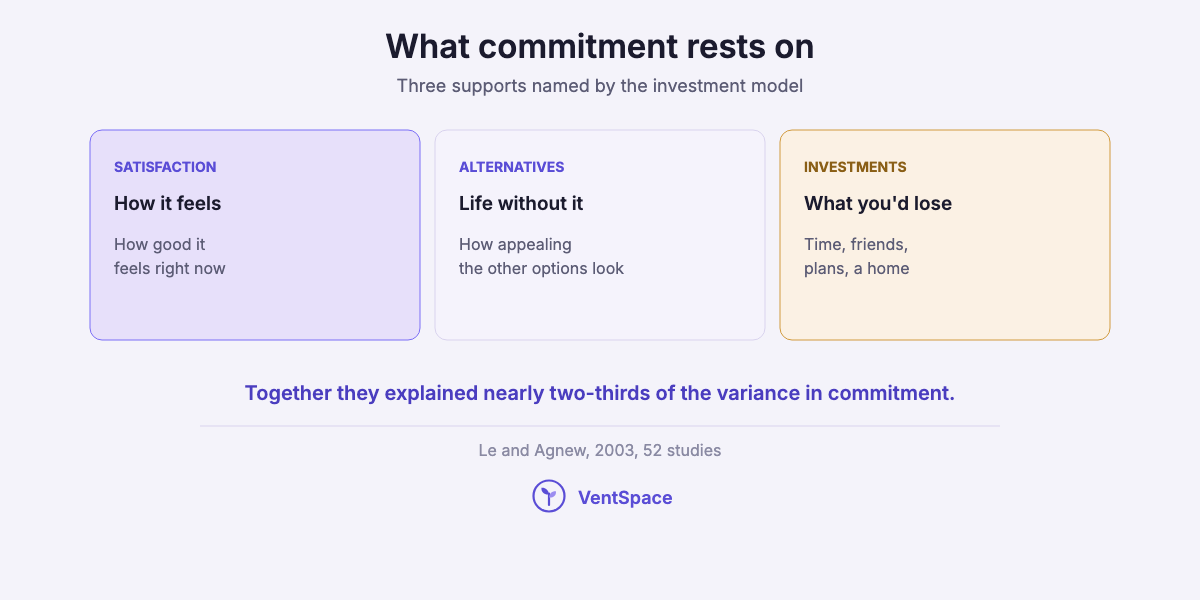
Psychologists have studied what commitment is made of. In a 2003 review of 52 studies with 11,582 participants, Benjamin Le and Christopher Agnew found that three things together accounted for nearly two-thirds of the differences in commitment: how satisfied people were, how attractive their alternatives looked, and how much they had invested in the relationship. Commitment, in turn, predicted whether couples broke up.
So a relationship is not only two people who like each other a lot. It is two people who have each decided to stay, and who are building something that would be costly to lose.
Dating vs relationship side by side
| Dating | A relationship | |
|---|---|---|
| The agreement | None yet. You are finding out | Both of you have said you are committed |
| Exclusivity | Not assumed. Has to be agreed | Usually agreed, sometimes openly not |
| The future | Mostly next weekend | Plans that assume you will both be there |
| Other people in your life | Often kept separate | Friends and family usually know and meet them |
| What is expected | Honesty, respect, turning up | Showing up in good times and hard ones |
| What ending looks like | Usually simpler, fewer shared things | Untangling plans, friends, sometimes a home |
Difference 1: a relationship is a decision, not a drift
The clearest difference is that a relationship is decided, and dating is still deciding. This sounds obvious, but many of us end up in relationships we never quite chose. We see each other more, we stop seeing other people, we leave a toothbrush, and one day we notice we are together without ever having said so.
Researchers call this sliding rather than deciding. In a 2013 study of 252 people, Jesse Owen, Galena Rhoades and Scott Stanley found that people who described more thoughtful decision-making about their relationships also reported more dedication to their partners, higher satisfaction and fewer involvements outside the relationship. That held whether they were dating, living together or married. It was one sample and it shows an association, not proof that deciding causes the rest. But it points our attention in a useful direction.
Why would deciding matter? Perhaps because a decision we have made is one we can stand behind. A drift leaves each of us privately unsure what the other thinks we agreed to.
Sliding has a recognizable shape. It is the Sunday when one of us stays over again because it is easier than going home, the group chat where a friend starts calling them “your boyfriend” or “your girlfriend” and nobody corrects it, the apartment lease that gets signed because the timing worked. None of these is wrong. The trouble is that each small step can feel like a decision while being only a convenience, and a year of conveniences can add up to a life we never discussed.
Deciding does not need to be grand. It can be one honest exchange: what do we each want this to be? The point is not ceremony. It is that both of us know what we chose, so that later, when things get hard, we are standing on an agreement rather than an assumption.
Quick Summary
Q: What is the main difference between dating and a relationship?
A: A relationship begins with a mutual decision to commit, said out loud. Dating is the period before that decision. Research on “sliding versus deciding” links more deliberate relationship decisions with more dedication and satisfaction.
Insight In Owen, Rhoades and Stanley’s 2013 study of 252 people, those who reported more thoughtful decision-making about their relationships reported more dedication and satisfaction, regardless of whether they were dating, living together or married. The link was the same at every stage, which suggests the habit of deciding matters more than the label we reach.
Difference 2: exclusivity is agreed, not assumed
While we are dating, exclusivity is not automatic. Two people can be seeing each other every week and still both be on dating apps, and neither has broken a promise, because no promise was made. That can be a painful discovery, and it comes from an assumption rather than a betrayal.
Exclusive dating is a halfway point some couples use: we have agreed not to see anyone else, but we have not yet called it a relationship. In our view it is best treated as its own stage, with its own conversation.
A relationship usually includes exclusivity, but not always. Some couples agree to an open relationship, where both partners can see other people. That is still a relationship, because the commitment and the terms have been agreed between them. What matters, in every version, is that the terms were said and both people chose them.
Raising exclusivity is easier than it looks. We tend to imagine it as a test the other person might fail. It is closer to a question about logistics and hope: are we still seeing other people, and would we like not to be? Asked plainly, it gives the other person room to say yes, no or not yet, and each of those answers is more useful to us than silence.
Quick Summary
Q: Is dating exclusive?
A: Not by default. Dating someone does not mean you have agreed not to see other people. Exclusivity has to be agreed, and exclusive dating is a common step before calling it a relationship.
Difference 3: what holds it together
Dating is held together by enjoyment. A relationship is held together by commitment, and commitment rests on more than enjoyment.
The investment model that Le and Agnew reviewed names three supports. Satisfaction is how good the relationship feels. Alternatives are how appealing life without it looks. Investments are everything we have put in that we would lose: time, shared friends, plans, a home, a history. While we are dating, most of the weight sits on satisfaction. As a relationship forms, investments grow, and the whole structure becomes sturdier and harder to walk away from.
This is also where compatibility on the big questions starts to matter more than chemistry. Do we want the same things about children, money, where to live, how to spend our time? Dating is the time to find out. A relationship is the place where differences on these questions either get worked out together or become the thing we argue about for years.
None of this means we need to agree on everything before committing. Most couples carry some differences for good. What helps is knowing which differences we can live with and which ones would quietly cost one of us a life we wanted. That is a conversation we can only have honestly once both of us admit we are thinking about the long term, which brings us back to the decision in Difference 1.
From Sai, who writes this blog
Relationships are only as good as our compatibility with our partners. If your dreams would give you a life that is totally different from the one your partner wants, or if you want kids and they do not, talk about it before taking the big step.
Quick Summary
Q: What makes a relationship different from just dating someone you like?
A: Commitment, which rests on more than liking. Research on the investment model finds that satisfaction, appealing alternatives and what you have invested together explain much of how committed people are, and commitment in turn predicts whether couples stay together.
Insight In Le and Agnew’s 2003 meta-analysis of 52 studies, satisfaction, alternatives and investments together accounted for nearly two-thirds of the variance in commitment, and commitment predicted breakup. For anyone wondering why a relationship feels heavier than dating, this is part of the answer: there is more in it to lose.
Difference 4: what is at stake
Dating tends to offer more novelty. A relationship tends to offer more meaning. Neither is the better stage. They give us different things, and many of us want different things at different times.
Dating can be exciting because everything is new: a new person, a new first date, a new version of ourselves. A relationship asks more of us. To be known well, we have to let ourselves be seen, including the parts we would rather edit out on a first date. That vulnerability is the price of the depth, and it is why some of us hesitate at the edge of commitment even when we like someone a great deal.
The stakes of ending are also different. When dating ends, there is usually less to untangle. When a relationship ends, there are shared friends, plans and sometimes a home, and the hurt often runs deeper. That is not a reason to avoid relationships. It is a reason to enter one on purpose. If you are going through an ending now, our guide on how to move on from a breakup is written for that week.
Expectations change in the same direction. While dating, what we owe each other is mostly honesty, respect and turning up when we said we would. In a relationship, the list grows: being there on the bad days, not only the good ones, making room in our plans, telling the other person things before they hear them elsewhere. Many of us experience this change as a loss of lightness. It can also be read the other way round. Someone now expects things of us because we have become someone they rely on, and being relied on is one of the quieter forms of being loved.
From Sai, who writes this blog
I have personally felt that dating around is exciting and fun, and that relationships are much more satisfying and meaningful.
Quick Summary
Q: Is dating or a relationship better?
A: Neither. Dating tends to offer more novelty and freedom with less at stake. A relationship tends to offer more depth and meaning, and asks for more vulnerability. Which one suits you depends on what you want right now.
Difference 5: decisions you make together
In a relationship, more of our decisions become shared. Where to live, how to spend a weekend, whether to take a job in another city: our lives become intertwined enough that we start deciding as a team. While dating, most of those choices stay our own.
Shared decisions are not the same as control. A partner who has opinions about a job offer is part of a team. A partner who decides what we wear, who we see, or checks our phone is not showing commitment. That is control, and it does not become romantic because it happens inside a relationship.
The difference is in how the decision is reached. In a healthy relationship, one of us says “I would rather you did not take that job across the country”, and then we talk, and either of us can still disagree. With control, there is no real conversation, only a rule, and disagreeing carries a cost: anger, silence, punishment. Commitment means we each give up some freedom by choice. Control means one person takes it from the other.
If you are afraid of your partner, or feel watched and restricted, you can talk to someone confidentially. In the United States, the National Domestic Violence Hotline is free and open 24/7: call 1-800-799-7233 or text START to 88788. If you are in immediate danger, call 911.
Quick Summary
Q: Do you lose your freedom in a relationship?
A: You share more decisions, because your lives are more connected. You do not hand over control of who you see, what you wear or where you go. Shared decisions are part of a relationship, and control is not.
How to tell which one you are in
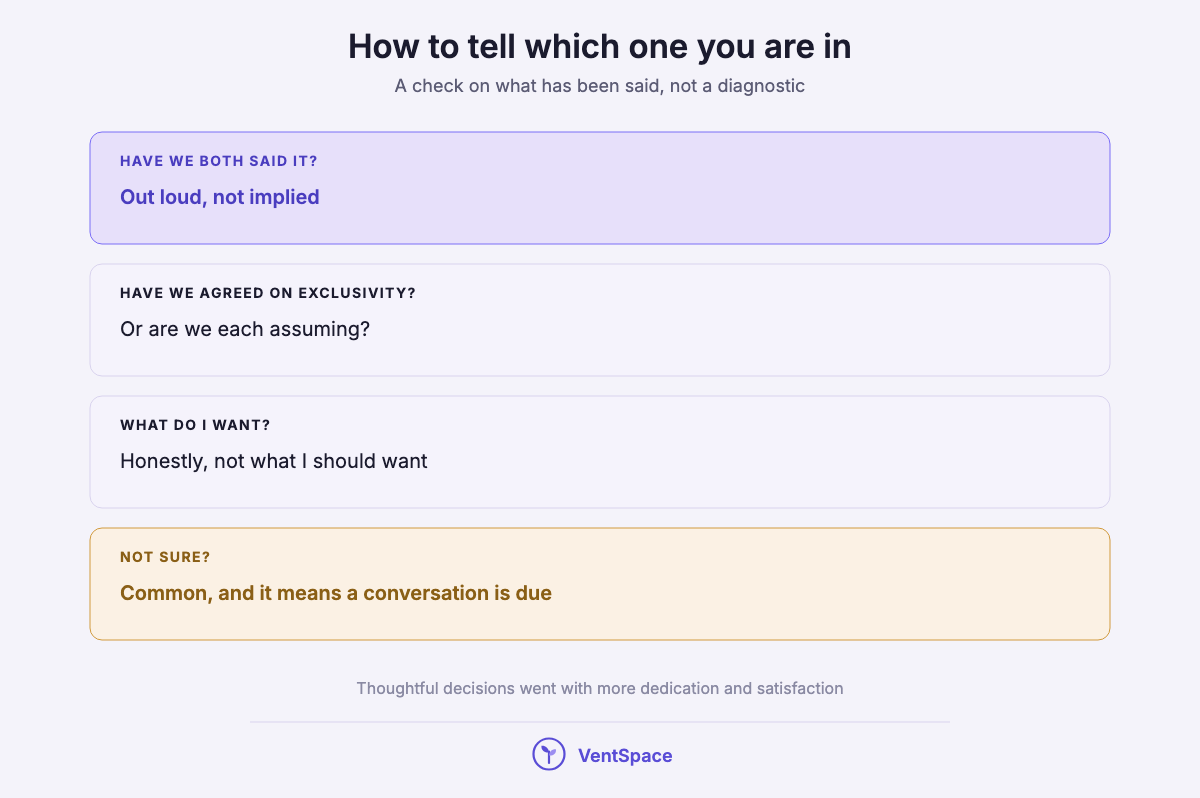
You cannot tell which one you are in by reading the other person’s signs. This is not a diagnostic and it cannot read anyone’s mind. It is a short check on what has been said and what you want, so you can go into the conversation knowing where you stand.
- Have we both said we want to be together? Out loud, not implied.
- Have we agreed whether we are seeing other people? Or are we each assuming?
- What would I call this if a friend asked me today? And would they call it the same?
- Do I want this to become a relationship? Honestly, not what I think I should want.
- Do I know what they want? Because they said it, not because I guessed.
If the answers to the first two are yes, you are in a relationship. If they are no, you are dating, however serious it feels. If you are not sure, that is the common case, and it is not a sign that something is wrong. It means a conversation is due.
Quick Summary
Q: How do I know if we are dating or in a relationship?
A: Ask yourself whether you have both said you want to be together and whether you have agreed on exclusivity. If not, you are dating. If you are unsure, the honest answer is to ask them, not to read signs.
What to do in each case
If you are dating and want a relationship, say so, plainly and early. Many of us put this off because we fear the answer. One short version: “I have loved spending time with you, and I am not seeing anyone else. I would like us to be together. Where are you with it?” Then listen. A clear no hurts, and it is still kinder to both of us than months of guessing.
If you are dating and do not want a relationship yet, it is worth saying that too, so the other person can choose with the same information we have. Dating on purpose is a perfectly good place to be.
If you are in a relationship and unsure about it, look at the three supports from Difference 3. Is it satisfaction that has dropped, or alternatives that look brighter, or are you mostly staying because of what you have invested? Each points to a different conversation.
Before any of these conversations, it helps to know what you want. Writing it down for ten minutes can make it clearer. If you want somewhere to do that, VentSpace is a journaling app that turns what you write into a clear read on your life balance, plus small, doable next steps. Prefer to try it on your laptop first? VentSpace Live runs in your browser, free, with nothing to install. It is ours, and it is free to start on Google Play. A notebook works too.
From Sai, who writes this blog
It is time for the big question. Can you imagine living a life that your partner is not a part of? If you cannot, that tells you something about what you want. If you can, take some more time. Sometimes it is not meant to be.
Quick Summary
Q: How do you move from dating to a relationship?
A: Say what you want and ask where they are. A short, honest sentence such as “I would like us to be together, where are you with it?” does more than waiting for a sign. Knowing your own answer first makes the conversation easier.
Where the line blurs
Real life does not always sort itself into two neat boxes. A few arrangements sit between dating and a relationship, and naming them can help us see what is missing.
- A situationship: a common term for something that feels like a relationship but has never been defined. Usually the missing piece is the conversation.
- Exclusive dating: you have agreed not to see other people, but have not called it a relationship.
- Long-term dating without a label: months or years together with no stated commitment. For some couples this works because both chose it. For others one person is waiting.
- An open relationship: committed, but not exclusive, by agreement. Still a relationship.
The common thread is the agreement. Where both people have chosen the arrangement, any of these can be fine. Where one person is quietly hoping for something else, it is time to talk.
Questions people ask
Can you be dating someone but not be in a relationship?
Yes. That is what dating is: spending time together before either of you has committed. You can date someone for a while, and even exclusively, without being in a relationship until you both decide you are.
How long should you date before being in a relationship?
There is no reliable number, and we would distrust any page that gave one. Some people know in weeks and some take many months. What matters more is that the decision is made on purpose, by both people, when both are ready.
Is “talking” the same as dating?
Often not. “Talking” is often used for the stage before dating, when two people are messaging and getting a sense of each other but have not started going out. Different people use the word differently, which is one more reason to ask.
What is the difference between a relationship and a serious relationship?
Little, in practice. If you are both committed, it is already serious. People sometimes use “serious” to mean they are thinking about the long term, like living together or marriage.
Can you tell from someone’s behavior whether they want a relationship?
Not reliably, and this is the most common myth on the subject. Behavior can suggest interest, but people are kind, busy, shy and uncertain for many reasons. The only reliable way to know is to ask.
Is an open relationship a real relationship?
Yes, if both people have agreed to it. Commitment and exclusivity are often bundled together, but they are separate agreements.
Two things to take with you
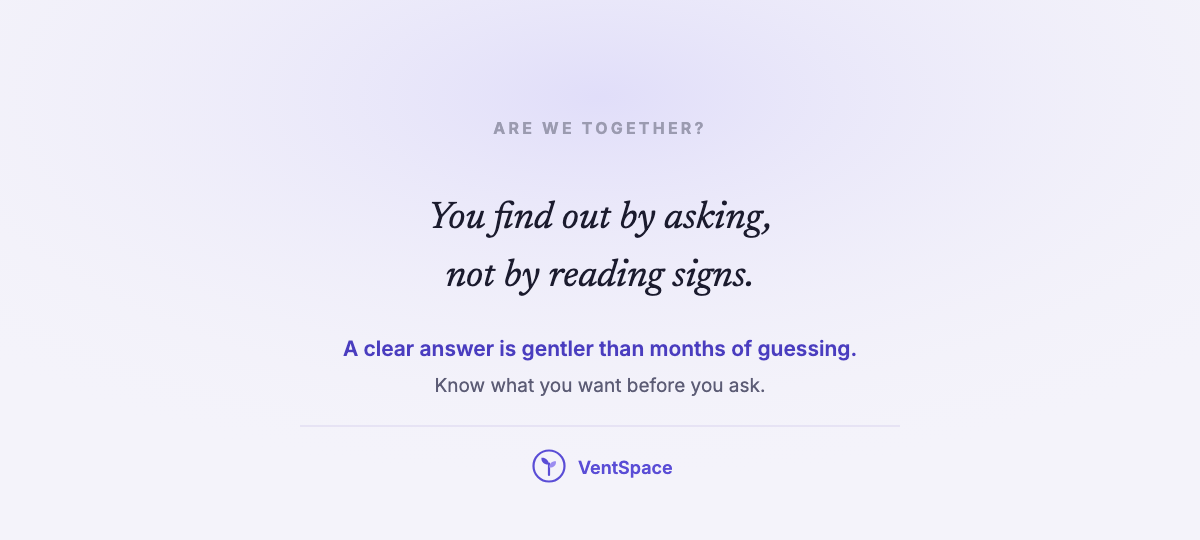
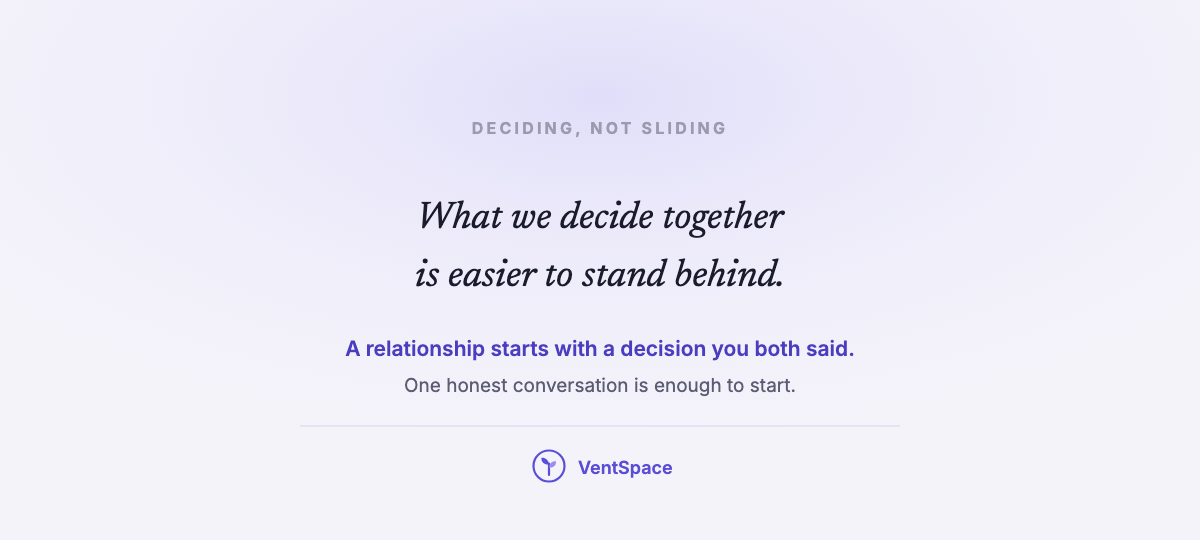
First, you do not find out whether you are in a relationship by reading signs. You find out by asking. The difference between dating and a relationship is a decision both of you have said out loud.
Second, the conversation is awkward, and it can end things. That is the honest cost. But a clear answer, even a disappointing one, is gentler on us than months of guessing, and in our view whatever we decide together is a better foundation than whatever we drift into.
About this article

Written by
Sai Subramaniam
Founder, VentSpace
I write these guides because I have been where you are. I am working through my own hard seasons, and I share the things that actually helped me, so that anyone going through it has a steady companion close by instead of facing it alone. VentSpace is the app I built for exactly that: a journaling app that turns what you write into a clear read on your life balance, plus small, doable next steps toward feeling more like yourself.
This writing is honest and every claim is sourced, and it is not a substitute for professional care. If you are struggling, reaching out to a professional is a strong move, not a failure.
Explore VentSpaceTry VentSpace LiveHow this one was checked. Every factual claim traces to a named source, and the source is printed next to the claim rather than kept in a footnote. Quotes are pinned to the work they come from, with the year, the letter or the chapter where one exists. Where a widely repeated claim could not be traced, it was left out and the omission recorded. Where a figure is contested, both sides are printed.
No affiliate links, no paid placements, and nobody paid to appear here. Where we mention our own app, we say that it is ours, we state its limits, and we never position it as a substitute for care.
Reviewed: October 2026. Prices, platforms and product availability move quickly, and anything we could not verify at the time of writing is marked as unverified rather than turned into a number.
Corrections. If something here is wrong, we would rather know. Corrections are made in place, with a note saying what changed.