
“the art is not one of forgetting but letting go. And when everything else is gone, you can be rich in loss.” · Rebecca Solnit, A Field Guide to Getting Lost, 2005
For a few hours you are fine. You answer emails, you laugh at something a coworker says, and you notice, almost with pride, that you have not thought about them since lunch. Then a song comes on in the grocery store, the one the two of you used to play, and the afternoon is gone. You stand in the cereal aisle feeling as if it ended this morning. Why does it still hurt this much, weeks or months later, when everyone around you seems to think you should be over it?
Part of the answer was photographed in 2010. Helen Fisher and her colleagues put 15 people into a brain scanner, all of them recently rejected by a partner and all of them still, in their words, intensely in love. When they looked at a photo of the person who had left, the areas that lit up included regions linked to craving, to gains and losses, and to emotion regulation. What they reported feeling while they looked was love, despair, good and bad memories, and wondering why it had happened. We are not weak for finding this hard. We are doing something the brain treats as serious.
This guide to how to move on from a breakup does not ask you to forget anyone. It starts from a different picture. When a relationship has gone on for a while, we do not only love a person, we move into a future with them: the apartment, the trips, the names of children we have not had. A breakup evicts us from a place we had already furnished. Moving on is the slow work of moving out, room by room, and the rest of this page is about how that is done.
If things feel dark right now. A breakup can hit harder than the people around you realize. If you are having thoughts of harming yourself, please contact a crisis line now rather than reading on. In the US, call or text 988 (Suicide & Crisis Lifeline, free and confidential, 24/7). Anywhere else, findahelpline.com lists free services by country.
If the relationship was not safe. If the person you are moving on from controlled where you went, who you saw, your money or your phone, or frightened you, that is coercive control, and some of the advice below about contact and closure does not apply to you. The National Domestic Violence Hotline is at 1-800-799-7233, or text START to 88788, any hour.
The short version
Moving on is not forgetting. It is the future you planned together slowly stopping being the place you live in your head.
It is hard for real reasons. Being left, a sudden ending, feeling betrayed and having rated the relationship highly all go with more distress in research on students after a breakup.
There are no stages and no deadline. The stage idea comes from research on death and dying, and researchers on grief argue it should be dropped.
Five steps: give the feeling one evening and then a break, turn down the feed of them, look at the whole relationship, put the anger down without performing it, and go back to who you were before the “us”.
Nobody can tell you how long this takes. Anyone who gives you a number is guessing.
What does it mean to move on from someone?
“You cannot forget but you can accept.” · Sai Subramaniam, in the first version of this page, 2022
Moving on from someone means the future you planned with them stops being the place you live in your head. It does not mean you forget them, stop caring what happens to them, or never feel a pang again. It means the rooms you furnished together are no longer where you go when you are tired, bored or lonely.
That definition matters because the instruction we are usually given is the opposite one. Just move on. Forget about them. Stop thinking about it. The trouble with “just move on” is that it names an outcome and gives no way to reach it. It asks for an act of will over something that is not under the will’s control, and when we cannot do it, we conclude there is something wrong with us. There is nothing wrong with us. We were given an instruction with no method attached.
Sai Subramaniam, who wrote the first version of this page in 2022 after a breakup of his own, put the difference plainly: you cannot forget, but you can accept. Have you ever tried to forget something on purpose? The attempt is a way of thinking about it. Forgetting is not on the menu, and the hope that it might be is one of the things that keeps us stuck.
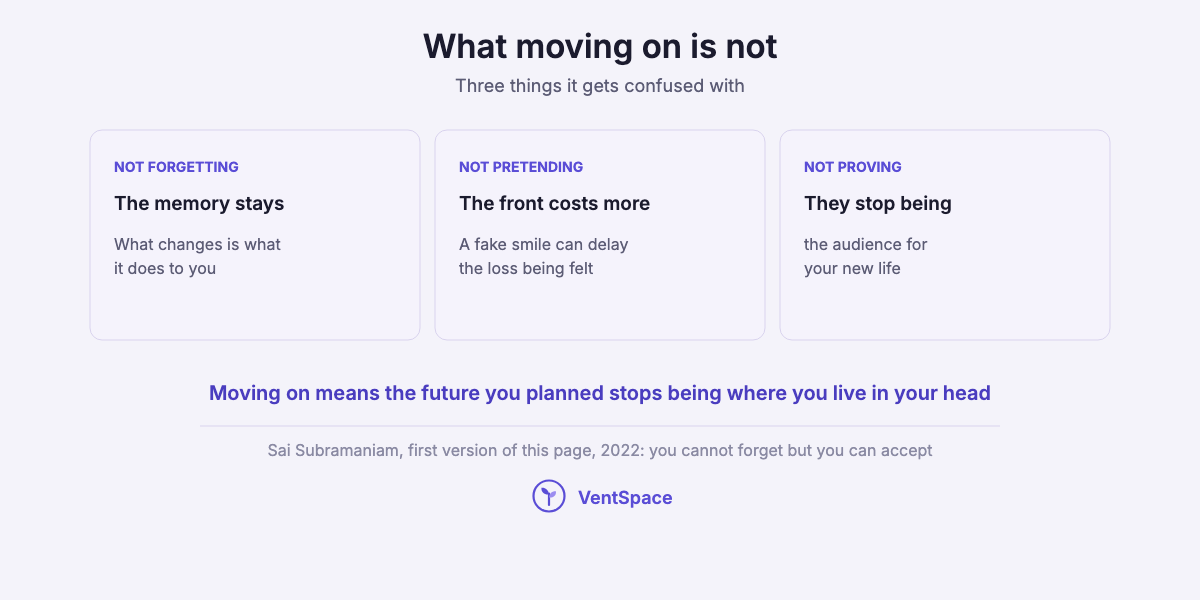
So it helps to be clear about what moving on is not.
It is not forgetting. You will remember this person, and some memories will stay sweet. Sai’s own test, from 2022, was whether you can look at the old pictures and “reminisce on the fond memory rather than feeling sad or angry or breaking down”. The memory stays. What changes is what it does to you.
It is not pretending. Telling everyone you are fine, and telling yourself the same, can delay the moment when the loss is felt. Sai wrote that a fake smile “might just prolong this process”, and most of us know the feeling of a front that takes more energy than the grief underneath it.
It is not proving anything to them. A new body, a new job, a new partner posted for their benefit keeps them as the audience. Moving out of a future means they stop being the person the performance is for.
Here is a position we hold, and it is a position rather than a research finding: what changes when we move on is how often we think of them, not how much it hurts when we do. Each thought may feel as sharp as the first one, which is why it seems from the inside that nothing is changing. What changes is the gap between thoughts, and nobody can feel a gap getting longer. That is why progress so often looks, from the inside, like no progress at all.
Quick Summary
Q: What does moving on from someone mean?
A: It means the future you planned with them stops being the place you live in your head. It does not mean forgetting them or never feeling sad about it. The memories stay, and over time they stop knocking you over.
Insight: Erica Slotter, Wendi Gardner and Eli Finkel, Personality and Social Psychology Bulletin (2010), on why a breakup can feel like losing part of yourself: “Romantic relationships alter the selves of the individuals within them. Partners develop shared friends and activities and even overlapping self-concepts. This intertwining of selves may leave individuals’ self-concepts vulnerable to change if the relationship ends.”
Why is it so hard to let go of someone you love?
“Activation of areas involved in cocaine addiction may help explain the obsessive behaviors associated with rejection in love.” · Helen Fisher, Lucy Brown, Arthur Aron, Greg Strong and Debra Mashek, Journal of Neurophysiology, 2010
Because the ending pulls on the same systems that kept you in the relationship, and because some endings are measurably harder than others. Neither of those is a verdict on you.
Start with the scanner study. Fisher’s team found that when rejected people looked at the person who had left them, areas tied to reward and craving were active, much as they are in people who are happily in love. The authors’ own explanation is careful, and the hedge is theirs: activity in those areas “may help explain” the obsessive checking, rereading and replaying that so often follows rejection. It was 15 people, so treat it as a window rather than a law. It does say something we need to hear. The pull toward them is the same pull that made the relationship feel like home, which is a long way from a lack of character.
Then there is the shape of the ending. In a 2009 study of 192 university students after a recent breakup, Tiffany Field and her colleagues found that the people in the most distress were more likely to be the ones who had not initiated it, whose breakup was sudden and unexpected, who felt rejected and betrayed, and who had not found a new relationship. Those students also reported more intrusive thoughts, more difficulty controlling them, and worse sleep. The strongest predictors were feeling betrayed, a higher rating of the relationship before it ended, a shorter time since the breakup, and depression scores. Students are not everyone, and a survey cannot say what causes what. It can tell you that if you were left, suddenly, by someone you thought highly of, the difficulty you are having is the expected kind.
There is also a quieter reason, and Sai’s 2022 page named it well. When we remember them, we remember the sweetest version: the long dates, the late-night talks, the way they made us feel wanted. The arguments and the silences fade first. Sai’s question to himself was whether he loved the other person, or the love she was giving him. There is no clean answer to that, and nobody needs to settle it. It is worth noticing, because the person we are missing is partly a highlight reel, and the highlight reel lives in the furnished future, not in the relationship as it was.
Finally, some of us lose more than a partner. Slotter, Gardner and Finkel’s work suggests that a breakup can blur our sense of who we are, because over time two people come to share friends, routines and even parts of a self-image, and reduced clarity about who we are predicted more distress after a breakup. If part of what you are feeling is I don’t know who I am anymore, that is a recognized part of this, separate from the sadness.
Quick Summary
Q: Why is it so hard to stop thinking about my ex?
A: Brain imaging of 15 recently rejected people found activity in reward and craving areas when they looked at their ex, which the researchers say may help explain obsessive thinking. Distress also tends to be higher when you did not choose the breakup, it was sudden, you felt betrayed, or you rated the relationship highly.
Insight: Tiffany Field and colleagues, Adolescence (2009), on what predicted breakup distress in 192 university students: “In a regression analysis, the most important predictors of the Breakup Distress scores were the depression score (CES-D), the feeling of being betrayed by the breakup, shorter time since the breakup occurred, and a higher rating of the relationship prior to the breakup.”
Are there stages of a breakup?
“Most disturbingly, the expectation that bereaved persons will, even should, go through stages of grieving can be harmful to those who do not.” · Margaret Stroebe, Henk Schut and Kathrin Boerner, Omega: Journal of Death and Dying, 2017
No, not in any order you can count on. The stage idea that most breakup advice borrows was built for something else, and researchers who study grief argue it should be dropped.
The best-known stage model, denial through acceptance, came from Elisabeth Kübler-Ross’s 1969 book on people who were dying, which she also extended to their families. From there it was taught as a sequence for anyone losing anything, without first being tested on the people grieving. In 2017, three researchers who study bereavement reviewed it and concluded that it lacks sound empirical evidence and “should be discarded by all concerned”. Their worry, in the line above, is the one that matters for you: when we expect stages, we start grading ourselves against them, and conclude we are failing when the order does not arrive.
Sai’s own experience did not arrive in order either. He describes a stretch after his breakup when he “walked down a path of hate and heartlessness”, cold and angry at her and at the world, which came before any acceptance and which he regrets. Then, he writes, “I pulled myself back together.” Then the anger came back, mixed with missing her. Sadness, blame and longing took turns, and some of them took more than one turn. Most of us will recognize that, and it is not a failure to progress.
What did the grief researchers put in place of the stages? The model most used now is Margaret Stroebe and Henk Schut’s dual process model, built for bereavement rather than breakups. In it, grieving moves back and forth between facing the loss and getting on with a rearranged life, sometimes within one day. The authors argue that taking breaks from both is part of coping, not a failure of it. It is a model, and its own authors have called for it to be tested more stringently. Applying it to a breakup is our extension, not theirs. It does explain the Tuesday you were fine and the Wednesday you were not, without calling Wednesday a relapse.
Quick Summary
Q: What are the stages of a breakup?
A: There is no reliable sequence. The five stages come from Kübler-Ross’s 1969 work on dying patients and their families, and grief researchers concluded in 2017 that stage theory lacks sound evidence and that expecting stages can harm people who do not follow them. Feelings tend to come and go in no fixed order.
Insight: Margaret Stroebe and Henk Schut, Death Studies (1999), describing the dual process model of coping with bereavement: “This model identifies two types of stressors, loss- and restoration-oriented, and a dynamic, regulatory coping process of oscillation, whereby the grieving individual at times confronts, at other times avoids, the different tasks of grieving.”
So what can you do with this week?
How to move on from a breakup, in five steps
“Give sorrow words. The grief that does not speak / Whispers the o’er-fraught heart, and bids it break.” · William Shakespeare, Macbeth, Act 4, Scene 3, Malcolm to Macduff, who has just learned his family was killed
Five steps, each one small enough to start today. Give the feeling a bounded place, turn down the feed of them, look at the whole relationship instead of the highlight reel, put the anger down without performing it, and go back to the person you were before the “us”. None of them is a deadline, and none of them asks you to forget anyone.
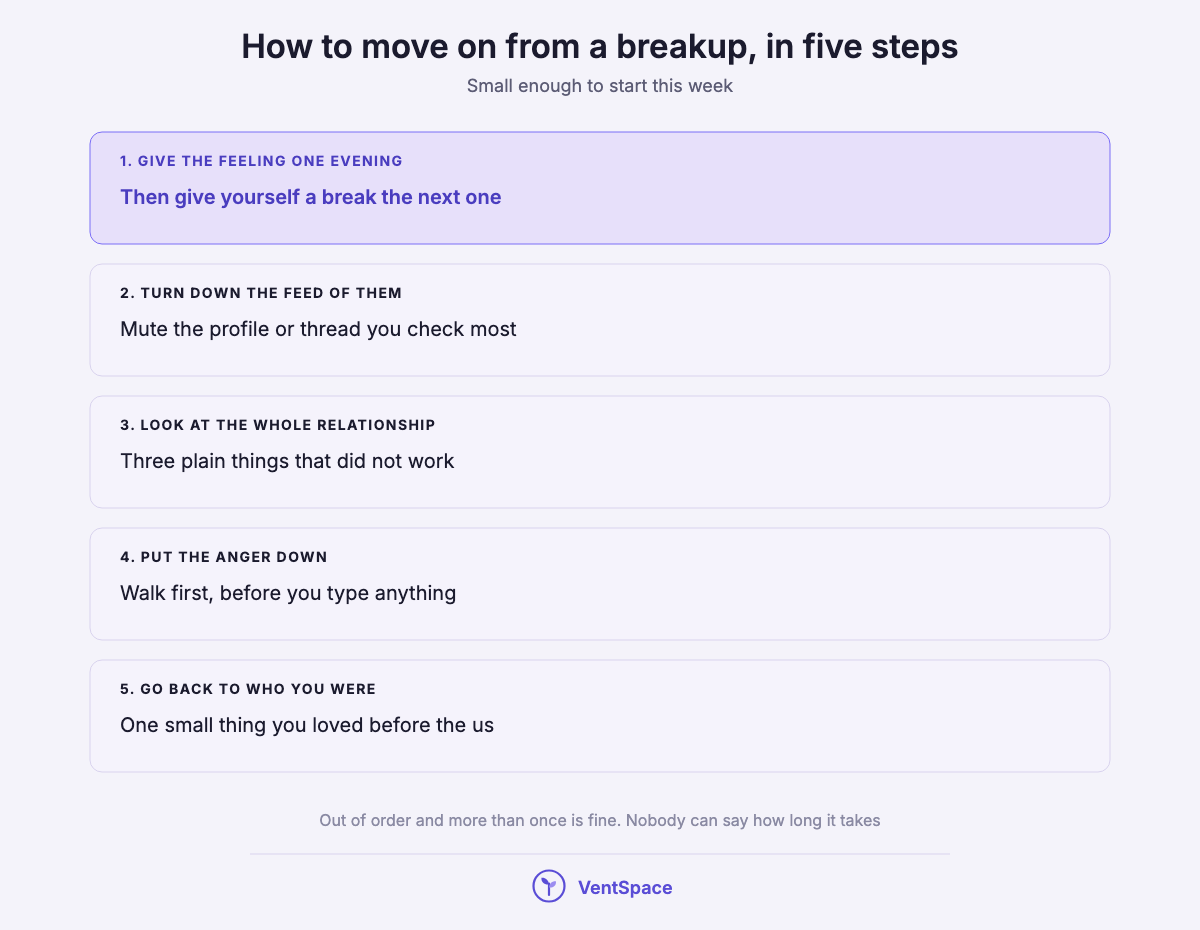
1. Give the feeling one evening, then give yourself a break
Pick one evening this week to let it hurt on purpose, and pick one thing to do the next evening that has nothing to do with them. The first is facing the loss. The second is the respite the grief researchers count as part of coping.
Sai’s way of facing it, in 2022, was a song. There was one track the two of them had played in what he called “the golden times of first love”, and after she left he kept listening to it. “It hurt, it got numb, it hurt again”, he wrote, and the point was that he did not run away from the feeling. He also wrote, years later, that he now listens to the same song with someone else, “someone who cares”. We include that not as a promise, because nobody can make you one, but because it is true for him.
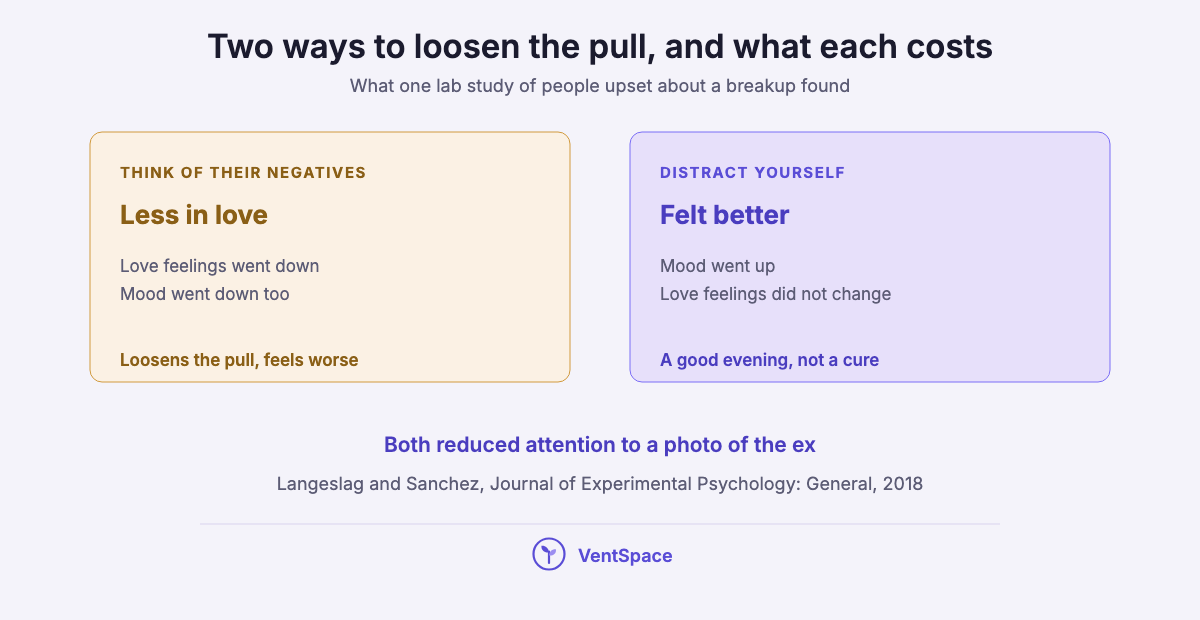
The break matters as much as the evening. In a 2018 lab study by Sandra Langeslag and M. E. Sanchez, people upset about a breakup who distracted themselves before seeing a photo of their ex felt more pleasant afterward, even though distraction did not reduce their love feelings. A good evening does not mean you have stopped caring. It means you had a good evening.
Before you choose, answer these for yourself:
- What do you avoid because it would make you feel it: a song, a street, a photo, a restaurant?
- Which one could you face on purpose, once, on a night when you have nowhere to be?
- What would you do the next evening if they had never existed?
- Who could you do it with?
You are allowed to cry through the whole evening and still go out the next one. Neither one is the right answer on its own.
2. Turn down the feed of them
Mute, archive or stop visiting one place where you see them, starting tonight. Their profile, the old message thread, the friend of theirs whose stories you watch for clues. Pick the one you open most.
This is not a rule about whether you should speak to them, and we are not going to give you one. It is about the stream of them that arrives without either of you choosing it. In a 2012 survey of 464 people after a breakup, Tara Marshall found that checking an ex’s Facebook page went with more distress, more longing and less personal growth, even after accounting for offline contact. Staying Facebook friends without checking was more mixed: less longing, but less growth too. It is one study and it is correlational. It matches what most of us know from our own late nights.
There is a harder kind of contact, the conversation for closure. Sai’s 2022 page describes his. Months after the breakup, he still believed they might get back together, and he asked her to tell him plainly that there was no chance. She did, briefly, without apologizing. “It hurt, but it worked,” he wrote. That was his experience, and we are not recommending it. It depends on the other person being safe to ask, and on you being able to hear the answer. If the relationship was controlling or frightening, closure is not worth going back for, and the hotline in the box near the top of this page can help you think it through.
Ask yourself:
- Which app or thread do you open first when you think of them?
- What are you hoping to find when you look?
- How do you feel in the hour after you look?
- What would you open instead?
You do not have to delete anything. Out of sight is enough for now, and you can decide about the photos later.
3. Look at the whole relationship, not the highlight reel
Write down, in plain sentences, three things that did not work in the relationship. Not insults about them. Things that happened: the plans that kept getting canceled, the conversation you could never have, the way you felt on Sunday nights.
This is the step the research supports most directly, and it comes with an honest cost. In the same Langeslag and Sanchez study, people who thought about their ex’s negative qualities before seeing the photo felt less in love afterward, and also felt worse. Reminding yourself of what was wrong loosens the pull. It does not feel good while you do it. That is the trade, and it is worth knowing before you start.
A caution about writing, because this step asks you to write. In a 2013 trial with 90 recently separated adults, average age 40 and married for 13.5 years on average, David Sbarra and his colleagues found that people who were actively searching for meaning in their separation did worse after writing deeply about their emotions than after writing a plain account of their day. So keep this list factual and short. Facts, not feelings, in the early weeks. If you notice that writing about the relationship leaves you replaying it for hours, stop, and come back to it later or not at all. Our page on expressive writing and journaling explains the difference between the two.
Ask yourself, as you write:
- What did you keep hoping would change, and did it?
- What did you stop doing or saying so the relationship would work?
- Which part of the furnished future was yours, and which part was theirs?
- What would you tell a friend who described this relationship to you?
Three lines is enough. You are making a fuller picture, not a case against them.
4. Put the anger down without performing it
The next time anger comes up, do something that takes you away from thinking about them, rather than something that acts it out. A walk without your phone, a shower, the dishes. Not the long message, not the box of their things in the fireplace.
Anger after a breakup is common and often fair, and Sai is honest about it: “anger is something that I feel so very often,” he wrote in 2022. The question is not whether the anger is justified. It is what to do with it. In a 2002 experiment, Brad Bushman had angered people hit a punching bag while thinking about the person who had angered them. They ended up angrier and more aggressive than people who thought about something else, or who did nothing at all. “Doing nothing at all was more effective than venting anger,” he concluded. Letting it out by rehearsing it, it turns out, mostly rehearses it.
None of this means you have to forgive anyone this week. Forgiveness, when it comes, is its own long road. Sai’s version of it, from 2022, was a sentence addressed to his ex that asked nothing of her: “I know what you did and it is not okay. You are more than that and I don’t need anything from you.” If you want to go further, our page on how to forgive and let go is built for that.
Ask yourself:
- What do you do in the first ten minutes after the anger arrives?
- Does it leave you calmer, or more wound up?
- What do you want from them that you are unlikely to get?
- What could you do with the evening if you stopped waiting for it?
Be honest with yourself here, nobody is grading this. Anger you notice is anger you can put down.
5. Go back to the person you were before the “us”
Write down one thing you loved doing before you met them, and do a small version of it this week. A sport you dropped, a friend you saw less, a kind of music they did not like, a city you meant to visit.
Sai’s 2022 page put this as a question, and it is still the best question on the page: “Go back to the person you were before you met them. What made you feel good?” He also wrote the line that sits under this whole step: nothing is worth losing yourself over. When two lives grow together, parts of each self get folded into the shared one, and they do not unfold on their own.
There is a modest piece of good news in the research, and we will keep it modest. In a 2003 study, Ty Tashiro and Patricia Frazier asked 92 undergraduates about a recent breakup, and they reported an average of five kinds of personal growth that they thought might improve their future relationships. It is self-reported, and it is students. It does not mean the breakup was good for you, and nobody else gets to tell you it was. It suggests that the person who comes out of the furnished future is not only smaller. Some of them come out with more room.
And if this is all too heavy to carry by yourself, a breakup is an ordinary reason to book an appointment with a counselor or therapist. It does not mean you are failing to cope. If you are unsure whether you need one, our page on whether you need therapy walks through it.
Ask yourself:
- What did you do on a free Saturday before you met them?
- Which friend did you see less of while you were together?
- What did you give up because they did not like it?
- What would you try now if nobody was watching?
Don’t overthink which one to pick. Any honest one will do.
Quick Summary
Q: How do I move on from a breakup?
A: Give the feeling one evening and then take a break from it, mute or stop checking where you see your ex, write three plain things that did not work in the relationship, put anger down by doing something else rather than acting it out, and do a small version of something you loved before you met them.
Insight: David Sbarra, Adriel Boals, Ashley Mason, Grace Larson and Matthias Mehl, Clinical Psychological Science (2013), on writing in the early weeks after a separation: “It does not appear advisable (for low ruminators) and may even be iatrogenic (for average to high ruminators and those actively searching for meaning) to write deeply about one’s emotional experiences in the immediate wake of a marital separation.”
Pulling it all together
“Nothing is worth losing yourself over.” · Sai Subramaniam, in the first version of this page, 2022
The five steps are one move, made five ways: moving out of the furnished future, a room at a time. You will do them out of order and more than once. That is fine.
Step 1, the evening and the break, lets the loss be felt without letting it take every evening. Commit to it: “This Thursday I play the song, and on Friday I see a friend.”
Step 2, turning down the feed, stops the furnished future being refilled every night. Commit: “Tonight I mute the profile I check most.”
Step 3, the whole relationship, replaces the highlight reel with what happened. Commit: “I write three plain things that did not work, and stop at three.”
Step 4, putting the anger down, keeps it from running the week. Commit: “When the anger comes, I walk for ten minutes before I type anything.”
Step 5, the person before the “us”, gives you somewhere to live that is yours. Commit: “This weekend I do one small thing I loved before I met them.”
Most weeks, one of these will feel impossible and another will feel easy. Do the easy one. The impossible one will still be there next week, and so will you.
Quick Summary
Q: What is the first thing to do to move on from someone?
A: Turn down the feed of them tonight by muting or archiving the profile or thread you check most. In one survey of 464 people, checking an ex’s Facebook page was linked to more distress and longing and less personal growth.
Insight: Tara Marshall, Cyberpsychology, Behavior, and Social Networking (2012), from a survey of 464 people after a breakup: “Overall, these findings suggest that exposure to an ex-partner through Facebook may obstruct the process of healing and moving on from a past relationship.”
Questions people ask
How long does it take to get over a breakup?
Nobody can honestly tell you, and we are declining the question rather than dodging it. The rule that it takes “half the length of the relationship” traces to no study, and neither does any other figure we have seen on ranking pages. What predicts harder breakups in research is the shape of the ending, such as being left suddenly or feeling betrayed, not a number of weeks. If you are measuring yourself against a deadline someone gave you, you can put it down.
Is a rebound relationship a bad idea?
Not necessarily, and the evidence is more mixed than the warnings suggest. In two studies published in 2015, Claudia Brumbaugh and R. Chris Fraley found that people in new relationships after a breakup were more confident in their desirability and had more resolution over their ex, and among them a faster start went with better psychological health. That is correlational, and people who can start again quickly may differ in other ways. Sai’s own view, in 2022, was that jumping into something new did not help him move on. Both can be true. What matters more than speed is whether the new person is someone you want, or someone you are showing to your ex.
Should I stay friends with my ex?
That is your call, and we will not make it for you. Marshall’s 2012 survey found that staying connected on Facebook without checking went with less longing but also less personal growth, while actively checking went with more distress. If you try friendship, notice how you feel in the hour after you talk. If it is mostly hope that they will come back, the friendship may be keeping the furnished future open.
Should I talk to my ex to get closure?
Sometimes a conversation helps and sometimes it reopens everything. Sai asked his ex, months after the breakup, to tell him plainly there was no chance, and he wrote that it hurt and it worked. Not everyone gets that. If you go, go for your own answer rather than for an apology, and be ready to leave without one. If the relationship was controlling, abusive or frightening, do not go back for closure. Call the National Domestic Violence Hotline at 1-800-799-7233 instead.
Why do I still miss someone who hurt me?
Because missing someone and approving of how they treated you are different things. Fisher’s scanner study found reward and craving areas active in people still in love with someone who had rejected them, and the highlight reel keeps the best moments brightest. Missing them does not mean you should go back. It means the relationship mattered.
When should I talk to a professional about a breakup?
Whenever you want to. A breakup is an ordinary reason to book an appointment, not a sign you are failing to cope. It is especially worth it if you cannot sleep, work or eat normally, if you are drinking more to get through it, or if the low is not lifting. If you are thinking about harming yourself, call or text 988 in the US, or find a local line at findahelpline.com, today.
In a nutshell
Two things to take with you.
First, moving on is moving out, not forgetting. You are leaving a future you had already furnished with someone, and you do that a room at a time: one muted profile, one honest list, one evening that belongs to you.
Second, the honest timeline: nobody can tell you how long this takes, and anyone who gives you a number is guessing. The thoughts will probably come less often before they hurt less, and you may not notice the gaps getting longer. Some weeks will feel like going backward. Those weeks still count.
If you are carrying a lot of this in your head right now, it can help to set some of it down somewhere. VentSpace is a journaling app that turns what you write into a clear read on your life balance, plus small, doable next steps, and it is there if writing would help. Prefer to try it on your laptop first? VentSpace Live runs in your browser, free, with nothing to install.
About this article

Written by
Sai Subramaniam
Founder, VentSpace
I write these guides because I have been where you are. I am working through my own hard seasons, and I share the things that actually helped me, so that anyone going through it has a steady companion close by instead of facing it alone. VentSpace is the app I built for exactly that: a journaling app that turns what you write into a clear read on your life balance, plus small, doable next steps toward feeling more like yourself.
This writing is honest and every claim is sourced, and it is not a substitute for professional care. If you are struggling, reaching out to a professional is a strong move, not a failure.
Explore VentSpaceTry VentSpace LiveHow this one was checked. Every factual claim traces to a named source, and the source is printed next to the claim rather than kept in a footnote. Quotes are pinned to the work they come from, with the year, the letter or the chapter where one exists. Where a widely repeated claim could not be traced, it was left out and the omission recorded. Where a figure is contested, both sides are printed.
No affiliate links, no paid placements, and nobody paid to appear here. Where we mention our own app, we say that it is ours, we state its limits, and we never position it as a substitute for care.
Reviewed: October 2026. Prices, platforms and product availability move quickly, and anything we could not verify at the time of writing is marked as unverified rather than turned into a number.
Corrections. If something here is wrong, we would rather know. Corrections are made in place, with a note saying what changed.