
“Some things torment us more than they ought; some torment us before they ought; and some torment us when they ought not to torment us at all.” · Seneca, Moral Letters to Lucilius, Letter 13 (trans. Richard M. Gummere, 1917)
It is late, the day is over, and something is still sitting on you. Perhaps it has a clear cause: a message that went unanswered, a relationship that ended, a remark at work that landed badly. Perhaps it has no cause you can name, and the only word you have for it is “bad”. You have tried to think your way out of it, and you have tried not thinking about it, and neither has made it leave. Why does a feeling we so badly want gone seem to stay longer the harder we push?
Seneca, writing to a friend nearly two thousand years ago, noticed that some things torment us more than they ought, and some before they ought. He was not telling his friend that the pain was imaginary. He was pointing at something narrower and more useful: that a hurt and our reaction to the hurt are two different things, and only one of them is entirely out of our hands.
This guide is about that difference. It covers whether you can stop feeling bad at all, the two layers that most bad feelings are made of, which of the usual remedies help and which only numb, and then five small steps you could try tonight, with an honest line on when it is more than a bad day.
If you are struggling right now. If this is more than a bad day and you are thinking about harming yourself or ending your life, please contact a crisis line now. In the US, call or text 988 (Suicide & Crisis Lifeline). Anywhere else, findahelpline.com lists free, confidential services by country. If you are in immediate danger, call your local emergency number. This page is not a substitute for that.
The short version
You cannot switch a feeling off by force. Pushing the experience of it away does not help, and trying not to think about it can make it louder.
Most bad feelings have two layers. The clean pain of what happened, and the dirty pain we add with the story we tell about it and the fight we put up against it.
The second layer is the part you can change. Accepting a feeling, rather than judging it, goes with less negative emotion when stress hits.
Some remedies help and some only numb. Distraction gives real short relief. Doing something you value has better evidence for the longer run.
Five steps for tonight: split “bad” into its parts, write the event and the story on separate lines, let the wave come, find the expectation that broke, and do one ordinary thing that is yours.
Can you stop feeling bad?
“an attempt to control the mind introduces 2 processes” · Daniel Wegner, Psychological Review (1994)
Not by force, and not on command. A feeling is not a light we can turn off, and the research on trying is unusually clear: pushing away the experience of a feeling does not reduce it. What we can change is how much we add to it, and that turns out to be a larger share of feeling bad than most of us assume.
The strongest evidence comes from a 2012 meta-analysis by Webb, Miles and Sheeran, who pooled 306 experimental comparisons of different ways people try to change what they feel. The word “suppression” hides three different things, and they behaved differently. Suppressing the expression of a feeling, keeping your face and voice steady, had a small helpful effect (d = 0.32). Suppressing the experience itself had essentially none (d = −0.04). Trying not to think about what upset you was slightly worse than nothing (d = −0.12). These were laboratory studies, mostly single short episodes, so they tell us about direction rather than about a hard month. The direction is still worth knowing: holding your face together in a meeting is one thing, and ordering yourself to stop feeling is another.
Why would trying not to feel something make it worse? The psychologist Wegner proposed an explanation in 1994. When we try to keep a thought out, he argued, the mind runs two processes at once: one that searches for something else to think about, and one that keeps checking whether the unwanted thought has come back. The checker has to keep the thought in view in order to look for it. When we are tired, stressed or distracted, Wegner suggested, the checker can win, and the thing we are avoiding becomes more noticeable. It is a theory, and it has been argued over, but anyone who has lain awake telling themselves not to think about a conversation will recognize its shape.
There is a longer-term version of the same finding. In five studies, Gross and John found that people who habitually suppress their feelings report more negative emotion, not less, and worse relationships and well-being, while people who habitually rethink what a situation means report the reverse. That is a correlation between habits, not proof that one causes the other. But it is hard to read it as an endorsement of gritting our teeth.
So the honest answer to the question in the heading is this. We cannot stop feeling bad by deciding to. We can stop making it worse, and the rest of this guide is about how.
Quick Summary
Q: Can you stop feeling bad by not thinking about it?
A: Usually not. Across 306 lab comparisons, suppressing the experience of a feeling had no effect and trying not to think about what upset you did slightly worse than nothing, while keeping a calm face had a small benefit. What helps more is changing how you relate to the feeling rather than ordering it to stop.
Insight: Webb, Miles and Sheeran, summarizing 306 experimental comparisons in Psychological Bulletin (2012): “suppressing the expression of emotion proved effective (d(+) = 0.32), but suppressing the experience of emotion or suppressing thoughts of the emotion-eliciting event did not (d(+) = -0.04 and -0.12, respectively).” Holding the feeling in and holding it off are not the same act.
Clean pain and dirty pain: the two layers of feeling bad
“Men are disturbed not by things, but by the views which they take of things.” · Epictetus, The Enchiridion, V (trans. Thomas Wentworth Higginson)
Most bad feelings have two layers: the pain of what happened, and the pain we add on top of it. Sai, who writes this blog, put it this way when he first wrote this page in 2022.
From Sai, who writes this blog: the two kinds of pain, as I wrote them in 2022
Clean pain is the pain that you feel when you lose a loved one. That’s direct, and it’s called clean pain. Clean pain needs to be grieved.
Dirty pain is the pain that you feel because of the thoughts that arise from the event of losing a loved one. “Maybe he left me because I wasn’t good enough. Maybe I am a bad person. Maybe I am meant to be alone.” These thoughts can bring in a great deal of unhappiness and pain.
The distinction is not his alone, and it is older than any of us. Epictetus, the Stoic teacher, said we are disturbed by our views of things rather than by the things, though he went much further than we would, using it to argue that even death is not terrible. We only need the first half. The modern version comes from acceptance and commitment therapy (ACT), an approach to therapy whose teaching materials separate clean discomfort, the kind “that comes and goes as a result of just living your life”, from dirty discomfort, the distress created “by efforts to control feelings”.
Put the two versions side by side and something useful appears. Dirty pain comes in two forms.
| Layer | What it is | What it sounds like |
|---|---|---|
| Clean pain | The hurt of the event itself | “I miss her.” “That was humiliating.” “I didn’t get it.” |
| Dirty pain, the story | What we tell ourselves the event means about us (Sai’s version) | “It’s because I’m not good enough.” “This always happens to me.” |
| Dirty pain, the struggle | The fight against having the feeling at all (ACT’s version) | “I shouldn’t still be upset.” “Why can’t I get over this?” |
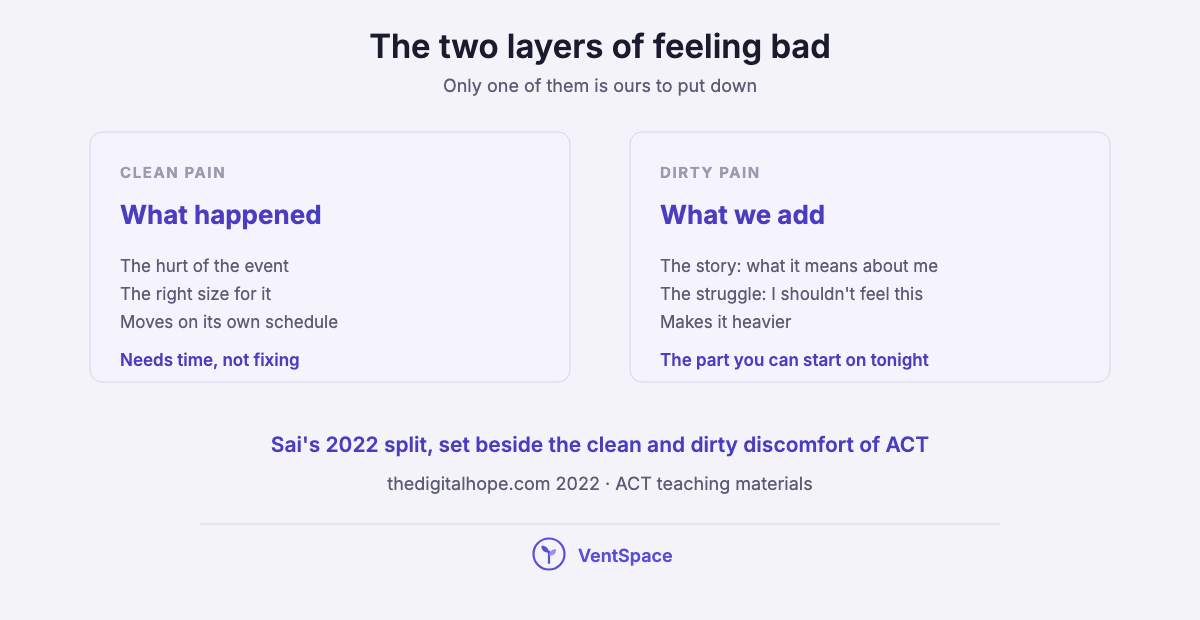
The clean layer is not a problem to solve. It is the right size for what happened, and it moves on its own schedule. The story and the struggle are different. They are things we do, usually without noticing, and they are the part most of us can start on tonight.
There is evidence for the struggle part in particular. In three studies, Ford and colleagues at the universities of Toronto and California, Berkeley, found that people who tend to accept their feelings and thoughts without judging them reacted to a standardized stressor with less negative emotion, and that in daily life, lower negative emotion during stress explained their better psychological health six months later. One detail matters here. The benefit belonged to accepting the feelings, not to accepting the situation. Nobody is asking you to be fine with what happened. The suggestion is smaller: that being upset about being upset is a second injury, and we can stop inflicting it.
Quick Summary
Q: What is the difference between clean pain and dirty pain?
A: Clean pain is the hurt of the event itself, such as a loss or a rejection. Dirty pain is what we add on top: the story about what the event means about us, and the struggle against having the feeling at all. The clean layer needs time. The dirty layer is the part we can change.
Insight: Ford, Lam, John and Mauss, describing what they tested across three studies in the Journal of Personality and Social Psychology (2018): “acceptance helps keep individuals from reacting to-and thus exacerbating-their negative mental experiences. Over time, experiencing lower negative emotion should promote psychological health.” The word that matters is exacerbating. The feeling is not the extra damage. The reaction to it is.
What helps, and what only numbs it
“reappraisers experience and express greater positive emotion and lesser negative emotion, whereas suppressors experience and express lesser positive emotion, yet experience greater negative emotion.” · James Gross and Oliver John, Journal of Personality and Social Psychology (2003)
Some things we do when we feel bad help the feeling pass, and some only pause it. Sai’s 2022 page sorted them into two piles: good measures, and escape measures that are “just a temporary relief”, which, he warned, could lower the quality of our life if we came to depend on them. The evidence mostly agrees with him, with one correction in escape’s favor.
Escape is not useless. In Webb’s meta-analysis, distraction was an effective short-term way to change a feeling (d = 0.27), while concentrating on the feeling, turning it over and over, made things slightly worse (d = −0.26). A film, a walk, a game on your phone: these can take the edge off a bad hour, and there is nothing shameful in using them. The trouble is not the escape. It is when escape becomes the only move we have, because distraction leaves the story and the struggle untouched, and they are waiting when the film ends.
Acceptance has better evidence than noticing. A 2025 meta-analysis by Raugh, Berglund and Strauss pooled 110 studies and 8,105 people testing mindfulness-based ways of handling a feeling. Overall the effect was small (g = .28), and the authors flagged publication bias, so the honest figure may be nearer .15. Split apart, accepting the feeling did most of the work (g = .30), while merely noticing it was significantly weaker (g = .17). Many of us already notice that we feel bad. Noticing is the part we have already done.
Doing something you value had a larger effect in its own trials. A meta-analysis of behavioral activation, a structured approach that asks people to schedule valued and enjoyable activities, pooled 20 randomized trials and 1,353 people and found a moderate effect on well-being (g = 0.52), in ordinary participants as well as those with raised depression symptoms. Those were structured programs, not a single evening, so one walk tonight is not a treatment. It is the first instance of a habit with a good record.
| Usually helps, longer run | Real short relief, if it is not the only move | Usually makes it worse |
|---|---|---|
| Accepting the feeling without judging it | Distraction: a film, a game, a walk | Trying not to feel it |
| Rethinking what the situation means | Keeping a calm face in public | Trying not to think about what happened |
| Doing something you value, regularly | · | Going over it again and again |
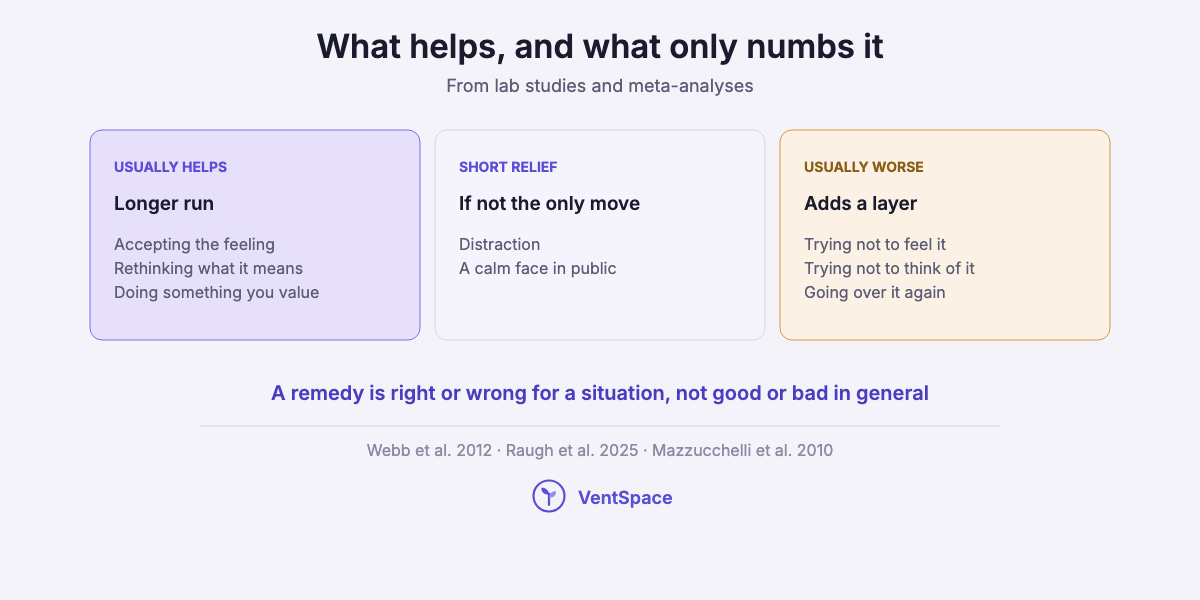
None of this means one technique fits every bad feeling. A remedy is right or wrong for a situation, not good or bad in general. A ninety-second distraction is the right size for a bad twenty minutes and the wrong size for a bad six months, and when it fails at the second job it says nothing about you.
Quick Summary
Q: What actually helps when you feel bad?
A: In the research, accepting the feeling without judging it and doing things you value regularly have the best evidence. Distraction gives genuine short-term relief. Trying not to feel the feeling, and going over what happened again and again, tend to make it worse.
Insight: Mazzucchelli, Kane and Rees, opening their 2010 meta-analysis of behavioral activation in the Journal of Positive Psychology: “One of the most promising ways to increase well-being is to engage in valued and enjoyable activities.” The word they chose is valued. Not busy, not distracted, but doing something that is yours.
So what do you do with a bad evening, tonight?
How to stop feeling bad, in five steps
“individuals who accept rather than judge their mental experiences may attain better psychological health, in part because acceptance helps them experience less negative emotion in response to stressors.” · Ford, Lam, John and Mauss, Journal of Personality and Social Psychology (2018)
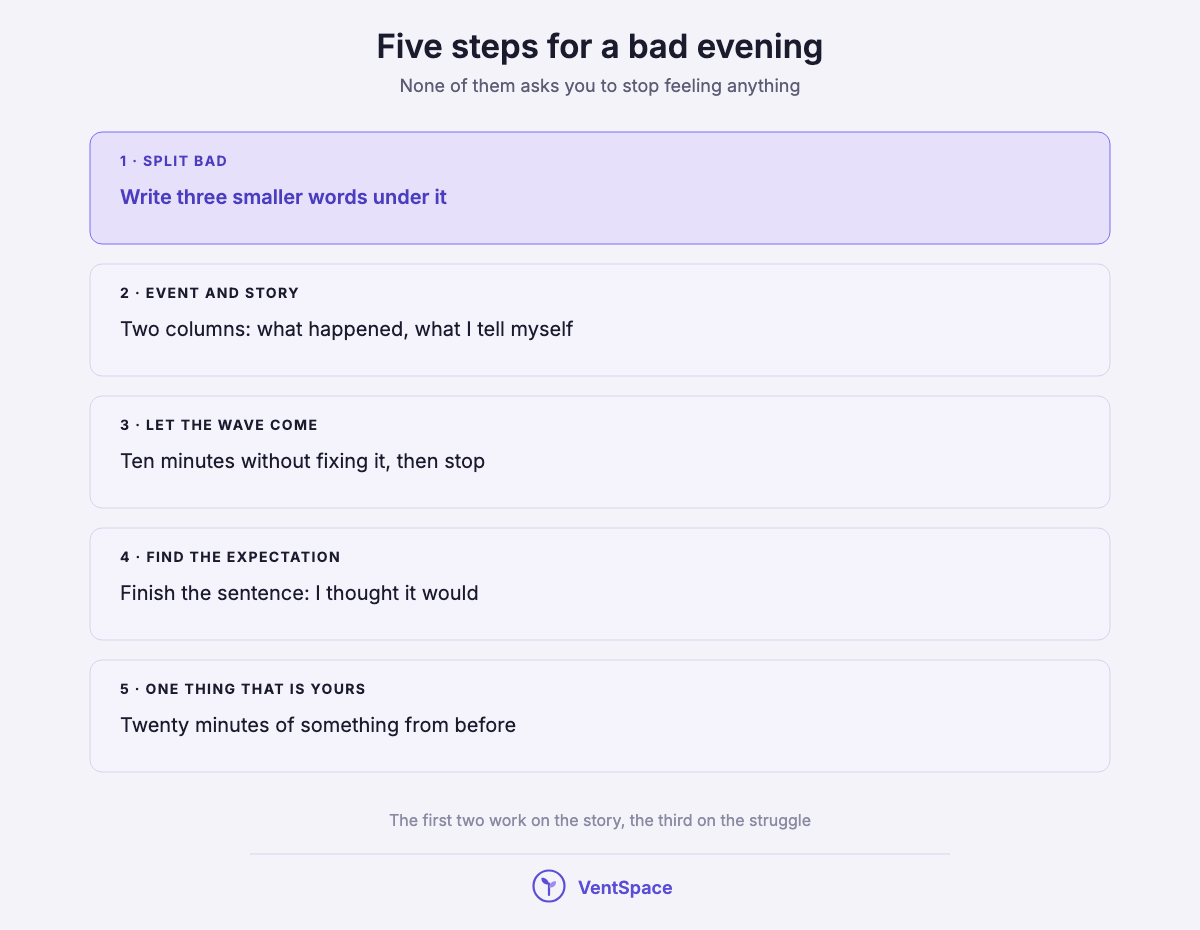
Five steps, in order, each small enough for tonight. The first two work on the story, the third on the struggle, the fourth on what broke, and the fifth gives the evening something of its own. None of them asks you to stop feeling anything.
1. Split “bad” into what it is made of
Take a piece of paper and write “I feel bad” at the top. Underneath, try to find three more specific words, or one place in your body where you feel it. Hurt, embarrassed, lonely, tired, jealous, ashamed, homesick, flat. Tight chest, heavy arms. You are not looking for the right word. You are looking for a smaller one.
Many of us arrive at a bad feeling with almost no vocabulary for it, and it is not a personal failing. One young adult in a 2023 study of people aged 18 to 25 with depression or anxiety symptoms put it plainly: “For myself, most of the time I can’t quite identify what I’m feeling other than ‘bad’ or ‘can’t do anything’.” That is the starting point for a great many people, not a sign of something wrong with you.
Why bother? A pooled analysis of 386 brain-imaging studies found that tasks which put emotion words in front of people more often engaged a language region, while tasks without emotion words more often engaged the amygdala, a region linked to threat. That is a finding about where activity shows up across a literature, not about how anyone felt. A separate meta-analysis of 17 studies found that people who describe their bad feelings in more differentiated terms were slightly less likely to fall back on harmful ways of coping (r = −.15). Small, and a correlation. But it points one way, and the cost of trying is a sheet of paper.
- Is it more hurt, or more embarrassed?
- Is it about something that happened, or something you are afraid will happen?
- Where in your body is it sitting?
- If a friend felt exactly this, what would you call it?
- Is there more than one feeling here at once?
There is no wrong word, and two words that seem to contradict each other can both be true.
2. Write the event and the story on separate lines
Draw a line down the middle of the page. On the left, write what happened, as a camera would have recorded it: “He didn’t reply for two days.” On the right, write what you are telling yourself it means: “He’s lost interest. I always do this. I’m too much.” The left column is the clean pain. The right column is where the dirty pain lives.
Sai’s 2022 advice here was to stop taking those thoughts seriously and say “no” to them. We would soften one part of that. Arguing with a thought, or ordering it away, is a form of the suppression that the research says does not help, and Wegner’s theory suggests it can make the thought louder. What works better is quieter: seeing the thought written down as a thought, in its own column, where it can be read as one possible story rather than as a fact about you. The thought “Maybe I am meant to be alone” looks different on paper, next to “We broke up in March.”
- What would a stranger watching the event have seen?
- Which words in the right column are about you as a person, rather than about what happened?
- Is the story one you have told yourself before, about other events?
- What is one other story that fits the same facts?
You do not have to believe the other story. You only have to notice there is more than one. If the right column fills and refills and you cannot leave it alone, that loop has a name and its own page: the difference between overthinking and problem solving.
3. Let the wave come instead of fighting it
Set ten minutes. Sit somewhere comfortable and let the feeling be as big as it is, without trying to fix it, shrink it or explain it. Notice where it rises and where it eases. When the ten minutes end, stop.
Sai wrote, about his own grief, that the intense emotions “tend to come and go in waves, and they move through more easily when we let them flow instead of resisting them.” That is his experience, not a law of nature, but it fits the evidence closely. Acceptance was the active part of the mindfulness research above, and in Ford’s studies it was accepting the feeling, not the situation, that went with less distress. A wave we brace against still arrives. A wave we let come still passes.
From Sai: the waves, as I wrote about them in 2022
It would be rough, and it would be different for different people, because the emotions are pretty unpredictable. We might feel better for a while, and out of nowhere the pain would come. I have been through this a lot of times, and trust me, I know how you feel. So let yourself feel it all.
- What happens to the feeling if you stop trying to make it smaller?
- Is there a sentence you keep saying to yourself, such as “I should be over this”?
- What is the feeling asking for, if anything?
- After ten minutes, is it the same size, bigger or smaller?
If it feels bigger for a few minutes, that does not mean you are doing it wrong. If the wave feels too big to let come, skip this step tonight and go to step 5.
4. Find the expectation that broke
Finish this sentence in writing: “I thought it would ___” I thought it would last. I thought they would call. I thought I would have the job by now. Most bad feelings sit on top of an expectation that did not hold, and naming it gives the feeling an edge you can see.
Sai’s old page called this step “stop expecting”, and he used a break-up to explain it: “we are stuck in a reality where you two end up together and happy”, when the actual reality may be that the relationship was not good for either of you. We would put it more gently. The aim is not to blame yourself for having hoped. Hoping is not a mistake. The aim is to see the hope clearly, so that you can grieve the thing you expected as well as the thing that happened. In Webb’s laboratory comparisons, two of the most effective approaches were rethinking what a situation means (d = 0.36) and taking another person’s perspective on it (d = 0.45), which is roughly what this step asks.
- What exactly did you expect, and when did you start expecting it?
- Was the expectation yours, or did someone hand it to you?
- What would it mean about you if the expectation had been unrealistic?
- What is still true, even though it did not happen?
It’s fine when things don’t go your way, as Sai wrote. That is not the same as being fine about it.
5. Do one ordinary thing that is yours
Pick one thing you did before this happened, something you did for its own sake, and do twenty minutes of it. Cook the dish you like. Play the song. Walk the route you used to walk. Call the one person you do not have to explain yourself to.
Sai’s advice in 2022 was to take care of yourself, because “sometimes we lose ourself in this process”, and to “do things that we normally do for fun and get a sense of ‘you’.” The behavioral activation trials say much the same thing in a drier voice: valued and enjoyable activities, done regularly, go with better well-being. One evening is not a program. It is the first line of one.
- What did you used to do that felt like you?
- Which of those is possible in the next hour?
- Who is one person you could be with without performing being okay?
- What would you tell a friend in your place to do tonight?
It does not have to feel good while you do it. The point is that the evening contains something that belongs to you, and not only the feeling.
Quick Summary
Q: How do I stop feeling bad right now?
A: Name what the bad feeling is made of in smaller words, write what happened separately from what you are telling yourself it means, let the feeling rise and fall for ten minutes without fighting it, name the expectation that broke, and then do one ordinary thing that belongs to you.
Insight: Seah and Coifman, pooling 17 studies in Emotion (2022): “our results indicated that NED was negatively associated with the enactment of maladaptive behaviors (r = -.15).” NED is negative emotion differentiation, the skill in step 1. The number is small and it is a correlation, which is the honest size of what a better word can do.
When the bad feeling is grief
“He says the best way out is always through.” · Robert Frost, “A Servant to Servants”, North of Boston (1914)
If what you are feeling follows a death, it is grief, and grief does not follow a schedule. Nobody can tell you how long it should take, and a page that gives you a number is guessing.
Sai’s 2022 page said “the only way out of grief is through it”, and the line has a long history. It usually traces back to Robert Frost, whose poem gives it to a farmer called Len. The woman speaking in the poem, worn out from cooking and cleaning for hired men, agrees with him only “in so far / As that I can see no way out but through”, and says a few lines earlier, “It’s rest I want.” We think both of them are right. Grief is gone through, not around. And going through it includes resting from it.
That second half has a name. Stroebe and Schut’s dual process model describes grieving as moving back and forth between facing the loss and getting on with a changed life, and it treats time off from grief as part of coping rather than a failure of it. So the day you laughed at something, and then felt guilty for laughing, was not you forgetting. It was part of the back and forth.
For more on telling grief from ordinary sadness, see grief vs sadness. If writing about the person helps, there are gentle, optional prompts in journal prompts for grief.
Quick Summary
Q: How do I stop feeling bad after someone dies?
A: Grief does not stop on a schedule, and nobody can give you a timeline. Researchers describe grieving as moving back and forth between facing the loss and resting from it, so a day that feels lighter is part of grieving, not a betrayal of the person.
Insight: Stroebe and Schut, setting out the dual process model in Death Studies (1999), describe “a dynamic, regulatory coping process of oscillation, whereby the grieving individual at times confronts, at other times avoids, the different tasks of grieving.” They argue for “the need for dosage of grieving, that is, the need to take respite”. Respite is in the model on purpose.
When it is more than a bad day
“If you show signs or symptoms of depression and they persist or do not go away, talk to a health care provider.” · National Institute of Mental Health, Depression (2024)
If the bad feeling stays most days, or it is getting in the way of sleep, work or the people around you, it is worth talking to someone. That is not a verdict on you. It is what the steps above cannot do on their own.
We are not going to give you a checklist of signs to score yourself against. A page cannot assess anyone, and a list read alone at night tends to frighten more than it helps. NIMH notes that clinicians diagnosing depression look for symptoms “most of the day, nearly every day, for at least 2 weeks.” That is the line a doctor uses before even considering a diagnosis. It is not a waiting period. You do not need to wait two weeks, or meet any threshold, to talk to someone.
Therapy is one option. For a lot of people it’s the right one. A primary care doctor is a reasonable first call too. If you are unsure whether what you are carrying calls for it, this guide to whether you need therapy works through the question without a quiz. If cost is what is stopping you, what actually helps when you can’t afford therapy covers low-cost routes.
If the feeling turns into thoughts of harming yourself, call or text 988 in the US, or find your local line at findahelpline.com, now.
Quick Summary
Q: When is feeling bad more than a bad day?
A: When it is there most days, or it is affecting your sleep, work or relationships, it is worth talking to a doctor or therapist. You do not need to meet a threshold or wait a set time first. If you are thinking about harming yourself, call or text 988 in the US, or find your local line at findahelpline.com.
Insight: The National Institute of Mental Health, in its 2024 guide to depression: “If you think you may have depression, talk to a health care provider, such as a primary care doctor, psychologist, or psychiatrist.” The sentence starts with “if you think”, not “if you are sure”. Thinking it is enough reason to ask.
Pulling it all together
“We are in the habit of exaggerating, or imagining, or anticipating, sorrow.” · Seneca, Moral Letters to Lucilius, Letter 13 (trans. Richard M. Gummere, 1917)
The five steps are one path, and you can walk it in an evening. Here is each one as a single action you could write down now.
Split “bad”. The feeling arrives as one heavy word. Tonight, write “I feel bad” and three smaller words under it.
Separate the event from the story. The story is where most of the extra hurt comes from. Tonight, draw the two columns and fill the left one first.
Let the wave come. Fighting the feeling is the second injury. Tonight, give it ten minutes without fixing it, then stop.
Find the expectation. Something you hoped for did not hold. Tonight, finish the sentence “I thought it would ___”
Do one thing that is yours. The evening needs something besides the feeling. Tonight, twenty minutes of something you did before this happened.
Quick Summary
Q: What is the quickest way to start feeling less bad?
A: Write down what the bad feeling is made of, separate what happened from what you are telling yourself it means, and then do twenty minutes of something that belongs to you. None of it makes the feeling vanish, and all of it stops you adding to it.
Questions people ask about feeling bad
Is it bad to feel bad?
No. A bad feeling after something painful is usually the right size for what happened, which is what Sai meant by clean pain. The part worth changing is the extra layer: the story about what it means and the fight against having the feeling at all. Feeling bad about feeling bad is the one piece we can let go of.
Why do I feel bad for no reason?
Often there is a reason that has not been found yet, such as tiredness, an expectation that quietly broke, or something earlier in the week. Sometimes there is no single cause. Splitting “bad” into smaller words in step 1 is a good place to start, and if the feeling stays most days for weeks, it is worth talking to a doctor.
How do I stop feeling bad about myself?
Look at the right-hand column from step 2. Feeling bad about yourself usually lives in the story layer, the part that turns “this happened” into “this is what I am”. Writing that story down as a story, rather than arguing with it, gives you a little distance from it.
Does distracting yourself help?
In the short term, yes. A meta-analysis of 306 lab comparisons found distraction had a small positive effect, while dwelling on the feeling made it slightly worse. The limit is that distraction leaves the story untouched, so it works best as one move among several rather than the only one.
How long does it take to stop feeling bad?
Nobody can give you a number. The clean pain of a real loss moves on its own schedule. The dirty pain, the story and the struggle, is the part you can start on tonight. The research on acceptance and on doing valued things is about habits kept up over time, so expect small changes that add up.
In a nutshell
A bad feeling is not something we can switch off, and most of us have spent a lot of energy trying.
Two things to take with you. First, the feeling is not the enemy. The second layer is. The hurt of what happened is the right size for it. The story we tell about it and the fight we put up against it are what make it heavier, and those are ours to put down. Second, the honest timeline: nobody can tell you how long the first layer lasts, and anyone who does is guessing. The second layer is the part you can start on tonight, and the habits with the best evidence are kept up over time, not done once.
Tonight, write “I feel bad” at the top of a page. What are the three smaller words underneath it?
Whatever you are carrying tonight, it does not have to be carried alone or all at once. If writing some of it down would help, VentSpace, the journaling app we make, is a quiet place to do it. Prefer to try it on your laptop first? VentSpace Live runs in your browser, free, with nothing to install.
About this article

Written by
Sai Subramaniam
Founder, VentSpace
I write these guides because I have been where you are. I am working through my own hard seasons, and I share the things that actually helped me, so that anyone going through it has something steady to read instead of facing it alone. No ads, no affiliate links, and nothing here is a sales pitch.
This writing is honest and every claim is sourced, and it is not a substitute for professional care, bereavement support or medical advice. If this is heavy right now, the numbers above are a better answer than anything else on this page.
How this one was checked. Every claim about feelings, suppression, acceptance and grief traces to a named study or public health source, re-read on the day of writing, and the limits of each are printed beside it. Sai’s own words from the 2022 version of this page are kept in labelled callouts and lightly edited.
No affiliate links, no paid placements, and nobody paid to appear here. This page does not promise that any step will make a feeling go away. Our own app is named once, in the last line, without a link.
Reviewed: October 2026.
Corrections. If something here is wrong, we would rather know. Corrections are made in place, with a note saying what changed.