
“Caring for myself is not self-indulgence, it is self-preservation, and that is an act of political warfare.”
Audre Lorde, A Burst of Light, 1988
Most of us arrive here having already done the arithmetic. You looked up what a session costs where you live, multiplied it by four, sat with that number for a moment, and closed the tab. Nobody needs to explain to us that therapy helps. We can read, and we did the sum.
The trouble is that the sum was done on the wrong number. What we priced was the most expensive version of the thing: a private therapist, at their full published rate, weekly, for an unknown number of months. That is the front door, and it is the only door with a sign on it. There are several others into the same building, and the reason we have not used them is not that they are locked. It is that nobody advertises them, because nobody makes money when we walk through.
So this page is not an argument that therapy is worth it. That decision has already been made and it was the right one, and we wrote about the evidence separately in whether therapy is worth it. This is the other thing: where the other doors are, what each one actually costs, what to say when you get there, and what to do during the weeks it takes to arrive.
Quick Digest
The number you calculated is the retail number. It is the most expensive route and the only visible one.
Two obstacles are hiding inside one word. Cost and wait are different problems and they have different answers.
One nonprofit publishes its actual figures, including an income ceiling and a session range, which almost nothing else in this field does.
Federally funded health centres are required to discount by income, on a published structure.
Ask the question. The single highest-yield thing available is asking a therapist about a reduced rate, and there is a sentence for it below.
The honest floor: low cost is not no cost, waits are long, and not every route exists everywhere.
If you are in crisis right now
Please do not work through a list. If you are in crisis or having thoughts of harming yourself, contact a crisis line now. In the US you can call or text 988 for the Suicide and Crisis Lifeline. Outside the US, findahelpline.com will find the equivalent where you are. Crisis lines are free, they are staffed at three in the morning, and they do not ask about insurance.
Why the number you calculated is the wrong number
The price we all quote ourselves is the retail price, and it describes one specific arrangement: an individual therapist in private practice, charging their full rate, seen weekly, for a length of time nobody will specify in advance. That last part is what makes the arithmetic unbearable. It is not that any single session is impossible. It is that we are being asked to multiply by an unknown.
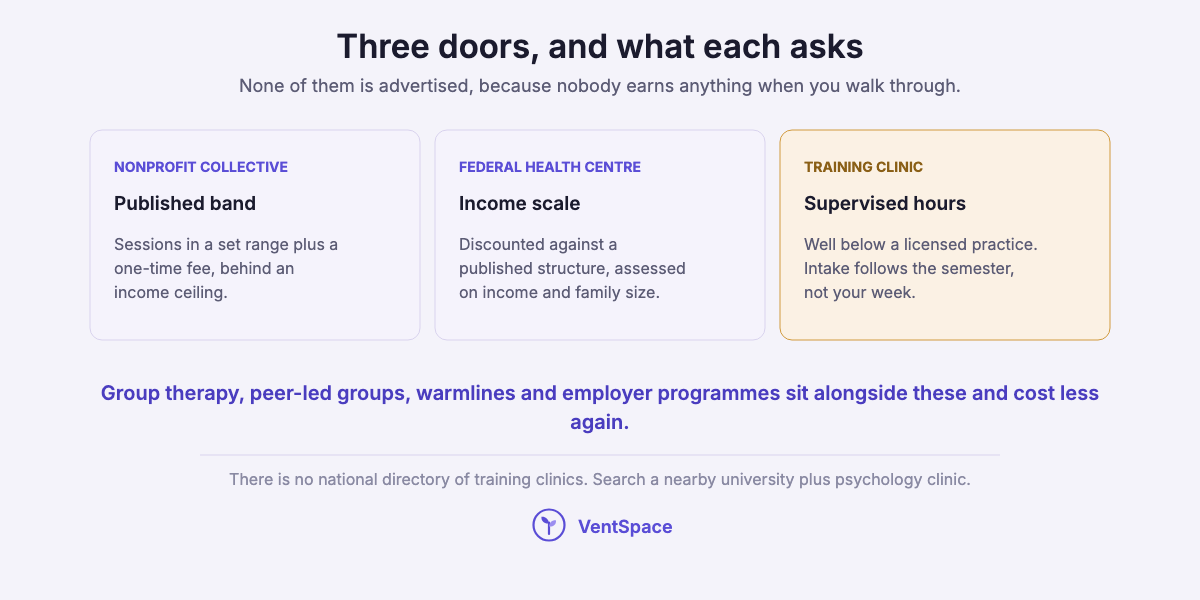
Almost every other route prices differently, and some of them do not price by the session at all. A nonprofit collective sets a band and asks its therapists to work inside it. A federally funded health centre discounts against a published scale. A university clinic charges what a supervised trainee’s time is worth rather than a licensed practice’s overheads. A peer-led group costs nothing and is not therapy, and is still a room with people in it on a Tuesday.
None of these is hidden, exactly. They are unmarked, which is different, and the practical consequence for all of us is the same: we do not find them, because finding them requires knowing they exist and then doing forty minutes of administration on a bad week, which is the week we are least able to spare it.
Quick Summary
Q: Why is therapy so expensive?
A: The figure you have probably calculated is the retail one: a private therapist’s full rate, weekly, for an unspecified number of months. Nonprofit collectives, federally funded health centres, university training clinics and group formats all price differently, and several do not price by the session at all.
The two obstacles underneath the one word
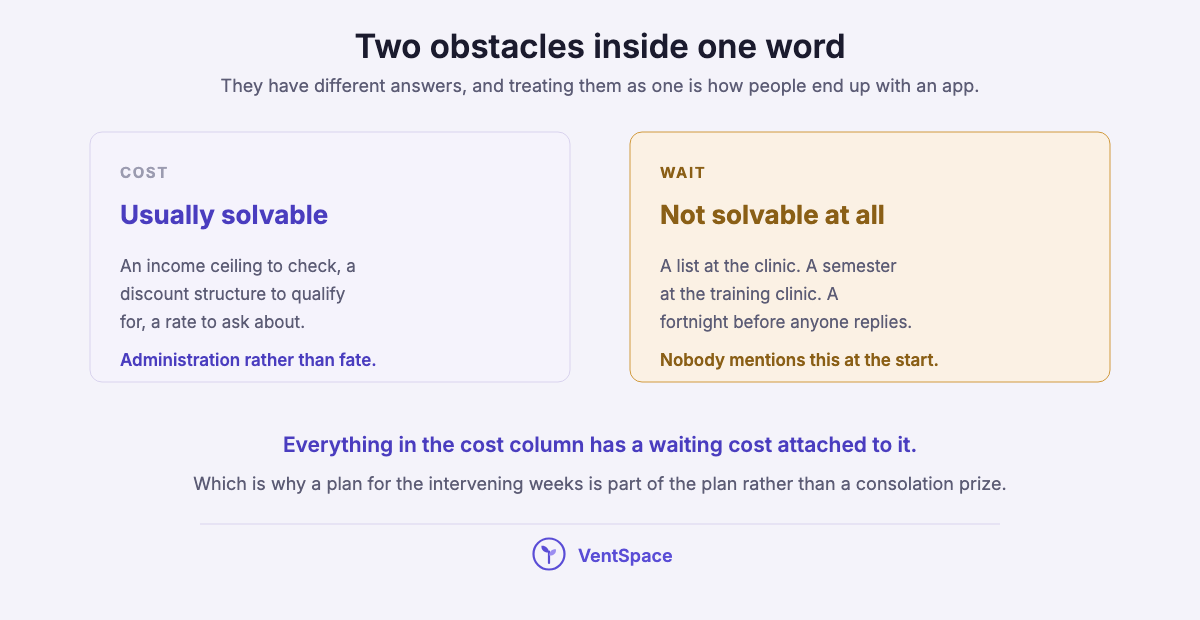
“Cannot afford” usually contains two separate problems, and separating them is the most useful thing on this page, because they have different answers and conflating them is how people end up with an app instead of care.
The first is cost, and cost is solvable more often than it looks. There is an income ceiling to check, a discount structure to qualify for, a rate to ask about. It is administration rather than fate, and in our experience of looking at what these routes publish, it responds to being worked at.
The second is the wait, and the wait is not solvable at all. A community clinic may have a list. A training clinic runs on academic terms and takes new clients when a semester starts. A directory search takes as long as it takes to email six people and hear back from two. Everything in the cost column has a waiting cost attached to it, and nobody mentions this in advance, which is why it is easy to conclude the routes do not work when what actually happened is that nothing happened for five weeks and they stopped checking.
Those two obstacles need two different plans. The rest of this page is the first plan, and the last step of it is the second.
One thing worth checking before either plan. This page assumes you have already decided you want therapy and are stuck on paying for it. If that decision is not actually settled, our piece on whether you need therapy is the better place to start, because the cost of a thing you have not decided on is an impossible number to weigh.
Quick Summary
Q: What are the actual obstacles to getting therapy when money is tight?
A: Two, and they are usually treated as one. Cost is administrative and often solvable through income-based discounts, nonprofit rates and asking directly. Waiting is not solvable, and every low-cost route has a wait attached, which is why a plan for the intervening weeks is part of the plan rather than a consolation.
So, where are the other doors.
What to do, in five steps
1. Find out what you are eligible for before you look at a single price
Most of the discount in this field is income-gated rather than negotiated, which means the first useful act is not shopping. It is establishing which brackets you fall inside, once, so that every later conversation is short.
The first action, and it takes about ten minutes: write down your annual household income, your household size, and whether you have any mental-health coverage at all, including a plan you have never used. That is the entire input for almost every route below.
Questions worth answering on paper before you contact anybody:
- What is my annual household income, as a number I would put on a form?
- How many people are in my household by the definition a clinic would use?
- Do I have insurance of any kind, and have I ever checked what it says about behavioural health?
- Is there an employer, a union, a college or a professional body in my life that might already be paying for something?
- Which of these questions have I been avoiding because I do not want to know the answer?
Be honest on that last one and then move on. Nobody is reading this but you, and an inaccurate number here costs you a phone call later.
Quick Summary
Q: What is the first step to finding affordable therapy?
A: Establish eligibility before comparing prices. Write down annual household income, household size, and whether any insurance or employer benefit exists. Most low-cost routes gate on income and household size rather than on negotiation, so having the figures ready shortens every later conversation.
2. Use the two federal locators, in this order
Start with a directory rather than a search engine, because a search engine sells this query to whoever bids the most and a federal locator does not.
The first action: open FindTreatment.gov, the US government’s treatment locator, and search your area. Then open HRSA’s Find a Health Center and do the same. Write down three names from each, with their phone numbers, in one list.
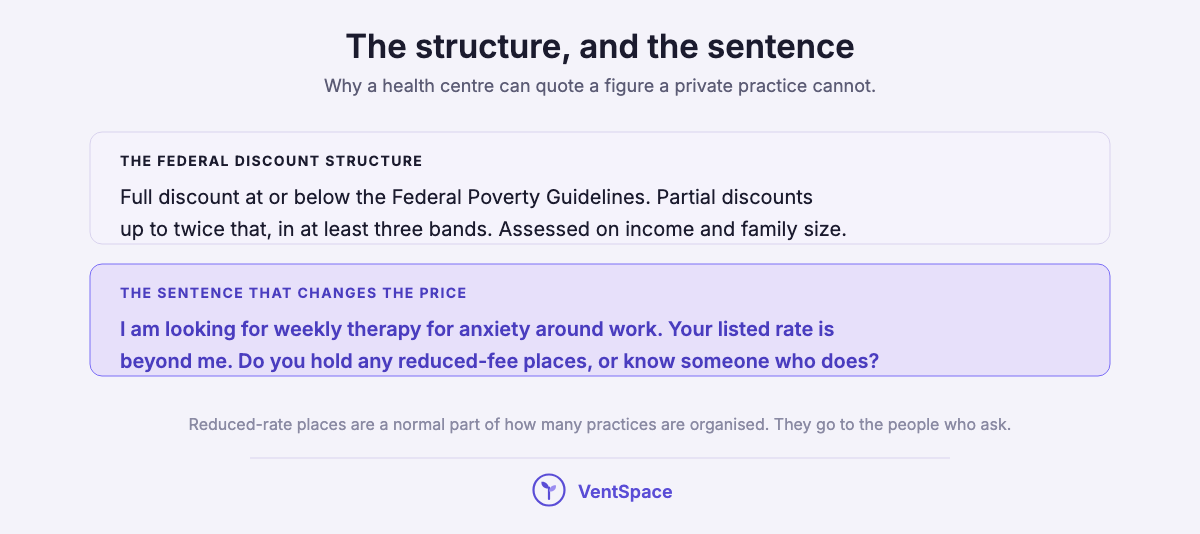
Why the second one matters more than it looks. Health centres in the federal Health Center Program are required to run a sliding fee discount programme, and its shape is published rather than discretionary: a full discount at or below the Federal Poverty Guidelines, partial discounts up to twice that level, arranged in at least three pay bands, and no discount above twice the guidelines. Eligibility is assessed on income and family size only. This is why a health centre can quote you a figure that a private practice cannot, and why it is worth asking even if you assume you earn too much.
- Have I searched by my actual postcode rather than my city?
- Did I write down the phone numbers, or am I planning to find them again later?
- Do I know which of these places offer behavioural health rather than only primary care?
- What would I need to have ready to be quoted a price on the first call?
It is reasonable for this step to take two sittings. Making a list is a real piece of work and it is the part that does not have to be done on a bad day.
Quick Summary
Q: Where do you find low-cost mental health care in the US?
A: Two federal locators. FindTreatment.gov searches treatment services by area, and HRSA’s Find a Health Center locates federally funded health centres, which are required to operate a sliding fee discount programme with a full discount at or below the Federal Poverty Guidelines and partial discounts up to twice that.
Insight: the structure that makes a health centre affordable
The federal Health Center Program requires a sliding fee discount programme assessed on income and family size only, with a full discount at or below 100 per cent of the Federal Poverty Guidelines, partial discounts between 100 and 200 per cent across at least three pay bands, and no discount above 200 per cent. It is a published structure rather than a favour, which is the reason it is worth asking about directly.
3. Ask the question that changes the price
This is the highest-yield thing available and it is easy to skip, because asking can feel like admitting something we would rather not say out loud. It is not a favour. Reduced-rate slots are a normal part of how many practices are organised, and a therapist who holds two of them is waiting for somebody to ask.
The first action, today: send one email. Here is the whole thing, and it should not be longer.
“Hello. I am looking for weekly therapy for anxiety around work. Your listed rate is beyond what I can manage at the moment. Do you hold any reduced-fee places, or could you point me to someone who does? Thank you.”
That is it. It names the thing, states the constraint without apology, and gives the person an easy second option so that no is cheap for them to say.
And the route with published figures. Open Path Psychotherapy Collective is a nonprofit that does this at scale, and unusually it prints its numbers. Read on 11 September 2026: individual sessions $40 to $70, couples or family $40 to $80, on a standard fifty-minute session, behind a one-time membership fee of $65, with a network described as over 40,000 vetted therapists.
Eligibility, in their words: clients who cannot afford market rates, lack adequate mental-health coverage, and have an annual household income below $100,000. They also list a limited number of $30 flat-rate sessions with student interns, working under close supervision.
- Have I actually sent one email, or only drafted it?
- Am I willing to send the same email to six people rather than one?
- Do I know what I would say if somebody asked what I can manage per session?
- Is there a figure I could sustain monthly, even if it is small?
You are allowed to name a low number. The people who hold these places have heard smaller.
Quick Summary
Q: How do you ask a therapist for a lower rate?
A: Directly, in three sentences: what you are seeking help with, that the listed rate is beyond you at the moment, and whether they hold reduced-fee places or can point you to someone who does. Reduced-rate slots are a normal part of how many practices are arranged, and they are given to the people who ask.
Insight: what a nonprofit route actually costs, in its own published figures
Open Path Psychotherapy Collective, read 11 September 2026: $40 to $70 per individual session on a standard fifty-minute session, a one-time membership fee of $65, and eligibility requiring an annual household income below $100,000 along with an inability to meet market rates. A limited number of $30 sessions with supervised student interns are also listed. Figures should be re-checked on their own page before you rely on them.
4. Take the formats that cost less than an hour of individual therapy
Individual weekly therapy is one format among several, and it is the most expensive one. The others are not consolation prizes, and two of them do things the individual hour does not.
The first action: pick one of the four below that could plausibly exist where you live, and spend fifteen minutes finding out whether it does.
- University training clinics. Doctoral programmes in psychology and counselling run clinics staffed by trainees under close supervision, at rates well below a licensed practice. There is no national directory, so the way to find one is to search the name of any nearby university together with “psychology clinic” or “counseling training clinic”. The work is supervised, and it is frequently the most closely reviewed hour of therapy anybody receives.
- Group therapy. Run by a clinician, several people, a fraction of the individual rate. It asks more of you socially and it gives back something individual work structurally cannot, which is other people with the same problem in the room.
- Peer-led support groups. Free, not therapy, and not trying to be. The Depression and Bipolar Support Alliance runs a national network of chapters and support groups, and NAMI is the other large peer network worth looking up locally.
- Warmlines. Peer-support telephone lines for the times that are difficult without being an emergency, usually free, usually staffed by people who have been through something similar, and generally run at state level. To find yours, search the word warmline together with the name of your state. They are not crisis lines, and if the situation is urgent the crisis number at the top of this page is the right one.
- Your employer, quietly. Many employers pay for an employee assistance programme providing a set number of counselling sessions at no cost to you. The allowance is usually small and finite, which is a real limit. Check your benefits portal rather than asking a manager, and read the programme’s own confidentiality statement rather than guessing at it.
- Which of these five could exist within travelling distance of me?
- Have I ever actually looked at my employer’s benefits portal?
- Am I ruling out the group format for a reason, or out of dislike of the idea?
- What would I need to know to try one of these once?
You are allowed to try a group and hate it. Once is information, not a commitment.
Quick Summary
Q: What are the cheaper alternatives to individual therapy?
A: University training clinics staffed by supervised trainees, clinician-led group therapy at a fraction of the individual rate, free peer-led support groups such as those run by DBSA, state warmlines for difficult times that are not emergencies, and employee assistance programmes, which often cover a small number of sessions at no cost.
5. Put something in place for the weeks in between
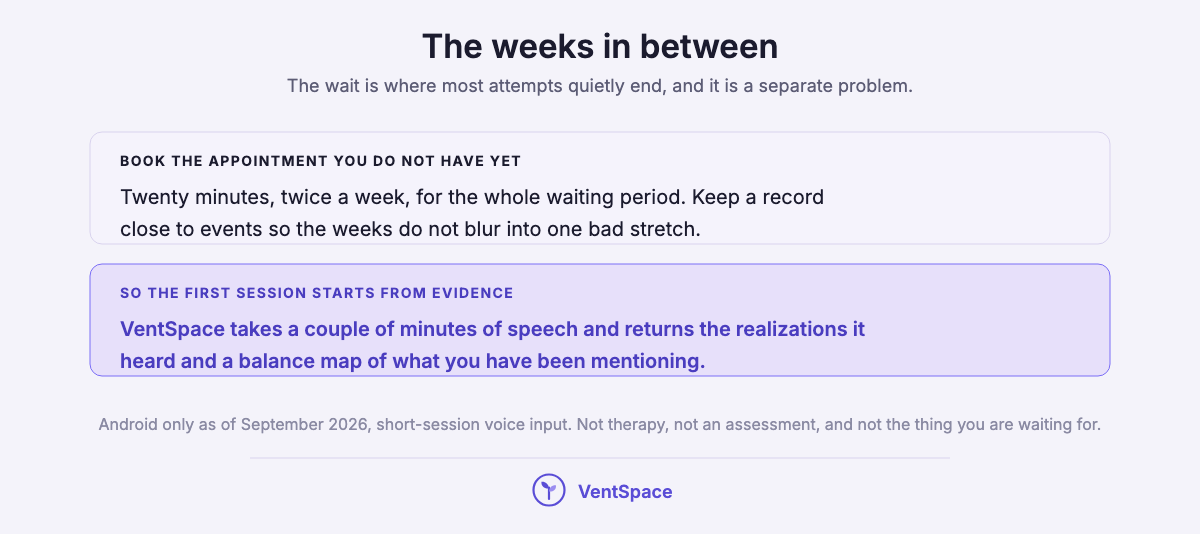
This step is about time, not money. Everything above has a wait attached: a list at the clinic, a semester at the training clinic, a fortnight of emails before two people reply. The waiting is where most of our attempts quietly end, because nothing happens for five weeks and it starts to feel like the answer was no.
The first action: put a repeating twenty-minute slot in your calendar, twice a week, for the whole waiting period, and treat it as the appointment you do not have yet. Then decide what goes in it.
What goes in it is mostly a record. Writing down what actually happened, close to when it happened, does two things during a wait: it stops the weeks blurring into one bad stretch, and it means the first session, whenever it comes, starts from evidence rather than from whatever you can remember on the day. If the blank page is where that stalls, VentSpace is a journaling app with prompts to start from, and it turns what you write into Realizations and a clear read on your life balance across the weeks. Its limits, plainly: Android only as of September 2026, voice input is short-session rather than long dictation, and it is not therapy, not an assessment and not the thing you are waiting for. Not on Android, or at a desk? VentSpace Live runs in your browser, free, with nothing to install. It is a way of keeping the weeks legible until the appointment arrives.
- What would I want the first session to know that I will not remember by then?
- Which two days of the week could hold twenty minutes without negotiation?
- Who is one person I could tell that I am waiting for an appointment?
- What would I do if the first route falls through, so that it does not become the end?
Write badly in those twenty minutes. Nobody is marking it, and a record kept carelessly is worth considerably more than one kept perfectly for four days.
Quick Summary
Q: What can you do while waiting for affordable therapy?
A: Treat the wait as its own problem. Book a repeating twenty-minute slot twice a week and use it to keep a record close to events, so the weeks do not blur and the first session starts from evidence. Tell one person you are waiting, and decide in advance what you will do if the first route falls through.
The routes, side by side
| Route | Roughly what it costs | What it asks of you | The honest catch |
|---|---|---|---|
| Nonprofit collective | Published band, plus a one-time fee | Meeting an income ceiling | Still a real cost every session |
| Federally funded health centre | Discounted on a published income scale | Proof of income and household size | Often a waiting list |
| University training clinic | Well below a licensed practice | Finding one, and academic timing | Intake follows the semester |
| Group therapy | A fraction of the individual rate | Being in a room with other people | Not available for every difficulty |
| Peer-led group | Free | Turning up | Not therapy, and does not claim to be |
| Warmline | Free | A phone call | Not a crisis line, and hours vary |
| Employee programme | No cost to you | Looking at your benefits portal | Usually a small, finite allowance |
Pulling it all together
One sitting, ten minutes: write down your household income, your household size and whether any coverage or employer benefit exists. That single piece of paper is the input to everything else.
One sitting, twenty minutes: search both federal locators and write six names and six phone numbers into one list. Do not evaluate them while you are making the list.
One email, today: three sentences, naming what you want help with, saying the listed rate is beyond you, and asking whether reduced-fee places exist. Send it to six people, not to one.
One fifteen-minute search: whether a university clinic, a group, a peer network or an employer programme exists near you. Pick the one you have the least resistance to.
One calendar entry: twenty minutes, twice a week, for the whole wait, and something to write in.
And the committed action underneath all five: decide now what you will do if the first route says no, because the first route frequently does, and the only version of this that fails completely is the one where a single no ends it.
Questions people ask
Is there any genuinely free therapy?
Some, and it is worth knowing what is genuinely free rather than low-cost. Peer-led support groups and warmlines are free and are not therapy. Employee assistance programmes usually cover a small number of sessions at no cost to you. Federally funded health centres are required to give a full discount at or below the Federal Poverty Guidelines, which for some people does mean no charge. Everything else on this page is cheaper rather than free.
Is low-cost therapy worse than expensive therapy?
This is the myth worth correcting, and it has it backwards in one specific case. A university training clinic’s hour is supervised closely, often reviewed in detail by an experienced clinician, which is a level of scrutiny a private hour rarely receives. What our money reliably buys is convenience: shorter waits, more choice, better hours. It does not straightforwardly buy a better clinician, and the evidence on therapy outcomes has never been organised around fee level.
What if I earn too much to qualify but still cannot manage it?
This is a common position and it is the one the direct ask is for. Open Path’s published ceiling is an annual household income below $100,000, which may be higher than you would assume, and reduced-fee places in private practices are held for exactly this gap. It is also worth checking any insurance you have but have never used, because behavioural-health coverage is worth reading before you assume it covers nothing.
Are the waiting lists as long as people say?
Often, yes, and it varies so much by area that any number quoted to us is a guess. What is reliable is that the wait exists and that nobody mentions it at the start. Plan for it, apply to more than one place at once, and treat a slow reply as ordinary rather than as an answer.
Does using an employer programme go on my record?
These programmes are normally confidential, and our honest answer is that you should read the programme’s own confidentiality statement rather than take anyone’s word for it, including ours. It is a reasonable question to ask the provider directly before the first session, and they are used to being asked.
In a nutshell
The first thing is that the price you priced was the retail one. The routes underneath it are unmarked rather than closed, they are reached by administration rather than by luck, and the single most effective act available is writing three sentences to somebody and asking. You may never have asked. It is not a favour and it is not an admission.
The second thing is the honest one, and it is about time. None of this resolves this month. Eligibility takes a sitting, a list takes an evening, replies take a fortnight, a clinic may have a list and a training clinic may have a semester, and somewhere in there a route will fall through and you will have to start the second one. That is not a sign it is not working. It is what this particular piece of admin looks like, and it is worth doing, because on the other side of it is the thing you already decided you wanted.
The front door is expensive. Try the ones without signs.
About this article

Written by
Sai Subramaniam
Founder, VentSpace
I write these guides because I have been where you are. I am working through my own hard seasons, and I share the things that actually helped me, so that anyone going through it has a steady companion close by instead of facing it alone. VentSpace is the app I built for exactly that: a journaling app that turns what you write into a clear read on your life balance, plus small, doable next steps toward feeling more like yourself.
This writing is honest and every claim is sourced, and it is not a substitute for professional care. If you are struggling, reaching out to a professional is a strong move, not a failure.
Explore VentSpaceTry VentSpace LiveHow this one was checked. Every factual claim traces to a named source, and the source is printed next to the claim rather than kept in a footnote. Quotes are pinned to the work they come from, with the year, the letter or the chapter where one exists. Where a widely repeated claim could not be traced, it was left out and the omission recorded. Where a figure is contested, both sides are printed.
No affiliate links, no paid placements, and nobody paid to appear here. Where we mention our own app, we say that it is ours, we state its limits, and we never position it as a substitute for care.
Reviewed: October 2026. Prices, platforms and product availability move quickly, and anything we could not verify at the time of writing is marked as unverified rather than turned into a number.
Corrections. If something here is wrong, we would rather know. Corrections are made in place, with a note saying what changed. Updated 15 October 2026: we corrected the description of VentSpace, which is a journaling app rather than something you talk to, removed an unrelated reading link, and softened two unsourced generalisations about clinics and insurance.