
It is a strange thing to be asked to decide about. The money is real and immediate, the time is real, and the thing being bought cannot be examined beforehand or returned afterwards. Most of us are used to making that trade for objects. We are not used to making it for an hour a week with a stranger, over an unknown number of months, toward an outcome nobody will name in advance.
And when we go looking for an answer, we find that almost every page addressing the question is published by an organisation that sells therapy, or sells software to therapists. That is not a conspiracy and it does not make them wrong. It does mean nobody in that search result has any reason to tell us the discouraging half.
So this is both halves. The evidence for therapy is genuinely strong, stronger than for most things sold as helping, and there is a body of research about who it does not help that almost nobody quotes. Between them sits a more useful question than the one in the title.
If you are in crisis or thinking about harming yourself, this is not a decision to weigh on cost. Please contact a crisis line now. In the US you can call or text 988 for the Suicide and Crisis Lifeline. Outside the US, findahelpline.com will find the equivalent where you are.
The short version
The positive evidence is strong. About three quarters of people who enter therapy show some benefit, and the effect holds up, smaller but still meaningful, once weaker trials are accounted for.
The unflattering evidence is also real. Between 30 and 50 per cent of clients do not improve, and roughly 8 per cent get worse.
The finding that matters most: measuring whether therapy is working, rather than going by feel, helps it work a little better.
If nobody in the room is measuring, you can be the one who does, and there are four steps below for doing that.
The question cannot be answered before you start. It can be answered at session eight.
What the evidence actually says
Therapy has one of the better evidence bases in this whole territory, and it is worth stating that clearly before anything else.
About 75 per cent of people who enter psychotherapy show some benefit from it. That figure is attributed to the American Psychological Association’s 2012 resolution on psychotherapy and to Michael Lambert’s 2013 review of outcome research. It is a different claim from the Smith and Glass result below, and the two are often mixed up.
The foundation for all of this was laid in 1977, when Mary Lee Smith and Gene Glass did something nobody had done before. They gathered 375 separate psychotherapy outcome studies and analysed them together, using a method that barely existed yet, and found that the average person in therapy improved more than about three quarters of comparable people who had not had it. That paper is why the question has an answer at all.
The best-known synthesis of therapy for adult depression puts the unadjusted effect at g = 0.70, a medium-to-large effect. The same analysis found only 23 per cent of the trials were at low risk of bias, and the effect fell to g = 0.31 once bias was accounted for, which is smaller but still above the threshold researchers treat as meaningful in depression (Cuijpers, Karyotaki, Reijnders and Ebert, 2019).
A comparison worth making, given who is publishing this. The expressive-writing research that sits behind journaling, including everything this company does, produces effects anywhere from not significantly different from zero (Mogk and colleagues, 30 randomised trials, 2006) to moderate against a waiting list (Gerger and colleagues, 2022, where neutral writing did almost as well). Set beside the adjusted therapy figure the gap in raw effect size is narrower than the old numbers suggested, but on volume, replication and trial quality therapy’s evidence base is substantially stronger than ours. Anyone telling you otherwise is selling you something, and that includes us.
Insight The founding study in this field is Smith and Glass (1977), which pooled 375 psychotherapy outcome studies using the then-new technique of meta-analysis. Before it, arguments about whether therapy worked were conducted case by case. After it, they were conducted with numbers, and the numbers were good.
Quick Summary
Q: Does therapy actually work?
A: For most people, yes. About 75 per cent of those who enter psychotherapy show some benefit, a finding drawn from more than fifty years of outcome research, and for depression the best-known synthesis puts the effect at g = 0.70 before adjusting for weaker trials and g = 0.31 after, which is still a meaningful effect.
The half that does not appear on the other pages
Now the part nobody quoting the 75 per cent figure ever quotes alongside it.
Michael Lambert has spent a career measuring what happens to people in treatment rather than in trials, and the picture is more mixed than the headline. His work reports that between 30 and 50 per cent of clients do not improve over the course of therapy, and that roughly 8 per cent get worse. In randomised trials, 35 to 40 per cent of patients do not improve, and among those non-responders, 5 to 10 per cent deteriorate, finishing treatment with more symptoms than they arrived with. For children and adolescents, deterioration estimates run higher still.
Dropout is harder to state honestly than it looks. The largest synthesis, 669 studies and nearly 84,000 clients, puts it at about one in five, 19.7 per cent, and found that the figure moves depending on how dropping out is defined (Swift and Greenberg, 2012). A separate meta-analysis of 115 CBT studies splits it usefully: about 16 per cent never start, and about 26 per cent of those who start do not finish (Fernandez and colleagues, 2015). Anyone citing a single dropout number without saying which definition produced it is not being careful with you.
None of this is an argument against going. It is the shape of the thing being bought. A treatment that helps three quarters of people is a good treatment, and it is not a treatment that helps everybody, and those two facts have to be held at once by anybody making this decision honestly.
Quick Summary
Q: Does therapy ever make things worse?
A: For a small proportion, yes. Research reports that around 8 per cent of clients get worse, and that among people who are not responding, 5 to 10 per cent finish with more symptoms than they started with. It is uncommon, it is documented, and knowing it exists is what makes it noticeable.
Why nobody can tell you in advance
Here is the actual structure of the problem.
Most purchases can be inspected before we commit, or returned after. This one can only be inspected from inside, some months in, by which point a good deal of the money is gone. It is not a gamble, because gambling implies chance and this has a genuine success rate. It is not an investment, because that implies a return we could calculate. It is a purchase we cannot examine until we already own it.
Which would be tolerable if somebody in the room were keeping track. This is where the research turns genuinely useful, because it shows that keeping track is itself part of what helps.
Measuring progress, rather than judging it by feel, makes a measurable difference. A 2021 meta-analysis of 58 studies and 21,699 patients found that routinely scoring progress with a questionnaire and showing the therapist the result improved outcomes by a small margin, d = 0.15, and reduced dropout (de Jong and colleagues, 2021). A 2022 analysis of six trials, with Lambert among its authors, found the same feedback narrowed the gap between more and less effective therapists (Delgadillo and colleagues, 2022). The effect is small, and it is the cheapest one in the field. None of this is an accusation of carelessness. It is what happens to anyone assessing something they are personally invested in, week after week, without an instrument. Doctors do it. Teachers do it. We all do it.
But it changes who has to notice. Not every therapist measures, so the person holding the money may have to. And it is easy to arrive at a first session without having decided how you will tell.
Quick Summary
Q: How do you know if therapy is working?
A: Not by how the sessions feel. Research on progress measurement finds that scoring how treatment is going, and showing the therapist the result, improves outcomes by a small margin and reduces dropout. Your own record is not the same validated instrument, but the method that helps is to decide before you start what you want to be different, and to score it yourself at regular intervals.
So the question changes. Not whether it is worth it, but how we would know.
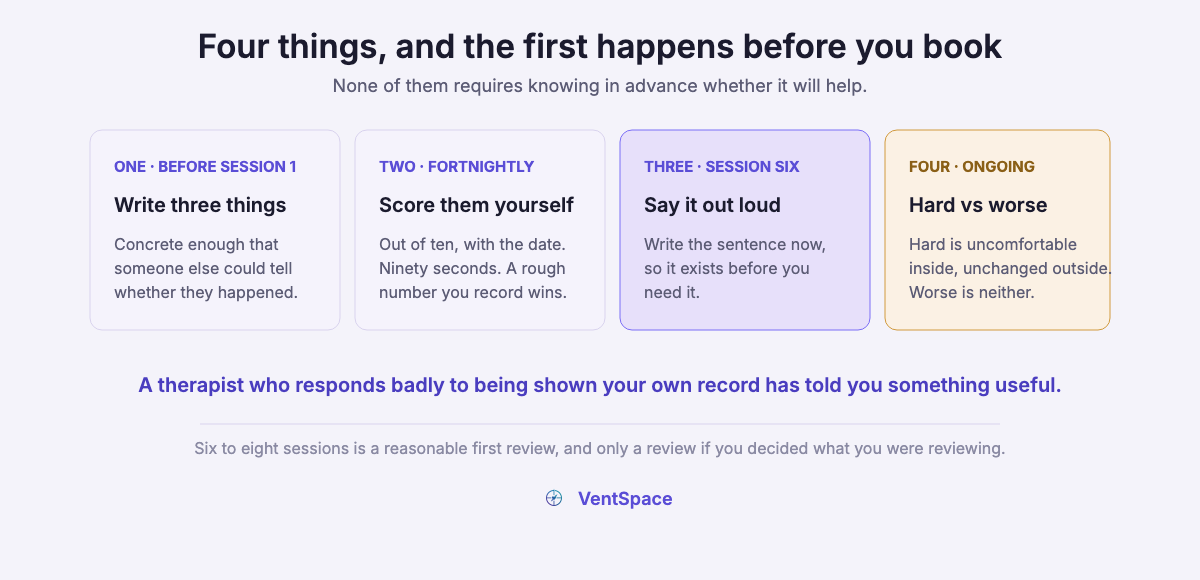
Four things to do, and the first one happens before session one
1. Write down what you want to be different, before you book
The first action: one sheet of paper, three things. Not goals and not feelings. Three concrete descriptions of what would be different in an ordinary week if this worked.
Sleeping through more nights than not. Getting through a Sunday evening without the dread. Saying the thing to your brother. Specific enough that somebody else could tell whether it had happened.
- What would be different on a Tuesday, not in your life generally?
- What have you stopped doing that you would like to be doing again?
- What would somebody who lives with you notice first?
- Which of these three is the one you would not say out loud in a first session?
Do not aim for the deep one. The deep one usually turns out to be underneath one of the ordinary ones anyway.
2. Score those three, yourself, every two weeks
The first action: put a recurring note in your phone for a fortnight’s time. When it goes off, score each of the three out of ten, write the date, and close it. It takes ninety seconds.
This is the whole method and it is unglamorous on purpose. The reason it works is that memory is unreliable about gradual change in both directions. Without a record we either conclude nothing is happening when something is, or keep going for a year because the sessions feel meaningful while nothing outside them has moved.
- Are the numbers moving at all, in either direction?
- Is one of the three moving while the others are stuck?
- Has anything changed outside the room, or only inside it?
- If a friend showed you this record, what would you tell them?
Do not overthink the scoring. A rough number you actually record beats a careful one you do not.
3. Say it out loud at session six
The first action: write the sentence now, so it exists before you need it. Something like: I want to check we are on track. Here is what I hoped would be different and here is where it actually is.
Session six is arbitrary and that is fine. What matters is that a date exists, because otherwise the conversation happens at month eleven or not at all. It is easy never to raise it, and the reason is usually the same: it feels rude, or it feels like an accusation, or it feels like admitting you have failed at therapy.
It is none of those. It is the one piece of information your therapist cannot get any other way, and a good one will be glad of it. A therapist who responds badly to being shown your own record has told you something useful.
- What exactly are you afraid they will say?
- Would you raise this with a physiotherapist after six sessions?
- What would you want them to do differently?
- Are you avoiding the conversation, or avoiding the answer?
Be plain about it. This is not a confrontation, and you do not need to soften it into unrecognisability first.
4. Learn the difference between hard and worse
The first action: write down, now, what “worse” would look like for you specifically. Sleep, appetite, whether you are still seeing people, whether you can work.
Therapy is often uncomfortable while working, particularly early, and particularly when it touches something long avoided. That discomfort is not the same as deterioration, and confusing the two is how people quit something that was about to help them.
But deterioration is a real and documented outcome for a small proportion of people, and it does not announce itself. The distinction that holds up is duration and direction. Hard is uncomfortable inside the session and unchanged or better outside it, over weeks. Worse is a sustained decline in the ordinary machinery of your life, and it belongs in the room immediately, with your therapist or with a doctor.
- Which of my four markers would have to change for me to say something?
- Am I sleeping and eating roughly as I was two months ago?
- Have I stopped seeing anyone I used to see?
- Is there a person in my life I would trust to tell me?
You are allowed to say this is making things worse. It is not disloyal and it is not a failure of effort.
Quick Summary
Q: How many sessions before you can tell if therapy is worth it?
A: Around six to eight is a reasonable point to review, provided you decided in advance what you were measuring. Without that, more sessions do not produce more clarity, because the judgement is being made from memory rather than from a record.
Pulling it all together
Before you book, one sheet of paper and three concrete descriptions of an ordinary week going better.
Then a recurring note, every two weeks, three scores and a date. Ninety seconds.
Then the sentence at session six, written out now while it is easy to write.
And a page in the same notebook describing what worse would look like, so that if it arrives you recognise it rather than absorbing it.
Four things, none of which requires knowing in advance whether any of this will help. That was never a question anybody could answer, including the people selling it.
What about the money
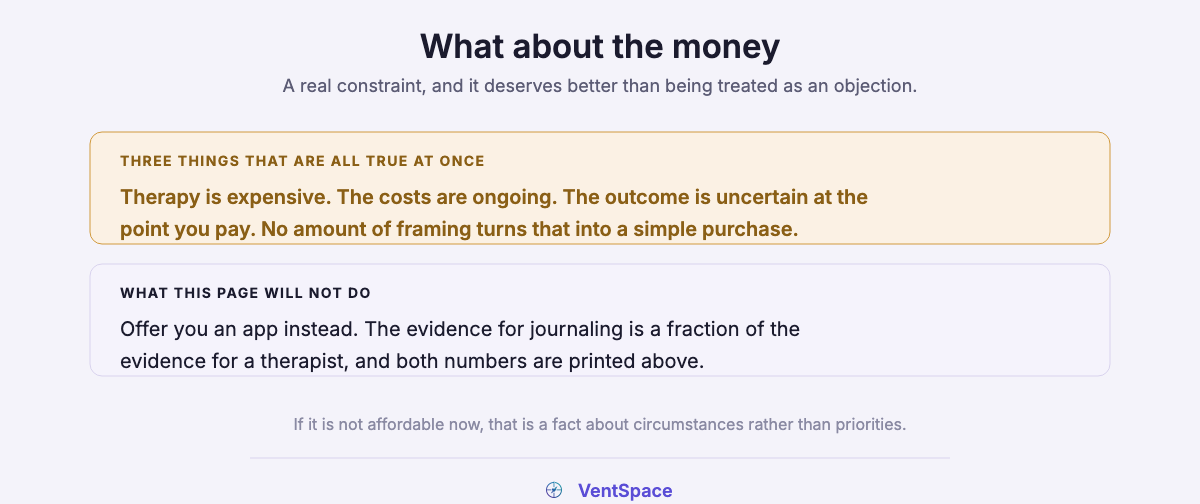
It is a real constraint and it deserves better than being treated as an objection.
Therapy is expensive, the costs are ongoing, and the outcome is uncertain at the point of payment. All three of those are true at once, and no amount of framing turns that into a straightforward purchase. If the honest answer is that it is not affordable right now, that is a fact about your circumstances rather than about your priorities, and the sliding-scale and community options are worth looking at properly rather than as a consolation prize. Our piece on what to do when you cannot afford therapy goes into those in detail.
One thing this article will not do is offer you an app instead. The evidence for what we make is a fraction of the evidence for what a therapist does, we said so above with the numbers attached, and pointing someone who cannot afford care toward a free journaling app would be a misrepresentation of both.
The waiting list is a different matter. If you have decided to go and the wait is three months, that gap is real and nothing fills it well. Writing in it helps some people, mostly by making the first session more useful, because arriving with three months of notes is a considerably better starting position than arriving with a summary you assembled in the car. If a blank page is where that stalls for you, VentSpace, our journaling app, turns what you write into a clear read on your life balance, plus small, doable next steps. Android only, free to start. Not on Android, or at a desk? VentSpace Live runs in your browser, free, with nothing to install. It is not therapy, it is not a substitute for the appointment you are waiting for, and it does not shorten the wait.
Questions people ask
How long before therapy starts working?
Sooner than you might expect for the general sense of relief, which can arrive in the first few sessions and is not by itself evidence of anything. Longer for the things you actually came about. Six to eight sessions is a reasonable point for a first honest review, and it is only a review if you decided in advance what you were reviewing.
What if I do not feel any different after a few months?
Then that is information and it belongs in the room. Not improving is common enough that the research has a number for it, somewhere between 30 and 50 per cent, and it does not always mean therapy is wrong for you. It may mean the approach, or the person, or the timing. Raising it is what moves any of those.
Is it worth it if I am not in crisis?
This is the myth worth putting down. Therapy is not an emergency service that only counts if you are falling apart. The research on outcomes is not restricted to severe presentations, and a great deal of what people bring is ordinary and unresolved rather than acute. Waiting until it is bad enough to qualify is a common and expensive mistake.
What if I do not like my therapist?
Change. The working relationship is one of the more consistently important factors in whether any of this helps, and enduring a bad fit out of politeness is the most avoidable way to waste both the money and the time. Two or three sessions is usually enough to know.
Is online therapy worth it?
Broadly, the evidence for remote delivery is encouraging for many common presentations, and the practical advantages are real. Everything on this page still applies. Our comparison of the main platforms covers the specifics.
In a nutshell
The honest answer is that most people who go show some benefit, and nobody can tell you in advance which group you are in. What you can do is stop trying to make the decision in advance, because it is not available in advance, and instead decide how you would tell. Three concrete descriptions, a fortnightly score, a conversation at session six.
And the timeline is longer than the marketing and shorter than the fear. Something usually shifts within a couple of months for the people it is going to help, but the thing that shifts first is rarely the thing you came about, which is why the record matters more than the impression. This is a purchase you cannot inspect until you own it. The only real choice is whether you inspect it at all.
About this article

Written by
Sai Subramaniam
Founder, VentSpace
I write these guides because I have been where you are. I am working through my own hard seasons, and I share the things that actually helped me, so that anyone going through it has a steady companion close by instead of facing it alone. VentSpace is the app I built for exactly that: a journaling app that turns what you write into a clear read on your life balance, plus small, doable next steps toward feeling more like yourself.
This writing is honest and every claim is sourced, and it is not a substitute for professional care. If you are struggling, reaching out to a professional is a strong move, not a failure.
Explore VentSpaceTry VentSpace LiveHow this one was checked. Every factual claim traces to a named source, and the source is printed next to the claim rather than kept in a footnote. Quotes are pinned to the work they come from, with the year, the letter or the chapter where one exists. Where a widely repeated claim could not be traced, it was left out and the omission recorded. Where a figure is contested, both sides are printed.
No affiliate links, no paid placements, and nobody paid to appear here. Where we mention our own app, we say that it is ours, we state its limits, and we never position it as a substitute for care.
Reviewed: October 2026. Prices, platforms and product availability move quickly, and anything we could not verify at the time of writing is marked as unverified rather than turned into a number.
Corrections. If something here is wrong, we would rather know. Corrections are made in place, with a note saying what changed. Updated 15 October 2026: the therapy effect size now gives both the unadjusted and bias-adjusted figures from a named 2019 study, the dropout figures now come from two named meta-analyses, the claim that therapists overestimate progress was replaced with the published research on progress measurement, the VentSpace description was corrected, an off-topic link was removed, and three images showing the old figures were taken down.