
If you’re in your twenties and you’ve been circling the idea of therapy for a while, you’re in good company, and you’re not behind. Young adults carry the highest rate of mental-health struggle of any age group, and, at the same time, the lowest rate of actually getting help. Usually for two plain reasons: it costs too much, and starting feels like more than you can manage on a Tuesday.
Online therapy doesn’t fix the cost completely, but it lowers almost every other barrier: no waiting room, no commute, a therapist you can often message between sessions, and a way to start tonight from your bed instead of a year from now. The research is also reassuring, which we’ll get to.
This is an honest list. Some of these platforms are genuinely good. A couple come with real baggage, and we’ll name it plainly rather than pretend otherwise.
If you’re in crisis right now
If you’re in crisis right now, a list of apps is the wrong place to be. Call or text 988 (the Suicide & Crisis Lifeline, US), or chat at 988lifeline.org. It’s free, confidential, and open 24/7. The platforms below are for ongoing support, not emergencies.
Quick Summary
Online therapy works about as well as in-person (the research is reassuring).
We ranked by what actually decides it for a young adult: cost and insurance, format (text vs live), and how easily you can switch when the first therapist isn’t the one.
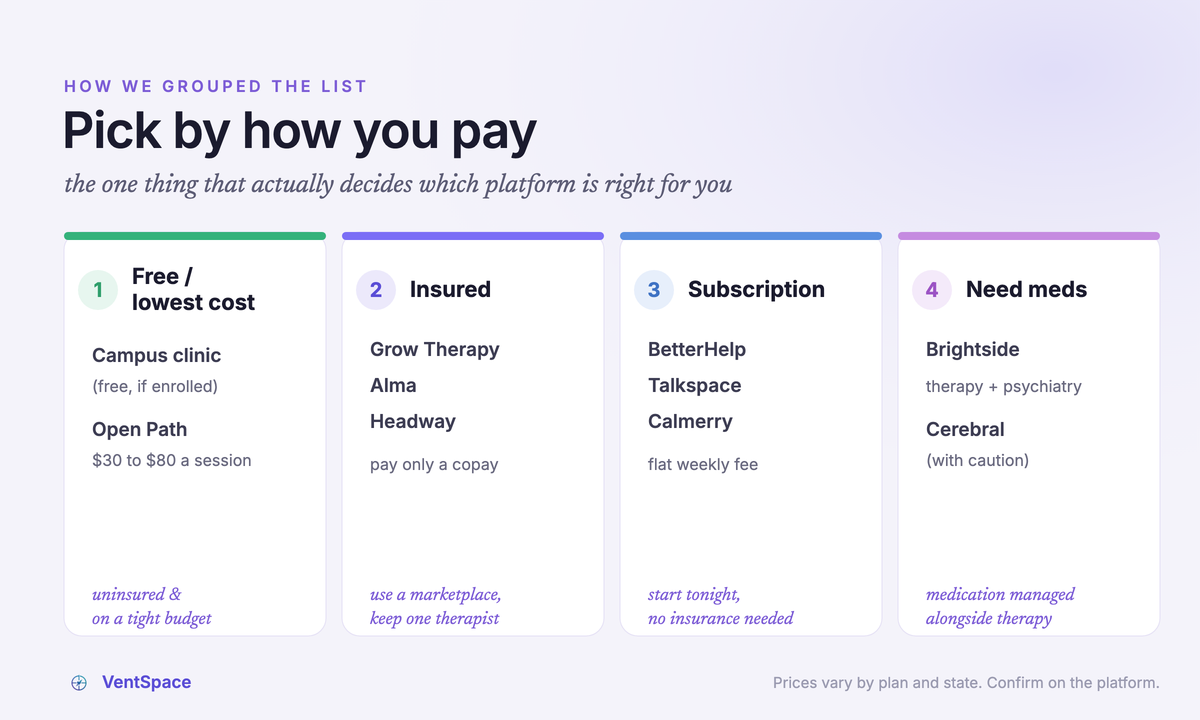
Cheapest real therapy: your campus counseling center (free) or Open Path ($40 to $70 a session). Insured: use a marketplace (Grow, Alma, Headway) and pay a copay. Fast and flexible: BetterHelp or Talkspace. Need medication too: Brightside.
Insight: does online therapy actually work?
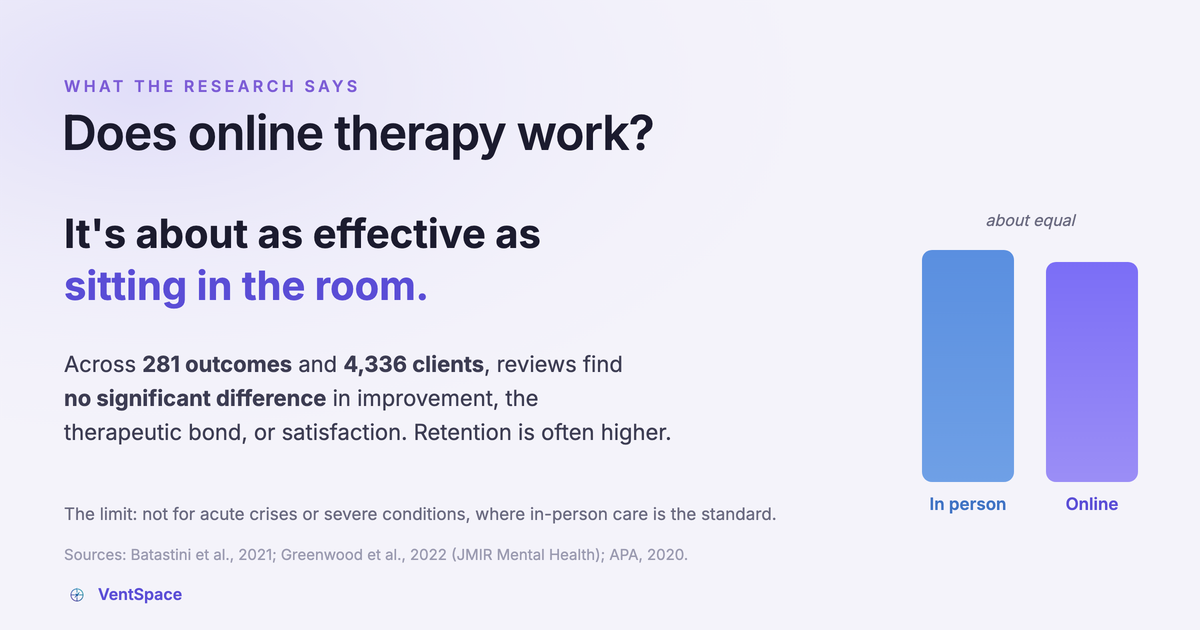
In one large meta-analysis, video therapy produced results “largely equivalent to in-person” treatment (Batastini et al., 2021, across 281 outcomes and 4,336 clients). A 2022 review found no significant difference in symptom improvement, the therapeutic relationship, or satisfaction (Greenwood et al., JMIR Mental Health). The honest limit: it is not for acute crises or severe conditions like psychosis, where in-person care is still the standard.
How we judged these
Not by which has the slickest ads. By the four things that actually decide it for someone young and on a budget:
- Cost and insurance. The number one barrier for this age group. We flag what’s cheapest, what takes insurance, and the sliding-scale options most lists skip.
- Format. Text vs live video. Async messaging suits an anxious or avoidant first-timer; it also has real limits.
- Matching and switching. The first therapist is not always the one. How easily can you change?
- Fit. Whether you can find someone who gets your identity and your specifics, not just any licensed face.
Insurance, when you have it, changes everything. So the list is grouped by how you’re paying.
The platforms at a glance
| Platform | Best for |
|---|---|
| Open Path Collective | The lowest cost if you’re uninsured |
| Grow Therapy | Using your insurance (broadest coverage) |
| Alma | Browsing and choosing your own in-network therapist |
| Headway | Insurance with a very large therapist pool |
| BetterHelp | Fast matching and text access (eyes open on privacy) |
| Talkspace | Therapy and medication in one app, often insured |
| Calmerry | A low-commitment paid subscription |
| Online-Therapy.com | A structured CBT program plus a therapist |
| Brightside Health | Therapy plus medication for anxiety or depression |
| Cerebral | Medication management (with the controversies noted) |
If money is the barrier: start here
Before any subscription, know this: the cheapest real therapy is often free. If you’re enrolled in college, your campus counseling center costs nothing, though sessions are usually capped at a handful and oriented to short-term help. University psychology training clinics offer supervised trainees on an income-based sliding scale. Neither is a “platform,” but for a broke 22-year-old, they beat everything below on price. When those run out, the cheapest managed option is:
Open Path Collective
Open Path isn’t a slick app; it’s a nonprofit directory of therapists who agree to charge less. You pay a one-time membership and then a low, fixed session fee, which makes it the single most affordable route to ongoing therapy if you don’t have insurance.
| Spec | Detail |
|---|---|
| Type | Sliding-scale nonprofit directory |
| Formats | Video or in-person (varies by the therapist) |
| Cost & insurance | ~$65 one-time lifetime membership, then $40 to $70 per session ($30 with a student intern, up to $80 for couples or family). No insurance used. |
| Best for | Uninsured young adults on a tight budget |
| Pros | The lowest ongoing cost here; real licensed therapists and supervised interns; lifetime access |
| Cons | It’s a directory, not a managed service (no auto-scheduling, no insurance billing); limited slots fill fast |
Who it’s for: anyone for whom price is the dealbreaker and a campus clinic isn’t an option. What you should know: eligibility is aimed at people who are uninsured or underinsured (household income under ~$100k). Verdict: if you can do a little legwork, nothing else gets you a real therapist this cheaply.
If you have insurance: use it
If you’re on a parent’s plan or your own, a marketplace is almost always the smart move: you see a licensed clinician and pay only your copay, often far less than any subscription.
Grow Therapy
Grow connects you to independent, licensed therapists who take your insurance, and it has the broadest plan coverage of the marketplaces, including Medicaid and Medicare in some states.
| Spec | Detail |
|---|---|
| Type | Insurance marketplace (independent providers) |
| Formats | Video, phone, some in-person |
| Cost & insurance | $0 to ~$22 copay with insurance; ~$100 to $200 out of pocket. 125+ plans, incl. Medicaid/Medicare in select states. |
| Best for | Insured young adults who want a real clinician, not async chat |
| Pros | Widest insurance acceptance; you keep one consistent therapist; video or in-person |
| Cons | Billing complaints about surprise copays reconciled later; no-show fees up to ~$200 |
Who it’s for: anyone insured who wants traditional therapy without the search. Verdict: for an insured reader, this is often the best value on the whole list.
Alma
Alma is the marketplace for people who want to choose their own therapist rather than be auto-matched. You can browse profiles and book a free consult before committing.
| Spec | Detail |
|---|---|
| Type | Insurance marketplace |
| Formats | Video, in-person |
| Cost & insurance | About $20 average per session with insurance (Alma’s own figure); ~$130 to $380 per session self-pay. Free 15-minute consults. |
| Best for | Control-seekers who want to vet a therapist first |
| Pros | You pick and pre-screen; free consults reduce the matching gamble; strong provider quality |
| Cons | Billing-surprise complaints (copay or out-of-network changes); support is email-only |
Who it’s for: the first-timer who’s nervous and wants agency. Verdict: the most reassuring on-ramp if being auto-assigned a stranger is what’s stopping you.
Headway
Headway works much like Grow and Alma, with a very large network and a clean experience: you filter by your insurance and pay only the copay.
| Spec | Detail |
|---|---|
| Type | Insurance marketplace |
| Formats | Video, in-person |
| Cost & insurance | Typically just your copay with insurance; 40+ plans, 34,000+ providers |
| Best for | Insured readers who want the biggest pool to choose from |
| Pros | Huge selection; transparent insurance-first pricing; easy to switch |
| Cons | Quality varies across such a large network; you do the choosing |
Who it’s for: insured readers who didn’t find a fit on Grow or Alma. Verdict: a strong third insurance option, worth checking which of the three actually takes your specific plan.
Fast and flexible: the subscription apps
These are the famous ones. You pay a flat weekly or monthly fee (insurance sometimes helps with Talkspace), and you get messaging plus live sessions. Convenient, quick to start, and a real step up from nothing, with a few honest catches.
BetterHelp
The best-known platform, and the fastest way to be matched and messaging a therapist, often within a day. For a lot of young adults it’s the first therapy they ever try, which counts for something.
| Spec | Detail |
|---|---|
| Type | Therapy subscription (no medication) |
| Formats | Async messaging, live chat, phone, video; weekly live session + unlimited messaging |
| Cost & insurance | ~$65 to $100 per week, billed monthly (~$280 to $400/mo). Insurance rarely applies and it varies by state, so confirm with your own plan; financial-aid discounts available. |
| Best for | First-timers who want fast matching and text access |
| Pros | Quick matching; message anytime; cheaper than ~$100 to $200 per in-person session; easy free switching |
| Cons | A real privacy black mark (below); billing while you switch therapists; you’re auto-matched (the self-pick link is buried) |
Who it’s for: someone who wants to start now and isn’t using insurance. The honest watch-out: in 2023 the FTC ordered BetterHelp to pay $7.8M after finding it had shared users’ email, IP, and health-questionnaire data with Facebook and others for advertising, despite privacy promises. That’s a fact, not a rumor, and worth weighing. Verdict: genuinely helpful for some people, and genuinely worth knowing what you’re handing over.
Talkspace
Talkspace’s edge is insurance and medication: it’s often covered by real plans, and it offers therapy and psychiatry in the same app (and serves teens 13+).
| Spec | Detail |
|---|---|
| Type | Therapy + psychiatry (and couples, teens) |
| Formats | Async messaging, live video, audio |
| Cost & insurance | $69 to $109/week self-pay; $0 to $30 copay with many plans (Aetna, Cigna, BCBS, Optum, Medicare, TRICARE; not Medicaid). Psychiatry intake ~$299. |
| Best for | Insured young adults, or anyone wanting therapy plus medication |
| Pros | Frequently covered by insurance; meds and therapy in one place; flexible formats |
| Cons | Lawsuits allege auto-enrollment on “match” and forfeiture of unused sessions (allegations, not findings); past data-sharing scrutiny |
Who it’s for: insured readers, especially if medication might be part of the picture. Verdict: the strongest insured pick among the subscription apps, if you check your plan and read the renewal terms.
Calmerry
A lower-pressure paid subscription with a gentler price than BetterHelp, plus a mood tracker and journaling built in. A reasonable middle option if marketplaces don’t take your insurance and Open Path is full.
| Spec | Detail |
|---|---|
| Type | Therapy subscription |
| Formats | Text/async + video; mood tracker, journaling |
| Cost & insurance | From $50 per week. No insurance; ~30% off the first three months. |
| Best for | A low-commitment paid entry point |
| Pros | Cheaper weekly rate; free therapist switching |
| Cons | Trustpilot reports of slow therapist responses and support lag |
Who it’s for: someone who wants a paid option without BetterHelp’s price or baggage. Verdict: a fine budget subscription, as long as a quiet therapist is something you’ll flag and switch from quickly.
Online-Therapy.com
The differentiator here is structure: alongside a therapist, you get a full eight-section CBT program with worksheets and journaling. Good if you want tools to work on, not just someone to talk to.
| Spec | Detail |
|---|---|
| Type | Therapy + structured CBT program |
| Formats | Messaging, live chat, phone, video |
| Cost & insurance | Pricing varies by plan and changes often, so check the current rate on the site before you commit. No insurance; provides receipts for out-of-network reimbursement. |
| Best for | Self-starters who want a CBT toolkit plus a therapist |
| Pros | The structured program is genuinely useful; receipts for possible reimbursement |
| Cons | Scheduling and cancellation friction; some reports of therapists cancelling sessions |
Who it’s for: the organized type who likes homework and frameworks. Verdict: a smart pick if you want to actively work between sessions, not only vent.
If medication might be part of it
Some anxiety and depression respond well to medication alongside therapy. These platforms offer prescribing, which means higher stakes and a higher bar for trust.
Brightside Health
Brightside is built around anxiety and depression specifically, pairs therapy with psychiatry, and, unusually, takes insurance including Medicare and Medicaid in places.
| Spec | Detail |
|---|---|
| Type | Therapy + psychiatry / medication |
| Formats | Video + unlimited messaging |
| Cost & insurance | Therapy ~$299/mo; psychiatry ~$95/mo; combined ~$349/mo. Accepts insurance (network limited). |
| Best for | Young adults who want medication managed alongside therapy |
| Pros | Focused on anxiety/depression; fast first appointments; insurance accepted |
| Cons | Billing and provider-change friction; no-show fees up to ~$200 |
Who it’s for: someone whose depression or anxiety may need medication, not just talk. Verdict: the most trustworthy medication-and-therapy option here, and the one to prefer over Cerebral.
Cerebral
Cerebral also offers therapy and medication, but it’s the one entry we’d approach with the most caution, for documented reasons.
| Spec | Detail |
|---|---|
| Type | Therapy + psychiatry / medication |
| Formats | Video, messaging |
| Cost & insurance | Pricing varies widely by plan and is hard to pin down, so check Cerebral’s site for the current rate; accepts insurance |
| Best for | Medication management, if you’ve weighed the history |
| Pros | Insurance accepted; convenient prescribing and therapy in one place |
| Cons | A serious regulatory history (below); pricing varies and is hard to pin down |
Who it’s for: honestly, most young adults are better served by Brightside or a marketplace psychiatrist. The watch-out (fact, sourced): in November 2024, Cerebral entered a non-prosecution agreement with the US Department of Justice ($3.65M forfeiture plus a $2.92M fine, with no admission of liability) over practices that facilitated unauthorized distribution of controlled substances between 2019 and 2022. Verdict: proceed with eyes wide open, and only if a more careful option won’t work for you.
Quick Summary: how to read this list
Q: Which online therapy platform is best for a young adult?
A: It depends entirely on how you pay. Uninsured and broke: a campus clinic or Open Path. Insured: a marketplace (Grow, Alma, Headway) so you owe only a copay. Want to start tonight without insurance: BetterHelp or Calmerry. Need medication: Brightside. There’s no single winner, only the right fit for your wallet and your nerve.
Insight: the real friction isn’t price, it’s the match
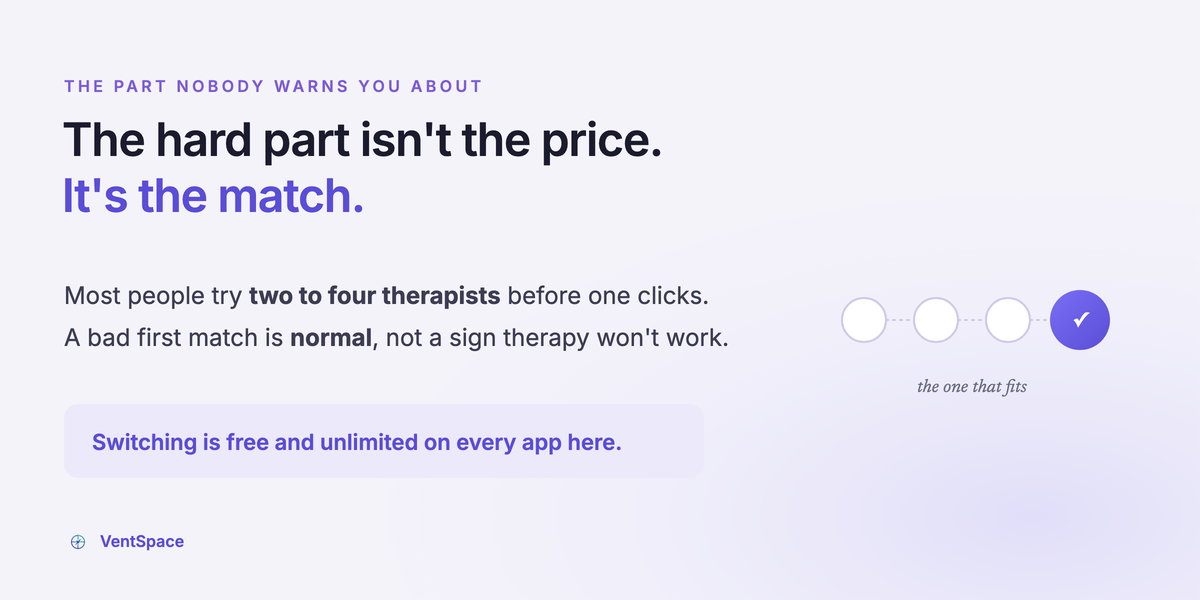
The most common young-adult complaint across reviews isn’t cost, it’s matching: getting paired with someone who doesn’t fit, and the grind of trying more than one therapist before one clicks. The good news is that switching is free on the subscription apps, and marketplaces let you pick and pre-screen. A bad first match is normal. It is not a sign that therapy won’t work for you.
All ten, side by side
| Platform | Type | Cost (rough) | Insurance | Best for | The watch-out |
|---|---|---|---|---|---|
| Open Path | Sliding-scale directory | $65 once + $40–70/session | No | Lowest cost, uninsured | Directory, not managed |
| Grow Therapy | Insurance marketplace | $0–22 copay | Yes (broadest) | Using insurance | Surprise copays |
| Alma | Insurance marketplace | ~$20 copay | Yes | Picking your own | Billing surprises |
| Headway | Insurance marketplace | Copay only | Yes | Biggest network | Quality varies |
| BetterHelp | Subscription (no meds) | ~$280–400/mo | Rarely | Fast text start | FTC privacy settlement |
| Talkspace | Therapy + psychiatry | $0–30 copay / $69–109 wk | Yes (many) | Insured + meds | Auto-enroll lawsuits |
| Calmerry | Subscription | From $50/week | No | Budget subscription | Slow responses |
| Online-Therapy.com | Therapy + CBT program | Varies by plan (check site) | No (receipts) | CBT structure | Scheduling friction |
| Brightside | Therapy + meds | ~$95–349/mo | Yes | Meds + therapy | No-show fees |
| Cerebral | Therapy + meds | Varies by plan (check site) | Yes | Medication mgmt | DOJ agreement (2024) |
Prices and coverage change often and depend on your plan and state. Treat these as rough guides and confirm on the platform before you commit.
How to actually pick one
Skip the rankings. Choose by your situation:
- You’re broke and uninsured: your campus counseling center first, then Open Path Collective. Don’t pay subscription prices if you don’t have to.
- You have insurance: start with a marketplace (Grow, Alma, or Headway) and check which takes your specific plan. You’ll likely pay a small copay.
- You want to start tonight and aren’t using insurance: BetterHelp (fastest) or Calmerry (gentler price).
- Talking out loud is the scary part: lean text-first at the start (BetterHelp, Talkspace, Calmerry), and move to live sessions when you’re ready.
- You might need medication: Brightside, or a psychiatrist through a marketplace.
- Your identity matters to the fit (LGBTQ-affirming, culturally responsive): use a directory that lets you filter by it, like Inclusive Therapists or TherapyDen, or filter on a marketplace.
One honest floor: online therapy is real therapy with real, licensed people, and the evidence that it helps is strong. It is not a magic fix, and it’s not for emergencies. If you’re in danger or thinking about harming yourself, call or text 988 now. Reaching for that is the strong move, not a failure.
A companion for therapy, not a replacement: VentSpace
VentSpace isn’t therapy, and it isn’t on this list. It’s a journaling app that turns what you write into a clear read on your life balance, plus small, doable next steps (an Android app, free to start on Google Play, plus a free web tool, VentSpace Live, that runs in any browser), and ranking it among licensed therapy platforms would be dishonest. But here’s where it genuinely earns a mention: the hard part of therapy is often the six days between sessions. You have the realization on a Wednesday, and by your next appointment it’s slipped away.
VentSpace is built for that gap. You journal, and its AI turns what you wrote into named realizations, a personalized action list, and a read on how balanced your life feels across work, relationships, health, and the rest. It will not diagnose you, prescribe anything, or replace a therapist. What it can do is hand you something concrete to bring into the room: a record of what actually came up this week, instead of “I don’t know, it was kind of a blur.” If you’re starting therapy on any platform above, it’s a free-to-start companion, not an alternative.
Not therapy. A place to notice, between sessions.
FAQ
Is online therapy actually as good as in-person?
For most common concerns, the research says yes: outcomes are largely equivalent, with no significant difference in improvement or satisfaction. The exceptions are acute crises and severe conditions, where in-person care remains the standard.
What’s the cheapest way to get real therapy?
If you’re a student, your campus counseling center is free. After that, university training clinics (sliding scale) and Open Path Collective ($40 to $70 a session) are the lowest-cost routes. If you’re insured, a marketplace copay is usually cheaper than any subscription.
Does insurance cover online therapy?
Often, yes, through a marketplace (Grow, Alma, Headway) or Talkspace, where you pay a copay. Most subscription apps like BetterHelp don’t take insurance, so you pay the full monthly fee.
Is it safe to share personal things with these apps?
Mostly, but read the privacy terms. BetterHelp was fined by the FTC in 2023 for sharing health-related data with advertisers, which is a real reason to check what any platform does with your information before you open up.
What if I’m in crisis?
These platforms are not for emergencies. If you’re in danger or thinking about harming yourself, call or text 988 (the Suicide & Crisis Lifeline) or chat at 988lifeline.org, free and 24/7.
My first therapist wasn’t a fit. Does that mean therapy won’t work?
No. A bad match is normal and expected, switching is free on the subscription apps, and finding the right person is worth the few false starts.
Find yourself. Find balance.

Written by
Sai Subramaniam
Founder, VentSpace
I write these guides because I have been where you are. I am working through my own hard seasons, and I share the things that actually helped me, so that anyone going through it has a steady companion close by instead of facing it alone. VentSpace is the app I built for exactly that: a journaling app that turns what you write into a clear read on your life balance, plus small, doable next steps toward feeling more like yourself.
This writing is honest and every claim is sourced, and it is not a substitute for professional care. If you are struggling, reaching out to a professional is a strong move, not a failure.
Explore VentSpaceTry VentSpace Live