
“Acceptance was the most frequently endorsed item and yearning was the dominant negative grief indicator from 1 to 24 months postloss.”
Maciejewski, Zhang, Block and Prigerson, JAMA, 2007
At some point in the second year, many of us notice that it has stopped behaving the way we were told it would. Not because it is worse. Because it is not on its way anywhere, and we had been given to understand that it would be.
Here is the distinction, before anything else. Sadness is a feeling. Grief is not a feeling at all. Grief is what happens to a relationship when one party is no longer available, and a relationship is not a mood. Feelings pass because that is what feelings do. Relationships do not pass, which is why one of these two ends and the other changes shape.
There is no stage you are supposed to have reached. The rest of this page is where that idea came from, what the research actually found, and what to look at instead.
If you need help now. If you are having thoughts of harming yourself, please contact a crisis line now. In the US you can call or text 988 for the Suicide and Crisis Lifeline. Outside the US, findahelpline.com will find the equivalent where you are. A doctor or a therapist is also a legitimate place to take grief, at any point.
The short version
Sadness is undirected. It arrives, it sits, it goes, and it is not about a particular person.
Grief is directed. In the largest study of its kind, the dominant negative experience across two years was yearning, which is aimed at somebody.
Acceptance was not only at the end. It was the most frequently endorsed item throughout, from the first measurement onward.
The five stages were derived from dying patients, extended by Kübler-Ross to their families, and never tested in bereaved people before being taught as a sequence. The clinical literature criticises applying them prescriptively.
The genre has been measured. Of 72 grief websites analysed, 61% covered the stage model, mostly without saying it is contested.
This page gives no timeline, and the reason is that a timeline is the specific harm the researchers warn about.
What sadness actually is
Sadness is a feeling, and feelings have a particular behaviour. They arrive in us, sometimes with a cause and sometimes without one, they occupy a stretch of time, and they subside, and we have all had enough of them to know the shape. A sad afternoon is an afternoon. A sad month is longer and still behaves the same way, rising and falling and eventually thinning out.
Crucially, sadness is not about anybody in particular. It can be occasioned by a person, and it can be occasioned by weather, a piece of music, an anniversary, or nothing that can be identified at all. It does not have a destination. That is not a criticism of it. It is the shape of the thing, and the shape is what allows us to wait it out, which is what we have learned to do with feelings and what we then try, uselessly, on the other one.
We are writing this plainly because the contrast depends on it. Everything ordinary about sadness is what grief turns out not to be.
Quick Summary
Q: What is sadness?
A: Sadness is an emotion. It arrives, occupies a period of time and subsides, and it is not necessarily directed at any particular person or thing. That undirected quality is what allows it to pass in the way feelings generally pass.
What grief actually is
Grief is what remains of a relationship when the other person is gone. It contains sadness, along with a great deal else, and when we treat it as simply a larger quantity of sadness we make the whole experience unintelligible to ourselves, which is most of why we conclude we are doing it wrong.
The evidence for this is unusually clean. Between 2000 and 2003 the Yale Bereavement Study followed 233 bereaved people in Connecticut, measuring five things at intervals from one month to two years after the loss: disbelief, yearning, anger, depression and acceptance. And the finding, in the authors’ own words, is the sentence at the top of this page. “Acceptance was the most frequently endorsed item and yearning was the dominant negative grief indicator from 1 to 24 months postloss.”
Look at which word won. Not depression. Yearning, which is not a mood at all but a state of reaching toward somebody who is not there. It is the feeling of having made a phone call in our heads before remembering. It is directed, it has a recipient, and that is exactly why it does not resolve on the schedule a feeling would.
Quick Summary
Q: What is grief, as distinct from sadness?
A: Grief is the ongoing experience of a relationship that continues without the other person. In the Yale Bereavement Study of 233 bereaved people, the dominant negative indicator from one month to two years after the loss was yearning, a state directed toward the absent person, rather than depression.
The two side by side
| Sadness | Grief | |
|---|---|---|
| What kind of thing it is | A feeling | A relationship, continuing without one party |
| What it is directed at | Often nothing in particular | Somebody specific, always |
| What the research found dominant | Not the subject of this study | Yearning, across the full two years measured |
| Does it resolve | Yes. Feelings subside | It changes shape rather than ending |
| What the popular account says | Little | Five stages, which came from interviews with dying patients |
| What the clinical neighbour is | None specific | Prolonged grief disorder, in both ICD-11 and DSM-5-TR, applied only by professionals |
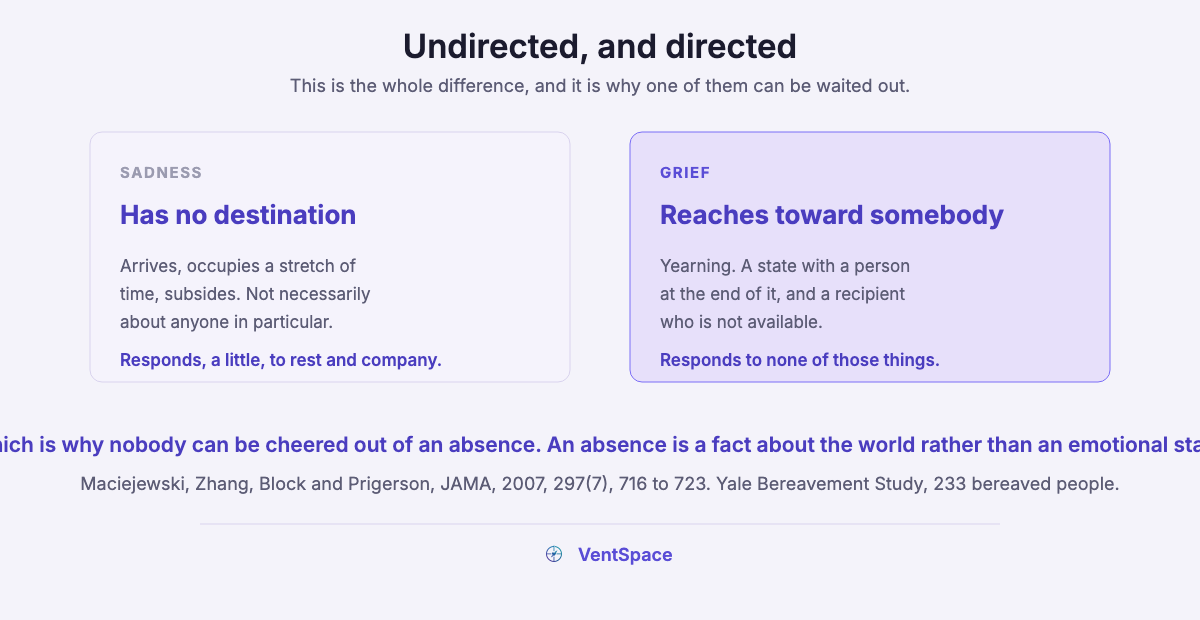
One of them is directed at somebody
The most useful thing in the Yale results is the word that did not win. Depression was measured. So were disbelief and anger. The item that dominated the whole two years was yearning, and yearning is the one item on that list with a person at the end of it.
This explains something that is otherwise bewildering to live through. Sadness responds, at least a little, to the ordinary things we know help feelings: rest, company, time, a change of weather. Yearning does not respond to any of them, because none of them addresses what it is about. None of us can be cheered out of an absence. The absence is not an emotional state. It is a fact about the world that has to be accommodated rather than felt through.
And there is a second finding in that sentence which is easy to read past and worth a great deal. Acceptance was the most frequently endorsed item. Not only at the end. Throughout, from the earliest measurement. Which means the thing the popular account places at the finishing line was already present in people who were, by every other measure, in the thick of it.
So acceptance is not the reward for completing the process. Most bereaved people appear to hold it and the yearning at the same time, continuously, and if we have been waiting to feel acceptant before we are allowed to think ourselves well, we may have been waiting for something we already had.
Quick Summary
Q: Why does grief feel different from ordinary sadness?
A: Because the dominant experience measured in bereavement is yearning, which is directed at a specific absent person, rather than depression or undirected low mood. Things that generally help feelings, such as rest and company, do not address an absence, which is a fact about the world rather than an emotional state.
Insight: what the largest test of the popular account found, including the part that supports it
“Counter to stage theory, disbelief was not the initial, dominant grief indicator. Acceptance was the most frequently endorsed item and yearning was the dominant negative grief indicator from 1 to 24 months postloss.” Maciejewski, Zhang, Block and Prigerson, “An Empirical Examination of the Stage Theory of Grief”, JAMA, 2007, 297(7), pages 716 to 723. The Yale Bereavement Study followed 233 bereaved people in Connecticut between January 2000 and January 2003. The same paper concludes that the five indicators reached their peaks “in the sequence (disbelief, yearning, anger, depression, and acceptance) predicted by the stage theory of grief”, so its authors read it as partial support for stages, and letters to JAMA questioned its design.
Where the stage story came from, and why it fits badly as a schedule
The five stages were not built from bereaved people. They were derived from dying patients, Kübler-Ross extended them to families herself in the same 1969 book, and they were never tested in bereaved people before being taught as a sequence.
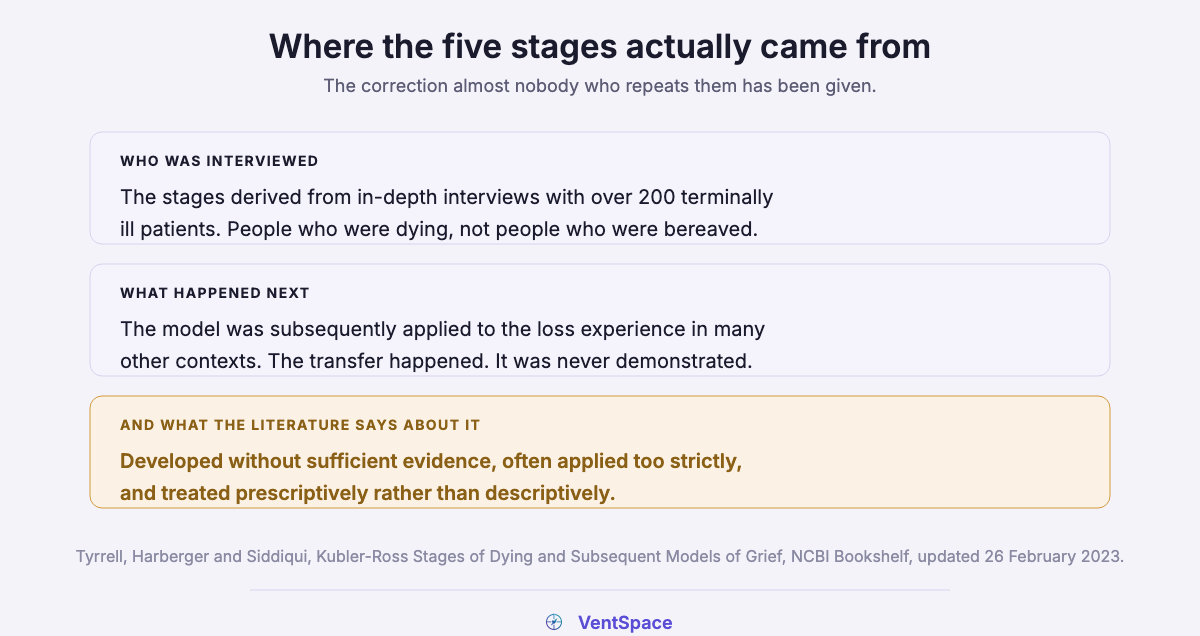
Elisabeth Kübler-Ross’s stages, set out in 1969, came from what the NCBI Bookshelf chapter on the subject describes as “in-depth interviews with over 200 terminally ill patients”. People who were dying. The account was of how a person might move through the knowledge of their own approaching death, and it was, the same chapter notes, “subsequently applied… to the loss experience in many contexts, including grief and other significant life changes.”
The transfer happened. It was never demonstrated. And the clinical criticisms of the model are not marginal. The same chapter records that “the stages were developed without sufficient evidence and are often applied too strictly”, that the model is treated prescriptively rather than descriptively, as though a person “must move through each stage to reach the final goal of ‘acceptance'”, and that attempting to push people through the stages risks causing harm.
We should be careful here, because the intention behind the original work was humane and the book changed how dying people were treated. The problem is not Kübler-Ross. The problem is a description of one thing being handed to us while we are going through another, and then hardening into a schedule we can fail.
If we have been quietly grading ourselves against five words in an order, that grading has no evidence behind it and never did.
Quick Summary
Q: Are the five stages of grief real?
A: They were derived from in-depth interviews with over 200 terminally ill patients, meaning people who were dying. Kübler-Ross extended them to families, and they were later applied to bereavement in other contexts without first being tested in bereaved people. The clinical literature criticises the model for having been developed without sufficient evidence and for being applied prescriptively rather than descriptively.
Insight: where the stages actually came from
The NCBI Bookshelf chapter “Kubler-Ross Stages of Dying and Subsequent Models of Grief”, by Tyrrell, Harberger and Siddiqui, updated 26 February 2023, records that the stages derived from “in-depth interviews with over 200 terminally ill patients”, that the model was subsequently applied to loss in many other contexts, and that “the stages were developed without sufficient evidence and are often applied too strictly”. It also names later models, including Bowlby and Parkes’ phases, Worden’s tasks and Neimeyer’s narrative approach.
The genre has been measured, and the result is not good
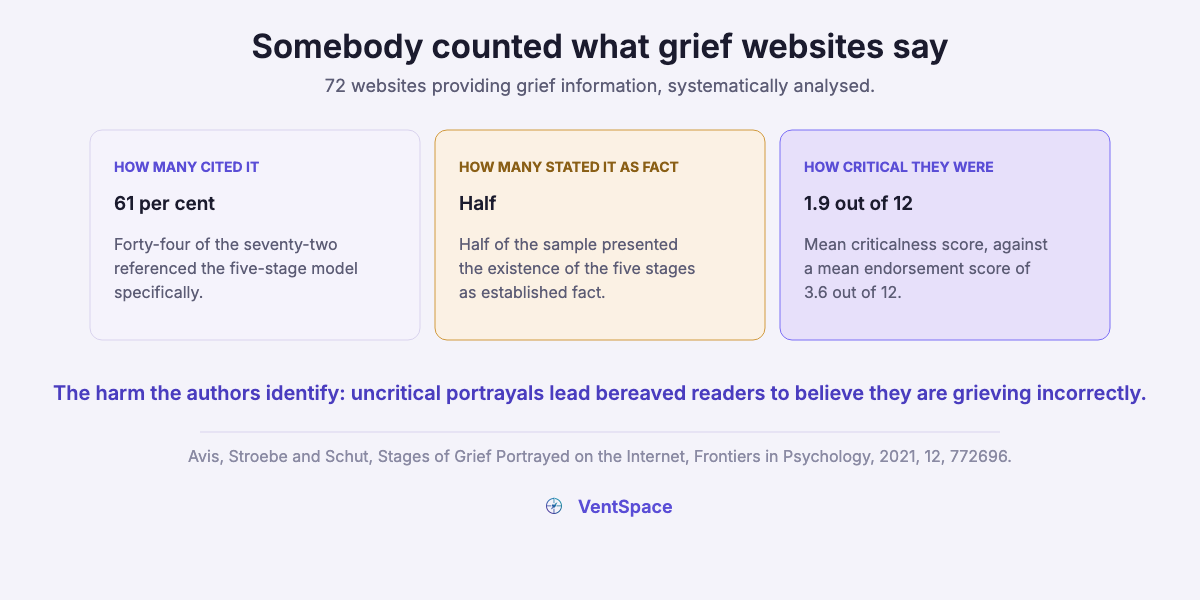
Somebody has counted what grief websites actually say, which is a strange and useful thing to have. In 2021, Avis, Stroebe and Schut published a systematic analysis in Frontiers in Psychology of 72 websites providing grief information.
Sixty-one per cent of them, 44 of the 72, specifically referenced the five-stage model. The authors scored each site for how critically it treated the model and found low criticalness, with sites often leaving out any evaluative comment and including definitive statements of endorsement.
The harm they are concerned about is precise and it is worth reading slowly. Uncritical portrayals can lead us, as bereaved readers, to conclude that we are grieving incorrectly, which in turn can produce ineffectual support from the people around us, and unnecessary intervention. They note alongside this that the evidence does not support psychological intervention for typical grief.
That last clause has to be handled honestly and here it is. It is a statement about routinely treating ordinary bereavement as though it required intervention. It is emphatically not a reason for anybody who is struggling to avoid asking for help, and the same authors’ concern is that people are made to feel abnormal, not that they should manage alone. If any of us is having a bad time, the door is open and always was.
Quick Summary
Q: Why does so much grief advice mention stages?
A: A 2021 systematic analysis of 72 grief websites found that 61 per cent referenced the five-stage model, mostly with little critical comment. The authors’ concern is that uncritical portrayals lead bereaved people to believe they are grieving incorrectly.
Insight: the study that looked at what we all read
Avis, Stroebe and Schut, “Stages of Grief Portrayed on the Internet: A Systematic Analysis and Critical Appraisal”, Frontiers in Psychology, 2021, 12, 772696. Seventy-two websites analysed. Forty-four referenced Kübler-Ross specifically, mostly without saying the model is contested. Two of the three authors are the researchers behind the dual process model of bereavement, which describes coping as an oscillation rather than a sequence.
What the clinical category actually is, and what it is not
There is a diagnosis in this territory and it is worth naming accurately, because the vague version does more harm than the precise one. As of the current editions, two different diagnoses called prolonged grief disorder have been formally included in ICD-11 and in DSM-5-TR. The two manuals do not agree with each other on the criteria, which is itself worth knowing.
Both require, as a core symptom, intense yearning or persistent preoccupation with the person who died. Note that this is the same state the Yale study found dominant in ordinary bereavement. The difference the manuals are pointing at is not a different kind of experience from the one most of us have. It is persistence and disability, and judging that is a trained person’s work and not ours.
Both also set a minimum period before the diagnosis may be considered at all. ICD-11 states that grief responses lasting less than six months should not be regarded as meeting its requirement. DSM-5-TR requires the death to have been at least twelve months ago, or at least six months for children and adolescents. Read those as floors and not as deadlines. They exist to stop clinicians pathologising a person who is three weeks bereaved. They are not a statement about how long grief ought to take, and nothing in either manual says a person should be finished by any date.
And the field has its own reservations about all of this, stated plainly in the literature: “The evidence that PGD is characterized by qualitatively different experiences than normal grief is yet unconvincing.” The concerns raised include the medicalisation of grief and stigma.
If this has become unbearable. If you are having thoughts of harming yourself, please contact a crisis line now rather than reading on. In the US you can call or text 988 for the Suicide and Crisis Lifeline. Outside the US, findahelpline.com will find the equivalent where you are. Nothing on this page can tell you whether what you are living through is the clinical category described above, and a doctor or a therapist is a legitimate place to take it, at any point, without needing to have qualified for anything first.
Quick Summary
Q: When does grief become something a professional should look at?
A: Prolonged grief disorder exists in both ICD-11 and DSM-5-TR, with different criteria in each, and both require intense yearning or persistent preoccupation with the deceased. Both also set minimum periods before the diagnosis may be considered, which are floors on diagnosis rather than deadlines for grieving. Only a professional can make that assessment.
Insight: the manuals, and the field's own caution
“Recently, two different diagnoses termed PGD have been formally included in the International Classification of Diseases, 11th edition and the Diagnostic and Statistical Manual of Mental Disorders 5, Text Revision.” And, from the same paper: “The evidence that PGD is characterized by qualitatively different experiences than normal grief is yet unconvincing.” Eisma, Australian and New Zealand Journal of Psychiatry, 2023, 57(7), pages 944 to 951.
How to tell what you are actually in
There is no stage to find and there is no schedule you are behind on, so this section cannot offer a sort and would be lying if it did. What it offers instead is a description, which is what tends to help us when the categories on offer do not fit.
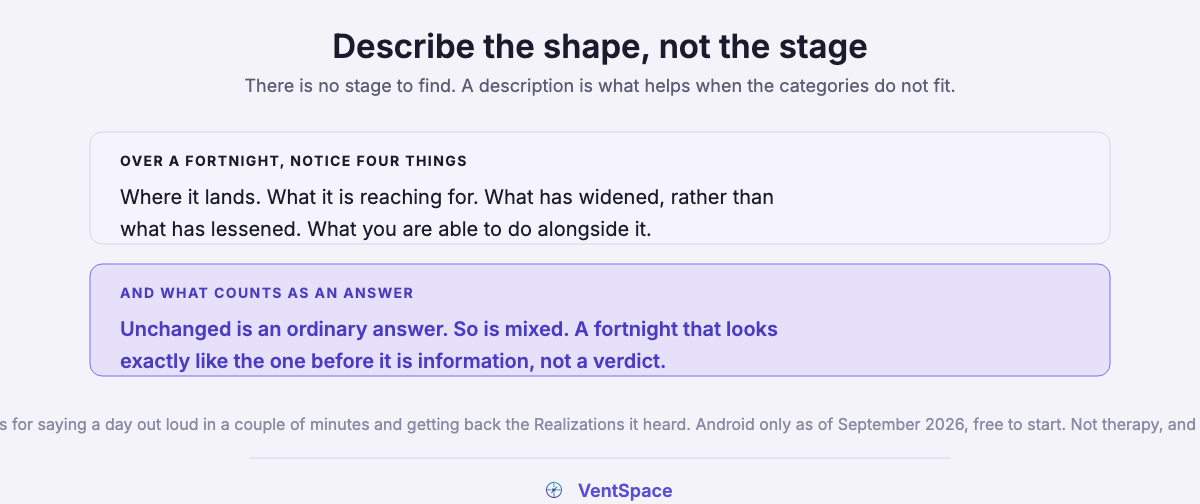
Over a fortnight, notice four things. Do not score them, and do not compare them to what anybody else seems to be managing.
- Where does it land? Sadness tends to arrive as weather across a day. Yearning tends to arrive attached to something specific: a chair, an hour, a sentence somebody almost said.
- What is it reaching for? If there is a person at the end of it, that is the directed kind, and it will not respond to the things that help feelings.
- What has widened? Not what has lessened. The honest question in the second year is whether the hours between are longer, not whether the hours themselves are smaller.
- What can you do around it? Ordinary life running alongside the grief is not a betrayal of it, and the oscillation between attending to the loss and attending to the rest is described in the research as coping rather than as avoidance.
Unchanged is an ordinary answer, and so is mixed. Neither is evidence that something has gone wrong in us, and a fortnight that looks exactly like the one before it is a piece of information rather than a verdict.
Where the shape becomes visible. The difficulty with all of the above is that the shape of grief cannot be seen from inside one bad Tuesday, and it is hard to remember which weeks were which. A few lines written down most days, anywhere, can make the widening visible across weeks. A notebook is not company, though, and grief is the thing people most need people for. Write it down and call the person afterwards.
Quick Summary
Q: How do I know whether what I feel is grief or sadness?
A: Notice whether it is directed. Sadness tends to arrive as undirected weather across a day, while grief tends to attach to something specific and to reach toward a particular person. Over a fortnight, the useful question is whether the gaps between have widened rather than whether the feeling itself has shrunk.
What to do in each case
If it is undirected. The ordinary things are not beneath you and they work better than their reputation suggests: sleep, daylight, somebody to eat with, a walk that is longer than you want it to be. Sadness responds to conditions. If it has been continuous for weeks and none of those conditions touch it, that is worth taking to a doctor, and going early is not an overreaction.
If it is directed. Then the task is not to reduce it, which cannot be done, but to give it somewhere to go. Say the person’s name out loud to another human being who knew them, this week. Write one thing you would have told them. Keep the object you have been meaning to deal with, and deal with it in a year or in ten, or never. What the research describes as coping is an oscillation between attending to the loss and attending to the life that has to continue around it, and both halves are permitted on the same afternoon.
And in both cases therapy is a legitimate option, at any point, whether or not anything qualifies as anything.
Where the line blurs
Grief contains sadness, so the two were never alternatives. Almost all of us, in the second year, have days of ordinary undirected low mood that have nothing to do with the loss and get attributed to it anyway, and separating those is not always possible or necessary. The distinction in this article is a tool for understanding why the thing is not passing; it is not a sorting hat.
The waves are real and they have no schedule. They arrive out of proportion and out of sequence, they are set off by things that make no narrative sense, and the research does not offer a pattern for them because none has been established.
And the evidence on this page deserves the same scepticism it applies to the stage model. The finding that anchors it comes from one cohort study of 233 people in one American state. It is the largest empirical test the popular account has had, which says as much about the popular account as it does about the study. We have also deliberately not printed the month figures that paper reports, because a set of numbers handed to a bereaved reader stops being a research result and becomes a timetable they are behind on, which is the exact harm the 2021 analysis warns about.
Quick Summary
Q: Does grief ever go away?
A: The honest answer is that it changes shape rather than ending. The one large empirical study found yearning dominant across the full two years measured, alongside acceptance, which was present from the earliest measurement. What tends to change is the space between the waves rather than the waves themselves.
Questions people ask
Does grief ever go away?
Not in the way a feeling goes away, and any page promising otherwise is describing something else. What the evidence describes is yearning persisting across the whole period measured, alongside acceptance that was there from the beginning. What changes, in most accounts, is the amount of ordinary life running between the episodes rather than the intensity of the episodes.
How long is grief supposed to last?
We are not going to give you a number and it is worth saying why. The researchers who studied how grief information is presented warn that uncritical, schedule-shaped accounts can lead bereaved people to believe they are doing it incorrectly. A number on this page would be a number you could be behind on, and there is no version of that which helps. The diagnostic manuals do contain minimum periods, and those are floors below which a clinician should not even consider a diagnosis. They are not a finishing line.
Are the five stages of grief real?
This is the myth worth correcting. The stages came from in-depth interviews with over 200 terminally ill patients, which is to say from people facing their own deaths. Kübler-Ross extended them to families herself, but they were never tested in bereaved people before being taught as a sequence. The clinical literature records that they were developed without sufficient evidence, are often applied too strictly, and risk harm when people are pushed through them.
Is grief the same as depression?
No, and the difference showed up in the measurements: depression was one of the five items tracked in the Yale study and it was not the dominant one. That said, the two can occur together, they can look similar from outside, and nothing you read can separate them in your own case. If the flatness has spread into everything and stayed there, a doctor is the person to ask.
Should I be worried that I still feel like this?
Not on the basis of duration alone, which is the thing people worry on. Prolonged grief disorder exists as a category, the two manuals that carry it disagree about its criteria, and researchers in the field have publicly worried that its introduction will medicalise ordinary grief. What is worth taking to somebody is not the length of it but whether you are able to live around it, and you are allowed to ask without being sure.
Two things to take
There is no stage to reach. The account that placed acceptance at the end came from interviews with dying patients and was carried across to bereavement without being demonstrated, and when somebody finally measured it, acceptance turned out to be the most commonly endorsed item from the very beginning. The thing that is not passing is not a feeling. It is a relationship, and relationships do not have a duration.
And the honest one. This does not resolve. The shape changes and the space around it grows, there is no month in which it is finished, and anybody who told us otherwise was either repeating a page they had read or trying to make us feel better faster than is possible. For some of us the second year is harder than the first, and few of us are warned.
You are not behind.
There was never a schedule.
If you are carrying a loss that has not moved the way you were told it would, and writing some of it down would help, VentSpace, our journaling app, is a quiet place to do it. If you are on a computer, VentSpace Live runs in your browser, with nothing to install.
About this article

Written by
Sai Subramaniam
Founder, VentSpace
I write these guides because I have been where you are. I am working through my own hard seasons, and I share the things that actually helped me, so that anyone going through it has something steady to read instead of facing it alone. No ads, no affiliate links, and nothing here is a sales pitch.
This writing is honest and every claim is sourced, and it is not a substitute for professional care, bereavement support or medical advice. If this is heavy right now, the numbers above are a better answer than anything else on this page.
How this one was checked. Every factual claim traces to a named source, and the source is printed next to the claim rather than kept in a footnote. Quotes are pinned to the work they come from, with the year, the letter or the chapter where one exists. Where a widely repeated claim could not be traced, it was left out and the omission recorded. Where a figure is contested, both sides are printed.
No affiliate links, no paid placements, and nobody paid to appear here. Where we mention our own app, we say that it is ours, we state its limits, and we never position it as a substitute for care.
Reviewed: October 2026. Prices, platforms and product availability move quickly, and anything we could not verify at the time of writing is marked as unverified rather than turned into a number.
Corrections. If something here is wrong, we would rather know. Corrections are made in place, with a note saying what changed. Updated 15 October 2026: we corrected where the five stages came from (derived from dying patients, extended by Kübler-Ross to families, never tested in bereaved people), added that the Yale study’s own conclusion partly supported stages, removed website-study figures and a quotation we could not re-check, added a crisis note near the top, moved our app to a single closing note, and removed two unrelated links.