
“This is certain, that a man that studieth revenge, keeps his own wounds green, which otherwise would heal, and do well.”
Francis Bacon, “Of Revenge”, Essays (1625)
You replay it. The conversation, the message, the moment you found out. You rewrite what you should have said, and then you rewrite it again in the shower, in the car, at two in the morning. Someone tells you to let it go, and you would, gladly, if you knew where to put it down. Why is it still this loud?
Part of the answer is that forgiveness is two things, not one. The forgiveness researcher Everett Worthington and his colleagues separate decisional forgiveness, an intention to stop pursuing the grudge and to respond differently to the person, from emotional forgiveness, the slower replacement of resentment with something warmer (Worthington and colleagues, Journal of Behavioral Medicine, 2007). You can make the first today. The second arrives on its own schedule, and it is not a sign of failure that it has not arrived yet.
So this page does two jobs. First, what forgiveness is, and what it does not ask of you, because most of the resistance lives there. Then five small steps you can start tonight with a notebook, adapted from the forgiveness method with the largest trial behind it.
The short version
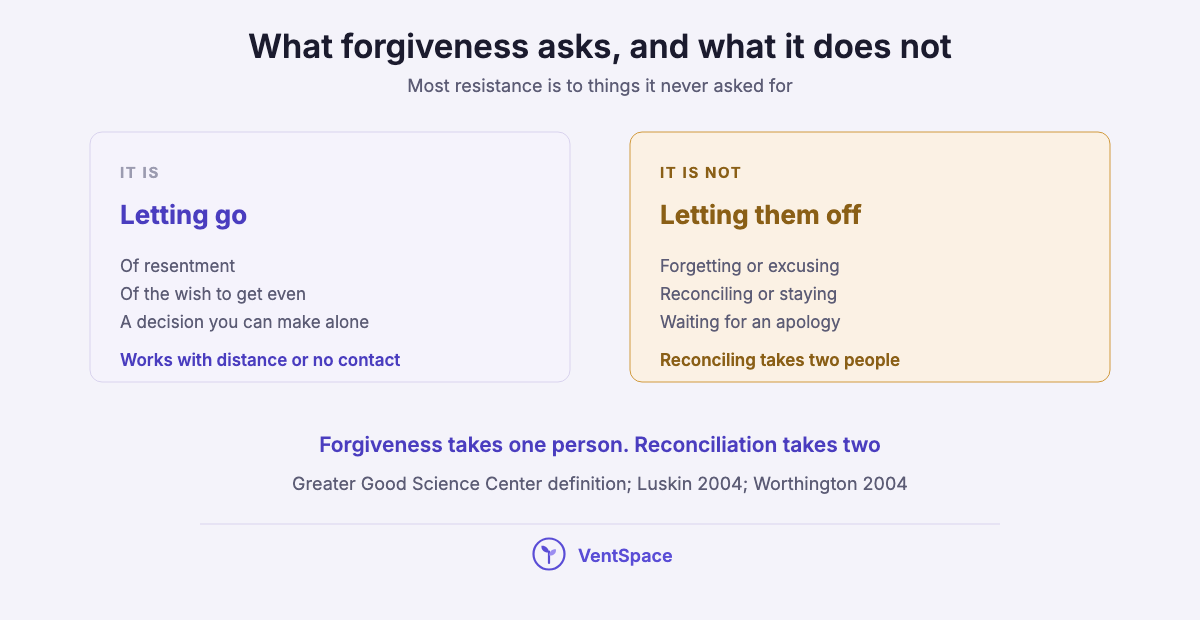
Forgiveness is not forgetting, excusing or making up. It is letting go of resentment and the wish to get even, and it does not require you to stay in contact.
You do not need their apology. Waiting for one hands the ending of your story to the person who hurt you.
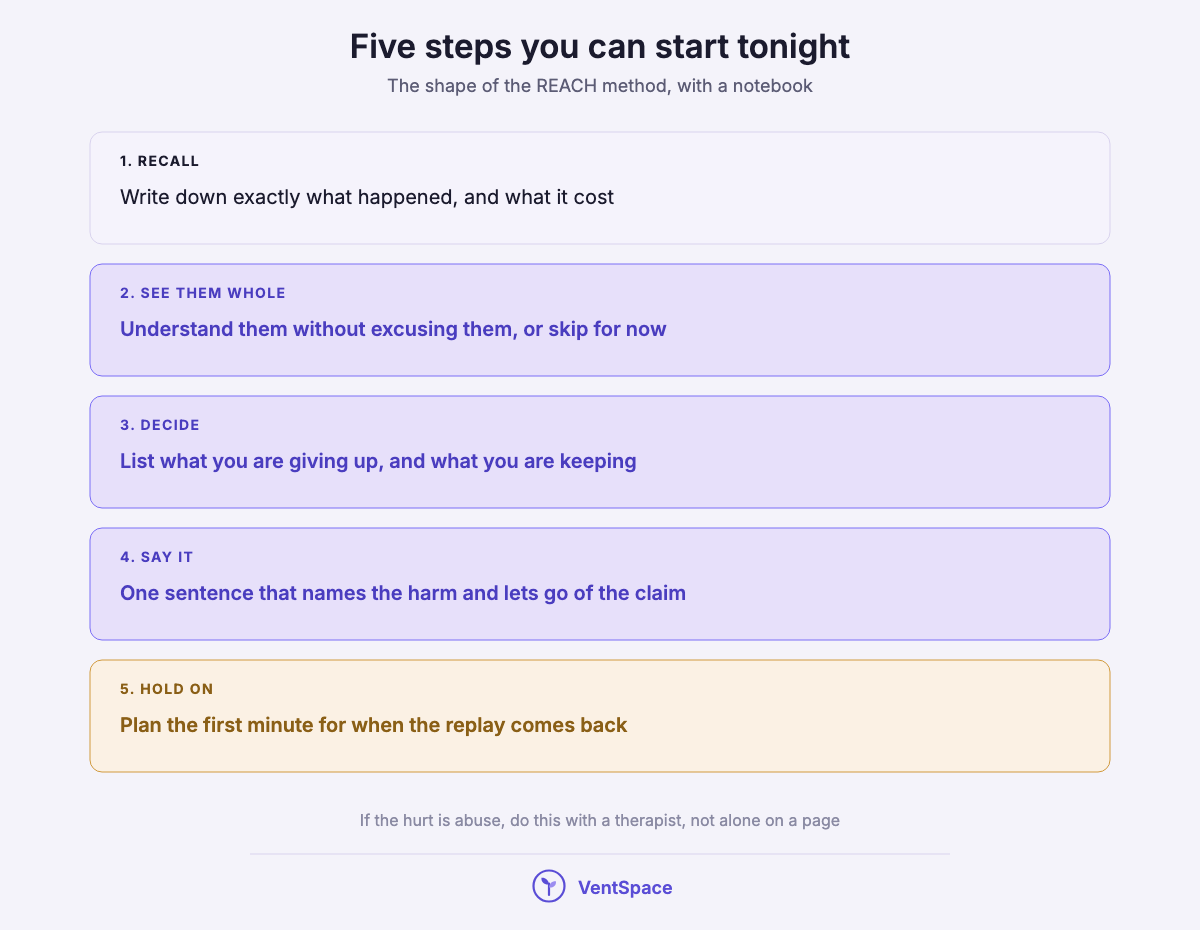
The five steps: write down exactly what happened, try to see the person whole without excusing them, decide what you are giving up, say it in one sentence, and hold on when it comes back.
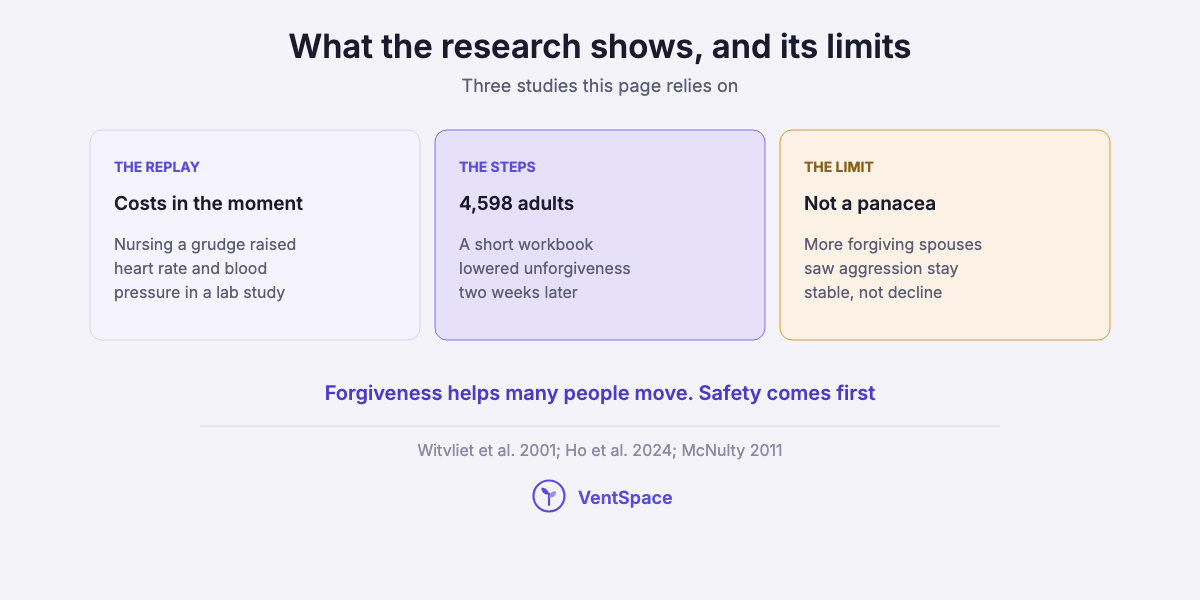
There is real evidence for this. In a trial of 4,598 adults in five countries, a two-to-three-hour forgiveness workbook lowered unforgiveness two weeks later, compared with people still waiting for it.
Forgiving is not always the right next step. If someone is still hurting you, safety comes first, and forgiveness can wait.
If you are in crisis or thinking about harming yourself, please contact the 988 Suicide & Crisis Lifeline now (US, call or text 988), or find a line in your country at findahelpline.com. This page is not a substitute for that help.
If the person you are trying to forgive is still hurting you, threatening you, or controlling your money, phone or movements, that is not a forgiveness question, and this page is not the right help. The National Domestic Violence Hotline (US) is free, confidential and open 24/7: call 800.799.SAFE (7233) or text START to 88788. If you are in immediate danger, call 911.
What forgiveness is, and what it is not
“Forgiving someone does not mean forgetting or approving of hurtful events in the past. Rather, it means letting go of your hurt and anger, and not making someone endlessly responsible for your emotional well-being.”
Fred Luskin, director of the Stanford Forgiveness Projects, “The Choice to Forgive”, Greater Good (2004)
Forgiveness is a decision to release resentment toward someone who harmed you, whether or not they deserve it. That is close to the working definition the Greater Good Science Center at UC Berkeley gives: “a conscious, deliberate decision to release feelings of resentment” toward a person or group who has harmed you, “regardless of whether they actually deserve your forgiveness.”
Most of the resistance to forgiving is a resistance to things forgiveness was never asking for. The same Berkeley page is plain that forgiving does not mean denying how serious the harm was, and “it doesn’t obligate you to reconcile with the person who harmed you, or release them from legal accountability.” Read that twice if you need to. Many of us carry an unspoken rule that forgiving means picking up the phone, inviting them back, or pretending it was fine. It does not.
| Forgiveness is | Forgiveness is not |
|---|---|
| Letting go of resentment and the wish to get even | Saying what they did was acceptable |
| A decision you can make on your own | Something they have to earn, or you have to announce |
| Compatible with distance, or with no contact at all | Reconciling, or letting them back in |
| Compatible with legal or practical consequences | Releasing them from accountability |
| Often slow, and often repeated | Forgetting |
Reconciliation is a separate decision, and it takes two people. Forgiveness takes one. Worthington makes the distinction from the other side: when we forgive someone we do not want a continuing relationship with, the goal is narrower, less resentment and less wish for revenge, not a warm reunion. That narrower goal is a complete forgiveness, not a lesser one.
And forgiveness is not a debt you owe anyone. Some people decide not to forgive a particular harm, and that is a legitimate choice too. This page is for the reader who wants to put something down, not for the reader being pressured to.
Quick Summary
Q: What does it really mean to forgive someone?
A: It means letting go of resentment and the urge to get even toward someone who hurt you. It does not mean forgetting, excusing what they did, reconciling, or staying in contact. You can forgive someone you never speak to again.
Insight: Everett Worthington, writing in Greater Good (2004): “Though most people probably feel they know what forgiveness means, researchers differ about what actually constitutes forgiveness. I’ve come to believe that how we define forgiveness usually depends on context. In cases where we hope to forgive a person with whom we do not want a continuing relationship, we usually define forgiveness as reducing or eliminating resentment and motivations toward revenge.”
Why the anger stays
“consider how much more pain is brought on us by the anger and vexation caused by such acts than by the acts themselves, at which we are angry and vexed.”
Marcus Aurelius, Meditations, XI.18, George Long translation
The hurt happened once. The replay happens every day, and the replay is the part you are living with now. Each time you rehearse it, you get a fresh dose of the original anger, sometimes stronger than the first, because now there is the added insult of it still being here.
From Sai, who founded VentSpace and wrote the first version of this page: “Anger is something that I feel so very often. I don’t get upset, I get angry. And so when people ask me, do you really need to get angry? I get more angry.”
If that sounds familiar, you are in ordinary company. Anger is a normal response to being wronged, and it can be useful in the short run. It tells you a line was crossed. The trouble starts when it becomes the place you live. In his original version of this page, Sai named three costs he had paid himself: anger made decisions he would not have made calmly, those decisions hurt someone else and then came back as regret, and anger got in the way of the actions that might have fixed the problem. He called it an endless cycle and asked the reader, “why don’t you break the wheel?”
There is a small but telling piece of lab research on what the replay does in the moment. In a study of 71 adults, Charlotte vanOyen Witvliet and colleagues asked people to think about a real person who had hurt them, first by rehearsing the hurt and nursing the grudge, then by imagining empathy and forgiveness (Psychological Science, 2001). The unforgiving thoughts came with more unpleasant emotion and higher heart rate, blood pressure, brow-muscle tension and skin conductance. The forgiving thoughts came with a greater sense of control and lower stress responses. It was one session of imagined scenes in a lab, so it says nothing about long-term health. What it does show is the cost of the replay, measured, while it is happening.
So why does it stay? Often because the replay feels like loyalty to yourself. If you stop being angry, it can feel as if you are agreeing it did not matter. It did matter. Forgiving is a way of saying so without paying for it every morning.
Quick Summary
Q: Why can’t I stop being angry at someone who hurt me?
A: Because the hurt happened once but the replay happens daily, and each replay brings the anger back. Stopping can also feel like agreeing it did not matter. Forgiving is a way of saying it mattered without reliving it.
Insight: Everett Worthington, describing Witvliet’s lab work in Greater Good (2004): “To ruminate on an old transgression is to practice unforgiveness. Sure enough, in Witvliet’s research, when people recalled a grudge, their physical arousal soared. Their blood pressure and heart rate increased, and they sweated more. Ruminating about their grudges was stressful, and subjects found the rumination unpleasant. It made them feel angry, sad, anxious, and less in control.”
Waiting for the apology that may never come
“How ridiculous and what a stranger he is who is surprised at anything which happens in life.”
Marcus Aurelius, Meditations, XII.13, George Long translation
A lot of unforgiveness is waiting. Waiting for them to apologize. Waiting for an explanation that makes sense of it. Waiting for them to understand what they did. Sai’s original page put it bluntly: some of us want an apology, some want an explanation, and “we get angry when we do not get those things from them.”
The difficulty is that an apology is not yours to produce. Fred Luskin, who directs the Stanford Forgiveness Projects, calls these “unenforceable rules”: desires we are powerless to turn into realities. In his nine steps to forgiveness, he puts it this way: “Give up expecting things from your life or from other people that they do not choose to give you.” You can hope for the apology. You cannot make it happen, and every day you insist on it is another day the person who hurt you decides how you feel.
That is the point Sai called his first lesson: do not be shocked by people’s behavior. Not because what they did was fine, but because being shocked again and again is its own wound. People can behave badly. Life is not fair, and sometimes it lets us down. Aligning your expectations with that is not cynicism. It is what frees you from waiting.
This does not make apologies worthless. Worthington’s own research found that a sincere apology made forgiving easier, and that insincere or incomplete apologies “actually riled people up more.” So if one comes, it can help. But it is not a precondition.
Quick Summary
Q: How do you forgive someone who isn’t sorry?
A: You stop making their apology the condition. An apology can help when it is sincere, but it is not yours to produce. Forgiveness is something you can complete without them, and waiting for it keeps them in charge of how you feel.
Insight: Desmond Tutu, who chaired South Africa’s Truth and Reconciliation Commission, writing in Greater Good (2004): “There is no question that such a confession is a very great help to the one who wants to forgive, but it is not absolutely indispensable. If the victim could forgive only when the culprit confessed, then the victim would be locked into the culprit’s whim, locked into victimhood, no matter her own attitude or intention. That would be palpably unjust.”
So where do you start?
How to forgive someone: five steps
“How can you forgive if you do not know what or whom to forgive?”
Desmond Tutu, “Truth and Reconciliation”, Greater Good (2004)
These five steps follow the shape of REACH, the forgiveness method developed by Everett Worthington: recall the hurt, empathize, give forgiveness as an altruistic gift, commit to it, and hold on to it. Its 2024 trial is, by its authors’ count, larger than all earlier forgiveness trials combined. In that randomized trial of 4,598 adults in Colombia, Hong Kong, Indonesia, South Africa and Ukraine, a self-directed REACH workbook of two to three hours lowered unforgiveness two weeks later, compared with people waiting to receive it, with smaller drops in depression and anxiety symptoms (Ho and colleagues, BMJ Public Health, 2024). The trial authors describe the workbook as freely available. The wording of the steps below is ours, written for doing with a notebook tonight.
One caution before you start. Writing about a hurt is not right for everyone. In a review of the expressive-writing research, Baikie and Wilhelm (Advances in Psychiatric Treatment, 2005) record that it was detrimental for adult survivors of childhood abuse and for a small sample of veterans. If the hurt you are carrying is abuse, do this with a therapist, not alone on a page.
Step 1: Write down exactly what happened
Open a notebook and write the hurt in plain sentences, as a reporter would: what happened, when, who was there, what was said. Then, in a second short paragraph, write what it cost you. Ten minutes is enough. Vague resentment is hard to let go of because you cannot see its edges.
- What exactly did they do, in one sentence?
- What did it take from me: trust, time, money, a version of the future, my sense of being safe?
- Which part still stings the most when I replay it?
- What is the story I keep telling myself about it?
- Is there anything I am not letting myself write down?
Be as angry on the page as you are. No one is reading this but you.
Step 2: Try to see the person whole, without excusing them
Write one paragraph about the other person as a whole human being, not only as the author of this harm. What was going on in their life? What were they afraid of, or protecting? This is the step most people want to skip, because it can feel like taking their side. It is not. Understanding why someone did something is different from agreeing that it was fine.
- What might they have been dealing with at the time?
- Have I ever done something smaller, in the same direction, for a similar reason?
- What would they say if they explained it honestly?
- Is there anything about them that is more than this one act?
If this feels unsafe or false, skip it for now. Empathy is not the price of admission. Some people get there later, and some never do.
Step 3: Decide what you are giving up
Write down the specific things you are choosing to stop pursuing: the revenge fantasy, the need for them to suffer, the speech you rehearse for the day you finally see them, the hope that they will one day admit it. This is decisional forgiveness, and it is a choice you can make today even if you do not feel warm toward them yet.
- What do I keep wanting to happen to them?
- What am I still waiting for them to say or do?
- What would I do with the time and energy the replay takes?
- What am I keeping, deliberately? Distance, a boundary, a consequence?
Write the keep-list as carefully as the give-up list. Forgiving is not the same as dropping your guard.
Step 4: Say it, to yourself, in one sentence
Write one sentence that names the harm and lets go of the claim. You do not have to send it, and in most cases you should not. It is for you. Sai wrote his version into the first draft of this page, and it is a good model because it refuses to pretend:
The sentence Sai wrote for the first version of this page: “I know what you did. It’s not okay. And I recognize that you are more than that. I don’t want to be angry at you. I can heal myself and I don’t need anything from you.”
Write your own. Change any part that is not true for you yet. If “you are more than that” is not true for you, leave it out.
- Can I say what they did without softening it?
- What exactly am I releasing them from?
- What do I no longer need from them?
- Does my sentence leave room for distance?
It does not have to feel true yet. The decision often comes before the feeling.
Step 5: Hold on when it comes back
Write down what you will do the next time the replay starts, because it will. A song, a place, an anniversary, a photo. When it comes back, it does not mean the forgiveness failed. It means you have a choice to make again. Read your sentence from Step 4. Then do one ordinary thing with your hands.
- What usually sets the replay off?
- What will I do in the first minute when it starts?
- Who can I tell, without needing them to fix it?
- What will I remind myself I already decided?
Expect to do this step many times. Holding on is the step, not a sign you missed one.
Quick Summary
Q: What are the steps to forgive someone?
A: Write down exactly what happened and what it cost you, try to see the person whole without excusing them, decide what you are giving up and what you are keeping, say it in one sentence, and hold on when the hurt comes back. These follow the shape of Everett Worthington’s REACH method, which has the largest trial behind it.
Insight: Everett Worthington, in Greater Good (2004): “It’s important to stress again that forgiveness usually takes time. In fact, in a meta-analysis of all research that measured the impact of forgiveness interventions, Nathaniel Wade and I found that a factor as simple as the amount of time someone spent trying to forgive was highly related to the actual degree of forgiveness experienced.”
Pulling it all together
“To become a forgiving person, we have to practice forgiving smaller grievances.”
Fred Luskin, “The Choice to Forgive”, Greater Good (2004)
Step 1, write it down. Tonight, give it ten minutes: what happened, in plain sentences, and what it cost you. Your committed action is one page, not a perfect one.
Step 2, see them whole. One paragraph about the person behind the act, or a note to yourself that you are not ready. Your committed action is to try, or to give yourself permission to wait.
Step 3, decide what you are giving up. Two short lists: what you are releasing, and what you are keeping. Your committed action is one item on each list.
Step 4, say it. One sentence, for you alone. Your committed action is to write it and read it back once.
Step 5, hold on. One plan for the next time it comes back. Your committed action is to write down what you will do in the first minute.
If the hurt is enormous, Luskin’s advice applies: start with something smaller. A rude colleague, an old friend who let you down. Practicing on the small ones makes the large one less unfamiliar.
Quick Summary
Q: What is the first thing to do if I want to forgive someone?
A: Write down exactly what happened and what it cost you, in plain sentences, for ten minutes. Everything else builds on seeing the hurt clearly.
Insight: Fred Luskin, describing a woman in his forgiveness class, in Greater Good (2004): “I emphasized to Delores that she could not change the hurtful parts of the past, but only how much space she rented to them in her mind. By putting less blame on the past, she could change the way she felt in the present.”
When forgiveness is not the next step
“These findings join just a few others in demonstrating that forgiveness is not a panacea.”
James McNulty, Personality and Social Psychology Bulletin (2011)
Forgiveness is not always safe, and it is not always the right next step. In a study following newlywed couples over the first four years of marriage, McNulty found that spouses who were more forgiving saw their partners’ psychological and physical aggression stay stable, while spouses who were less forgiving saw it decline. One reading, which the study proposes, is that forgiveness can remove the consequences that would otherwise discourage someone from doing it again. If the person is still hurting you, the priority is your safety, not your forgiveness, and the hotline at the top of this page is the place to start.
Therapy is a legitimate route here, not a last resort. A meta-analysis of 54 research reports, covering more than 2,000 people, found that people who received treatments explicitly designed to promote forgiveness reported more forgiveness than people who received no treatment or a different treatment (Wade and colleagues, Journal of Consulting and Clinical Psychology, 2014). Longer interventions predicted more change. If you are not sure whether this is something to carry alone, our page on whether you need therapy is a fair place to start.
The honest ceiling matters too. The large workbook trial measured people two weeks after they started, with some evidence the effect held at four weeks, and the authors say longer-term maintenance could not be settled by their design. The effects on depression and anxiety were real but small. Forgiveness methods help many people move. They are not a cure for what happened.
Quick Summary
Q: Should you always forgive?
A: No. Forgiveness is a choice, not an obligation. If someone is still hurting you, safety comes first, and research on newlywed couples found that more forgiving spouses saw aggression continue. Therapy is a legitimate route for a heavy hurt.
Insight: Everett Worthington, in Greater Good (2004): “Teaching people to forgive raises some important questions. Are some offenses so heinous that they ought never to be forgiven? Are there times when justice should trump forgiveness? Justice and forgiveness do clash at times. I do not advocate forgiving under all circumstances (unless a person’s religion dictates it).”
Questions people ask about forgiveness
Do I have to forgive the person who hurt me?
No. Forgiveness is not owed to anyone, and choosing not to forgive a particular harm is a legitimate decision. Many people find that letting go of resentment makes their own days lighter, which is a reason to try, not a duty.
Is “forgive and forget” real?
It is a myth. Forgetting is not part of forgiveness, and the Greater Good Science Center’s definition says plainly that forgiving does not mean forgetting or condoning. You can remember exactly what happened and still stop paying for it.
Can you forgive someone and still not talk to them?
Yes. Forgiveness and reconciliation are separate. Forgiveness takes one person and can happen with no contact at all. Reconciliation takes two, and it depends on whether it is safe and whether the other person has changed.
How long does it take to forgive someone?
Nobody can tell you, and we decline to guess. Worthington’s review of the research found that the time people spent trying to forgive was strongly related to how much forgiveness they experienced, which means it is usually slow. Any page that gives you a number is inventing it.
What if I decided to forgive, but I still feel angry?
That is common, and it does not mean it failed. Researchers separate the decision to forgive from the emotional change that may follow later. The anger often comes back with reminders. Read the sentence you wrote, and decide again.
What about forgiving myself?
That is a related but different question. Much of this page applies, especially writing down exactly what happened and what you are giving up, but self-forgiveness also involves taking responsibility for your own part. It deserves its own page, and this one does not try to answer it.
In a nutshell
First, forgiveness asks for less than you think. It does not ask you to forget, to excuse, to reconcile, to wait for their apology, or to stay anywhere you are not safe. It asks you to put down the claim that they owe you a different past.
Second, it takes as long as it takes, and nobody can tell you how long. The decision can happen tonight, on one page. The feeling may follow slowly, and the hurt may come back many times before it quiets. Coming back to Step 5 is not starting over.
Carrying something someone did to you, for months or years, is tiring in a way that is hard to explain to anyone else. If writing some of it down would help, VentSpace is a journaling app that turns what you write into a clear read on your life balance, plus small, doable next steps. Prefer to try it on your laptop first? VentSpace Live runs in your browser, free, with nothing to install.
About this article

Written by
Sai Subramaniam
Founder, VentSpace
I write these guides because I have been where you are. I am working through my own hard seasons, and I share the things that actually helped me, so that anyone going through it has a steady companion close by instead of facing it alone. VentSpace is the app I built for exactly that: a journaling app that turns what you write into a clear read on your life balance, plus small, doable next steps toward feeling more like yourself.
This writing is honest and every claim is sourced, and it is not a substitute for professional care. If you are struggling, reaching out to a professional is a strong move, not a failure.
Explore VentSpaceTry VentSpace LiveHow this one was checked. Every factual claim traces to a named source, and the source is printed next to the claim rather than kept in a footnote. Quotes are pinned to the work they come from, with the year, the letter or the chapter where one exists. Where a widely repeated claim could not be traced, it was left out and the omission recorded. Where a figure is contested, both sides are printed.
No affiliate links, no paid placements, and nobody paid to appear here. Where we mention our own app, we say that it is ours, we state its limits, and we never position it as a substitute for care.
Reviewed: October 2026. Prices, platforms and product availability move quickly, and anything we could not verify at the time of writing is marked as unverified rather than turned into a number.
Corrections. If something here is wrong, we would rather know. Corrections are made in place, with a note saying what changed.