
“Anyone who is suffering from shame and public humiliation needs to know one thing: You can survive it. I know it’s hard. It may not be painless, quick or easy, but you can insist on a different ending to your story.”
Monica Lewinsky, “The price of shame”, TED2015
It happened in front of people, and now it happens again every time you close your eyes. The laugh that went around the table, the comment your manager made with the whole team on the call, the clip in the group chat, the moment on stage when your mind went blank and someone in the third row smirked. Public humiliation has a way of replaying itself on a loop, often at two in the morning, and with each replay the room gets bigger and the faces get clearer. So what do we do with a feeling that refuses to stay in the past?
Part of the answer comes from a strange finding in social psychology. In a series of experiments published in 2001, Kenneth Savitsky, Nicholas Epley and Thomas Gilovich found that people who suffer a public blunder expect to be judged more harshly than they are, because they are staring at the moment while everyone else is looking at a dozen other things. The researchers had already given the underlying bias a name: the spotlight effect. We feel lit up. The light is mostly ours.
That does not make the pain imaginary. Humiliation is one of the most intense feelings we know, and this guide takes it seriously: why it hits harder than embarrassment, why it keeps replaying, what the people who saw it are likely to think, and then five small steps for the days after, including the hardest one, which is walking back into the room.
The short version
Humiliation is not the same as embarrassment. It involves being brought down in front of others, often unfairly, and it mixes shame with anger.
It is unusually intense. In one brain-recording study, scenarios of humiliation produced stronger responses than anger or happiness.
Other people judge us less harshly than we expect. Four studies found the fear of being judged after a public failure is commonly exaggerated.
The steps: get through tonight without a rematch, write it down from a step back, check the verdict against what people did, go back into the room once, and decide what it is allowed to change.
If you’re in crisis or thinking about harming yourself, please contact the 988 Suicide & Crisis Lifeline now (US, call or text 988), or find a line in your country at findahelpline.com. If what happened has left you feeling that you cannot face anyone again, ever, or that people would be better off without you, that is a reason to reach out tonight, not to keep reading.
From Sai, who writes this site
Having experienced humiliation first hand, I know how horrible it feels to be laughed at for being who you are and doing what you like. I wrote the first version of this page in 2022. This version keeps that line and adds what the research says.
Why public humiliation hurts more than embarrassment
“Prototypical humiliation involved feeling powerless, small, and inferior in a situation in which one was brought down and in which an audience was present.”
Maartje Elshout, Rob Nelissen and Ilja van Beest, Cognition and Emotion, 2017
Humiliation is the feeling of being brought down in front of others, and it usually arrives with a sense that it was unfair. That is what separates it from ordinary embarrassment, where we trip on the stairs and everyone, including us, can laugh. In humiliation, someone else does the lowering, or the situation does, and an audience is part of the injury.
The clearest research picture comes from a 2017 study by Maartje Elshout, Rob Nelissen and Ilja van Beest at Tilburg University, who noted that humiliation “lacks an empirically derived definition, sometimes simply being equated with shame.” They mapped 61 features people associate with it. The central ones were losing self-esteem, feeling powerless, small and inferior, being brought down, and having an audience present. The result was “a mix of emotions, most notably disappointment, anger, and shame.”
That mix explains a lot. We feel ashamed and furious at the same time, and the two pull against each other. The shame says hide. The anger says get them back. Elshout and her colleagues found that some features overlap with shame (looking like a fool, losing self-esteem) and others with anger (being brought down, unfairness), and they suggest that which features are present may decide whether a given humiliation turns more shame-like or more anger-like.
A 2010 paper in the Journal of the American Academy of Psychiatry and the Law, by Walter Torres and Raymond Bergner, adds a useful distinction. Their account has four ingredients: we make some claim to a social standing, the claim fails in front of at least one witness, the person rejecting it has the standing to do so, and the rejection goes further than the claim itself. In humiliation, what is denied is not only the thing we tried but our right to have tried it. In Torres and Bergner’s account, that fourth element is what separates humiliation from embarrassment. Being told your idea is wrong stings. Being told, with others watching, that someone like you should not have spoken at all is a different wound.
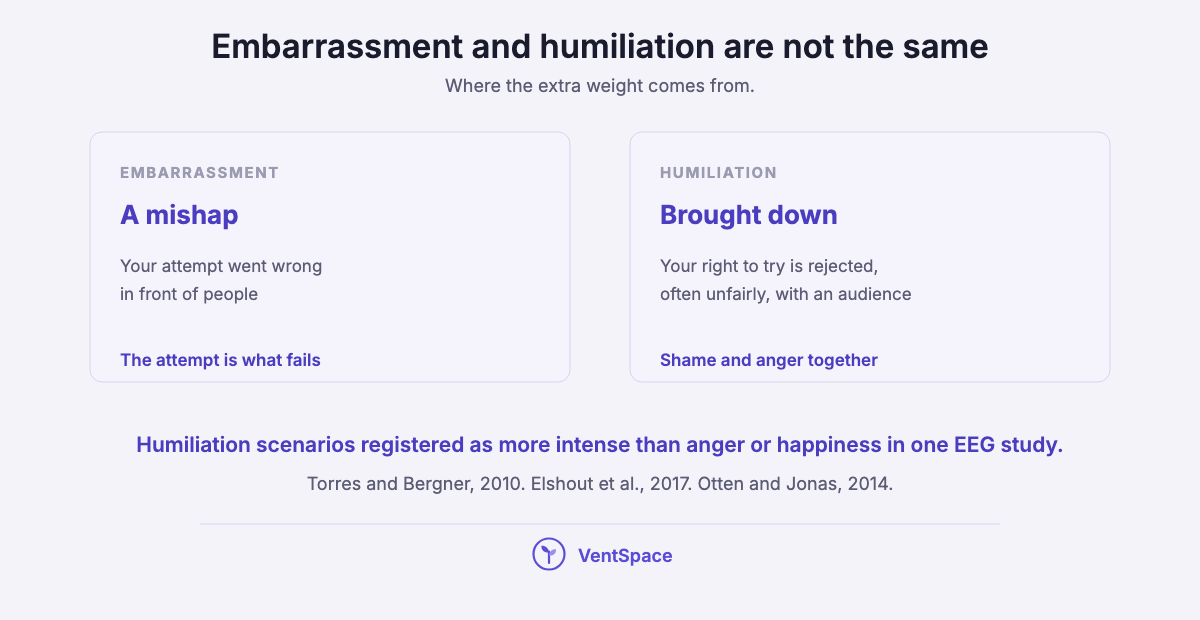
And it is a deep one. In a 2014 study in Social Neuroscience, Marte Otten and Kai Jonas recorded brain activity while people read scenarios designed to evoke humiliation, anger or happiness. The humiliation scenarios produced markedly stronger responses on two electrical measures of intensity than either of the others. The study used imagined scenarios, not real events, so it says nothing precise about your week. It does say something about the size of the feeling. If this has knocked you sideways, you are not overreacting. You are reacting to something that registers as unusually intense.
Quick Summary
Q: What is the difference between humiliation and embarrassment?
A: Embarrassment follows a mishap. Humiliation involves being brought down in front of others, often unfairly, so it mixes shame with anger. Torres and Bergner (2010) describe its extra ingredient as having your right to make the attempt rejected, not only the attempt itself.
Insight: why it feels out of proportion
“Humiliation, the emotion associated with being lowered in status in the eyes of others, seems to be very intense. As such, humiliation has been implied to play an important role in the escalation of inter-individual and inter-group conflict. Here, we provide the first clear empirical evidence that humiliation is indeed a very intense experience.” Marte Otten and Kai Jonas, Social Neuroscience, 2014.
Why you can’t stop replaying it
“Post-event processing can be defined as an individual’s repeated consideration and potential reconstruction of his performance following a social situation.”
Faith Brozovich and Richard Heimberg, Clinical Psychology Review, 2008
The replay has a name in the research: post-event processing. It is the going-over that happens after a social moment goes badly, and it rarely stays faithful to the original. We rewrite it. The pause gets longer, the laugh gets louder, and the version we carry by Thursday is worse than the one that happened on Monday.
Most of that research was done with people who have social anxiety, and this page is not suggesting you have anything of the kind. The mechanism is still worth knowing, because it is ordinary. Brozovich and Heimberg’s review starts from an older finding that self-focused thoughts and negative feelings feed each other, and the replay is self-focus in its purest form. Every pass through the scene puts us at the center of it again.
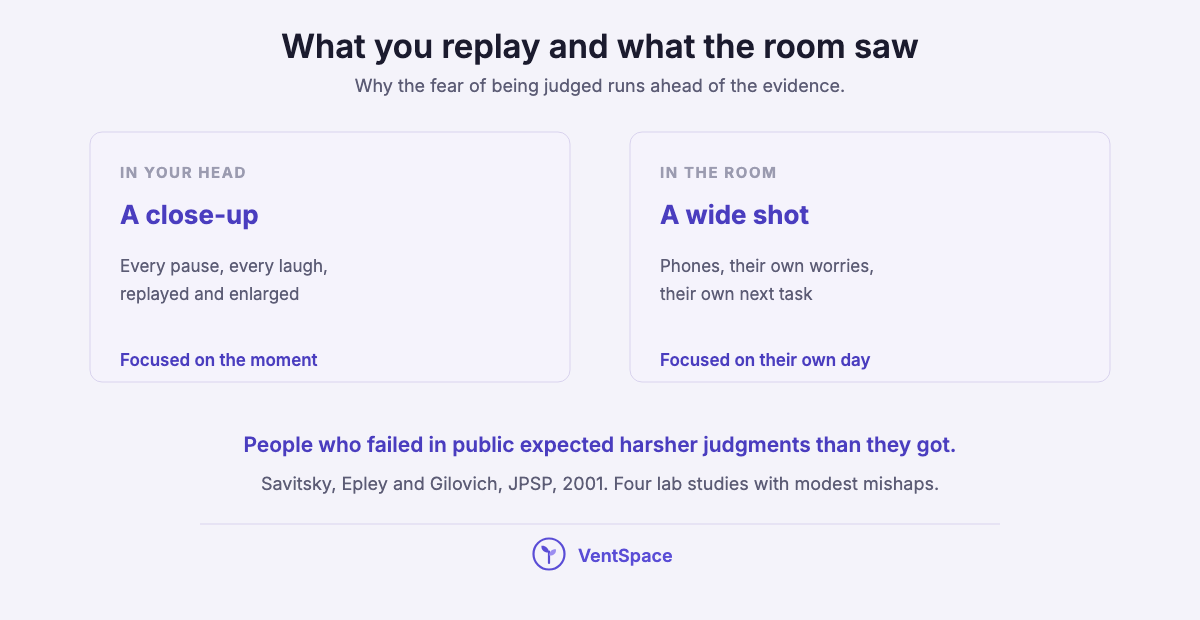
The same research group’s work on public failure found the same engine at work. Savitsky and his colleagues traced people’s exaggerated fears partly to their “tendency to be inordinately focused on their misfortunes” and their failure to consider everything else going on in the room. The replay is a close-up shot. It cuts out the person checking their phone, the one worrying about their own presentation next, the one who did not hear the comment at all.
What seems to help is not stopping the replay by force, which rarely works, but changing where we stand while we watch it. In seven studies with 585 people, Ethan Kross and his colleagues found that people who talked themselves through a stressful social task using their own name or “you” instead of “I” showed less distress, and in a public-speaking study, less of this kind of replaying afterward. One research group ran these studies, and they concern stress around social performance, so treat this as a thing to try rather than a promise. It shows up in step 2 below.
Quick Summary
Q: Why can’t I stop thinking about an embarrassing moment?
A: Researchers call the replay post-event processing: repeated, often distorted going-over of a social moment. It keeps you at the center of the scene. Stepping back from it, for example by thinking about it in the second person, was linked to less distress and replaying in one lab’s studies.
Insight: a small change in grammar
“Together, these findings demonstrate that small shifts in the language people use to refer to the self during introspection consequentially influence their ability to regulate their thoughts, feelings, and behavior under social stress, even for vulnerable individuals.” Ethan Kross and colleagues, Journal of Personality and Social Psychology, 2014.
What the people who saw it are likely to think
“I have often wondered how it is that every man loves himself more than all the rest of men, but yet sets less value on his own opinion of himself than on the opinion of others.”
Marcus Aurelius, Meditations, Book 12, translated by George Long
The people who saw it are, on the evidence, thinking about it less and judging it more gently than you fear. That is the central finding of two papers from Thomas Gilovich’s research group, and it is the one most worth carrying out of this page.
The first, published in 2000 by Thomas Gilovich, Victoria Husted Medvec and Kenneth Savitsky, introduced the spotlight effect. Participants who were asked to put on a T-shirt with a potentially embarrassing image overestimated how many observers would be able to recall what was on it. The authors’ explanation is that we anchor on our own vivid experience of the moment and then adjust, not nearly enough, for the fact that other people are living inside their own.
The second paper, in 2001, went straight at the fear this page is about. “When people suffer an embarrassing blunder, social mishap, or public failure, they often feel that their image has been severely tarnished in the eyes of others,” Savitsky, Epley and Gilovich wrote. “Four studies demonstrate that these fears are commonly exaggerated.” People who imagined a social blunder, who failed publicly at an intellectual task, or who were described in an embarrassing way all expected to be judged more harshly than they were.
There is a ceiling on this, and we want to be honest about it. These were laboratory studies, mostly of modest mishaps. A blank moment in a quiz is not a manager ridiculing you in front of the team, and nothing in these studies tells us how a deliberate humiliation is judged by the people who watched it. The finding is about the gap between what we expect and what happens, not a guarantee that nobody thought badly of you.
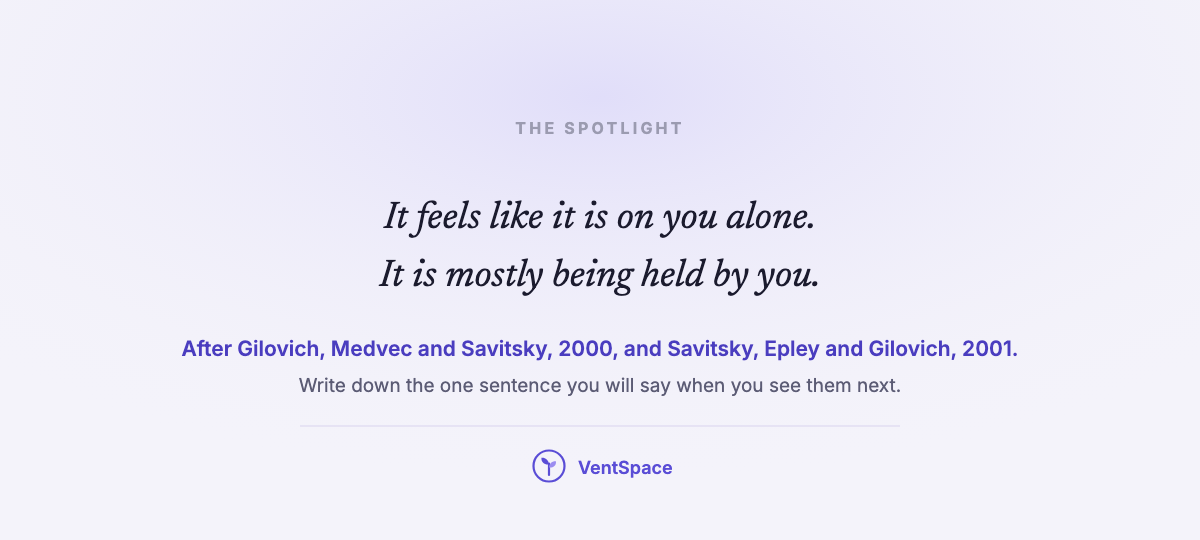
Even so, the gap runs in a consistent direction. Most of the people in that room went home and thought about their own day. Some of them felt for you. Few of them are replaying it. That is the one thing we keep coming back to, and it is why the spotlight in this guide is the controlling image: the light feels like it is on you alone, at full strength, for everyone to see, and it is mostly being held by you.
Quick Summary
Q: Do people remember embarrassing things you did?
A: Less than you think. In studies by Gilovich and colleagues, people overestimated how many observers could recall an embarrassing shirt, and people who failed publicly expected harsher judgments than they got. These were lab studies with modest mishaps, so they cannot speak to deliberate cruelty.
Insight: where the exaggeration comes from
“These exaggerated fears were produced, in part, by the actors’ tendency to be inordinately focused on their misfortunes and by their resulting failure to consider the wider range of situational factors that tend to moderate onlookers’ impressions.” Kenneth Savitsky, Nicholas Epley and Thomas Gilovich, Journal of Personality and Social Psychology, 2001.
So, what do we do in the days after?
Five steps for the days after a public humiliation
“When we struggle or make mistakes, there’s often an irrational but pervasive sense of isolation – as if “I” were the only person in the world having this painful experience.”
Kristin Neff, “What Is Self-Compassion?”, self-compassion.org
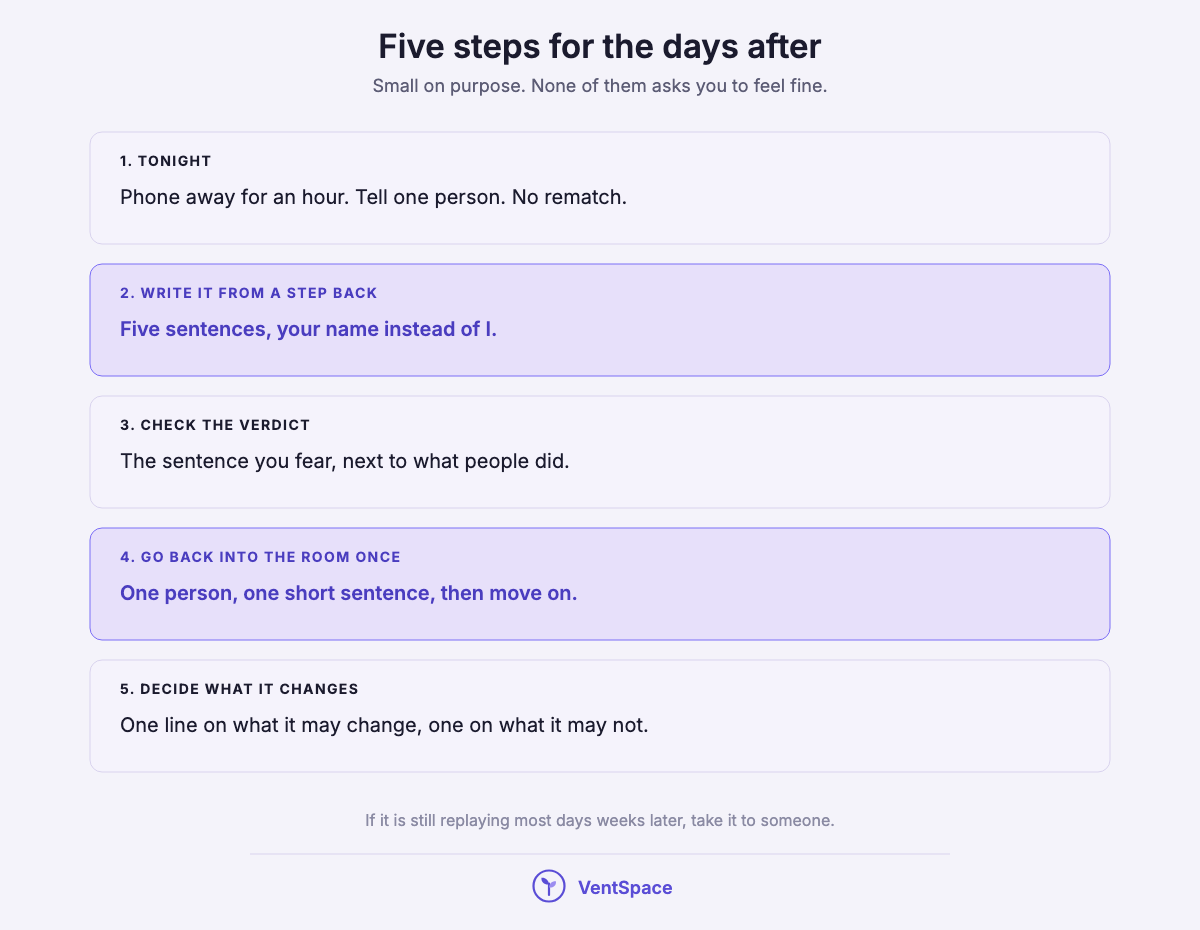
These five steps are small on purpose. None of them asks you to feel fine, and none of them asks you to pretend it was funny. They are in the order most of us need them: tonight first, the room later.
1. Get through tonight without a rematch
Put the phone in another room for one hour and tell one person you trust what happened, in two or three sentences. Do not reply, post, delete in a panic or confront anyone tonight. The anger half of humiliation wants a rematch, and the rematch written at midnight is almost never the one we would choose in daylight.
- Who is one person who would be on my side without needing the whole story?
- Is there anything that has to be done tonight, or can every decision wait until tomorrow?
- If I wrote a reply right now, would I want the people who saw the first moment to see this one?
You are allowed to be angry. You do not have to act on it tonight.
2. Write it down from a step back
Write what happened in five or six plain sentences, as if it happened to someone else. Use your own name or “you” instead of “I”: “Sam stood up to present, lost her place, and her manager said, ‘Maybe leave this one to someone else.'” This is the self-distancing move from the Kross studies above, and on paper it tends to turn a close-up back into a wide shot.
- What happened, in the order it happened, without adjectives?
- What did the other person do, and what did I do?
- What would I say to a friend who wrote this paragraph about herself?
- What part am I most afraid other people believe now?
Stop if the writing makes it sharper rather than clearer. Writing about hard experiences has not helped everyone in the research, and for adult survivors of childhood abuse it was found to make things worse, so if this event touches something older, it belongs with someone trained to hold it.
Where the paragraph can live. Paper is enough. If you would rather keep it on your phone, VentSpace is a journaling app that turns what you write into a clear read on your life balance, plus small, doable next steps. It is ours, so read that as a declared interest. It is Android only and free to start as of October 2026, it has no published evidence on outcomes, and it is not therapy. Not on Android, or at a desk? VentSpace Live runs in your browser, free, with nothing to install. The paragraph works without it.
3. Check the verdict against what people did
Write down the sentence you are afraid everyone now believes about you, then write down what people have done since. Not what you imagine they think. What they did. Who messaged you, who carried on as normal, who said nothing at all.
- What is the verdict I have handed myself, in one line?
- What evidence do I have that anyone else reached it?
- Has anyone treated me differently since, in a way I could point to?
- If one person did judge me harshly, is that person’s view the one I want to organize my life around?
This is where the spotlight research earns its place. The fear runs ahead of the evidence, and writing both down side by side lets you see the distance between them. Be fair to yourself here. If the list of what people did is short, that usually means people moved on, not that they are quietly condemning you.
4. Go back into the room once, with one sentence
The first encounter with the people who saw it is the one we dread most, so choose it rather than waiting to be ambushed by it. Pick one person or one meeting, and prepare a single short sentence that acknowledges what happened without reopening it: “That was a rough presentation, I’m glad it’s behind us.” Then move to something else.
There is research behind the short acknowledgment. In five studies published in 2012, Matthew Feinberg, Robb Willer and Dacher Keltner found that observers rated people who showed embarrassment as more prosocial and less antisocial, and were more willing to trust them and want to spend time with them, than people who showed another emotion or none. The work builds on earlier research treating embarrassment as “a nonverbal apology and appeasement gesture.” A brief, visible “yes, that happened” tends to land better than either pretending nothing did or apologizing for ten minutes.
- Who is the one person I can face first, at the lowest stakes?
- What is my one sentence, and can I say it out loud twice before I need it?
- What will I move on to talk about straight after?
You do not owe anyone a speech. One sentence and a change of subject is a complete return.
If you were humiliated by someone else, rather than by a mishap, this step changes shape. You are not the one who owes an acknowledgment. The sentence may be to a colleague who witnessed it, or there may be no sentence at all, and the step is walking into the room with your head where it usually is.
5. Decide what it is allowed to change
Write one sentence about what this moment is allowed to change in your life, and one about what it is not. Humiliation is a lesson some of the time: a presentation needed more preparation, a joke landed on someone it should not have. Some of the time it is only pain, and the lesson our fear wants us to draw, never try that again, is the wrong one.
- Is there one specific, useful thing I would do differently?
- What have I started avoiding since it happened?
- What would I still do, wear, say or try if nobody had ever laughed?
From Sai, who writes this site
I sometimes wonder how different things would look if we were free of the fear of judgment. Maybe my mom would have been a happy teacher instead of a physician. Maybe my brother would have been a famous chess player. Maybe I would have quit college and become a full-time vlogger. Some of it might sound risky, yes. But isn’t that who we are and what we want?
Being thought foolish is the price of trying almost anything in front of others. Epictetus put it bluntly nearly two thousand years ago: “If you want to improve, be content to be thought foolish and stupid with regard to external things.” That is not a call to seek out humiliation. It is permission not to let one bad moment set the size of your life.
Quick Summary
Q: How do you get over public humiliation?
A: In small steps. Get through the first night without a rematch, write it down in the second person, compare the verdict you fear with what people have done since, face one person with one short acknowledgment, and decide what the moment is and is not allowed to change.
Insight: kinder is not softer
“Study 4 found that low-self-compassionate people undervalued their videotaped performances relative to observers. Study 5 experimentally induced a self-compassionate perspective and found that self-compassion leads people to acknowledge their role in negative events without feeling overwhelmed with negative emotions.” Mark Leary and colleagues, Journal of Personality and Social Psychology, 2007.
When it happened online
“What’s true is that we are clever and stupid; what’s true is that we’re grey areas.”
Jon Ronson, “When online shaming goes too far”, TEDGlobal London, 2015
Online humiliation is different because the room never empties. A meeting ends. A post can be found again next month, by people who were never there and who meet you only at your worst moment. That changes the steps a little, and it adds some practical ones.
Don’t argue in the replies. Every reply puts the moment back in front of people, and a pile-on tends to feed on response. Save the evidence before you do anything else: screenshots with dates and usernames, links, and anything that threatens you. Then use the platform’s own reporting tools, and if something threatens your safety, the police are a legitimate route.
If intimate images of you have been shared without your consent, there are free removal services. StopNCII.org, operated by the Revenge Porn Helpline, part of the not-for-profit charity SWGfL, creates a digital fingerprint of the image on your own device and shares only that fingerprint with participating companies so they can detect and remove copies. It is for adults whose images were taken when they were 18 or older. For images taken when you were under 18, Take It Down (takeitdown.ncmec.org, from the National Center for Missing & Exploited Children) is a free service that can help remove them, and you can stay anonymous. Neither service needs you to send the images to anyone.
And if you are under 18 and this is happening at school or among people you know, tell an adult you trust: a parent, a teacher, a school counselor. A humiliation that is happening to you is not something you have to manage on your own.
Quick Summary
Q: What should I do if I’ve been publicly shamed online?
A: Do not argue in the replies. Save screenshots and links, report through the platform, and contact the police if you are threatened. For intimate images shared without consent, StopNCII (adults) and Take It Down (images taken under 18) can help get copies removed.
Insight: why it spreads
“This invasion of others is a raw material, efficiently and ruthlessly mined, packaged and sold at a profit. A marketplace has emerged where public humiliation is a commodity, and shame is an industry. How is the money made? Clicks. The more shame, the more clicks.” Monica Lewinsky, “The price of shame”, TED2015.
When it is more than a bad week
“In addition to loss, humiliating events that directly devalue an individual in a core role were strongly linked to risk for depressive episodes.”
Kenneth Kendler and colleagues, Archives of General Psychiatry, 2003
If it is fading, let it. It is worth taking to someone when it is not. If weeks later it still replays most days, gets in the way of your sleep or your work, or keeps you away from people you used to see, a counselor or therapist can help you work through it. Therapy is one option. For a lot of people it’s the right one. Our guide on whether you need therapy asks one useful question instead of handing you a checklist.
There is a reason to take this seriously rather than wait it out. In a study of 7,322 adult twins, Kenneth Kendler and his colleagues found that events involving humiliation, especially being devalued in a core role, were linked to a higher risk of depression, and combined with loss they were more strongly linked than loss alone. That is a population finding about risk, and it does not mean you are becoming depressed. It does mean the feeling is not trivial, and that wanting help with it is reasonable.
If the humiliation is a pattern, not a moment, it is a different problem. A partner who mocks you in front of friends, a parent who belittles you at every family gathering, a boss who singles you out in every meeting: none of these is a confidence issue you can fix with five steps. If it is a partner or someone you live with, you can call The National Domestic Violence Hotline at 1-800-799-7233, or text START to 88788. At work, write down dates and what was said, and take it to someone with the power to act on it.
Quick Summary
Q: When should I get help for humiliation?
A: When it is not fading: weeks later it still replays most days, disrupts sleep or work, or keeps you from people. Humiliating events have been linked to higher depression risk in population research. Repeated humiliation by a partner, family member or boss is a separate problem with its own routes.
Insight: one person is enough to start
“It was the compassion and empathy from my family, friends, professionals and sometimes even strangers that saved me. Even empathy from one person can make a difference.” Monica Lewinsky, “The price of shame”, TED2015.
Pulling it all together
“Things not in our control are body, property, reputation, command, and, in one word, whatever are not our own actions.”
Epictetus, The Enchiridion, 1, translated by Elizabeth Carter
Each step hands you back one small piece of the moment.
Tonight, the job is to keep the anger from writing a second scene. One hour without the phone and one person told is the whole of it. Write down that person’s name.
This week, the paragraph in the second person turns the close-up into a wide shot. Write the five or six sentences once, and stop if they sharpen the pain.
Next to it, the verdict you fear sits beside the evidence of what people did. Write both. Notice the distance.
When you are ready, the room becomes a place you choose to walk into, with one sentence prepared. Write the sentence.
And over time, the moment gets a fixed size. Write what it is allowed to change and what it is not. What other people think of us is, as Epictetus says, not ours to command. What we do on Monday is.
Questions people ask
Will people remember my embarrassing moment forever?
Almost certainly not as vividly as you will. Studies on the spotlight effect found that people overestimated how much others noticed and could recall about them. A deliberate, public cruelty may stay with witnesses longer, but even then most of them are replaying their own lives, not yours.
Should I just laugh it off?
Only if it was funny to you. Laughing along with something that hurt can feel like agreeing with it. A short, honest acknowledgment, “that was rough”, tends to work better than either forced laughter or a long apology, and the research on embarrassment suggests people warm to someone who visibly minds.
Is humiliation the same as shame?
They overlap but are not the same. In Elshout and colleagues’ 2017 study, humiliation shared some features with shame and others with anger, especially the sense of unfairness. Shame is mostly about who we think we are. Humiliation adds an audience and someone, or something, that brought us down. Our separate piece, guilt vs shame, covers that pair.
Is it a sign I’m too sensitive?
No. Humiliation registered as more intense than anger or happiness in the one brain-recording study we found, and the ancient writers on this page were already wrestling with how much we care what others think. Feeling it strongly is ordinary. It becomes worth taking to someone when it does not fade.
How do I stop being afraid of being humiliated again?
By doing, at small stakes, the kind of thing you have started avoiding, and noticing what happens. If the fear has become a reason to avoid people altogether, our piece on insecurity goes further into confidence, and our self-compassion exercises for difficult days are a gentler place to start.
In a nutshell
The spotlight is brighter from the inside. The people who saw it are, on the evidence, thinking about it less and judging it more gently than the replay in your head suggests, and the first time you walk back into the room is usually the hardest.
There is no schedule for this. Nobody can give you a number of days, and anyone who does is guessing. If it is not loosening, or if it is part of a pattern someone is putting you through, that is a reason to take it to someone rather than a sign that something is wrong with you.
Write down the one sentence you will say when you see them next.
About this article

Written by
Sai Subramaniam
Founder, VentSpace
I write these guides because I have been where you are. I am working through my own hard seasons, and I share the things that actually helped me, so that anyone going through it has a steady companion close by instead of facing it alone. VentSpace is the app I built for exactly that: a journaling app that turns what you write into a clear read on your life balance, plus small, doable next steps toward feeling more like yourself.
This writing is honest and every claim is sourced, and it is not a substitute for professional care. If you are struggling, reaching out to a professional is a strong move, not a failure.
Explore VentSpaceTry VentSpace LiveHow this one was checked. Every factual claim traces to a named source, and the source is printed next to the claim rather than kept in a footnote. Quotes are pinned to the work they come from, with the year, the letter or the chapter where one exists. Where a widely repeated claim could not be traced, it was left out and the omission recorded. Where a figure is contested, both sides are printed.
No affiliate links, no paid placements, and nobody paid to appear here. Where we mention our own app, we say that it is ours, we state its limits, and we never position it as a substitute for care.
Reviewed: October 2026. Prices, platforms and product availability move quickly, and anything we could not verify at the time of writing is marked as unverified rather than turned into a number.
Corrections. If something here is wrong, we would rather know. Corrections are made in place, with a note saying what changed.