
“the desire for security and the feeling of insecurity are the same thing.” · Alan Watts, The Wisdom of Insecurity (1951)
This page began in 2022 as something unusual for a guide: Sai’s own list of what he felt insecure about, written out with his answers next to each one. When we came to rewrite it, we hesitated over how much of that to keep. A personal list can look like oversharing on a page that is meant to help someone else. But the more we read the advice that ranks for this question, the clearer it became that his list was the most useful thing on the page, because almost nobody shows you what doing the exercise looks like. So we kept it. What we changed is everything around it.
Here is the shape most of us know. A doubt sits under an ordinary day: about how you look, where your life is going, whether your partner still feels the way they did. You ask for reassurance, it helps for an hour, and the doubt comes back. Sound familiar? In one study of dating and married couples, people with low self-esteem dramatically underestimated how positively their partners saw them. The doubt felt like information. Much of it was a misreading.
So this guide does three things. It explains what insecurity is and where it tends to come from, it looks closely at insecurity in a relationship, including the one situation where the problem is not you at all, and then it gives you five steps built on Sai’s original exercise. Where would you like to start?
The short version
Insecurity is a doubt about whether you measure up, usually in one or two areas of life rather than all of them, and almost everyone has some.
Much of it is learned. From things people said to us, and from comparison, which in the research mostly leaves people feeling worse about their abilities.
In a relationship, insecurity often misreads the other person. Insecure partners tend to underestimate how they are seen, and asking for reassurance again and again goes with feeling worse.
Not every insecure feeling is yours to fix. Monitoring, threats, put-downs and control are not your insecurity.
Five steps: write the list and the feedback behind each, sort what you can work on from what you can’t change, catch the comparison, speak to yourself as you would to a friend, and ask what you are proud of, grateful for and excited about.
What is insecurity?
“the repetitious experience of a mind attempting to generate a feeling of security about the future, failing, then trying again and again and again.” · Oliver Burkeman, Four Thousand Weeks (2021)
Insecurity is a doubt about whether you measure up: whether you are attractive enough, capable enough, loved enough, on track enough. It is usually specific. Most of us are not insecure about everything. We are insecure about our body, or our career, or where we stand with one person, and fairly steady elsewhere.
Sai’s 2022 version described insecurity as “your brain asking for help”, a signal that it doubts its ability to handle something. We like the spirit of that, with one caution. A signal can be accurate or it can be miscalibrated. Sometimes the doubt is pointing at something real you want to work on. Sometimes it is pointing at an old injury, or at someone else’s standard. Part of the work is learning to tell which is which, and that is what the steps below are for.
Why does it feel so unstable, fine one day and crushing the next? One clue comes from research on how self-worth is held. In a study of 2,187 people, Neff and Vonk found that self-esteem, the global judgment of how good we are, went with self-worth that was more contingent on particular outcomes, rising and falling with how things went. Self-compassion, which they define as treating yourself with kindness, recognizing your shared humanity, and being mindful when considering your flaws, went with more stable feelings of self-worth and less comparison with others. If your sense of being enough depends on today’s result, have you noticed how often it changes?
Is insecurity normal? Yes. It is part of being a person with hopes, and Sai’s 2022 page said it plainly: “As long as we have dreams and fears, insecurities will always be present.” The goal is not to feel certain. As Alan Watts suggested, chasing certainty is often what keeps the feeling going. The goal is for the doubt to stop running the day.
Quick Summary
Q: What is insecurity?
A: Insecurity is a doubt about whether you measure up, usually in a specific area such as your looks, your work or your relationship. It is common, and it tends to swing with outcomes when your sense of worth depends on how things go. The aim is not to feel certain but to stop the doubt from running your day.
Insight: Neff and Vonk, comparing two ways of relating to oneself in the Journal of Personality (2009): “self-compassion predicted more stable feelings of self-worth than self-esteem and was less contingent on particular outcomes. Self-compassion also had a stronger negative association with social comparison, public self-consciousness, self-rumination, anger, and need for cognitive closure.” It is a correlation, and the two overlap more than this suggests (see step 4). The word that matters is stable.
Where does insecurity come from?
“The thing that moves us to pride or shame is not the mere mechanical reflection of ourselves, but an imputed sentiment, the imagined effect of this reflection upon another’s mind.” · Charles Horton Cooley, Human Nature and the Social Order (1902)
Much of our insecurity is learned, from what other people said about us and from how we compare ourselves with them. Sai’s 2022 page put it plainly: “All the things you listed out up here were learnt through bad experiences.”
He had his own examples, and they are worth reading because they are so ordinary.
From Sai, who writes this blog: where mine came from, as I wrote it in 2022
If someone called us dark-skinned and ugly (this happened to me), we will be very insecure about being in our own skin. I used to be insecure about it as a child because of the heavy racism that was going around. I knew I couldn’t do anything about it, and yet I chose to stay and dwell on my insecurity, which affected my life in many ways. Eventually I overcame it when I realized that being dark doesn’t mean ugly, like I used to believe.
I remember how I got humiliated in front of everyone in college, when a professor abused and humiliated me for the way I looked and presented myself during a speech.
Notice what Cooley noticed more than a century ago. The professor’s words were said once. What lasts is the imagined judgment, the sense of being seen that way by everyone in the room, carried into every room afterward. Did the boy who was called ugly see himself in a mirror differently? Probably not. He saw himself through someone else’s sentence. If public embarrassment is the thing you are carrying, there is a separate guide on coping with public humiliation.
The second source is comparison, and the research on it is sobering. A 2018 meta-analysis by Gerber, Wheeler and Suls pooled more than sixty years of social comparison studies. Given a choice, people showed a strong preference for comparing upward, with people doing better than them, even when nothing was threatening them. And the most common result of comparing was contrast: people came away judging themselves as further from the other person, not closer, with judgments of their own ability most strongly affected. In plain terms, we tend to compare ourselves with people ahead of us, and we tend to come away feeling we are further behind.
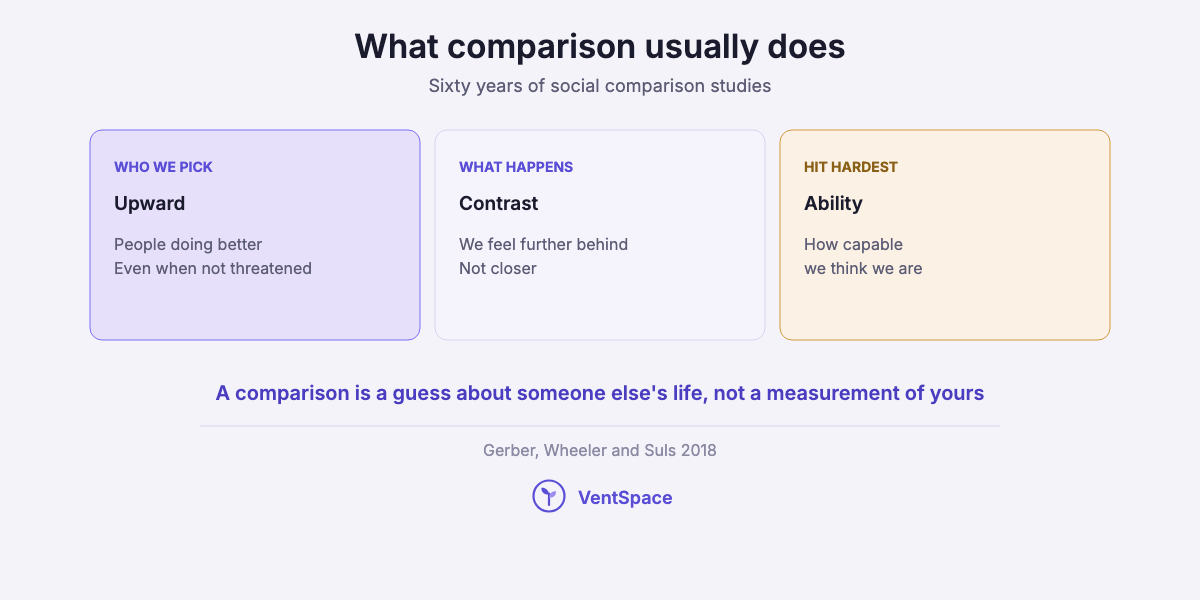
Why would we keep doing something that makes us feel worse? The authors raise exactly that question themselves. One reasonable reading, ours rather than theirs, is that comparison feels like information about where we stand, so it is hard to stop checking. Which comparisons do you make most often, and with whom?
Quick Summary
Q: Why am I so insecure?
A: Insecurity is usually learned, from things people said or did to us and from comparing ourselves with others. Research pooling sixty years of social comparison studies found people tend to compare upward and come away judging their own abilities as further behind. Knowing where a particular insecurity came from makes it easier to see as a reading rather than a fact.
Insight: Gerber, Wheeler and Suls, in Psychological Bulletin (2018): “For reaction studies, contrast was, by far, the dominant response to social comparison, with ability estimates most strongly affected.” The authors close by discussing “why people choose to compare upward when the most likely result is self-deflating contrast”. Self-deflating is their word, and it is the right one.
How to stop being insecure in a relationship
“Such unwarranted and unwanted insecurities were associated with less generous perceptions of partners and lower relationship well-being.” · Murray, Holmes and Griffin, Journal of Personality and Social Psychology (2000)
Insecurity in a relationship often comes from misreading how your partner sees you, and the fix starts with saying it once, plainly, instead of asking for reassurance again and again. But before anything else in this section, one thing needs saying.
If your relationship is not safe. If your partner monitors your phone or location, controls money or who you see, threatens you, puts you down, or you are afraid of what happens when you disagree, that is not your insecurity, and working on yourself is not the answer to it. That may be coercive control or abuse. In the US, the National Domestic Violence Hotline is free, confidential and open 24/7: call 1-800-799-7233 or text START to 88788. If you are in crisis or thinking about harming yourself, call or text 988. Outside the US, findahelpline.com lists local services.
Sai’s 2022 page said, “If you are insecure in your relationship, you are really just insecure with yourself.” We would put it more carefully: often, not always. The exception is the block above, and it comes first. With that said, the research does support the core of what he meant.
In their study of dating and married couples, Murray, Holmes and Griffin asked each person to describe themselves, their partner, and how they thought their partner saw them. People with low self-esteem dramatically underestimated how positively their partners saw them. That misreading went with seeing their partners less generously and with lower relationship well-being, and in dating couples followed over time, those vulnerabilities grew. The insecure feeling was not a window onto the partner’s mind. It was mostly a mirror. How often has your doubt about them turned out to be a doubt about you?
Then there is what insecurity makes us do. Asking for reassurance once is ordinary. Asking again and again is something researchers have measured. Starr and Davila pooled 38 studies with 6,973 people and found that excessive reassurance seeking was associated with depression (r = .32), and across 16 studies with being rejected by others (r = .14), a small association that was marginally stronger in romantic relationships. These are associations measured at the same moment, not proof of cause, and the authors list important caveats. But they match what many of us know from the inside: the reassurance helps for an hour, the doubt returns, and the other person starts to feel they can never say it enough.
So what do you do instead? Sai’s advice in 2022 was to “communicate your insecurities to your partner first”, and to work on them together. That is different from asking for reassurance. Reassurance seeking asks the other person to make the feeling go away. Telling them about the insecurity asks them to understand it. It might sound like this: “When you don’t reply for a few hours, I start telling myself you’re losing interest. I know that’s my old stuff. I’m not asking you to change anything, I just want you to know it’s there.” Can you hear the difference?
There is one more pattern Sai named that is worth keeping in his words: “Do not bring the insecurities from your past relationships into this relationship. It’s not fair to punish your current partner for the crimes committed by someone from the past.” If someone cheated on you before, the vigilance makes sense. It just belongs to a different person.
And if your insecurity has you checking your partner’s phone, or trying to limit who they see, be honest with yourself about it. That hurts the other person, whatever the feeling underneath. It is a good reason to talk to a therapist, not a reason for shame.
Quick Summary
Q: How do I stop being insecure in my relationship?
A: First check that the relationship is safe: monitoring, threats, put-downs and control are not your insecurity. If it is safe, notice that insecure partners often underestimate how positively they are seen, tell your partner about the insecurity once and plainly instead of asking for reassurance repeatedly, and keep past relationships out of this one.
Insight: Starr and Davila, in their meta-analytic review in the Journal of Abnormal Psychology (2008): “A meta-analysis of 38 studies (N = 6,973) revealed an aggregate effect size (r) of .32 between ERS and concurrent depression.” ERS is excessive reassurance seeking. Reassurance is not the problem. The loop of asking again is.
So where do you start?
How to stop being insecure, in five steps
“Self-compassion entails treating oneself with kindness, recognizing one’s shared humanity, and being mindful when considering negative aspects of oneself.” · Neff and Vonk, Journal of Personality (2009)
Five steps, in order, and the first two need a piece of paper. They are built on the exercise Sai did in 2022, with the research added where it helps. Do them over a week rather than in one sitting, if you can.
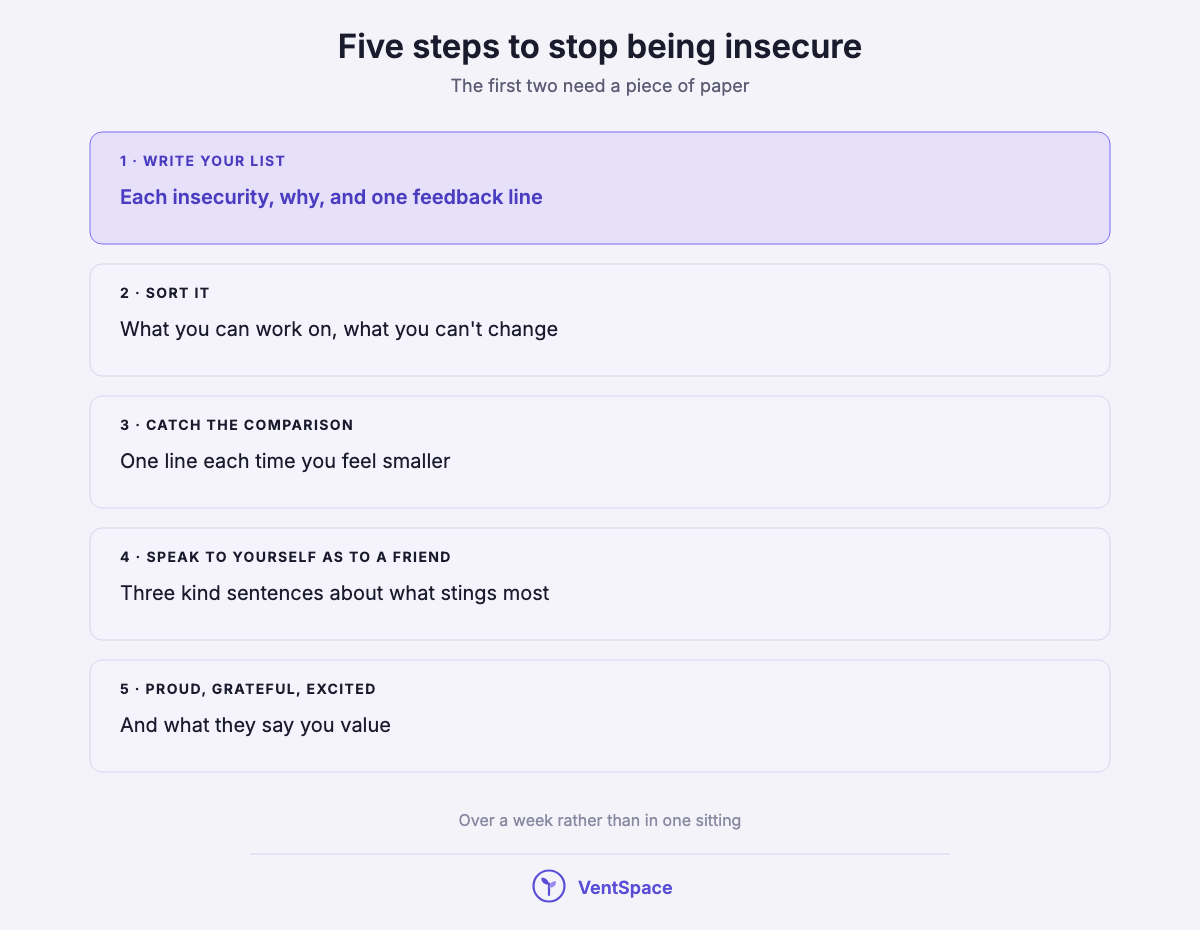
1. Write your list, then the feedback behind each one
Take a piece of paper and write “What do I feel insecure about?” List as many as you can. Then, for each one, ask “Why?” and write the answer. Finally, under each answer, write one line starting with “Feedback:”, the thing this insecurity might be asking you to do.
Here is what Sai’s looked like. We have kept it close to how he wrote it.
From Sai: my list in 2022
What I feel insecure about. My future, my body, and my relationship.
My future. I still am not very sure about my personal values, and I am not working toward them either. It makes me fear that I will never get to live any version of my dreams. Feedback: I need to work on my dreams.
My body. Even though I am fit, I look too lean. I am moving to Europe this year and I fear that I won’t look good. Feedback: I need to put on weight.
My relationship. I fear there will be a lot of disconnect between me and my partner, since I am moving to Europe. Feedback: work more on communicating with my partner.
Look at what the list does. Three vague worries became three sentences, and each sentence ends in something you could do. Some insecurities connect to each other, which is why Sai asked “why” for every one. Do any of yours share a root?
- What do you feel insecure about? List as many as you can.
- For each one, why? What happened, or what do you fear will happen?
- Which of them share a cause?
- What is each one asking you to do, if anything?
- Which “feedback” line feels true, and which sounds like someone else’s voice?
Be honest. Nobody else is reading this list. And if a “feedback” line comes out as a harsh rule about your body or your worth, treat that as a sign the insecurity is speaking, not the feedback.
2. Sort it into what you can work on and what you can’t change
Draw two columns: “I can work on this” and “I can’t change this.” Move each item from your list into one of them.
Sai’s 2022 page credited this split to Jocko Willink: insecurities “that we can attack” and insecurities “that we can’t attack”. For the first kind, the feedback line from step 1 becomes a plan. For the second kind, his advice was to accept it, and his own example was his skin. He could not change it. What changed was what he believed it meant. “Being dark doesn’t mean ugly” was not a decision to feel better. It was noticing that the belief had come from other people, and putting it down.
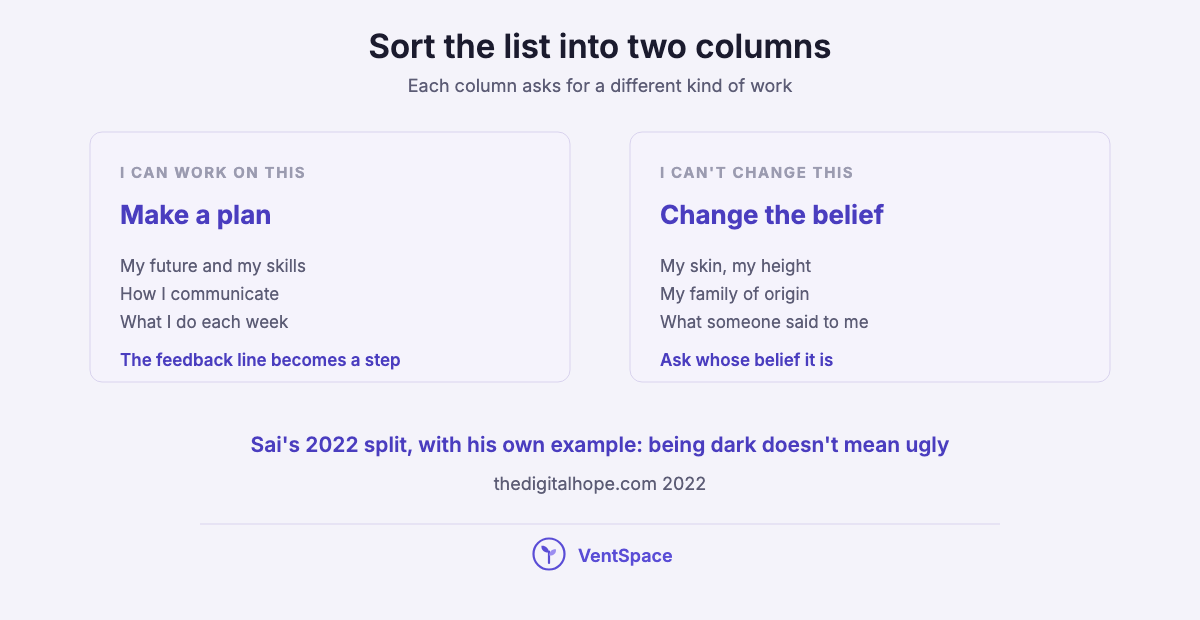
Your future, your skills, how you communicate: those usually go in the first column. Your height, your skin, your family of origin, what someone said to you at twelve: those go in the second. What sits in the second column is not a failure to improve. It is a different kind of task.
- Which items can you take one small step on this month?
- Which ones are about something you cannot change?
- For those, whose belief is it? Where did you first hear it?
- What would it mean to stop arguing with the second column?
Some items will refuse to sit in one column. That is fine. Your body might be partly in each. Split it into two lines.
3. Catch the comparison before it lands
For one week, every time you notice yourself feeling smaller, write down who you were just comparing yourself with, and on what. A friend’s promotion, a stranger’s body on your phone, a couple who seem happier. One line each.
Remember what the comparison research found: we lean toward comparing upward, and the usual result is feeling further behind, especially about our abilities. You cannot stop the comparisons from arising. You can stop treating them as measurements. A week of notes may show a pattern: the same two or three people, the same one or two areas. That pattern tells you which items from step 1 are about comparison rather than about you.
- Who did you compare yourself with today?
- Were they ahead of you, behind you, or level?
- What did you know about their life, and what were you guessing?
- Would you swap your whole life for theirs, or only the part you were looking at?
The goal is not to stop comparing. It is to notice that you did.
4. Speak to yourself the way you would speak to a friend
Pick the item from your list that stings most. Write two or three sentences to yourself about it as if you were writing to a close friend who had told you the same thing. Then read it back.
This is the core move of self-compassion, which Neff and Vonk define as kindness toward yourself, recognizing your shared humanity, and being mindful when considering your flaws. In their study, it went with steadier self-worth and less comparison. In a meta-analysis of 27 randomized trials, structured self-compassion programs produced moderate reductions in self-criticism (g = 0.56) and in depression (g = 0.66). Those were programs, often guided, not a single note, so one letter is a beginning rather than a treatment. And it is not a rival to self-esteem: a 2023 meta-analysis of 76 studies and 35,537 people found the two overlap heavily (r = 0.65) and each adds something the other does not.
- What would you say to a friend who felt this?
- Would you call them the names you call yourself?
- What do you know about them that makes you kinder?
- What is true about you that the insecurity leaves out?
If the kind version feels fake at first, write it anyway. You are practicing a voice, not reporting a feeling.
5. Ask what you are proud of, grateful for and excited about
Sai’s page ended with what he called a small test. Three questions, answered in writing, slowly: What would you feel proud of, if you let yourself? What are you grateful for? What are you excited about right now? Then, for each, ask what about it makes you feel that way.
From Sai: my answers in 2022
Proud. That I have been fit for the past seven years, and I love that. That I never gave up hope on my career path and am still running in the same direction I started in seven years ago. That I never gave up hope of finding love, despite having my heart broken. What I noticed: I am proud of things that involved a lot of hard work and discipline. I value hard work and things that aren’t easily attained. This was a huge realization.
Grateful. For my parents, family and friends. For having someone who loves me and is mature enough to give me space to live my life. For being healthy, and for having grown up in a free society.
Excited. That my childhood dream of living in Europe is about to come alive, and all the new experiences that brings.
Notice the line in the middle: “I value hard work.” The exercise did not only make him feel better. It told him something about what he values, which is the thing an insecurity is so often measuring against. What does your proud list say you value?
- What are you proud of, if you let yourself say it?
- What do those things have in common?
- What are you grateful for this week, specifically?
- What are you looking forward to, even a little?
This step is not about ignoring the list from step 1. It is about making sure the page holds more than the doubts.
Quick Summary
Q: How do I stop being insecure?
A: Write down what you feel insecure about and why, with one line of feedback for each. Sort the list into what you can work on and what you cannot change. Notice who you compare yourself with, speak to yourself the way you would to a friend, and write down what you are proud of, grateful for and excited about.
Insight: Muris and Otgaar, after pooling 76 studies in Psychology Research and Behavior Management (2023): “Self-esteem and self-compassion can best be seen as complementary concepts”. Their meta-analysis is also part of a running debate about how self-compassion is measured, which is worth knowing. The practical point stands: you do not have to choose between liking yourself and being kind to yourself.
Pulling it all together
The five steps are one path, and it can be walked in a week. Here is each as a single action you could write down today.
Write your list. The doubt is vague until it is on paper. Today, write three insecurities, a “why” for each, and one feedback line.
Sort it. Some of it is yours to work on and some is not. Today, draw the two columns and move each item.
Catch the comparison. Most of us compare upward without noticing. This week, write one line every time you feel smaller after looking at someone else.
Speak to yourself as to a friend. The harsh voice is a habit, not a fact. Today, write three kind sentences about the item that stings most.
Ask the three questions. Proud, grateful, excited. Tonight, answer them and look for what they say you value.
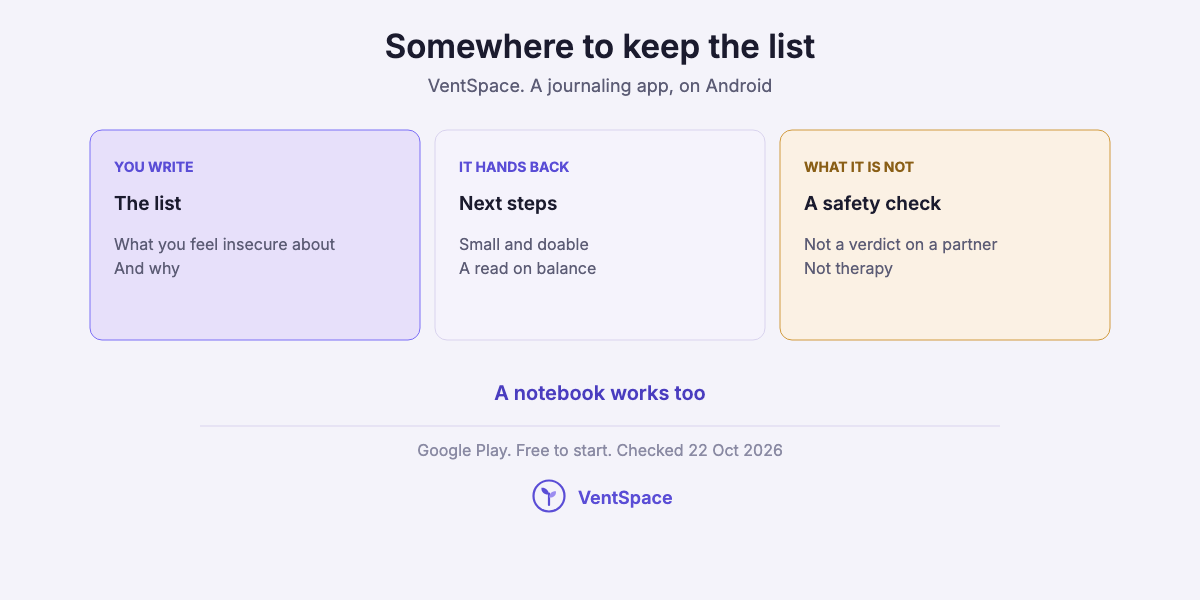
If you want somewhere to keep that list and come back to it, VentSpace, the journaling app we make, turns what you write into a clear read on your life balance, plus small, doable next steps. It is free to start, on Android, as of October 2026. Not on Android, or at a desk? VentSpace Live runs in your browser, free, with nothing to install. It will not tell you whether a relationship is safe, and it is not therapy. A notebook works too.
Quick Summary
Q: What is the first step to stop feeling insecure?
A: Write down what you feel insecure about, why, and what each insecurity might be asking you to do. A vague doubt becomes a few specific sentences, and you can then sort what you can work on from what you cannot change.
Questions people ask about insecurity
Do secure people never feel insecure?
No. Feeling secure is not the absence of doubt. Everyone has some insecurities, and the difference is usually whether the doubt runs the day. Research on self-worth suggests that worth which depends less on particular outcomes is steadier, which is a different thing from never wobbling.
Is insecurity the same as low self-esteem?
They overlap, but they are not the same. Insecurity is usually a doubt in one area, while self-esteem is a broader judgment of your worth, and someone can be confident in their abilities and still feel insecure about whether they are enough. There is a fuller comparison in self-esteem vs self-confidence.
How do I stop asking my partner for reassurance?
Tell them about the insecurity once, plainly, instead of asking them to fix it. Something like “when this happens, I start telling myself a story, and I want you to know that” asks for understanding, not proof. Research links repeated reassurance seeking with feeling worse, so the goal is to ask less often, not to stop needing your partner.
What if my partner says my insecurity is the problem?
Sometimes they are right, and sometimes it is a way of avoiding their own behavior. If they monitor you, control money or who you see, threaten you or put you down, that is not your insecurity. The safety note at the start of the relationship section above lists free, confidential help.
Can therapy help with insecurity?
Yes. Therapy is one option, and for a lot of people it’s the right one, especially when an insecurity is tied to something that happened to you or keeps repeating in relationships. If you are unsure, this guide to whether you need therapy works through the question without a quiz.
How long does it take to stop being insecure?
Nobody can give you a number, and no study we found offers one. The self-compassion research behind step 4 tested structured programs, not a single exercise. What tends to change first is not the feeling but what you do when it shows up.
In a nutshell
Insecurity tells you something about how you are measuring yourself, and far less about how you measure up.
Two things to take with you. First, an insecurity is a reading, and readings can be wrong, often in the same direction: insecure partners underestimate how they are seen, and comparison makes us feel further behind than we are. Second, the honest timeline: nobody can tell you when the feeling will stop, and it may turn up again in new places. What you can change this week is how you answer it, on paper, one line at a time.
Today, write down three things you feel insecure about. Which one would you put in the “can’t change” column, and whose voice told you it mattered?
About this article

Written by
Sai Subramaniam
Founder, VentSpace
I write these guides because I have been where you are. I am working through my own hard seasons, and I share the things that actually helped me, so that anyone going through it has a steady companion close by instead of facing it alone. VentSpace is the app I built for exactly that: a journaling app that turns what you write into a clear read on your life balance, plus small, doable next steps toward feeling more like yourself.
This writing is honest and every claim is sourced, and it is not a substitute for professional care. If you are struggling, reaching out to a professional is a strong move, not a failure.
Explore VentSpaceTry VentSpace LiveHow this one was checked. Every factual claim traces to a named source, and the source is printed next to the claim rather than kept in a footnote. Quotes are pinned to the work they come from, with the year, the letter or the chapter where one exists. Where a widely repeated claim could not be traced, it was left out and the omission recorded. Where a figure is contested, both sides are printed.
No affiliate links, no paid placements, and nobody paid to appear here. Where we mention our own app, we say that it is ours, we state its limits, and we never position it as a substitute for care.
Reviewed: October 2026. Prices, platforms and product availability move quickly, and anything we could not verify at the time of writing is marked as unverified rather than turned into a number.
Corrections. If something here is wrong, we would rather know. Corrections are made in place, with a note saying what changed.