
“One problem is an unfortunate semantic ambiguity with the word “jealousy” (but NOT with the word “envy”).”
Richard H. Smith, social psychologist, “What Is the Difference Between Envy and Jealousy?”, Psychology Today, 2014
A friend gets the job we wanted, and we say we are jealous. A partner mentions a new colleague twice in one evening, and we say we are jealous. Same word, and we rarely notice that we have used it for two different experiences.
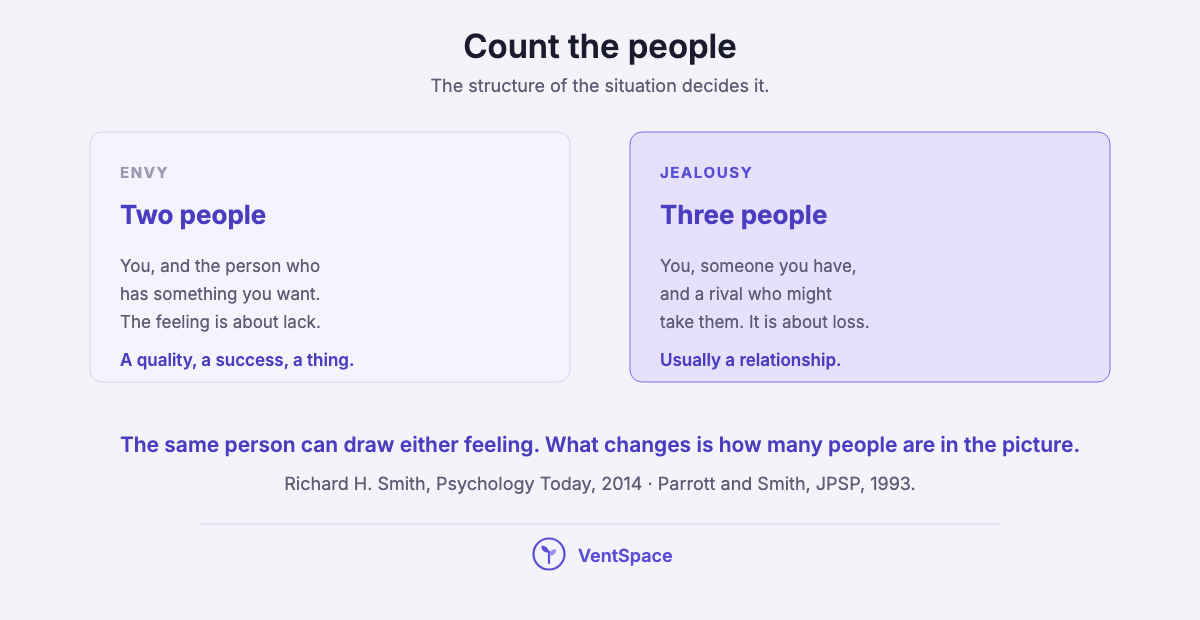
Here is the difference between envy vs jealousy, stated plainly. Envy is wanting something someone else has. Jealousy is fearing you will lose something you have, usually a person, to someone else. Envy needs two people: you and the one who has it. Jealousy needs three: you, the person you could lose, and the rival. English lets “jealous” cover both, which is one source of the confusion. Neither feeling is a verdict on the person having it.
The short version
Envy is about lack. It arrives when someone else has a quality, a success or a thing we want.
Jealousy is about loss. It arrives when something we have, usually a relationship, seems threatened by a third person.
They feel different from inside. In experiments, envy carried inferiority, longing, resentment and disapproval of the feeling itself. Jealousy carried fear of loss, distrust, anxiety and anger.
“Jealous” is the ambiguous word. People use it for both. “Envious” does not carry the same ambiguity, in Smith’s account.
Whether envy can be “benign” is argued. Some researchers split it in two. Others say the split confuses the feeling with what we do next.
The test takes a minute: count the people, then ask whether it is something you lack or something you could lose.
Envy and jealousy side by side
| Envy | Jealousy | |
|---|---|---|
| People involved | Two: you and the person who has it | Three: you, the person you could lose, and a rival |
| What is at stake | Something you lack | Something you have and fear losing |
| What it felt like in experiments | Inferiority, longing, resentment, disapproval of the feeling itself | Fear of loss, distrust, anxiety, anger |
| Usual object | A quality, success or possession | A relationship or someone’s attention |
| Betrayal? | Usually not, in Smith’s account | Can be central, as in his Othello example |
| How English uses the word | “Envious” points to envy | “Jealous” is used for both |
What envy is
Envy is the feeling of lacking something another person has, and minding. In a 2007 review in Psychological Bulletin, the psychologists Richard H. Smith and Sung Hee Kim concluded that envy “is reasonably defined as an unpleasant, often painful emotion characterized by feelings of inferiority, hostility, and resentment caused by an awareness of a desired attribute enjoyed by another person or group of persons.”
The object can be almost anything: a talent, a salary, an easy confidence, a family that seems to work. What makes it envy is the comparison. There are two people in the picture, and one of them has what the other wants.
The same review distinguishes “envy proper”, which contains hostile feelings, from what researchers call benign envy, which is free of them. We will come back to whether that distinction holds.
Quick Summary
Q: What is envy?
A: Envy is an unpleasant, often painful feeling of inferiority and resentment caused by seeing another person enjoy something we want, in the definition Smith and Kim gave in a 2007 review. It involves two people: the one who has it and the one who wants it.
What jealousy is
Jealousy is the feeling that something we already have is under threat from someone else. In Smith’s own short definition, “Jealousy occurs when something we already possess (usually a special relationship) is threatened by a third person.”
The thing at stake is usually a relationship: a partner, a close friend, a parent’s attention, a mentor’s favor. What makes it jealousy is the rival. There are three people in the picture, and the fear is about losing one of them to another.
This is one place the two feel different. Smith notes that envy, “as unpleasant as it can be, usually doesn’t contain a sense of betrayal and resultant outrage”. His example of jealousy is Othello, who believes he has been betrayed for a rival.
Quick Summary
Q: What is jealousy?
A: Jealousy is the fear of losing something we already have, usually a relationship, to a third person. It involves three people, and unlike envy it can carry a sense of betrayal.
Two people or three
The cleanest way to tell them apart is to count the people in the situation. Smith puts the two definitions side by side: “Envy occurs when we lack a desired attribute enjoyed by another.” Jealousy, by contrast, needs a third person to threaten something we already have.
That sounds like a technicality until we try it on a real evening. The friend with the job is two people: we want what she has. The partner and the colleague is three people: we fear losing someone to someone. The count can settle it in a few seconds, which is more than can be said for staring at the feeling itself.
It also explains why the same person can make us feel either one. A sibling who is admired for a talent we lack draws envy. The same sibling drawing a parent’s attention away from us draws jealousy. The person has not changed. The structure of the situation has.
Quick Summary
Q: What is the main difference between envy and jealousy?
A: Envy involves two people: you want something another person has. Jealousy involves three: you fear losing something you have, usually a relationship, to a rival. Counting the people in the situation is a quick way to tell which one it is.
Insight: the two definitions together
“Envy occurs when we lack a desired attribute enjoyed by another.” And: “Jealousy occurs when something we already possess (usually a special relationship) is threatened by a third person.” Richard H. Smith, a social psychologist who taught at the University of Kentucky, Psychology Today, 2014.
What does each one feel like inside?
They are different experiences, not two names for one. In 1993, W. Gerrod Parrott and Richard H. Smith published two experiments in the Journal of Personality and Social Psychology designed to separate them. In one, people recalled a time they had felt envy or jealousy. In the other, people read stories in which the circumstances for each were varied independently.
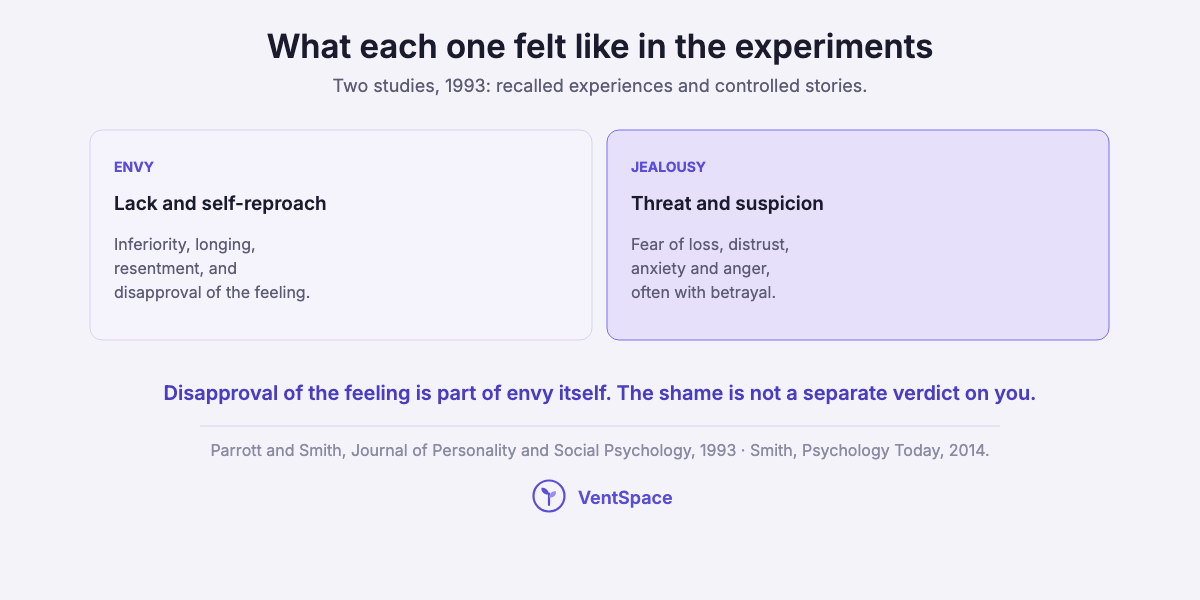
Both experiments found what the authors called qualitative differences. In their abstract: “Envy was characterized by feelings of inferiority, longing, resentment, and disapproval of the emotion. Jealousy was characterized by fear of loss, distrust, anxiety, and anger.”
One item on the envy list deserves a pause. Disapproval of the emotion. Envy is the feeling we tend to judge ourselves for having, which may be one reason we reach for the softer-sounding “jealous” instead. If the pang came with a small wave of disapproval at yourself, that fits what people in the experiments reported, and it is not evidence that we are worse than anyone else. The disapproval is part of the feeling, not a separate judgment on us.
Quick Summary
Q: How does envy feel different from jealousy?
A: In two experiments published in 1993, Parrott and Smith found envy characterized by inferiority, longing, resentment and disapproval of the emotion itself. Jealousy was characterized by fear of loss, distrust, anxiety and anger.
Insight: the study that drew the line
“This article describes the nature and significance of the distinction between the emotions of envy and jealousy and reports 2 experiments that empirically investigated it.” W. Gerrod Parrott and Richard H. Smith, “Distinguishing the experiences of envy and jealousy”, Journal of Personality and Social Psychology, 1993. Only the abstract was available to us, so the sample sizes are not printed here.
What does each one make you want to do?
Here the research is genuinely divided, and the honest page says so. One group of researchers argues that envy comes in two kinds. Niels van de Ven, Marcel Zeelenberg and Rik Pieters, in three studies published in Emotion in 2009, reported that “benign envy leads to a moving-up motivation aimed at improving one’s own position, whereas the experience of malicious envy leads to a pulling-down motivation aimed at damaging the position of the superior other.” They found both experiences in the Netherlands, where Dutch has separate words for them, and in the United States and Spain, where one word covers both.
A later set of four studies (1,094 people in total) included one with marathon runners, in which a tendency toward benign envy predicted faster race times through higher goal setting, and a tendency toward malicious envy predicted giving up on race goals (Lange and Crusius, 2015).
Other researchers think the split is a mistake. Yochi Cohen-Charash and Elliott C. Larson argued in 2017 that studying “benign” and “malicious” envy “involves confounding envy with its outcomes”, and concluded that the distinction “is unwarranted”. On their view there is one feeling, and what we do with it depends on the person and the situation.
We are not going to settle that, and nobody needs to before deciding what to do on a Tuesday. What both sides agree on is that envy can be followed by widely different actions. That is a description of choices, not a ranking of feelings. Jealousy, in Smith’s account, carries a sense of betrayal and outrage that envy usually lacks.
Quick Summary
Q: Can envy be a good thing?
A: Researchers disagree. Some describe a “benign” envy that pushes people to improve their own position and a “malicious” envy that pushes them to pull the other person down. Others argue this confuses the feeling with what people do next. Both sides agree that envy can be followed by widely different actions.
Insight: the case against splitting envy
“We suggest that studying ‘benign’ and ‘malicious’ envy involves confounding envy with its outcomes, which causes confusion and impairs the understanding of envy.” Yochi Cohen-Charash and Elliott C. Larson, “An Emotion Divided”, Current Directions in Psychological Science, 2017.
Why English blurs them
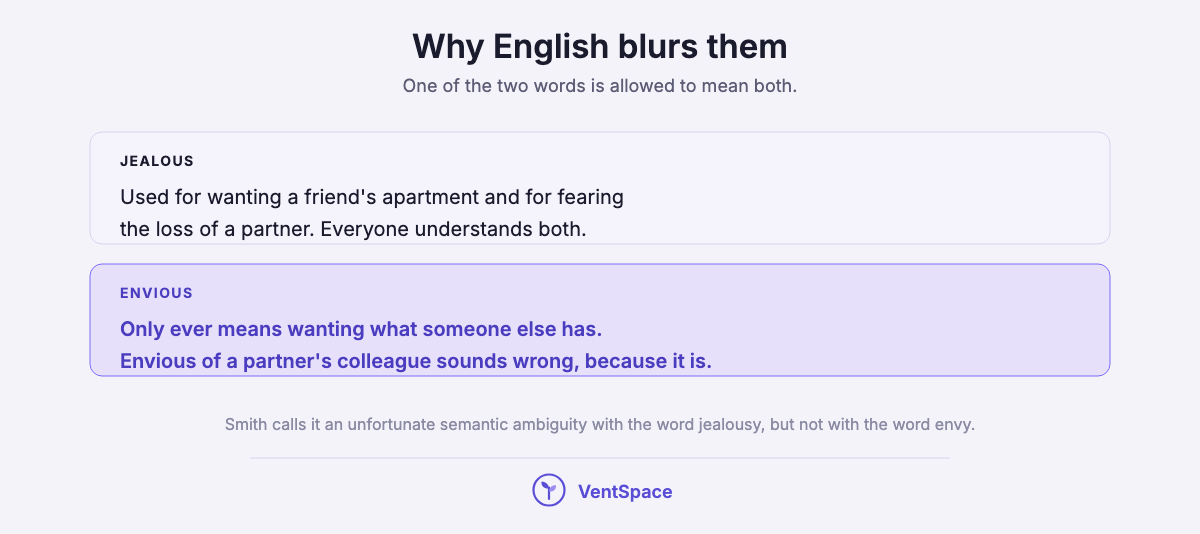
Because “jealous” is allowed to mean both, and “envious” is not. Smith calls it “an unfortunate semantic ambiguity with the word “jealousy” (but NOT with the word “envy”).” When someone says they are jealous of a friend’s new apartment, they mean envy, and nobody corrects them. When someone says they are envious, nobody wonders whether they mean the fear of losing a partner.
There is a second reason the two get tangled, which is that they often arrive together. Smith again: “when you are feeling jealous, you are often feeling envious as well.” If we fear losing a partner to someone, we may also envy that person’s looks, ease or success. The jealousy is about the relationship. The envy is about the rival.
So the confusion is not careless. It is built into the language and into the situations themselves.
Quick Summary
Q: Is it “jealous of” or “envious of” someone’s success?
A: Envious is the precise word, because wanting someone’s success is envy. “Jealous of” is used widely in everyday English for the same meaning, which is the ambiguity Richard H. Smith describes. “Envious” is not normally used for the fear of losing a relationship.
Insight: why they arrive together
“This means that when you are feeling jealous, you are often feeling envious as well.” Richard H. Smith, Psychology Today, 2014. The two feelings can share a single evening and still be two feelings.
How to tell which one you are feeling
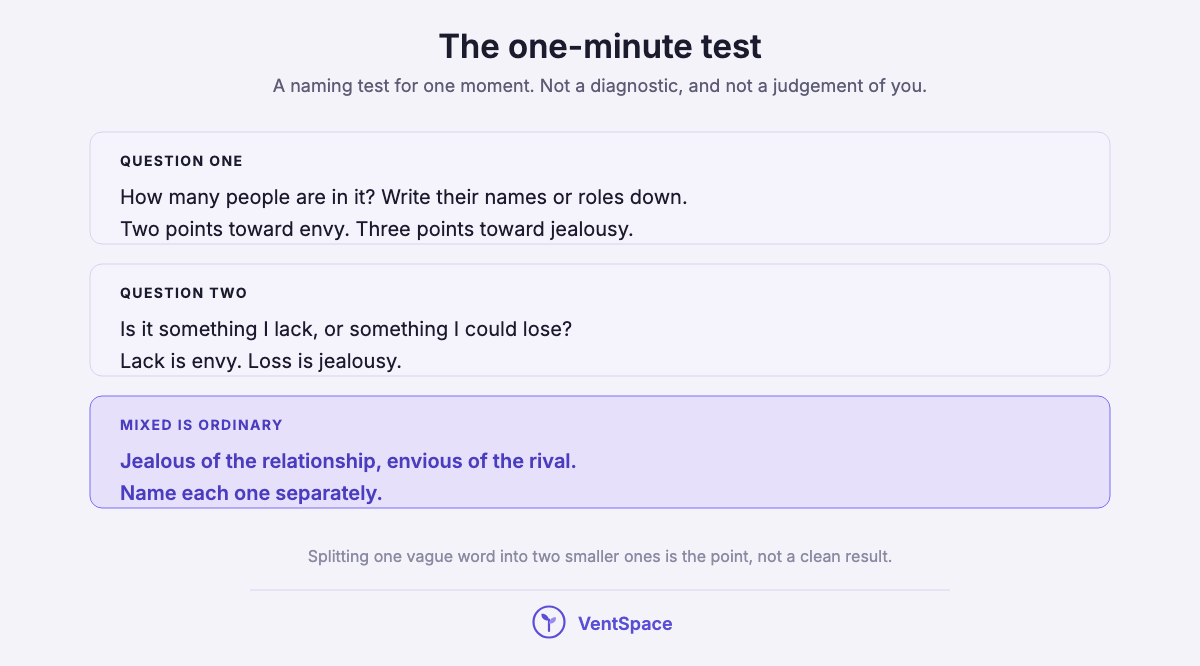
This is not a diagnostic, and it says nothing about what kind of person you are. It is a naming test for one moment, built from the two-and-three-person distinction.
Think of the moment the feeling arrived, then answer two questions.
1. How many people are in it? Write their names or roles down. You and one other person points toward envy. You, someone you have, and a third person points toward jealousy.
2. Is it something I lack, or something I could lose? Lack is envy. Loss is jealousy.
Then read what you wrote.
- Two people, something you lack. Envy. Name the specific thing: not “her life” but the promotion, the ease at parties, the paid-off loan.
- Three people, something you could lose. Jealousy. Name what you fear losing: time, attention, closeness, first place in someone’s day.
- Three people, and you also want what the rival has. Both, which Smith describes as common. Name each separately.
- You cannot tell, or nothing fits. That is a legal answer. Some pangs are about a whole situation rather than a person, and the words will not always sort them.
Mixed is ordinary. Splitting the vague word into two smaller ones is the point of the test, not getting a clean result.
If you want somewhere to write it. If you would rather write the count down than hold it in your head, VentSpace is a journaling app that turns what you write into a clear read on your life balance, plus small, doable next steps. It is ours, so read this as a declared interest. Android only and free to start as of October 2026, with no published evidence on outcomes, and it is not therapy. Not on Android, or at a desk? VentSpace Live runs in your browser, free, with nothing to install.
Quick Summary
Q: How do I know if I am jealous or envious?
A: Count the people in the situation and ask whether it is something you lack or something you could lose. Two people and a lack is envy. Three people and a possible loss is jealousy. Both at once is common. This is a naming test, not a diagnostic.
What to do in each case
If it was envy, make it specific before doing anything with it. “I envy her” is too large to act on. “I envy that she asked for the raise” is a sentence with something in it. Sometimes the specific thing points at something we want and could work toward. Sometimes it points at something we cannot have, and then the honest move is to notice that, not to manufacture a plan. Neither result makes the envy wrong to have. If envy has settled into a long, bitter comparison with one person that keeps returning, that is worth talking through with someone, and a therapist is a legitimate choice.
If it was jealousy, separate the fear from the evidence. Write down what happened, in plain terms, and then what you fear it means. Keeping the two lists apart is most of the exercise. If the fear is about a partner, a calm conversation about what you need is a better first step than an investigation. Our piece on insecurity is a related read if the fear is a familiar one.
Therapy is one option. For a lot of people it’s the right one, especially when the same feeling keeps returning in the same shape. Our guide on whether you need therapy offers a question with an answer in it rather than a checklist.
Quick Summary
Q: What should I do when I feel envious or jealous?
A: For envy, name the specific thing you want, then notice whether it is something you could work toward or something you cannot have. For jealousy, write down what happened and, separately, what you fear it means. If either keeps returning, talking to a therapist is a legitimate option.
Where the line blurs
The two feelings blur into each other, and jealousy can blur into something that is no longer a feeling at all.
The first blur is ordinary. As Smith notes, jealousy often carries envy inside it, and a single evening can hold both. Naming them separately does not make either go away. It makes each one smaller and easier to look at.
The second blur matters more. A jealous feeling is not the same as controlling behavior. Checking someone’s phone, restricting who they see, demanding to know where they are at all times, or making threats are not ways of managing a feeling. If that describes what you are doing, it is worth getting help with it. If it describes what is being done to you, it is not a naming question, and nothing on this page is the right tool.
If a relationship involves coercive control, monitoring or threats, the National Domestic Violence Hotline is available in the US at 1-800-799-7233 (800-799-SAFE), or text START to 88788. If you’re in crisis or thinking about harming yourself, call or text 988 (US), or find a line in your country at findahelpline.com. This article is not a substitute for that.
Quick Summary
Q: When is jealousy a problem?
A: Jealousy is a feeling, and having it is not a problem in itself. It becomes a different matter when it turns into checking, restricting, monitoring or threatening someone. That is behavior, not emotion. If it is being done to you, the National Domestic Violence Hotline (1-800-799-7233) is one place to start.
Questions people ask
Is it “jealous of” or “envious of” someone’s success?
“Envious of” is the precise phrase, because wanting someone’s success is envy. “Jealous of” is common in everyday speech and widely understood. The reverse rarely works: “envious” is not the word people reach for when they fear losing a relationship.
Is envy always a bad emotion?
No verdict on a feeling holds up well here. Envy is unpleasant by definition, and people tend to disapprove of themselves for it, as Parrott and Smith found. But researchers disagree about whether it comes in a “benign” form, and both sides agree it can be followed by widely different actions. Having it says nothing final about you.
Can you feel envy and jealousy at the same time?
Yes, and Richard H. Smith describes it as common. Jealousy is about the relationship you fear losing, and envy is often about the rival’s qualities. Naming each one separately makes each easier to look at than treating them as a single feeling.
Is jealousy a sign of love?
It is a sign that something matters to you and feels at risk, which is what jealousy is about. It is not a measure of how much someone is loved, and it never justifies controlling another person.
What is benign envy?
It is a term some researchers use for envy without hostility, which they link to wanting to improve one’s own position (van de Ven, Zeelenberg and Pieters, 2009). Other researchers argue the term confuses envy with what people choose to do next (Cohen-Charash and Larson, 2017). It is a live argument, not a settled category.
Two things worth keeping
The first is the count. Two people and something we lack is envy. Three people and something we could lose is jealousy. It takes less than a minute, and it turns one vague, slightly shameful word into two smaller and more honest ones.
The second is about what naming can and cannot do. Knowing which feeling it is does not make it leave, and the researchers have not agreed on whether envy has a useful side. What naming does is let us look at the feeling instead of from inside it, which is slower work than any test suggests and may have to be done more than once.
Therapy is one option, and for a lot of people it’s the right one. A pen and a count of the people in the room is another.
About this article

Written by
Sai Subramaniam
Founder, VentSpace
I write these guides because I have been where you are. I am working through my own hard seasons, and I share the things that actually helped me, so that anyone going through it has a steady companion close by instead of facing it alone. VentSpace is the app I built for exactly that: a journaling app that turns what you write into a clear read on your life balance, plus small, doable next steps toward feeling more like yourself.
This writing is honest and every claim is sourced, and it is not a substitute for professional care. If you are struggling, reaching out to a professional is a strong move, not a failure.
Explore VentSpaceTry VentSpace LiveHow this one was checked. Every factual claim traces to a named source, and the source is printed next to the claim rather than kept in a footnote. Quotes are pinned to the work they come from, with the year, the letter or the chapter where one exists. Where a widely repeated claim could not be traced, it was left out and the omission recorded. Where a figure is contested, both sides are printed.
No affiliate links, no paid placements, and nobody paid to appear here. Where we mention our own app, we say that it is ours, we state its limits, and we never position it as a substitute for care.
Reviewed: October 2026. Prices, platforms and product availability move quickly, and anything we could not verify at the time of writing is marked as unverified rather than turned into a number.
Corrections. If something here is wrong, we would rather know. Corrections are made in place, with a note saying what changed.