
The work list, the reply you owe, the thing with your sister, the bill. They all arrived this week, and none of them has been written anywhere. Every time you try to think about one, three others push in.
A brain dump is the plain answer to that: get everything out of your head and onto one page. This version takes ten minutes. Five to get it out, one item per line. Five to sort it, so every line ends up as a task, a worry or nothing at all.
Why the second five minutes?
Because the first half is the easy half, and it is the half with the least evidence behind it.
The short version
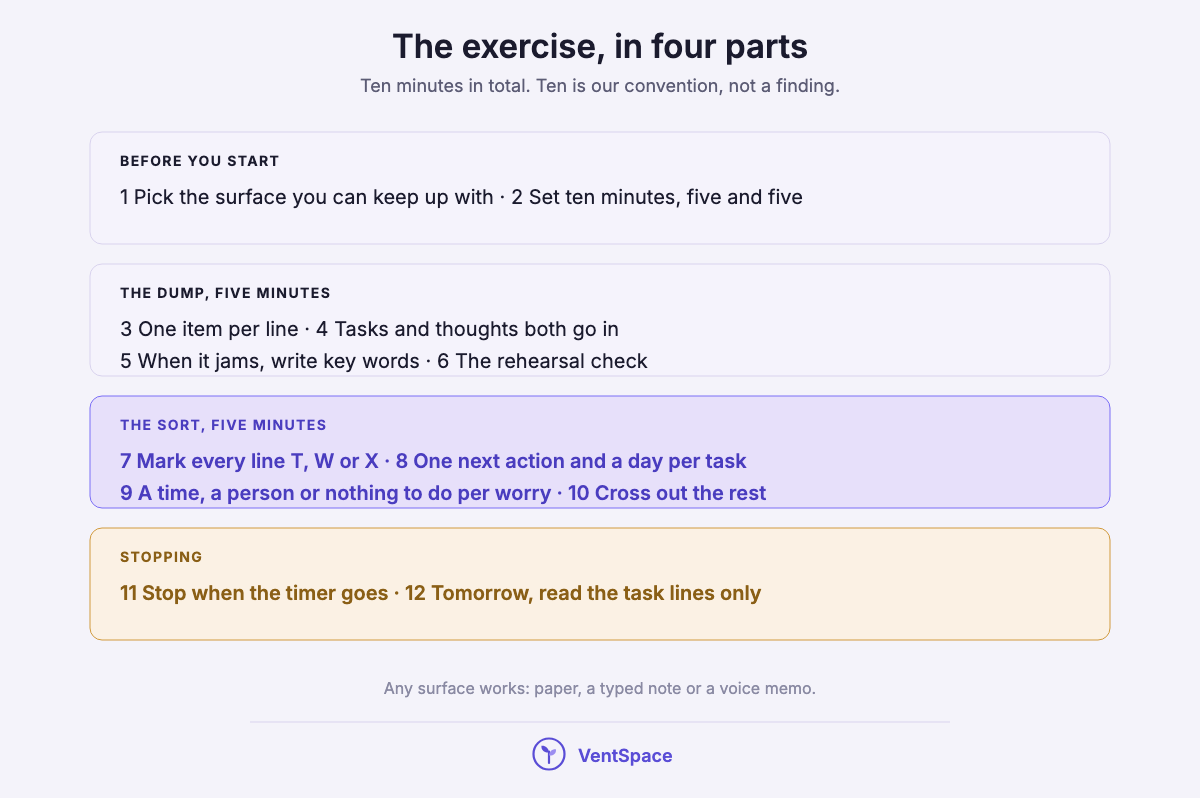
Ten minutes, twelve steps, one page. Five minutes to dump, five to sort.
Any surface works. Paper, a typed note or a voice memo. The research found no difference by mode.
The sort is the point. Every line gets marked as a task, a worry or neither, and each task gets one next step.
Stop if it starts repeating. The same thing, in the same words, for the third time, is a signal to stop.
A brain dump is a capture, not a cure. Nothing here is shown to empty your head or lower anxiety.
What this exercise is for, and what it is not. It is for a head full of mixed tasks and worries on an ordinary bad week. It is not sleep advice, it is not a way to work through something painful from your past, and it is not for a crisis.
The exercise on one card
Copy this onto paper or keep it open on your phone. Each step is explained underneath.
| # | Step | Time |
|---|---|---|
| 1 | Pick the surface you can keep up with | Under 1 min |
| 2 | Set ten minutes, split into five and five | Under 1 min |
| 3 | One item per line | Dump, 5 min in total |
| 4 | Tasks and thoughts both go in | (same 5 min) |
| 5 | When it jams, write key words | (same 5 min) |
| 6 | The rehearsal check | (same 5 min) |
| 7 | Mark every line T, W or X | Sort, 5 min in total |
| 8 | One next action and a day for each task | (same 5 min) |
| 9 | A time, a person or “nothing to do” for each worry | (same 5 min) |
| 10 | Cross out the rest | (same 5 min) |
| 11 | Stop when the timer goes | At 10 min |
| 12 | Tomorrow, read the task lines only | 1 min, next day |
Quick Summary
Q: How do you do a brain dump?
A: Set a timer for ten minutes. For the first five, write everything on your mind, one item per line, tasks and worries together. For the second five, mark each line as a task, a worry or neither, give each task one next action and a day, and stop when the timer goes.
How the exercise is built
- Time-boxed on both halves. Five minutes out, five minutes sorting. Ten is our convention, not a research finding.
- One line, one item. So the sort has something to work on.
- Three marks, no ratings. Task, worry or neither. Nothing gets scored.
- What we left out. Open-ended writing with no check. The pages we read ask you not to filter, and none includes a check for when the writing starts repeating. For anyone whose thoughts tend to circle, that is the riskiest version. Also left out: any list of apps.
Before you pick up the pen, three questions to answer in your head:
- Is the pile mostly things to do, or mostly things to worry about?
- Do I have ten minutes now, or should I set a time later today?
- What would a good page look like at the end?
Before you start
1. Pick the surface you can keep up with
If your thoughts come faster than your pen, the pen is the wrong tool for today. Pick the surface you can keep up with, not the one that looks right. In the largest meta-analysis of this kind of writing, 146 randomized studies, “the mode of disclosure (hand writing, typing, talking) did not significantly moderate the effect for any of the outcome types” (Frattaroli, 2006). Those studies were about writing on difficult events, not to-do lists, but the point carries: nothing we found shows paper beats a phone. Which one is already in your hand?
Do this:
1. Choose paper, a typed note or a voice memo.
2. If typing, open one blank note, not a document with headings.
3. If speaking, record into your phone and plan to type the lines up at step 7.
| Time | Under a minute |
| You need | Paper and pen, or your phone |
| Best for | Anyone whose thoughts outrun their handwriting |
| What it will not do | Make one surface better than another. The research found no difference by mode, which is not proof that none exists |
2. Set ten minutes, split into five and five
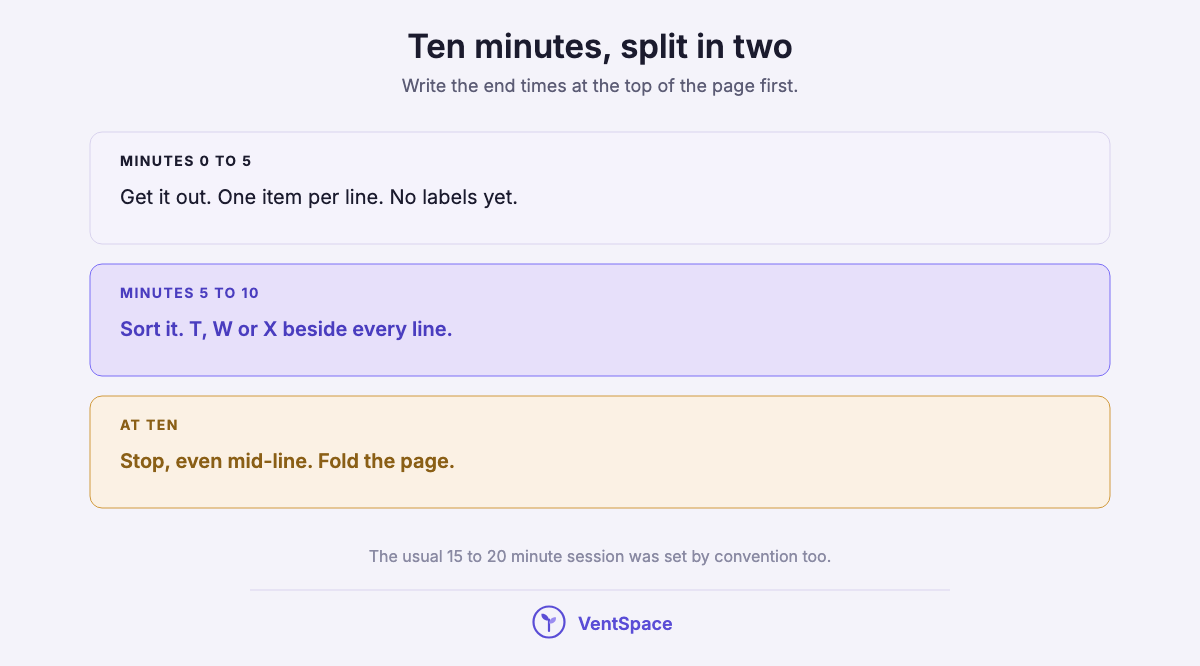
A brain dump with no end can turn into an evening. So set the clock first. Is ten minutes enough? No study we found sets the right length for this. Two researchers who went looking for the basis of the usual fifteen-to-twenty-minute writing session concluded it “has been driven primarily by convention rather than empirical evidence” (Burton and King, 2008). Our ten minutes is a convention too, and we say so. The split is the design choice that matters here: the sort gets its own five minutes, so it is not the thing left over at the end.
Do this:
1. Set a timer for five minutes.
2. Write the time it will end at the top of the page.
3. Below that, write “sort at” and the time five minutes later.
| Time | Under a minute |
| You need | A timer |
| Best for | Every brain dump, every time |
| What it will not do | Prove that ten minutes is right. It is a usable convention, not a finding |
Quick Summary
Q: How long should a brain dump take?
A: There is no researched answer. This exercise uses ten minutes, five to write and five to sort, as a convention. Two researchers who tested a two-minute version wrote that the standard fifteen-to-twenty-minute writing session was set by convention too.
The dump
3. One item per line
Start the timer and write. The only rule is the line: one item, one line, then a new line. “Email Dana about Thursday” is a line. “The thing with work” is a line too, even if it is vague. Do not write paragraphs, because a paragraph hides four items inside one and the sort cannot separate them later. Short is better than complete. If a line needs more, write the shortest version that will still mean something to you tomorrow, and move on. What is the next thing pushing in?
Do this:
1. Start the five-minute timer.
2. Write one item, then start a new line.
3. Keep each line under about ten words.
4. If a line turns into a paragraph, break it into lines.
| Time | Part of the five-minute dump |
| You need | The page |
| Best for | A pile with lots of small, mixed items |
| What it will not do | Make the items smaller. It only makes them separate, so step 7 can sort them |
4. Tasks and thoughts both go in
The brain dump guides we read treat the page mostly as a to-do list. Yours is probably not one. The pile in a full head is mixed: errands next to a worry about your mother, a deadline next to a conversation you keep replaying. Put all of it on the page in whatever order it arrives. Do not stop to decide which kind each line is, because that is the sort’s job and doing it now slows the dump down. Do not leave a worry off because it does not feel like a “real” item. Does it keep coming back? Then it gets a line.
Do this:
1. Write each item as it arrives, task or thought, in any order.
2. Do not label anything yet.
3. If you notice you are skipping something, write it as one line anyway.
| Time | Part of the five-minute dump |
| You need | The page |
| Best for | A head where worries and errands are tangled together |
| What it will not do | Settle any of the worries. It only puts them where you can see them |
5. When it jams, write key words
Sometimes the page jams not because there is nothing to write, but because there is too much. A participant in a 2022 Norwegian study of writing in a therapy program put it this way: “I was incapable of writing because of the chaos I felt inside me.” The same program taught simple ways around it, including “only writing key words”. That is the move here. If a whole sentence will not come, write one or two words that stand for the thing. A key word is a full line. Can you name it in one word?
Do this:
1. When you stall, write one or two key words for the next item.
2. If nothing comes, write the last word you thought of.
3. Keep the pen or cursor moving until the timer goes.
| Time | Part of the five-minute dump |
| You need | The page |
| Best for | A page that will not start because there is too much |
| What it will not do | Unblock what is underneath. The study describes a workaround that participants used, not a measured fix |
6. The rehearsal check
Some brain dumps stop being a dump and become a lap. The same worry comes out again, then again, slightly reworded, and the page fills with one thing. Here is the check. Are you finding out something, or saying the same thing again in different words? If the same material is arriving in the same words, in the same order, for the third time this week, more free writing is not the answer. Structure is. That means moving straight to the sort, or stopping. This is a check on the page, not a verdict on you.
Do this:
1. Glance at the page. Is one item written three or more times?
2. If yes, draw a box around the repeats and write “same” next to the box.
3. Stop the dump there and go to step 7, even if time is left.
| Time | Under a minute, any time during the dump |
| You need | The page |
| Best for | A worry that keeps coming out in the same words |
| What it will not do | Stop the worry. It stops the page from feeding it, which is a smaller thing |
If you’re in crisis or thinking about harming yourself, please contact the 988 Suicide & Crisis Lifeline now (US, call or text 988), or find a line in your country at findahelpline.com. A brain dump is not a substitute for that help.
The sort
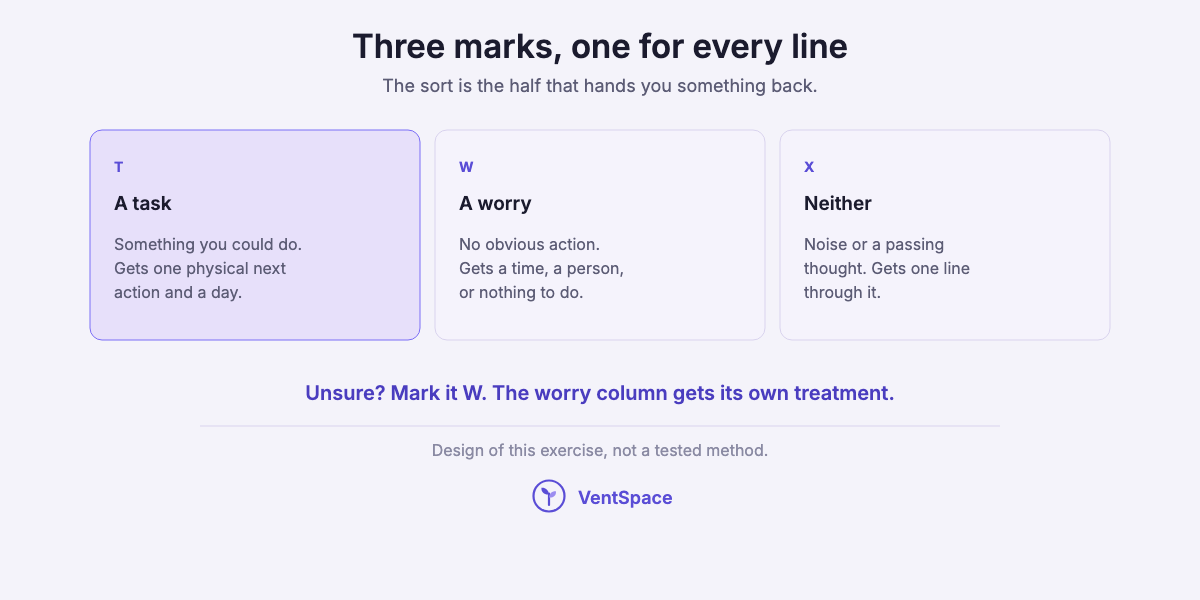
7. Mark every line T, W or X
The timer goes, and the second five minutes start. Read down the page once and put one letter beside each line. T means a task: something you could do. W means a worry: something you are thinking about that has no obvious action. X means neither: noise, a passing thought, something that is not yours to carry today. Do not agonize over borderline lines. If you are unsure, mark it W, because the worry column gets its own treatment at step 9. How many Ts are there?
Do this:
1. Reset the timer for five minutes.
2. Read each line once and write T, W or X beside it.
3. If you dumped into a voice memo, type the lines up first, then mark them.
| Time | Part of the five-minute sort |
| You need | The page and a pen in a second color, if you have one |
| Best for | Every dump |
| What it will not do | Tell you what matters most. The letters say what kind of item each line is, not its rank |
8. One next action and a day for each task
Unfinished tasks have a way of following people home. In a 2026 meta-analysis, unfinished work tasks were linked with more work-related thoughts in time off, and the link was strongest for rumination, across 2,473 people in between-person studies and 12,129 in within-person studies (Wendsche, Weigelt and Syrek). That link is correlational. Nobody we could read has shown that writing a plan ends the thinking. What a next action does give you is a task you can start, instead of a task you can only worry about. What is the first physical step?
Do this:
1. Next to each T, write the first physical action: “open the form”, not “deal with taxes”.
2. Add a day.
3. Move any T with a day this week into your calendar now.
| Time | Part of the five-minute sort |
| You need | The page and your calendar |
| Best for | Tasks that have sat undone for days |
| What it will not do | Guarantee the thinking stops. The research links unfinished tasks with more thinking, and does not show a plan ends it |
9. A time, a person or “nothing to do” for each worry
Worries cannot be ticked off, so they need a different outcome. Each W gets one of three answers. A time, if it is something to think about properly later. A person, if it is something to say to someone. Or “nothing to do”, if there is honestly no action available. That third answer is allowed, and it is information: a worry with nothing to do is not going to be solved by another lap of the page. Which of the three fits this one?
Do this:
1. Next to each W, write a time, a name, or “nothing to do”.
2. If it is a time, make it a specific one this week.
3. If it is a name, write the one sentence you would say to them.
| Time | Part of the five-minute sort |
| You need | The page |
| Best for | Worries that have no task attached |
| What it will not do | Make the worry go away. It gives it a place to wait, which is our design, not a tested method |
10. Cross out the rest
The X lines are the easiest part of the page, and the most satisfying. They are the passing thoughts, the noise, the things that are not yours to carry today. Cross each one out with a single line, so you can still read it. Not a scribble: a line. Crossing something out is a decision you can see, and a page with a few lines through it looks different from a page that is all open. Is anything you marked X a worry after all? Change its letter and send it back to step 9.
Do this:
1. Draw one line through each X.
2. Read the crossed-out lines once more.
3. Change any that still pull at you to W.
| Time | Part of the five-minute sort |
| You need | The page |
| Best for | A page full of small things that are not tasks |
| What it will not do | Stop those thoughts coming back. It records that you decided they can wait |
Quick Summary
Q: What do I do with a brain dump after writing it?
A: Sort it. Mark every line as a task, a worry or neither. Give each task one physical next action and a day, give each worry a time, a person or “nothing to do”, and cross out the rest. Unfinished tasks are linked with more thinking in time off, though no study we found shows a plan ends it.
Stopping
11. Stop when the timer goes
When the second timer goes, stop, even mid-line. A brain dump is listing, but the moment it turns into writing about something painful, a different and more cautious literature applies. Pooled results for that kind of writing run from no significant effect, in a 2006 meta-analysis of 30 randomized trials (Mogk and colleagues), to small (Frattaroli, 2006). In psychiatric samples the effect was 0.07, not significant, and it was found to be harmful for adult survivors of childhood abuse and in a small sample of eight veterans (Baikie and Wilhelm, 2005). One participant in a 2018 trial of writing after childbirth, in England, said 15 minutes on a stressful thing “made me more stressed”. Therapy is one option, and for a lot of people it is the right one.
Do this:
1. When the timer goes, put the pen down or close the note.
2. Fold the page or move the note out of sight.
3. If the dump turned into something heavy, write one line saying so, and leave it there.
| Time | Under a minute |
| You need | The timer |
| Best for | Every dump |
| What it will not do | Stop you thinking. It stops the page, which is all a timer can do |
12. Tomorrow, read the task lines only
The next day, open the page and read the T lines, nothing else. Rereading the worry lines on a bad morning can restart the same loop you wrote them down to leave, so leave the W lines for the times and people you gave them. Do the first task with a day of today. Then decide whether you need another dump this week, or whether this page still covers it. How many of yesterday’s Ts already have a line through them?
Do this:
1. Read only the lines marked T.
2. Do the first one that has today’s day next to it.
3. Draw a line through each task as you finish it.
| Time | One minute, plus the task |
| You need | Yesterday’s page |
| Best for | The morning after a dump |
| What it will not do | Settle the worries. Rereading them is not part of this exercise, and that is our call, not a finding |
Quick Summary
Q: When should I stop a brain dump?
A: When the timer goes, even mid-line, and earlier if the same worry keeps repeating. If the writing turns into something painful from your past, the research on that kind of writing is mixed and in some groups harmful, and a therapist is a better place for it.
All twelve at a glance
| Step | What it is for | Time | Difficulty | Do it when |
|---|---|---|---|---|
| 1. Pick the surface | Keeping up with your thoughts | Under 1 min | Easy | Always, first |
| 2. Set ten minutes | Bounding the exercise | Under 1 min | Easy | Always |
| 3. One item per line | Making the sort possible | Dump | Easy | Always |
| 4. Tasks and thoughts | Not pre-filtering | Dump | Easy | The pile is mixed |
| 5. Key words | Getting past a jam | Dump | Medium | The page will not start |
| 6. Rehearsal check | Catching a loop | Under 1 min | Medium | One item keeps repeating |
| 7. T, W or X | Sorting by kind | Sort | Easy | Always |
| 8. Next action and day | Turning tasks into starts | Sort | Medium | There are Ts |
| 9. Time, person or nothing | Giving worries a place | Sort | Hard | There are Ws |
| 10. Cross out the rest | Deciding what waits | Sort | Easy | There are Xs |
| 11. Stop | Ending on purpose | Under 1 min | Hard | The timer goes |
| 12. Task lines only | Starting the next day | 1 min | Easy | The next morning |
Why the sort matters more than the dump
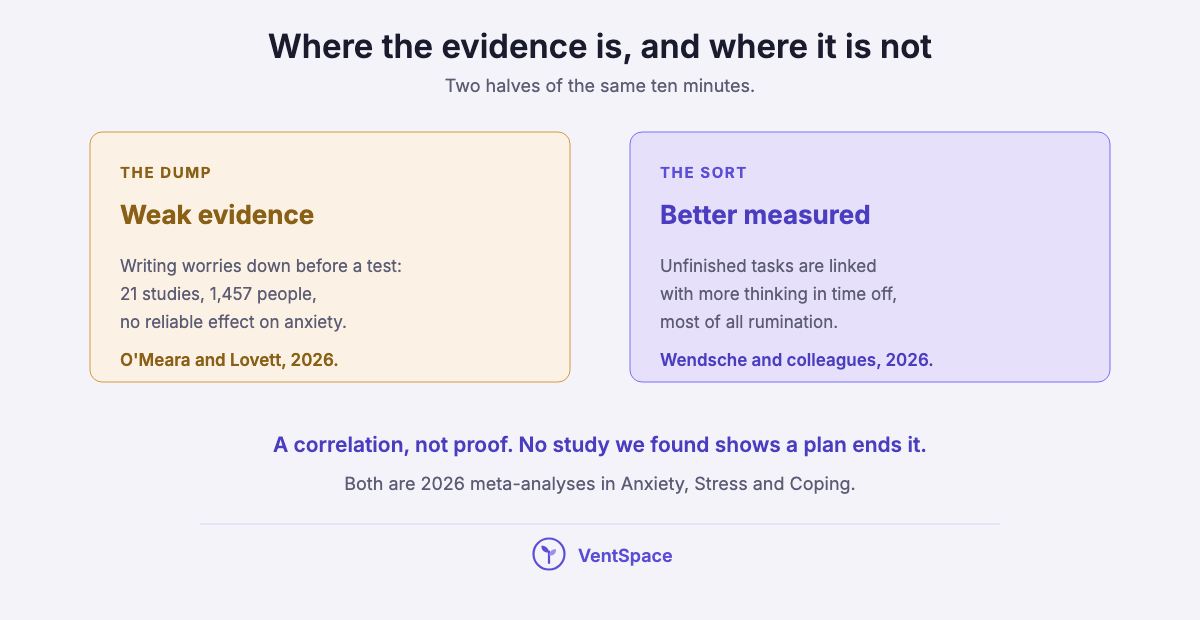
The getting-it-out half is the one with the weakest evidence. Several brain dump pages we read say that getting worries out of your head makes them easier to deal with. The closest test of that promise is the advice to write worries down just before a stressful event. When a 2026 meta-analysis pooled 21 studies of that advice for test anxiety, 1,457 participants in all, the effect on anxiety was “negligible” and not significant (O’Meara and Lovett). Those were students before exams, not a full head on a Tuesday, but it is the best test available, and it did not hold up.
The sort works on something better measured. Unfinished tasks are linked with more thinking in time off, most strongly with rumination, in a 2026 meta-analysis covering 2,473 people in between-person studies and 12,129 in within-person ones (Wendsche, Weigelt and Syrek). That is a correlation, and the famous effect it is often explained with, that unfinished tasks are better remembered, “could not be reliably replicated”, according to a 2025 paper (Ghibellini and Meier). So the honest claim is narrow. Turning a task into a next action and a day gives you something to start. It is not shown to end the thinking.
And how you write it does not seem to matter. Hand, typed or spoken made no significant difference in 146 randomized studies (Frattaroli, 2006). If your dump keeps turning into another round of overthinking, our piece on why journaling doesn’t always stop overthinking explains what may be going on, and overthinking vs problem solving helps tell the two apart.
Quick Summary
Q: Does a brain dump help?
A: The evidence that writing worries down settles them is weak: pooled across 21 studies, writing worries down before a test did not reliably lower anxiety. Sorting is on firmer ground, because unfinished tasks are linked with more thinking in time off, but no study we found shows a plan ends that thinking.
Insight: the claim that did not hold up
“The available research literature fails to support single sessions of expressive writing as a treatment for test anxiety.” P. O’Meara and B. J. Lovett, Anxiety, Stress and Coping, 2026. That is the evidence under “write your worries down and you will feel better”, and it is why this exercise spends half its time on the sort.
Questions people ask
Is a brain dump the same as journaling?
Not exactly. A brain dump is a list, written fast and then sorted. Journaling can mean sentences about one thing. A brain dump journal is a notebook kept for dumps. Both can turn into a loop, which is why this exercise has a stop.
Does a brain dump reduce anxiety?
That is not established. Pooled across 21 studies, writing worries down once before a test did not reliably lower anxiety (O’Meara and Lovett, 2026). What a brain dump gives you is a sorted page. If anxiety is most of your days, a doctor or therapist is the better first step.
Should I do a brain dump before bed?
This page is not sleep advice, and it does not offer a bedtime routine. If it helps to get the list out of your head in the evening, do the full ten minutes with the sort, not the dump alone. If sleep trouble goes on for weeks, that is a question for a doctor first.
Is paper better than a phone for a brain dump?
No study we found shows that. In 146 randomized studies of related writing, hand, typed and spoken made no significant difference (Frattaroli, 2006). Use whatever keeps up with you. If you are looking for an app, our roundup of brain dump apps covers that separately.
How often should I do a brain dump?
There is no researched answer. Whenever the pile is back is a reasonable rule. If the same worries appear in every daily dump, go back to the rehearsal check at step 6.
Two things to take with you
The dump is the easy half. The sort is the half that hands you something. Five minutes to get it out, five minutes to mark every line and give each task a next action.
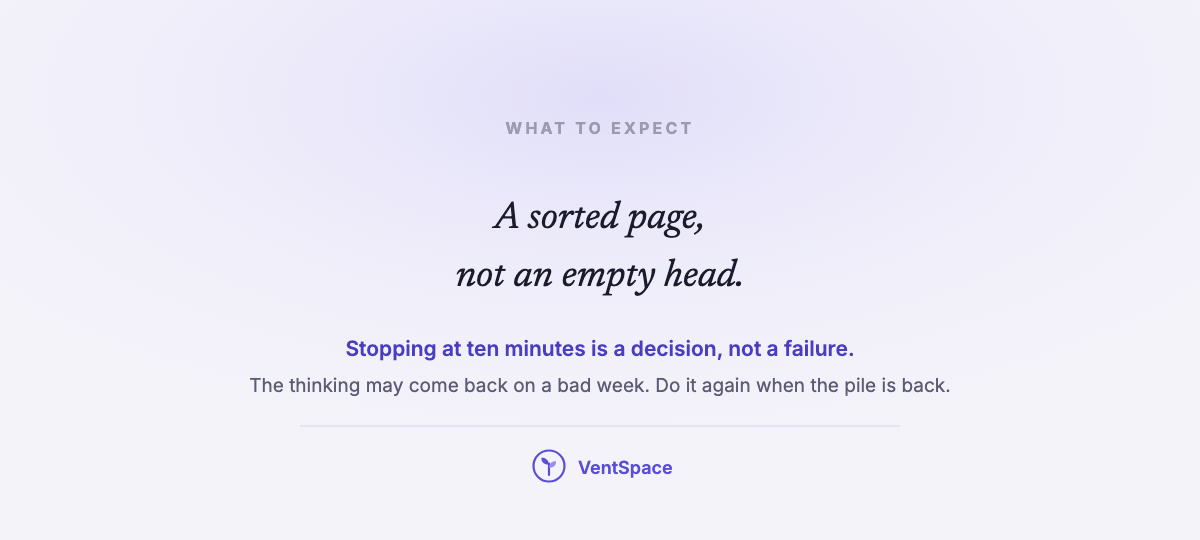
Expect a sorted page, not an empty head, and expect to do it again. The thinking will come back on a bad week, and the evidence does not promise otherwise. Stopping at ten minutes is a decision you make, not a sign you did not finish.
Set a timer for five minutes, and write line one.
One note from us. If you would rather do your dumps somewhere other than paper, VentSpace is a journaling app that turns what you write into a clear read on your life balance, plus small, doable next steps. It is ours. It will not empty a full head either, and the sort above still does the work. Android only and free to start as of October 2026, with no published evidence on outcomes, and it is not therapy. Not on Android, or at a desk? VentSpace Live runs in your browser, free, with nothing to install.
About this article

Written by
Sai Subramaniam
Founder, VentSpace
I write these guides because I have been where you are. I am working through my own hard seasons, and I share the things that actually helped me, so that anyone going through it has a steady companion close by instead of facing it alone. VentSpace is the app I built for exactly that: a journaling app that turns what you write into a clear read on your life balance, plus small, doable next steps toward feeling more like yourself.
This writing is honest and every claim is sourced, and it is not a substitute for professional care. If you are struggling, reaching out to a professional is a strong move, not a failure.
Explore VentSpaceTry VentSpace LiveHow this one was checked. Every factual claim traces to a named source, and the source is printed next to the claim rather than kept in a footnote. Quotes are pinned to the work they come from, with the year, the letter or the chapter where one exists. Where a widely repeated claim could not be traced, it was left out and the omission recorded. Where a figure is contested, both sides are printed.
No affiliate links, no paid placements, and nobody paid to appear here. Where we mention our own app, we say that it is ours, we state its limits, and we never position it as a substitute for care.
Reviewed: October 2026. Prices, platforms and product availability move quickly, and anything we could not verify at the time of writing is marked as unverified rather than turned into a number.
Corrections. If something here is wrong, we would rather know. Corrections are made in place, with a note saying what changed.