
It is one of the quieter cruelties of grief that, somewhere along the way, it acquires a deadline that nobody set. The honest answer to how long grief lasts is that nobody can give you a number, and the research that follows grieving people over time does not offer one.
What they found instead, when they followed grieving people over time, is several different shapes, not one schedule. So the useful thing to watch is not the calendar. It is the weight: whether your grief is severe, is not easing, and is stopping you living. Below is what the research shows, and then 50 questions to ask on the days when other people’s clocks get loud.
If you are struggling right now. If you are in crisis or thinking about harming yourself, please contact a crisis line now. In the US, call or text 988 (Suicide & Crisis Lifeline). Anywhere else, findahelpline.com lists free, confidential services by country. This page is not a substitute for that help.
The short version
There is no normal length for grief. Any page that gives you one is not reporting research.
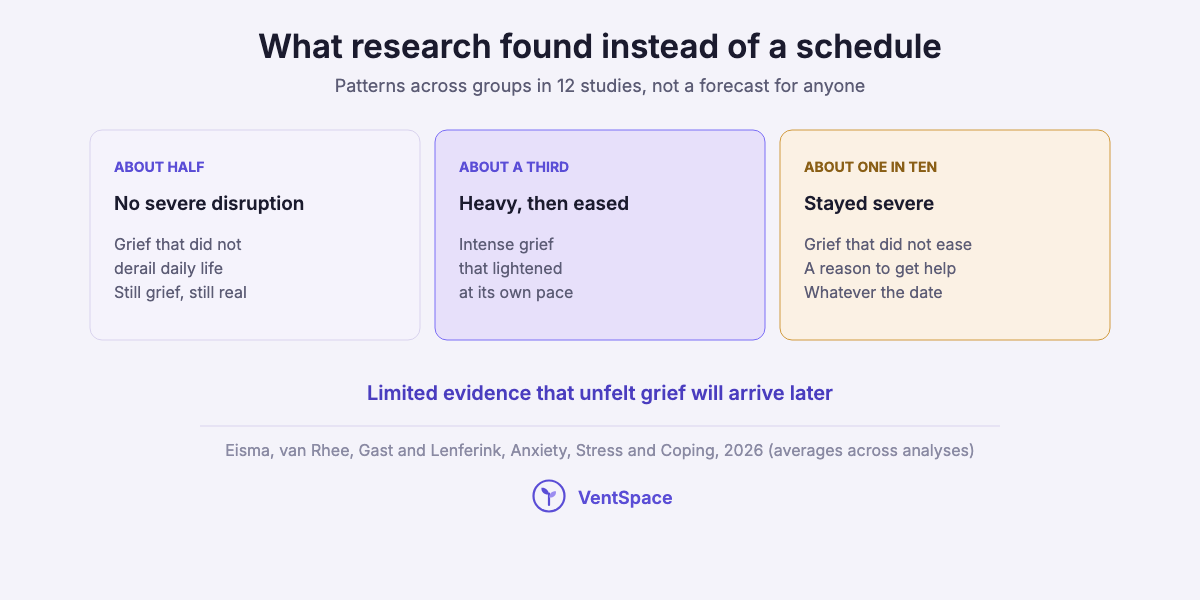
Research finds several shapes: for about half, grief does not become severely disruptive, for about a third it is intense and then eases, and for a smaller group it stays severe.
There is little evidence for “delayed grief”, the idea that grief you are not feeling now will catch up with you.
The five stages are not a clock, and they were never tested as one.
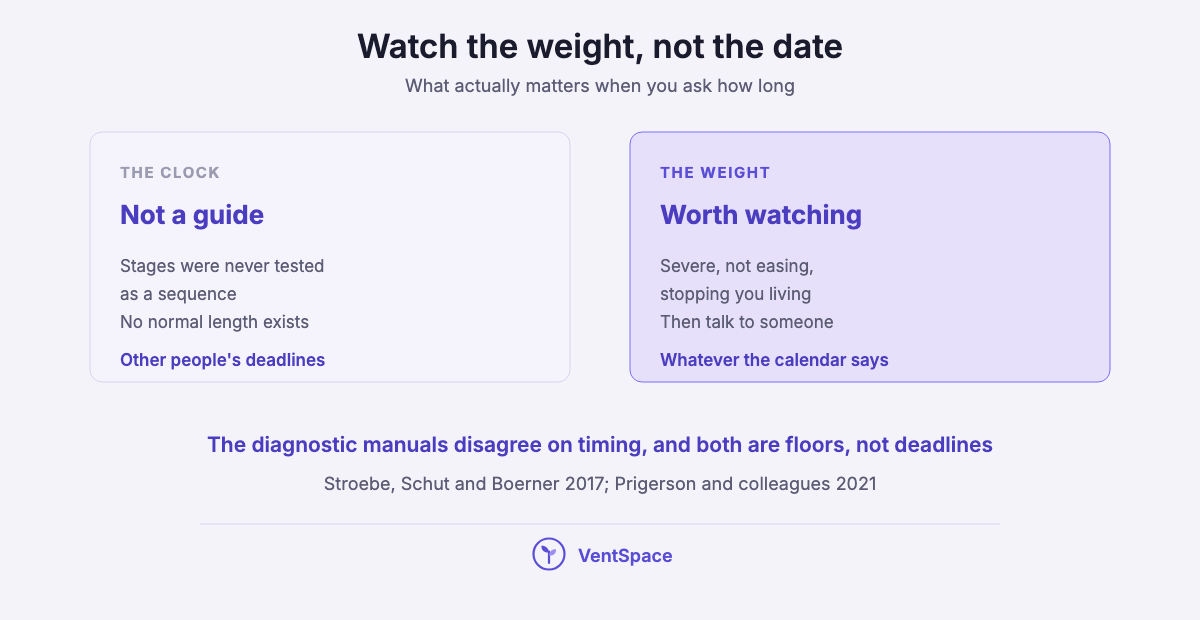
What matters is weight, not time. If grief is severe, not easing and stopping you living, that is a reason to get help, whatever the calendar says.
How long does grief last? The honest answer
Nobody can tell you, because grief does not have one length. A 2026 systematic review by Maarten Eisma and colleagues brought together 12 studies that tracked grieving adults over time. On average, about half of people coped without severe disruption, about a third had intense grief that eased, and about one in ten had grief that stayed severe. These are patterns across groups, not a forecast for anyone. The same review found “limited evidence for a delayed grief trajectory”.
The clocks we are handed come from elsewhere. The five stages came from Elisabeth Kübler-Ross’s conversations with dying patients in the 1960s. She extended them to families herself, but they were never tested in bereaved people before being taught as a sequence, and researchers now argue the expectation of stages can harm people who do not follow them.
Even the diagnostic manuals disagree. ICD-11 will not consider a grief diagnosis before six months, and DSM-5-TR waits twelve, a figure chosen out of concern about “pathologizing normal grieving”. Those are floors, not deadlines: grief that lasts longer but is normal for your culture is not a disorder. The reason to seek help is how heavy it is, never the date. How someone died matters too. After a sudden, violent or self-inflicted death, specialist support exists and is worth looking for.
When grief does not ease. A small group of people develop prolonged grief disorder: grief that is severe, persistent and disabling beyond what is normal in their culture. Only a professional can assess it, and specific, tested help exists. If it is heavy right now, call or text 988 in the US, or find a local line at findahelpline.com.
Quick Summary
Q: How long does grief last?
A: There is no set length. Research that followed bereaved people found several patterns. On average, about half coped without severe disruption, about a third had intense grief that eased, and about one in ten had grief that stayed severe. What matters is whether grief is severe, not easing and stopping you living, not how long it has been.
Insight: “Grief is not a disease and most people adjust without professional psychological intervention.” Margaret Stroebe, Henk Schut and Wolfgang Stroebe, reviewing the health outcomes of bereavement in The Lancet, 2007.
How to actually use these questions
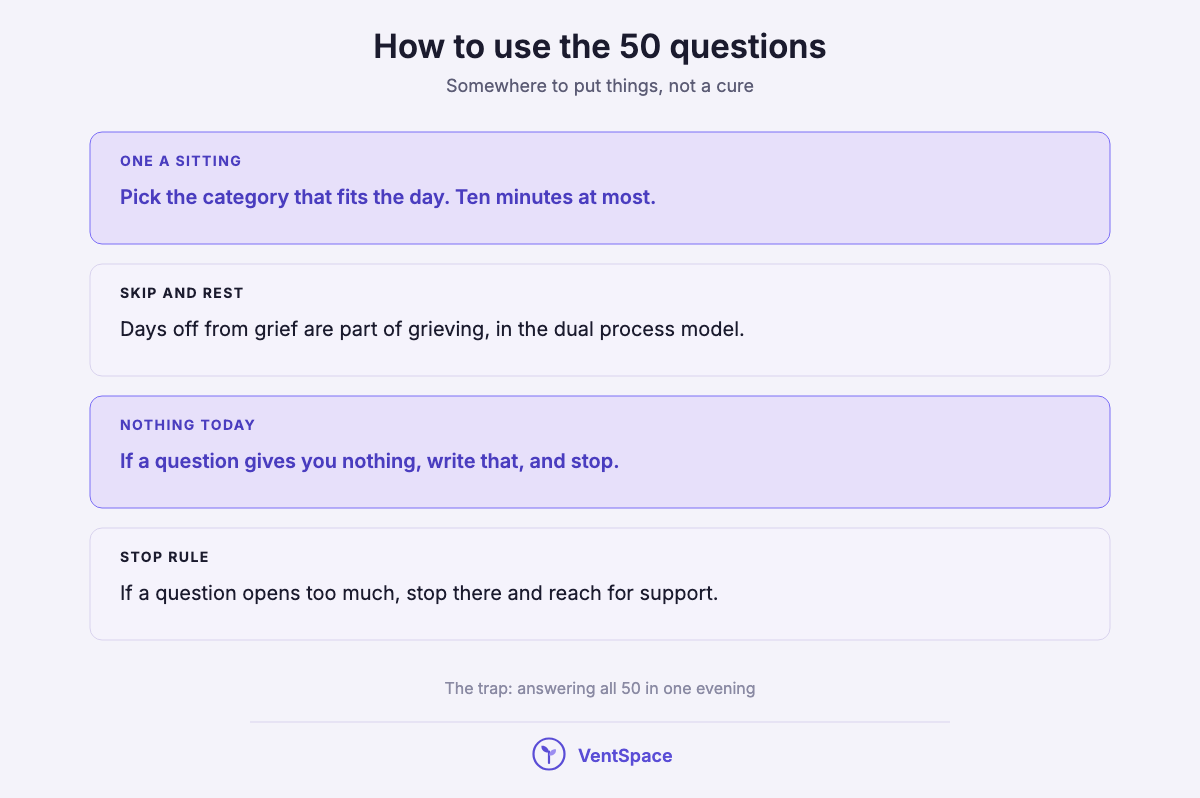
One question a sitting, and no more than ten minutes. Pick the category that matches the day you are having, not the next one in order. Write the answer on paper or in a notes app, in a sentence or two. A single honest line is a complete answer.
Skip freely, and take days off. Stroebe and Schut’s dual process model, a description of grieving rather than a rule, treats “the need to take respite” from grief as part of coping, not a failure of it. A day without a question is not a day you fell behind.
If a question produces nothing, write “nothing today” and stop. If one opens something too heavy to hold, stop there too, and use the crisis line above if you need it.
The trap to avoid is answering all 50 in one evening. That produces a long document and nothing you can use. We should also be plain about the limit: writing about a death in the standard way has not been shown to reduce grief. These questions offer somewhere to put things, not a cure. If you want more writing-focused material, our journal prompts for grief are built for days when there is nothing to fix.
Quick Summary
Q: How should I use questions like these while grieving?
A: One question at a time, ten minutes at most, chosen for the day you are having. Skip any that do not fit, take days off, and stop if a question opens something too heavy. They offer somewhere to put things, not a treatment.
Insight: In their 1999 paper, Margaret Stroebe and Henk Schut describe grieving as “a dynamic, regulatory coping process of oscillation, whereby the grieving individual at times confronts, at other times avoids, the different tasks of grieving.”
1. When someone says “it’s been long enough”
A woman whose brother died, interviewed for a University of Oxford collection of bereavement accounts, described the clock other people run:
“You know they’ll say, ‘Oh you know it happened six months ago.’ And you’re still you know in the most incredible state, but people, but you have to hide it”
These questions are for that moment, and for the version of it we start saying to ourselves.
1.Whose clock is this, mine or someone else’s?
A deadline on grief can be borrowed from someone else, and we can carry it a long way without checking. Naming who set this one can loosen it.
2.What did they say, word for word?
Remembered pressure can grow louder than the sentence that started it, because we replay it. Write the sentence down and look at its real size.
3.What might they have needed when they said it?
Sometimes people hurry our grief because they do not know what to do with it. This is not an excuse for them, only a clue.
4.Did I believe them, even for a minute?
The sting can come from the part of us that already suspected it. Name that part kindly, the way we would name it in a friend.
5.If grief had no deadline at all, what would I stop forcing myself to do?
The answer is a list of the performances the clock has been demanding.
6.Where did my own idea of “long enough” come from?
A film, a parent’s way of grieving, a page of stages. It is worth asking whether you chose it, or inherited it.
7.What would I tell a friend who asked me this question about their grief?
Borrow the answer you would give them, if it is gentler than the one you give yourself.
8.Is there one person with whom I do not have to look finished?
Everyone needs one room where the act can stop. If there is no such person yet, that is worth knowing too.
9.What is one sentence I could say next time, so I am not caught off guard?
Something short: “It’s still with me, and that’s allowed.” Having it ready takes some of the power out of the moment.
Quick Summary
Q: What do I do when people say I should be over my grief?
A: Notice whose deadline it is and where it came from. Research gives no normal length for grief, so the pressure says more about other people’s discomfort than about your progress.
2. What has changed, and what has not
These are for noticing, not for scoring. There is no right answer and no threshold here.
10.What can I do now that I could not do at the start?
It might be small: open the mail, say their name, cook. Change in grief can be quiet.
11.What still stops me in my tracks?
Some things will keep their weight. Knowing which ones lets you plan around them rather than be ambushed.
12.When was the last ordinary hour, one where I was just in it?
An hour like that is not disloyalty. It is part of how grieving moves.
13.Did I feel guilty about that hour?
Lightness can feel like a betrayal of the person who died. Ask whether they would have seen it that way.
14.What does a bad day look like now, compared with a bad day before?
Not to measure progress, but to recognize that bad days can change their shape without disappearing.
15.What did today hold besides grief?
Errands, work, a phone call. The field’s leading model, the dual process model, describes grieving as moving back and forth between the loss and the rest of our lives, and both halves count.
16.Which part of my week is about facing the loss, and which part is about living around it?
Both are part of grieving. Notice if one side has crowded out the other entirely.
17.What have I stopped doing that I used to love, and do I miss it yet?
“Not yet” is an answer. So is “I can’t imagine it”. Neither is a verdict.
18.Is there anything I am waiting to feel before I let myself do it?
Sometimes we wait for permission that is not coming. You can do it while sad, and still be grieving.
Quick Summary
Q: How do I know if my grief is changing?
A: Look for what you can do now that you could not at first, and what still stops you. Grief can change shape without going away, and a bad day returning does not have to mean going backwards.
3. The days that come back
A man interviewed for the same Oxford collection, on Christmas: “Yes, this is my third one now on my own, and it just doesn’t get any easier.” Later dates can be just as hard as the first ones. These questions are for the weeks before them.
19.Which dates in the next few months am I already dreading?
Writing them down turns a vague dread into a list we can plan for, rather than a fog we walk into.
20.Is the build-up worse than the day itself?
For some people it is. If so, the plan needs to start earlier than the date.
21.What would I like to do on the day, if nobody else’s expectations counted?
Mark it, ignore it, leave town. There is no correct way to spend it.
22.Who else will be thinking of them that day?
A message to that person can turn a lonely date into a shared one.
23.Who could I ask to remember the date with me?
Some people fear that mentioning the date will hurt you. Asking them directly removes the guesswork.
24.Which ordinary places still catch me off guard?
A supermarket aisle, a song in a store, a road. These are not setbacks. They are where the person lived.
25.What is one small thing I could plan for the evening after a hard date?
The day after can go unplanned. A meal with someone, an early night, a walk.
26.If a hard date knocks me back, what will I tell myself the next morning?
Write it now, while you can be kind. A hard anniversary is not proof that nothing has moved.
Quick Summary
Q: Why does grief come back on anniversaries?
A: Dates, holidays and birthdays bring the person and the loss back into focus, and later ones can be as hard as the first. Planning for the date, including the days before it, can make it less of an ambush.
4. What you still carry of them
Grief researchers no longer treat an ongoing connection to the person who died as a problem to be fixed. Reviews find these bonds bring comfort and sometimes distress, and whether they help in the long run is still unsettled. So these questions offer permission, not a prescription.
27.What do I still do because of them, or for them?
A recipe, a route, a habit of speech. These are ways the relationship continues.
28.Which of those bring comfort, and which bring a sharper ache?
Both are normal. Knowing which is which lets you choose when to reach for them.
29.Do I talk to them? What did I last say?
Many bereaved people do. It is not a sign of anything except that the relationship mattered.
30.What would they say about the way I am grieving?
Sometimes their voice is kinder than ours. Sometimes it is harder. Either way it is information.
31.What am I afraid of losing if the grief gets lighter?
For some of us the pain feels like the last thread to them. Name the fear so it can be looked at.
32.Which of their things am I not ready to decide about?
Nobody sets a deadline for a wardrobe. “Not yet” is a full answer.
33.What did they teach me that I am still using?
This is not a silver lining. It is a record of influence, which is one of the shapes love takes.
34.Is there something I never got to say to them?
You can write it now. An unsent letter asks nothing of anyone.
Quick Summary
Q: Is it normal to keep a connection to someone who died?
A: Yes. Researchers no longer see an ongoing bond with the person as something to be broken. Bonds bring comfort and sometimes distress, and keeping them is not a sign of being stuck.
5. What you need now, and from whom
The help that arrives around a funeral tends to thin out once the practical tasks end. A partner bereaved in Sweden put it plainly in a 2026 study: “The acute help was good, but then people grow tired.” These questions are about what you need now, not what you needed then.
35.Who still asks how I am?
That person is worth more than they know. Consider telling them.
36.Who stopped asking, and do I want them back?
Some people go quiet because they do not know what to say, not because they stopped caring. You decide whether to reach out.
37.What kind of help do I want most: company, practical help, or talk?
Knowing which one you need makes it easier to ask, and easier for someone to say yes.
38.What is one specific thing I could ask for this week?
“Come with me on Sunday” is easier to say yes to than “I need support”.
39.What am I doing to protect other people from my grief?
Bereaved people describe hiding it to keep others comfortable. Notice what that costs you.
40.Where can I be honest without managing anyone’s reaction?
A friend, a group of people bereaved in the same way, a counselor, a page. It helps to have at least one.
41.What practical task is still hanging over me?
Paperwork, an account, a phone line. Sometimes what we call grief is partly the dread of the task.
42.Who could do that task with me, or for me?
Asking for help with a task can be easier than asking for help with a feeling.
Quick Summary
Q: What do I do when people stop checking on me after a death?
A: Name the one or two people who still ask, and ask for something specific. Support often thins after the early weeks, and a direct request is easier for others to meet than a general one.
6. If it is getting heavier, not lighter
This is not a test. It does not measure anything. It is for planning, so that if grief is weighing more over time, help is easier to reach.
43.In my own words, what would “this is too much” look like?
Write it while you can see clearly, so you will recognize it if it arrives. It can be hard for us to judge our own weight from inside a bad week.
44.Who would I tell first if I got there?
One name is enough. Write it down.
45.What has stopped me reaching out so far?
Cost, time, the fear of being told it is normal. Each has an answer, and naming it is the start.
46.Do I believe help is only for people whose grief is worse than mine?
Help is not reserved for the worst-off. If grief is severe, not easing and stopping you living, it is for you.
47.Is the way they died part of what I cannot put down?
After a sudden, violent or self-inflicted death, specialist support exists. You are not expected to carry that alone.
48.What would make a first appointment easier: a phone call, a message, someone with me?
Lowering the first step matters more than choosing the perfect service.
49.Is there a doctor I could tell, even briefly?
A doctor is a reasonable first door, and you do not need the right words.
50.If someone I loved felt this way, what would I want them to do?
Then let that answer apply to you as well. Notice if the standard we set for the people we love is kinder than the one we set for ourselves.
If any of these questions brings you close to harming yourself, please stop and contact a crisis line: 988 in the US, or findahelpline.com elsewhere. Therapy and grief counseling are legitimate options, and for some people they are the right one.
Which questions to use when
| The moment | Start with | One question to try |
|---|---|---|
| Someone has just said “it’s been long enough” | Category 1 | 2. What did they say, word for word? |
| A date is coming up | Category 3 | 19. Which dates am I already dreading? |
| You had a good hour and felt guilty | Category 2 | 13. Did I feel guilty about that hour? |
| You miss them in an ordinary place | Category 4 | 27. What do I still do because of them? |
| Nobody asks anymore | Category 5 | 38. What is one specific thing I could ask for? |
| It feels heavier than before | Category 6 | 44. Who would I tell first? |
| You feel nothing at all | Any | Write “nothing today” and stop |
If you only answer five
- Question 1: Whose clock is this, mine or someone else’s?
- Question 13: Did I feel guilty about that hour?
- Question 21: What would I like to do on the day, if nobody else’s expectations counted?
- Question 31: What am I afraid of losing if the grief gets lighter?
- Question 44: Who would I tell first if I got there?
Questions people ask
Is it normal to still be grieving this long after a death?
There is no normal length to measure against. Research that followed grieving people found several patterns rather than one length, so there is no deadline you have missed. If it is severe, not easing and stopping you living, that is a reason to talk to someone, whatever the date.
Does grief ever go away?
For many people the weight eases, and for some it stays severe. Many bereaved people describe keeping a connection to the person who died, which researchers no longer treat as a problem. Grief tends to change shape rather than vanish on a schedule.
Is delayed grief real?
The idea that grief you are not feeling now will hit you later has little evidence behind it. A 2026 review of grief trajectories found “limited evidence for a delayed grief trajectory”. Feeling steadier is not a warning sign.
How long does each stage of grief last?
The stages do not come with durations, and they are not a sequence you will go through. They came from Kübler-Ross’s work with dying patients, were extended by her to families, and were never tested in bereaved people before being taught as a sequence. For how grief differs from sadness, see our page on grief vs sadness.
Does it matter how the person died?
Yes. After a sudden, violent or self-inflicted death, grief is more likely to become prolonged, and it is a recognized reason to look for specialist support. That is about the support you are owed, not a prediction about you.
Grief keeps no calendar
We would not wait for a calendar to tell us a broken arm needed a doctor, and grief deserves the same plainness. The question was never how long. It is how heavy, and whether you are carrying it alone.
There is a dignity in that shift. A grief that refuses to finish on time is not a failure of character. It is the shape that a large love takes when it has nowhere left to go, and it is allowed to take as long as it takes.
Whatever you are carrying, and however long it has been, it is yours to carry at your own pace. If writing some of it down privately would help, VentSpace, the journaling app we make, is a quiet place to do it. If you are on a computer, VentSpace Live runs in your browser, with nothing to install.
About this article

Written by
Sai Subramaniam
Founder, VentSpace
I write these guides because I have been where you are. I am working through my own hard seasons, and I share the things that actually helped me, so that anyone going through it has something steady to read instead of facing it alone. No ads, no affiliate links, and nothing here is a sales pitch.
This writing is honest and every claim is sourced, and it is not a substitute for professional care, bereavement support or medical advice. If this is heavy right now, the numbers above are a better answer than anything else on this page.
How this one was checked. The research on how grief changes over time comes from the 2026 systematic review of grief trajectories, read at its published abstract, and the diagnostic-manual wording from the papers that describe them. Every other claim traces to a named source printed next to it, and the quotations from bereaved people were checked against the University of Oxford collection and the published study they come from.
No affiliate links, no paid placements, and nobody paid to appear here. Our own app is named once, in the last line, without a link.
Reviewed: October 2026.
Corrections. If something here is wrong, we would rather know. Corrections are made in place, with a note saying what changed.