
“The origins of SWOT analysis have been enigmatic, until now.”
Puyt, Lie and Wilderom, opening line of the abstract of “The origins of SWOT analysis”, Long Range Planning, 2023
A personal SWOT analysis is a four-box grid for one decision: your strengths and weaknesses on the inside, your opportunities and threats on the outside. You fill it in, you look at how the boxes connect, and you pick one move.
Maybe it started with a date. A review is coming, an application closes on Friday, a manager has asked where you see yourself next year. You draw the four boxes, and the strengths box fills with words that could belong to anyone. Hard-working. Good communicator. Team player. Maybe the weaknesses box fills faster, and that is the part you were dreading.
So how do you fill the boxes with something real?
The short version
Pick one decision and a time window. A SWOT of your whole life is too wide to act on.
Put evidence in every box: a dated example, a request people make of you, a date on the calendar.
Write weaknesses as self-ratings for this goal, not verdicts on you.
Borrow one outside view for the strengths box. It is the box you see least well alone.
End with one move and a date. Then redo the grid later and compare.
The grid, and the one rule that changes it
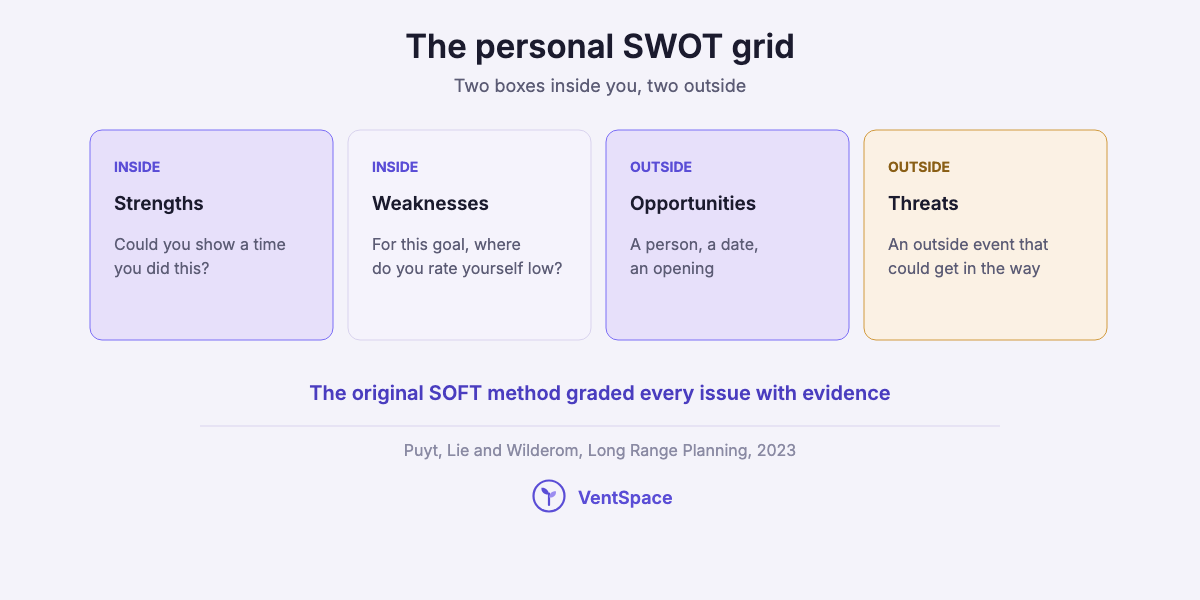
The grid has two internal boxes and two external ones. Strengths and weaknesses are about you. Opportunities and threats are about the world around the decision.
| Box | Inside or outside you | The test |
|---|---|---|
| Strengths | Inside | Could you show someone a time you did this? |
| Weaknesses | Inside | For this goal, where would you rate yourself low? |
| Opportunities | Outside | Is there a person, date or opening you could use? |
| Threats | Outside | What outside event could get in the way? |
The tool did not begin as a solo exercise. A 2023 reconstruction in Long Range Planning by Puyt, Lie and Wilderom credits Robert Franklin Stewart, and an earlier 2020 paper by the same group places him at the Stanford Research Institute, where his 1965 approach, called SOFT, evolved into SWOT in 1967. Several pages you will find credit Albert Humphrey instead. In the original, every manager wrote down eight to ten key issues and graded each one “with evidence”. Then subgroups of managers talked the issues through.
Two things carry over to the personal version: evidence, and another person. The evidence part keeps the boxes specific. The other-person part matters because, in the words of one review of self-knowledge research, “each perspective has some knowledge that the other does not”. You see your own intentions and effort. Someone close to you sees how your work lands. A grid filled from only one of those views is missing whatever the other view holds.
That is the whole theory. The rest of this page is doing it.
Quick Summary
Q: What is a personal SWOT analysis?
A: A four-box grid for one decision: strengths and weaknesses inside you, opportunities and threats outside you. In our view it is most useful when every box holds evidence rather than adjectives, and when one other person adds a view you cannot get alone.
Insight: the original grid was graded with evidence
Puyt, Lie and Wilderom describe the first version this way: “Each manager grades, with evidence, these issues as either safeguarding the Satisfactory; opening Opportunities; fixing Faults; or thwarting Threats: hence SOFT (which is later merely relabeled to Strengths, Weaknesses, Opportunities and Threats, or SWOT).” Evidence was in the method from the start.
How we sorted them
Sixteen short exercises in six families, in the order you would do them.
- Set the frame (1 and 2). One decision and one time window, before any box.
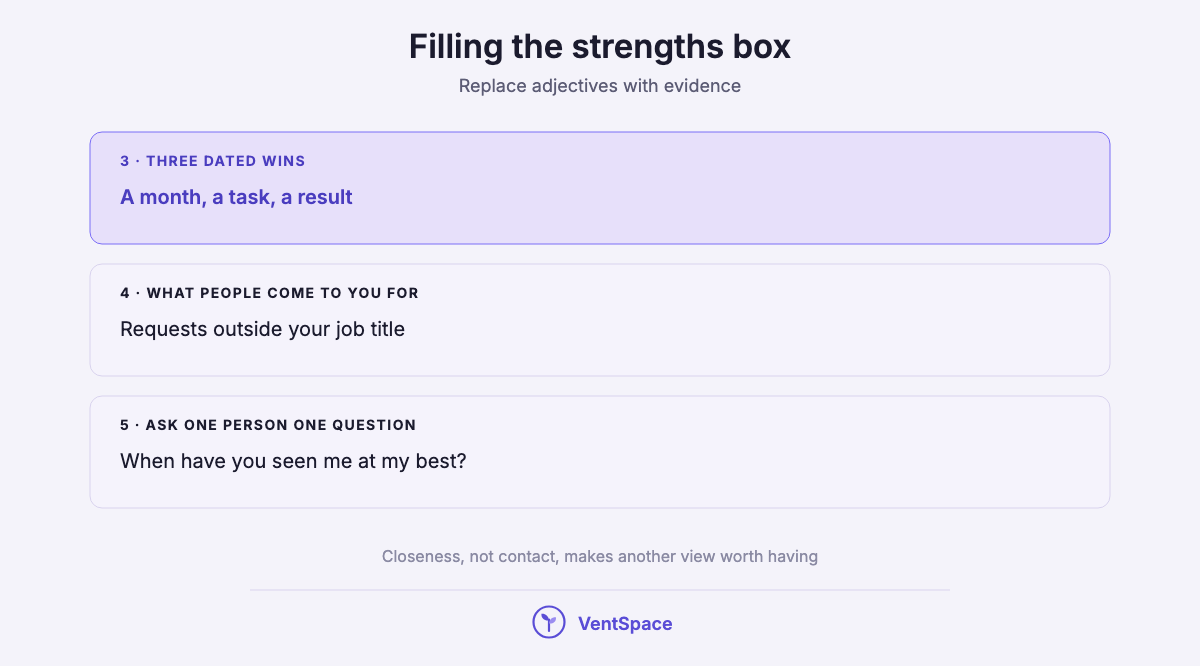
- Strengths (3 to 5). Three ways to fill the box from evidence, the last one with another person.
- Weaknesses (6 to 8). Three ways to write them as information about this goal.
- Opportunities (9 to 11). Openings with a name or a date on them.
- Threats (12 and 13). Outside events only, each with an early sign.
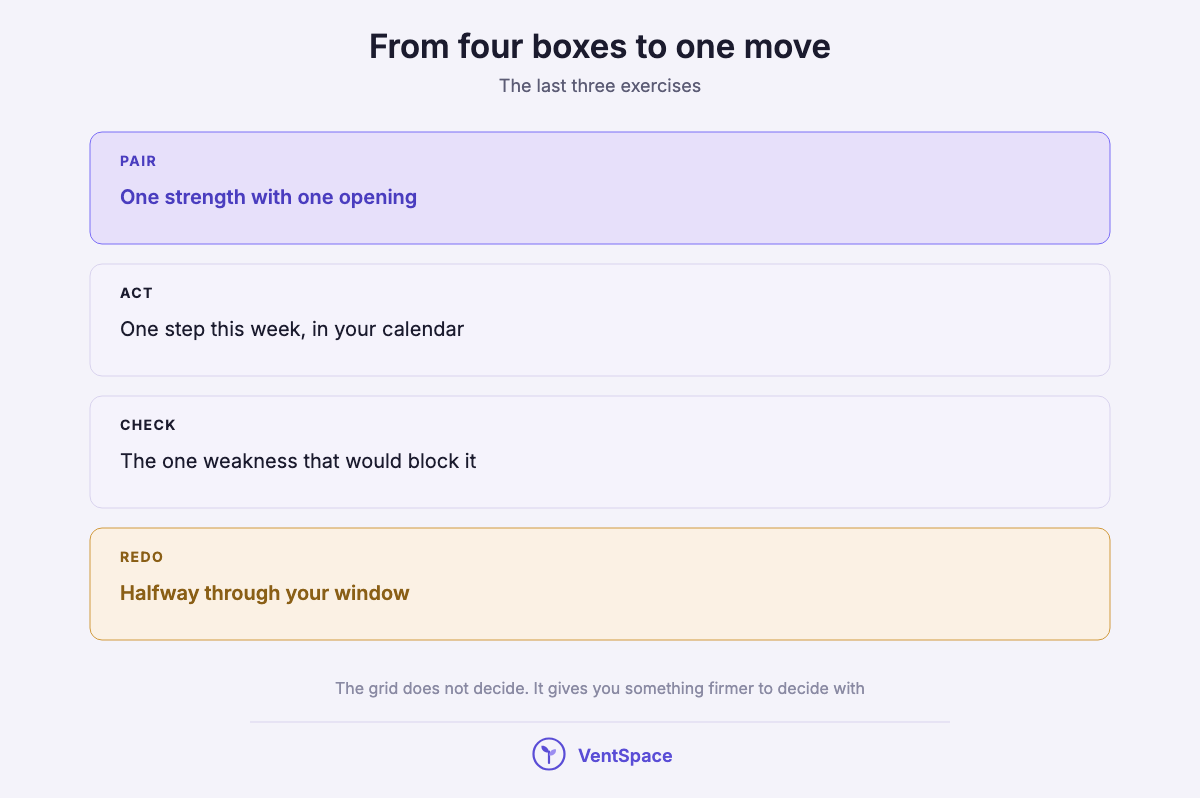
- Turn it into a move (14 to 16). One pairing, one action, one date to redo the grid.
- Time. Between five and fifteen minutes each, about three hours in all, which can be split across evenings. Exercise 5 also means waiting for a reply.
- Left out. Scores, ratings of you as a person, and any step that makes the decision for you. A grid can show what you are working with. It cannot tell you whether to go.
Set the frame
1. Name one decision
A SWOT needs a target. A strength for one goal can be irrelevant to another, and a threat to a promotion may be nothing to a career switch. So the first box you fill is not a box at all. It is one line at the top of the page naming the decision. Keep it to a choice you could make, with a yes or a no at the end of it. What are you deciding? If you have two decisions, do two grids. Mixing them is how the boxes turn into a general review of your life.
Do this:
1. Write “Decision:” at the top of a blank page.
2. Finish the line in one sentence that ends in a question mark.
3. Cross out any word that makes it two decisions.
4. Underline the verb.
| Time | 5 minutes |
| You need | A sheet of paper and a pen |
| Best for | Anyone whose first attempt at a SWOT came out as a list of adjectives |
| What it will not do | Make the decision easier. It makes it smaller, which is different |
2. Set the window
Opportunities and threats have dates, so the grid needs a time window. We suggest twelve months, and shorter if the decision has a deadline. The window changes what belongs in each box. A course that starts in eighteen months is not an opportunity for a twelve-month window. It goes in a margin note. Be honest about the window you have, not the one you wish you had. Is it the next quarter, or the next year? Write it down, because you will use it in exercises 10, 13 and 16.
Do this:
1. Under the decision, write “Window:” and a start and end date.
2. Draw the four boxes underneath, two on top and two below.
3. Label the top row Strengths and Weaknesses, the bottom row Opportunities and Threats.
4. Write “inside” beside the top row and “outside” beside the bottom.
| Time | 5 minutes |
| You need | The same page and a calendar |
| Best for | Decisions with a deadline, such as an application or a review |
| What it will not do | Predict anything inside the window |
Strengths: what you can show
Before the three exercises, keep these questions open on the page:
- What have you done that someone else noticed?
- What do you do that takes you less effort than it seems to take others?
- Which of those would matter for the decision at the top of your page?
3. Three dated wins
Adjectives are not strengths. They are claims about strengths. This exercise replaces each claim with an instance you could point to: a date, a task and a result. “Good communicator” becomes “March, rewrote the onboarding guide, new hires stopped asking the same five questions.” Three instances usually show you a pattern the adjective was hiding. Which of them would matter for the decision at the top of your page? Keep only those in the box. Do not worry if your wins look small. Small and specific is easier to explain than large and vague.
Do this:
1. Write down three times in the past two years when something went well because of what you did.
2. Give each one a month, a task and a result.
3. Next to each, write the skill it shows in four words or fewer.
4. Move only the skills that bear on your decision into the Strengths box.
| Time | 15 minutes |
| You need | Your page, and your sent email or calendar for reminders |
| Best for | Strengths boxes full of words that could describe anyone |
| What it will not do | Tell you which strengths are rare. It only shows the ones you have used |
4. What people come to you for
Some strengths are easier to see in other people’s behavior than in your own memory. The requests people make of you are evidence: the questions colleagues bring to you, the jobs that land on your desk, the thing friends ask you to look over. They are also easy to miss, because a strength you use daily can stop feeling like a strength. Think back over the past month. What did people ask you for? Which requests would you happily get more of, and which would you rather hand back? Both answers belong on the page, in different places.
Do this:
1. List every request someone made of you in the past four weeks that was not part of your job title.
2. Mark each one with a plus if you would welcome more of it, a minus if not.
3. Move the plus requests that bear on your decision into Strengths.
4. Keep the minus list for exercise 7.
| Time | 15 minutes |
| You need | Your page, and your messages from the past month |
| Best for | People who find it hard to describe themselves outside their role |
| What it will not do | Separate what you are good at from what you are available for |
5. Ask one person one question
Nine of the ten SWOT guides we read give this step one line. A large review of personality research by Connelly and Ones found that when the outcome was academic achievement or job performance, other people’s ratings predicted it better than self-ratings and added to them. How close they were to you mattered more than how often they saw you. That research rated personality, not SWOT entries, so treat it as a reason, not a guarantee. The University of Michigan’s Reflected Best Self Exercise, born from research there, is a fuller version: you collect positive feedback from people in your life and build a portrait of yourself at your best. This is the one-person version. Who knows your work well and wants you to do well?
Do this:
1. Pick one person who knows your work closely and is on your side.
2. Send one question: “When have you seen me at my best at work, and what was I doing?”
3. Write their answer down in their words, without editing it.
4. Add anything new to the Strengths box with their name beside it.
| Time | 10 minutes, plus waiting for the reply |
| You need | One trusted person, and a phone or email |
| Best for | Anyone whose strengths box still looks thin after exercises 3 and 4 |
| What it will not do | Give you the truth about yourself. One view is one view |
This is not an exercise to run with someone who is unkind to you, or who has a stake in the answer, or whom you are currently fighting with. If there is nobody you can ask right now, a therapist is one of the other people, and so is a former colleague. Our piece on self-awareness covers the inside and outside views in more depth.
Quick Summary
Q: How do you find your strengths for a SWOT?
A: Replace adjectives with evidence. Write three dated wins, list what people come to you for, and ask one person who knows your work when they have seen you at your best. Are you being too generous with your strengths? Probably not on average: across 152 samples, how people rated their own personality did not differ on average from how people who knew them rated it. The more useful thing to fix is vagueness.
Insight: why the strengths box needs another view
Connelly and Ones pooled 263 samples and 44,178 people rated by others. Their summary: “When the criterion was academic achievement or job performance, other-ratings yielded predictive validities substantially greater than and incremental to self-ratings.” They also found that closeness, not frequency of contact, was what made another person’s view accurate.
Weaknesses: self-ratings for this goal
6. Rate yourself for this goal, not in general
The weaknesses box is where a SWOT most easily goes wrong, in our view, because it is easy to write it as a list of verdicts. A weakness on this grid is a self-rating for one goal, nothing more. You are not weak at presenting. For this particular move, you rate yourself low at presenting to senior people, today. That sentence is more accurate and easier to act on. It also expires, because self-ratings change as you practice. A Harvard Business Review article by Roberts and colleagues opens with the line “Most feedback accentuates the negative.” Your own list may do the same. Is every item on yours about this decision?
Do this:
1. For each weakness, start the line with “For this goal, I rate myself low at”.
2. Finish it with one specific skill or situation, not a trait.
3. Cross out any item that is not about the decision at the top of the page.
4. Write “today” at the end of each line.
| Time | 10 minutes |
| You need | Your page and a pen |
| Best for | Anyone who dreads the weaknesses box |
| What it will not do | Measure you. A self-rating is not a measurement |
7. The avoidance list
What you put off is information. Tasks you keep postponing can point at a skill you do not trust yet, or a part of the work you do not want. Both matter for a decision, and they matter differently. This is where the minus list from exercise 4 comes back. Look at what you avoid and ask which kind of avoidance it is. Is it “I do not know how” or “I do not want to”? The first is a weakness for this goal. The second may be a reason the decision exists at all, and it belongs in a note beside the grid rather than in a box.
Do this:
1. List three tasks you have postponed more than once in the past month.
2. Add the minus requests from exercise 4.
3. Mark each one K for “do not know how” or W for “do not want to”.
4. Move the K items that bear on your decision into Weaknesses.
| Time | 10 minutes |
| You need | Your page and your to-do list |
| Best for | People whose weaknesses box feels vague |
| What it will not do | Explain why you avoid something. It only shows that you do |
8. Gap or constraint
Not everything in the weaknesses box is the same kind of thing. A gap is something you could close: a skill, a qualification, a piece of experience. A constraint is something you work around: caring responsibilities, a visa, money, health. Mixing them makes the box feel heavier than it is, because constraints cannot be practiced away and gaps can. Sorting them also stops the grid from blaming you for a fact of your situation. Do not panic if the constraint list is long. A constraint is not a flaw. It is part of the ground the decision sits on.
Do this:
1. Read every item in the Weaknesses box.
2. Mark each one G for gap or C for constraint.
3. Next to each gap, write one way someone could close it.
4. Move each constraint to a short list under the grid titled “Working around”.
| Time | 10 minutes |
| You need | Your page and a pen |
| Best for | Weaknesses boxes that feel like a judgment |
| What it will not do | Close the gaps. It only shows which ones can be closed |
If the weaknesses box turns into a list of reasons you are not good enough, stop there. A decision-sized grid is the wrong tool for that, and it is worth talking to someone. If it has felt heavier than a decision for a while, a therapist is a good person to talk to. If you are in crisis or thinking about harming yourself, call or text 988 in the US, the Suicide and Crisis Lifeline, or find your country’s line at findahelpline.com.
Quick Summary
Q: What should go in the weaknesses box of a personal SWOT?
A: Self-ratings for this one goal, written as specific skills or situations. Start each line with “For this goal, I rate myself low at”, sort them into gaps you could close and constraints you work around, and drop anything that is not about the decision.
Opportunities: openings with a date
9. The people scan
Opportunities are outside you, and many of them have a name. The people scan looks for them: someone who has made the move you are weighing, someone who hires for it, someone who could introduce you. Who has done what you are thinking of doing? Who would answer a message from you? You are not asking anyone for anything yet. You are only seeing who is there.
Do this:
1. Write down five people who have made a similar move, hire for it, or could introduce you to someone who does.
2. Next to each, write how you know them in three words.
3. Circle the two you could message this week.
4. Put those two in the Opportunities box.
| Time | 15 minutes |
| You need | Your page and your contacts |
| Best for | Decisions where you do not yet know what the new role involves |
| What it will not do | Make anyone say yes |
10. The calendar scan
The second kind of opportunity has a date. Openings inside your window: an application round, an internal posting cycle, a course start date, a quiet season at work when you could try something. Put them on the page with their dates, because an opportunity without a date tends to stay a wish. Look at your window from exercise 2 and walk through it month by month. What opens, and when does it close? A date also tells you which opportunity to act on first.
Do this:
1. Write the months of your window down the side of a page.
2. Next to each month, write anything that opens or closes then.
3. Add any date you would need to prepare for, two weeks earlier.
4. Move the dated openings into the Opportunities box.
| Time | 15 minutes |
| You need | Your page, a calendar, and the websites you would apply through |
| Best for | Applications, promotions, course places |
| What it will not do | Create openings. It shows the ones already there |
11. Pair a strength with an opening
Four full boxes are still not a plan. The step several guides mention in a sentence is the useful one: draw a line from a strength to an opportunity it fits. One strength next to one opening is something you can act on. Heinz Weihrich’s 1982 paper on what he called the TOWS matrix is often cited for this matching step. Our version is simpler. Which of your strengths is the best fit for which opening? If none fits, that is worth knowing too.
Do this:
1. Draw a line from each strength to any opportunity it could help you use.
2. Count the lines on each opportunity.
3. Circle the opportunity with the most lines.
4. Write one sentence: “I could use [strength] to [opportunity] by [date].”
| Time | 10 minutes |
| You need | Your filled grid and a pencil |
| Best for | Grids that are full but feel static |
| What it will not do | Tell you the pairing is the right one. It shows the strongest fit on paper |
Quick Summary
Q: What are examples of opportunities in a personal SWOT?
A: Named people and dated openings. Someone who has made the move you are weighing, a hiring cycle, a course start date, an internal posting. Then pair each with a strength it fits, and write one sentence with a date.
Threats: outside, specific, finite
12. The outside-only test
Threats are an easy box to fill with the wrong things. A threat is an outside event, not a feeling about yourself. “I might not be good enough” is not a threat. It is a weakness written as a fear, and it belongs in exercise 6 as a self-rating. “The team is being restructured in spring” is a threat. So is “three internal candidates applied last time.” Run each item through one question: could this happen even if I did everything right? If yes, it stays. If no, it moves up a row.
Do this:
1. Read every item in the Threats box.
2. Ask of each one: “Could this happen even if I did everything right?”
3. Move every “no” up into Weaknesses, rewritten as a self-rating.
4. Rewrite every remaining threat as a specific event with a likely month.
| Time | 10 minutes |
| You need | Your page and a pen |
| Best for | Threats boxes full of worries about yourself |
| What it will not do | Make the threats less likely |
13. The early sign
A threat you cannot see coming is a worry. A threat with an early sign is something you can watch. For each one, write what you would notice first: an announcement, a change in who is invited to meetings, a closing date being moved. You can also mark each threat as likely or unlikely in your window. That rates an outside event, not you, and it stops one big threat from filling the whole page. What is the first thing you would notice? Write it down, then let the threat sit on the page rather than in your head.
Do this:
1. Next to each threat, write the first sign you would notice.
2. Mark each threat “likely” or “unlikely” within your window.
3. Pick the likeliest one and write one thing you would do if its sign appeared.
4. Leave the rest on the page.
| Time | 10 minutes |
| You need | Your page and a pen |
| Best for | Decisions made under uncertainty you cannot control |
| What it will not do | Tell you how likely anything is. “Likely” is your judgment, written down |
Quick Summary
Q: What is the difference between a weakness and a threat in a personal SWOT?
A: A weakness is inside you, a threat is outside you. The test is whether it could happen even if you did everything right. “I might not be good enough” is a weakness written as a fear. “The team is being restructured in spring” is a threat.
Turn the grid into one move
14. Pick one pairing and one action
The grid has done its job when it gives you one action you can start this week. Not a plan. A plan is a separate document, and the grid is not trying to be one. Take the sentence you wrote in exercise 11 and make its first step physical: a message, an application form opened, a conversation booked. If a value of yours keeps getting in the way of the pairing, that is a different question, and our piece on turning values into daily habits is a better place for it. What could you do in the next seven days?
Do this:
1. Copy your pairing sentence from exercise 11 under the grid.
2. Write the first physical step, something you could do in under thirty minutes.
3. Give it a day this week.
4. Put it in your calendar now.
| Time | 10 minutes |
| You need | Your grid and your calendar |
| Best for | Anyone who has filled a SWOT before and filed it |
| What it will not do | Make the decision. It moves you one step closer to knowing |
15. Find the weakness that blocks it
Now go back to the weaknesses box with the action in hand. Many of the weaknesses may not matter for this step. Look for the one that does. It might be a gap you could start closing or a constraint you need to plan around. This keeps the weaknesses box in proportion: you are not fixing everything you wrote, only the one item standing in front of the move. Which line in the box would trip you up first? Circle it, and leave the others alone for now. Permission granted to ignore them.
Do this:
1. Read your action from exercise 14.
2. Read the Weaknesses box and circle the one item most likely to block it.
3. If it is a gap, write one small way to start closing it.
4. If it is a constraint, write how you will work around it for this one step.
| Time | 10 minutes |
| You need | Your grid |
| Best for | Grids where the weaknesses box feels like it cancels the strengths box |
| What it will not do | Remove the weakness. It only puts it in its place |
16. Date the grid and redo it
A grid filled once is a snapshot. A grid filled twice shows you what moved: a gap that closed, an opportunity that opened, a threat that never arrived. The original method sat inside a firm’s planning process rather than standing alone. Yours can be repeated. Choose a redo date inside your window, often around the halfway point. When it comes, fill a fresh grid first and only then look at the old one. Did the strengths box get more specific? Did a threat never arrive?
Do this:
1. Write today’s date in the top corner of the grid.
2. Photograph it and keep the photo where you will find it.
3. Set a reminder for the halfway point of your window.
4. On that day, fill a new grid before you look at the old one.
| Time | 5 minutes now, 45 minutes later |
| You need | Your grid, a phone and a calendar |
| Best for | Decisions that will take months to play out |
| What it will not do | Tell you whether the changes are good |
Quick Summary
Q: What do you do with a personal SWOT once it is filled in?
A: Pick one pairing of a strength and an opportunity, turn it into one action this week, and find the single weakness that would block it. Then date the grid and redo it halfway through your window, filling the new one before you look at the old one.
Personal SWOT analysis examples
Two invented examples, to show the shape. Neither is a real person. Notice that every item has evidence, a name or a date in it.
Example A: a marketing coordinator weighing a move into UX research. Decision: “Should I apply for the junior UX research role that opens in January?” Window: October to June.
| Box | Entries |
|---|---|
| Strengths | Ran the customer survey in April and wrote up the findings for the product team · colleagues bring me their survey questions to check · my manager said I was at my best “running the interviews for the rebrand” |
| Weaknesses | For this goal, I rate myself low at usability testing (gap, never done it) · at statistics beyond averages (gap) · four days a week only, for childcare (constraint) |
| Opportunities | A former colleague moved into UX research last year and offered to talk · internal posting opens January 6 · a free course on usability testing starts November |
| Threats | Hiring freeze rumored for Q1 (early sign: the posting date moves) · two internal applicants from the design team (likely) |
Pairing and move: “I could use my interviewing experience to apply for the January role by sitting in on one usability test before then.” First step: message the former colleague this Thursday. Blocking weakness: usability testing, a gap. Redo date: February.
Example B: a college senior choosing between a job offer and a master’s. Decision: “Should I accept the analyst offer or start the master’s in September?” Window: now to August.
| Box | Entries |
|---|---|
| Strengths | Senior thesis data cleaning, finished three weeks early · classmates ask me to explain the stats homework · my thesis advisor said I was at my best “when the data was a mess” |
| Weaknesses | For this goal, I rate myself low at knowing what the master’s leads to (gap) · at budgeting a year without income (gap) · student loan limit (constraint) |
| Opportunities | Two alumni from the program agreed to a call · the offer deadline is May 15 · the employer may defer start dates (ask) |
| Threats | Funding decision not due until June (early sign: the email date) · the offer may not be held past May 15 (likely) |
Pairing and move: “I could use my data skills to compare both options by talking to two alumni before May 1.” First step: book the first alumni call this week. Blocking weakness: not knowing what the master’s leads to, a gap. Redo date: after the funding decision.
Before you put the grid away, answer these on the back of the page:
- Which box was hardest to fill, and why?
- Which item surprised you?
- Whose view is missing from the grid?
- What would have to be true at the redo date for you to say yes?
All sixteen, side by side
| Exercise | What it is for | Time | Difficulty | Do it when |
|---|---|---|---|---|
| 1. Name one decision | Giving the grid a target | 5 min | Gentle | First |
| 2. Set the window | Dating the outside boxes | 5 min | Gentle | Second |
| 3. Three dated wins | Strengths from evidence | 15 min | Moderate | Strengths look generic |
| 4. What people come to you for | Strengths others already use | 15 min | Gentle | You struggle to describe yourself |
| 5. Ask one person | The outside view | 10 min plus reply | Harder | Strengths still thin |
| 6. Rate for this goal | Weaknesses as self-ratings | 10 min | Moderate | You dread the box |
| 7. The avoidance list | Weaknesses you act out | 10 min | Moderate | Weaknesses feel vague |
| 8. Gap or constraint | Sorting what can change | 10 min | Gentle | The box feels like a judgment |
| 9. The people scan | Named opportunities | 15 min | Gentle | You lack inside knowledge |
| 10. The calendar scan | Dated opportunities | 15 min | Gentle | There is a deadline |
| 11. Pair a strength | Connecting the boxes | 10 min | Moderate | The grid feels static |
| 12. Outside-only test | Real threats only | 10 min | Gentle | Threats are worries about you |
| 13. The early sign | Watchable threats | 10 min | Moderate | Uncertainty is high |
| 14. One pairing, one action | A first step | 10 min | Moderate | Always |
| 15. The blocking weakness | Proportion | 10 min | Gentle | Weaknesses feel overwhelming |
| 16. Date and redo | Seeing what moved | 5 min, then 45 | Gentle | Last |
Keeping the evidence
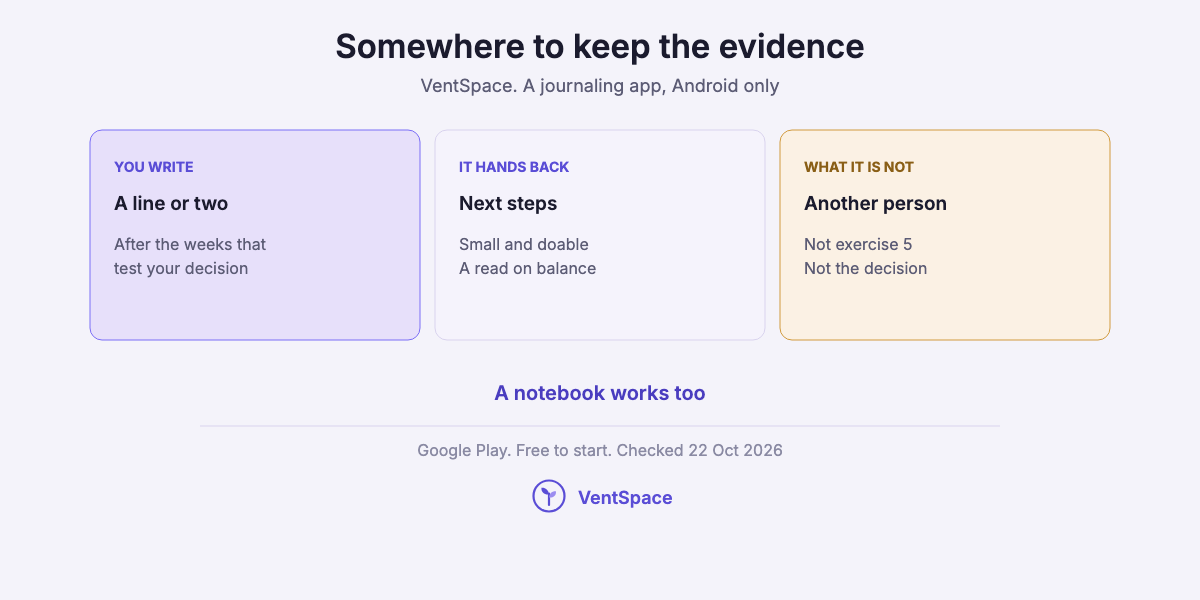
The strengths and weaknesses boxes are only as good as the examples behind them, and those are easy to forget between one grid and the next. Writing down a line or two after the weeks that test your decision gives the redo something to work from. If you want somewhere to keep those notes, VentSpace is ours: a journaling app that turns what you write into a clear read on your life balance, plus small, doable next steps. It is free to start, on Android only (Google Play, checked October 22, 2026). Not on Android, or at a desk? VentSpace Live runs in your browser, free, with nothing to install. It works on the inside view. It is not the person in exercise 5, and it will not make the decision for you.
What can a personal SWOT not do?
A personal SWOT cannot tell you whether to make the move. It shows what you are working with, from your own vantage point plus one other. Everything in the inside boxes is a self-rating, which is useful and is not a measurement. The research is more reassuring than the dread suggests: one registered study found people were “at least moderately accurate” about their own abilities, and others added insight on some of them.
The tool also has critics. A 1997 paper in Long Range Planning is titled “SWOT analysis: It’s time for a product recall”, and a 2021 review of six decades of SWOT research concluded that “a collective understanding of SWOT analysis remains vague.” We did not find any study testing whether a personal SWOT changes outcomes for the people who do one. It is a structured way to look, not a proven intervention.
And if the question under your decision is less “should I take this role” and more “why does none of it feel like it matters”, a grid is the wrong shape. Our piece on purpose versus productivity sits closer to that question.
Quick Summary
Q: Is a personal SWOT analysis accurate?
A: It is as accurate as the evidence you put in it, and it is a self-rating, not a measurement. In one registered study, people were at least moderately accurate about their own abilities, and other people added insight on some of them. No study we found tests whether doing a personal SWOT changes outcomes.
Questions people ask
What is a personal SWOT analysis?
A four-box grid for one decision: strengths, weaknesses, opportunities and threats. The first two are inside you and the last two are outside. It is the business planning tool pointed at one person and one choice.
How do you write a personal SWOT analysis?
Name one decision and a time window, then fill each box with evidence. Use dated wins and other people’s requests for strengths, self-ratings for this goal for weaknesses, named people and dated openings for opportunities, and specific outside events for threats. Finish by pairing one strength with one opportunity and taking one step this week.
What are good examples of personal strengths and weaknesses?
Good examples are specific and evidenced. “Ran the customer survey in April and wrote up the findings” is a strength you can show. “For this goal, I rate myself low at usability testing” is a weakness you can act on. “Hard-working” and “impatient” are too general to help with a decision.
What is the difference between a weakness and a threat?
A weakness is inside you and a threat is outside you. If it could happen even if you did everything right, it is a threat. If it is about your skills or habits, it is a weakness.
How often should you do a personal SWOT analysis?
Once per decision, and again halfway through its window. We found no research-backed schedule. Redoing it while the decision is live is how you see what moved.
Did Albert Humphrey invent SWOT analysis?
This is the myth worth correcting. Several pages credit him. The most thorough reconstruction we found, published in Long Range Planning in 2023, credits Robert Franklin Stewart. The same group’s 2020 paper dates his SOFT approach to 1965 and its change into SWOT to 1967. The same paper describes the original as graded “with evidence” and discussed in groups, which is why this page asks for both.
Two things to take with you
The first: a personal SWOT is only as good as its evidence, and the strengths box is the one you cannot fill well on your own. In our view, one question to one person adds more than another hour alone with the page.
The second, and it is the honest one: one evening gets you a first grid. The evidence for some boxes takes weeks to collect, and you may not see what moved until the redo date. The grid will not give you an answer to the decision. It gives you something firmer to decide with.
Write the decision at the top of a page tonight. The boxes can wait until tomorrow.
About this article

Written by
Sai Subramaniam
Founder, VentSpace
I write these guides because I have been where you are. I am working through my own hard seasons, and I share the things that actually helped me, so that anyone going through it has a steady companion close by instead of facing it alone. VentSpace is the app I built for exactly that: a journaling app that turns what you write into a clear read on your life balance, plus small, doable next steps toward feeling more like yourself.
This writing is honest and every claim is sourced, and it is not a substitute for professional care. If you are struggling, reaching out to a professional is a strong move, not a failure.
Explore VentSpaceTry VentSpace LiveHow this one was checked. Every factual claim traces to a named source, and the source is printed next to the claim rather than kept in a footnote. Quotes are pinned to the work they come from, with the year, the letter or the chapter where one exists. Where a widely repeated claim could not be traced, it was left out and the omission recorded. Where a figure is contested, both sides are printed.
No affiliate links, no paid placements, and nobody paid to appear here. Where we mention our own app, we say that it is ours, we state its limits, and we never position it as a substitute for care.
Reviewed: October 2026. Prices, platforms and product availability move quickly, and anything we could not verify at the time of writing is marked as unverified rather than turned into a number.
Corrections. If something here is wrong, we would rather know. Corrections are made in place, with a note saying what changed.