
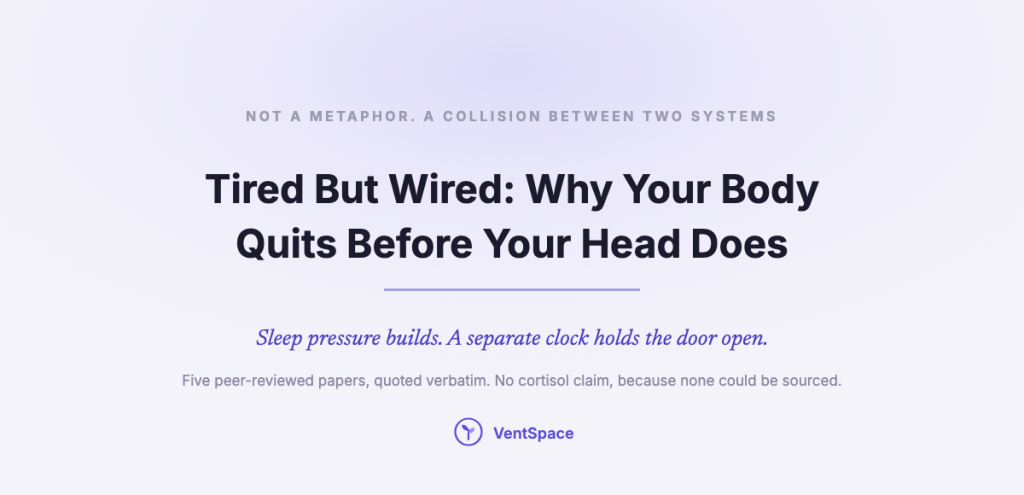
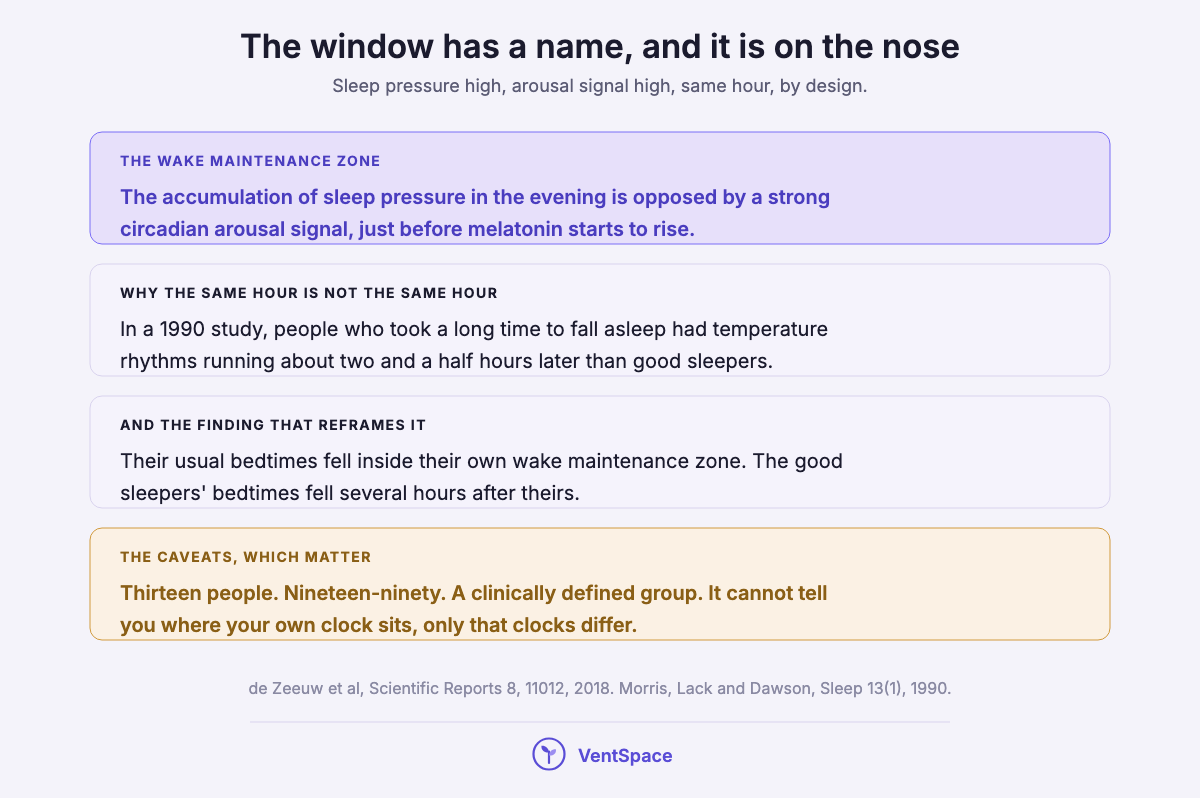
“Under entrained conditions, the accumulation of homeostatic sleep pressure in the evening is opposed by a strong circadian arousal signal prior to the dim light melatonin onset, called the Wake Maintenance Zone.”
de Zeeuw and colleagues, Scientific Reports 8, 11012 (2018)
You were falling asleep on the sofa at nine. You remember thinking, with some relief, that tonight would be easy. Then you brushed your teeth, got into bed, turned off the lamp, and something came back on. Not anxiety exactly, and not energy in any usable sense. Your body is still exhausted. It is just that some separate part of you has evidently decided the day is not finished, and it is now 12:40, and you have been lying in the dark reading the same thing on your phone for forty minutes. What is that, and why does it happen at exactly the hour you finally have time to sleep?
Almost everything you will find about this says cortisol. It might be involved. What is worth knowing before you go any further is that the pages telling you so are, with very few exceptions, not citing anything, and one of the results on the first page of this search is a shop that sells supplements.
There is a better answer, and it is more specific and considerably more useful. The phrase “tired but wired” is not a metaphor. It is an accurate description of two separate systems that both work, both run on different schedules, and routinely disagree in the evening. One of them has a name that could not be more on the nose, and the sentence at the top of this page is where it comes from.
If you are in crisis or thinking about harming yourself, please contact a crisis line now. In the US you can call or text 988 for the Suicide and Crisis Lifeline. Outside the US, findahelpline.com will find the equivalent where you are.
And the plain part, before any of the interesting part. If this has been going on for months rather than weeks, or if it is affecting your work, your mood or your safety driving, see a doctor. Not because of anything on this page, but because several genuinely treatable things present exactly like this and none of them can be told apart by reading. There is also a specific treatment for long-running sleeplessness, it is named further down, and a clinician can tell you whether it applies to you. This article is an explanation, not an assessment.
The short version
Adrenal fatigue has been systematically reviewed and the review is titled “Adrenal fatigue does not exist”.
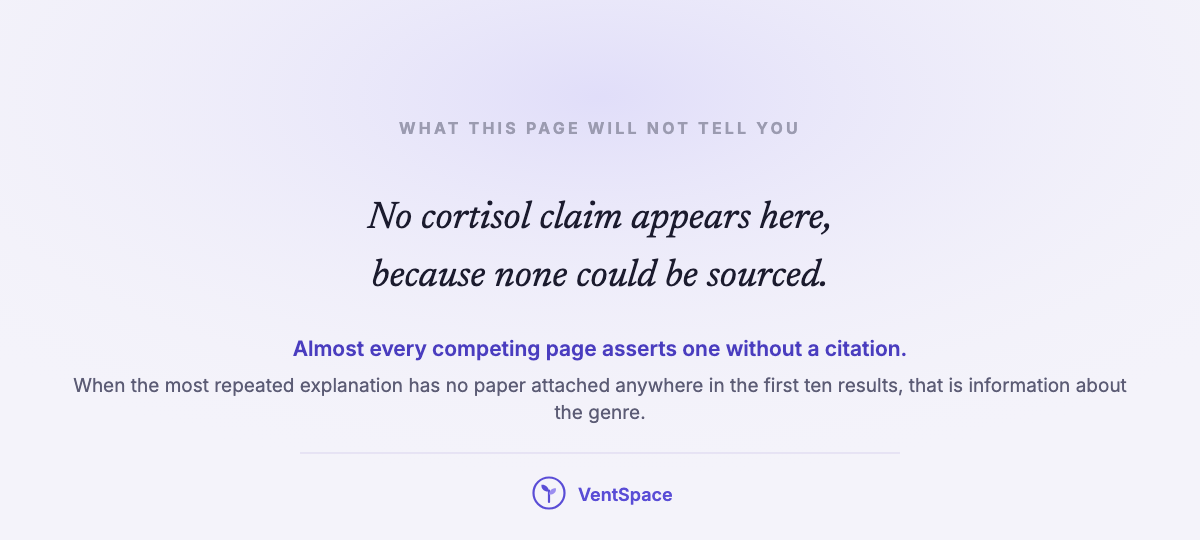
No cortisol claim appears on this page, because none could be sourced properly, which is itself worth knowing.
⭐ There are two systems, not one broken one. Sleep pressure builds while you are awake. A separate body clock sets an alert signal by time of day.
The evening collision has a name, the wake maintenance zone, and it sits just before melatonin starts rising.
Four things to do, none of which is a treatment, and one genuinely useful five-minute one from a sleep laboratory.
Is it cortisol, or adrenal fatigue?
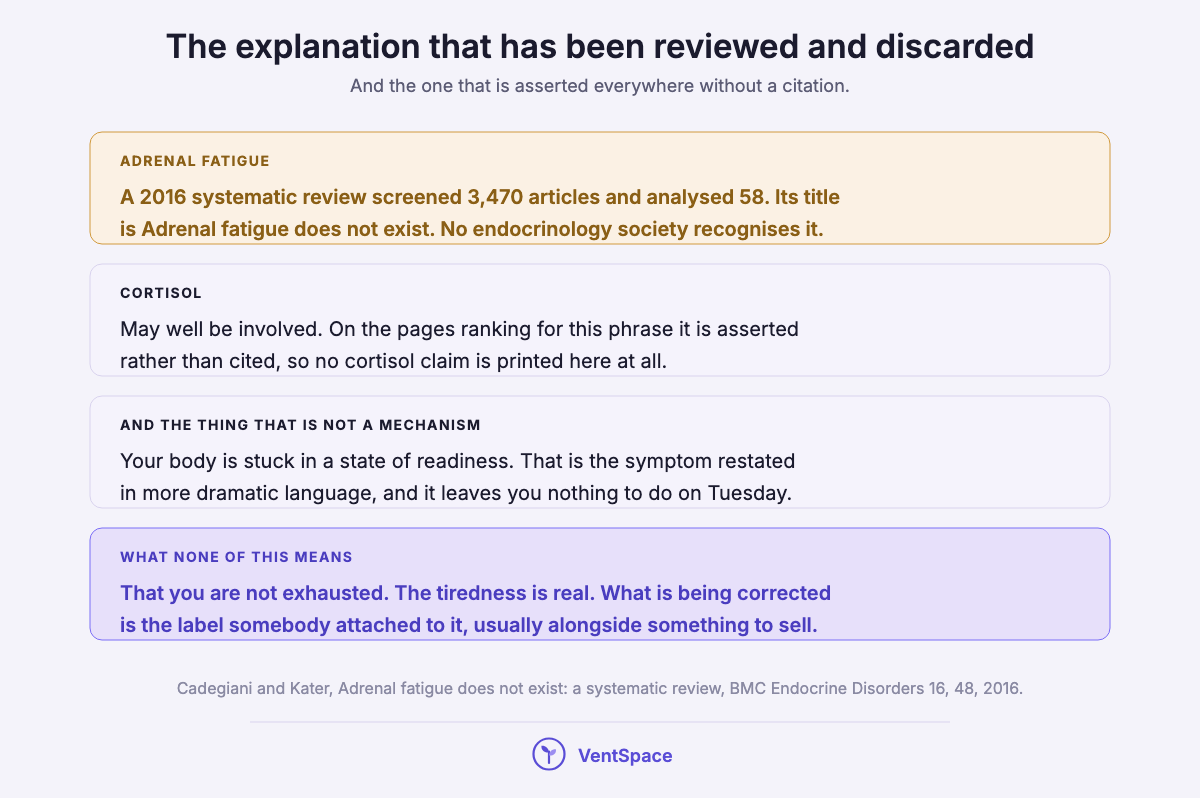
“Therefore, adrenal fatigue is still a myth.”
Cadegiani and Kater, “Adrenal fatigue does not exist: a systematic review”, BMC Endocrine Disorders 16, 48 (2016)
Start with the second half of that question, because it is the easier one to settle. In 2016, two researchers went looking for evidence that adrenal fatigue exists. They searched three databases, screened 3,470 articles, and analysed the 58 that met their criteria, 33 in healthy people and 25 in symptomatic patients. The paper is called “Adrenal fatigue does not exist”. Their conclusion is that there is no substantiation for it as an actual medical condition, and they note that it has not been recognised by any endocrinology society.
Now the important part, and please do not skip it. None of that says you are not exhausted. The tiredness is real, it is the reason you are reading this at midnight, and nothing in that review touches it. What the review disposes of is a particular explanation that has been attached to the tiredness, usually by people with something to sell. Those are different things, and conflating them is how a person ends up feeling both wrecked and dismissed.
So what about cortisol?
Here is the honest answer, and it is an unusual thing to print. It might well be involved. Evening cortisol is a real subject with a real literature. But on the pages currently ranking for this exact phrase, the cortisol explanation is asserted rather than cited, and nothing was located during this write-up that would let us print a specific claim about your cortisol at a standard this page is willing to use. So we are not going to print one.
That may be unsatisfying. It is also the useful signal. When the most-repeated explanation for something turns out to have no paper attached to it anywhere in the first ten results, that is information about the genre rather than about you. And there is a mechanism with papers attached, and it explains the timing far more precisely than a hormone does.
The other phrase worth retiring while we are here is the one about your body being stuck in a state of readiness. That is not a mechanism. It is a restatement of the symptom in slightly more dramatic language, and it leaves you with nothing to do on Tuesday.
Quick Summary
Q: Is being tired but wired caused by cortisol or adrenal fatigue?
A: Adrenal fatigue was the subject of a 2016 systematic review titled “Adrenal fatigue does not exist”, which screened 3,470 articles, analysed 58, and concluded there is no substantiation for it as a medical condition. Cortisol may be involved, but the explanation is asserted rather than cited on almost every page ranking for this phrase. There is a better-sourced mechanism, which is about timing rather than hormones.
Insight
The review states its background plainly: “The term ‘adrenal fatigue’ (‘AF’) has been used by some doctors, healthcare providers, and the general media to describe an alleged condition caused by chronic exposure to stressful situations. Despite this, ‘AF’ has not been recognized by any Endocrinology society, who claim there is no hard evidence for the existence.” And its conclusion, after screening 3,470 articles and analysing 58: “This systematic review proves that there is no substantiation that ‘adrenal fatigue’ is an actual medical condition.”
Flávio Cadegiani and Claudio Kater, BMC Endocrine Disorders 16, 48 (2016)
Two switches, one light
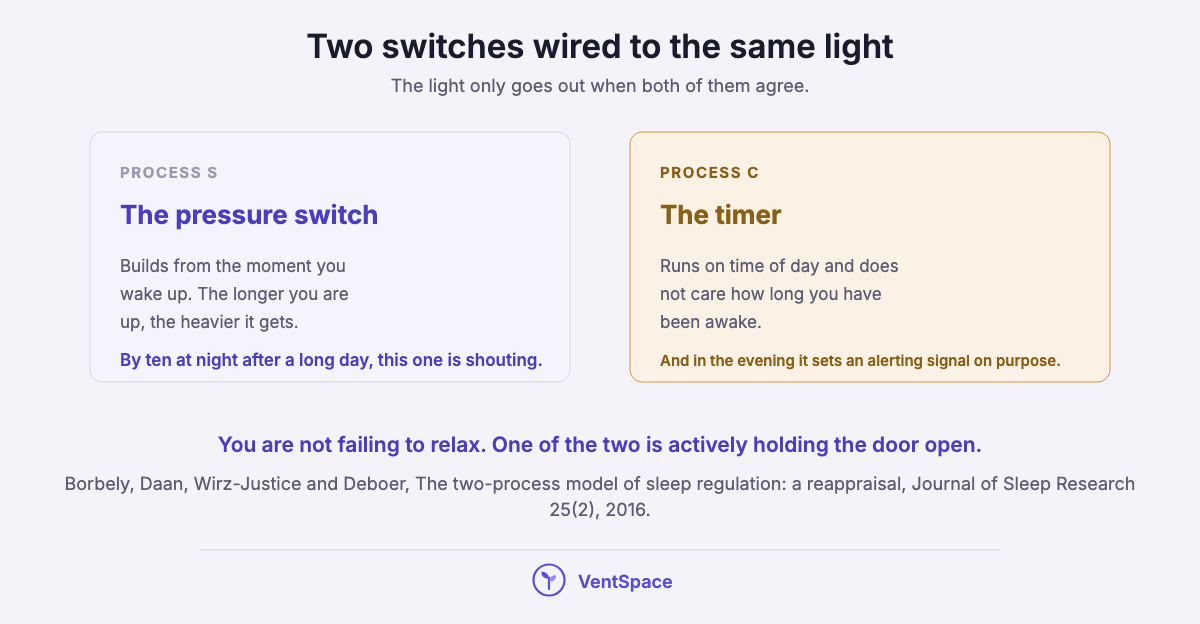
“The model posits that a homeostatic process (Process S) interacts with a process controlled by the circadian pacemaker (Process C), with time-courses derived from physiological and behavioural variables.”
Borbély, Daan, Wirz-Justice and Deboer, “The two-process model of sleep regulation: a reappraisal”, Journal of Sleep Research 25(2), 131–143 (2016)
This is the sentence that reorganises the whole experience, so it is worth translating carefully. For roughly four decades, sleep research has worked with a model in which two separate processes decide how sleepy you are. Not one. Two.
The first is sleep pressure. It is a counter. It starts building the moment you wake up and it keeps building for as long as you stay awake, and the longer you have been up, the higher it goes. By ten in the evening after a fourteen-hour day, this one is shouting.
The second is the body clock, and it does not care how long you have been awake. It runs on time of day, more or less on a schedule, and it sets an alerting signal that rises and falls across the twenty-four hours regardless of what you have been doing.
So how does that produce a night like last night?
Picture two switches wired to the same light. One is a pressure switch that gets heavier the longer you are up. The other is a timer. The light only goes off when both of them agree, and the reason you are lying in the dark fully awake at 12:40 is not that one of them is broken. It is that at that hour, on your particular schedule, they are not agreeing.
Why would a system be built to do that?
Because being awake in the early evening is useful, and the alerting signal is there on purpose. In the words of the paper this article opens with: the accumulation of sleep pressure in the evening is opposed by a strong circadian arousal signal just before melatonin starts to rise, and that window has a name. The wake maintenance zone. Not a malfunction. A feature, with a label, in the literature, described in a sentence that is almost word for word the thing you typed into a search box.
Which changes what you are dealing with entirely. You have not been failing to relax. You have been trying to fall asleep during a period in which one of the two systems responsible for sleep is actively holding the door open.
Quick Summary
Q: Why am I exhausted but wide awake as soon as I lie down?
A: Because sleepiness is set by two separate systems, not one. Sleep pressure builds the longer you are awake, while a separate body clock sets an alerting signal by time of day. In the evening those two can pull in opposite directions, and the window where the clock’s arousal signal opposes accumulated sleep pressure is called the wake maintenance zone. Tired and wired at the same time is what that collision feels like.
Insight
“Under entrained conditions, the accumulation of homeostatic sleep pressure in the evening is opposed by a strong circadian arousal signal prior to the dim light melatonin onset, called the Wake Maintenance Zone (WMZ).” That is the definition as the researchers state it, and it is the background they were working from rather than their own finding. Their study itself was small, twelve young men on a constant-routine protocol, and it is the definition being borrowed here, not their results.
de Zeeuw and colleagues, Scientific Reports 8, 11012 (2018)
Why is it worse for some people at the same hour?
Because the clock is not set to the same time in everybody, and bedtimes are.
In 1990, three researchers compared thirteen people who took a long time to fall asleep with nine who did not, chosen to differ only in that one respect, with polysomnography confirming it. What they found was not a difference in effort or in habits. It was a difference in timing: the markers of the slow group’s temperature rhythm ran about two and a half hours later than the good sleepers’.
And then the finding that matters for this page. The slow group’s usual bedtimes fell inside their own wake maintenance zone. The good sleepers’ bedtimes fell several hours after theirs.
What does that actually mean for two people going to bed at eleven? Two people, same bedtime, same routine, same dark room, and one of them is lying down in the middle of their own alert window while the other is lying down well after theirs. The first person is going to describe themselves as bad at sleeping. They are doing the same thing. The clock underneath is in a different place.
Four honest caveats, because this is a small old study about a clinically defined group. Thirteen people. Nineteen-ninety. A group selected for a specific sleep problem. And nothing here can tell you where your own clock sits. What it does suggest is that the same hour is not the same hour for everybody, and a much larger, more recent study points the same way from a different angle. In a 2025 pre-registered study of 994 adults, people with late body clocks who were tested in the morning showed the same pattern on a motivation task as people reporting much higher apathy. That study was not about sleep, but the lesson carries: the hour on the clock is not the hour your body is having.
So where does a page like this stop being useful?
Here, more or less, because this is where an explanation turns into a referral. If this has been running for months, there is a named treatment for long-term sleeplessness and it is not a tip. The American College of Physicians recommends cognitive behavioural therapy for insomnia as the first thing adults should be offered, and that is a strong recommendation in a clinical guideline. This page is not that treatment, does not contain it, and is not going to pretend that four suggestions are a version of it. A doctor can tell you whether it applies to you.
Quick Summary
Q: Why do some people get the tired-but-wired feeling worse than others?
A: Partly because body clocks are not set to the same time. In a 1990 study, people who took a long time to fall asleep had temperature rhythms running about two and a half hours later than good sleepers, and their usual bedtimes fell inside their own wake maintenance zone rather than after it. The sample was small and clinically defined, so it explains why the same hour is not the same hour for everybody rather than telling you where your own clock sits.
Insight
“ACP recommends that all adult patients receive cognitive behavioral therapy for insomnia (CBT-I) as the initial treatment for chronic insomnia disorder. (Grade: strong recommendation, moderate-quality evidence).” That is a clinical guideline speaking to clinicians, printed here for one reason: so that a reader who has been at this for months knows that something specific and recommended exists, and can ask for it by name.
Qaseem and colleagues, Annals of Internal Medicine 165(2), 125–133 (2016)
So if the hour is real and the clock is not yours to reset by willpower, what is actually adjustable?
Four things, and none of them is a treatment
“Participants in the to-do list condition fell asleep significantly faster than those in the completed-list condition.”
Scullin and colleagues, Journal of Experimental Psychology: General 147(1), 139–146 (2018)
All four can be started tonight with a notebook and a pen. None of them is medical, none requires anything to be bought, and the first one is only observation.
1. Find out where your own window actually is
The first action: for the next seven nights, write down two times. The time you got into bed, and the time you genuinely felt sleepy, meaning eyes-closing sleepy rather than tired. Two numbers a night. Nothing else.
You may never have separated those two, and the gap between them is the single most informative thing available to you. You are not measuring how badly you sleep. You are finding out whether you have been lying down before your own light goes out, which is a completely different question and one you can answer by Sunday.
- What time did you actually get into bed?
- What time did the sleepy feeling genuinely arrive?
- How big is the gap, on an average night?
- Is the gap roughly the same every night, or does it move?
- What time do you get sleepy on a night when nobody is watching the clock?
Do not change anything this week. A week of honest observation beats a month of adjustments made blind.
2. Stop arguing with the alert hour
The first action: on the next night the second wind arrives, notice it rather than fight it. Write down the time it came on and what you did for the twenty minutes after. Nothing to fix yet, just a record.
The reason is not mystical and it is not a technique. The alerting signal is not negotiating with you and it is not aware of you, so the argument in the dark is one you cannot win by trying harder. Seeing what you actually do in that window, night after night, is information. It is the kind a clinician will ask for if this turns out to be more than a bad patch.
One thing to be clear about, since this is the place people get misled. What is described above is observation, not a treatment, and it is deliberately not a description of, or a stand-in for, the structured programme named in the section above. If this is chronic, ask a clinician about that programme rather than assembling your own version out of articles.
- What do you usually do when the second wind arrives?
- How long do you lie there before giving up?
- What is the least stimulating thing available in your house at midnight?
- What happens to the bed as a place, after a hundred nights of that?
- What would you do with twenty minutes if you had decided in advance?
Be unambitious here. The aim is not to fall asleep, it is to stop the argument.
3. Offload forwards, not backwards
The first action: five minutes before bed, write tomorrow’s to-do list. As specifically as you can manage. Not a reflection on the day, not how it went, not what you should have done. What is still to come.
This one has a controlled study behind it and the direction is counterintuitive. Fifty-seven healthy adults aged eighteen to thirty spent five minutes writing before an overnight sleep-laboratory recording, half about tasks still to come and half about tasks already completed, and those writing the to-do list fell asleep significantly faster. The more specific the list, the faster.
It was one night, in a narrow population, and it is worth knowing that most evening-journaling advice tells you to do the slower of the two conditions. We have written about that finding at more length in our guide to evening journal prompts, which is where it belongs.
- What is still unfinished that your head keeps returning to?
- Can you write it specifically enough that tomorrow-you does not have to re-decide anything?
- What are you afraid of forgetting?
- Which of these could be done in under ten minutes tomorrow?
- Which of them is not actually yours?
Keep it to five minutes. This is offloading, not planning, and planning wakes you up.
4. Decide what the loud hour is for
The first action: write one sentence, tonight, answering this. If the hour between midnight and one is going to be awake anyway, what is it for?
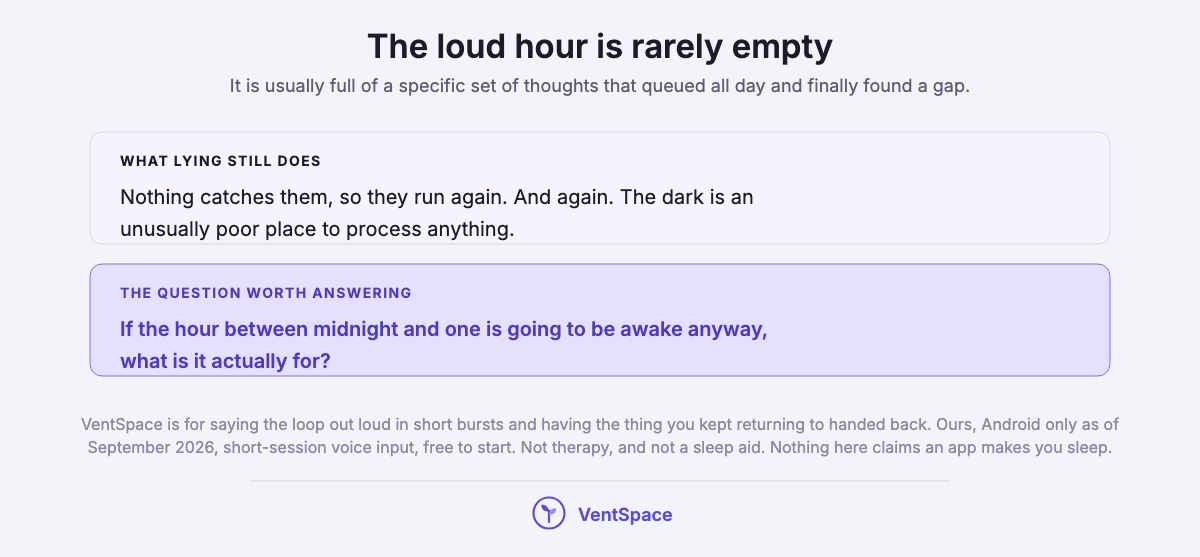
This is the least medical thing on the page and it is often the one that changes the night. The wired hour is rarely empty. It is usually full of a specific set of thoughts that have been queued all day and have finally found a gap, and lying still in the dark is an unusually poor way of processing them, because there is nothing to catch them and they run again. And again. What exactly is the loop rehearsing?
If you would rather write that sentence somewhere other than a notebook, VentSpace is ours: a journaling app that turns what you write into a clear read on your life balance, plus small, doable next steps. It is Android only and free to start, and it is not therapy and it is not a sleep aid. Not on Android, or at a desk? VentSpace Live runs in your browser, free, with nothing to install. Nothing on this page is going to claim an app makes you sleep.
- What is the hour actually full of?
- Which of those thoughts has come back more than three nights running?
- What would you say about it if somebody were in the room?
- What are you trying to solve that cannot be solved at midnight?
- What would you rather be doing with a wakeful hour?
Do not aim for a resolution. Getting it out of the loop is the whole job.
Quick Summary
Q: What actually helps when you are tired but wired?
A: Four things, none of which is a treatment. Spend a week writing down when you got into bed and when you genuinely felt sleepy, so you know whether you have been lying down before your own window. Notice and note the alert hour rather than arguing with it. Spend five minutes writing tomorrow’s specific to-do list rather than reviewing the day, which was the faster condition in a controlled study. And decide what a wakeful hour is for instead of lying still inside it.
Insight
The most encouraging line in the two-process literature is a dry one about what the model can do: it “simulates successfully the timing and intensity of sleep in diverse experimental protocols.” Timing and intensity. Which is to say the thing being modelled here is a schedule rather than a character, and a schedule is the kind of thing that can be observed, described and, within limits, worked with.
Borbély, Daan, Wirz-Justice and Deboer, Journal of Sleep Research 25(2), 131–143 (2016)
Pulling it all together
This week, two numbers a night. Bedtime and the time you genuinely felt sleepy, written down, with nothing changed yet.
Then, on the next bad night, notice the second wind instead of fighting it. Write down when it came and what you did with it, because the argument in the dark accumulates nothing.
Then five minutes on tomorrow, specifically, before bed, rather than five minutes on today.
Then one sentence about what the loud hour is for, which is the only one of the four that touches the actual content of the hour.
Four things, and none of them asks you to relax, be calm, or want it less. They are all attempts to find out where your own window sits and to stop spending the evening arguing with a signal that is not listening.
Questions people ask
Why am I exhausted but cannot fall asleep?
Because two separate systems decide how sleepy you are and they can disagree. Sleep pressure builds the longer you are awake. A body clock sets an alerting signal by time of day, and just before melatonin starts rising there is a window where that signal actively opposes the accumulated pressure. Researchers call it the wake maintenance zone. Being tired and wired simultaneously is exactly what two opposed systems feel like from inside.
Is tired but wired caused by cortisol?
It may be involved, and this page is not going to tell you it is, because nothing was found during this write-up that would support a specific claim about your cortisol at a standard worth printing. Almost every competing page asserts it without a citation. That is worth knowing before you spend money on a test somebody sells alongside the explanation.
Is this adrenal fatigue?
This is the myth worth putting down. A 2016 systematic review in BMC Endocrine Disorders, titled “Adrenal fatigue does not exist”, screened 3,470 articles, analysed 58, and concluded that there is no substantiation for adrenal fatigue as an actual medical condition, adding that no endocrinology society recognises it. None of which means you are not exhausted. It means the label attached to the exhaustion has no evidence behind it.
What time should I go to bed?
Nobody can answer that for you from a page, which is precisely why the first step is a week of observation. What the research suggests is that the answer is not the same for everybody: in a 1990 study, people who struggled to fall asleep had temperature rhythms about two and a half hours later than good sleepers, and were going to bed inside their own alert window rather than after it.
Does this mean I have insomnia?
This page cannot tell you that and would be wrong to try. Insomnia is a diagnosis, it is made by a clinician, and a single bad fortnight is not it. What is worth knowing is that if it has been months, something specific and recommended exists, and that the American College of Physicians names cognitive behavioural therapy for insomnia as the first treatment adults should be offered.
When should I see a doctor about this?
When it has been going on for months rather than weeks, when it is affecting your work, your mood or your driving, or when somebody has told you that you snore heavily or stop breathing at night. Several treatable conditions present exactly like this and no article can distinguish between them. That is not a disclaimer, it is the actual limit of what a page can do.
In a nutshell
Tired but wired is not a figure of speech and it is not a personal failing. It is a fair description of two systems that are both working correctly and are not, at that hour, in agreement, and the window where they collide is documented, named and studied. Knowing that will not make you sleep tonight. It does remove the part of the night you were spending on the question of what is wrong with you, which on most nights is a significant portion of it.
And the honest floor is that none of this is a fix. The observation week gives you information rather than sleep. The studies here are small, one of them is from 1990, and the sleep-laboratory finding covers one night in fifty-seven young adults. If this has been running for months, the useful move is not another article, including this one. It is a doctor, and the name of the treatment to ask about is in the section above.
About this article

Written by
Sai Subramaniam
Founder, VentSpace
I write these guides because I have been where you are. I am working through my own hard seasons, and I share the things that actually helped me, so that anyone going through it has a steady companion close by instead of facing it alone. VentSpace is the app I built for exactly that: a journaling app that turns what you write into a clear read on your life balance, plus small, doable next steps toward feeling more like yourself.
This writing is honest and every claim is sourced, and it is not a substitute for professional care. If you are struggling, reaching out to a professional is a strong move, not a failure.
Explore VentSpaceTry VentSpace LiveHow this one was checked. Every factual claim traces to a named source, and the source is printed next to the claim rather than kept in a footnote. Quotes are pinned to the work they come from, with the year, the letter or the chapter where one exists. Where a widely repeated claim could not be traced, it was left out and the omission recorded. Where a figure is contested, both sides are printed.
No affiliate links, no paid placements, and nobody paid to appear here. Where we mention our own app, we say that it is ours, we state its limits, and we never position it as a substitute for care.
Reviewed: October 2026. Prices, platforms and product availability move quickly, and anything we could not verify at the time of writing is marked as unverified rather than turned into a number.
Corrections. If something here is wrong, we would rather know. Corrections are made in place, with a note saying what changed. Updated 15 October 2026: step 2 now asks you to observe the alert hour rather than giving an instruction, the 1990 study is no longer the opening quote of its section, an unsupported line about the completed-list group was removed, the VentSpace description was corrected, and two unrelated links were removed.