
The notification arrives around eight. And before you have consciously decided anything, you have run a small calculation about whether you have the energy for it tonight, and somewhere underneath that there is a flicker of something that is unmistakably guilt.
About software.
Take a second with that, because it is the whole article. You feel bad about disappointing an application on your phone, and the app in question is one you downloaded specifically because self-care was supposed to feel gentler than everything else you were already failing at.
None of which means it is a bad app. It worked for a while, and it is well made, and it is warm in a way most of this category is not. A lot of people have got something real out of it and a good number of them still are.
But there is a mechanic underneath it, and the mechanic that made it stick is the same mechanic that turned it into a debt. That is not a flaw somebody sneaked in. It is what that mechanic does, over enough months, to enough people. The tell is the guilt.
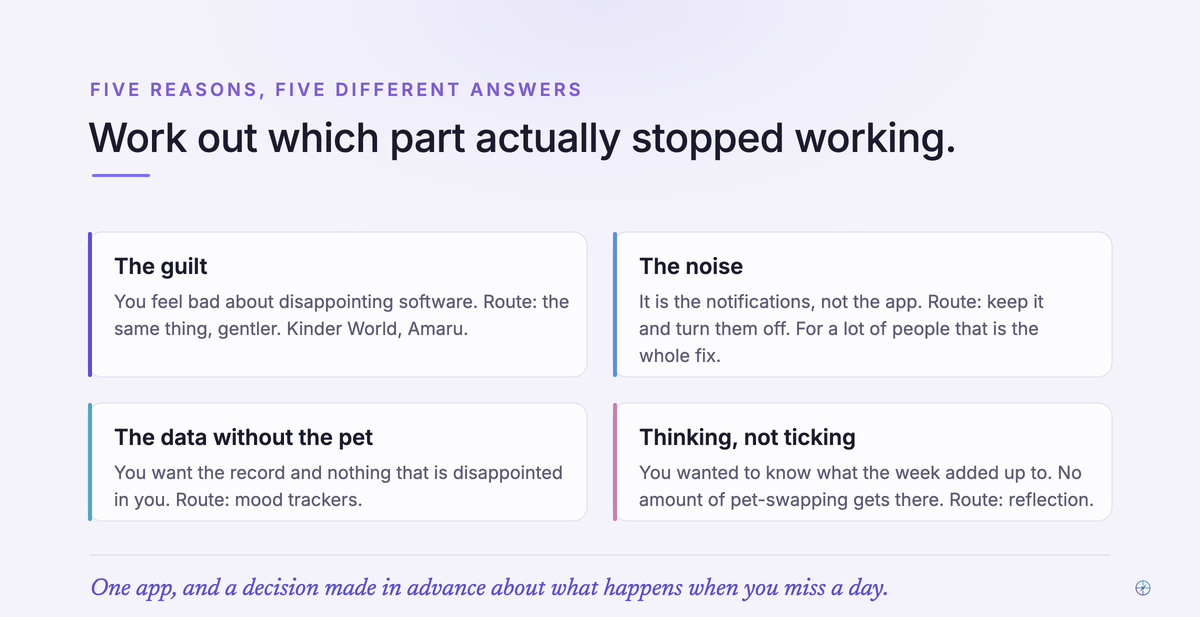
So before you download the fourteenth app, and there is always a fourteenth app, sitting in the store with a soft colour palette and a promise that this one will be different because it has a slightly rounder animal on it, the useful thing is to work out which part actually stopped working. There are five common answers and they route to completely different places. One of them is not an app at all.
The short version
Five reasons people leave, and they route differently: the guilt, the noise, the money, wanting data without a character, and wanting to think rather than tick.
The streak is a design decision, not a measurement of you. Research on contingent rewards is one plausible account of why the warmth turned into an obligation.
You can miss a day. In a well-known real-world habit study, missing a single opportunity did not materially affect habit formation.
The range is enormous. The same study found habits taking anywhere from 18 to 254 days, so comparing your day thirty to anybody’s is comparing noise.
Guilt is not a free motivator. Self-criticism is one of the variables that actually moves in the self-compassion trials.
Keeping Finch with the notifications off is a real option, and for some readers it is the whole fix.
A quick note before the list
This is a roundup of apps, not treatment. If the flatness is bigger than a habit problem, therapy is an ordinary option rather than a last resort. And if things are worse than that, call or text 988 in the US for the Suicide & Crisis Lifeline, or use findahelpline.com elsewhere.
Why leaving a self-care app feels like letting someone down
Because it was built to feel like a relationship, and it succeeded. That is the honest answer, and it is not a criticism. A companion that reacts to whether you showed up is a genuinely clever way to make a boring task feel like company, and for the first few months it does exactly that.
The trouble is what happens on month seven, on the evening you have nothing left. A neutral tracker just sits there. A companion produces a small consequence, and consequences accumulate into something that feels less like care and more like an account you are behind on.
Then comes the strange part, which almost nobody says out loud. You start avoiding the app because you are behind on it. Which is the exact opposite of what a self-care tool is for, and it can be the point at which you go looking for alternatives without being able to explain why.
None of that is a moral event. Needing the streak is a design fact, not a character fact. You did not fail at self-care. You responded to a mechanic in the way the mechanic is built to make people respond, and then the mechanic outlasted your enthusiasm for it.
Quick Summary: why the guilt happens
Q: Why do I feel guilty about not opening a self-care app?
A: Because the app was designed to feel like a relationship, with a companion that responds to whether you showed up. That works well early and turns into an obligation later, when the consequence for missing a day starts to feel like a debt. The guilt is a response to a design decision, not evidence about your discipline.
Insight: the question that sorts this out in ten seconds
Intrinsic motivation is doing something because the thing itself is worth doing, as distinct from doing it for what happens if you do or do not. Here is that idea as a question you can answer tonight. Would you still open this if the bird did not mind either way? If the honest answer is yes, keep it and turn the notifications off. If the answer is no, you already know what the app has become for you.
What a streak actually does to you
Here is a finding worth knowing, with a caveat attached that matters as much as the finding.
Deci, Koestner and Ryan’s 1999 meta-analysis pooled 128 experiments on the effects of extrinsic rewards on intrinsic motivation. Rewards contingent on doing a task showed a significant undermining effect on free-choice intrinsic motivation: engagement-contingent rewards at d = −0.40, completion-contingent at −0.36, and performance-contingent at −0.28.
Now the caveat, and it is not a formality. That is laboratory research on tangible rewards for target behaviours. It is not a study of Finch, of streaks, or of any app, and nobody should present it as proof about a specific product. What it is, legitimately, is a well-established finding about a mechanic that resembles the one you are dealing with, and one plausible account of a feeling that is easy to recognise.
Read it as an explanation you are allowed to consider, rather than a verdict, and hold it the way you would hold any plausible account of your own behaviour that arrived from a laboratory rather than from your own life, which is to say loosely, and only for as long as it keeps explaining something. The thing you did for its own sake became the thing you did to keep a counter alive, and the counter is now the reason you are here.
Quick Summary: streaks and motivation
Q: Are streaks bad for motivation?
A: The reward literature suggests a mechanism worth knowing about. Across 128 experiments, rewards contingent on doing a task showed a significant undermining effect on free-choice intrinsic motivation (Deci, Koestner & Ryan, 1999). That is lab work on tangible rewards rather than a study of any app, so treat it as a plausible account of why a task you enjoyed became one you owe, not as proof about a product.
Insight: what 128 experiments found
Deci, Koestner and Ryan reported undermining effects on free-choice intrinsic motivation of d = −0.40 for engagement-contingent rewards, −0.36 for completion-contingent and −0.28 for performance-contingent. The pattern is consistent: attach a reward to doing a thing, and the reason for doing the thing shifts toward the reward. Whether that generalises cleanly to a self-care app is a genuinely open question, and the honest thing is to say so rather than to borrow the authority.
You can miss a day
This is the most useful section on the page, and it is one sentence long.
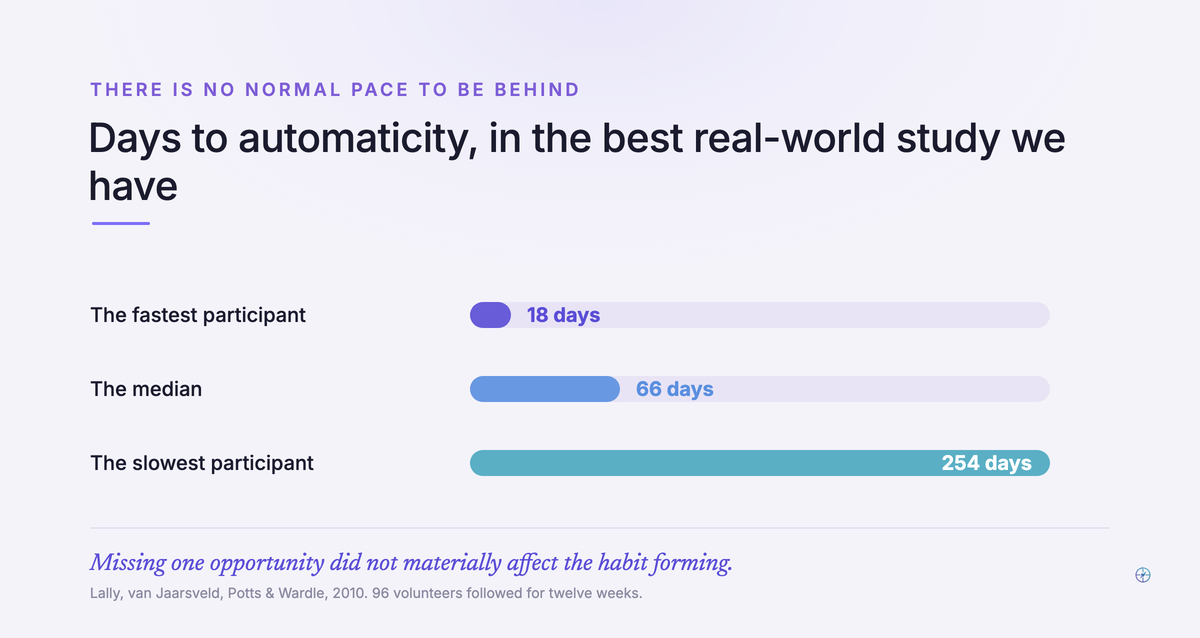
Lally and colleagues (2010) followed 96 volunteers for 12 weeks as they tried to form a new daily habit, measuring automaticity as they went. Among those whose data fitted the model, the median time to automaticity was 66 days. And the finding that matters here: missing a single opportunity did not materially affect the habit forming.
Read that again, because it contradicts the interface. You can miss Tuesday. Nothing measurable happens. The habit does not reset, the progress is not lost, and the counter going back to zero is describing the counter rather than describing you.
The streak is enforcing a rule the evidence does not support. Read that once more.
And there is a second thing in that same study which is quietly liberating. The range was 18 to 254 days. The slowest person took roughly fourteen times longer than the fastest to reach the same point. Which means comparing your day thirty to anybody else’s day thirty is comparing noise, and any app implying there is a normal pace is implying something the research does not contain.
Quick Summary: does breaking a streak matter
Q: Does breaking a streak mean starting over?
A: No. In a well-known real-world habit study, missing one opportunity did not materially affect habit formation (Lally et al., 2010). The counter resetting is a product feature, not a fact about your brain. The same study found time to automaticity ranging from 18 to 254 days, so there is no normal pace to be behind.
Insight: 18 to 254 days
Lally and colleagues found a median of 66 days to automaticity, with a range of 18 to 254 days across their participants. That range is the number worth carrying out of this article. There is no schedule. A person forming the same habit as you may take four months longer for reasons that have nothing to do with either of you, and no app on this page knows which one you are.
Why the guilt is the part that costs you
There is a common assumption that guilt is a free motivator. Unpleasant, but useful. Something that gets you off the sofa at no real cost.
The self-compassion literature suggests otherwise. Ferrari and colleagues (2019) in Mindfulness meta-analysed 27 randomised controlled trials of self-compassion interventions and found effects on self-criticism at g = 0.56 and on rumination at g = 1.37, alongside depression at 0.66 and stress at 0.67. Notably, the depression gains continued to increase at follow-up.
The relevant part for this article is not the size of any single number. It is that self-criticism and rumination are variables that move, which means they are things happening to you rather than neutral background conditions. A daily mechanism that reliably produces a small amount of self-criticism is not costless, even when the app is warm and the tone is kind.
So a mechanic that produces a small, reliable, daily dose of self-criticism, wrapped in a warm interface and delivered by something that looks like a friend, is not doing nothing to you over the course of eleven months, even though every individual instance of it is far too small to notice or complain about. Which is a reasonable thing to want out of.
Quick Summary: guilt as a motivator
Q: Is feeling guilty about a habit app actually a problem?
A: It is not free. Self-compassion trials show self-criticism and rumination are variables that respond to intervention (Ferrari et al., 2019), which means a daily mechanism producing a small amount of self-criticism is doing something rather than nothing. Wanting out of that is a reasonable response, not a failure of resilience.
Insight: the variables that actually move
Across 27 randomised trials, self-compassion interventions showed effects on self-criticism (g = 0.56) and rumination (g = 1.37), with depression gains still increasing at follow-up (Ferrari et al., 2019). Set that beside the design of a companion app that responds to your absence. The direction of travel matters more than any single figure, and it points away from guilt as a maintenance strategy.
How we judged them
Five questions, so you can check the ranking against your own reason for leaving.
- Which reason for leaving does it answer? The whole spine. An app that fixes the wrong problem is a fourteenth download.
- What happens when you miss a day? The single most important line in every table below.
- How loud is it by default? Notification behaviour out of the box, before you go looking through settings.
- Is the pricing honest and cancellable? Named tiers, trials flagged.
- Does it run on your phone? Stated for every entry, including ours, and some of these are one platform only.
Ranking inside each group uses the first two. Prices are as of September 2026. Anything we could not confirm on a store page is marked [unverified] rather than guessed at. Nobody paid to be on this page and there are no affiliate links on it.
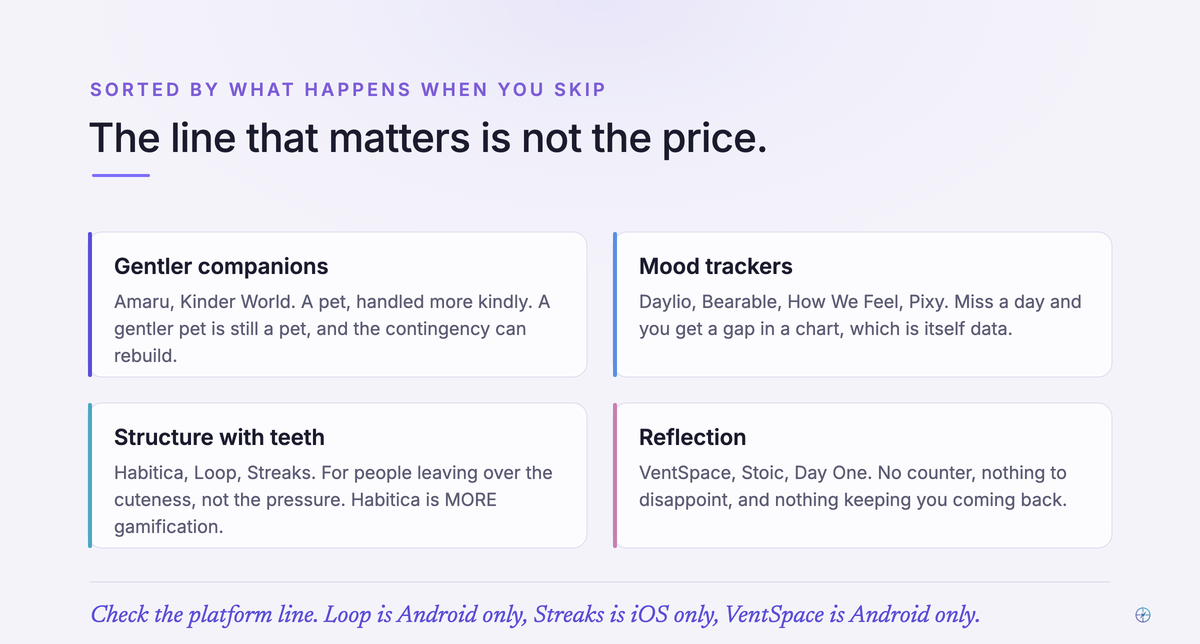
The eleven alternatives at a glance
| App | Which reason it answers | If you miss a day |
|---|---|---|
| Amaru: The Self-Care Pet | The guilt | A pet, more gently handled |
| Kinder World: Cozy Plant Game | The guilt | Designed to be judgment-free |
| Daylio | Data without a character | Nothing. A gap in the chart |
| Bearable | Data without a character | Nothing |
| How We Feel | Data without a character | Nothing |
| Habitica | Structure, not softness | You lose health. More gamification, not less |
| Loop Habit Tracker | Structure, not softness | A score dips, and it recovers |
| Streaks | Structure, not softness | The streak breaks. It is in the name |
| VentSpace | Thinking, not ticking | Nothing. There is no counter |
| Stoic | Thinking, not ticking | Nothing |
| Day One | Thinking, not ticking | Nothing |
Group one: the same thing, gentler
If the accounting was the reason you left, this is probably the group you want. Not no pet. A pet that does not keep an account. It is worth being precise about that distinction before you migrate, because the two things get sold as the same product and they are not: one of them removes the character and leaves you with a spreadsheet that has feelings about nothing, and the other one keeps the character, keeps the warmth, keeps the small daily reason to open the thing at all, and quietly declines to run a tally of the evenings you did not manage it.
Amaru: The Self-Care Pet
If what you actually liked was the creature, and the thing you wanted gone was the ledger it was keeping, this is the closest like-for-like swap available, built around caring for an animal and its environment with tasks spread across mood, movement and rest, handled with a noticeably lighter touch than the category norm. The caveat is structural rather than cosmetic. There is still a companion. It still notices.
| Type | Self-care companion app built around caring for a creature and its environment |
| Platforms | iOS and Android, last store update December 2025 |
| Price (Sept 2026) | Free tier, paid options [unverified] |
| If you miss a day | A pet, handled more gently than the category norm. There is still a companion and it still notices |
| Best for | Someone who wants the warmth and the character without the daily ledger |
| Pros | Keeps the companion, which may be the part you actually liked, tasks across mood, movement and rest, gentler consequence than the norm |
| Cons | A gentler pet is still a pet, and the same contingency can rebuild over a few months |
Who it’s for: the reader whose complaint was the accounting, not the animal.
In practice: the warmth is what people move for, and the question that tends to return somewhere around the sixth month, once the novelty of a new creature has worn through, is whether the obligation has quietly rebuilt itself in the same shape as the one they left.
Verdict: the closest like-for-like swap. Worth trying if the character was the part you liked. Check again at month six.
Kinder World: Cozy Plant Game
You water plants. That is most of it, and the restraint is the product: the developer describes a deliberately judgment-free design, which in practice means that the thing you came here to escape, the small accumulating sense of being behind on something that was supposed to be kind to you, has been engineered out rather than merely dialled down. The trade is real and worth naming in advance. Quieter also means less pull.
| Type | Cozy plant-care game with self-care check-ins |
| Platforms | iOS, Android |
| Price (Sept 2026) | Free, with paid options [unverified] |
| If you miss a day | Designed to be judgment-free. Nothing accumulates against you |
| Best for | The reader whose specific complaint is being made to feel bad |
| Pros | Genuinely gentle by design, free, keeps a character without keeping an account |
| Cons | Quieter also means less pull, and some people stop opening it entirely |
Who it’s for: anyone who left because an app made them feel bad.
In practice: the calm is exactly what it is chosen for, and the drift away from it is the thing that tends to follow.
Verdict: the gentlest thing in this group. Try it first if the guilt was the problem. Nothing is owed here.
The honest limit for the whole group, stated rather than glossed over. A gentler pet is still a pet. The mechanic is the same shape with the volume turned down, and if it turns out you cannot have a companion without eventually owing it something, the answer is in group two or four rather than here. That is worth knowing before you migrate.
Quick Summary: gentler pet apps
Q: What is a gentler alternative to Finch?
A: Kinder World if being made to feel bad was the specific complaint, since its design is deliberately judgment-free, and Amaru if you want the closest like-for-like companion. Both keep the character, which is the point and also the risk: a gentler pet is still a pet, and the same contingency can rebuild over a few months.
Insight: what "gentler" can and cannot fix
Softening the consequence changes how a mechanic feels without changing what it is. A companion that reacts to your absence is still a companion that reacts to your absence, and the effect accumulates over months rather than days. That is not a reason to avoid this group. It is a reason to notice, around month six, whether the feeling has come back, and to treat that as information rather than as a second personal failure.
Group two: the data without the companion
A tap, a pattern, and nothing that is disappointed in you. What you are trading away is the reason to come back, which sounds like a small thing until the fourth week, when nothing has asked after you, nothing has been waiting, nothing has grown or wilted or expressed anything at all about your absence, and you notice that the app you chose specifically because it made no demands has consequently made no impression either. For a lot of people leaving Finch, this turns out to be what they wanted the whole time.
Daylio
Ten seconds, a mood, a few activity icons, and after a month a chart that quietly tells you which days were consistently worse and what happened to be on them, which is a genuinely different proposition from an app that reacts to your absence. Nothing in it is disappointed in you. Nothing in it is anything at all, which is the entire pitch and the reason this is the default recommendation for anybody arriving here out of guilt fatigue.
| Type | Icon-based mood and activity tracker |
| Platforms | iOS, Android |
| Price (Sept 2026) | Free, Premium [unverified] |
| If you miss a day | Nothing. A gap in the chart, which is itself data |
| Best for | Anyone who wants the record without a relationship attached to it |
| Pros | The lowest-friction habit in this whole article, correlations surfaced over weeks, no character and no counter |
| Cons | Icons only. Nuance disappears the moment a day is complicated |
Who it’s for: the person who wants a record and not a relationship.
In practice: speed is what keeps it installed, which is precisely why it produces enough data to be worth reading.
Verdict: the default recommendation for this group. Ten seconds a day.
Bearable
The serious one, and the only entry on this page that will ask something substantial of you before it gives anything back, because tracking mood alongside sleep, energy, symptoms, medication and food is a much larger configuration job than tapping an icon, and the links it eventually surfaces only exist once there are weeks of data underneath them. For the right reader that trade is obviously worth it. If you mostly want a light daily check-in, it is not.
| Type | Multi-factor health and mood tracker with correlation analysis |
| Platforms | iOS, Android |
| Price (Sept 2026) | Free, Premium [unverified] |
| If you miss a day | Nothing |
| Best for | Anyone whose mood is tangled up with physical health |
| Pros | Tracks sleep, energy, symptoms, medication and food together, then finds links a person would not spot |
| Cons | Setup is real work, and the payoff arrives weeks later |
Who it’s for: people managing a physical condition alongside their mood.
In practice: the correlations can make visible a pattern you had suspected for months, and the setup is the most likely reason to give up on it in the first fortnight.
Verdict: the most powerful option here, and the least casual. Set aside an evening.
How We Feel
Sometimes the problem is not the tracking, it is that “off” is the only word available and it is doing far too much work, and this app exists to widen that vocabulary until the state you are in has a name specific enough to be manageable. It is free, non-profit, and there is no tier above the one you get. That last sentence is rarer in this category than it should be.
| Type | Emotion-naming and check-in app, non-profit |
| Platforms | iOS, Android |
| Price (Sept 2026) | Free, non-profit |
| If you miss a day | Nothing |
| Best for | Wanting a better word rather than a better graph |
| Pros | Genuinely free with no funnel attached, widens the vocabulary, quick to use |
| Cons | Lighter on analysis than the data-heavy trackers |
Who it’s for: anyone who answers “fine” and knows it is not the word.
In practice: the vocabulary is what people name as useful, more than the tracking wrapped around it.
Verdict: genuinely free with no funnel attached, which is rare. No tier above it.
The honest limit for this group. A tracker shows correlation, not cause. A chart of a bad month tells you it was a bad month. It will not tell you why, and it can quietly become one more thing to feel bad about looking at.
Quick Summary: mood trackers instead of a pet
Q: What is a good app like Finch without a character?
A: Daylio for the lowest-effort daily log, Bearable if your mood is tangled with sleep, symptoms or medication, How We Feel if you want a more precise word and no paid tier at all. None of them minds if you skip a day, which may be the entire specification if that is why you are leaving.
Insight: what a gap in the chart is
On a companion app, a missed day is a consequence. On a tracker, a missed day is a data point. That is not a small distinction. It changes what the app is for, from something that keeps you accountable to something that reports back, and for a reader arriving here out of guilt fatigue it is usually the more useful of the two.
Group three: structure without softness
Read the first line of this section carefully, because it goes against every other list on this topic.
This group is for people leaving over the cuteness, not over the pressure. If you are here because a companion made you feel bad, this is the wrong group and you should be in group one, two or four.
Habitica
It is a genuinely good app and it is probably the wrong answer if you are reading this page, which is an awkward pair of sentences to publish given that it is the default recommendation on nearly every Finch-alternatives article currently ranking. Habits, dailies and to-dos become a role-playing game with a character, a party and real consequences, and if you left because the aesthetic was too soft then this is exactly the structure you wanted. If you left because a small daily consequence became a burden, read the next line twice. Missing a day costs you health.
| Type | Role-playing-game habit system with a character, a party and consequences |
| Platforms | iOS, Android, web |
| Price (Sept 2026) | Free core, subscription [unverified] |
| If you miss a day | You lose health. Your character can die |
| Best for | Someone leaving because the aesthetic was too soft, who wants structure with teeth |
| Pros | Real structure, a party of other people, deep customisation, strong free core |
| Cons | This is more gamification, not less, and for the guilt-fatigued reader it is the most likely to make things worse |
Who it’s for: people who want teeth, not softness.
In practice: the party accountability is what devoted users credit for keeping them going through stretches where nothing else would have, and it is precisely the same feature, unchanged and working exactly as designed, that makes the app the wrong recommendation for the reader this article was written for.
Verdict: excellent for the right person and actively wrong for the guilt-fatigued one. Know which you are first.
Loop Habit Tracker
The one entry on this page that solves the actual mechanical complaint rather than routing around it, because instead of a counter that resets to zero it keeps a strength score that dips when you miss and then recovers when you do not, which is both a more accurate model of how habits behave and a considerably kinder one to look at on a Wednesday. It is free, open-source, and there is no company behind it planning a subscription. It is also Android only.
| Type | Open-source habit tracker with a recovering strength score |
| Platforms | Android only |
| Price (Sept 2026) | Free, open-source |
| If you miss a day | A score dips, and it recovers |
| Best for | Anyone who wants structure with no counter and no subscription in its future |
| Pros | Free and open-source, no account, no upsell, and the strength score is the fairest model here |
| Cons | Android only, and deliberately plain |
Who it’s for: Android users who want a tracker that will never be monetised at them.
In practice: the strength score is the feature people name when explaining why they left streak apps for it.
Verdict: the best free structure option, if you are on Android. Nobody will monetise it.
Streaks
Included for completeness and for one specific reader: the person who is leaving Finch over the companion rather than over the counter, who actually likes a streak, and who wants a well-built iOS habit tracker that does that one thing properly without a character attached to it. There is no ambiguity about what you are getting. It is called Streaks.
| Type | Streak-based habit tracker |
| Platforms | iOS only |
| Price (Sept 2026) | Paid [unverified] |
| If you miss a day | The streak breaks. It is in the name |
| Best for | People who like a streak and are leaving over the companion rather than the counter |
| Pros | Well built, fast, no character, entirely honest about its mechanic |
| Cons | It is a streak app. If the counter was the problem, this is not the answer |
Who it’s for: iOS users who genuinely like a counter.
In practice: the build quality is what people praise, and nobody is confused about what the app does.
Verdict: good at what it says on the label. No surprises anywhere.
Quick Summary: habit trackers without a pet
Q: Is there a habit tracker without streaks?
A: Loop Habit Tracker on Android is the closest, using a strength score that dips and recovers rather than a counter that resets. Most other habit trackers keep the streak, including one that is named after it. Habitica is more gamification rather than less, so it is the wrong move if you are leaving because you felt pressured.
Insight: the most-recommended alternative is often the wrong one
Habitica is the default suggestion on nearly every Finch-alternatives page, and it is a genuinely good app. It is also the one that turns missing a day into losing health. If the reason you are reading this is that a small daily consequence became a burden, the popular answer is the one to skip, which is a strange thing for a roundup to say and it is what the sorting logic requires.
Group four: reflection rather than tasks
Some readers work out, somewhere around the third replacement, having migrated their data twice and rebuilt the same six habits in three different colour schemes and arrived, each time, at the identical Tuesday evening feeling with a slightly different animal on the screen, that the thing they wanted was never a better tick-box. It was to understand what the week added up to. No amount of pet-swapping gets there.
VentSpace
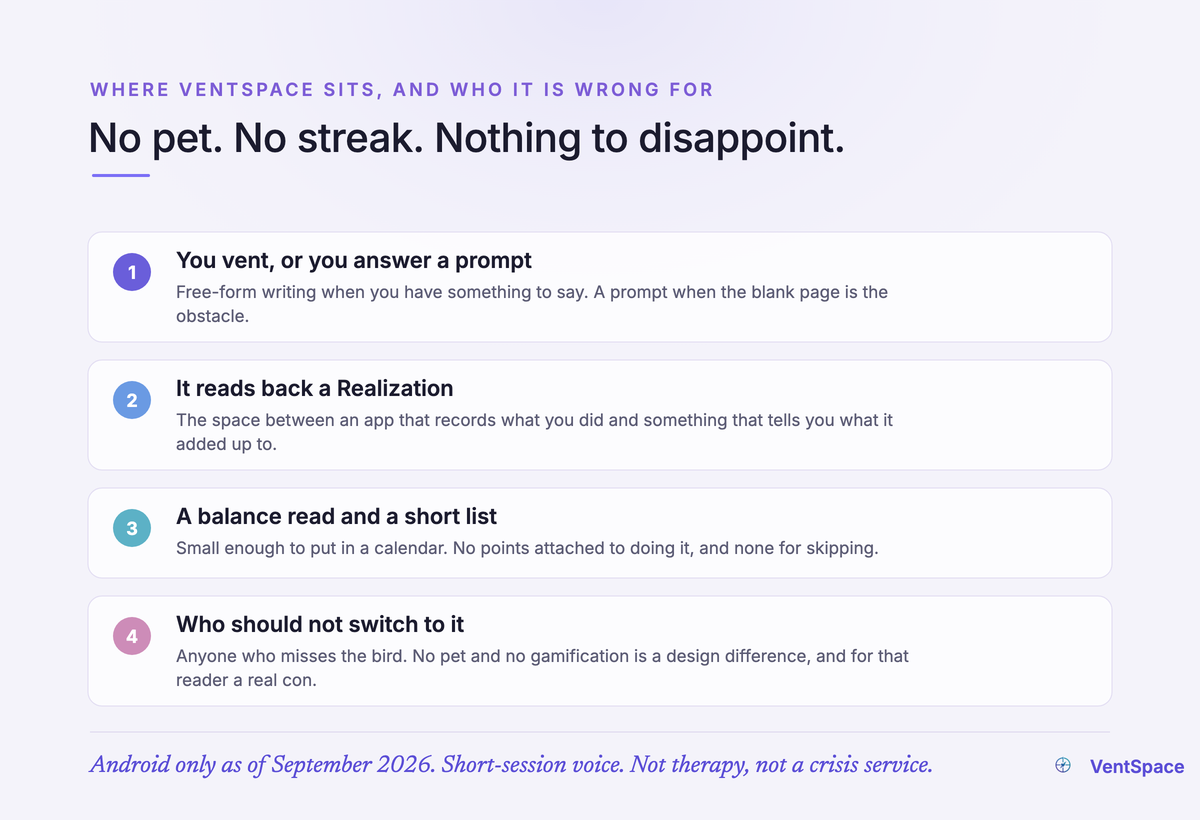
VentSpace is a journaling and self-reflection app, and it is here because this group is reflection. It is not the article’s overall pick. This page assumes you mostly want a gentler companion, and putting a journal at the top of the page would break the article’s own sorting logic.
It also has no pet, no streak and no gamification of any kind, which is a genuine con if the character was the part you came for. That is a design difference rather than a moral one, and it is stated flatly rather than as a claim to be better. What VentSpace does instead is take what you wrote and give something back: you vent freely, or answer a prompt when the blank page is the obstacle, and it returns Realizations, named plainly, alongside a balance read across the areas of your life and a short action list. It sits in the space between an app that records what you did and something that tells you what it added up to. It comes as an Android app and as a web tool, VentSpace Live, which runs in any browser on phone or desktop with nothing to install.
| Type | Journaling app: free-form venting or prompted writing, read back as Realizations |
| Platforms | Android app + web (VentSpace Live) |
| Price (Sept 2026) | Free to start |
| If you miss a day | Nothing. There is no counter, no character and nothing to disappoint |
| Best for | Someone who has worked out that they wanted to think about the week rather than tick it off |
| Pros | No pet, no streak, no points, your own writing returned as a named realization, a balance read across life areas, a short action list |
| Cons | The app is Android only for now, though VentSpace Live works in any browser, iPhone included. Live does not keep your history. Voice input is short sessions only, newer than the incumbents, and not therapy, not treatment, not a crisis service. If the character was what you came for, this is the wrong product |
Who it’s for: the reader whose complaint turned out to be the ticking rather than the app.
In practice: it is newer than everything else here, so there is less of a track record to go on, and no published outcome data.
Verdict: right for the reader whose actual complaint was the ticking, and wrong for the one who misses the bird.
Stoic
The middle option, for the person who wants some scaffolding in the writing but has had enough of anything that looks like a task list, offering prompts, mood logging and quotes inside a default tone that is deliberately calm rather than encouraging. It does several things reasonably rather than one thing exceptionally. Check the free tier carefully. It is narrower than it first appears.
| Type | Prompted journaling app with mood logging |
| Platforms | iOS, Android |
| Price (Sept 2026) | Free tier, paid [unverified] |
| If you miss a day | Nothing |
| Best for | Wanting structure in the writing without a task list |
| Pros | Calm default tone, prompts plus mood logging in one place, no streak pressure |
| Cons | It does several things rather than one, and the free tier is narrower than it first appears |
Who it’s for: people who want prompts without a programme.
In practice: the tone is the reported draw, and the free-tier limits are the recurring surprise.
Verdict: a reasonable middle option. Read the free tier.
Day One
If what you actually want is to be able to look back in three years and read what a particular week was like, nothing else in this article comes close, because the free tier is unusually generous, entries are unlimited, and end-to-end encryption on one device makes it a reasonable place to put things you would not put anywhere else. Be clear about what it is not. It stores. It does not respond.
| Type | General-purpose journaling app and long-term archive |
| Platforms | iOS, Android, macOS |
| Price (Sept 2026) | Generous free tier, paid tier available |
| If you miss a day | Nothing |
| Best for | Anyone whose real goal is a private long-term record |
| Pros | Unlimited entries free, end-to-end encryption on one device, excellent search across years, mature and maintained |
| Cons | It stores, it does not respond. No prompts to follow and nothing that reads it back |
Who it’s for: archive-keepers.
In practice: the long-range search is the part that pays off the longer you keep writing in it.
Verdict: the best free option in this group, and the right one if the archive is the point. It keeps everything.
The honest limit for this group. Reflection apps have nothing keeping you coming back. That is the entire appeal and it is also the risk. Nothing here will notice you are gone, which means the return has to come from the thing itself or it will not come at all.
Quick Summary: reflection instead of habits
Q: What if I want to think about my week rather than track it?
A: Day One for a private long-term archive with a genuinely generous free tier, Stoic for prompted journaling with structure, and VentSpace (an Android app, or VentSpace Live in any browser) if you want your own writing read back as a named realization. None of them has a counter, which is the point and also means nothing will chase you.
Insight: what nothing-to-disappoint costs
Removing the companion removes the guilt and removes the pull in the same move. An app with no mechanism for wanting you back will be opened only when you want to open it, which is either exactly what you were looking for or the reason you stop within a month. It is worth knowing which of those you are before you treat the absence of a streak as an unambiguous upgrade.
In defence of Finch
A fair account, because this article’s critique is of a mechanic and not of a company.
Finch does something the rest of this category mostly fails at. It makes self-care feel like company rather than a chore. The tone is kind. The tasks are small enough to actually do. The community around it is warm in a way that is genuinely unusual for a mental-health app. It has real value to offer, and for a while it probably gave some to you.
Nothing in this article is a claim about anybody’s intent, ethics or business practices, and it is worth stating that plainly rather than by implication, because the internet’s default register for a piece like this is the accusation, the implied dark pattern, the suggestion that somebody in a meeting somewhere decided to make you feel this way on purpose, and none of that is being said here or believed here. The thing under examination is streak-and-companion contingency as a mechanic, which appears in dozens of products and which does the same thing in all of them over enough months.
And here is the option no other page on this topic offers.
Keep it. Turn the notifications off. All of them.
Not fewer notifications. Off. Then open it when you want to, with no guilt attached because nothing is asking. For some readers that is the whole fix, and it costs nothing, and you keep the thing you liked.
If a month of that goes well, you never needed an alternative. If a month of that means you never open it again, you have your answer and you got it for free.
The ones on other lists that are gone
Short, factual and dated, because migrating your data into something that is closing is a bad afternoon, and it happens more often than it should in a category where roundups get republished with a new year in the title and no new checking underneath, which means the app somebody recommends to you this week may have stopped existing eighteen months ago without anybody updating the sentence that sent you there.
- Woebot closed its consumer app on 30 June 2025. It is still recommended by at least one Finch-alternatives page updated in May 2026.
- Youper is gone. The app stopped working on 30 September 2026, by the company’s own notice, and data export closed on that date. Checked again on 8 October 2026: its Google Play listing returns a 404 and an App Store lookup returns nothing, against a control that returned normally.
- Happify is the complicated one, and since this section was first written both store listings have been read. Its parent rebranded to Twill in 2022 and was acquired by DarioHealth in February 2024, with the business pivoting toward clinical and employer channels. As of 11 September 2026 the app returns nothing on Google Play or the App Store in any of seven regional storefronts tested, and `happify.com` now redirects to a Dario Mind page. We still will not write that it shut down, because a Happify-derived web programme does exist behind an access code, and because nobody has announced anything. The honest version is narrower: you cannot download it, and we are not recommending it. The full evidence trail, including the vendor’s own page that still describes the app in the present tense while both of its download buttons return 404, is in our piece on what happened to Happify.
Those are product and corporate facts with dates attached. No claim is made about any company’s conduct, motives or finances. The practical takeaway is the same one this whole section exists for: a list with the current year in its title is not evidence that anything on it still exists.
All eleven, side by side
| App | Which reason | Price (Sept 2026) | Platforms | If you miss a day | The watch-out |
|---|---|---|---|---|---|
| Amaru | The guilt | Free tier, paid [unverified] | iOS, Android | A pet, more gently handled | A gentler pet is still a pet |
| Kinder World | The guilt | Free, paid [unverified] | iOS, Android | Judgment-free by design | Quieter also means less pull |
| Daylio | The data | Free, Premium [unverified] | iOS, Android | Nothing | Icons only, nuance lost |
| Bearable | The data | Free, Premium [unverified] | iOS, Android | Nothing | Setup is real work |
| How We Feel | The data | Free, non-profit | iOS, Android | Nothing | Light on analysis |
| Habitica | Structure | Free core, subscription [unverified] | iOS, Android, web | You lose health | More gamification, not less |
| Loop | Structure | Free, open-source | Android only | A score dips and recovers | Android only, deliberately plain |
| Streaks | Structure | Paid [unverified] | iOS only | The streak breaks | It is a streak app. It says so |
| VentSpace | Thinking | Free to start | Android app + web (VentSpace Live) | Nothing. No counter | App Android only, Live keeps no history. No pet, no streak |
| Stoic | Thinking | Free tier, paid [unverified] | iOS, Android | Nothing | Free tier is narrower than it looks |
| Day One | Thinking | Generous free tier | iOS, Android, macOS | Nothing | Stores, does not respond |
How to actually pick one
Find your sentence. This is the part that saves you three downloads.
- “I still want the pet, I just want it to stop guilting me.” Group one. Kinder World first.
- “It is the notifications, not the app.” Keep Finch and turn them off. Try that for a month before anything else.
- “I want the mood data without the character.” Group two. Daylio if you want it in ten seconds.
- “I want structure and the cuteness was never it.” Group three, and not if you are leaving over pressure. Habitica is more of it, not less.
- “I want to know what my week actually added up to.” Group four.
- “I think I want fewer apps.” That is a legitimate answer, and the next section is for you.
The rule: one app, and a decision made in advance about what happens when you miss a day. Decide it now, while nothing has gone wrong. The answer is “nothing happens, I open it again on Thursday”, and having said that to yourself in advance is worth more than the app you pick.
When the answer is not another app
Sometimes the honest move is fewer of these, not a better one. That is a genuinely unpopular thing for an article like this to say, because the entire economics of a page like this one assume that you arrived wanting to be told what to download and will leave dissatisfied if nobody tells you, and it is nonetheless the correct recommendation for some of the people reading this sentence.
Three options that are not a download, offered without any expectation that you will pick one, because the honest position here is that the best outcome for a certain kind of reader is to close this page having decided that the problem was never which app they had installed and that the correct number of self-care applications on a phone is occasionally zero.
Turn the notifications off on everything in this category, not only Finch. Most of the pressure in your phone is scheduled by somebody else, and you are allowed to unschedule it.
One paper list on the fridge. Three things, crossed off with a pen. It has no counter, no account and no opinion, and it cannot be opened at midnight.
Nothing, for a month. Not as a test. Just to find out what you do without a structure, which is genuinely useful information and costs you nothing to collect.
And if what is underneath this is bigger than a habit problem, if the flatness has been running for months and does not lift on a good weekend, that is an ordinary reason to talk to a GP or a therapist. Not a last resort, and not a bigger step than it sounds. The numbers at the top of this page are there for the worse version of it.
Questions people ask
What is the best alternative to Finch?
It depends entirely on why you are leaving, which is why this article sorts by that rather than by rating. If the guilt was the problem, Kinder World. If you want the data without a character, Daylio. If you want a private record and a genuinely generous free tier, Day One. And if the real issue is the notifications, keep Finch and turn them off, which costs nothing and works for a lot of people.
Is there a free app like Finch?
Several, with platform caveats. Kinder World is free and deliberately judgment-free. How We Feel is free and non-profit with no paid tier at all. Loop Habit Tracker is free and open-source but Android only. Check the platform line before you get attached.
Does breaking a streak mean starting over?
No. In a well-known real-world habit study, missing one opportunity did not materially affect habit formation (Lally et al., 2010). The counter going back to zero describes the counter. The same study found time to automaticity ranging from 18 to 254 days, which means there is no normal pace you could be behind.
Why do I feel guilty about not opening a self-care app?
Because it was built to feel like a relationship and it worked. Research on contingent rewards found that attaching a reward to doing something significantly undermined free-choice intrinsic motivation across 128 experiments (Deci, Koestner & Ryan, 1999), which is one plausible account of why something you enjoyed became something you owe. That is lab work rather than a study of any app, and it is offered as an explanation to consider rather than a verdict. It is also worth knowing that self-criticism is a variable that moves, so the guilt is not free.
Is there a habit tracker without streaks?
Loop Habit Tracker is the closest, using a strength score that dips and recovers rather than a counter that resets, and it is free and open-source on Android. Most mood trackers, including Daylio and Bearable, have no streak at all, because a gap in a chart is just a gap. Reflection apps have nothing to break by design.
Is Finch worth the subscription?
For a lot of people, genuinely yes, and this article is not a case against it. It is warm, well made, and it does something the rest of the category struggles with. The question is not whether it is good. It is whether the mechanic has turned into a debt for you specifically, and the test is the one at the top: would you still open it if the bird did not mind? Before you cancel, try a month with the notifications off. You may find you liked the app and not the schedule.
Related. Youper Is Closing on 30 September 2026.
Related. Mental Health Apps in 2026.
The counter was never measuring what you thought
You did not fail at self-care, and the fact that this needs saying at all is a reasonably good indictment of an entire product category that has quietly taught a large number of capable adults to read a reset counter as a summary of their character. You kept a small daily appointment for four months, which is no small thing, and then a mechanic outlasted your enthusiasm for it, which is what mechanics do.
The day you missed did not cost you anything. Not the Tuesday in February when you were ill, not the fortnight in June when work went sideways and every small good habit you had built quietly went with it, and not the evening last week when you looked at the notification, felt the familiar flicker of something owed, and put the phone face down instead. The best evidence available says so plainly, and the number that went back to zero was describing a feature.
So name the reason you are leaving, take the one app that answers it, and decide tonight what happens on the day you skip.
The answer is nothing. You open it again on Thursday.
About this article

Written by
Sai Subramaniam
Founder, VentSpace
I write these guides because I have been where you are. I am working through my own hard seasons, and I share the things that actually helped me, so that anyone going through it has a steady companion close by instead of facing it alone. VentSpace is the app I built for exactly that: a journaling app that turns what you write into a clear read on your life balance, plus small, doable next steps toward feeling more like yourself.
This writing is honest and every claim is sourced, and it is not a substitute for professional care. If you are struggling, reaching out to a professional is a strong move, not a failure.
Explore VentSpaceTry VentSpace LiveHow this one was checked. Every factual claim traces to a named source, and the source is printed next to the claim rather than kept in a footnote. Quotes are pinned to the work they come from, with the year, the letter or the chapter where one exists. Where a widely repeated claim could not be traced, it was left out and the omission recorded. Where a figure is contested, both sides are printed.
No affiliate links, no paid placements, and nobody paid to appear here. Where we mention our own app, we say that it is ours, we state its limits, and we never position it as a substitute for care.
Reviewed: October 2026. Prices, platforms and product availability move quickly, and anything we could not verify at the time of writing is marked as unverified rather than turned into a number.
Corrections. If something here is wrong, we would rather know. Corrections are made in place, with a note saying what changed. Updated 15 October 2026: removed Pixy, which has not been updated since December 2022, so the list is now eleven apps. Also softened lines about how many readers a tip helps and how often people open an app, removed a user-report line about our own app, and removed an unrelated link and a duplicate download button.