
There is an app on your phone right now that you downloaded in January. You used it properly for about nine days. The reminders still arrive and you still swipe them away, and at some point the icon stopped being a plan and became a small piece of evidence about you.
Maybe there are three of them. Plenty of people who search this have done this before, which is an uncomfortable place to be standing: sceptical of the whole category, and still tired.
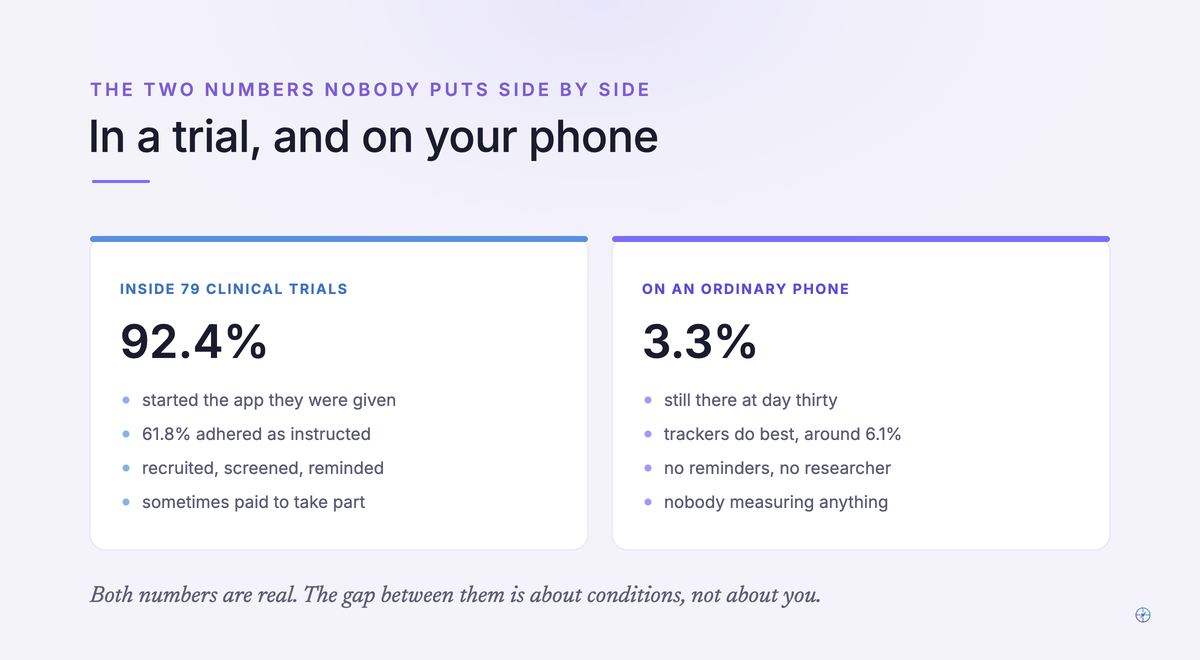
So before the list, the thing nobody puts on these pages. The apps are not junk and the research behind the good ones is real. That research was also produced in one particular set of rooms. People were recruited, screened, reminded, sometimes paid, and often given the app as part of a study they had agreed to take part in. Under those conditions, across 79 clinical trials of depression and anxiety apps, about nine in ten people started and roughly six in ten kept going.
On an ordinary phone, with nobody watching, the median mental-health app has about three of every hundred users left at day thirty.
Both of those numbers are real. The gap between them is where every abandoned app you own lives. It is not a statement about fraud and it is not a statement about you. It is a statement about conditions, and it means the useful question was never which app is best. It is which one survives an ordinary week.
Which turns the whole problem inside out. You have been shopping for the best content, comparing libraries and course structures and the number of guided sessions, when the thing that decides whether any of it is still on your phone in March is not the content at all. It is the floor. How little the app can accept from you on the worst day and still count.
The problem was never your discipline.
That is how the fifteen below are sorted.
The short version
The evidence is real and it was collected in conditions your week does not reproduce. In trials, uptake 92.4% and adherence 61.8%. In the wild, median 30-day retention 3.3%.
“Works” means something smaller than the marketing implies. A small but significant movement on a symptom questionnaire over a few weeks, mostly short-term.
The most consistent evidence sits with the structured, CBT-shaped apps. We do not make one of those and we say so.
Sort by the bad-week test. Seconds to done, works when you are flat, nothing punishes you for missing, needs no decision from you.
Four groups. Thirty-second trackers · the best-evidenced structured apps · the ones for the body · the ones that help you notice.
Most of this category has no published outcome evidence of its own, ours included. The master table has a column for it and it is filled in honestly for every row.
Before the list, plainly
This is a roundup of consumer tools. It is not treatment, it cannot diagnose anything, and none of it replaces therapy if therapy is available to you or worth trying. Therapy is an ordinary option and a good one. If things are heavier than tired, if you are in crisis or thinking about harming yourself, please reach out now rather than downloading anything. In the US you can call or text 988, free and confidential, any hour. Anywhere else, findahelpline.com will find the local service.
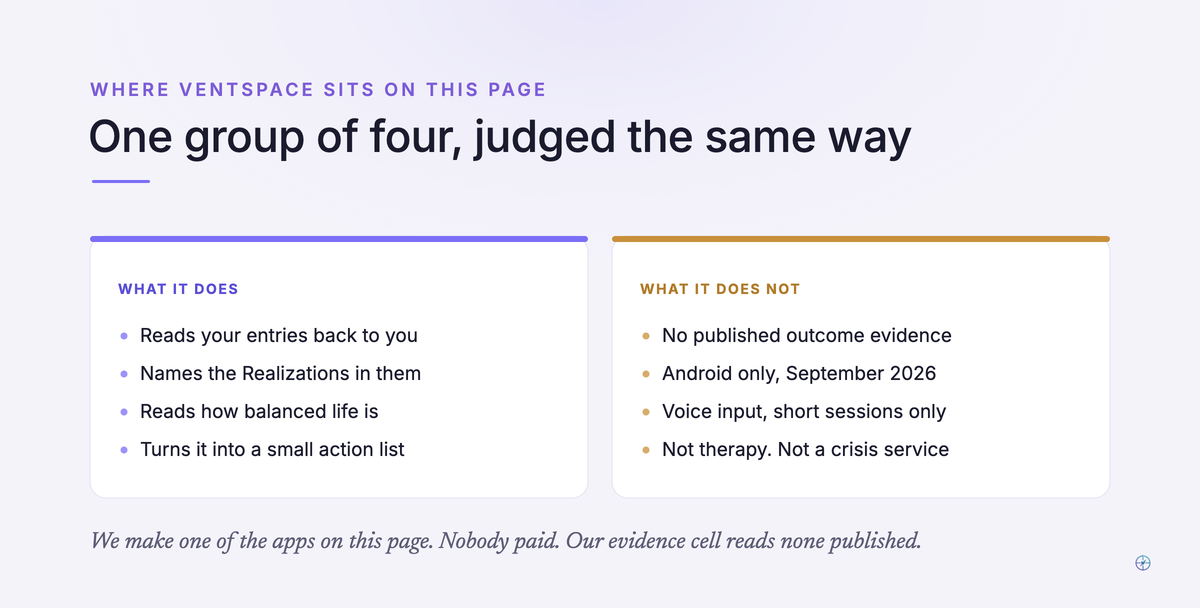
Disclosure, up front where you can see it. We make one of the apps on this page. VentSpace sits in one group of four, judged on the same criterion as everything else, and it is not this article’s overall pick. Nobody paid to be here, there are no affiliate links, and in the evidence column of the master table our own row reads “none published”, because that is what is true. We are not clinicians and this is not clinical advice.
Do self-care apps actually work?
Yes, a little, under conditions that are hard to reproduce at home. The evidence for the better-studied apps is genuine and it is also narrower than the download page suggests. That is the whole answer, and everything below is the detail.
Start with the trials. A 2025 systematic review and meta-analysis in JAMA Psychiatry pooled 79 clinical trials of depression and anxiety apps, covering 92 app conditions and 78 control conditions. App uptake was 92.4%. Adherence was 61.8%. Post-test attrition ran at 18.6% and follow-up attrition at 28.4%. Attrition was higher in the app groups than in wait-list controls, though not meaningfully different from other kinds of control.
Read that first pair of numbers slowly, because they describe an environment, not a product. Ninety-two in a hundred people opened the app. Sixty-two in a hundred used it as instructed. Those people had been screened for fit, had consented, were being contacted, and knew somebody was measuring.
Now the same category outside the study. Baumel and colleagues, in a 2019 JMIR analysis of real-world engagement, found that the median 30-day retention across mental-health apps was 3.3%. Mood and symptom trackers, one of the better-performing formats, managed around 6.1% at day thirty, and the median daily open rate across the category was 4.0%.
Nine in ten, against three in a hundred.
This is not an accusation. The trials are not rigged, the researchers are doing the work properly, and the apps in group two below have more behind them than almost anything else in consumer wellness. The point is narrower and more useful than cynicism: the conditions that produced the good result are part of the result. Take away the recruitment, the reminders and the sense of being observed, and what is left has to survive on its own design.
Which is why the honest sentence, the one this page exists for, is you did not fail the app. You met it in the conditions it was never tested in.
Quick Summary: do self-care apps actually work
Q: Do self-care apps actually work?
A: Somewhat, and mostly under study conditions. Across 79 clinical trials of depression and anxiety apps, uptake was 92.4% and adherence 61.8% (JAMA Psychiatry, 2025). In everyday use, median 30-day retention is 3.3% (Baumel et al., JMIR, 2019). Both figures are real. The useful question is which app survives an ordinary week, not which app performed best in a trial.
Insight: what the trial data actually describes
The 2025 JAMA Psychiatry meta-analysis pooled 79 randomized trials of depression and anxiety apps and reported 92.4% uptake, 61.8% adherence, 18.6% post-test attrition and 28.4% follow-up attrition. Attrition was higher in app conditions than in wait-lists (RR 1.49) but did not differ significantly from other controls. It is a picture of engagement inside a trial, and it is the fairest comparison point we have.
What “works” actually measured
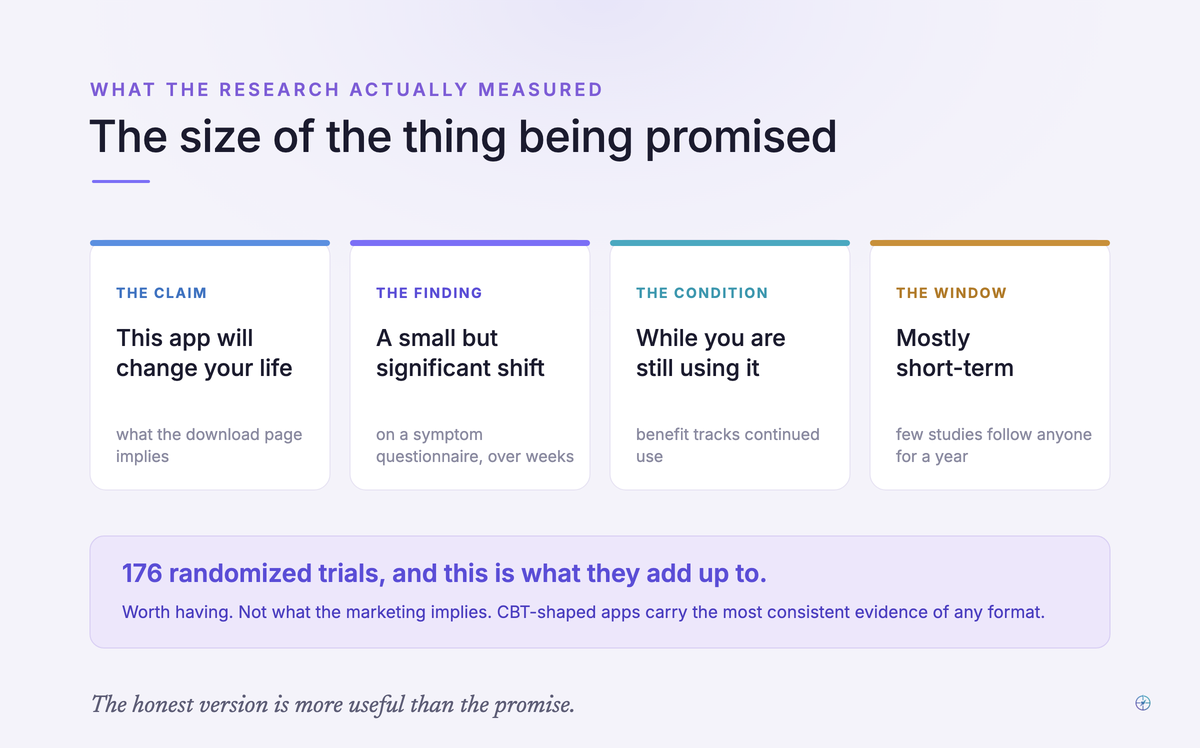
A small but significant movement on a symptom questionnaire, over a few weeks. That is the finding. It is worth having, and it is not what the marketing implies.
The largest synthesis in this area is Linardon, Torous, Firth, Cuijpers, Messer and Fuller-Tyszkiewicz (2024) in World Psychiatry, a meta-analysis of 176 randomized controlled trials of mental-health smartphone apps for symptoms of depression and anxiety. That is a serious evidence base by consumer-software standards, and it supports three qualitative findings worth carrying around.
The effect is small but statistically significant. CBT-based apps carry the most consistent evidence of any format in the category. And the effects depend on continued use, which loops straight back to the retention problem above.
The fourth finding is the one that gets left out. Most of these studies are short-term. They tell you what happened over weeks. They do not tell you what a year of it does.
So here is the honest translation, and it is more useful than the promise. “This app works” means that in a study, a group of people using it scored somewhat better on a questionnaire about how they had been feeling recently than a group who did not. Not that anyone’s life reorganised itself. Not that the tiredness lifted. A modest, measurable shift, while people were still using it.
If that sounds deflating, hold it next to the alternative. A tool that reliably produces a small real effect is a completely reasonable thing to own. It is only disappointing against a claim nobody should have made.
Quick Summary: what "works" means for a self-care app
Q: What does it actually mean when a self-care app is described as working?
A: It means a small but significant improvement on a symptom questionnaire over a few weeks, measured while people were still using it. A 2024 World Psychiatry meta-analysis of 176 randomized trials found the effect small, most consistent for CBT-based apps, and dependent on continued use, with most studies running short-term. It does not mean a life changed.
Insight: where the evidence concentrates
Linardon and colleagues (2024, World Psychiatry) pooled 176 randomized controlled trials of mental-health smartphone apps. The pattern across that literature is that structured, CBT-shaped apps hold the most consistent evidence, that benefit tracks continued use, and that the follow-up windows are short. Most consumer self-care apps, including reflection and journaling tools, sit outside that evidence base entirely.
The part nobody checks
Most trials of mental-health apps never looked for harm at all. That is the finding, and it needs stating carefully, because it is easy to turn into something it is not.
A 2024 systematic review and meta-analysis in npj Digital Medicine went looking for adverse-event reporting across the clinical-trial literature on mental-health apps. Of 171 identified trials, only 55 reported adverse events in any form. Roughly a third. Where reporting existed it was heterogeneous, differing in what was assessed, what counted as an event, and how much detail was given.
Across the 13 app conditions where deterioration could be pooled, the deterioration rate was 6.7% (95% CI 4.3–10.1), and it did not differ between app groups and control groups.
Those two halves belong in the same sentence permanently. Where anyone measured, people using an app got worse at about the same rate as people who were not. The problem identified by that paper is a reporting gap, not a danger signal. No app named on this page has been associated with deterioration, and nothing in that literature says otherwise. It describes a body of research, not a product.
Why include it on a shopping page at all. Because a page that sorts by evidence has to be honest about where the evidence is missing, and this is the largest hole in it. The common belief that an app cannot possibly make anything worse is not supported by evidence. It is supported by nobody having checked. Those are different, and knowing the difference is part of choosing well.
Quick Summary: can a self-care app make things worse
Q: Can a self-care app make things worse?
A: Mostly, nobody looked. Of 171 clinical trials of mental-health apps, only 55 reported adverse events at all (npj Digital Medicine, 2024). Where deterioration could be pooled across 13 app conditions it was 6.7%, and no different from control groups. The honest reading is that the reporting is thin, not that the apps are dangerous.
Insight: a reporting gap, stated precisely
The 2024 npj Digital Medicine review found adverse-event reporting in 55 of 171 trials, with heterogeneous assessment and detail. Pooled deterioration across the 13 app conditions where it could be measured was 6.7% (95% CI 4.3–10.1), not different from controls. The finding concerns a literature, and it is a reason to want better trials rather than a reason to avoid the category.
The bad-week test
Everything above collapses into one criterion, and it is the only one this article ranks on.
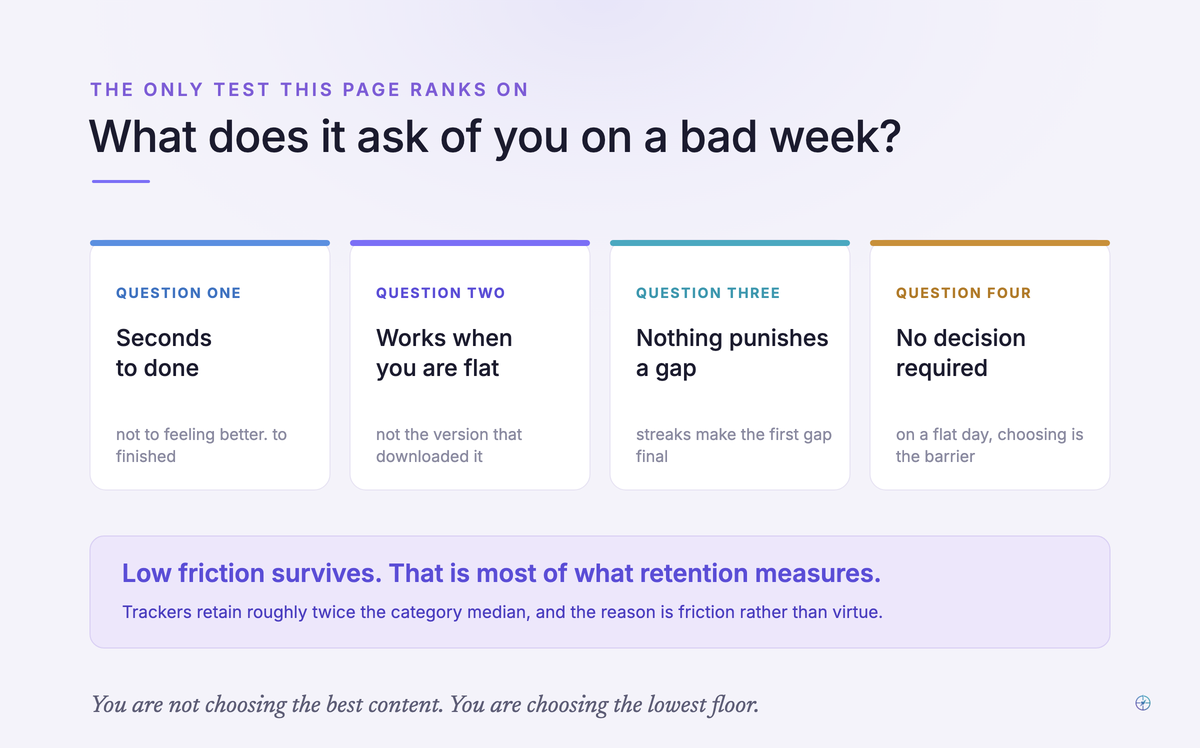
What does this app ask of you on a bad week?
Four questions, in order of how much they predict:
- How many seconds from opening it to being done? Not from opening it to feeling better. To being finished.
- Does it work when you are flat rather than motivated? Almost every app is designed for the version of you that downloaded it. Very few are designed for the version three weeks later.
- Does anything punish you for missing? A streak, a wilting plant, a guilt notification. Anything that makes a gap feel like a verdict gets deleted after the first gap.
- Does it need a decision from you? Choosing a meditation, picking a category, deciding which prompt. On a flat day the choice is the barrier, not the activity.
There is a data point underneath this rather than just a hunch. In Baumel’s real-world engagement data, mood and symptom trackers retained roughly twice the category median at thirty days. Trackers are not more virtuous than meditation apps. They are cheaper to complete. Ten seconds, no decisions, no performance. Low friction survives, and that is most of what retention measures.
Which reframes the whole shopping problem. You are not choosing the app with the best content. You are choosing the one with the lowest floor.
Quick Summary: how to choose a self-care app
Q: How should I choose a self-care app?
A: Judge it on what it asks of you on a bad week: seconds to done, whether it works when you are flat rather than motivated, whether anything punishes you for missing, and whether it needs a decision from you. Real-world data supports this: trackers, the lowest-friction format, retain about twice the category median at day thirty (Baumel et al., 2019).
Insight: friction, not virtue
Baumel and colleagues (JMIR, 2019) found median 30-day retention of 3.3% across mental-health apps, with trackers among the better performers at roughly 6.1% and a category median daily open rate of 4.0%. The format that survives is the one that finishes fastest. Design beats intention over thirty days, reliably.
How we judged them
Six things, in this order.
- Seconds to done. The single strongest predictor of whether it is still there in a month.
- Does it work flat. Whether the app is usable by someone with no motivation left today.
- What happens if you miss. Anything that punishes a gap loses points, because gaps are certain.
- Decisions required. Fewer is better. Zero is best.
- Honest, cancellable pricing. Free tiers described accurately, no dark-pattern trials.
- Any published evidence for this specific product. Filled in for every row, including ours, where the answer is “none published”.
Prices and platforms are as of September 2026 and they move. Anything we could not read directly off a store page in that check is marked [unverified] rather than quietly turned into a number. Nobody paid to appear here and there are no affiliate links. For a proper audit of what the free tiers hold, that is the free self-care apps piece, and this page does not repeat it.
The fifteen apps at a glance
| App | What it asks of you | Any published evidence? | Best for |
|---|---|---|---|
| Daylio | About ten seconds, no writing | None published for the product | Logging a whole day without sentences |
| How We Feel | Under a minute, tap a feeling | None published for the product | Naming it more precisely than “bad” |
| Finch | A minute or two, gentle check-ins | None published for the product | Wanting warmth without a scolding |
| Bearable | A minute, more fields if you want them | None published for the product | Linking mood to sleep, meds and symptoms |
| MindShift CBT | A structured exercise, several minutes | Format with the most consistent evidence | Doing something with an anxious spiral |
| Headspace | 3–20 minutes and a choice | Format with the most consistent evidence | A guided course rather than a library |
| Calm | 3–30 minutes and a choice | Format with the most consistent evidence | Sleep, mostly, and it is good at it |
| Insight Timer | As little as one minute, many choices | Format with the most consistent evidence | A free library you can grow into |
| Smiling Mind | Around 10 minutes, structured | Format with the most consistent evidence | Free, non-profit, no upsell pressure |
| Nike Training Club | 15–45 minutes of actual effort | Movement itself is well evidenced | Free, complete, no equipment needed |
| Down Dog | 10–60 minutes, generated each time | Movement itself is well evidenced | Never doing the same class twice |
| FitOn | 10–40 minutes, class format | Movement itself is well evidenced | Following someone rather than deciding |
| Your phone’s own settings | A single setup, once | Not applicable | Sleep and quiet, at no cost |
| VentSpace | A few lines, whenever | None published | Being told what was in your own words |
| Day One | As long as you want, blank page | None published for the product | A private archive that lasts years |
| Stoic | A prompt and a few minutes | None published for the product | Structure around the reflection |
Group one: the ones that need thirty seconds
These lead because they win the article’s own criterion. They ask for the least, they finish fastest, and they are among the few formats with real-world retention meaningfully above the median. If you have historically abandoned everything, start here rather than with the group that has better evidence. An unopened well-evidenced app does nothing at all.
Daylio
Tap a face, tap what you did, and you are finished in about ten seconds, with no sentence to compose, no blank page waiting for you to be articulate about a day you would rather not describe, and nothing anywhere in it that requires you to have an opinion about how you are doing beyond the one you already have. That is the whole product. It still wins.
| What it is | A mood and activity tracker with no writing required. Tap a face, tap what you did, done |
| Seconds to done | About ten, which is the lowest floor in this article |
| Works when flat? | Yes. It asks for taps, not sentences |
| If you miss a week | Nothing happens. The chart has a gap in it and that is all |
| Price (Sept 2026) | Free core, Premium tier [unverified] |
| Platforms | iOS and Android |
| Any published evidence? | None published for the product. Trackers as a format have the best real-world retention in the category |
| The watch-out | It shows you correlation, not cause. A graph of a bad month is a record of it, not an explanation |
Who it’s for: ten seconds of capacity.
In practice: the appeal is that it asks for no words at all, which happens to be precisely the friction every other format in this category assumes you can absorb on the exact day you are least able to absorb anything, and it is why it can still be in use four months later.
Verdict: the best default here.
How We Feel
Free, from a non-profit, and built around naming the feeling precisely rather than rating it out of five, so that you tap a quadrant and then narrow it and narrow it again until the word you land on is the one you would not have reached for on your own, which is the entire point, and useful if you have discovered that “bad” is a word that helps nobody. The vocabulary is the product. Nothing else in it matters much.
| What it is | A free emotion check-in built around naming the state precisely rather than scoring it |
| Seconds to done | Under a minute, and often much less |
| Works when flat? | Yes. You are choosing a word, not writing a paragraph |
| If you miss a week | Nothing happens. No streak, no companion, no nudge with a face on it |
| Price (Sept 2026) | Free, non-profit |
| Platforms | iOS and Android |
| Any published evidence? | None published for the product |
| The watch-out | It gives you vocabulary and no follow-through. Naming it is where this one stops |
Who it’s for: something is off, unnamed.
In practice: the vocabulary is the point, and it can be surprising how difficult it is to find the accurate word for a state you have been carrying around unexamined for a fortnight, and how much the accurate word changes about what you then do with the evening.
Verdict: the strongest free option in group one. No upsell anywhere.
Finch
A gentle check-in app where a small bird responds to what you log, friendlier than anything else in this category, deliberately soft about gaps, and it may be the first tool of this kind that does not feel like a clinical instrument handed over by somebody who had never had a bad month themselves. There is a catch. It is worth naming.
| What it is | A warm check-in app built around a companion character that responds to what you log |
| Seconds to done | A minute or two |
| Works when flat? | Mostly. The tone is designed for exactly that day |
| If you miss a week | The companion notices. Kindly, and it still notices |
| Price (Sept 2026) | Free tier, Finch Plus [unverified] |
| Platforms | iOS and Android |
| Any published evidence? | None published for the product |
| The watch-out | A gentle guilt mechanism is still a guilt mechanism. Anything that reacts to your absence has one inside it |
Who it’s for: the clinical ones felt cold.
In practice: the warmth is what draws people in and keeps them checking in on days when a bar chart would not have got them to open anything at all, and the same warmth is what makes coming back after a fortnight away feel less like resuming a habit and more like apologising to somebody.
Verdict: good, with one caveat. If a wilting plant has ever ended a habit for you, then what you are looking at here is the same mechanism drawn far more kindly, and kindness does not switch the mechanism off.
Bearable
The most detailed tracker here by a distance, holding mood, sleep, symptoms, medication and energy in one place with correlations drawn between them, which makes it genuinely the right instrument if the question you are actually trying to answer is whether the bad weeks line up with something physical rather than something psychological, and that is a question a mood-only tracker can never answer for you. It also asks the most. In a group defined by asking almost nothing.
| What it is | A detailed tracker linking mood to sleep, symptoms, medication and energy, with correlations |
| Seconds to done | One to three minutes, more if you fill in every field |
| Works when flat? | Partly. The minimum entry is small. The temptation is not |
| If you miss a week | Nothing happens, though the correlations get thinner |
| Price (Sept 2026) | Free tier, Premium [unverified] |
| Platforms | iOS and Android |
| Any published evidence? | None published for the product |
| The watch-out | The highest friction in group one. Fill in everything and it stops being a thirty-second app |
Who it’s for: something physical alongside the mood.
In practice: the correlations are what people stay for, and the field count is what they quietly trim back after the first fortnight, when it becomes obvious that an app you fill in completely is an app you fill in for eleven days and then stop filling in at all.
Verdict: most useful data, highest friction. The second one decides it.
Quick Summary: are mood trackers worth using
Q: Are mood tracking apps actually worth it?
A: They are the format most likely to still be on your phone in a month. Real-world data puts trackers at roughly 6.1% 30-day retention against a 3.3% category median (Baumel et al., 2019), because they finish in seconds and ask nothing of a flat day. The limit is real too: a tracker shows you a pattern, not a reason.
Insight: what a tracker can and cannot give you
Trackers are descriptive instruments. They record what happened and when, and over weeks they show shape. They do not supply the explanation, and reading a low month back does not tell you what caused it. That is why the honest use of one is as a starting point for a question rather than as an answer in itself.
Group two: the ones with the most consistent evidence
This is the best-evidenced end of the category and we are not in it. Structured, CBT-shaped and guided-practice apps carry the most consistent research support of any format here (Linardon et al., 2024). If your priority is the thing with the most behind it, this group is the answer and nothing else on this page is.
The trade-off is exactly the one the bad-week test predicts. These ask for minutes, attention and a decision. That is why they win in trials and lose on ordinary Tuesdays.
MindShift CBT
Free, built by a non-profit that has since closed, and built on the shape of thing the research keeps pointing at, which is to say thought records, belief experiments and structured coping plans rather than ambient audio, and that makes it the best content on this entire page by a clear margin as well as the single item most likely to sit unopened through a flat Wednesday, because what it asks of you is the work of a worksheet. Both things are true. Neither cancels the other.
| What it is | A free anxiety app built by Anxiety Canada, now sold by 247 Labs Inc, built on cognitive behavioural therapy tools: thought records, belief experiments, structured coping plans |
| Seconds to done | Minutes, not seconds. It is an exercise, not a log |
| Works when flat? | Partly. Better when you are anxious than when you are empty |
| If you miss a week | Nothing punishes you. It is a toolkit, not a habit |
| Price (Sept 2026) | Free. Its non-profit maker has closed |
| Platforms | iOS and Android |
| Any published evidence? | The format carries the most consistent evidence in the category. Product-specific outcome trials are not something we verified |
| The watch-out | It expects you to do the work of a worksheet. On a flat day that is a real ask |
Who it’s for: an anxious spiral, wanting a procedure.
In practice: it is substantial and unglamorous, which is roughly what you would expect of something built by a non-profit rather than a marketing department, and you may find you are glad to own it long before you find you have opened it this week.
Verdict: the best free thing here. Ranked first in its group because it is free and shaped like the evidence rather than merely adjacent to it.
Headspace
The most course-like of the meditation apps, in that you are led through a sequence rather than dropped into a library and left to work out where to start, which suits people who do not want to choose and which matters more than it sounds like it should, because choosing can end a session before it starts. You are not buying content. You are buying the absence of a decision.
| What it is | A guided meditation course with a taught sequence rather than an open library |
| Seconds to done | Three to twenty minutes, plus a choice |
| Works when flat? | Sometimes. The shortest sessions are the honest entry point |
| If you miss a week | Nothing punishing. The course waits |
| Price (Sept 2026) | Subscription [unverified] |
| Platforms | iOS and Android |
| Any published evidence? | Guided-practice formats carry the category’s more consistent evidence. Nothing product-specific verified here |
| The watch-out | You are paying for structure, which is a reasonable thing to pay for and worth knowing you are doing |
Who it’s for: bounced off a library twice.
In practice: the teaching and the sequencing are the strength, and the weak point is the subscription, which arrives every month whether or not the sequence is still being followed and can be the thing that eventually ends the relationship rather than any judgement about the content.
Verdict: strong for beginners. Not free, in a group where the free one is best.
Calm
More of a library than a course, and best in class for sleep specifically, which is what you may end up using it for regardless of what you downloaded it to do, and that gap between the intention and the actual use is worth paying attention to when you decide whether the subscription is earning its money. Judge it on sleep and it is very good indeed. Judge it as a meditation programme and it is one of several.
| What it is | A meditation and sleep library, strongest on sleep stories and wind-downs |
| Seconds to done | Three to thirty minutes, plus a choice |
| Works when flat? | Yes, for the sleep content specifically |
| If you miss a week | Nothing punishing |
| Price (Sept 2026) | Free tier, subscription [unverified] |
| Platforms | iOS and Android |
| Any published evidence? | Guided-practice formats carry the category’s more consistent evidence. Nothing product-specific verified here |
| The watch-out | Strongest for sleep, not for meditation. The free layer is thin |
Who it’s for: the hour after lights out.
In practice: the sleep content is what gets renewed year after year and everything else is what gets forgotten within a fortnight, which is a fairly precise description of what people are actually paying for and a reasonable way to decide whether you want to.
Verdict: buy it for sleep. On that one job it earns the money.
Insight Timer
An enormous free library with a paid layer sitting on top of it, and the free tier is genuinely usable rather than a five-day sample of somebody else’s product, which in a category built almost entirely on trials that convert is unusual enough to be the headline rather than a footnote. The size is the whole pitch. The size is also the problem, because on a flat evening an app offering you forty thousand ways to begin is an app you close without beginning.
| What it is | A very large library of free guided practices, timers and talks, with a paid layer above it |
| Seconds to done | One to sixty minutes, and a lot of choices to get there |
| Works when flat? | Partly. Filter by length first and it becomes a much smaller app |
| If you miss a week | Nothing punishing |
| Price (Sept 2026) | Free core, paid tier [unverified] |
| Platforms | iOS and Android |
| Any published evidence? | Guided-practice formats carry the category’s more consistent evidence. Nothing product-specific verified here |
| The watch-out | Choice paralysis, and quality that swings by teacher |
Who it’s for: a library to grow into.
In practice: the free catalogue is the praise and the lack of curation is the complaint, and anyone who has spent ten minutes scrolling it looking for something eight minutes long will recognise that these are not two observations about the app but one observation stated twice.
Verdict: the most generous free option here. Filter by length first.
Smiling Mind
Australian, non-profit, free, with structured programmes and no commercial pressure of any kind, meaning nothing inside it is trying to convert you, upsell you, win back a lapsed trial or remind you what you are missing on the tier above the one you are on, and after an hour spent inside the rest of this category that absence stops feeling like a missing feature and starts feeling like the point. It is plain. It stays free.
| What it is | Free structured mindfulness programmes from an Australian non-profit |
| Seconds to done | Around ten minutes, structured |
| Works when flat? | Partly. It is a programme, and programmes assume a little capacity |
| If you miss a week | Nothing punishing |
| Price (Sept 2026) | Free, non-profit |
| Platforms | iOS and Android |
| Any published evidence? | Guided-practice formats carry the category’s more consistent evidence. Nothing product-specific verified here |
| The watch-out | Less polished than the paid apps, which is the trade you are making |
Who it’s for: a programme, no funnel.
In practice: plain, free, and still free next year, which is more or less the entire review, and in a category full of subscriptions, it is worth noticing that this one has nothing to bill you for.
Verdict: the honest one.
Quick Summary: which self-care apps have the most evidence
Q: Which self-care apps have the most evidence behind them?
A: The structured, CBT-shaped ones. Across a 2024 meta-analysis of 176 randomized trials, CBT-based apps carried the most consistent evidence in the category (Linardon et al., World Psychiatry). MindShift CBT is the strongest free example. Consistency is not the same as size, and the effects remain small and short-term.
Insight: consistent is not the same as large
The finding that CBT-based apps have the most consistent evidence is often read as meaning they work well. It means something narrower: more studies point the same direction. The effect those studies measure is still small and short-term, and it still depends on continued use. Both facts are worth holding at once.
Group three: the ones for the body
Movement is among the better-supported things a person can do for mood, and an app is only the scheduling layer on top of it. That is the honest framing for this whole group. The app is not the intervention. The walk is.
Which is also why the free ones win here. There is very little a paid fitness app does that a free one does not, once you are moving.
Nike Training Club
Completely free, in full, with no tier above it waiting to be sold to you, and the workouts run from fifteen-minute bodyweight sessions you can do in the space beside a bed all the way up to structured multi-week programmes, which matters less than the reason it sits this high on the page, namely that the thing underneath it has more support behind it for mood than almost anything else listed here. The app is the scheduling layer. Movement is the ingredient.
| What it is | A completely free library of guided workouts, from 15-minute bodyweight sessions to full programmes |
| Seconds to done | 15 to 45 minutes. The highest ask in this article, and the honest one |
| Works when flat? | Sometimes, if you pick the shortest thing and treat it as the whole plan |
| If you miss a week | Nothing. No streak, no guilt mechanic |
| Price (Sept 2026) | Free, in full |
| Platforms | iOS and Android |
| Any published evidence? | Not for the app. Physical activity itself has substantial support for mood |
| The watch-out | Fitness content assumes a body that wants to move. On the worst days that assumption is the barrier |
Who it’s for: three days without moving.
In practice: the free-and-complete combination can be hard to believe at first and easy to keep for years, since there is no renewal date to reconsider and nothing that will ever ask you to justify the expense to yourself in January.
Verdict: the best free thing in this group.
Down Dog
Generates a different yoga, barre or HIIT session every single time you open it, so that you never repeat a class, which sounds like a novelty feature until you notice that it is aimed squarely at one common reason people abandon a home practice. Not difficulty or time. Tedium.
| What it is | Generated yoga, barre and HIIT sessions, different every time |
| Seconds to done | 10 to 60 minutes, your choice at the start |
| Works when flat? | Partly. Set it short and it is manageable |
| If you miss a week | Nothing happens |
| Price (Sept 2026) | Free tier, subscription [unverified] |
| Platforms | iOS and Android |
| Any published evidence? | Not for the app. The movement underneath it is what carries the support |
| The watch-out | Generated, so never familiar. Some people want the same class on a bad day |
Who it’s for: quit the last one from boredom.
In practice: the variety is the selling point and the absence of a familiar routine is the trade, which suits people who get bored and frustrates people who wanted the same twenty minutes they did on Tuesday, and you probably already know which of those two you are.
Verdict: the best answer to boredom.
FitOn
Class-format workouts with a genuinely usable free tier, built on the observation that following a person is easier than deciding for yourself, which is most of what it offers and sounds like faint praise right up until you count how many home-workout attempts died at the exact moment somebody had to open an app and decide what today was going to be. That decision is the barrier. Not the effort.
| What it is | Class-format guided workouts with a usable free tier |
| Seconds to done | 10 to 40 minutes, class length |
| Works when flat? | Partly. Someone else is making the decisions, which helps |
| If you miss a week | Nothing happens |
| Price (Sept 2026) | Free tier, paid [unverified] |
| Platforms | iOS and Android |
| Any published evidence? | Not for the app. The movement underneath it is what carries the support |
| The watch-out | Upsell pressure inside the free tier |
Who it’s for: easier when somebody else counts.
In practice: the class format is the draw and the prompts to upgrade are the friction, and in a group where one of the alternatives is free in full and never asks for anything, that friction is a larger factor in the decision than it would be anywhere else on this page.
Verdict: solid, and Nike is cleaner.
The bedtime and do-not-disturb settings already on your phone
Named deliberately and ranked here rather than tucked in at the bottom, because a wind-down schedule with a hard cut-off on notifications is free, already installed, evidenced by nothing in particular and useful for plenty of people, and because it is one setup, once, after which it asks nothing of you at all, which on this page’s own criterion beats almost everything else listed. Nobody sells it. That is the only reason it is missing from every other list.
| What it is | The wind-down schedule and notification cut-off already built into your phone |
| Seconds to done | A single setup, once. Nothing after that |
| Works when flat? | Yes. It runs whether or not you are having a good week |
| If you miss a week | Not applicable. There is nothing to miss |
| Price (Sept 2026) | Free, already installed |
| Platforms | iOS and Android |
| Any published evidence? | Not applicable. This is a setting, not a product |
| The watch-out | Easy to override at 1am, and you will |
Who it’s for: everybody, before paying for anything.
In practice: there are no reviews for a settings menu and no affiliate programme behind one either, which is a fairly complete explanation of why a free thing that works keeps getting left off lists compiled by people who need something to link to.
Verdict: the highest-value free thing here. Set it up tonight.
Quick Summary: do fitness apps help mental health
Q: Do fitness or movement apps help with mood?
A: The movement helps and the app is only the scheduling layer. Physical activity has substantially more support for mood than most consumer wellness formats, and a free app like Nike Training Club delivers the same scheduling function as a paid one. The honest limit: on the flattest days the assumption that your body wants to move is itself the barrier.
Insight: the app is not the active ingredient
Nothing in this group has product-level outcome evidence. What has evidence is the behaviour underneath it. That is a useful distinction when choosing, because it means the free option and the expensive option are delivering the same active ingredient, and the only thing you are paying for is whether you will press play.
Group four: the ones that help you notice
Noticing is not changing. That is the honest limit on this whole group, and it should be said before anything else in it. These tools help you see what is going on. What you do about it afterwards is a separate problem and none of them solve it.
The second honest thing: most of this group has no published outcome evidence, including ours. Journaling and reflection apps sit outside the CBT-shaped literature that group two draws on. That does not make them useless. It means the confidence should be lower, and a page that prints an evidence column has to say so about itself first.
VentSpace
This one is ours. Disclosed at the top, disclosed again here, and judged on the same criterion as everything else on the page.
It is a journaling app that turns what you write into a clear read on your life balance, plus small, doable next steps. You vent freely or write from a prompt, and the app reads it back to you: it names the Realizations in what you wrote, gives a read on how balanced your life is across the areas that matter to you, and turns the whole thing into a small action list you can put on a calendar. The part it is built for is coming back later and pulling the meaning out.
A month of small entries, laid out that way, stops being a list of days and becomes an Inner Map: a shape you can see the edges of, rather than a scroll you would never reread. That is the narrow thing it does, and it is the reason it exists. It comes as an Android app and as a web tool, VentSpace Live, which runs in any browser with nothing to install. Only the app keeps your entries, so the Inner Map builds there.
| What it is | A journaling app that reads your entries back as named Realizations, a balance read across life areas, and a calendar-ready action list |
| Seconds to done | A few lines, whenever. No minimum, no session length |
| Works when flat? | Yes. There is no blank page waiting for a well-formed paragraph |
| If you miss a week | Nothing. No streak, nothing waiting, no character judgement |
| Price (Sept 2026) | Free to start |
| Platforms | Android app + web (VentSpace Live). The app is Android only for now. Live works in any browser, iPhone included, but does not keep your history. Voice input works for short sessions only |
| Any published evidence? | None published. It is newer than every incumbent on this page |
| The watch-out | It is a reflection tool. It is not therapy, not treatment, and not a crisis service |
Who it’s for: plenty to say, no appetite for rereading it.
In practice: the reading-back is the part that gets noticed, which makes sense, since the writing was always possible in a notes app that came free with the phone and the rereading, which is where the actual value was supposed to be, never once happened.
Verdict: good on the bad-week test, poor on the evidence question, and there is no version of this page on which those two sentences do not both belong in the same paragraph. If what you want is the most-researched option, group two, and MindShift CBT is free.
Day One
The best-built plain journal there is, with a free tier that is usable in practice, end-to-end encryption on a single device, and enough history behind it that you can reasonably expect to still be able to open what you wrote today in five or six years, which is not a small thing to be able to say about a piece of consumer software. It gives back exactly what you put in. For some people that is the appeal, and for others it is the entire problem.
| What it is | A mature, private long-form journal with a genuinely usable free tier |
| Seconds to done | As long as you want. A blank page, and no minimum |
| Works when flat? | Partly. A blank page is friction, however well built |
| If you miss a week | Nothing happens |
| Price (Sept 2026) | Free tier, subscription [unverified] |
| Platforms | iOS, Android, web |
| Any published evidence? | None published for the product |
| The watch-out | It gives back exactly what you put in. There is no reading-back layer |
Who it’s for: an archive, not an interpretation.
In practice: it is the one people keep for years and mention least, which is exactly the review an archive should get, since the whole job of an archive is to be there quietly when you finally want it and to make no demands at all in the meantime.
Verdict: the right pick for an archive.
Stoic
A journal with structure built around it, meaning prompts in the morning, a review in the evening and mood logging running alongside both, so that if the blank page is the specific point at which you freeze then the scaffolding is genuinely worth having, and if it is not the specific point at which you freeze then the same scaffolding turns into homework somewhere around day nine. It depends entirely on the freeze. Nothing else.
| What it is | A prompted journal with morning and evening structure and mood logging alongside |
| Seconds to done | A prompt and a few minutes |
| Works when flat? | Partly. The prompt removes the blank page. It does not remove the effort |
| If you miss a week | Nothing happens |
| Price (Sept 2026) | Free tier, paid [unverified] |
| Platforms | iOS and Android |
| Any published evidence? | None published for the product |
| The watch-out | Structure can feel like homework on a week with none in it |
Who it’s for: frozen at the blank page.
In practice: the prompts are the reason people start and the twice-daily rhythm is the reason a good number of them stop, because two scheduled appointments with yourself is one more than most weeks can carry and the second one is always the one that gets missed first.
Verdict: good scaffolding for a blank page.
One note rather than a fourth entry in this group. How We Feel, from group one, belongs here too, for a different reason: precision of language is a form of noticing, and it is the only free tool on this page built specifically for that. It is the same download either way, so it is listed once, above.
Quick Summary: do journaling and reflection apps work
Q: Do journaling apps actually help?
A: They help you see, which is not the same as help you change. Reflection tools sit outside the CBT-shaped literature that carries the category’s most consistent evidence, and most of them, ours included, have no published outcome evidence. What they are genuinely good at is low friction: a few lines, whenever, with nothing punishing a gap.
Insight: the honest position of this group
The strength of a reflection app is that it survives a bad week better than almost anything with a session length. The weakness is that it asks you to supply the meaning, or trusts software to supply it for you, and neither route has trial evidence behind it. Lower friction, lower confidence. Choose accordingly.
Where an app stops
Fairly early, and it is worth naming the line rather than blurring it.
Everything on this page is a consumer tool. It records, it guides, it prompts, it schedules. None of it assesses you, and none of it treats anything. The apps in group two with the most consistent evidence behind them are, in the main, delivering a simplified version of something a person does better. That is not a criticism of them. It is what they are: cognitive behavioural therapy tools without a therapist, which is a real and useful thing to have and is also a smaller thing than therapy.
Therapy is an ordinary option. For a lot of people it is the right one, and the evidence in this article keeps pointing back toward it rather than away from it. If a person is available to you, that is generally the better call and no app on this page competes with it.
And if what you are carrying is heavier than tired, please use the line rather than the list. In the US, call or text 988, free and confidential, any hour. Elsewhere, findahelpline.com will find the local service.
All fifteen, side by side
| App | What it asks of you | Any published evidence? | Price (Sept 2026) | Platforms | If you miss a week | The watch-out |
|---|---|---|---|---|---|---|
| Daylio | ~10 seconds, no writing | None published for the product | Free, Premium [unverified] | iOS, Android | Nothing happens | Correlation, not cause |
| How We Feel | Under a minute | None published for the product | Free, non-profit | iOS, Android | Nothing happens | Vocabulary only, no follow-through |
| Finch | A minute or two | None published for the product | Free tier, Plus [unverified] | iOS, Android | The companion notices | A gentle guilt mechanism is still one |
| Bearable | 1–3 minutes, more fields optional | None published for the product | Free tier, Premium [unverified] | iOS, Android | Nothing happens | Highest friction in group one |
| MindShift CBT | A structured exercise | Best-evidenced format | Free, built by Anxiety Canada (closed) | iOS, Android | Nothing happens | Worksheet effort on a flat day |
| Headspace | 3–20 min plus a choice | Best-evidenced format | Subscription [unverified] | iOS, Android | Nothing punishing | You are paying for structure |
| Calm | 3–30 min plus a choice | Best-evidenced format | Free tier, sub [unverified] | iOS, Android | Nothing punishing | Strongest for sleep, not meditation |
| Insight Timer | 1–60 min, many choices | Best-evidenced format | Free core, paid [unverified] | iOS, Android | Nothing punishing | Choice paralysis |
| Smiling Mind | ~10 min, structured | Best-evidenced format | Free, non-profit | iOS, Android | Nothing punishing | Less polished than the paid apps |
| Nike Training Club | 15–45 minutes | Not for the app. Movement is evidenced | Free | iOS, Android | Nothing happens | Assumes a body that wants to move |
| Down Dog | 10–60 minutes | Not for the app | Free tier, sub [unverified] | iOS, Android | Nothing happens | Generated, so never familiar |
| FitOn | 10–40 minutes | Not for the app | Free tier, paid [unverified] | iOS, Android | Nothing happens | Upsell pressure in the free tier |
| Phone bedtime and DND | One setup, once | Not applicable | Free | iOS, Android | Not applicable | Easy to override at 1am |
| VentSpace | A few lines, whenever | None published | Free to start | Android app + web (VentSpace Live) | Nothing waiting | Reflection tool, not therapy |
| Day One | As long as you want | None published for the product | Free tier, sub [unverified] | iOS, Android, web | Nothing happens | Gives back exactly what you put in |
| Stoic | A prompt, a few minutes | None published for the product | Free tier, paid [unverified] | iOS, Android | Nothing happens | Structure can feel like homework |
How to actually pick one
Find the sentence that sounds like you.
- “I have thirty seconds and no motivation.” → Group one. Daylio, or How We Feel if you want the words as well as the number.
- “I want the thing with the most evidence behind it.” → Group two. MindShift CBT first, because it is free and built on the best-evidenced shape. Not us. We have none published and this route is not ours to answer.
- “I haven’t moved in three days.” → Group three. Nike Training Club, free, shortest session in the library.
- “I can’t tell if I’m okay.” → Group four. Day One if you want an archive, VentSpace if you want it read back to you.
- “I keep starting and stopping.” → The lowest-friction thing in this article, which is ten seconds in Daylio, and nothing else for a fortnight.
- “I’ve tried all of this and it isn’t touching it.” → Not an app. That is a conversation with a person, and if it is heavier than that, 988 or findahelpline.com first.
Then the rule that makes any of it hold. One app. Chosen on what it asks of you on a bad Tuesday, not on what it promises on a good January. Not four on a Sunday night, which is the behaviour that built the graveyard in the first place. If you want the wider map of what each category of tool is for, we sorted every kind of mental health app and what each one does, and if the thing you want is a plain writing habit rather than a self-care routine, the journaling apps are compared separately.
FAQ
Do self-care apps actually work?
A little, and mostly under conditions you cannot reproduce. In 79 clinical trials of depression and anxiety apps, uptake was 92.4% and adherence 61.8% (JAMA Psychiatry, 2025). In ordinary use, median 30-day retention is 3.3% (Baumel et al., JMIR, 2019). Both numbers are accurate. The apps in trials were being used by screened, reminded, supported people, and the conditions are part of the result. Pick for your conditions, not theirs.
What is the best self-care app?
It depends entirely on what it has to ask of you on a bad week. For ten seconds and no motivation, Daylio. For the most consistently evidenced format, MindShift CBT, free. For movement, Nike Training Club, free. For being able to see what has been going on, Day One or VentSpace. There is no single best one, and any page that gives you one without asking about your worst week is guessing.
Why do I always stop using them?
Because you met the app in conditions it was never tested in, not because you lack discipline. The research showing these tools work was produced with recruitment, screening, reminders and observation in place. Strip those out and what remains has to survive on friction alone. The fix is not more consistency. It is a lower floor: something that finishes in seconds, works when you are flat, and does not punish a gap.
Are self-care apps worth paying for?
Sometimes, and less often than the category implies. The best-evidenced app on this page, MindShift CBT, is free. So are Smiling Mind, How We Feel, Nike Training Club and the bedtime settings on your phone. Paying usually buys structure and polish rather than a different active ingredient. We audited what the free tiers hold in the free self-care apps piece. Pay monthly first, whatever you choose.
Is Calm or Headspace better?
They are more alike than the comparison implies. The real difference is shape: Headspace leads you through a course, Calm is a library with the strongest sleep content in the category. If you want to be told what to do next, Headspace. If you mostly want help sleeping, Calm. The difference that actually decides it is which one you will open on a bad week, and only you can answer that.
Can a self-care app make things worse?
Mostly, nobody checked. Of 171 clinical trials of mental-health apps, only 55 reported adverse events at all, and where deterioration could be pooled across 13 app conditions it was 6.7% and no different from control groups (npj Digital Medicine, 2024). So the honest answer has two halves that belong together: the reporting is thin, and where anyone looked, there was no excess of harm. The confident claim that an app cannot possibly make anything worse is not evidence. It is an absence of measurement.
Related. Best Free Mental Health Apps.
Related. Apps Like Finch for People Who Are Done With Streaks.
The one thing worth taking from all this
The apps were tested on the version of you that had just decided to change something. They were never tested on the version of you that has had a bad week, and that is the only version that decides whether any of this is still on your phone in March.
You do not need to become more consistent. You need something with a floor low enough that a bad week cannot get underneath it.
Ten seconds is a real answer. So is a walk. Pick the one you could do today, on today’s energy, and let the rest of the list stay a list.
The best app is the one you still open on your worst day. Everything else is a shopping decision.
About this article

Written by
Sai Subramaniam
Founder, VentSpace
I write these guides because I have been where you are. I am working through my own hard seasons, and I share the things that actually helped me, so that anyone going through it has a steady companion close by instead of facing it alone. VentSpace is the app I built for exactly that: a journaling app that turns what you write into a clear read on your life balance, plus small, doable next steps toward feeling more like yourself.
This writing is honest and every claim is sourced, and it is not a substitute for professional care. If you are struggling, reaching out to a professional is a strong move, not a failure.
Explore VentSpaceTry VentSpace LiveHow this one was checked. Every factual claim traces to a named source, and the source is printed next to the claim rather than kept in a footnote. Quotes are pinned to the work they come from, with the year, the letter or the chapter where one exists. Where a widely repeated claim could not be traced, it was left out and the omission recorded. Where a figure is contested, both sides are printed.
No affiliate links, no paid placements, and nobody paid to appear here. Where we mention our own app, we say that it is ours, we state its limits, and we never position it as a substitute for care.
Reviewed: October 2026. Prices, platforms and product availability move quickly, and anything we could not verify at the time of writing is marked as unverified rather than turned into a number.
Corrections. If something here is wrong, we would rather know. Corrections are made in place, with a note saying what changed. Updated 15 October 2026: trackers are now described as one of the better-performing formats rather than the best, and a daily-open figure we could not trace is removed. MindShift CBT’s non-profit maker, Anxiety Canada, has closed and a company now sells the app. Several claims about what most people do are softened, three internal links are fixed, and a link to a page being reworked is removed.