
Somebody told you to try Happify. A friend, a coach, a wellness email from work, or a review page with 2026 in the title. So here is the short answer, before anything else. As of September 2026 there is no Happify app on Google Play and none in the Apple App Store. Something of it does still exist, under a different name, and the detail is worth three minutes of your time. The person who recommended it was almost certainly not lying to you. They did not check.
One question before any of the detail, because it decides which half of this page you need. What were you hoping it would do for you?
What Happify was
Happify was a positive-psychology exercise programme with a game layer on top of it, and it is worth describing properly rather than in the past tense of a eulogy. It was made by Happify, Inc., and its own description of itself is still online: it combined cognitive behavioural therapy, mindfulness and positive psychology with what the company called best practices from the game industry.
What you got was structured. The unit was the track, a month-long programme of activities aimed at one goal, and the company says there were more than seventy of them, with names like Conquering Negative Thoughts and Building Mindfulness Through Meditation. Underneath the tracks sat a six-skill framework the company called STAGER: savour, thank, aspire, give, empathise, revive. The activities were small and often deliberately silly, which was the point. You popped balloons with your worries written on them. You wrote down three good things. You were asked to thank somebody specific.
The academic input was real, and that is what makes this a genuine loss rather than one fewer app on a phone. The advisers named on its own consumer page include Barbara Fredrickson, whose work is on positive emotions, and Sonja Lyubomirsky, who wrote The How of Happiness. John Gottman is named there too.
So why did people like it? Because it asked little of them and still gave them something to do, which is harder to build than it sounds, and because the exercises came from somewhere rather than from a content calendar. The company says it ran in ten languages and over a hundred countries.
Quick Summary
Q: What was the Happify app?
A: A self-guided positive-psychology and CBT programme built around month-long “tracks” of small activities and games, made by Happify, Inc., with academic advisers including Barbara Fredrickson and Sonja Lyubomirsky. It ran in ten languages by the company’s own account and is no longer available on either app store as of September 2026.
The short version
– There is no Happify app on Google Play or in the App Store, checked across seven and eight regional storefronts respectively on 11 September 2026.
– The company did not vanish. Happify Health became Twill in 2022, DarioHealth bought Twill in 2024, and the consumer brand sits inside Dario Mind now.
– A Happify-derived web programme still exists. `happify.com` now lands on it. Getting in appears to run through a login rather than an open sign-up, and we did not test how access is granted.
– The reason everyone still recommends it is that almost nobody re-checks a recommendation, including the pages carrying this year in their titles.
– Seven alternatives below, each loaded and verified on the same day, including one that is free, research-backed and not an app at all.
What the evidence actually shows
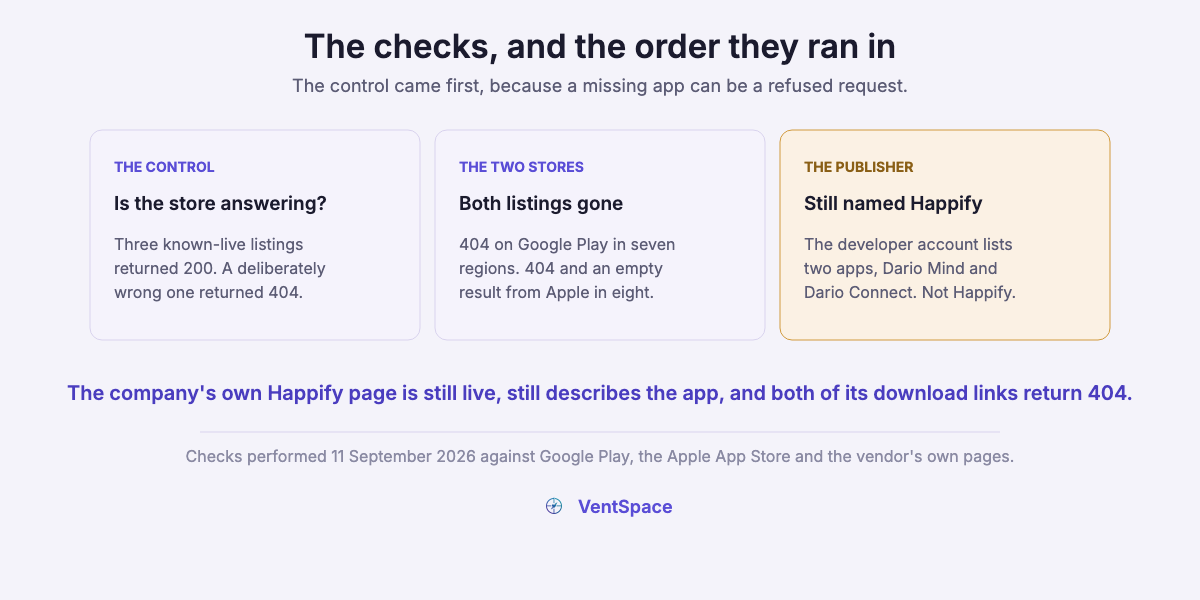
Four checks, run in a deliberate order. Why does the order matter? Because an app that looks missing can turn out to be a request that was refused, and getting that wrong in public is how bad app advice spreads.
So the control came first. Three known-live listings were loaded through the same request path, and a deliberately wrong package name alongside them. The three live ones returned 200. The wrong one returned 404. So when something comes back missing below, it is missing rather than blocked.
Check one, Google Play. The package name that every roundup still links, `com.happify.happifyinc`, returns 404. Not in the United States, not in the United Kingdom, Canada, Australia, Germany, India or the Netherlands. A search of the store for “happify” returns Calm, Headspace, Finch, Moodfit and a Dario app, and no Happify.
Check two, the Apple App Store. The app id that the company’s own marketing still points at, 730601963, returns 404 in the browser and an empty result from Apple’s own lookup service, in all eight storefronts tried. A control app id returned a result from every storefront it was checked against.
Check three, the publisher. This is the quietest and most persuasive one. The developer account is still called Happify, Inc. It is still active. It published an update on 2 September 2026. And it now lists exactly two apps, Dario Mind and Dario Connect, both free, neither of them Happify.
Check four, the company’s own front door. Typing `happify.com` redirects you to `happify.dariomind.com`. The page that loads is titled Dario Mind, carries the familiar Happify copy about science-based activities and games, names the same advisers, and has a line in the footer that does the work of this whole section: “Twill Therapeutics is now Dario Mind.”
And then the detail that no other page on this subject mentions. The company still publishes a Happify product page. It is live today, it describes the app in the present tense, and it offers two download buttons. Both of those buttons are dead. The Apple link on it returns 404 and the Google Play link on it returns 404. That is not an outside party’s claim about the market. It is the company’s own page, linking to its own listings, which are not there. A health-information library in New Zealand has at least updated its entry, which now reads only that the app is no longer available.
Now the careful part, and it matters more than anything above. This is not a shutdown, and calling it one would be wrong. There was no closure notice. A Happify-derived programme still runs on the web under the Dario Mind name, and the redirect from `happify.com` carries an access code in the address. When you ask that site for its sign-up page it sends you to a log-in page instead. We did not create an account, so how somebody gets access is something this page does not claim to know. What can be said is narrow and solid: there is no app to install, and the web programme does not appear to have an open front door.
Quick Summary
Q: Is Happify still available in 2026?
A: No, not as an app. The Google Play and App Store listings both return 404, checked across multiple regional storefronts on 11 September 2026 with live controls, and the publisher account now lists only Dario Mind and Dario Connect. A Happify-derived web programme still exists under the Dario Mind name, and its sign-up path redirects to a log-in page.
Where the programme went
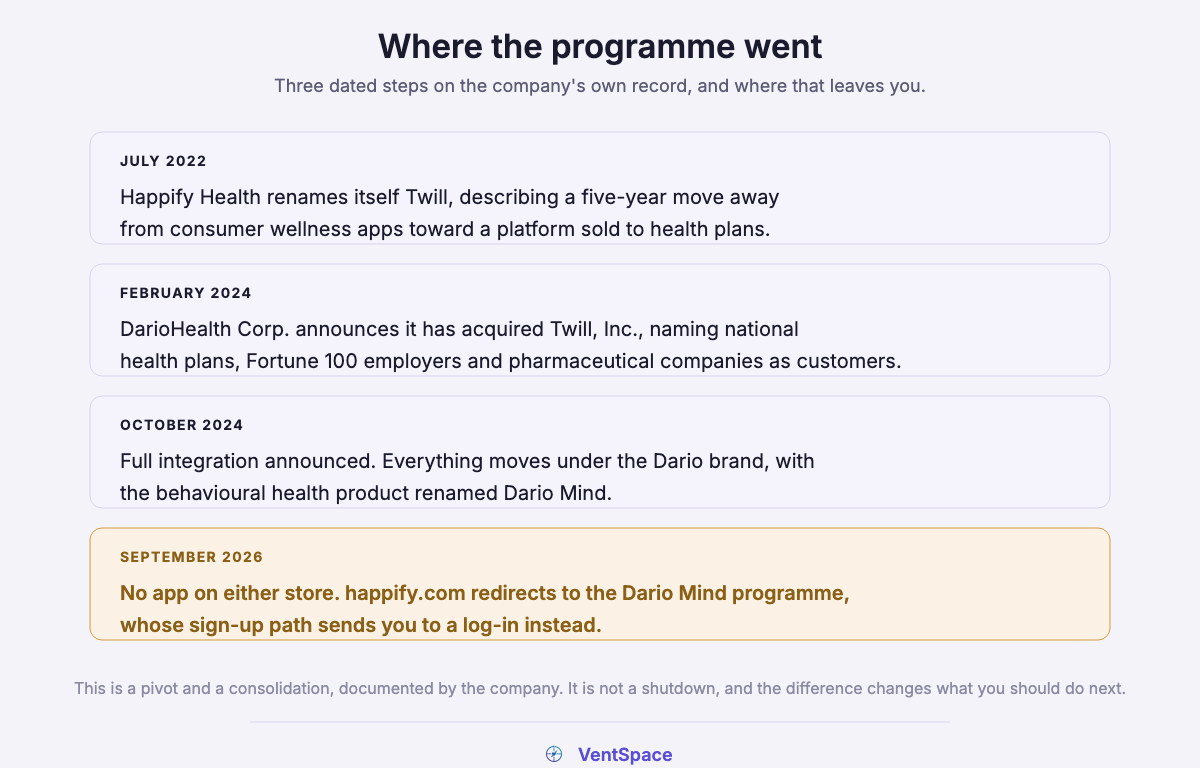
The company did not fail, it changed who it sells to, and the three steps are all on the record with dates.
July 2022. Happify Health renamed itself Twill. Its own announcement described this as the end of a five-year move away from consumer wellness apps and toward a clinical-grade platform sold to health plans, employers and pharmaceutical companies.
February 2024. DarioHealth Corp., listed on Nasdaq as DRIO, announced that it had acquired Twill, Inc. The release describes the customer base it was buying: three of the top eight national health plans, multiple Fortune 100 employers, several major pharmaceutical companies.
October 2024. DarioHealth announced the full integration and said plainly that everything would now sit under the Dario brand, listing its behavioural health product as Dario Mind, formerly Twill Therapeutics. The release names who it is for: payers, employers and pharma companies.
Read those three dates in order and the missing app stops being a mystery. Who buys a programme like that? Health plans, employers and pharmaceutical companies, by the company’s own account, and none of them needs a store listing where one person downloads something and pays by the month. What that kind of buyer needs is a programme it can hand to a workforce with a code, which is roughly what the redirect now lands on. Whether that was the reason is documented nowhere, and this page will not invent a motive for it.
Quick Summary
Q: What happened to Happify and who owns it now?
A: Happify Health renamed itself Twill in July 2022 as it moved from consumer apps toward selling to health plans and employers. DarioHealth Corp. acquired Twill in February 2024 and announced in October 2024 that the products would be consolidated under the Dario brand, with the behavioural health product renamed Dario Mind.
Insight: the pivot, in the company's own words
The 2022 name change was described by the company as “the culmination of a five-year journey to build in-house capabilities, which have enabled the company to transition from wellness apps to a clinical-grade platform.”
Source: the Happify Health rebrand announcement, 12 July 2022, read via Nasdaq’s republication of the release, 11 September 2026. The shift away from the consumer app was stated four years before the listing disappeared.
What people actually used it for
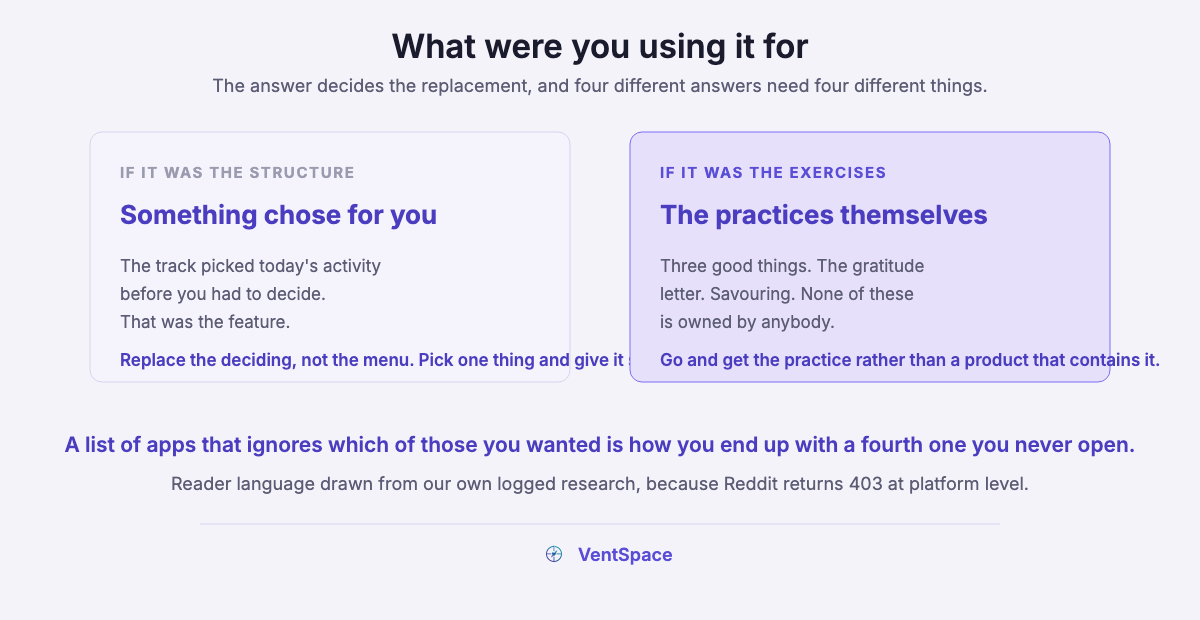
Before any replacement, the honest question: what was it doing for you? Five reasons people kept Happify on their phone. They need different answers, and a list of apps that ignores the difference is how you end up with a fourth one you do not open.
Start here, and answer these for yourself rather than reading on.
- Was it the structure, knowing what today’s activity was without deciding?
- Was it the lightness, a game rather than a blank page?
- Was it the gratitude and savouring exercises specifically?
- Was it that somebody credible had chosen the exercises for you?
1. You wanted somebody else to decide what today’s exercise was. The track did that. You opened it and the next thing was already picked.
This week: pick one practice and commit to it for seven days before evaluating anything. The deciding was the feature you are missing, so do not replace it with a menu.
2. You wanted it to be light. Popping a balloon is not writing a journal entry, and for a lot of people that is the difference between doing something and doing nothing.
This week: find something with a timer under five minutes. If it asks you to write a page, it is the wrong replacement for what you had.
3. You wanted the specific exercises. Three good things. The gratitude letter. Savouring. These are real practices with a research literature behind them, and they are not owned by anyone.
This week: go and get the practices themselves rather than a product that contains them. The free option below is genuinely the best answer for this one.
4. You wanted the credibility. The named advisers mattered to you, because the internet is full of exercises invented by a marketing team on a Tuesday.
This week: look for who chose the content before you look at the interface. Ask whose name is on it and what they published.
5. You were using it as your support, full stop. Not as an extra. It was the thing you opened when the week got heavy, and now it is gone.
This week: this is the situation that deserves more than an app swap, and the section after the alternatives is written for you. Do not rush to refill the slot.
Quick Summary
Q: What did people use Happify for?
A: Mostly for structure and lightness. It chose the day’s activity for you, the activities were short and game-like rather than written, and the exercises came from recognised positive-psychology research. Which of those you valued decides what you should replace it with.
Where to go instead
So what now? Seven options, each one loaded and checked on 11 September 2026, which is not a formality on this topic. No price appears below. Four different figures for Happify are circulating on pages that rank for it today and not one of them can be traced to the company or to a live store listing, so printing any number here would be repeating the exact mistake this page is about. Every one of these is free to begin, and where there is a paid tier you should read the figure on the vendor’s own page on the day you buy.
Dario Mind. The literal successor, and the honest first answer. Built by the same publisher, carrying the same programme copy and the same advisers, on both stores as a free download, last updated 1 July 2026.
Who it suits better: anyone who wants the actual continuation rather than a substitute.
The watch-out, and it is significant: the web programme at `happify.dariomind.com` sends you to a log-in rather than a sign-up, the company sells primarily to employers and health plans, and we did not test whether an individual can get in. Check before you build anything on it.
Greater Good in Action, from the Greater Good Science Center at UC Berkeley. The strongest recommendation on this page and it is not an app. A free web library of the practices themselves, each one laid out with a duration, a frequency, a difficulty rating, how to do it and why it is thought to work, with a printable version. Three Good Things sits there as a ten-minute daily practice with its research explained.
Who it suits better: anyone whose answer to the question above was the exercises. This is Happify’s content without Happify.
The watch-out: no reminders, no phone app, no one nudging you. The structure you liked is the thing it does not supply.
Intellect. Structured self-guided programmes rather than a single tool, on both stores, updated 9 September 2026.
Who it suits better: anyone who wanted the track format, a defined sequence with a beginning and an end.
The watch-out: it leans more clinical and less playful than Happify did, so the lightness is mostly gone.
Fabulous. Short science-framed journeys you work through, built around behaviour change, updated 24 August 2026.
Who it suits better: anyone who misses the feeling of being walked through something, with momentum designed in.
The watch-out: it is about habits more than about feelings, and the coaching voice is enthusiastic in a way that some people find tiring.
Finch. A self-care app built around a small bird that grows when you look after yourself, updated 10 September 2026.
Who it suits better: anyone whose honest obstacle is opening any app at all. It is the gentlest thing in this list.
The watch-out: if a cartoon bird makes you wince, you will delete it inside a week.
Headspace. Guided courses, on both stores, updated 9 September 2026.
Who it suits better: anyone whose favourite part of Happify was the meditation tracks rather than the exercises.
The watch-out: it is a meditation product. If sitting still was never your problem, this answers a question you did not ask.
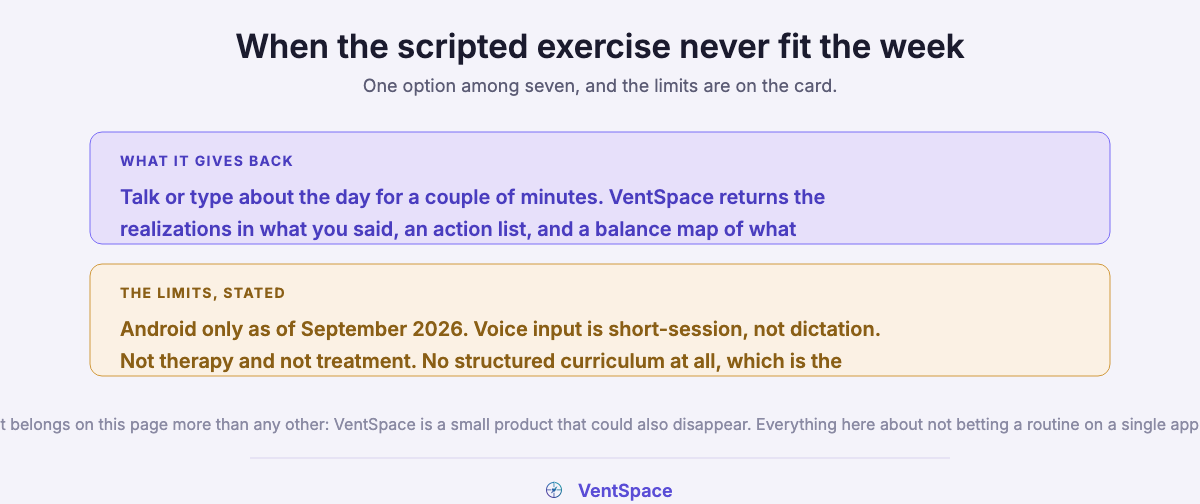
VentSpace. In this list because one of the five reasons above has no app-shaped answer. If what failed you was the scripted exercise landing in a week it did not fit, a curriculum is not the fix. It is a journaling app that turns what you write into a clear read on your life balance, plus small, doable next steps. You write about the day for a couple of minutes, and it reflects back the realizations in what you wrote, an action list, and a balance map of which parts of your life you have been mentioning and which you have gone quiet about. Words rather than points.
Who it suits better: anyone who noticed that the activity was already chosen before the app knew anything about their week.
The watch-outs, and there are four: it is Android only as of September 2026, voice input is short-session rather than long dictation, it is not therapy and not treatment, and it has no structured curriculum at all, which is precisely what Happify was good at. Free to start. And one more thing, which belongs on this page more than any other: VentSpace is a small product that could also disappear one day. Not on Android, or at a desk? VentSpace Live runs in your browser, free, with nothing to install. Everything below about not betting a routine on a single app applies to ours.
| Tool | Shape | Platforms | Verified live | Best for |
|---|---|---|---|---|
| Dario Mind | The successor programme | iOS, Android, web | 1 Jul 2026 | The actual continuation, if you can get in |
| Greater Good in Action | Free practice library | Web, any device | 11 Sept 2026 | The exercises themselves, at no cost |
| Intellect | Structured programmes | iOS, Android | 9 Sept 2026 | The track format, done seriously |
| Fabulous | Guided journeys | iOS, Android | 24 Aug 2026 | Momentum and being walked through it |
| Finch | Gentle gamified care | iOS, Android | 10 Sept 2026 | When opening anything is the obstacle |
| Headspace | Guided courses | iOS, Android | 9 Sept 2026 | If the meditations were the part you used |
| VentSpace | Journaling app | Android only | 11 Sept 2026 | When a scripted exercise never fit your week |
One more option, and somebody needs to say it. You could not replace it at all. Was it relief you felt when you opened it, or obligation? If it was obligation, its disappearance has handed you a decision you were never going to make for yourself. That is a legitimate outcome, and nobody writing a list of apps will offer it to you.
Quick Summary
Q: What can I use instead of Happify?
A: Dario Mind is the literal successor, though access appears to run through a log-in rather than an open sign-up. Greater Good in Action from UC Berkeley is free and contains the practices themselves. Intellect and Fabulous come closest to the structured track format, Finch is the gentlest, and Headspace suits anyone who mainly used the meditations. All were verified live on 11 September 2026.
Where none of this will help
An exercise programme is practice, and practice has a ceiling. Happify never claimed otherwise, and the company now running it prints a line on its own site saying it does not provide medical advice, diagnosis or treatment. That sentence is worth keeping in view while you pick a replacement, because the thing that just disappeared was not a clinician.
Four situations where the right answer is a person rather than another download. Read these as questions about your own week.
- Has the low stretch been going on for more than a few weeks without lifting?
- Was the app the only thing standing between you and a bad evening?
- Is the actual problem a job, a relationship or a loss, which no activity contains?
- Are you looking for a replacement mainly so that you do not have to sit with how much you were relying on one?
If any of those landed, the useful next step is a conversation rather than an install. Therapy is one option here, and it may well be the right one for you. Losing a self-guided tool is a reasonable moment to find out what a trained person would make of the same few weeks. A free practice library is not a substitute for that, and neither is anything else on this page.
If this is heavier than a missing app
If you are in crisis or thinking about harming yourself, please contact a crisis line now rather than looking for an app. In the US you can call or text 988 for the Suicide and Crisis Lifeline. Outside the US, findahelpline.com will find the service where you are. No self-guided programme can assess risk, and none of them is a substitute for a person.
Quick Summary
Q: Can a positive-psychology app replace therapy?
A: No. Self-guided exercise programmes are practice, and the company now running Happify’s successor states on its own site that it does not provide medical advice, diagnosis or treatment. If low mood has persisted for weeks, or the app was the only thing holding an evening together, a conversation with a professional is the better next step.
Questions people ask
Is Happify still available?
Not as an app. The Google Play listing and the App Store listing both return 404, checked on 11 September 2026 across multiple regional storefronts with live controls running in the same session. A Happify-derived web programme still exists under the Dario Mind name at the address `happify.com` now redirects to.
Did Happify shut down?
No, and that is the wrong word. There was no closure notice, the company still trades as DarioHealth, the publisher account is still named Happify, Inc., and a version of the programme is still running on the web. What happened is narrower: the consumer app was withdrawn from both stores and the brand was folded into Dario Mind. Those are different facts and the difference changes what you should do next.
Why do review sites and search results still say it is available?
This is the myth worth correcting, and it is the reason this page exists. The top-ranking Happify review today is stamped as updated on 29 July 2026. It prints four confident price points, never mentions Twill, DarioHealth or Dario Mind, and includes a section comparing Happify to Sanvello, which was itself pulled from both app stores in June 2024. A clinician-facing review database still lists Happify as a programme with no note that it has gone. And on 11 September 2026 a live search answer stated that the app “has not been discontinued” and “remains fully active and available on mobile devices”, citing a link that returns 404. A date on a page tells you when somebody edited it. It does not tell you what they re-checked.
Can I get my old account or my tracks back?
This page cannot promise you either. `happify.com` redirects to the Dario Mind programme, where there is a member log-in, and your old credentials may or may not work there. We did not create or test an account, so anything more definite would be a guess. If the tracks mattered to you, the underlying practices are public, and the free library above carries a good many of the same ones with their research attached.
Can I install it from an APK site instead?
You can find one. Do not. A withdrawn build from a third-party mirror gets no updates and no security fixes, you have no way to know what was changed before it was uploaded, and this is a thing you were going to type your low days into. The cost is not worth the nostalgia.
Related. Reflectly Review 2026.
Related. What happened to Youper, your data, and what to use instead.
What this is worth knowing for
There is an inversion here worth noticing. In our own logged research on why people stop using wellness tools, almost every line is somebody blaming themselves. Downloaded five apps, abandoned all. The fifth uninstall is not a failure, it is a data point. They all want to be my daily habit and I have about three daily habits left. This time it was not you. You kept your end of it and the tool left, which is a different experience and deserves to be named rather than absorbed into the usual self-criticism.
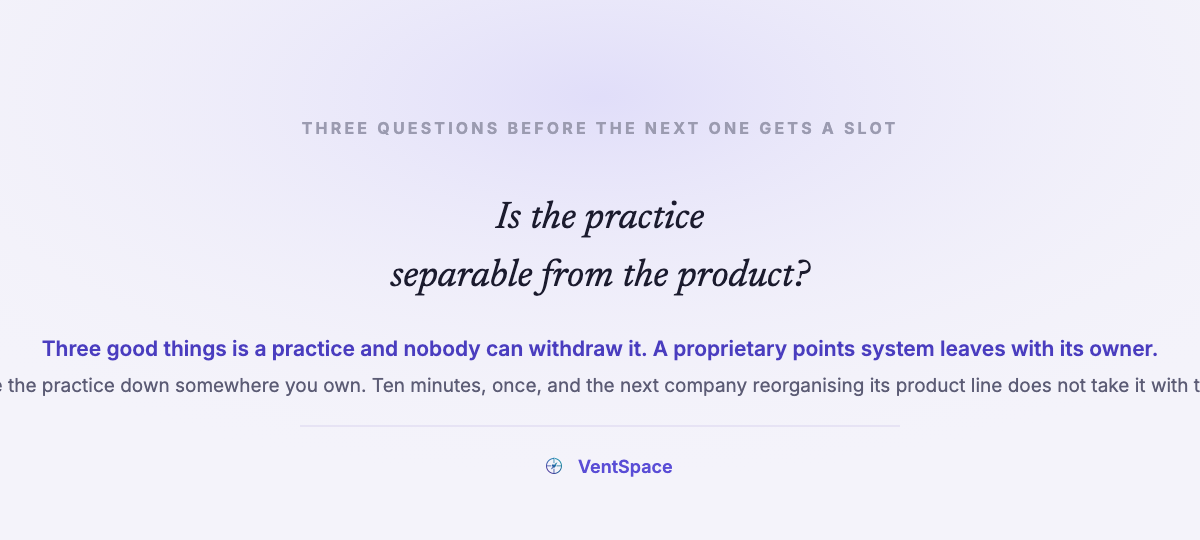
The practical half is three questions to ask before the next one gets a slot in your week. Is the practice separable from the product? Three good things is a practice and nobody can withdraw it. A proprietary points system vanishes with its owner. Who actually pays for this? A product sold to employers and health plans can stop being sold to you without anybody doing anything wrong, and that is most of what happened here. Could you write down what you do in it on a postcard? If yes, you are safe, because you can keep doing it anywhere.
The honest timeline. A practice like the ones Happify contained takes a few weeks before it is anything more than a chore, which is longer than any app will tell you. So if you are replacing something today, pick one thing and give it a month before judging it. And if you can, write the practice itself down somewhere that is not an app, on paper, in a note, anywhere you own. Ten minutes, once, and the next company reorganising its product line does not take it with them.
About this article

Written by
Sai Subramaniam
Founder, VentSpace
I write these guides because I have been where you are. I am working through my own hard seasons, and I share the things that actually helped me, so that anyone going through it has a steady companion close by instead of facing it alone. VentSpace is the app I built for exactly that: a journaling app that turns what you write into a clear read on your life balance, plus small, doable next steps toward feeling more like yourself.
This writing is honest and every claim is sourced, and it is not a substitute for professional care. If you are struggling, reaching out to a professional is a strong move, not a failure.
Explore VentSpaceTry VentSpace LiveHow this one was checked. Every factual claim traces to a named source, and the source is printed next to the claim rather than kept in a footnote. Quotes are pinned to the work they come from, with the year, the letter or the chapter where one exists. Where a widely repeated claim could not be traced, it was left out and the omission recorded. Where a figure is contested, both sides are printed.
No affiliate links, no paid placements, and nobody paid to appear here. Where we mention our own app, we say that it is ours, we state its limits, and we never position it as a substitute for care.
Reviewed: October 2026. Prices, platforms and product availability move quickly, and anything we could not verify at the time of writing is marked as unverified rather than turned into a number.
Corrections. If something here is wrong, we would rather know. Corrections are made in place, with a note saying what changed. Updated 15 October 2026: we corrected the description of VentSpace, which is a journaling app rather than a spoken-reflection tool, relabelled two related reading links honestly, and removed an unrelated link and a duplicate app link.