
“Brothers and sisters, I bid you beware
Of giving your heart to a dog to tear.”
Rudyard Kipling, “The Power of the Dog”, Actions and Reactions, 1909
Somewhere there is a reply box with a cursor in it, and the difficulty is not that we cannot think of anything. It is that we can think of four things and suspect all of them are wrong.
What makes this particular message harder than a message about a person is not the vocabulary. It is that we are not sure how much this is allowed to matter, and we can feel, underneath the sentence we are drafting, a small ungenerous thought about proportion. Our friend can feel it too, from the other side, which is why they have apologised twice already for being upset. That is the actual problem on this page, and it has a name.
So this is not a bank of messages to copy. There is no sentence that fixes this and there is no template with a blank in it, because the moment a condolence sounds assembled it stops working. What follows is thirty things a person might genuinely say, sorted by where the other person is in the event, each with the reason it tends to land and the situation in which it would be the wrong one. Presence beats phrasing, every time, and most of the useful help is not verbal at all.
The short version
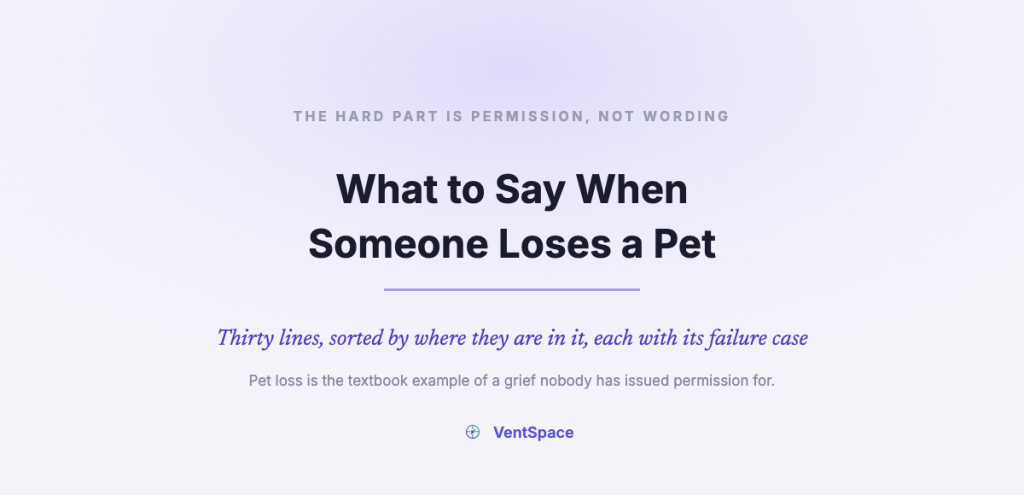
The hard part is permission, not wording. Pet loss is the standard example of a grief that is real and socially unsanctioned, and a sentence’s first job here is to say plainly that this counts.
Use the animal’s name. It is the single move that separates a message that helps from one that is merely polite.
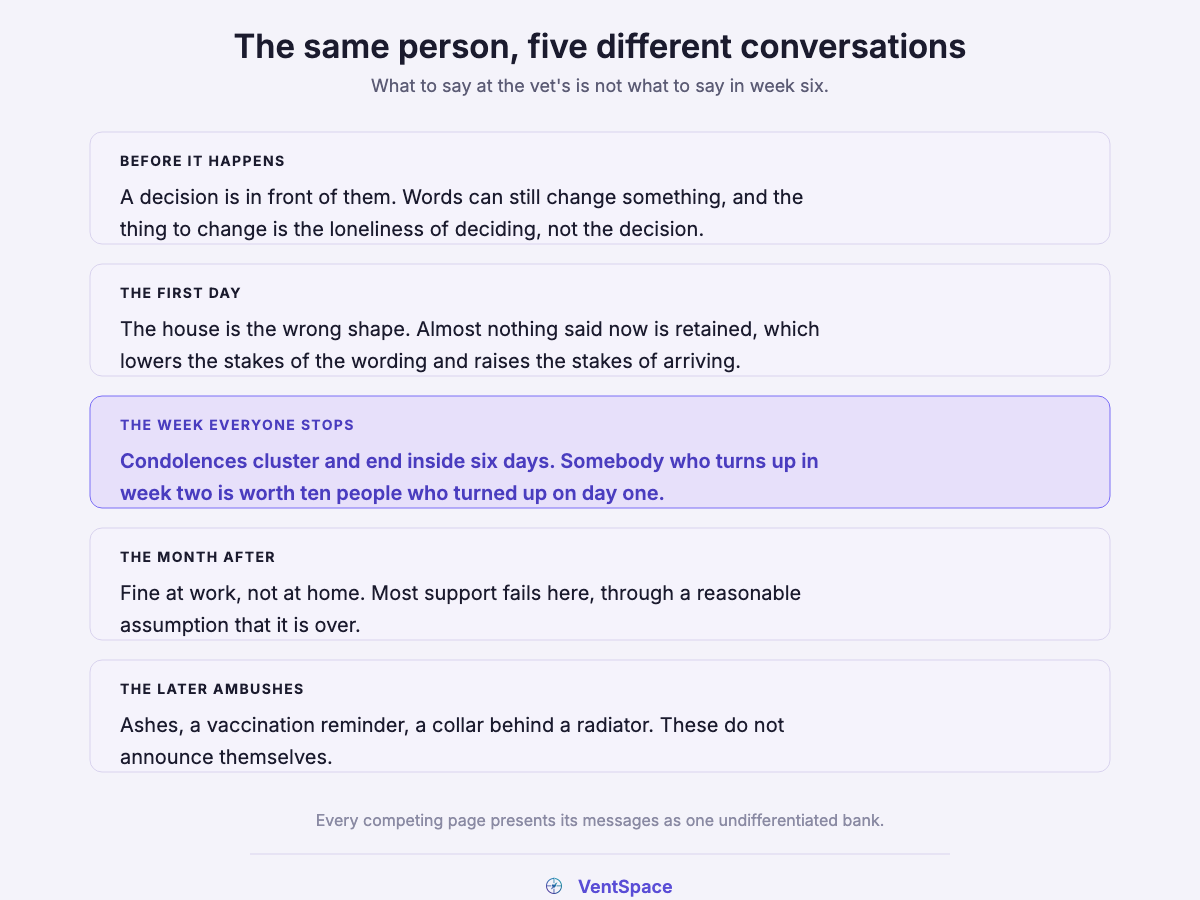
Sorted by stage, because what to say at the vet’s is not what to say in week six, and every other page treats them as the same message.
Every line has a failure case, printed next to it. A line with no failure case has not been thought about.
The people who say the wrong thing are usually frightened, not unkind. The page is not written against them.
If you are in crisis or thinking about harming yourself, please contact a crisis line now. In the US you can call or text 988 for the Suicide and Crisis Lifeline. Outside the US, findahelpline.com will find the equivalent where you are.
Why this one is harder than it looks
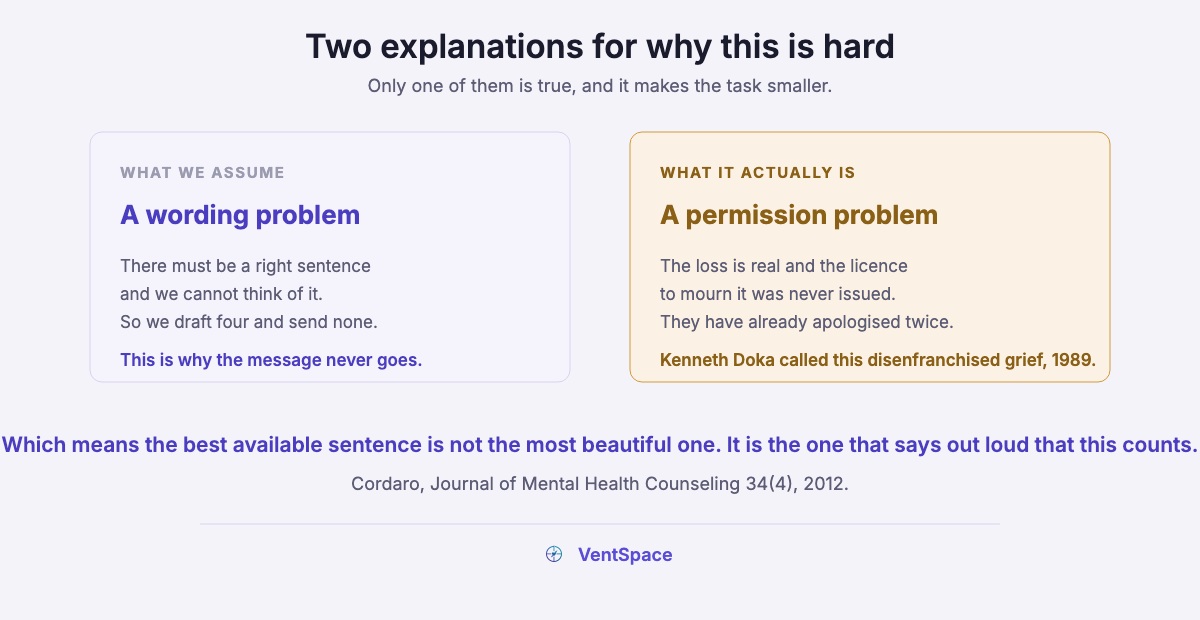
In 1989 Kenneth Doka gave a name to grief over a loss that cannot be openly acknowledged, publicly mourned or socially supported. He called it disenfranchised grief, and the category describes the situation where the loss is real and the permission to mourn it has not been issued. Nobody sends a rota of casseroles. There is no funeral to take a day off for. The griever is left with a full-sized feeling and a half-sized social licence for having it.
Pet loss is the textbook instance. Writing in the Journal of Mental Health Counseling in 2012, Millie Cordaro surveyed the literature and found that many bereaved pet owners experience exactly this, and that the disenfranchisement itself does damage on top of the loss. Cordaro also frames pet loss through the Kübler-Ross stages, which this page does not use, for the reasons given in the questions at the end.
Which reorganises the task in front of us. We have been treating this as a wording problem, and it is a permission problem. The best sentence available is usually not the most beautiful one. It is the one that says out loud that this counts, delivered without any hedging that could be mistaken for a judgement about scale. That is why “I’m so sorry about Bramble” outperforms every carefully composed paragraph. It treats the animal as a named individual who has died, which is the thing our friend has been quietly braced for us not to do.
Quick Summary
Q: Why is it so hard to know what to say when someone’s pet dies?
A: Because the difficulty is social rather than verbal. Pet loss is a standard example of disenfranchised grief, a real loss for which no public permission to mourn has been issued, so the person is already braced for the loss to be treated as small. A sentence that plainly treats it as serious does more work than a sentence that is well written.
What not to say, and what it does
Almost every line below is said by somebody who is trying to help and has arrived at the edge of what they know how to do. That is worth holding on to before reading the effects, because the temptation of a page like this one is to make the reader feel superior to their own relatives, and none of us is reliably better at this than anyone else.
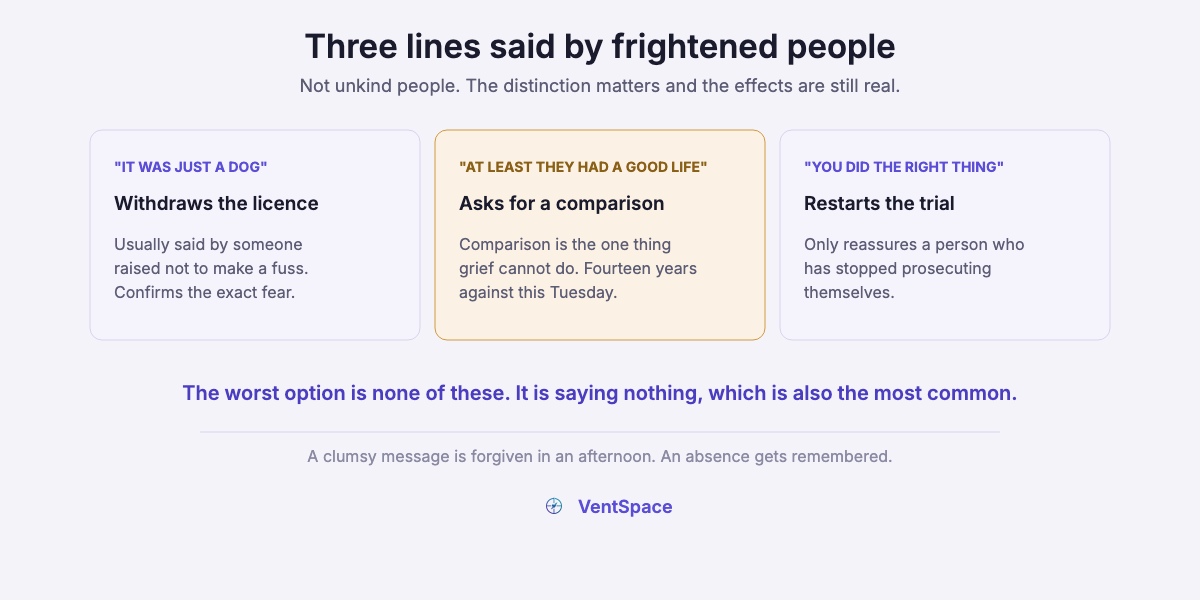
“It was just a dog.” Nobody says this to be cruel. It is usually said by a person raised not to make a fuss, and it lands as the confirmation of the exact fear the bereaved person walked in with. It does not merely fail to comfort. It withdraws the licence.
“At least they had a good life.” The word doing the damage is the first one. “At least” is a comparison, and comparison is the one operation grief cannot perform. The sentence asks somebody to weigh fourteen good years against this particular Tuesday, and on this particular Tuesday they cannot.
“Are you going to get another one?” Asked early, this reads as a suggestion that the animal was a role rather than a creature, and that the vacancy can be filled. Asked later by somebody who has been paying attention, the same question is kind. Timing is the whole of it.
“They’re in a better place.” For a person who holds that belief it can be steadying. For a person who does not, it changes the subject from their dead cat to a cosmology they are now expected to nod along with. The risk is not offence. It is that they stop talking.
“You did the right thing.” This one is the most surprising, because it is offered as pure reassurance. But it can only reassure somebody who has already stopped prosecuting themselves. To a person turning over whether they waited too long or not long enough, a verdict from outside sounds like a verdict, and they will hear the trial resume.
None of this means we should say nothing. Saying nothing is worse than all five, and it is the most common failure by a wide margin. A clumsy message can be forgiven in an afternoon. An absence gets remembered.
Quick Summary
Q: What should you not say when someone loses a pet?
A: Anything that measures the loss against something else (“at least”, “just a”), anything that proposes a replacement early, and any verdict on a euthanasia decision the person is still turning over. The single worst option, though, is saying nothing at all, which is also the most common one.
Before it happens, when the decision is theirs
Some pet deaths are scheduled, and almost no condolence advice accounts for that. The person we are writing to may be sitting in a waiting room with a decision in front of them, or may have made it and be waiting for Thursday. This is the only stage where our words can still change something, and the thing to change is the loneliness of the deciding, not the decision.
1.“I’m so sorry. Do you want company at the appointment, or would you rather I was at the other end of the phone afterwards?”
Why it lands: It offers two specific, different kinds of help and lets them pick, which is easier to answer than an open offer. It also signals that we have thought about the appointment as an event rather than a formality.
Not if: They have not told you it is happening. Finding out from somebody else and then referencing the date is an intrusion, however kindly meant.
2.“Whatever you decide, I’m not going to have an opinion about it.”
Why it lands: Most of the pressure at this point comes from an imagined jury, and we are all on it by default. Removing ourselves from it, explicitly, is a rare and useful thing to do.
Not if: You do in fact have an opinion you are likely to voice later. A promise of neutrality that gets withdrawn in week three is worse than never offering it.
3.“Can I drive?”
Why it lands: Three words, no emotional demand, and it solves a genuine problem. Driving home afterwards is hard, and it is something a friend can simply take off their hands.
Not if: You are not physically able to be there. An offer that has to be retracted adds a small administrative grief to a large one.
4.“Tell me about her. What was she like before she got ill?”
Why it lands: It moves the animal from patient back to character, which is where the person would rather have her, and it invites a story rather than an update.
Not if: They are mid-crisis or mid-appointment. This is a question for a long evening, not for a corridor.
5.“You don’t have to make this decision well. You have to make it, and then it will be made.”
Why it lands: It quietly lowers a bar that none of us can clear. Much of the agony here is the belief that there is a correct moment and that we could identify it from inside.
Not if: They are looking for information rather than absolution. If what they want is a second opinion on a prognosis, this reads as a way of ending the conversation.
6.“I’ll be awake tonight. Text me at any hour and I won’t mind what it says.”
Why it lands: The specific hours matter. Three in the morning is when this is at its worst and when everyone assumes they are not allowed to disturb anybody.
Not if: You will not actually be awake or will not answer. Do not write this sentence unless it is true.
Quick Summary
Q: What do you say to someone who has to put their pet down?
A: Offer something concrete and optional, such as driving them or being reachable that night, and say plainly that you will not have an opinion on the decision. Avoid any verdict, including a positive one, because a person still weighing it will hear any verdict as the argument continuing.
The first day, when the house is the wrong shape
For the first day or two the problem is not the feeling, it is the architecture. There is a bowl where a bowl should not be. The route to the kettle has a gap in it. Everything we say in this window will probably be forgotten, which is worth knowing, because it lowers the stakes of getting it right and raises the stakes of it arriving at all.
7.“I’m so sorry about Bramble.”
Why it lands: The name does almost all of the work for us. It converts an abstract sympathy into an acknowledgement that a specific individual is no longer in the world.
Not if: You are unsure of the spelling or the pronoun. Check with somebody rather than guessing, because getting it wrong in the first message is a small wound that sits oddly for years.
8.“I loved that ridiculous face.”
Why it lands: Fondness is more useful than sorrow here, and a particular detail proves we were paying attention while the animal was alive.
Not if: You never met the animal. Borrowed affection is transparent, and the honest version, that you know how much they mattered, is stronger.
9.“You don’t have to reply to this.”
Why it lands: It removes the obligation that turns a wave of kind messages into an unanswerable inbox, which is a real and rarely mentioned burden of the first week.
Not if: It is your only sentence. On its own it can read as a way of tidying up the interaction. Attach it to something warmer.
10.“I’m going to keep checking in for a while, and you can ignore all of it.”
Why it lands: It tells them, in advance, that your attention has a longer horizon than the current wave, which is the reassurance that matters most and is almost never given.
Not if: You do not intend to keep checking in. This is a promise, and the fourth stage below is where it gets tested.
11.“What happened? I would like to know, if you want to tell me.”
Why it lands: Many bereaved owners want to tell the story and have found that nobody asks, because asking feels intrusive. The conditional clause is what makes it safe.
Not if: The death was violent or involved an accident they may hold themselves responsible for. Then the story is a confession and should be offered, never requested.
12.“He had a good life and I am not saying that to console you. I am saying it because I watched it happen.”
Why it lands: It converts the most suspect sentence in the genre into a testimony. What makes it work is the evidence, not the sentiment.
Not if: You were not there for it. Without the witnessing this collapses back into “at least he had a good life”, which is the line the section above warns about.
Quick Summary
Q: What do you say when someone’s dog or cat has just died?
A: Use the animal’s name, say sorry plainly, and add one specific detail you remember. Tell them they do not need to reply. Anything more elaborate can wait.
The week when everyone else has stopped mentioning it
The condolences arrive in a cluster and then stop, and the gap between the last message and the first ordinary morning is where this gets genuinely lonely. Somebody who turns up in week two is worth ten people who turned up on day one. This is the least competitive stage and the most valuable one.
If you are in crisis or thinking about harming yourself, please contact a crisis line now. In the US you can call or text 988 for the Suicide and Crisis Lifeline. Outside the US, findahelpline.com will find the equivalent where you are.
13.“How are you doing with it this week?”
Why it lands: The qualifier is everything. “How are you” gets “fine” from all of us. “How are you doing with it this week” is a question about one specific thing and is much harder to deflect politely.
Not if: You are in a group setting. Asked in front of colleagues it forces a performance, and it can push them towards the lie.
14.“I keep thinking about Nell.”
Why it lands: It reports our own state rather than interrogating theirs, so it costs the recipient nothing and still tells them the animal is being held in somebody else’s mind.
Not if: It is not true. This sentence is easy to say and easy to detect, and an insincere version of it does more harm than silence.
15.“Is it still bad in the mornings?”
Why it lands: Specificity signals that you have some idea what this is like. Mornings and evenings are the two commonly reported hard edges, because they were the parts of the day with a routine in them.
Not if: You are guessing at a routine you never knew about. If you have no idea what their mornings involved, ask what the worst part of the day is instead.
16.“I don’t think you are being ridiculous.”
Why it lands: It answers the sentence they have almost certainly said out loud twice already, and it answers it without requiring them to have said it to you.
Not if: They have shown no sign of embarrassment. Introducing the idea that they might look ridiculous, in order to deny it, plants something that was not there.
17.“Do you want to talk about her, or would you rather talk about anything else at all?”
Why it lands: It hands over the controls. Both options are legitimate, stated out loud, which is unusual and quietly relieving.
Not if: You are not prepared for the second answer. Offering the distraction and then steering back to the loss is worse than not offering it.
18.“I was telling someone the story about the shoes yesterday.”
Why it lands: It shows the animal has an afterlife in other people’s conversation, which is close to the only continuation available and matters more than it sounds.
Not if: The story is one they have reason to be embarrassed about. A destroyed sofa is funny later. It may not be funny yet.
Quick Summary
Q: What should you say a week or two after someone’s pet dies?
A: Anything that shows you have not moved on when everyone else has. Naming the animal, asking a specific question rather than a general one, and saying that you have been thinking about them all work. This is the point at which support usually stops and the point at which it is most needed.
The month when they are fine at work and not at home
By now the outward version has been rebuilt. They answer emails, they are pleasant in meetings, and the difficulty has retreated to the parts of the day nobody sees. This is where most support fails, not through unkindness but through a reasonable assumption that it is over. Nothing here should imply a schedule, because nobody knows what the schedule is and a 2017 review of the evidence argues that telling people there is one can do harm.
19.“Nobody’s asked you about her in a while. I’m asking.”
Why it lands: It names the silence rather than adding to it, and it does not require the recipient to admit they noticed.
Not if: You are the person who stopped asking and are now arriving with a flourish. In that case the honest version begins with an apology.
20.“Do you want to come for a walk? We can go the other way.”
Why it lands: The second sentence is the whole point. It shows we have worked out that the old route is a problem, which is the sort of noticing that cannot be faked.
Not if: They have said they find the old route consoling. Some people want to walk it every day, and rerouting them is a small theft.
21.“How is the other one doing?”
Why it lands: A surviving animal may be unsettled and is easy to overlook, and the question lets the owner talk about the loss at one remove, which some people find much easier.
Not if: There is no surviving animal. In an empty house this question is a door opening onto the wrong room.
22.“I still think about him.”
Why it lands: The word is “still”. It quietly refuses the timetable that everyone else has adopted.
Not if: It has been long enough that this arrives as a surprise. In that case pair it with what prompted the thought, so it reads as a memory rather than a check-up.
23.“You look tired. Do you want to come and sit in my kitchen and not talk?”
Why it lands: It offers company without conversation, which is the form of help we most often want and least often think to offer.
Not if: Your kitchen has a dog in it. This seems obvious and is missed constantly.
24.“Has any of it been harder than you expected?”
Why it lands: It opens the door to the unsanctioned material, the guilt and the relief and the resentment, without naming any of it and without implying that any of it is expected.
Not if: You are not able to hear the answer without reassuring. If the reply is “I think I killed her” and the response is “no you didn’t”, the door shuts again.
Quick Summary
Q: How do you support someone a month after their pet died?
A: By behaving as though nothing has changed in your attention, and by offering things rather than sentences: a walk on a different route, an hour in your kitchen, a question about the surviving animal. Avoid anything that implies a schedule, because there is no reliable one and suggesting otherwise is its own small harm.
The things that arrive later without warning
Long afterwards, objects keep arriving. The ashes come back. A vaccination reminder lands in an inbox, generated by a system that does not know. A collar turns up behind a radiator. These are ambushes rather than anniversaries, and they do not announce themselves, so the useful thing we can do is be the sort of person who can be texted at the moment one lands.
25.“I saw the date. Thinking about you today.”
Why it lands: Remembering an anniversary that nobody else has marked is disproportionately powerful, precisely because none of us had to.
Not if: You have the date wrong. Check before sending, because an anniversary message on the wrong day is a peculiar kind of painful.
26.“The vet reminder came through, didn’t it. That’s a horrible piece of admin.”
Why it lands: It names a specific indignity that rarely gets said out loud, and it treats it as an insult from a system rather than as a feeling to be managed.
Not if: You are about to offer to fix it. Ask first. Some people want the record deleted and some want it left exactly where it is.
27.“Is today a bad one?”
Why it lands: Four words, and it assumes that days differ, which is truer to the experience than any question that assumes a direction of travel.
Not if: You ask it repeatedly. As an occasional question it is a kindness. As a weekly ritual it becomes a status report they have to file.
28.“I found a photo. Do you want it, or would you rather I didn’t send things like that?”
Why it lands: It asks permission before delivering an ambush, which is the correct etiquette for images of the dead and one almost none of us observe.
Not if: You have already attached it. The question is meaningless once the picture is in the thread.
29.“You don’t have to do anything with the ashes.”
Why it lands: Some people carry a quiet obligation to arrange a meaningful resting place and cannot face it, and this lifts it without implying they were wrong to feel it.
Not if: They have told you about a plan they are looking forward to. Then this sounds like discouragement.
30.“There isn’t a wrong length of time to keep a collar on a shelf.”
Why it lands: It grants permission for the exact thing we are most self-conscious about, which is the visible evidence of a continued attachment.
Not if: They have just put the collar away and seem relieved. Reopening it turns a decision into a question.
Quick Summary
Q: What do you say on the anniversary of a pet’s death?
A: Say that you remembered, name the animal, and keep it short. Check the date first. The power of the message is in the fact that nobody required you to send it, so it does not need to be long or beautiful.
Insight The most-shared object in this whole genre turns out to have an author. “Rainbow Bridge” was written in 1959 by Edna Clyne-Rekhy, then nineteen, at her family’s home near Inverness, after her Labrador Major died and her mother suggested she write down what she felt. It travelled anonymously for decades, printed uncredited by Dear Abby in February 1994, and the art historian Paul Koudounaris identified her in January 2023 after a decade of research into pet cemeteries. She had no idea it had gone anywhere. If you send it, you can now say who wrote it and for whom, which is a considerably better message than forwarding a piece of folklore.
National Geographic, 22 February 2023
If they go quiet
Silence after a message is the point at which it is tempting to withdraw, usually for a generous reason: the assumption that you have intruded. In practice, a person who has stopped replying is usually not offended, they are underwater, and the inbox is one of the first things to go.
What we can do instead is keep the contact light and one-directional for a while. Send things that do not need answering. Report your own life at low volume. Remove the question mark, which is the part that makes a message a task. “Thinking of you this morning” costs the recipient nothing. “How are you doing?” requires an accounting they may not have in them.
Two exceptions, and they are the reason this section exists. If the silence is long and total, and other people are also not hearing from them, go round. And if what they are saying is not silence but something darker, the last section of this page is the relevant one.
What to do instead of speaking
Most of the value here is not verbal, and this is the section to act on if the rest of the page feels like a set of tightropes.
Take the bowls away, or do not, but ask. Somebody has to decide what happens to the bed, the bowl, the half-bag of food. It is a small, awful task and it is easier when it is not done alone.
Deal with the food. An unopened sack is a daily reminder and a waste that makes people feel guilty twice over. Offer to take it to a shelter and to handle the handover.
Cover the practical gap. If they had a dog, their day had a structure in it that has now gone. If they have another animal, they still have to keep going out. Walk it for them on a Wednesday.
Send something with the animal’s name on it. A card, a print, a donation to a rescue in the animal’s name. The name is the part that matters, not the object.
Print a photograph. A physical one, without asking them to choose it, and with a note saying you can replace it if it is the wrong picture.
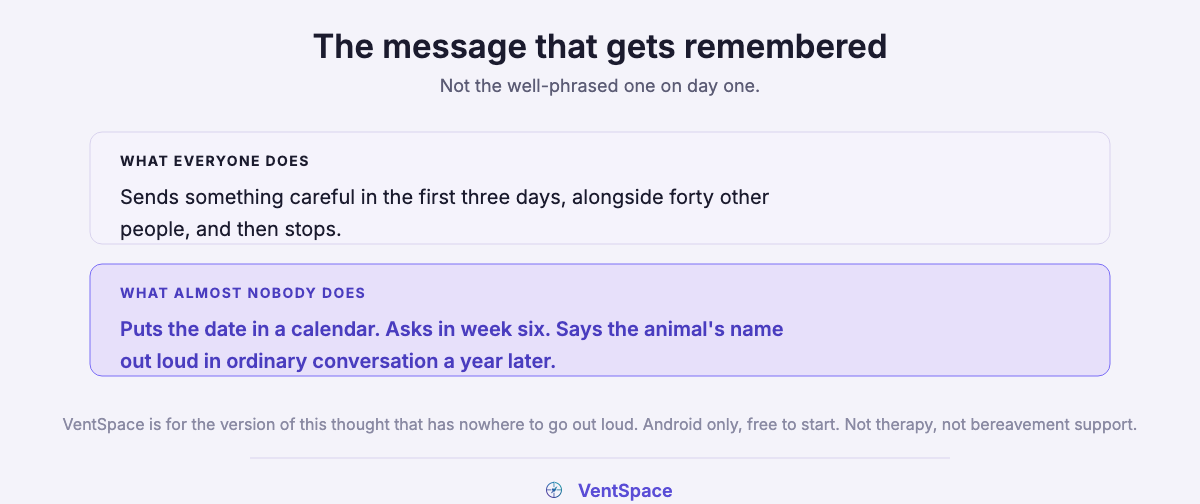
Remember the date and do nothing with it now. Put it in a calendar for a year ahead. Almost nobody does this, and it is the cheapest high-value act available on this page.
Say the name out loud in ordinary conversation months later. Not as a commemoration. As a normal reference to a creature you both knew.
Quick Summary
Q: What can you do for someone whose pet has died, other than send a message?
A: Take on the practical residue: the food bag, the bed, the empty structure in the day, the walk their surviving animal still needs. Print a photograph. Put the date in your own calendar for next year. These are the acts people remember, and none of them require getting the words right.
If you are the one closest to it
Some readers of this page are not the supporter. They are the person whose animal has died, reading a condolence guide to work out whether their own reaction is reasonable.
It is. The ordinary difficulty here is not the grief but the apologising, the reflex to add “I know it’s silly” to the end of every sentence, and that reflex is a direct product of the permission problem described at the top of this page rather than evidence about the size of the loss. Nobody who has watched an animal die for sixteen years needs to caveat it. And if the grief is not easing, or it is stopping you living your life, that is a good reason to talk to somebody about it, and the hotline further down is a reasonable place to start.
If writing helps, our journal prompts for grief are built for exactly this and make no promises about where it leads. If there is nobody to say any of this to out loud, that is worth saying to somebody who is not carrying it too, and on the worst afternoons the right thing is one of the numbers below or a person in the room.
Where this page stops
This page can improve a message. It cannot do anything about the death, and it is not a substitute for actual support, either for the bereaved person or for the reader carrying it.
If you are in crisis or thinking about harming yourself, please contact a crisis line now. In the US you can call or text 988 for the Suicide and Crisis Lifeline. Outside the US, findahelpline.com will find the equivalent where you are.
There is a free and under-used category of support built specifically for this, run out of veterinary schools and veterinary associations. The Cornell University Pet Loss Support Hotline is staffed by trained volunteer veterinary students, many of whom, by Cornell’s own account, have lost an animal themselves, on 607-218-7457. Hours vary seasonally, so their own page is the place to check before calling, and it carries an important caution in its own words: “The Cornell Pet Loss Support Hotline is not a mental health hotline.” Cornell’s page also points to equivalent hotlines at Tufts and at the Chicago Veterinary Medical Association, and to the Association for Pet Loss and Bereavement. Number and wording checked against Cornell’s page on 15 October 2026.
Grief counselling and therapy are legitimate options here and for some people they are the right one. A grief that other people treat as unserious is a well-documented reason to want somebody whose job it is to take it seriously.
Questions people ask
What do you say when someone’s dog dies?
Use the dog’s name, say you are sorry, and add one detail you remember about him. “I’m so sorry about Bramble. I loved that ridiculous face.” That is a complete message. Then tell them they do not have to reply, and check in again in a fortnight, which is when everyone else will have stopped.
Is it appropriate to say “sorry for your loss” about an animal?
Yes, and the formality is part of why it works. It is the sentence we use for a death, and using it here quietly asserts that this is one. The version to avoid is the one that hedges, because any hedge is heard as a ruling on scale.
What do you say to someone who had to have their pet put to sleep?
Offer something practical and avoid any verdict, including a favourable one. “You did the right thing” only helps a person who has already stopped arguing with themselves. If they raise the decision, the useful response is to ask what they have been turning over rather than to close it down.
How long does grief for a pet last?
Nobody can tell you, and this page will not give you a number. There is a whole genre that does, and the honest position is that the figures are not there. What is worth knowing is that arriving late is more useful than arriving on time.
Is it normal to grieve a pet this much? What about the stages of grief?
The stage model is contested and should not be used as a measure of anybody. The five stages came from Elisabeth Kübler-Ross’s 1969 work with dying patients, which she extended to their families, and they were never tested in bereaved people before being taught as a sequence. Reviewing the evidence in 2017, Stroebe, Schut and Boerner found stage theory lacking in empirical support and concluded it should be discarded, warning that the expectation that people will, or should, go through stages can be harmful to those who do not. So there is no sequence to be on schedule with. As for the intensity, the comparison with grief for a person is the one comparison nobody in the situation finds useful, and this page declines to make it.
If the person is telling you this does not feel like the grief they expected. We go into it properly in Grief vs Sadness.
If they would rather be sent something than told something. We go into it properly in Grief Quotes That Don’t Rush You Through It.
Two things worth keeping
The name is the whole technique. Almost every effective message on this page works because it treats a specific animal as having existed and as being gone, and almost every failed one works by referring to a category. If you remember nothing else, say the name.
And the timing matters more than the wording. The message that will be remembered is not the well-phrased one on day one. It is the plain one on day forty, from the only person who was still counting.
If someone you love has just lost an animal, or you are the one who has, none of this needs to be done well or done quickly. If writing some of it down would help, VentSpace is a quiet place to do it: a journaling app we built, where what you write stays yours. If you are on a computer, VentSpace Live runs in your browser, with nothing to install.
About this article

Written by
Sai Subramaniam
Founder, VentSpace
I write these guides because I have been where you are. I am working through my own hard seasons, and I share the things that actually helped me, so that anyone going through it has something steady to read instead of facing it alone. No ads, no affiliate links, and nothing here is a sales pitch.
This writing is honest and every claim is sourced, and it is not a substitute for professional care, bereavement support or medical advice. If this is heavy right now, the numbers above are a better answer than anything else on this page.
How this one was checked. Every factual claim traces to a named source, and the source is printed next to the claim rather than kept in a footnote. Where a widely repeated claim could not be traced, it was left out and the omission recorded. Where a figure is contested, both sides are printed.
No affiliate links, no paid placements, and nobody paid to appear here. Our own app appears only in one quiet line at the very end, and nothing on this page is a sales pitch.
Reviewed: October 2026. Anything we could not verify at the time of writing is marked as unverified rather than turned into a number.
Corrections. If something here is wrong, we would rather know. Corrections are made in place, with a note saying what changed. Updated 15 October 2026: the crisis details now also appear near the top and beside the section on the weeks after, the five-stages attribution was made more precise, a few generalisations we could not source were removed, and the Cornell hotline details were rechecked.