
“You matter because you are you and you matter until the last moment of your life.”
Dame Cicely Saunders, founder of St Christopher’s Hospice, as the hospice prints it
There is a message in a drafts folder that has been there for nine days, and a visit that keeps being scheduled for next week.
Almost all of us assume the difficulty here is linguistic. We imagine that somewhere there exists a sentence equal to the situation, that we have not found it, and that turning up without it would be worse than not turning up at all. That assumption is comfortable, because it makes the delay look like diligence. It is also the single most costly mistake available on this subject, and the evidence for that is unusually clear.
So this page is not a bank of sentences to copy, and there is no template with a blank in it. What follows is thirty things a person might genuinely say, sorted by where the illness is rather than by how they sound, each with the reason it tends to land and the situation that makes it the wrong one. Presence matters more than phrasing, and the most important decision in this whole business is made before a word is chosen.
If this is heavy for you too, or you are in crisis or thinking about harming yourself, please contact a crisis line now. In the US you can call or text 988 for the Suicide and Crisis Lifeline. Outside the US, findahelpline.com will find the equivalent where you are.
The short version
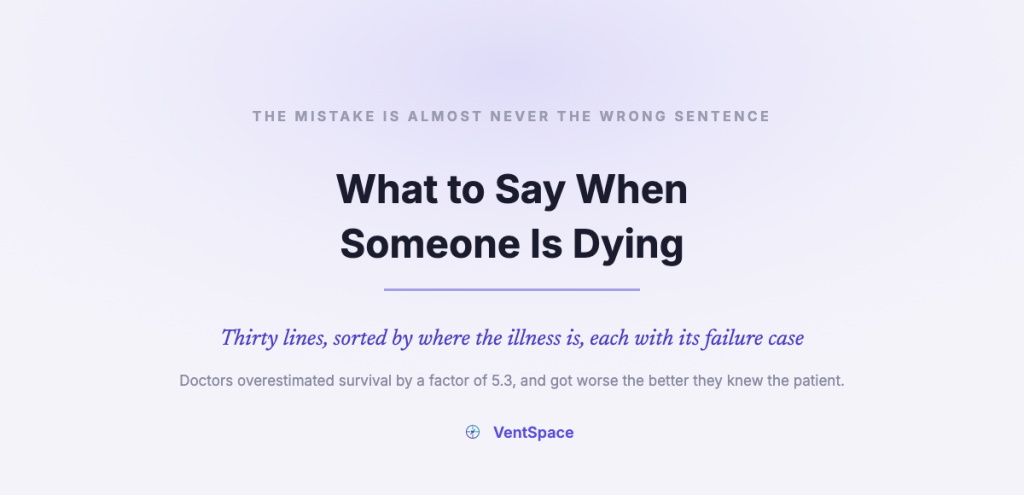
The mistake is almost never the wrong sentence. It is the wait. Survival is systematically overestimated, and by the people closest to the patient most of all.
Sorted by stage, because what to say in the first fortnight is nothing like what to say in the last week.
Every line carries its failure case. Several of the most-recommended sentences on this subject are only right for some people.
There is a stage for when they cannot answer. Almost no page covers it, and it is the part readers fear most.
You will probably cry, and that is not the disaster you think it is. The disaster is the visit that never happens.
Why the words are not the problem
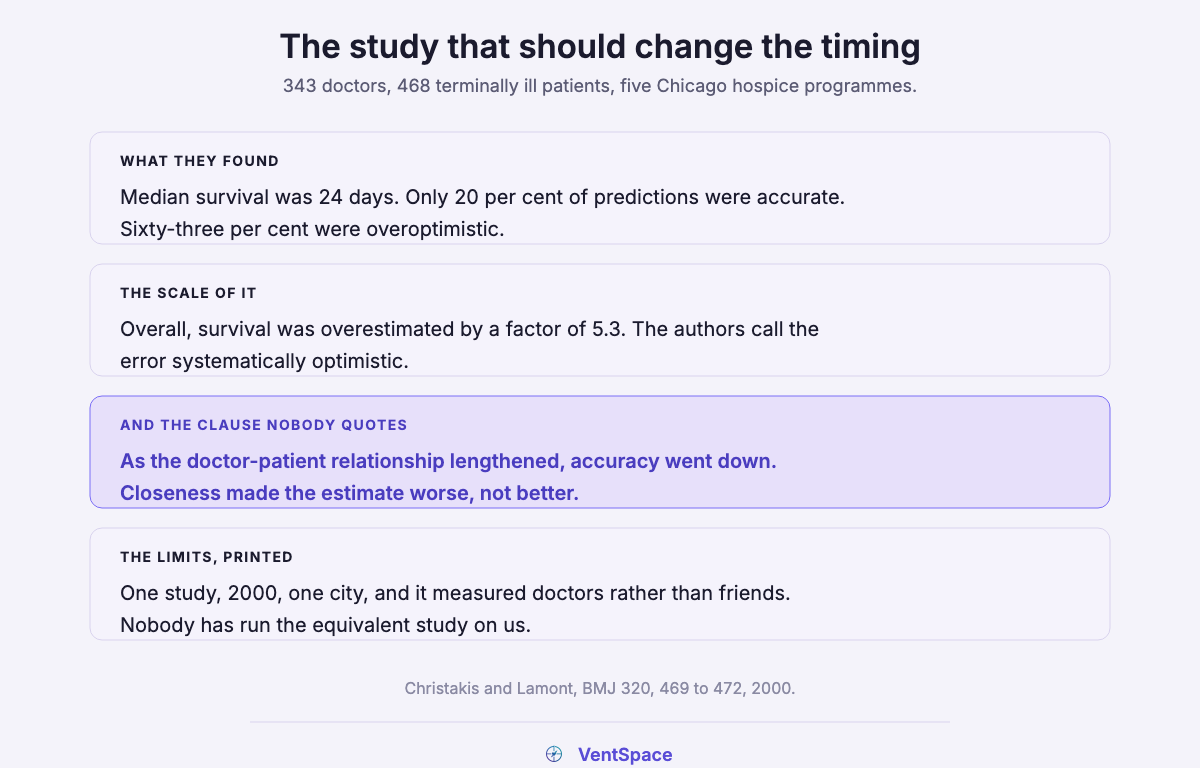
In 2000, Nicholas Christakis and Elizabeth Lamont published a study in the BMJ that ought to be better known than it is. At five outpatient hospice programmes in Chicago, 343 doctors gave survival estimates for 468 terminally ill patients at the point of hospice referral. Median survival turned out to be 24 days.
Only 20 per cent of the predictions were accurate, meaning within a third of the real figure. Sixty-three per cent were overoptimistic. Taken together, the doctors overestimated survival by a factor of 5.3. The authors’ conclusion is worth reading slowly: doctors are inaccurate in their prognoses for the dying, and the error is systematically optimistic.
Then there is the finding that reorganises everything else on this page. As the length of the doctor-patient relationship increased, prognostic accuracy went down. The better a doctor knew the patient, the more wrong they were, in the hopeful direction.
Two honest limits before we do anything with that. It is one study, published in 2000, at hospices in one city, and it measured doctors rather than friends. Nobody has run the equivalent study on us. But there is no reason to believe we are the exception to a bias that gets worse with attachment, and every one of us is considerably more attached than the referring physician.
Which changes what this page is for. We have been treating this as a problem of composition, and it is a problem of arithmetic. If the estimate in our heads is likely to be generous, then the correct response to not knowing what to say is to go and say something inadequate now. The inadequate thing said in March is worth a great deal more than the perfect thing drafted in June.
Quick Summary
Q: Why is it so hard to know what to say to someone who is dying?
A: Mostly it is not a wording problem. A 2000 BMJ study of 343 doctors and 468 hospice patients found only 20 per cent of survival predictions accurate, 63 per cent overoptimistic, and accuracy falling as the doctor knew the patient better. The practical consequence is that waiting for the right words costs more than saying an imperfect thing early.
Insight The most useful sentence in the study is the one nobody quotes: “As duration of doctor-patient relationship increased and time since last contact decreased, prognostic accuracy decreased.” Closeness made the estimate worse, not better. Everyone reading this page is closer to the person than the doctor who made the referral.
Christakis and Lamont, BMJ 320, 469 to 472, 2000
What not to say, and what it does
Every line below is said by somebody frightened, and most of them are said by people who love the patient. It is worth holding that before reading the effects, because none of us reliably does better under pressure, and a page that invites the reader to feel superior to their own family has taught them nothing.
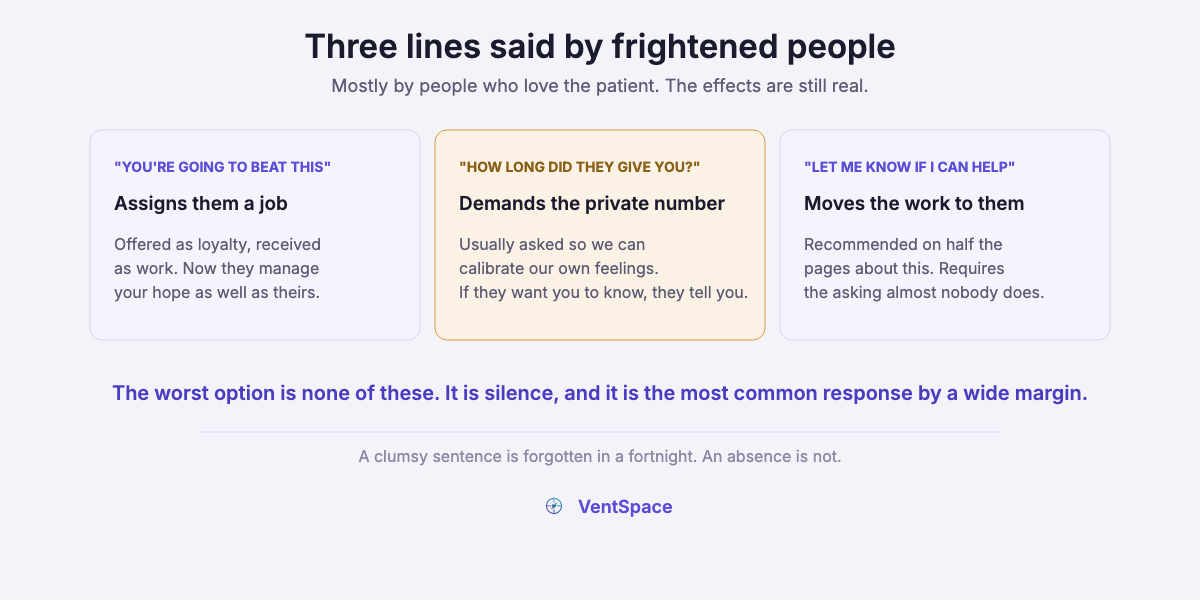
“You’re going to beat this.” It is offered as loyalty and lands as a job. The ill person now has to manage our hope in addition to their own, and if they were about to say something true they will not say it now. The version that works keeps the loyalty and drops the forecast.
“Everything happens for a reason.” This asks somebody to accept that their illness is an instrument of instruction. To a person who already believes it, it may steady them. To anyone else it converts a catastrophe into a lesson they are apparently failing to learn, and it ends the conversation.
“How long did they give you?” The question sounds like interest and functions as a demand for the most private number in their life, usually so that we can calibrate our own feelings. If they want us to know, they will tell us. The study above is also a reason to hold the figure loosely when they do.
“Let me know if there’s anything I can do.” Recommended on half the pages about this subject, and among the least useful sentences available. It transfers the work of thinking to the person with the least capacity for it, and it requires them to ask, which is hard to do. Name the specific thing instead.
“You’re so brave.” Bravery is a performance requirement, and it has a failure mode built in. A person praised for courage cannot later admit they are terrified without feeling they have let somebody down.
None of this is an argument for silence. Silence is worse than all five. A clumsy sentence is forgotten in a fortnight. An absence is not.
Quick Summary
Q: What should you not say to someone who is dying?
A: Anything that assigns them a job: to fight, to be brave, to find the meaning, or to tell you their prognosis. And avoid the open offer of help, which sounds generous and moves the work of asking onto the person least able to do it. Name a specific thing you will do instead.
The first weeks, when the words have arrived and the meaning has not
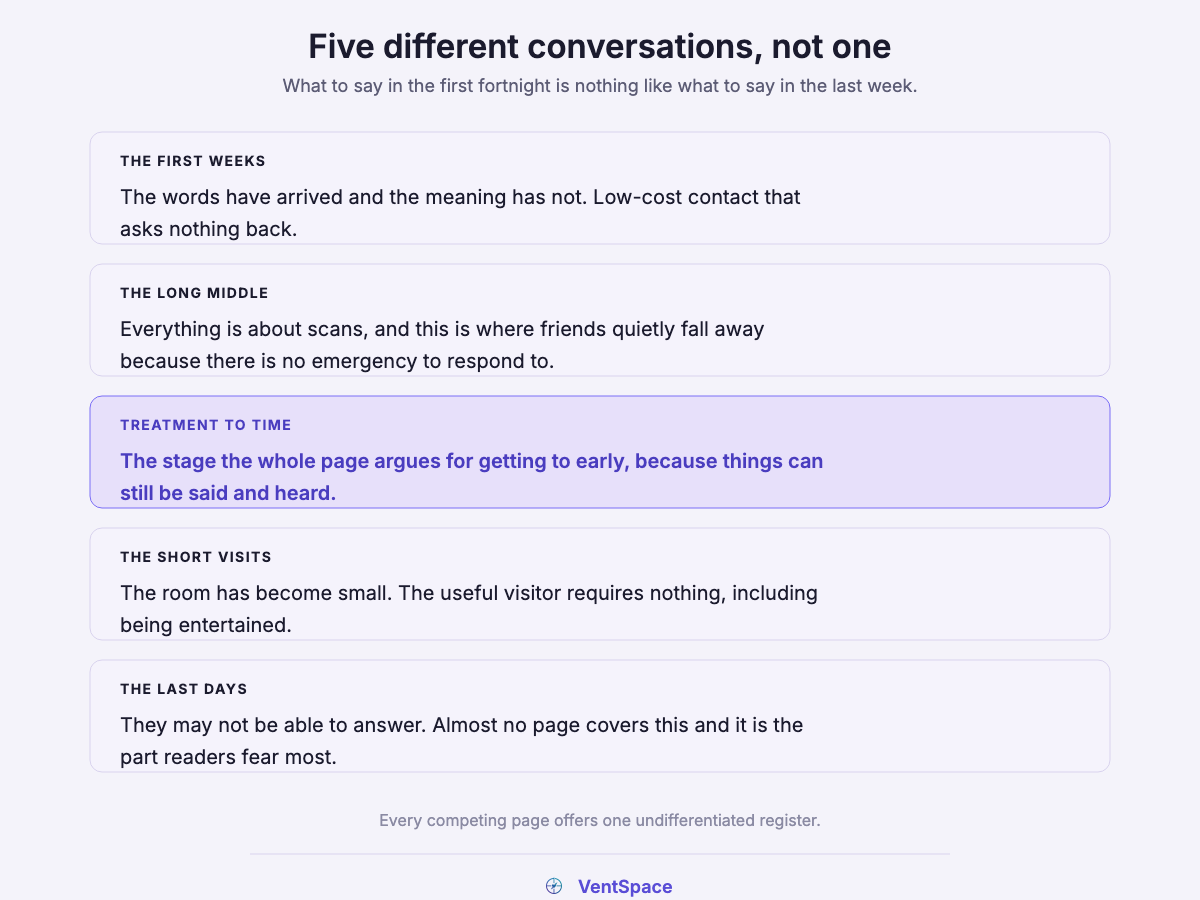
At this point the diagnosis is a set of terms rather than a fact. There is a great deal of information and almost no comprehension, and the person is spending most of their energy managing other people’s reactions to news they have not absorbed themselves. What helps here is low-cost contact that asks nothing back.
1.“I heard. I don’t have anything useful to say and I didn’t want that to stop me writing.”
Why it lands: It names the absence of the right words rather than performing them, which is more honest than any composed paragraph and much easier to believe.
Not if: You are unsure whether they have told you deliberately. If the news came through somebody else, ask that person whether it is yours to know before you write.
2.“Do you want to talk about it, or would you rather I asked you about anything else at all?”
Why it lands: It hands over control at the one point where they have lost most of it, and it makes the second option properly legitimate rather than a polite fiction.
Not if: You are not prepared for the second answer. Offering the ordinary conversation and then steering back to the diagnosis is worse than never offering it.
3.“I’m not going anywhere.”
Why it lands: Friends thinning out is a real risk in this situation, and a stated intention to stay is a promise they will remember and notice you keeping.
Not if: You are not sure you can. A promise of permanence that dissolves in month four does more damage than a warm vague message.
4.“What do you actually know so far?”
Why it lands: It lets them tell it in their own order, and it does not assume they have been given clarity, which frequently they have not.
Not if: They have said they do not want to go through it again. Repeating the medical story to each new person can be one of the exhaustions of the first month.
5.“Would it help if I came over, or is the house already full of people?”
Why it lands: The second clause is the kindness. It gives them a way to say no that does not sound like rejecting you.
Not if: You are the fifth person to ask this week. In that case send food and do not require an answer.
6.“You don’t have to be positive with me.”
Why it lands: It quietly cancels the contract other people in their life may have silently signed them up to, and it tends to produce the first real conversation.
Not if: They have built their own approach around optimism and have said so. Some people need the frame and dismantling it is not a favour.
Quick Summary
Q: What do you say when someone has just been told they are dying?
A: Something short that admits you do not have the words, plus an offer they can decline without embarrassment. Do not ask for the prognosis and do not assign them a fight. The purpose of a first message is to establish that you are still here, not to say anything memorable.
The long middle, where everything is about scans
This stretch can last a long time and is where most friends quietly fall away, because there is no emergency to respond to and the person appears to be coping. The work in this stage is showing up when nothing has happened, which is unglamorous and matters more than anything said in the first fortnight.
7.“How are you, separate from the treatment?”
Why it lands: By this point every conversation they have is about a body. The question gives them back the rest of themselves for five minutes.
Not if: They are mid-cycle and feeling terrible. Then the separation is artificial and the question can sound like a refusal to hear about the thing that is happening.
8.“I’ve got nothing to report and I’m ringing anyway.”
Why it lands: It establishes that contact does not require an occasion, which is the exact belief that can make contact stop.
Not if: You then talk for forty minutes about your own week without checking. The point is that the call has no agenda, not that it has yours.
9.“Do you want to watch something terrible with me on Thursday?”
Why it lands: A concrete, low-effort, fixed-date invitation that requires nothing from them but presence. Specificity is what separates a real offer from a gesture.
Not if: Getting to you is difficult. Then the invitation has to come to them, and saying so should not be their job.
10.“What’s been the most irritating part of this week?”
Why it lands: It invites the small material indignities, the parking, the forms, the fourth person asking about diets, which are enormously present and which nobody thinks to ask about.
Not if: Something serious has just happened. Then this reads as changing the subject away from it.
11.“Do you want me to keep asking about results, or would you rather I stopped?”
Why it lands: Both preferences are common and neither is guessable, and being asked which is a relief in itself.
Not if: You are asking because you have become uncomfortable. They will hear that, and the honest version of the sentence is a different one.
12.“I told somebody your line about the parking last week. It is still the funniest thing I have heard this year.”
Why it lands: It reports that they still exist as a person in the world outside the illness, which is one of the things most at risk in this stage.
Not if: The story involves something they now find painful. Check the memory is still a good one before it is repeated.
Quick Summary
Q: How do you support someone through months of treatment?
A: By making contact that does not need an occasion and invitations that do not need energy. Ask about the parts that have nothing to do with the illness, ask whether they want to be asked about results, and keep going during the stretch when there is no news, which is when it is easiest to stop.
When the subject changes from treatment to time
At some point the conversation moves from what is being done to how long there is. This is the stage the whole page has been arguing to get to early, because it is the one in which things can still be said and heard, and because nobody reliably knows how long it lasts.
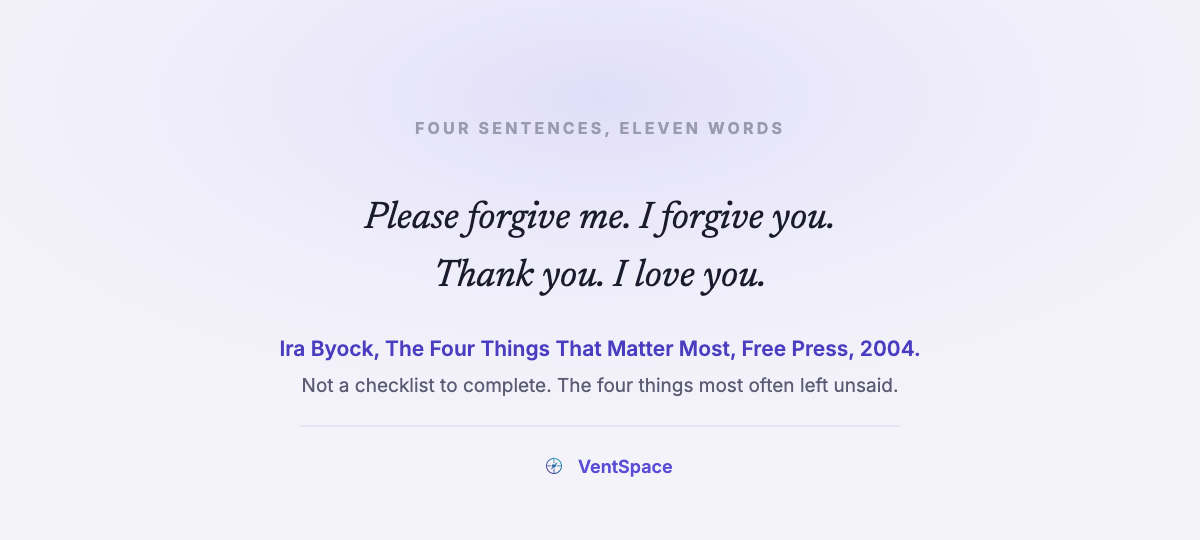
The palliative care physician Ira Byock wrote a book about the four sentences he found mattered most at this point: please forgive me, I forgive you, thank you, and I love you. They are not a checklist and they do not have to be completed. They are simply four things that often go unsaid, and any one of them said badly is worth more than all four said never.
13.“Thank you. I’ve never said it properly and I would like to.”
Why it lands: Gratitude is specific, finishable and does not require them to reciprocate. Of Byock’s four it is usually the easiest to start with.
Not if: It is a summing-up delivered as a farewell they were not expecting. Attach it to one particular thing rather than to their whole life.
14.“I love you. You don’t have to do anything with that.”
Why it lands: The second sentence removes the obligation to answer, which is what makes this sayable between people who have never said it.
Not if: It would read as a goodbye and they are not there yet. Said too much like a verdict, it can sound like being written off.
15.“Is there anything you want said to someone, that you would rather not say yourself?”
Why it lands: It offers a service that is easy not to think of and can be badly wanted, and it can be answered with a name and a sentence.
Not if: You cannot commit to doing it. This is a promise that will be remembered by more than one family.
16.“I’m sorry about the years I wasn’t in touch.”
Why it lands: It is an apology that is often needed and often avoided, and offering it without requiring absolution is what makes it bearable to receive.
Not if: You need them to forgive you before they die. If the apology is for our benefit, they will feel the weight of it and have to manage us again.
17.“Do you want to talk about what you want to happen, or would you rather do that with somebody else?”
Why it lands: Some people want this conversation and find that everyone who loves them changes the subject. The escape clause makes it safe to decline.
Not if: There is a named person or a palliative care team already holding it. Then the useful thing is to ask what they have decided, not to reopen it.
18.“If there’s something you’ve always wanted to say to me, this would be a very good time.”
Why it lands: It grants explicit permission for the difficult thing, which is otherwise almost impossible to introduce from their side.
Not if: You are not able to hear an answer you will not like. Some of what comes out here is not flattering, and reacting badly closes the door for good.
Quick Summary
Q: How do you say goodbye to someone who is dying?
A: Ira Byock’s four sentences are the best-known framework and they are short: please forgive me, I forgive you, thank you, I love you. Say whichever is true, attach it to something specific, and add that they do not have to respond. It is a set of things worth saying, not a checklist to finish.
The short visits, when the room has become small
Visits shorten. Conversation becomes intermittent, energy arrives in twenty-minute windows, and the ordinary rules of company stop applying. The useful visitor here is the one who requires nothing, including the requirement to be entertaining.
19.“I’ll stay ten minutes and then go, and I’ll come back on Tuesday.”
Why it lands: It removes the two anxieties of a visit at once: how long this will go on for, and whether there will be another one.
Not if: You then stay an hour. The value of the sentence is entirely in keeping it.
20.“Do you want the curtains open or shut?”
Why it lands: A small, answerable question about an environment they have almost no control over, and control is the commodity in shortest supply.
Not if: Asked as a substitute for anything else. As the whole of the visit it becomes a way of not being present.
21.“Shall I sit here while you sleep?”
Why it lands: It makes unconsciousness an acceptable way to spend time with somebody, which removes the pressure to stay awake and perform being visited.
Not if: There is a queue of people waiting. Occupying the chair for three hours is its own kind of taking.
22.“The hedge has gone completely mad. Nobody has touched it since April.”
Why it lands: Ordinary news from the world is more welcome than almost anybody expects, and it treats them as a participant rather than a subject.
Not if: It is used to keep the conversation shallow when they are trying to open it. Follow their lead, not your comfort.
23.“Do you want me to read to you?”
Why it lands: It offers company that costs them no energy at all, and it gives the visitor something to do with their hands and voice.
Not if: They find being read to infantilising. Ask once, and take the first answer as the answer.
24.“Is there anyone you want me to get on the phone?”
Why it lands: Arranging a call is a real, discharged task, and there is often somebody they have been meaning to speak to and cannot organise.
Not if: You are volunteering to broker a reconciliation nobody asked for. This is an offer of logistics, not of diplomacy.
Quick Summary
Q: What do you say when you visit someone in hospice?
A: Say how long you are staying and when you will come back. Ask small answerable questions about the room. Bring ordinary news from outside, offer to sit while they sleep, and do not require them to be good company. Short and repeated beats long and singular.
The last days, when they may not be able to answer
In the final stretch there may be no reply. This is the part of the whole subject people are most frightened of and the part almost no page covers, which leaves us improvising in a room where improvising is hard.
Two honest notes before the lines. We do not know what an unresponsive person hears, and anyone who tells us with confidence is going beyond the evidence. What we can say is that speaking costs nothing, and that the words are partly for us. Second, nothing on this page is a substitute for the nurses and the palliative care team in the room, who are the people to ask about anything physical.
25.“It’s me. I’m here.”
Why it lands: Identification and presence, in four words, with no demand attached. It is a natural first thing to say and it is the correct instinct.
Not if: It is followed immediately by a question. The point of the sentence is that it closes rather than opens.
26.“You don’t have to respond to any of this.”
Why it lands: It relieves a pressure that may or may not still exist, at no cost, and it relieves the same pressure in the speaker.
Not if: They are still able to talk and want to. Assuming unresponsiveness too early is its own small cruelty.
27.“Thank you. For all of it.”
Why it lands: Short, complete, and needs no reply. The compressed version of Byock’s third sentence, which may be the easiest one to manage.
Not if: You are working through a list. A recital at a bedside becomes a performance, and the room will feel it.
28.“Everyone is all right. We’re looking after each other.”
Why it lands: For many dying people the live worry is not their own death but what happens to the people around them, and this answers it directly.
Not if: It is untrue and they would know. A person who has spent fifty years reading you will read you now.
29.“I’m going to sit here for a while and not talk.”
Why it lands: It gives the silence a shape, so that it becomes company rather than an absence of conversation.
Not if: You are about to leave in four minutes. Then say that instead.
30.“You can go when you’re ready.”
Why it lands: For a person who is holding on out of a sense of obligation to the people in the room, this can be the sentence that matters most.
Not if: It arrives as a schedule. Said too early, or repeatedly, or by somebody who is exhausted and wants this over, it becomes a pressure of its own. And it is not a mechanism: dying is not something anyone chooses the hour of, and this sentence should never be offered as though it were.
Quick Summary
Q: What do you say to someone who is dying and cannot respond?
A: Identify yourself, say you are there, and say the short true things without requiring an answer. Nobody knows for certain what an unresponsive person takes in, so say it because it costs nothing and because the words are partly for you. Anything physical is a question for the nurses in the room.
If they go quiet
Messages stop being answered, and almost every friend reads that as a signal to withdraw. It very rarely is. Replying to forty people is a job, and it is the first job to be dropped. A person in the middle of treatment may also be avoiding the moment where they have to summarise their own prognosis for somebody kind.
So the move is to keep sending things that need no answer. Photographs. One-line reports of nothing. A message that says explicitly that no reply is expected. Remove the question mark, which is the thing that turns a message into a task.
Two exceptions. If the silence is total and nobody in the wider circle is hearing anything either, contact the household rather than the patient. And if the quiet is coming from us rather than from them, if we have been meaning to visit since spring, the whole argument of this page applies: the estimate in our heads is likely to be generous, and going late is still going.
What to do instead of speaking
Most of the useful help here is not verbal, and this is the section to act on if everything above reads as a set of tightropes.
Name the specific thing and then do it. Not “let me know if you need anything”. Say that you will take the bins out on Wednesdays, and then take the bins out on Wednesdays.
Take a job off the household permanently. The washing, the school run, the lawn, the dog. One task, owned, for as long as it lasts, is worth more than any amount of availability.
Drive. Appointments are relentless, the parking is awful, and the drive home is when people talk.
Bring food that survives a week. Something that can be frozen and reheated at two in the morning by whoever is up.
Handle the admin nobody has the stomach for. Insurance, benefits, the endless forms. Ask first, because some people want to keep this.
Send things that do not require a reply. A photograph of a place they like. A postcard. The crossword.
Look after the carer, who is usually invisible and is being asked how the patient is by every single person they meet.
Keep turning up after everyone else has become busy. The month four visitor is worth ten of the week one visitors.
Quick Summary
Q: What can you do for someone who is dying, other than visit?
A: Take one recurring task off the household and own it. Drive to appointments. Send things that need no reply. Look after the person doing the caring, who is being asked about the patient all day and about themselves by nobody. Specific beats available, every time.
If you are the one closest to it
Some readers of this page are not the visitor. They are the person who lives there.
The odd difficulty of that position is that everyone asks after the patient and nobody asks after us, and there is a strong internal argument that this is correct, because we are not the one who is dying. That argument is wrong and it is very hard to argue with from the inside. Anticipatory grief is real, exhaustion is real, and so is the resentment that arrives uninvited at four in the morning and then has to be hidden by breakfast.
If writing helps, our journal prompts for grief are built for the version of this with no conclusion in it. And if the four in the morning thought cannot be said to anybody in the house, the team already involved in this take questions from families and not only from patients.
Where this page stops
This page can improve a visit. It cannot do anything about the illness, and it is not support.
If you are in crisis or thinking about harming yourself, please contact a crisis line now. In the US you can call or text 988 for the Suicide and Crisis Lifeline. Outside the US, findahelpline.com will find the equivalent where you are.
The real support here is already attached to the person who is ill. Palliative care and hospice teams include social workers, counsellors and nurses whose work explicitly covers the family and the friends, and they are easy to overlook if you assume the service is for the patient alone. Asking them what to expect, and what to say, is a normal request and they will not find it strange. In the UK, Marie Curie publishes the most useful article on this subject that this page found, written by a named hospice counsellor.
Therapy and bereavement counselling are legitimate options, before as well as after. Grief that starts while the person is still alive is well described and is not a sign of disloyalty.
Questions people ask
What do you say to someone who is dying?
Something short, true and early. “I heard. I don’t have the words and I didn’t want that to stop me writing” is a complete message. Then go, and let them decide whether the conversation is about the illness. The thing that is remembered is that you came, not what you said when you got there.
Is it acceptable to talk about death with them?
Yes, if they open it, and it is usually a relief. When everyone who loves them changes the subject, it leaves them holding the largest fact in their life alone. The safe way in is a question with an exit in it: would you rather talk about this with me, or with somebody else.
What do you say when they can no longer reply?
Identify yourself, say you are there, say the short true things, and stop requiring an answer. Nobody can tell you with confidence what an unresponsive person takes in, and any page that does is overstating the evidence. Say it because it costs nothing and because the words are partly for you.
What do you say to the family?
Almost anything except “let me know if there’s anything I can do”. Pick the task and announce it. The household is drowning in offers and has no capacity to allocate them, so the useful friend is the one who says they will be there on Wednesday with the shopping.
How long do they have, and what about the stages of grief?
Nobody can tell you the first, and this page will not give you a number. The 2000 study above found that even doctors at the point of hospice referral got it right only a fifth of the time and were wrong in the optimistic direction, more so the better they knew the patient. As for the second, the five stages were derived from Elisabeth Kübler-Ross’s 1969 work with dying patients, which is at least the right population. She extended them to families herself, and they were never tested in bereaved people before being taught as a sequence. As a description of how anybody ought to proceed, the model is contested. Reviewing the evidence in 2017, Stroebe, Schut and Boerner found it lacking empirical support and concluded it should be discarded, warning that the expectation that people will, or should, move through stages can harm those who do not. There is no sequence to be on schedule with.
Related. For what comes after, Grief vs Sadness.
Two things worth keeping
Say the plain version now. The four sentences Byock names are short on purpose, and a clumsy version of one of them, delivered in March, outperforms the composed version that never gets delivered at all.
And assume there is less time than it looks. That is not pessimism. It is the finding, and the people who love the patient are the most likely of anyone to get it wrong in the other direction.
If someone you love is dying, you are carrying something heavy, and you do not have to carry it well. If writing some of it down would help, VentSpace, the journaling app we make, is a quiet place to do it. If you are on a computer, VentSpace Live runs in your browser, with nothing to install.
About this article

Written by
Sai Subramaniam
Founder, VentSpace
I write these guides because I have been where you are. I am working through my own hard seasons, and I share the things that actually helped me, so that anyone going through it has something steady to read instead of facing it alone. No ads, no affiliate links, and nothing here is a sales pitch.
This writing is honest and every claim is sourced, and it is not a substitute for professional care, bereavement support or medical advice. If this is heavy right now, the numbers above are a better answer than anything else on this page.
How this one was checked. Every factual claim traces to a named source, and the source is printed next to the claim rather than kept in a footnote. Where a widely repeated claim could not be traced, it was left out and the omission recorded. Where a figure is contested, both sides are printed.
No affiliate links, no paid placements, and nobody paid to appear here. Our own app appears once, in a short note at the end and nowhere near the support numbers, because a page about a death is not a place to sell anything.
Reviewed: October 2026. Anything we could not verify at the time of writing is marked as unverified rather than turned into a number.
Corrections. If something here is wrong, we would rather know. Corrections are made in place, with a note saying what changed. Updated 15 October 2026: the crisis numbers now also appear near the top, the Kübler-Ross attribution was corrected, a few unsourced lines about what families and patients report were cut or softened, a word count was fixed, an unrelated link was removed, and a short closing note about our journaling app was added.