
If you had Youper on your phone, the useful part of this page is the first paragraph and the rest can wait.
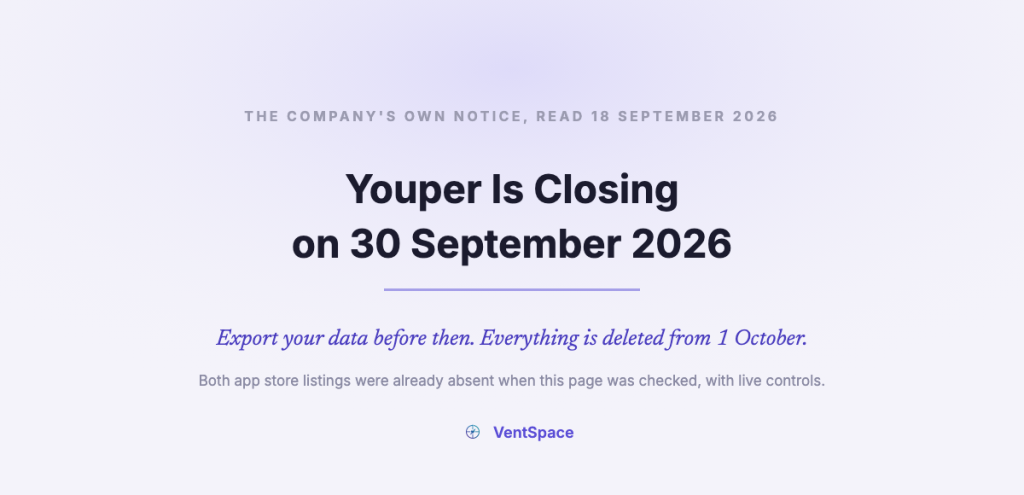
Youper has closed. Its notice, in its own words, read on 18 September 2026: “Youper, Inc. is closing and winding down its business. All services will end on September 30, 2026.” The same notice said that from 1 October, all accounts, chat histories and personal information would be permanently deleted from its servers and its backups. That date has passed, so if you did not export your conversations, they are very likely gone.
If you came here because a list recommended it, that list has not been re-checked. And if you came here because you already knew, one short question before the practical part. What were you using it for?
What happened on 30 September, and what is left to do
The export window has closed. This is what the company’s notice said, kept here as a record, and the one or two things still worth doing.
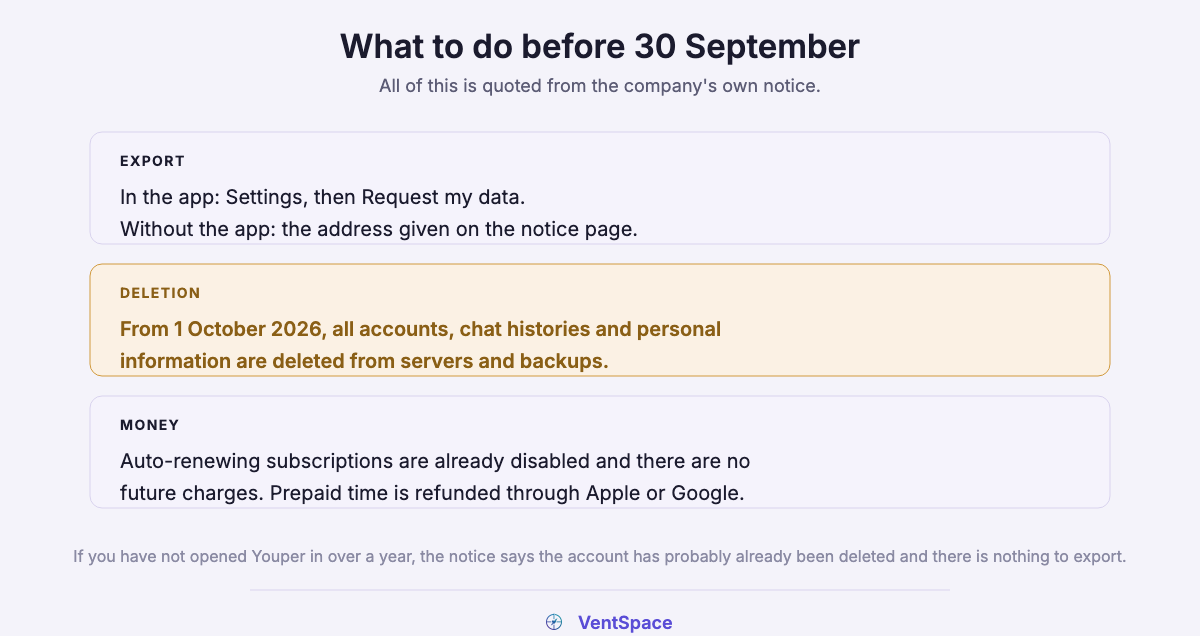
- The export route: while the service ran, the notice gave Settings, then “Request my data”, or the address `start.youper.ai/export-data`. With services ended and deletion under way from 1 October, we do not expect either to work now, and we have not tested them.
- If you exported in time: keep the file somewhere that is not an app, such as a folder on a computer or a printed copy.
- On money: the notice stated that all auto-renewing subscriptions were disabled and that there would be no future charges. Prepaid time is refunded through Google Play or Apple, which handle it differently, and the notice said affected users would receive an email. If you were charged after 30 September, raise it with the store you paid through.
- On where your data went: the notice said plainly that it would not be sold or transferred to any other company.
A word about what the export is worth. A file of your own chat history is not a keepsake for most people and it is not nothing either. Would you read it back? Probably not for a year. But a record of what you were worried about in a hard month is the kind of thing that turns out to matter later, which is why, if you did get a copy out, it is worth keeping somewhere that does not depend on any company.
One thing this page did not test. No account was created here, so we reported the route the company published rather than confirming that it worked. The notice gave an address, `hello@youper.ai`, for queries before the closing date. We do not know whether it is still answered.
Quick Digest
Youper closed on 30 September 2026, by its own notice, read 18 September 2026.
All data was set to be deleted from 1 October, servers and backups, and not sold or transferred.
The export window has closed, so the export route in the notice should not be relied on now.
Both app store listings were already gone, verified here with live controls twelve days before the closing date.
Subscriptions were stopped. Refunds run through Apple or Google, not through Youper.
Six alternatives below, each loaded and checked on 18 September 2026, chosen by what you were using Youper for.
Quick Summary
Q: Has Youper shut down?
A: Yes. Youper, Inc. published a notice saying it was closing and winding down its business, with all services ending on 30 September 2026 and all user data deleted from 1 October. Both app store listings were already absent when this was checked on 18 September 2026. The export window closed with the service.
What Youper was
Youper was a conversational agent you typed to, and it deserves describing properly rather than in the past tense of a eulogy. Its own site described it, when we read it on 18 September 2026, as an application that uses conversational techniques to help you track your mood, reflect on how you are doing, and organise your thoughts in a journal. In practice you opened it, it asked how you were, and it walked you through a short structured exchange drawn from cognitive behavioural therapy: what happened, what you thought, what the thought was doing, what else might be true.
It was unusually honest about what it was, and this is the part worth carrying forward into whatever you choose next. Its published disclosures say that it is powered entirely by artificial intelligence, that you are not talking to a human, and that no response has been reviewed by a licensed professional. They say it does not provide medical advice, diagnosis or treatment, that it is not a medical device and has not been cleared or approved by the US Food and Drug Administration, and that it is intended for people aged eighteen and over. Its crisis section names 988 and the Crisis Text Line and states outright that it cannot provide crisis intervention.
How many products in this category tell you all of that on the front page? Few, and it is a reasonable thing to go looking for in a replacement.
So why did people like it? Because it was there at one in the morning, because it asked a sequence of questions rather than offering a slogan, and because typing something to a thing that responds is a different act from typing it into a box that does not. That last difference is real and it is the one people are going to miss.
Quick Summary
Q: What was the Youper app?
A: A self-guided conversational app, made by Youper, Inc. of San Francisco, that used artificial intelligence and cognitive behavioural therapy techniques to walk users through short structured exchanges about mood and thoughts. Its own disclosures stated that it was entirely AI, not reviewed by a licensed professional, not an FDA-cleared device, and not a substitute for care.
What the evidence actually said
Youper is one of the few apps in this category with a peer-reviewed paper attached to it, and it is worth reading properly, because the roundups quote half of it.
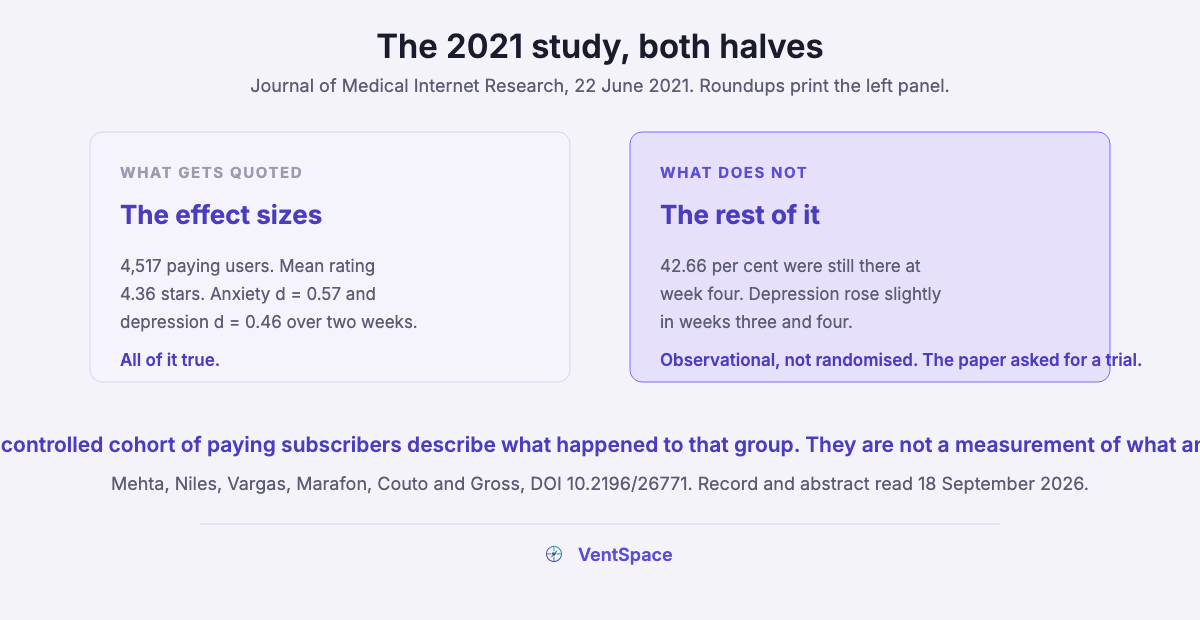
The study is Mehta, Niles, Vargas, Marafon, Couto and Gross, in the Journal of Medical Internet Research, 22 June 2021. It looked at 4,517 paying Youper users who allowed their data to be used for research. Users rated the app 4.36 stars on average. Over the first two weeks, anxiety symptoms fell with an effect size of d = 0.57 and depression symptoms with d = 0.46.
Now the half that almost never gets quoted, and it is in the same abstract. By week four, 42.66% of those users were still there. Fifty-seven per cent were not. And in weeks three and four, while the anxiety improvement held, depression symptoms rose slightly again, at d = 0.05.
The design matters as much as the numbers. This was a longitudinal observational study of the company’s own paying subscribers, not a randomised trial, and the paper says so itself: its conclusion calls for continued study in a randomised clinical trial. Three of the six authors also appear on an earlier feasibility paper about the same product, which is normal in this field and is worth knowing when you read an effect size. None of that makes the study worthless. It makes it a description of what happened to a group of paying users rather than a measurement of what the app does to a person.
Why spend three paragraphs on this when the product has closed? Because the next app you install will quote a number at you, and the shape of the question is always the same. Who was in the study, compared to what, and how many of them were still there a month later?
Quick Summary
Q: Did Youper work?
A: A 2021 study in the Journal of Medical Internet Research found reductions in anxiety and depression symptoms over two weeks among 4,517 paying users, with effect sizes of 0.57 and 0.46. The same study found that under 43% were still using it by week four and that depression symptoms rose slightly in weeks three and four. It was observational rather than randomised, and its own conclusion called for a randomised trial.
Insight: what the paper asked for, in its own words
The 2021 study’s conclusion describes Youper as a low-cost, completely self-guided treatment accessible to users who may not otherwise reach mental health care, and says its findings “support continued study of Youper in a randomized clinical trial.”
Source: Mehta, Niles, Vargas, Marafon, Couto and Gross, Journal of Medical Internet Research, 22 June 2021, DOI 10.2196/26771. Bibliographic record and registered abstract read 18 September 2026. The randomised trial the paper asks for is not something this page could find, and the company has now closed.
Why half the internet still recommends it
This is the section no competing page can write, and it is the reason this one exists. On the day this was written, twelve days before the closure date, page one for this app’s name carried several roundups of the best mental health and AI therapy apps, all describing Youper in the present tense. Some print a monthly price. Some link to store pages that no longer resolve. None of them mentions the notice sitting on the company’s own home page.
None of that is dishonest and most of it is not even careless. A roundup is written once, gets edited, and the edit date goes on the page. What does an edit date tell you? That somebody changed something. It does not tell you that anybody re-opened the store listing.
This has bitten this site too, which is why the rule here is written down. A previously published article on this site recommended an app that was no longer in either store, sourced from a review page carrying a current year in its title. It was corrected in place. A date on a page tells you when it was touched. Only a store listing tells you whether the app is there.
Quick Summary
Q: Why do review sites still recommend Youper?
A: Because roundups are edited rather than re-verified. On 18 September 2026, several pages ranking for this app described it in the present tense, some with prices, while the company’s own home page carried a closure notice. A current year in a page’s title is not evidence that anything on it was re-checked.
What you were using it for
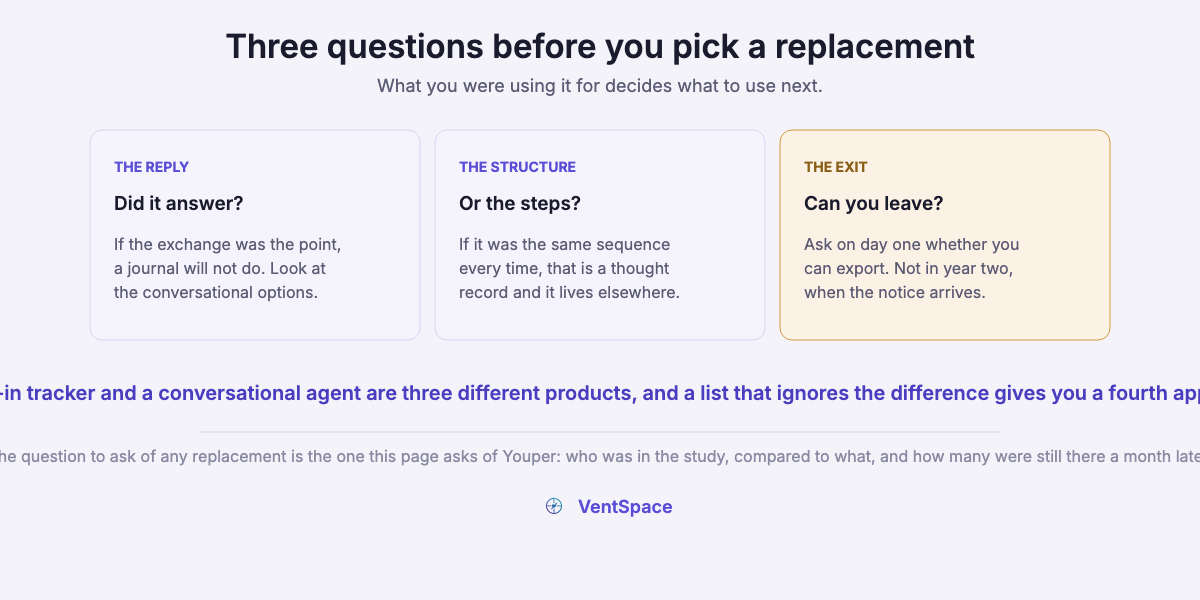
Before any replacement, the honest question: what was it doing for you? Five reasons someone might have kept Youper, and they need different answers. A list that ignores the difference is how you end up with a fourth app you do not open.
Answer these for yourself before reading on.
- Was it the conversation, something that replied rather than a blank box?
- Was it the structure, the same sequence of questions every time?
- Was it the hour, that it was there at one in the morning and nobody else was?
- Was it the record, a history of how the months went?
- Was it the privacy, saying a thing out loud to something that was not a person in your life?
1. It replied to you. This is the one with the fewest good answers and it should be said first. A journal does not reply.
This week: if it was the reply you valued, look at the conversational options below rather than the writing ones, and read their disclosure pages before you type anything real into them.
2. It walked you through the same steps. The structure did the thinking about how to think, which is most of what a thought record is.
This week: try one thought record on something small. Not the big thing. The big thing needs practice first.
3. It was there at one in the morning. No appointment, no person to inconvenience.
This week: whatever you pick, check that it works offline and with no signal, because that is the hour it will be needed.
4. You wanted the record. Six months of check-ins is a different thing from a memory of how six months went.
This week: export the Youper history first, then choose something that lets you export from the start. Ask that question on day one, not in year two.
5. You did not want to say it to anyone you know. This is a legitimate reason.
This week: the section below on where none of this helps is written for you, and it is worth reading before you refill the slot.
Quick Summary
Q: What might people have used Youper for?
A: Often, it seems, for a structured conversation available at any hour, and for the sense of saying something to a thing that answers. Which of those you valued decides what to replace it with, because a journal, a check-in tracker and a conversational agent are three different products.
Where none of this will help
A self-guided tool is practice, and practice has a ceiling. Youper said so itself, on its own site, in language plainer than most of its competitors use. The thing that closed was never a clinician, and whatever replaces it will not be one either.
Four situations where the right answer is a person rather than another download. Read them as questions about your own month.
- Has the low stretch been going on for weeks without lifting, whatever you type in the evening?
- Was this app the only thing standing between you and a bad night?
- Is the actual problem a job, a relationship or a loss, which no exchange of messages contains?
- Are you looking for a replacement mainly so that you do not have to notice how much you were relying on one?
If any of those landed, the useful next step is a conversation rather than an install. Therapy is one option here, and it may well be the right one for you. Losing a tool you used every day is a reasonable moment to find out what a trained person would make of the same few months. Nothing on this page is a substitute for that, ours included.
If this is heavier than a closing app
If you are in crisis or thinking about harming yourself, please contact a crisis line now rather than looking for an app. In the US you can call or text 988 for the Suicide and Crisis Lifeline. Outside the US, findahelpline.com will find the service where you are. No self-guided tool can assess risk, and none of them is a substitute for a person.
Quick Summary
Q: Can an AI app replace therapy?
A: No, and Youper’s own disclosures said so: entirely AI, no response reviewed by a licensed professional, no medical advice, diagnosis or treatment, and not an FDA-cleared device. A self-guided tool can support the gaps between appointments. If low mood has persisted for weeks, that belongs with a professional.
What to use instead
So what now? Six options, each one loaded and checked on 18 September 2026, which on this topic is not a formality. No price appears below. Several apps in this category have opaque or shifting in-app pricing, and a figure printed here in September is a liability in November. Every one of these is free to begin, and the number should be read on the vendor’s own page on the day you buy.
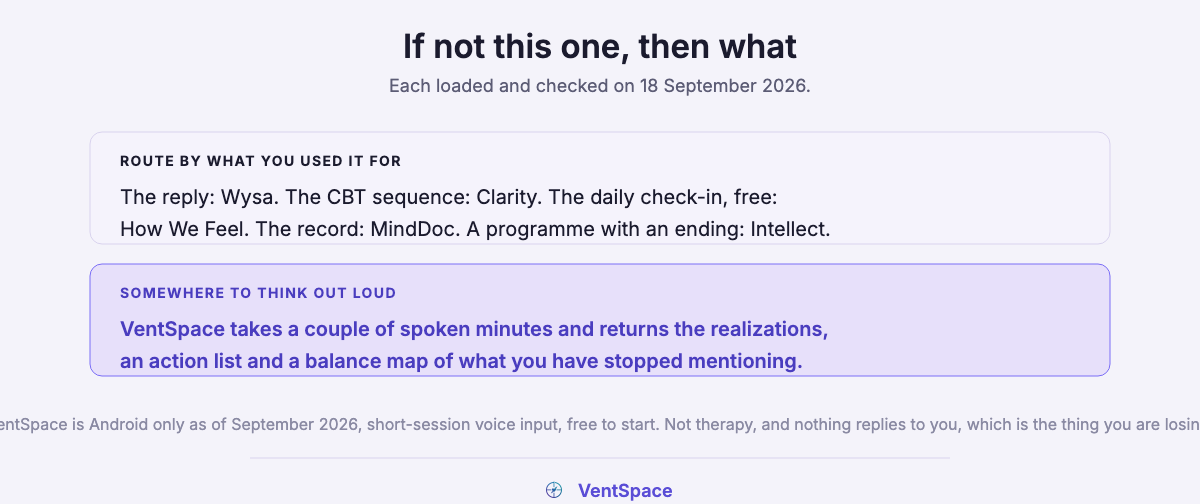
Wysa. The closest live thing to what Youper was: a conversational agent with structured exercises behind it, from Touchkin eServices. Updated 16 September 2026.
Who it suits better: anyone whose answer to the question above was the reply.
The watch-out: it is a different personality and a different pace, and the first week will feel like talking to a stranger, because it is.
Clarity: CBT Self Help Journal. Thought records as the whole product rather than one feature, from Inquiry Health LLC. Updated 13 September 2026.
Who it suits better: anyone who used Youper mainly for the structured sequence.
The watch-out: nothing replies. It is a form, and a good one, and it is a form.
How We Feel. Free, from a non-profit, built with Yale’s Center for Emotional Intelligence to widen the vocabulary you have for what you are feeling. Updated 18 September 2026 on Google Play.
Who it suits better: anyone who mostly wanted the daily check-in and a record.
The watch-out: no conversation at all, and it is deliberately light on analysis.
MindDoc. Structured monitoring with a more clinical feel, from MindDoc Health GmbH. Updated 7 September 2026.
Who it suits better: anyone who valued the record more than the exchange.
The watch-out: it is not playful and some people find the register heavy.
Intellect. Structured self-guided programmes with a beginning and an end. Updated 9 September 2026.
Who it suits better: anyone who wanted the sequence to go somewhere rather than repeat.
The watch-out: it asks more of you per session than Youper did.
VentSpace. In this list for one of the five reasons above and not the others. If what you will miss is having somewhere to put the day that is not a person in your life, you write for a couple of minutes and it turns that into a clear read on your life balance, with the realizations in what you wrote, an action list of what you seem to want to do about it, and a balance map of which parts of your life you have been mentioning and which have gone quiet.
Who it suits better: anyone who used Youper as a place to think out loud rather than for the exchange itself.
The watch-outs, and there are four: it is Android only as of September 2026, voice input is short-session rather than long dictation, it is not therapy and not treatment, and nothing replies to you, which is precisely the thing you are losing. Free to start. And one more, which belongs on this page more than on any other: VentSpace is a small product and could one day publish a notice of its own. Not on Android, or at a desk? VentSpace Live runs in your browser, free, with nothing to install. Everything below about not betting a routine on a single company applies to us.
| Tool | Shape | Platforms | Verified live | Best for |
|---|---|---|---|---|
| Wysa | Conversational agent | iOS, Android | 16 Sept 2026 | When the reply was the point |
| Clarity | CBT thought records | iOS, Android | 13 Sept 2026 | The structured sequence, on its own |
| How We Feel | Free emotion check-in | iOS, Android | 18 Sept 2026 | The daily habit, at no cost |
| MindDoc | Structured monitoring | iOS, Android | 7 Sept 2026 | When the record mattered most |
| Intellect | Guided programmes | iOS, Android | 9 Sept 2026 | Wanting it to go somewhere |
| VentSpace | Journaling app | Android only | 18 Sept 2026 | Somewhere to write it down |
One more option, and somebody should say it. You could not replace it at all. Was it relief you felt when you opened it, or obligation? If it was obligation, a company’s closure has handed you a decision you were never going to make yourself, and taking it is a legitimate outcome.
Quick Summary
Q: What is the best alternative to Youper?
A: Wysa is the closest live equivalent as a conversational agent. Clarity suits anyone who used Youper for the CBT sequence, How We Feel is free and suits the daily check-in, MindDoc suits the record, and Intellect suits anyone who wanted a programme with an ending. All were verified live on 18 September 2026.
Questions people ask
Has Youper actually shut down?
Yes. The phrase is the company’s own. Its notice reads: “Youper, Inc. is closing and winding down its business. All services will end on September 30, 2026.” A banner carrying the same line sat across its home page, read on 18 September 2026. Both app store listings were already absent when this page was checked, with live controls run first.
How do I get my data out?
Probably not any more. While the service ran, the route was the app’s Settings, then “Request my data”. If the app is no longer installed, the notice gave the address `start.youper.ai/export-data`, which was live on 18 September 2026. Deletion was set to begin on 1 October, so we do not expect either route to work now. If you have not opened the app in more than a year, the notice said the account had probably already been deleted.
Will I be refunded?
The notice says all auto-renewing subscriptions have been disabled and that there will be no future charges. For prepaid time still outstanding, it says an email will explain the route, which differs depending on whether you bought through Google Play or through Apple. The refund runs through the store, not through Youper.
Was Youper any good?
This is the question the roundups answer badly. There is a peer-reviewed study behind it, from 2021, showing symptom reductions over two weeks in a group of 4,517 paying users. The same study shows that fewer than 43% of those users were still there at week four, that depression symptoms ticked up again in weeks three and four, and that the design was observational rather than randomised. Both halves are true and neither on its own is an answer.
Why do so many pages still recommend it?
Because pages get edited rather than re-checked, and the edit date is what gets published. Several roundups ranking for this app on 18 September 2026 described it as available, some with a price attached, while the closure notice sat on the company’s own front page. If you are choosing any app from any list, open the store listing yourself. It takes fifteen seconds.
Can I still use it?
No. The notice said all services ended on 30 September 2026. There is no listing left to install from, and a copy from a third-party mirror would have no updates, no security fixes and no server to talk to. It is not worth it, and for a product you typed your worst evenings into, an unofficial build is the last thing you want.
What this is worth knowing for
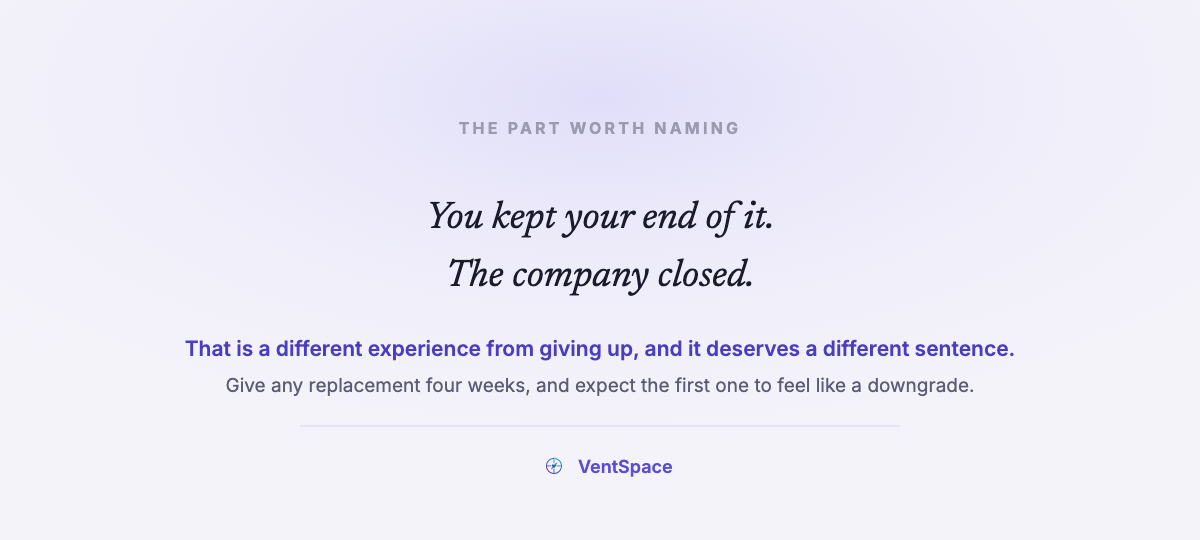
There is an inversion here worth noticing. In our own logged research on why people stop using tools like this, almost every line is somebody blaming themselves for inconsistency. Downloaded five apps, abandoned all five. This time it was not you. You kept your end of it and the company closed, which is a different experience and deserves naming rather than being absorbed into the usual self-criticism.
The practical half is three questions to ask before the next one gets a slot in your week. Can you get your data out, and have you checked on day one rather than year two? Is the practice separable from the product, so that a thought record or a daily check-in survives the company that hosted it? And who is paying for this, because a product that is free to you is being paid for by somebody, and that somebody can stop.
The honest timeline. Anything you pick now will feel wrong for about a fortnight, because you are not comparing it to nothing, you are comparing it to something you had built a habit around. Give a replacement four weeks before judging it, and expect the first week to feel like a downgrade whatever you choose. And if you can, write down somewhere that is not an app the two or three things you kept going back to. Ten minutes, once, and the next company winding down does not take them with it.
About this article

Written by
Sai Subramaniam
Founder, VentSpace
I write these guides because I have been where you are. I am working through my own hard seasons, and I share the things that actually helped me, so that anyone going through it has a steady companion close by instead of facing it alone. VentSpace is the app I built for exactly that: a journaling app that turns what you write into a clear read on your life balance, plus small, doable next steps toward feeling more like yourself.
This writing is honest and every claim is sourced, and it is not a substitute for professional care. If you are struggling, reaching out to a professional is a strong move, not a failure.
Explore VentSpaceTry VentSpace LiveHow this one was checked. Every factual claim traces to a named source, and the source is printed next to the claim rather than kept in a footnote. Quotes are pinned to the work they come from, with the year, the letter or the chapter where one exists. Where a widely repeated claim could not be traced, it was left out and the omission recorded. Where a figure is contested, both sides are printed.
No affiliate links, no paid placements, and nobody paid to appear here. Where we mention our own app, we say that it is ours, we state its limits, and we never position it as a substitute for care.
Reviewed: October 2026. Prices, platforms and product availability move quickly, and anything we could not verify at the time of writing is marked as unverified rather than turned into a number.
Corrections. If something here is wrong, we would rather know. Corrections are made in place, with a note saying what changed. Updated 15 October 2026: Youper closed on 30 September, so the page now describes the closure, the export window and the deletion date in the past tense, the VentSpace description was corrected to a journaling app, and an off-topic link and a duplicate app link were removed.