
It is one of the more disorienting features of this market that five genuinely different services are sold under a single word, at roughly the same price, on pages that use the same three photographs of a person on a sofa.
You have five tabs open, and there is no way, from any of them, to work out what you would be buying. That is not carelessness on our part. The distinction has simply never been commercially useful to the people writing those pages, so nobody has drawn it, and the confusion that follows is a property of the market rather than a defect in the person trying to read it.
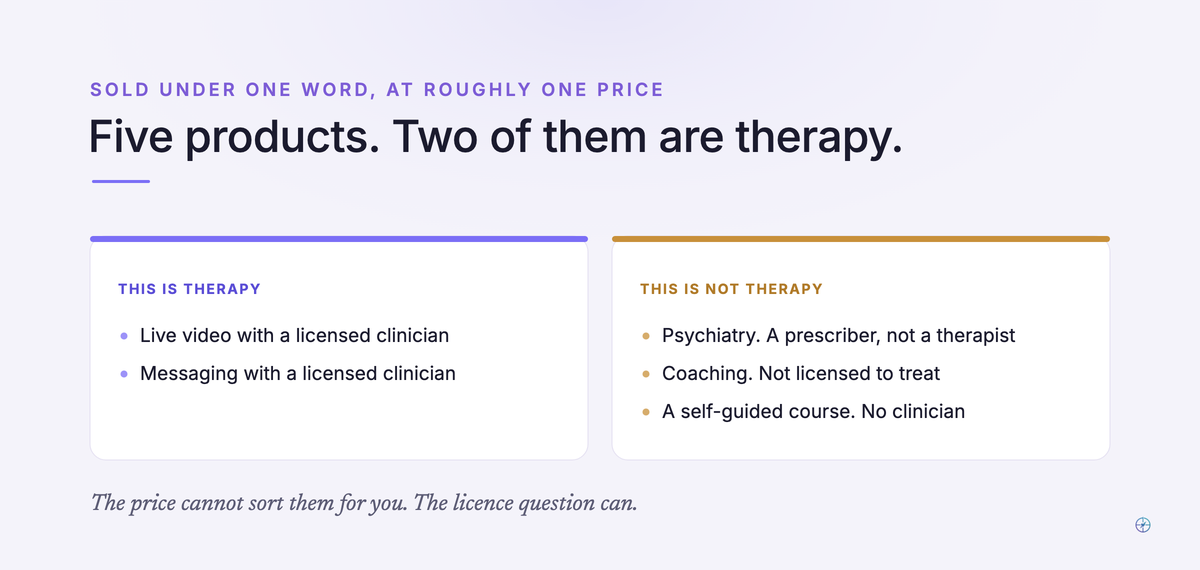
One of those five is live video with a clinician licensed in your state. One is somebody typing back to you within a day. One is a prescriber, which is a different profession. One is coaching, which is a real service and is not therapy. One is a self-guided programme, which has no clinician in it at all.
And before any of that, the thing every page like this leaves until the end, if it says it at all. For some people the cheaper and better option is a local clinician on insurance, or a community mental health centre, or a university clinic. It is worth an afternoon of phone calls before it is worth a subscription.
If you need someone tonight
None of the platforms on this page is a crisis service, and most of them say so in their own terms and conditions.
988 Suicide & Crisis Lifeline. Call or text 988 in the US, free and confidential, any hour.
findahelpline.com. The local equivalent in most other countries.
The short version
Five products, one word. Live video with a licensed clinician, asynchronous messaging, psychiatry, coaching, self-guided programmes. Only the first two involve a clinician treating you, and only one of them is what the research covers.
The efficacy evidence attaches to live video. Video psychotherapy against face-to-face shows broadly comparable outcomes. That does not transfer to messaging, coaching or courses.
You can verify a licence yourself. Ask for the clinician’s full name and licence type before the first paid session, then check your state board’s public register.
Two completed regulator actions are public record, and both concern data and billing practices rather than the quality of anyone’s clinical care.
“Unlimited” describes what you can send, not what you receive.
An app is often not the cheapest route. Insurance, community clinics and sliding-scale places usually are.
Disclosure, where you can see it. We take no affiliate commissions, nobody paid to appear here, and we do not sell therapy. On this particular search results page that is a real difference rather than a formality. We are also not clinicians, and nothing here is clinical advice.
Five products, one word
Only two of the five involve a licensed clinician treating you, and the price does not tell you which one you are buying. That is the whole problem this page exists to solve.
Start with the definition, because everything else depends on it. Therapy, in the sense that matters when you are entering a card number, is treatment delivered by a person licensed to provide it in your state. Coaching is not that. A self-guided programme is not that. Neither of those is a criticism, and both are legitimate things to buy. They are different purchases, and you are entitled to know which one you are making.
| What it is | What you actually get | Rough cost | Is this therapy? |
|---|---|---|---|
| Live video with a licensed clinician | Scheduled sessions on video with someone licensed in your state, usually weekly | Weekly subscription or per-session [unverified] | Yes |
| Asynchronous messaging with a clinician | You write, a licensed clinician writes back, usually within a day or so | Weekly subscription [unverified] | Yes, and a different modality |
| Psychiatry and medication management | Appointments with a prescriber, who is a physician or a psychiatric prescriber | Per appointment or monthly [unverified] | No. It is a different service |
| Coaching | Structured conversations with someone who is not licensed to treat a mental health condition | Often similar to therapy pricing [unverified] | No |
| Self-guided programmes | A course you work through, sometimes with prompts or check-ins | Subscription [unverified] | No |
Two of those rows will connect you to somebody licensed. Three will not. All five are sold in the same aisle, in similar language, at prices close enough that the price cannot sort them for you.
Quick Summary: are all therapy apps the same thing
Q: Are therapy apps all the same thing?
A: No, and the price will not tell you the difference. Five distinct products are sold under one word: live video with a licensed clinician, asynchronous messaging with a clinician, psychiatry and medication management, coaching, and self-guided programmes. Only the first two involve a licensed clinician treating you. Coaching and courses are legitimate products and neither is therapy.
Insight: what "therapy" means for this purchase
Therapy here means treatment delivered by someone licensed to provide it in your state. Licences are issued state by state, which is why every platform asks where you live before it shows you anyone. A coach is not licensed to treat a mental health condition, and a self-guided programme has no clinician in it at all. Both can be useful. Neither is the thing the word therapy usually promises.
Does online therapy actually work?
For live video with a licensed clinician, the evidence is genuinely reassuring. For the other four products, it has not been tested the same way. Those two sentences have to travel together, and almost no page in this category prints the second one.
A recent systematic review and multilevel meta-analysis comparing synchronous video-based psychotherapy with face-to-face psychotherapy across mental disorders reported outcomes broadly comparable, with no important difference between remote and in-person delivery for anxiety, depression, obsessive-compulsive disorder and panic disorder (Journal of Medical Internet Research, 2026).
One objection to that is not about outcomes at all. It is that you cannot build a relationship with someone through a screen. That objection has been directly tested: Seuling, Fendel, Spille, Göritz and Schmidt (2024), in the Journal of Telemedicine and Telecare, published a systematic review and meta-analysis of therapeutic alliance in videoconferencing psychotherapy compared with in-person psychotherapy. It is worth knowing the comparison exists rather than treating the objection as self-evidently true.
Now the rule that governs this entire page. That evidence attaches to one of the five products. It describes live video sessions with a licensed clinician. It does not extend to asynchronous messaging, to coaching, or to self-guided programmes, each of which is a different intervention with a different and generally thinner evidence base.
This matters because those four products are frequently sold on the same website, in the same checkout, at a similar price, next to a sentence about research showing online therapy works. The sentence is true about the product it describes, and it is not true about the thing in your basket.
So: online therapy is not automatically a lesser version of therapy. For video with a clinician, that belief is not supported by the comparison studies. For everything sold beside it, the honest position is that nobody has run the equivalent comparison, and you should price it accordingly.
Quick Summary: does online therapy actually work
Q: Does online therapy actually work?
A: For live video with a licensed clinician, yes, and comparably to in-person therapy. A systematic review and multilevel meta-analysis found no important difference between video and face-to-face delivery for anxiety, depression, OCD and panic disorder (JMIR, 2026), and therapeutic alliance in videoconferencing has been directly compared with in-person alliance (Seuling et al., 2024). That evidence does not transfer to messaging, coaching or self-guided programmes, which are different products.
Insight: what the evidence is attached to
The comparison studies enrolled people receiving scheduled psychotherapy from licensed clinicians, delivered by video instead of in a room. That is the intervention that was tested. Reading a research claim off a homepage and applying it to whatever is in the checkout is the most common error a buyer makes in this category, and it is an error the marketing rarely goes out of its way to prevent.
What “licensed” means, and how to check it yourself
Ask for the clinician’s full name and licence type before the first paid session, then verify it with your state’s licensing board. That single habit is the most useful thing on this page, and it works regardless of which platform you choose.
In the US, therapy is delivered by clinicians holding state-issued licences. The common ones you will see are LCSW (licensed clinical social worker), LPC or LMHC (licensed professional counselor, or licensed mental health counselor, depending on the state), LMFT (licensed marriage and family therapist), and licensure as a psychologist. Psychiatrists are physicians, and they are the only group in this list who prescribe.
Licences are state-specific. That is the reason every platform asks where you live before it will show you anyone, and it is also why a therapist you liked can become unavailable if you move.
Every state board maintains a public register of who holds a licence. You are entitled to the clinician’s full name and licence type, and looking it up takes a few minutes. We are deliberately not printing a lookup URL or a state-by-state mapping of titles here, because boards and titles differ and a wrong pointer is worse than none. Search for your own state’s licensing board for the profession in question, and use its own register.
None of this implies that any particular platform’s clinicians are not licensed. It is that verification is available to you, it is free, and almost nobody mentions it.
Quick Summary: are therapy app counsellors real therapists
Q: Are therapy app counsellors real licensed therapists?
A: On the platforms that sell therapy, they hold state licences, and you can check. The common US licence types are LCSW, LPC or LMHC, LMFT, and licensed psychologist, with psychiatrists as physicians who prescribe. Licences are state-specific. Ask the platform for your clinician’s full name and licence type before the first paid session, then look them up on your state board’s public register. Coaches are not licensed to treat a mental health condition, which is why knowing which product you bought matters.
Insight: why the state question is asked first
Every platform in this category asks for your state before it shows you a single face. That is not a marketing funnel step. A clinical licence is issued by a state and is valid in that state, so the pool of people who can legally treat you is set by where you are sitting. It is also the reason platforms describe therapist availability differently in different places, and a fair question to ask before you pay is how many clinicians they currently have licensed in yours.
What regulators have actually done
Two completed regulatory actions in this space are matters of public record, and they belong on a page where the reader is about to hand over health-questionnaire answers and a card number.
Both concern data and billing practices. Neither is a judgement about the quality of anyone’s clinical care, and nothing below should be read as one.
The Federal Trade Commission and BetterHelp. The FTC’s order received final approval on 14 July 2023. It bans BetterHelp from disclosing sensitive health data for advertising purposes and required $7.8 million for consumer refunds. The FTC alleged the disclosure of email addresses, IP addresses and health-questionnaire responses to Facebook, Snapchat, Criteo and Pinterest, including the upload of lists of over 7 million email addresses to Facebook and the disclosure of data on approximately 5.6 million visitors to Snapchat.
The FTC, the Department of Justice and Cerebral. A proposed order announced in April 2024 required $7 million, restricted the use or disclosure of sensitive consumer data for advertising, and required a simple way to cancel services. The FTC described disclosures of sensitive information affecting nearly 3.2 million consumers to third parties including LinkedIn, Snapchat and TikTok, and alleged the company had not honoured its promise to make cancellation easy.
Three things about how to read those, because it would be easy to read them badly.
An order describes conduct at a particular time and the remedies imposed for it. It is not a statement about how a company operates today, and we are making no claim about current practices at either company. It says nothing about the companies not named, in either direction. And it says nothing at all about whether the clinicians on those platforms are good at their jobs, which is a separate question these actions did not address.
What it is fair to take from them is narrower and useful: the questions about data and about cancellation are not paranoid ones. They are the two areas where regulators have actually found something, which makes them worth asking of any platform you are considering.
Quick Summary: what have regulators found about therapy apps
Q: Have regulators taken action against online therapy companies?
A: Yes. Two FTC orders are public record, and both were about data and billing rather than clinical care. The FTC’s order against BetterHelp received final approval on 14 July 2023, banning the disclosure of sensitive health data for advertising and requiring $7.8 million for refunds. A proposed FTC and DOJ order against Cerebral in April 2024 required $7 million, restricted advertising use of sensitive data, and required a simple cancellation path. Neither concerns the quality of anyone’s therapy.
Insight: what an order is, and what it is not
A regulatory order describes conduct at a point in time and imposes remedies for it. It is not a verdict on a company’s present-day operation, it carries no implication about competitors who were not investigated, and in both of these cases it concerns the handling of data and the mechanics of cancellation rather than anything clinical. Read that way, the useful takeaway is a checklist item rather than a warning: ask what happens to what you type, and ask how cancellation works.
Before the criteria, one thing worth saying about the reader rather than the products. We are usually looking at these pages on a day when we would rather not be, with limited patience and a strong wish for somebody else to have already decided. That is the ordinary condition of anyone shopping for care, and it is the reason we have tried to make the sorting question small enough to hold on such a day.
How we judged them
Five things, and the ranking inside each group uses the first two.
- Which of the five products is it? This is the whole spine. A platform selling three of them is three different purchases at three prices.
- Who exactly will you be talking to, and what are they licensed as? Name and licence type, verifiable by you.
- What does it cost, at which tier, and is video included? Video is frequently a separate line item, and the headline price often is not the one you end up paying.
- How do you cancel? A completed regulator order in this space was specifically about cancellation, which makes this a checkable question rather than a cynical one.
- What does it say about your data?
Every price on this page is `[unverified]` and stated as a band or a model rather than a number. This category re-prices constantly, the figures circulating in roundups come from other roundups, and the credibility of a page like this rests entirely on its numbers being right. Check the company’s own pricing page before you buy anything.
We take no affiliate commissions, nobody paid, and we do not sell therapy. We are not clinicians.
The platforms at a glance
| Platform or product | Which of the five | Is this therapy? | Cost model | Best for |
|---|---|---|---|---|
| BetterHelp | Live video, with messaging alongside | Yes | Weekly subscription [unverified] | Scale, and the widest availability by state |
| Talkspace | Live video and messaging | Yes | Weekly or monthly plans [unverified] | People who want both modalities in one place |
| Brightside | Live video, with psychiatry alongside | Yes | Monthly, per set of sessions [unverified] | A structured course of scheduled video sessions |
| Grow Therapy | Live video, insurance-led | Yes | Insurance copay where covered [unverified] | Anyone with insurance, which is most people’s cheapest route |
| Calmerry | Live video and messaging | Yes | Weekly subscription [unverified] | A lower price band than the largest platforms |
| Pride Counseling | Live video and messaging | Yes | Weekly subscription [unverified] | Wanting a service oriented to LGBTQ+ clients |
| ReGain | Live video and messaging | Yes | Weekly subscription [unverified] | Relationship and couples work |
| Psychiatry platforms | Prescribing | No. A different service | Per appointment or monthly [unverified] | Medication questions. A prescriber is not a therapist |
| Coaching services | Coaching | No | Often similar to therapy pricing [unverified] | Goals and structure, with no clinical licence involved |
| Self-guided programmes | A course | No | Subscription [unverified] | Working through material alone, at low cost |
Group one: live video with a licensed clinician
This group leads because it is the one the evidence covers. Everything here connects you to a clinician licensed in your state, on scheduled video.
BetterHelp
| Which of the five | Live video with a licensed clinician, with messaging alongside it |
| Is this therapy? | Yes |
| Who you talk to | A licensed clinician matched to your state. The company states it works with more than 30,000 licensed therapists |
| Cost (Sept 2026) | A weekly subscription, billed in blocks. [unverified] Confirm on the pricing page, and confirm how many video sessions are included at your tier |
| Changing therapist | Available through the platform, and worth knowing how before you need it |
| On the public record | The FTC’s order against BetterHelp received final approval on 14 July 2023, banning the disclosure of sensitive health data for advertising and requiring $7.8 million for refunds. That order concerns data practices, not the quality of clinical care, and we make no claim about the company’s current practices |
| The watch-out | Ask what your subscription includes. The number of live video sessions per month is the variable that matters most and the one least visible in the marketing |
Who it’s for: someone who wants the largest pool of licensed clinicians and the widest state coverage.
In practice: the breadth of availability is the reason people start here, and the question worth asking early is how many live video sessions the tier actually includes.
Verdict: the default in this category, with the two questions everyone should ask it anyway: how many video sessions am I getting, and what happens to what I type. Those are fair questions to ask any platform here.
Talkspace
Both live video and messaging, sold in tiers, with insurance accepted in some plans. It is the platform that takes the two-modality idea most seriously, which is its real distinction and also where the pricing gets difficult to read.
| Which of the five | Live video and messaging, sold together in tiers |
| Is this therapy? | Yes |
| Who you talk to | A licensed clinician matched to your state |
| Cost (Sept 2026) | Weekly or monthly plans. [unverified] The plan that includes video is not the entry plan. Confirm on the pricing page |
| Insurance | Accepted in some plans. Check before you subscribe |
| Changing therapist | Available through the platform |
| The watch-out | Know which tier you are on. Whether live video is included is the variable that decides the value |
Who it’s for: people who want to write between sessions as well as speak during them.
In practice: the two-modality combination is the draw, and the tier structure is the thing to read carefully on the way in.
Verdict: strong when you actually use both modalities, and worth pricing carefully. [unverified]
Brightside
Structured video sessions, sold as a set per month, with psychiatry available alongside. It is the one platform here whose arithmetic you can do in your head before you enter a card number, which turns out to be rarer than it should be.
| Which of the five | Live video, with psychiatry available alongside |
| Is this therapy? | Yes |
| Who you talk to | A licensed clinician, on scheduled video |
| Cost (Sept 2026) | Monthly, for a defined set of sessions. [unverified] |
| Insurance | Varies. Confirm first-party |
| Changing therapist | Available through the platform |
| The watch-out | Psychiatry sold alongside is a second service at a separate price, with a different clinician |
Who it’s for: someone who wants a defined course of scheduled sessions rather than an open-ended subscription.
In practice: the defined session count is the appeal, precisely because it removes the question everybody else’s pricing leaves open.
Verdict: the clearest per-session arithmetic in the group, which is unusual here and genuinely useful. [unverified]
Grow Therapy
Insurance-led. It matches you with licensed clinicians who take your insurance, so what you pay is a copay rather than a subscription. That single difference makes it the entry most likely to save a reader real money, which is why it sits here rather than lower.
| Which of the five | Live video, insurance-led |
| Is this therapy? | Yes |
| Who you talk to | A licensed clinician in your state who takes your insurance |
| Cost (Sept 2026) | An insurance copay where you are covered. [unverified] |
| Insurance | The entire premise. Check your own plan first |
| Changing therapist | Available, subject to who takes your plan locally |
| The watch-out | Coverage varies by plan and by state, and so does who is accepting new clients |
Who it’s for: anyone with insurance, which is a larger group than the subscription platforms’ marketing implies.
In practice: the copay is the headline, and availability of a clinician who takes your specific plan is the friction.
Verdict: check this before you buy a subscription anywhere. For a great many of us, this route or a local clinician on insurance is substantially cheaper than any weekly plan on this page.
Calmerry
Video and messaging at a lower price band than the largest platforms. [unverified] The proposition is straightforward and the questions you should ask it are exactly the ones you would ask the larger platforms.
| Which of the five | Live video and messaging |
| Is this therapy? | Yes |
| Who you talk to | A licensed clinician matched to your state |
| Cost (Sept 2026) | A weekly subscription, in a lower band than the largest platforms. [unverified] |
| Insurance | Generally not the model. Confirm first-party |
| Changing therapist | Available through the platform |
| The watch-out | The same tier question. How many live video sessions, at which tier |
Who it’s for: someone who wants group one at a lower price band.
In practice: the price is the draw and the session count is the thing worth checking before, not after.
Verdict: the value option in group one, and the same two questions apply.
Pride Counseling
Live video and messaging, oriented toward LGBTQ+ clients. The orientation is the point: for a lot of people, not having to explain the context before the work starts is worth more than any feature comparison would suggest.
| Which of the five | Live video and messaging |
| Is this therapy? | Yes |
| Who you talk to | A licensed clinician matched to your state |
| Cost (Sept 2026) | A weekly subscription. [unverified] Confirm on the pricing page |
| Insurance | Generally not the model. Confirm first-party |
| Changing therapist | Available through the platform |
| The watch-out | An orientation is not a specialism guarantee. Ask a matched clinician directly about their experience |
Who it’s for: anyone who would rather not spend the first two sessions providing context.
In practice: the orientation of the service is the reason people choose it, and the individual match still decides whether it works.
Verdict: worth it for the starting point it gives you, with the same tier and data questions as the rest of group one.
ReGain
Live video and messaging, oriented toward relationship and couples work, which is a genuinely different clinical task from individual therapy and is sold here at a comparable price.
| Which of the five | Live video and messaging, relationship-oriented |
| Is this therapy? | Yes |
| Who you talk to | A licensed clinician matched to your state |
| Cost (Sept 2026) | A weekly subscription. [unverified] |
| Insurance | Generally not the model. Confirm first-party |
| Changing therapist | Available through the platform |
| The watch-out | Couples work has its own safety considerations. If there is any fear in the relationship, joint work is not the starting point, and the resources at the top of this page are |
Who it’s for: two people who both want to do the work and want it scheduled.
In practice: the convenience of joint scheduling is the draw, and the match matters more here than in individual work.
Verdict: a reasonable route into couples work, with the safety caveat above taken seriously rather than as a formality.
Quick Summary: what is the best therapy app
Q: What is the best therapy app?
A: It depends which of the five products you are buying, and the honest first step is often not an app at all. If you want live video with a licensed clinician, that is the group the research covers, and checking whether your insurance covers a local or online clinician usually costs less than any subscription. If you want to write between sessions, that is messaging. Coaching and self-guided programmes are neither of those, whatever they cost.
Insight: why the session count is the number that matters
A weekly price is not a price per session, and in this category the two can differ substantially depending on tier. The variable that decides value is how many live sessions with a licensed clinician you actually receive per month, and it is the variable least likely to be on the landing page. Asking it before you subscribe converts an opaque subscription into an arithmetic problem you can solve.
Group two: messaging-led
Asynchronous messaging with a licensed clinician is a real product and it suits some people well. Many of us are more honest in writing than in speech, and that is a fact about how we are made rather than an avoidance of the harder thing. Writing at midnight when the thing is actually happening, rather than reconstructing it on Thursday afternoon, is a genuine advantage, and for people who find speaking harder than writing it can be the difference between engaging and not.
Two honest things about it.
It is not the product the video evidence covers. The comparison studies looked at scheduled video psychotherapy against face-to-face psychotherapy. Messaging is a different modality with a thinner published base, and that is a statement about what has been tested rather than a criticism of the product.
And “unlimited” describes what you can send, not what you receive. Every messaging plan in this category permits unlimited writing. What varies, and what determines whether the thing works, is how often a clinician replies and at what length. Ask about response cadence before you pay, in plain words: how many times a week will my therapist respond, and roughly how long are the replies.
Most of the platforms in group one sell messaging alongside video, frequently at a lower tier. Knowing which tier you are on is the same problem as knowing which of the five products you bought.
Quick Summary: is unlimited messaging the same as therapy
Q: Is unlimited messaging therapy?
A: It is therapy delivered in a different modality, and “unlimited” refers to what you send. A licensed clinician writing back to you is a real clinical service, and it suits people who write more easily than they speak. What varies is response cadence, so ask how often the clinician replies and at what length before you subscribe. The video-versus-in-person evidence does not cover this modality, which is worth knowing at a similar price.
Insight: what asynchronous actually changes
Messaging moves the therapy to when the difficulty happens rather than to when the appointment is, which is a real advantage that scheduled sessions cannot offer. It also removes the hour of continuous attention that a session provides. They are different shapes rather than better and worse versions, and the useful question is which shape fits the way you process things.
Group three: psychiatry and medication management
Prescribing is a different profession from therapy, and a prescriber is not a therapist.
This is worth being blunt about, because psychiatry is frequently sold on the same platform, in the same checkout, at a separate price. A psychiatrist is a physician. Psychiatric nurse practitioners and other psychiatric prescribers also prescribe within their scope. None of them is providing talking therapy in an appointment about medication, and if you use both you may be seeing two different people for two different things.
None of this is obvious from the outside, and there is no reason it should have been. We are not born knowing which professions may prescribe and which may not, and finding out is a piece of admin rather than a test of seriousness.
We are not naming or discussing any medication anywhere on this page, and we are not going to tell you whether medication is right for you. That is a conversation with a prescriber and it is the only place it can happen.
We are also not ranking psychiatry platforms here. Prescribing scope and controlled-substance policy change with regulation and vary by state, and we did not verify any platform’s current position first-party. Naming one without that check would be exactly the kind of confident wrongness this page is arguing against. If you want this service, the questions are: who is the prescriber and what are they licensed as, what happens at follow-up appointments and what do they cost, and what happens to your prescription if you stop the subscription.
Cerebral, named in the regulator section above, is a company in this part of the market. That proposed order concerned data and billing practices, not clinical care, and it is not a statement about any other prescribing platform.
Psychiatry platforms
| Which of the five | Prescribing. A different profession from therapy |
| Is this therapy? | No |
| Who you talk to | A psychiatrist, who is a physician, or another psychiatric prescriber working within their own scope |
| Cost (Sept 2026) | Per appointment or monthly. [unverified] |
| Insurance | Varies by platform and state |
| Ranked here? | No. Prescribing scope and controlled-substance policy change with regulation and vary by state, and we did not verify any platform first-party |
| The watch-out | A prescriber is not a therapist. If you want both, that is two clinicians and usually two appointments |
Who it’s for: someone whose question is about medication rather than about talking.
What to expect: a clinical appointment with a prescriber, separate from any therapy you are doing.
Verdict: not ranked here, deliberately. No medication is named or discussed anywhere on this page, and that conversation belongs with a prescriber.
Quick Summary: can a therapy app prescribe medication
Q: Can a therapy app prescribe medication?
A: Only where it connects you to a prescriber, and that is a different service from therapy. Psychiatrists are physicians, and other psychiatric prescribers work within their own scope. A prescriber is not a therapist, and the appointment is a different appointment at a different price. Prescribing scope and policy vary by state and change with regulation, so ask who the prescriber is, what follow-up costs, and what happens to a prescription if you cancel.
Insight: the two-appointments reality
If you use both therapy and medication, you may be seeing two different clinicians for two different things, sometimes on the same platform and sometimes not. The platforms that sell both are selling two services, and the bundle price rarely makes that visible. Knowing that you are buying two things is most of what protects you from paying for one and expecting the other.
Groups four and five: coaching, and self-guided programmes
Both of these are legitimate products. Neither is therapy. We tend to assume that a price signals a category, and in almost every other market it does, which is why so many of us have bought one of these believing it was the other. That sentence is the most useful one in this section, and it is not said with any contempt.
Coaching is structured conversation aimed at goals, habits and direction. Good coaches are genuinely valuable and a lot of people get real use out of one. A coach is not licensed to treat a mental health condition, is not bound by the same clinical regulation, and is not who you want if what you are dealing with is clinical.
Self-guided programmes are courses. You work through material, sometimes with prompts, exercises or automated check-ins. Some are built on well-evidenced therapeutic frameworks and are worth having. There is no clinician in them.
The honest point about both, and the reason they are in this article at all: they are frequently sold at prices comparable to therapy, on pages that use the language of therapy, alongside claims that draw on the video-therapy research. That research does not apply to either of them. You may still want one. You should know what you are buying.
We are not ranking specific coaching services or self-guided programmes here, because we did not verify current offerings, credentials or pricing first-party for that part of the market, and a list assembled from other lists is precisely the failure mode this page is written against.
Coaching services
| Which of the five | Coaching. Structured conversation aimed at goals, habits and direction |
| Is this therapy? | No |
| Who you talk to | A coach, who holds no clinical licence for treating a mental health condition |
| Cost (Sept 2026) | Often comparable to therapy pricing. [unverified] |
| Insurance | No |
| Ranked here? | No. We did not verify current offerings, credentials or pricing first-party for this part of the market |
| The watch-out | Priced like therapy, marketed in the language of therapy, and not licensed to treat anything |
Who it’s for: someone who wants structure and direction and is clear that this is not clinical care.
What to expect: a real service that can be valuable, with no clinical licence behind it.
Verdict: legitimate, and not therapy. That sentence carries no contempt in it and is the whole of what needs saying.
Self-guided programmes
| Which of the five | A course. Material, prompts, exercises, sometimes automated check-ins |
| Is this therapy? | No |
| Who you talk to | Nobody. There is no clinician in them |
| Cost (Sept 2026) | Subscription. [unverified] |
| Insurance | No |
| Ranked here? | No, for the same first-party verification reason as the two rows above |
| The watch-out | Some borrow the video-therapy research to describe a product with no clinician in it |
Who it’s for: someone who wants to work through material alone, at low cost.
What to expect: a course, sometimes built on well-evidenced frameworks, with nobody on the other end.
Verdict: worth having, and not a substitute for a person. The absence of a clinician is the defining fact, not a detail.
Quick Summary: is coaching the same as therapy
Q: Is a mental health coach the same as a therapist?
A: No. A coach is not licensed to treat a mental health condition. Coaching is structured conversation aimed at goals and direction, and it is a legitimate service that can be useful. It is not clinical treatment, it is not covered by the same regulation, and the research comparing video therapy with in-person therapy does not apply to it. The same is true of self-guided programmes, which are courses with no clinician in them.
Insight: why the price cannot sort them
Coaching and self-guided programmes are frequently priced in the same range as licensed care, which removes the one signal a buyer instinctively trusts. The only reliable sort is the licence question: is there a person licensed in my state who is treating me, and can I see their name and licence type. If the answer is no, whatever you are buying may still be good, and it is not therapy.
Where each of these stops
There is no dignity lost in having found this confusing. Most of us come to this market at a point when our capacity for reading terms and conditions is at its lowest, which is precisely when the market is least willing to be plain with us.
None of them is a crisis service. Most say so in their own terms, in language you will not read at signup. If you need someone tonight, 988 is free, confidential and answered by a person, any hour, and findahelpline.com will find the local equivalent elsewhere.
And the thing that costs a commission we are not taking anyway, repeated here because it belongs in the body of the page rather than in a closing line. For some people the cheaper and better route is not on this page at all. A local clinician who takes your insurance. A community mental health centre. A university or training clinic, where sessions are supervised and substantially cheaper. A sliding-scale directory, where the fee is set against what you earn. Copays for covered sessions are commonly a fraction of a weekly subscription [unverified], and the only way to find out is to check your own plan.
If you cannot pay anything at all, that is a different article: what is actually free, including the parts that are not apps. If you are a young adult specifically and want the comparison written for that situation, that version exists separately. And if you have read all of this and concluded that what you want is not therapy at all, that is a legitimate conclusion and the alternatives are compared honestly here. If you are weighing one specific platform against the field, the BetterHelp alternatives comparison goes deeper on that question than this page does.
All of them, side by side
| Platform or product | Which of the five | Is this therapy? | Cost model (Sept 2026) | Insurance? | Cancellation | Data question to ask |
|---|---|---|---|---|---|---|
| BetterHelp | Live video plus messaging | Yes | Weekly subscription [unverified] | Limited [unverified] | Through the platform. Ask how many taps | What is shared with advertising platforms |
| Talkspace | Live video plus messaging | Yes | Tiered plans [unverified] | Accepted on some plans [unverified] | Through the platform | Same question, asked plainly |
| Brightside | Live video, psychiatry alongside | Yes | Monthly, per set of sessions [unverified] | Varies [unverified] | Through the platform | Same question |
| Grow Therapy | Live video, insurance-led | Yes | Copay where covered [unverified] | Yes, that is the model | Per clinician arrangement | Same question |
| Calmerry | Live video plus messaging | Yes | Weekly subscription [unverified] | Limited [unverified] | Through the platform | Same question |
| Pride Counseling | Live video plus messaging | Yes | Weekly subscription [unverified] | Limited [unverified] | Through the platform | Same question |
| ReGain | Live video plus messaging | Yes | Weekly subscription [unverified] | Limited [unverified] | Through the platform | Same question |
| Psychiatry platforms | Prescribing | No | Per appointment or monthly [unverified] | Varies | Ask what happens to a prescription | Same question |
| Coaching services | Coaching | No | Often therapy-comparable [unverified] | No | Varies | Same question |
| Self-guided programmes | A course | No | Subscription [unverified] | No | Varies | Same question |
The four questions before you enter a card number
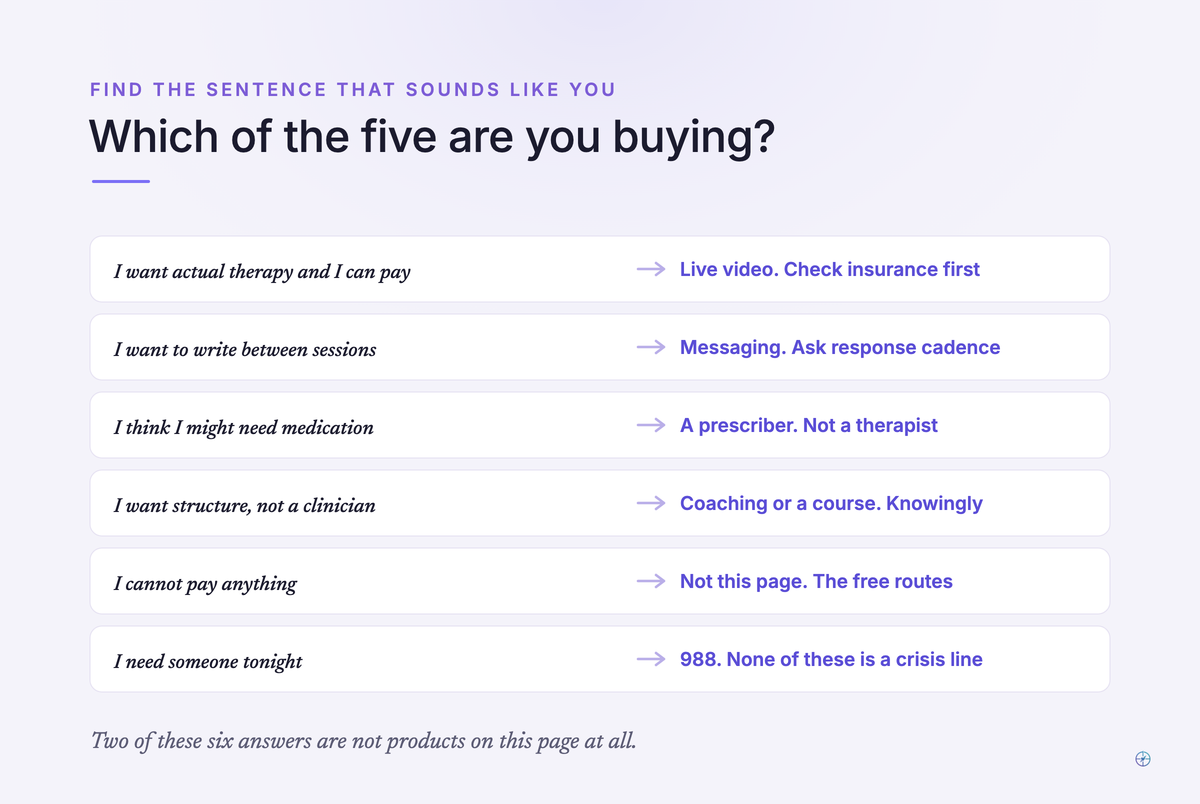
These work on any platform, including ones that did not exist when this was written.
1. Who exactly will I be talking to, and what are they licensed as? Full name, licence type, and the state it is held in. Then check the board’s public register yourself.
2. What happens to what I type? Specifically, what is shared with advertising and analytics platforms. This is the area where regulators have actually found something, which makes it a checkable question rather than a suspicious one.
3. How do I cancel, and how many taps is it? A completed order in this space required a simple cancellation path, so the question is grounded rather than cynical. Find the cancellation flow before you subscribe, not after.
4. What happens if I am in crisis at three in the morning? The honest answer from every platform here is that they are not a crisis service. Know what you would do instead, before you need to know.
How to actually pick one
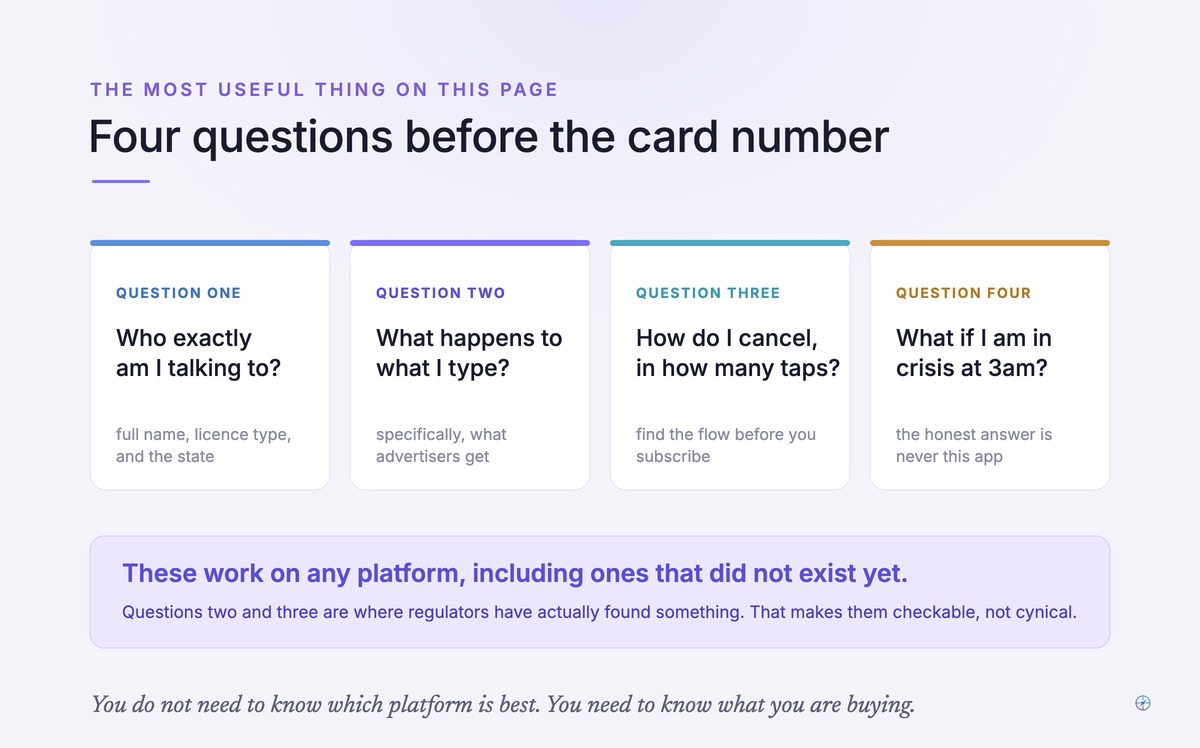
Find the sentence that sounds like your situation.
- “I want actual therapy and I can pay.” → Group one, and check your insurance first. A covered local or online clinician is frequently cheaper than any subscription here.
- “I want to be able to write to someone between sessions.” → Group two, and ask about response cadence before you pay.
- “I think I might need medication.” → Group three, and remember that a prescriber is not a therapist. You may end up seeing both.
- “I want structure rather than a clinician.” → Coaching or a self-guided programme, knowingly, and at a price you have compared against what a licensed session costs.
- “I can’t pay anything.” → Not this page. The free-resources piece, including the free routes that involve a person.
- “I need someone tonight.” → 988, and the block at the top of this page.
Then the rule, which is two steps rather than a recommendation. Work out which of the five products you are buying. Then ask the four questions before the card number.
If you are already in therapy and the week between sessions is the hard part
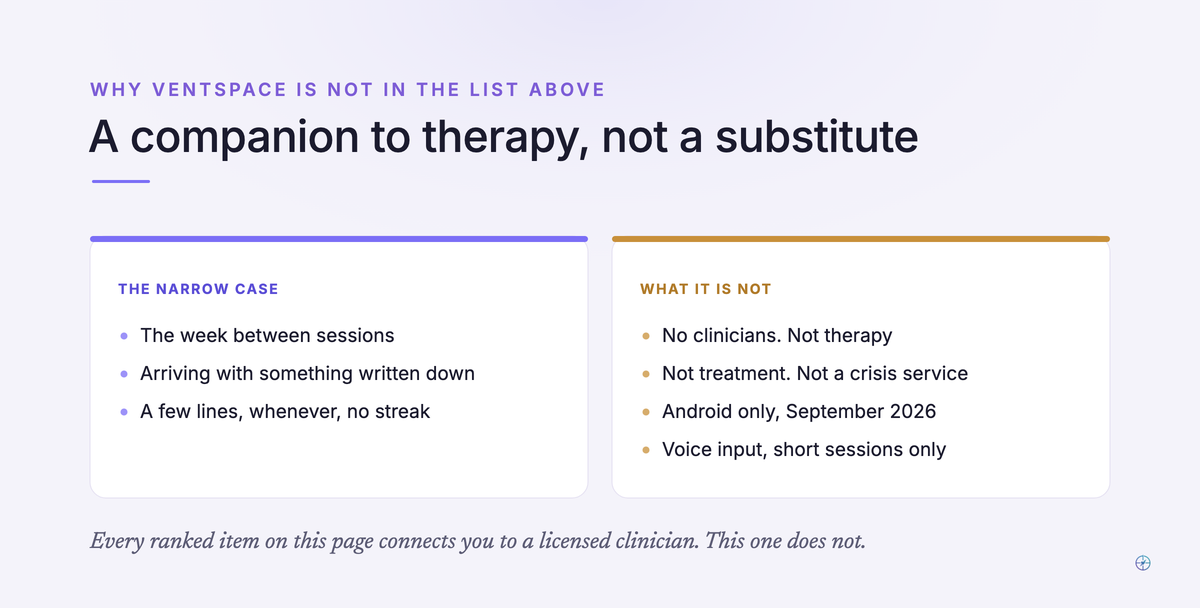
This one is ours, it is not in the list above, and it is not a therapy app. It is here because there is a narrow case for it that has nothing to do with choosing a platform.
Most of the material in therapy does not happen in the room. It happens on a Wednesday, in the middle of something ordinary, and by Thursday’s session it has flattened into “it was a difficult week”. VentSpace is a journaling app: you write freely or from a prompt, and it reads the entry back to you, naming the Realizations in it, giving a read on how balanced your life is across the areas that matter, and turning it into a small action list. Prefer to try it on your laptop first? VentSpace Live runs in your browser, free, with nothing to install. Arriving at a session with something written down is a real, small, non-clinical benefit, and the space between appointments is the only thing this is for. It is a companion to therapy, not a substitute for it.
The limits, in the same breath. There are no clinicians in it. It is not therapy, not treatment, and not a crisis service. It is Android only as of September 2026, and voice input works for short sessions only. It is newer than everything named above it. And if you are not currently in therapy, nothing about this page’s argument changes: the five products above are still the five products, and this is not a sixth.
FAQ
What is the best therapy app?
The question that decides it is which of five products you want. For live video with a licensed clinician, which is the group the research covers, BetterHelp has the widest availability, Grow Therapy is the insurance-led route and usually the cheapest for anyone covered, and Brightside has the clearest per-session arithmetic. For writing between sessions, that is messaging, and response cadence is the thing to ask about. Coaching and self-guided programmes are not therapy, whatever they cost. And before any of it, check what a local clinician on your insurance would cost.
Does online therapy actually work?
For live video with a licensed clinician, the evidence is reassuring. A systematic review and multilevel meta-analysis comparing video-based with face-to-face psychotherapy found outcomes broadly comparable, with no important difference for anxiety, depression, OCD and panic disorder (JMIR, 2026). Therapeutic alliance over video has been directly compared with in-person alliance (Seuling et al., 2024, Journal of Telemedicine and Telecare). None of that evidence covers messaging, coaching or self-guided programmes, which are different products sold in the same aisle.
Are therapy app counsellors real therapists?
On the platforms selling therapy, they hold state licences, and you can verify that yourself. The common types are LCSW, LPC or LMHC, LMFT, and licensed psychologist. Licences are state-specific, which is why every platform asks where you live. Ask for your clinician’s full name and licence type before the first paid session and look them up on your state board’s public register. Coaches are not licensed to treat a mental health condition, so the licence question is also how you tell which product you bought.
Does insurance cover online therapy?
Often, and it is the single most valuable thing to check before subscribing to anything. Some platforms are built around insurance, some accept it on particular plans, and some do not take it at all. Copays for covered sessions are commonly a fraction of a weekly subscription [unverified], and a local clinician on your plan may be cheaper still. Call the number on the back of your insurance card and ask what your behavioural health benefit covers, in network and out.
Is unlimited messaging the same as therapy?
It is a real clinical service in a different modality, and “unlimited” refers to what you send. A licensed clinician writing back to you is therapy delivered asynchronously, and for people who write more easily than they speak it can work well. What varies between plans is how often the clinician replies and at what length, so ask before you pay. The video-versus-in-person research does not cover this modality, which is worth knowing when the price is similar.
How do I cancel, and what happens to my data?
Both are fair questions with a public record behind them. The FTC’s order against BetterHelp, finalised 14 July 2023, banned the disclosure of sensitive health data for advertising and required $7.8 million for refunds. A proposed FTC and DOJ order against Cerebral in April 2024 required $7 million and a simple way to cancel services. Both concerned data and billing practices rather than the quality of clinical care, and neither says anything about companies that were not named. Practically: find the cancellation flow before you subscribe, and ask any platform directly what it shares with advertising and analytics services.
What was actually difficult here
The hard part was never choosing between five apps. The hard part was that nobody told us they were five different things, sold at one price, under one word, with the research from one of them quoted on all five pages.
You do not need to know which platform is best. You need to know which of the five you are buying, and whether there is a person licensed in your state on the other end of it.
Work that out, ask the four questions, and check your insurance before any of it. The rest of this page can wait.
And it is worth saying, at the end of a page that has spent a long time on the fine print, that the difficulty here was never a failure of judgement on anybody’s part. We were asked to tell five things apart using materials designed not to distinguish them. Nobody does that well. Knowing that the five exist is most of the work, and it is work that only has to be done once.
About this article

Written by
Sai Subramaniam
Founder, VentSpace
I write these guides because I have been where you are. I am working through my own hard seasons, and I share the things that actually helped me, so that anyone going through it has a steady companion close by instead of facing it alone. VentSpace is the app I built for exactly that: a journaling app that turns what you write into a clear read on your life balance, plus small, doable next steps toward feeling more like yourself.
This writing is honest and every claim is sourced, and it is not a substitute for professional care. If you are struggling, reaching out to a professional is a strong move, not a failure.
Explore VentSpaceTry VentSpace LiveHow this one was checked. Every factual claim traces to a named source, and the source is printed next to the claim rather than kept in a footnote. Quotes are pinned to the work they come from, with the year, the letter or the chapter where one exists. Where a widely repeated claim could not be traced, it was left out and the omission recorded. Where a figure is contested, both sides are printed.
No affiliate links, no paid placements, and nobody paid to appear here. Where we mention our own app, we say that it is ours, we state its limits, and we never position it as a substitute for care.
Reviewed: October 2026. Prices, platforms and product availability move quickly, and anything we could not verify at the time of writing is marked as unverified rather than turned into a number.
Corrections. If something here is wrong, we would rather know. Corrections are made in place, with a note saying what changed. Updated 15 October 2026: we removed three unrelated reading links and a duplicate app link, reworded three platform notes that implied user reports we cannot source, and made clear that the two regulator actions described are the two FTC orders.