
Two people type the word Reflectly into a search box on the same afternoon, and they want opposite things.
The first saw it on a list of journaling apps and wants to know whether it is worth installing. The second has had it for years, paid for something recently, and has a nagging sense that the app is not the app they signed up to. This page answers the second person first, because the reason for their nagging sense turns out to be a matter of public record, and because it changes the answer for the first person too.
So, one question before any feature list. What are you hoping a journal will do that a notes app will not?
What Reflectly actually is
Reflectly is a prompt-led journal with a mood check-in attached, and it is the friendliest front door in this category. You open it, it asks you how the day was, you tap a face, and then it asks you a small question about the day and gives you a box. There is no blank page anywhere. Is that a small thing? For the person who has abandoned four journals, it is the whole thing.
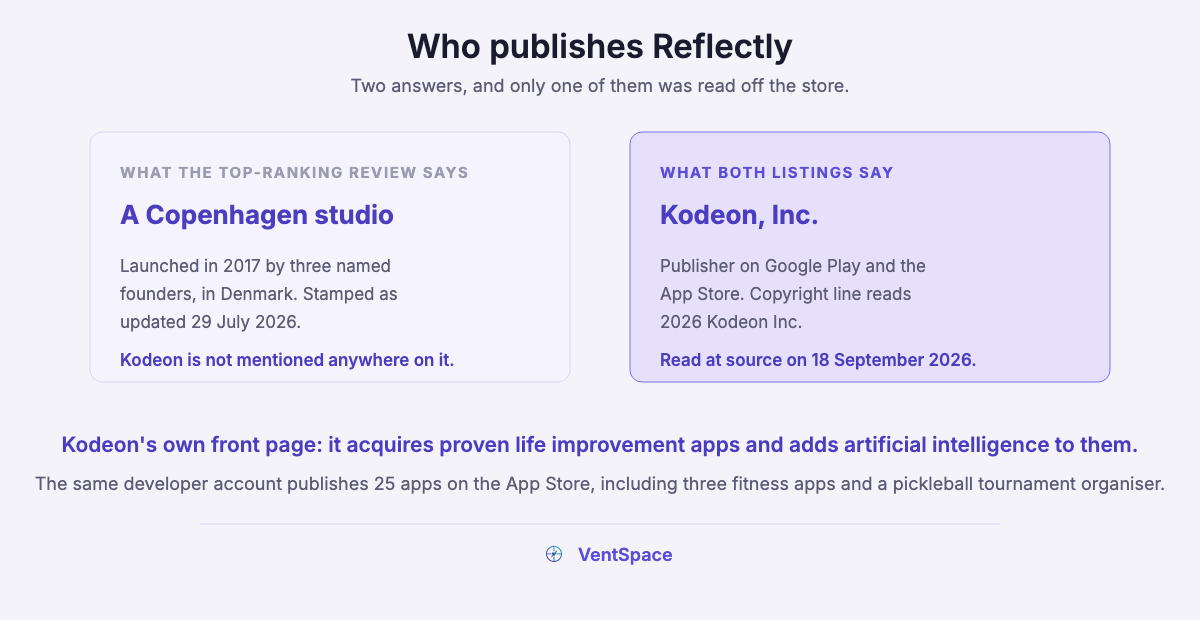
Who makes it is where this page separates from every other page about it. Both store listings name the publisher as Kodeon, Inc., and the copyright line on the App Store product page reads © 2026 Kodeon Inc, both read on 18 September 2026. The top-ranking review of this app, stamped as updated in July 2026, still describes it as a Copenhagen startup run by its three founders. The app’s own website still says it was made in Copenhagen. Both of those things can be true at once and neither tells you who is running it now.
Kodeon says what it does on its own front page, and there is no need to interpret it: it acquires proven life improvement apps and adds artificial intelligence to them. Its Apple developer account publishes 25 apps. Alongside Reflectly there is a habit tracker, three fitness apps, a brain-training app, a sobriety counter, a gratitude journal, a second mood tracker, a daily planner, an affirmations app, a meditation app, a device finder and a pickleball tournament organiser. Reflectly is one title in a portfolio now. Does that make it a worse journal? No. Does it change what you are deciding when you install it? Yes, and that is the honest answer.
One practical thing before anything else. The app has two different names. On Google Play it is Reflectly: Mood Tracker Diary. On the App Store it is Reflectly – Journal & AI Diary. Same product, same publisher.
Quick Digest
What it is: a prompt-led journal and mood check-in, free to install, on iOS and Android.
Who publishes it: Kodeon, Inc., on both listings, read 18 September 2026. Not the independent studio the top-ranking review still describes.
Verified live: App Store build 21 July 2026, version 5.0.4. Google Play build 4 March 2026. First released 30 July 2017.
The ratings: 4.57 from 81,691 ratings on the App Store, 4.2 from 40.7K reviews and 1M+ downloads on Google Play.
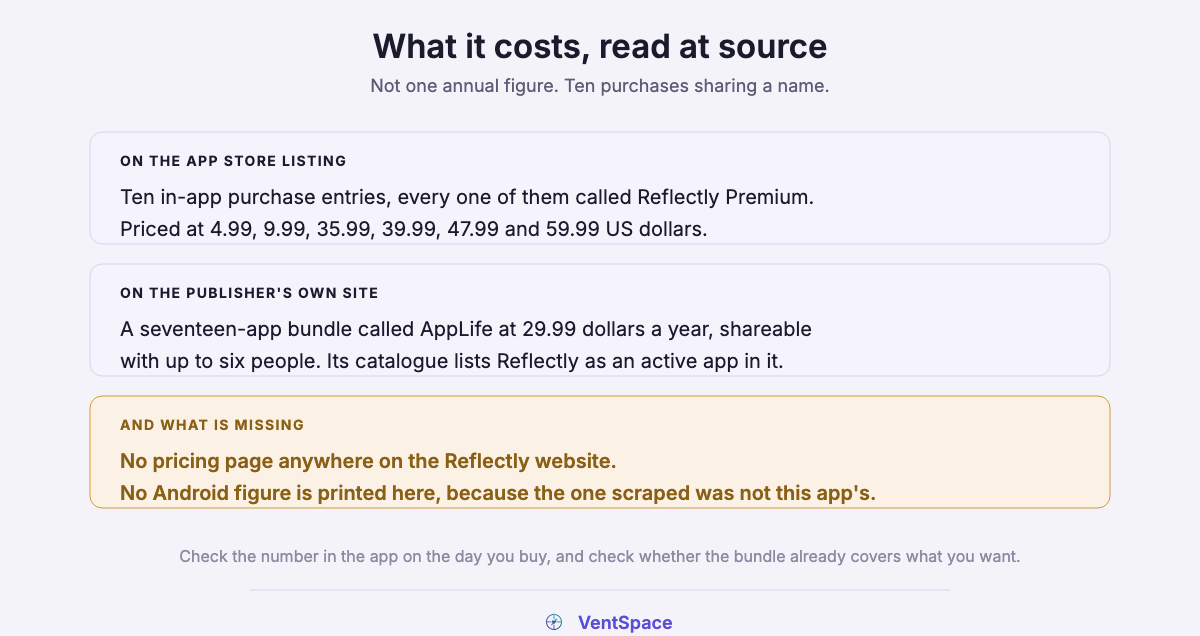
What it costs: free to install. The App Store listing shows ten in-app purchases, all called “Reflectly Premium”, at six different prices from $4.99 to $59.99. The parent company separately sells a seventeen-app bundle that includes Reflectly for $29.99 a year.
Who it suits: anybody who has never kept a journal and has failed at the blank page. Who should skip it: anybody who already knows what they want to write about.
Quick Summary
Q: What is the Reflectly app?
A: A prompt-led journaling and mood-tracking app, free to install on iOS and Android, that replaces the blank page with a daily question and a mood check-in. It was first released in July 2017 and is published by Kodeon, Inc., a company whose own site says it acquires life improvement apps.
Who this makes sense for
Who is this genuinely for? Four situations where installing it is a decision rather than a hope. If none of them is yours, that is worth more to you than any rating on this page.
1. You have never kept a journal and every attempt died on the first page. This is the situation Reflectly was built for. The blank page is the obstacle, and there is no blank page here. The app asks, you answer, the entry exists.
This week: answer the question it gives you, badly, for seven days. Do not write more than four sentences. The habit is the point and the writing is not yet.
2. You want a record of the year without doing the work of keeping one. The mood check-in takes about ten seconds. Over a few months you get a rough shape of how the weeks went.
This week: check in once a day and write nothing at all. Add the words later, once the checking-in has stopped requiring a decision.
3. You want something gentle to open in the evening. The design does a lot of quiet work here. Soft colours, an unhurried tone, a daily quote. For a certain kind of evening that is the difference between opening something and opening nothing.
This week: put it next to the thing you already do at that hour. Attach it to brushing your teeth rather than to a reminder.
4. You are looking for something to suggest to a parent or a friend who is new to all of this. The bar to entry is the lowest of anything credible in this category, and the free tier is good enough to hand over without a conversation about money.
This week: install the free version yourself first, use it for three days and read its privacy policy before you recommend it, since this page has not. What survives contact with your own week is the only recommendation worth making.
Quick Summary
Q: Who is Reflectly actually for?
A: People who have never kept a journal and keep stalling at the blank page. The guided prompt removes the hardest part of starting, and the free tier is enough to find out whether the habit takes. It suits people who already know what they want to write about far less well.
The factors that should decide it
Before the features, the criteria. Most of these have nothing to do with how good the app is, and they are what decides whether it is still open in six weeks.
- What is this costing you over a year, not over a month?
- What happens to your entries if you stop paying?
- Do you know exactly what you are buying when you tap the purchase button?
- Would you rather be asked a question, or left alone with a page?
- Who owns the company, and does that matter to you for something this private?
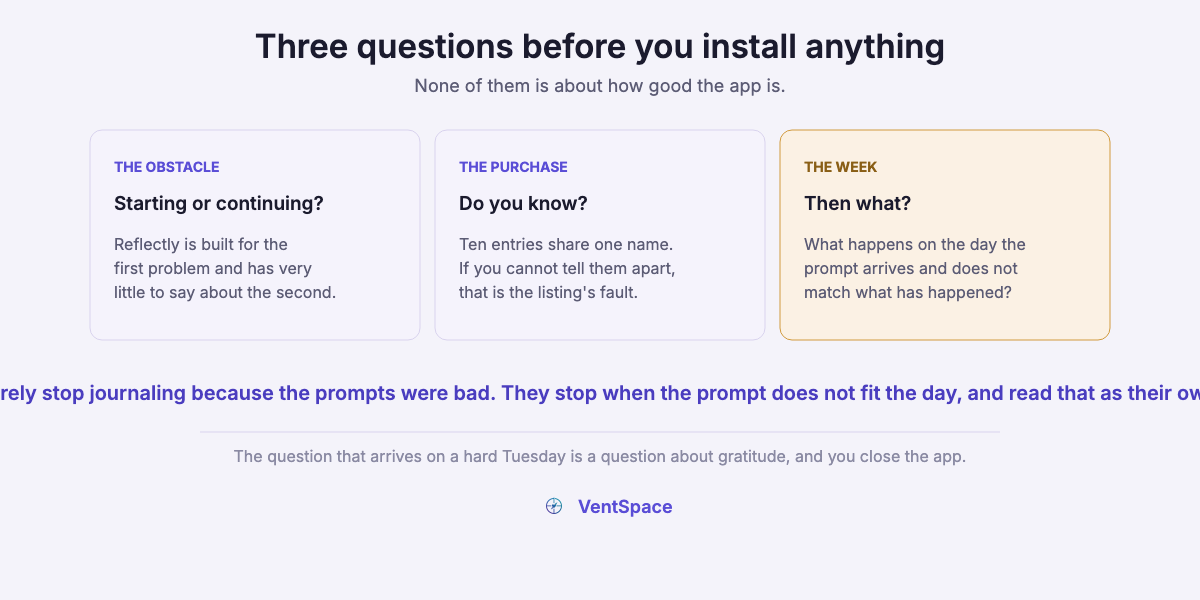
- Is the obstacle starting, or is the obstacle continuing?
That last question decides everything else on this page. Reflectly is built for starting. Whether it is good at continuing is a different question and the answer is less flattering, which we get to below.
On the practical side of that list, here is what was read at source on 18 September 2026 and it is not what the rest of the internet will tell you. The App Store product page lists ten in-app purchases. Every one of them is called “Reflectly Premium”. They cost $4.99, $9.99, $35.99, $39.99, $47.99 and $59.99. Apple caps that display at ten entries, so there may be more than ten. Nothing on the listing distinguishes one from another, and there is no pricing page on the company’s own website, which is a single screen carrying a tagline and two legal links.
There is a second price, and it is the useful one. Kodeon sells a bundle called AppLife at $29.99 a year, covering seventeen of its apps, shareable with up to six people. Its own catalogue lists Reflectly as an active app inside it. So the same product appears at $59.99 on its own and inside a seventeen-app subscription for half of that. Neither number is secret and neither is on the store listing you are looking at.
Quick Summary
Q: How much does Reflectly cost?
A: It is free to install. The US App Store listing shows ten in-app purchases, all named “Reflectly Premium”, priced between $4.99 and $59.99, read on 18 September 2026. The publisher also sells a seventeen-app bundle including Reflectly for $29.99 a year on its own site. There is no pricing page on the Reflectly website, so check the figure in the app before you buy.
Insight: what the publisher says it does, in its own words
Kodeon’s home page, read on 18 September 2026, describes the business in one sentence: “At Kodeon, we acquire proven life improvement apps and enhance them with applied AI.” The same page claims 65 million app downloads across the portfolio and a 4.6 average rating. Reflectly is not named on that page, though both of its store listings name Kodeon as the publisher.
What it does well
The onboarding removes the blank page. Many journaling apps hand you a screen and an implied instruction. Reflectly hands you a question with a box under it. If you have tried to start a journal four times, that is the difference worth testing.
The daily check-in costs almost nothing. Ten seconds, a face, a couple of taps. That matters more than any feature. Which app survives a bad week? The one that asks almost nothing of you during one.
The free tier is genuinely usable. It is not a demo. Several long-term reviewers in the App Store feed say explicitly that they recommend the free version and have used it for years without paying. That is unusual in this category and it deserves saying plainly.
It has been maintained for eight years. First release 30 July 2017, most recent iOS build 21 July 2026. Not every app still recommended in journaling roundups can say that.
And the tone is right. Soft, unhurried, never shouting at you about a streak you broke. For an app you open at eleven at night, is the absence of a scolding a feature? It is the feature.
Quick Summary
Q: What is Reflectly good at?
A: Getting a person who has never journaled to write something. The guided prompt removes the blank page, the mood check-in takes about ten seconds, the free tier is usable rather than a demo, and the app has been maintained continuously since 2017. There is no blank page to get past.
Where it falls short
Start with the price surface, because it is the easiest thing to get wrong. Ten purchases with the same name at six different prices is not a price list, it is a shrug. A reader cannot look at that listing and know what a year costs. Every review page that prints one confident annual figure for this app is reporting something it did not read, and the figures on those pages do not match what the listing shows today.
The most repeated complaint in the App Store feed is that paid features did not appear. These are user complaints and not our findings, and they are specific. One reviewer who says they had used the app for almost eight years describes upgrading and none of the premium features unlocking. Another says the charts still do not work after paying. A third describes a sign-in failure immediately after buying a membership. Three of the fifty most recent reviews, all in the same shape.
A long-term subscriber complains that the cross-app bundle changed under them, saying a plan that used to cover the developer’s apps at a reasonable price no longer did on renewal. That reads differently once you know about AppLife, and it is why both facts belong on the same page.
The Android build is behind. The App Store version shipped on 21 July 2026 and the Google Play version on 4 March 2026. That gap was four and a half months when we checked in September and seven months by 9 October. It is not fatal. Does it tell you which platform gets the attention? It does. The rating gap points the same way: 4.57 on iOS against 4.2 on Play.
The artificial intelligence is doing less than the name suggests. What you get is a well-designed sequence of prompts and some summarising. Is there anything wrong with that? No. Is it what the word AI in a store name suggests? Also no.
One user complaint about the quote library is worth reporting rather than repeating. A reviewer says they were served a quote from the general category by a public figure whose views on autism they then looked up, and deleted the app over it. We are not reproducing the quote or making any claim about it. The point for a reader is narrower: the quote library is curated by somebody, and you do not get to see who or on what basis.
And then the ownership question, which is not an accusation. Companies are bought and sold and the app on your phone does not change on the day it happens. What changes is who decides what happens next, and for a product you have been typing your low evenings into for eight years, some people will want to know that and some will not care. The honest position is that you now know, and the top-ranking review of this app does not tell you.
One thing this review does not cover. The privacy policy was not read in this session, so this page makes no claim about what Reflectly does with your entries. Read it yourself before you write anything you would not want stored.
Quick Summary
Q: What are the downsides of Reflectly?
A: The App Store listing shows ten identically named in-app purchases at six different prices, with no pricing page on the vendor’s site. Users report paying for premium and not receiving it, and one long-term subscriber reports the publisher’s cross-app bundle changing on renewal. The Android build was four months behind the iOS build in September 2026.
Where it will not help
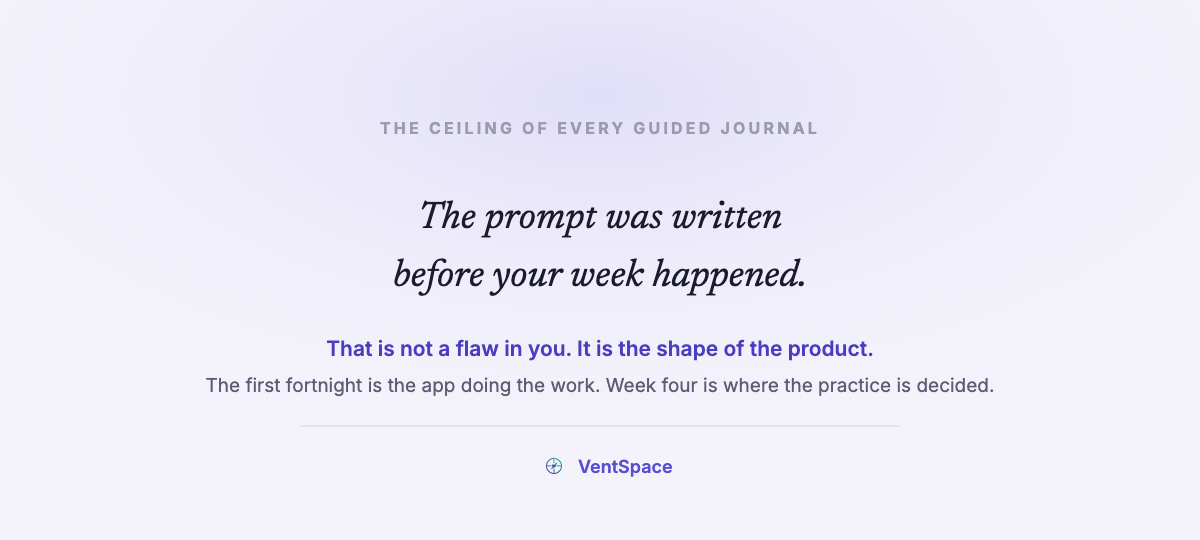
A prompt was written before your week happened. That is the ceiling of every guided journal, Reflectly included, and it is a common reason to stop. The question that arrives on a Tuesday when something has actually gone wrong is a question about gratitude, and you close the app, and you do not tell yourself the prompt was badly timed. You tell yourself you are bad at journaling.
There are also situations where an app of any kind is the wrong tool, and they should be said plainly rather than hinted at. Read these as questions about your own month.
- Has the low stretch been going on for weeks without lifting, whatever you write in the evening?
- Is the thing you would need to write about something you are not willing to write down?
- Is the real problem a person, a job or a loss, which no prompt contains?
- Are you looking for an app mainly so that you do not have to say any of this out loud to somebody?
If any of those landed, the useful next step is a conversation rather than an install. Therapy is one option here and it may be the right one. A journal can make a first appointment better by giving you something to bring. It cannot be the appointment, and no app in this category claims otherwise.
If this is heavier than an app
If you are in crisis or thinking about harming yourself, please contact a crisis line now rather than opening an app. In the US you can call or text 988 for the Suicide and Crisis Lifeline. Outside the US, findahelpline.com will find the service where you are. No journaling app can assess risk, and none of them is a substitute for a person.
Quick Summary
Q: Can a journaling app replace therapy?
A: No. A journal is a place to put things down and it has no one else in it. It can make a first appointment more useful by giving you a record rather than a recollection. If low mood has persisted for weeks, or the thing you need to talk about involves another person, that belongs with a professional rather than with an app.
What to use instead
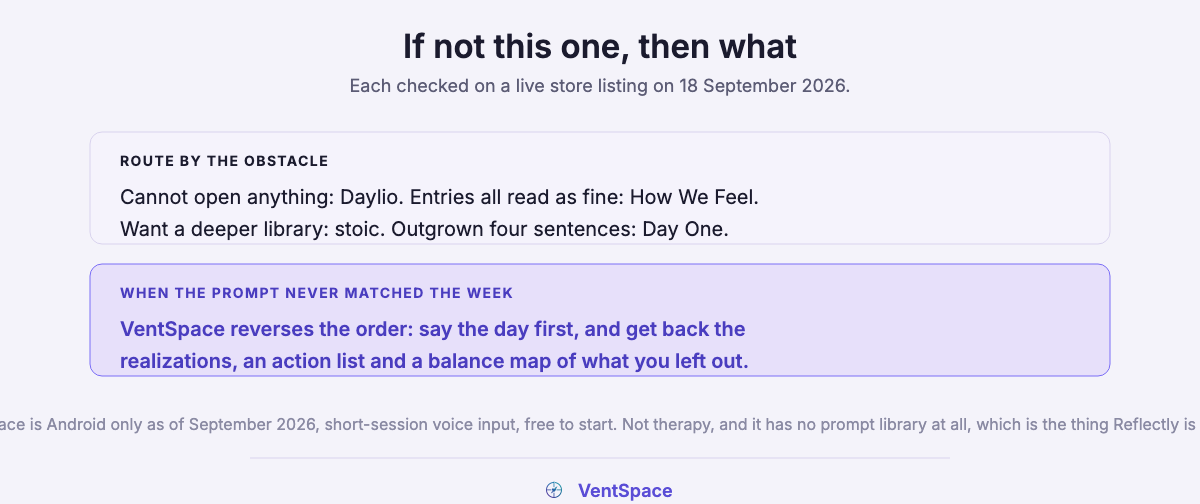
So if not this one, then what? Each of these was checked on a live store listing on 18 September 2026, which is not a formality on this topic. Roundups in this category routinely still recommend apps that no longer exist, and several products that appear on competing lists for this keyword were left off this one for exactly that reason.
Daylio. The lowest-friction tracker there is: tap a mood, tap a few activity icons, done. Updated 16 September 2026 on Play and 10 September on iOS.
Who it suits better: anyone whose obstacle is remembering to open anything at all.
The watch-out: it deliberately gives you almost nothing to do with what you record.
How We Feel. Free, from a non-profit, and described on its own listing as conceived in conjunction with the work of Marc Brackett, to widen the vocabulary you have for what you are feeling. Updated 18 September 2026 on Play.
Who it suits better: anyone whose entries keep coming out as “fine” and “bad”.
The watch-out: it is a check-in tool more than a writing tool, so it will not replace the journaling half.
stoic. A journal with a large prompt library and a philosophy frame, updated 14 September 2026 on iOS and 5 September on Play.
Who it suits better: anyone who liked the guided question but wants a much deeper library and more control over it.
The watch-out: the iOS version is roughly ten times the size of the Android one by rating count, and the paid tiers are layered.
Day One. The serious long-form journal: rich entries, photos, real export, a decade of development behind it. Updated 14 September 2026.
Who it suits better: anyone who has outgrown four-sentence entries and wants something they can keep for twenty years.
The watch-out: it hands you a blank page, which is the thing Reflectly was solving.
Rosebud. A conversational journal that responds to what you wrote rather than asking a fixed question. Updated 11 September 2026.
Who it suits better: anyone whose complaint about Reflectly is that the prompt never changes shape.
The watch-out: it is the most expensive habit on this list to build, and a responding journal is not to everybody’s taste.
VentSpace. Prefer to try it on your laptop first? VentSpace Live runs in your browser, free, with nothing to install. On this list for one reason, which is the sentence at the top of the section above. A scripted prompt cannot know what week you are having, so here you can write freely about whatever the day was, with prompts there if you want one. It is a journaling app that turns what you write into a clear read on your life balance, plus small, doable next steps.
Who it suits better: anyone who stopped journaling because the question that arrived did not match the day.
The watch-outs, and there are four: it is Android only, it is newer than every other app on this list, it has no published evidence behind it, and it is not therapy and not treatment. Free to start.
Nothing. A page about journaling apps should say this once. If you have installed four of these and used none of them past a fortnight, a fifth is not the missing piece. Was it relief you felt when you opened Reflectly, or obligation? If it was obligation, deleting it is a legitimate answer and nobody selling an app will offer it to you.
| App | Shape | Platforms | Verified live | Best for |
|---|---|---|---|---|
| Reflectly | Guided prompt journal | iOS, Android | 21 Jul and 4 Mar 2026 | Starting when the blank page keeps winning |
| Daylio | Minimal tracker | iOS, Android | 16 Sept 2026 | Keeping the habit at all |
| How We Feel | Emotion vocabulary | iOS, Android | 18 Sept 2026 | Naming it better than “fine” |
| stoic. | Deep prompt library | iOS, Android | 14 Sept 2026 | The guided question, done seriously |
| Day One | Long-form journal | iOS, Android | 14 Sept 2026 | Writing you intend to keep |
| Rosebud | Responsive journal | iOS, Android | 11 Sept 2026 | When a fixed prompt stopped fitting |
| VentSpace | Free-form journal with a balance read | Android only | 12 Jul 2026 | When the prompt never matched the week |
Quick Summary
Q: What are the best alternatives to Reflectly?
A: Daylio for the lowest-friction habit, How We Feel for a better emotional vocabulary at no cost, stoic. for a much deeper prompt library, Day One for long-form writing you intend to keep, and Rosebud for a journal that responds rather than repeats. All were verified live on 18 September 2026.
Questions people ask
Is Reflectly free?
Yes, and the free tier is the honest place to start. It covers the daily prompt, the mood check-in and your entries. Several long-term users in the App Store review feed say they have never paid and still use it. Find out whether the habit takes before any money changes hands.
How much does Reflectly premium cost?
This is the myth worth correcting. Pages ranking for this app print one confident annual figure, usually a different one per platform. What the US App Store listing shows on 18 September 2026 is ten in-app purchases, all named “Reflectly Premium”, priced at $4.99, $9.99, $35.99, $39.99, $47.99 and $59.99, with nothing to tell them apart. The publisher’s own site carries no pricing page, and separately sells a seventeen-app bundle including Reflectly at $29.99 a year. Check the number in the app on the day you buy, and check whether the bundle covers what you want.
Who owns Reflectly now?
Both store listings name Kodeon, Inc. as the publisher, and the App Store copyright line reads © 2026 Kodeon Inc, read on 18 September 2026. Kodeon’s own site says it acquires life improvement apps and adds artificial intelligence to them. We found no primary source giving a date or terms for how Reflectly came to sit in that portfolio, so this page does not state one.
I paid and my premium features did not appear. Is that common?
It is the most repeated complaint in the recent App Store reviews, appearing three times in the fifty most recent. That makes it a pattern in the public reviews, not a measured failure rate, and this page does not claim to know how often it happens. If it happens to you, the refund route runs through Apple or Google rather than through the app.
Is Reflectly better than Daylio?
They answer different questions. Daylio is built so that logging costs you nearly nothing and gives you a chart. Reflectly is built so that writing costs you nearly nothing and gives you an entry. If your obstacle is the blank page, Reflectly. If your obstacle is opening anything at all, Daylio.
Is the Android version the same as the iPhone one?
Not identical, as of September 2026. The App Store build shipped on 21 July 2026 and the Google Play build on 4 March 2026, and the ratings differ by about four tenths of a star. If you are on Android, install the free tier and use it for a week before paying for anything.
The verdict
Reflectly is still the best way into journaling for somebody who has never managed it. That has not changed and it is not a small thing. If you have stalled at the blank page four times, install the free version today and answer whatever it asks you, badly, for a week. Almost nothing else in this category will get you that far.
Should you pay for it? Not yet, and possibly not ever. The free tier is usable, the paid surface is the least clear thing on the store, the most common recent complaint is about paying and not receiving, and the same product turns up inside the publisher’s own seventeen-app bundle for less than its own top price. If you do decide to pay, read the number in the app on the day, and know that the company behind it is a portfolio operator rather than the Copenhagen studio most of the internet still describes.
The honest timeline, and it is the thing nobody selling an app will tell you. The first fortnight of any journal is the app doing the work. Somewhere around week four the prompt arrives on a day it does not fit, and what you do at that moment decides whether you have a practice or an uninstall. What would you write on that day if nothing asked you anything? That question is worth more than any feature on this page, and it is the one to sit with before you pick anything at all.
About this article

Written by
Sai Subramaniam
Founder, VentSpace
I write these guides because I have been where you are. I am working through my own hard seasons, and I share the things that actually helped me, so that anyone going through it has a steady companion close by instead of facing it alone. VentSpace is the app I built for exactly that: a journaling app that turns what you write into a clear read on your life balance, plus small, doable next steps toward feeling more like yourself.
This writing is honest and every claim is sourced, and it is not a substitute for professional care. If you are struggling, reaching out to a professional is a strong move, not a failure.
Explore VentSpaceTry VentSpace LiveHow this one was checked. Every factual claim traces to a named source, and the source is printed next to the claim rather than kept in a footnote. Quotes are pinned to the work they come from, with the year, the letter or the chapter where one exists. Where a widely repeated claim could not be traced, it was left out and the omission recorded. Where a figure is contested, both sides are printed.
No affiliate links, no paid placements, and nobody paid to appear here. Where we mention our own app, we say that it is ours, we state its limits, and we never position it as a substitute for care.
Reviewed: October 2026. Prices, platforms and product availability move quickly, and anything we could not verify at the time of writing is marked as unverified rather than turned into a number.
Corrections. If something here is wrong, we would rather know. Corrections are made in place, with a note saying what changed. Updated 15 October 2026: the VentSpace entry now describes it correctly as a journaling app with prompts, How We Feel’s research link is now given in its own listing’s words, the teenager suggestion was removed, the Android gap is updated, several best-in-category claims we could not source were cut, and an extra app link and an unrelated link were removed.