
“Many people find it easier to build their self-confidence than their self-esteem, and, conflating the one with the other, end up with a long list of talents and achievements.”
Neel Burton, psychiatrist, “Self-Confidence Versus Self-Esteem”, Psychology Today, 2015
Self-confidence is trust in what you can do. Self-esteem is the verdict on what you are worth. One is scored task by task, and the other is scored once, overall, against whatever you have decided your worth depends on. That is why you can be good at almost everything you touch and still go home feeling not good enough. Both are true at once.
Getting better at things was never going to close that gap. Here is why.
The short version
Self-confidence is about tasks. It is the belief that you can meet the demands of a particular job, and it grows with practice.
Self-esteem is about you. It is how positively you see the whole of yourself.
They come apart when self-worth is staked on performance. In a daily study of 122 students, self-esteem rose on good-grade days and fell on bad ones.
Boosting self-esteem directly has not been shown to cause benefits. Therapy aimed at low self-esteem has better evidence, and the page says what it is.
What self-confidence actually is
Self-confidence is trust in your ability to do a thing. The APA Dictionary of Psychology gives it two senses: “trust in one’s abilities, capacities, and judgment”, and, more narrowly, “a belief that one is capable of successfully meeting the demands of a task”. That second sense is close to what research calls self-efficacy, a construct the APA credits to Albert Bandura, whose 1977 paper defined an efficacy expectation as “the conviction that one can successfully execute the behavior required to produce the outcomes”.
Notice what that definition is about. A task. You can be supremely confident giving a presentation to two hundred strangers and quietly terrified of making a phone call to book a dentist, and both of those are perfectly normal, because confidence is local.
What self-esteem actually is
Self-esteem is how positively you see yourself overall. The APA Dictionary defines it as “the degree to which the qualities and characteristics contained in one’s self-concept are perceived to be positive”. It is not about one task. It is a judgment on the whole package, and the APA entry lists what goes into it: your physical self-image, your view of your accomplishments and capabilities, your values and how well you think you live up to them, and the ways other people see and respond to you. Different scale entirely.
And high self-esteem is not one thing either. A major review of the subject, by Baumeister and colleagues (2003), warns that it is “a heterogeneous category, encompassing people who frankly accept their good qualities along with narcissistic, defensive, and conceited individuals”. So when somebody seems to think highly of themselves, that tells you less than it appears to.
The two side by side
| Self-confidence | Self-esteem | |
|---|---|---|
| What it judges | Whether you can do this | What you are worth |
| Scope | One task, skill or situation | The whole of you |
| What builds it | Doing the thing, successfully, more than once | It depends on what you have staked it on |
| After a good result | Rises for that task | Can rise for the day |
| After a bad result | Dips for that task | Can fall, more so when your worth is staked on that area |
| High while the other is low? | Yes | Yes |
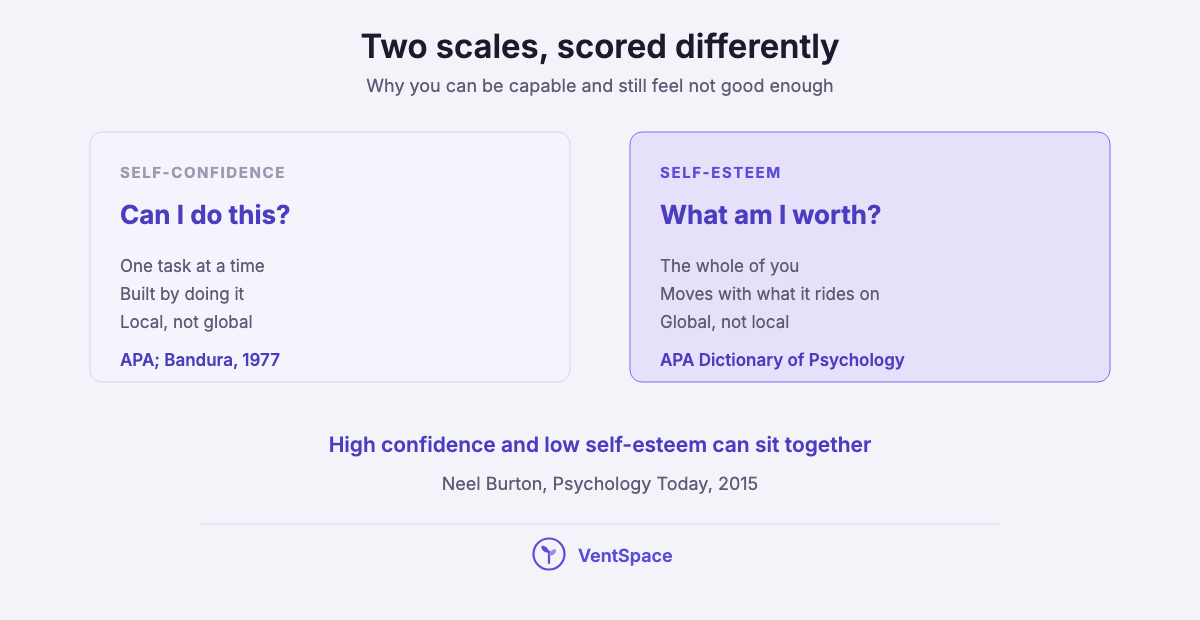
One is about a task, and the other is about a person
Confidence lives in specific places, and self-esteem lives everywhere at once. That is the first difference, and it explains the version of the problem this page exists for, which is the person who walks into a quarterly review, hears “exceeds expectations” in three categories, nods, drives home, and spends the evening feeling like a fraud who has not been caught yet.
Neel Burton, a psychiatrist, puts the possibility plainly, “it is possible to be highly self-confident and yet to have low self-esteem”, and notes in the same short essay that a person can be confident in one area, such as dancing, while being insecure in another, which is exactly the shape of a life where the work goes well and the evenings do not. Confidence is that granular. The review went well. Confidence went up. The verdict on the person did not move.
This is why “be more confident” is such useless advice for this reader. You already are. In the places that count at work you have years of evidence, you trust it, other people trust it, and you could walk into most of those rooms tomorrow and do the job well without a second thought, which is exactly what makes the evening feeling so confusing. The thing that hurts is a different thing. It reads different evidence.
Even the praise misfires. Bandura listed verbal persuasion, being told you can, among the sources of confidence, and wrote that confidence built that way is “likely to be weaker than those arising from one’s own accomplishments because they do not provide an authentic experiential base for them”. If being told builds weaker confidence than doing, it is no surprise that being told you are great does so little for the deeper verdict.
Quick Summary
Q: Can you have high self-confidence and low self-esteem?
A: Yes. Confidence is trust in your ability to do specific things, so it can be high wherever you have practice. Self-esteem is a judgment on your overall worth, so it can stay low even when you are good at a great deal. Being capable does not settle what you think you are worth.
Insight: confidence is local
The APA Dictionary’s narrower sense of self-confidence is “a belief that one is capable of successfully meeting the demands of a task”. A task, not a person. That is why a single person can hold high confidence and low self-esteem at the same time without any contradiction.
Success builds one reliably, and the other only on conditions
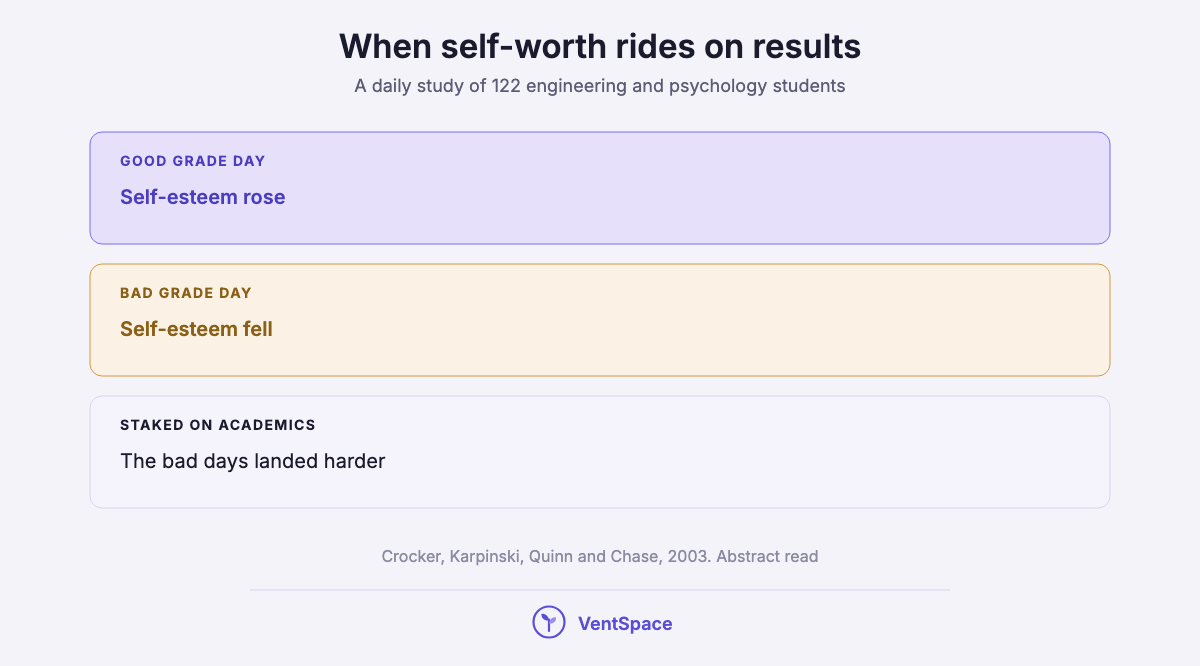
Practice builds confidence almost by definition, but success builds self-esteem only when your worth is riding on it, and then it charges interest. Here is the clearest evidence we found. In a study by Crocker and colleagues (2003), 122 engineering and psychology students reported their self-esteem day by day through a stretch of graded work, and their self-esteem went up on days they received good grades and down on days they received poor ones.
Read that again. Engineering and psychology students. Self-worth moving on one grade.
The study also found that how much students based their self-esteem on academic competence changed how hard the bad grades landed. And it found that instability in self-esteem predicted increases in depressive symptoms among the students who started out more depressed. We read the abstract only, and it is one study of students, but it describes the mechanism precisely: when your worth is staked on performance, every result becomes a referendum on you. Every single one.
If you are in crisis or thinking about harming yourself, please contact a crisis line now. In the US, call or text 988, the Suicide and Crisis Lifeline, free and confidential, at any hour. Outside the US, findahelpline.com lists the service for your country.
Crocker and Park later argued, in a 2004 review, that “the importance of self-esteem lies more in how people strive for it rather than whether it is high or low”, and that “the short-term emotional benefits of pursuing self-esteem are often outweighed by long-term costs”. It is an argument rather than a settled finding, and three published comments answered it in the same journal issue, but it fits the reader who has spent years chasing the next result, getting it, feeling the lift for an afternoon, and then needing another one, almost uncomfortably well.
Baumeister’s review points the same way from the other side: “Occupational success may boost self-esteem rather than the reverse.” Notice the word may. Success can help. It just may not hold.
Quick Summary
Q: Does achievement build self-esteem?
A: Sometimes, briefly, and at a price. In a daily study of 122 students, self-esteem rose on good-grade days and fell on bad ones. When your worth is staked on performance, it moves with every result. Achievement reliably builds confidence in the task. It does not reliably settle self-esteem.
Insight: when grades decide your worth
Crocker, Karpinski, Quinn and Chase, Journal of Personality and Social Psychology (2003): self-esteem, mood and identification with one’s major “increased on days students received good grades and decreased on days they received poor grades”. One study, students, abstract only. Its value is that it watched the swing happen day by day instead of asking people to remember it.
Confidence predicts what you will try, and self-esteem mostly does not
If you want to know whether someone will attempt the hard thing, confidence is the better predictor. Bandura’s 1977 paper argued that expectations of personal efficacy determine “whether coping behavior will be initiated, how much effort will be expended, and how long it will be sustained in the face of obstacles”, which is a theory with laboratory support behind it, mostly from the treatment of fears, and which is about specific tasks rather than about how anybody feels about themselves overall.
Self-esteem has a much weaker record here. Baumeister’s review found that “laboratory studies have generally failed to find that self-esteem causes good task performance, with the important exception that high self-esteem facilitates persistence after failure”. It also found no evidence that boosting self-esteem, by therapeutic interventions or school programs, causes benefits, and noted that efforts to boost pupils’ self-esteem “have not been shown to improve academic performance and may sometimes be counterproductive”.
People quote that sentence alone. They should not. The same review says the authors are “persuaded that high self-esteem does lead to greater happiness”, and that low self-esteem “is more likely than high to lead to depression under some circumstances”. Self-esteem matters. Pumping it up directly is what has not been shown to work. Different claim entirely.
None of it judges therapy. A 2018 meta-analysis by Kolubinski and colleagues pooled seven studies of cognitive behavioral therapy built specifically for low self-esteem and found summary effect sizes of 1.12 for weekly sessions and 0.34 for one-day workshops, on self-report measures. It is a small literature, and the authors add that it is unclear whether these treatments differ from those aimed at depression. Therapy is one option, and for low self-esteem it is the one with the clearest evidence we found.
Quick Summary
Q: Which matters more, self-esteem or self-confidence?
A: For getting things done, confidence predicts more. Self-esteem has not been shown to cause better task performance, though it helps people persist after failure. For how you feel about your life, self-esteem matters, and the clearest evidence for improving low self-esteem comes from therapy, not from boosting programs.
Insight: both halves of one review
Baumeister, Campbell, Krueger and Vohs, Psychological Science in the Public Interest (2003), found no evidence that boosting self-esteem causes benefits, and in the same abstract said they are persuaded high self-esteem leads to greater happiness. Either half alone misreads the paper.
How to tell which one is low
Run through these on paper. It is a self-check, not a diagnosis, and there is no score.
- Praise for a piece of work lifts you for an hour and then evaporates.
- One bad result at work spreads into how you feel about your whole self by evening.
- You are confident in the meeting and feel worthless in the car afterward.
- You avoid trying new things because failing at them would say something about you, not just about the attempt.
- You can list what you are good at, and the list does not help.
- You hesitate before a specific task because you doubt you can do it.
The first five point at self-esteem staked on performance. The last points at confidence in a particular task. A mix is possible, and the useful question is which one is driving this week.
Quick Summary
Q: How do I know if I have low self-esteem or low confidence?
A: Ask whether the doubt is about a task or about you. “I am not sure I can do this presentation” is confidence. “If this presentation goes badly I am worthless” is self-esteem riding on the outcome. This is a self-check, not a diagnosis.
What to do in each case
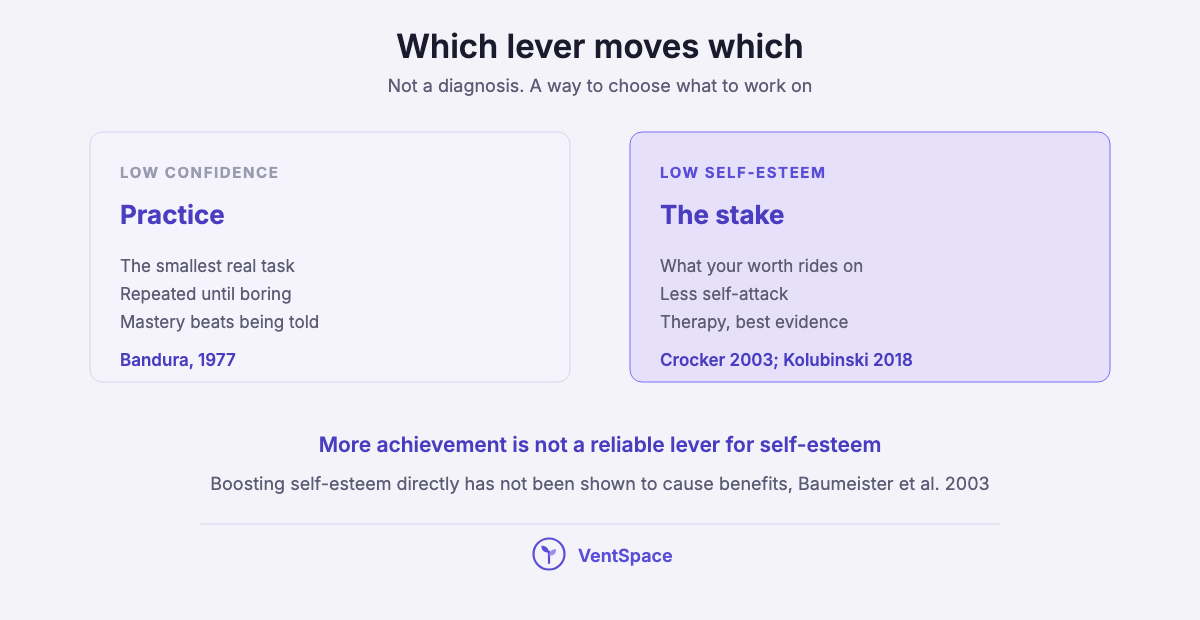
For low confidence, do the specific thing, small, and more than once. Bandura called personal mastery “especially influential” among the sources of confidence, because it rests on direct experience rather than on somebody telling you that you can, so pick the smallest real version of the task, the five-minute call rather than the keynote, and repeat it until it is boring.
For low self-esteem, more achievement is not a reliable lever. Not on its own. The evidence above says what you have staked your worth on matters more than the next result. Two places to look. One is self-compassion: in two studies, Neff and Vonk (2009) found it went with steadier self-worth that depended less on outcomes, though the two were about equal on happiness, its lead author originated the construct, and a 2023 meta-analysis (below) found the two overlap heavily. Its main questionnaire is also in an open dispute, and a meta-analysis in young people found the self-critical half carried the stronger signal, so easing the self-attack may matter more than adding kind words. The other is therapy, which has the clearest evidence we found for low self-esteem itself.
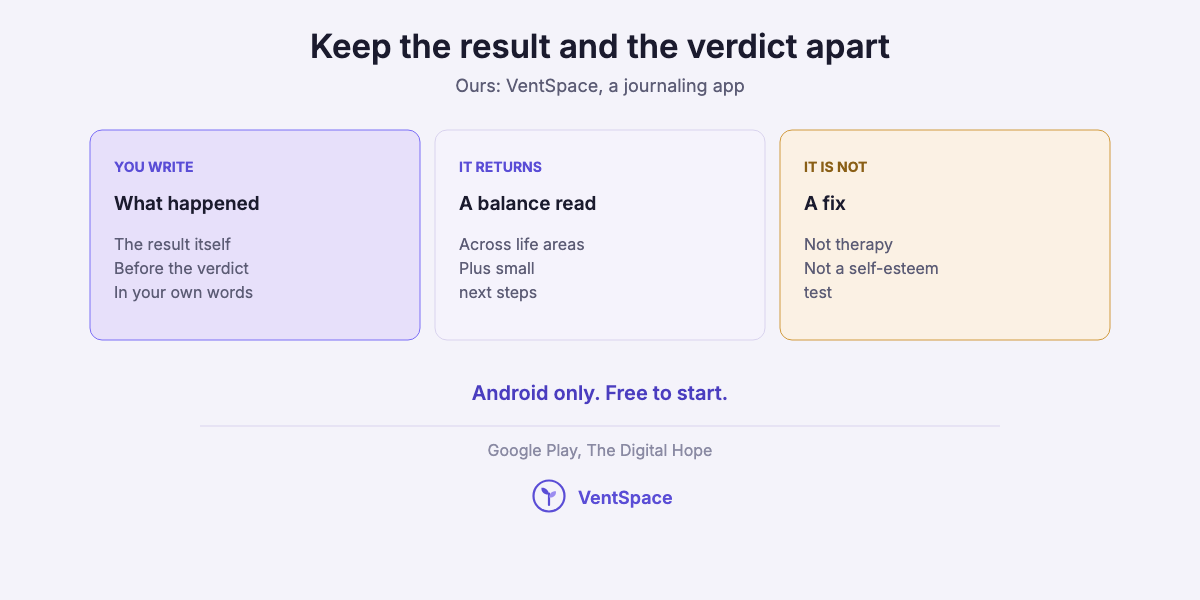
Writing down what happened, before what you concluded about yourself, keeps the result and the verdict apart. VentSpace is ours: a journaling app that turns what you write into a clear read on your life balance, plus small, doable next steps. Prefer to try it on your laptop first? VentSpace Live runs in your browser, free, with nothing to install. Our self-esteem journaling prompts are a free place to start.
Quick Summary
Q: How do I build self-esteem if achievements do not help?
A: Look at what your worth is staked on, not at the next result. Ease the self-criticism, and consider therapy, which has the clearest evidence for low self-esteem.
Where the line blurs
The two often move together. Doing well at things you care about can lift how you feel about yourself, as Baumeister’s line about occupational success allows, and nothing on this page is an argument against getting good at things you care about, because the confidence that comes with it is real and useful. The lift to self-esteem is just conditional.
The neighbor that causes the most confusion is self-compassion, and a 2023 meta-analysis of 76 studies and 35,537 people found self-esteem and self-compassion correlated at 0.65 and called them complementary rather than rival, though its authors are parties to the dispute about measuring self-compassion.
Quick Summary
Q: Is self-esteem the same as self-compassion?
A: No, but they overlap heavily. A meta-analysis of 76 studies found them correlated at 0.65 and described them as complementary. They are neighbors, not substitutes.
Questions people ask
Does confidence build self-esteem?
This is the myth worth correcting. Confidence grows with practice in a task. Self-esteem only follows when your worth is staked on that task, and then it falls when the task goes badly too, as the daily-grades study showed. More confidence is not the reliable route to more self-esteem.
Which comes first, self-esteem or self-confidence?
Neither, reliably. Baumeister’s review suggests success may boost self-esteem rather than the reverse, and Bandura’s work puts direct experience first for confidence. It depends what your worth rides on.
Is arrogance a sign of high self-esteem?
Not necessarily. Baumeister and colleagues describe high self-esteem as a mixed category that includes narcissistic and defensive people, and Neff and Vonk found self-esteem, but not self-compassion, associated with narcissism, on a self-compassion questionnaire whose scoring is disputed. Loud is not the same as high.
Is low self-esteem a mental illness?
It is not something a page can diagnose. The APA Dictionary notes that low self-esteem is a common symptom of depression, so if yours has stayed low for a long time or is getting in the way of work, sleep or relationships, that is worth taking to a doctor or therapist.
The short of it
Two things. Self-confidence answers to practice: do the thing, small, again. Self-esteem answers to what you have staked it on, and if that is performance, it tends to rise and fall with every result for as long as the stake stays.
And the honest part. No source we found gives a timeline for raising self-esteem, and the clearest evidence is for therapy rather than for any trick. Being good at things was never the problem.
It just was not the answer.
About this article

Written by
Sai Subramaniam
Founder, VentSpace
I write these guides because I have been where you are. I am working through my own hard seasons, and I share the things that actually helped me, so that anyone going through it has a steady companion close by instead of facing it alone. VentSpace is the app I built for exactly that: a journaling app that turns what you write into a clear read on your life balance, plus small, doable next steps toward feeling more like yourself.
This writing is honest and every claim is sourced, and it is not a substitute for professional care. If you are struggling, reaching out to a professional is a strong move, not a failure.
Explore VentSpaceTry VentSpace LiveHow this one was checked. Every factual claim traces to a named source, and the source is printed next to the claim rather than kept in a footnote. Quotes are pinned to the work they come from, with the year, the letter or the chapter where one exists. Where a widely repeated claim could not be traced, it was left out and the omission recorded. Where a figure is contested, both sides are printed.
No affiliate links, no paid placements, and nobody paid to appear here. Where we mention our own app, we say that it is ours, we state its limits, and we never position it as a substitute for care.
Reviewed: October 2026. Prices, platforms and product availability move quickly, and anything we could not verify at the time of writing is marked as unverified rather than turned into a number.
Corrections. If something here is wrong, we would rather know. Corrections are made in place, with a note saying what changed.