
You want to try CBT without booking anyone, and you want to start this week.
Here is the useful part. CBT techniques are small, specific practices, not a mindset and not positive thinking. You catch a thought, you test it, you change one thing you do, and you look back at what happened.
This page gives you twenty CBT exercises you can do on your own, each with steps, a time, and one honest line about what it will not do. It also says, plainly, when doing this alone is the wrong tool.
Quick Digest
– Catching the thought: the three-line catch, rate the feeling first, name the thinking trap, the hour-by-hour log, the downward arrow.
– Testing the thought: questions to ask a thought, the friend test, worst, best and most likely, a small behavioral experiment, the positive data log.
– Changing what you do: the pleasure and mastery list, two activities in the calendar, the values pick, break it down to five minutes, five-step problem solving.
– Worry, body, sleep and review: worry postponement with an if-then plan, the can-I-act-on-it sort, progressive muscle relaxation, the get-up rule for sleepless nights, the weekly review.
– Not on this list: exposure work for panic, OCD or trauma. That is done with a trained therapist.
If you need help right now
If you are in crisis or thinking about harming yourself, please reach out now. In the United States you can call or text 988 for the Suicide and Crisis Lifeline, or text HOME to 741741 for the Crisis Text Line. Outside the US, findahelpline.com lists the number where you are. These exercises are not built for that moment, and a person is.
What CBT asks you to do
CBT, cognitive behavioral therapy, works on the link between what you think, what you feel and what you do. Change one and the others can shift. The techniques are the tools for doing that on purpose.
Two of the main ones have been tested head to head against full CBT. A 2021 network meta-analysis of 45 studies and 3,382 adults with depression found no evidence of a difference between cognitive restructuring, behavioral activation and full CBT. All three beat usual care. Those were therapists delivering each one face to face, so the finding is about the techniques, not about doing them alone (Ciharova and colleagues, Journal of Consulting and Clinical Psychology).
What about doing them alone? A 2024 meta-analysis of 92 trials and 16,706 adults found self-guided programs for depressive symptoms moderately effective, at g = 0.53 after the program and g = 0.32 at six to twelve months (Tong and colleagues, eBioMedicine). Those were structured programs inside trials, not a page of exercises. And the protection is not equal for everyone. In a pooled analysis of 18 trials, guided internet self-help lowered the risk of getting worse overall, but for participants with less formal education that protection did not show up (Ebert and colleagues, Psychological Medicine, 2016).
So here is the honest position. For a mild patch, these exercises are worth practicing. For anything more, CBT with a therapist is the real route, and these are the practices a therapist would teach you and adjust as you go. The Association for Behavioral and Cognitive Therapies runs a directory of CBT clinicians at abct.org. If cost is what stops you, our guide on what helps when you can’t afford therapy goes through the options.
Quick Summary
Q: Can you do CBT techniques on your own?
A: Yes, for mild, everyday difficulty. Self-guided programs show moderate effects in trials, with a high risk of bias. That is not the same as CBT with a therapist, who chooses and adjusts the techniques with you.
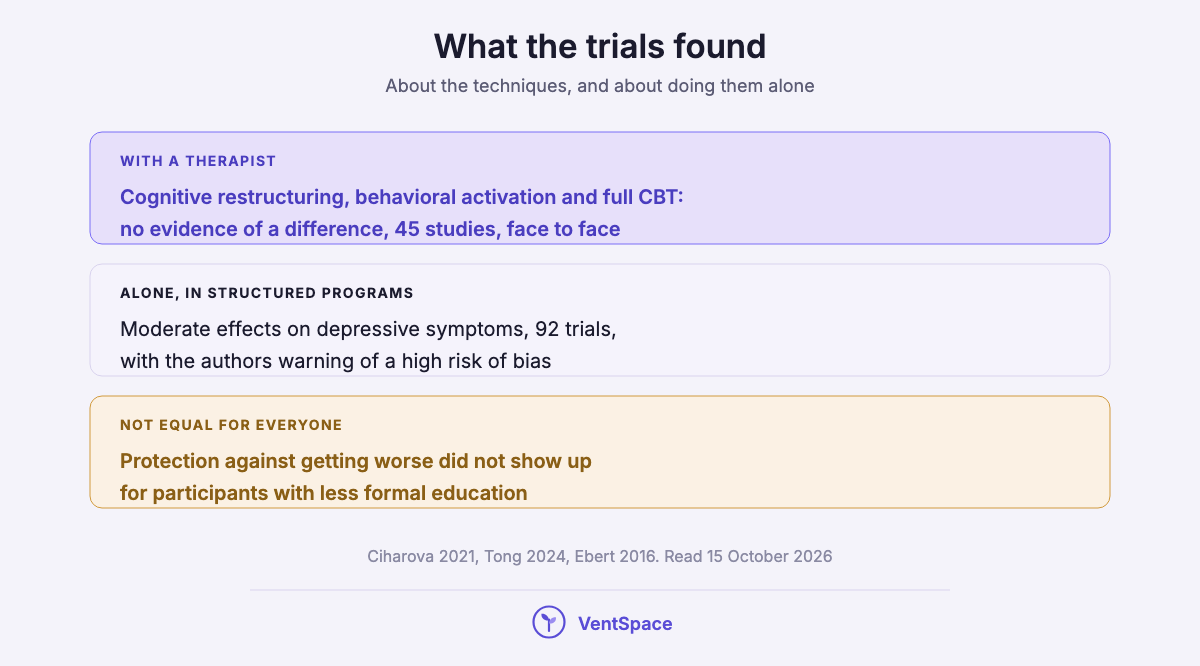
Insight The authors of the 2024 self-guided meta-analysis put their own warning in the abstract: “Existing trials on self-guided interventions are at high risk of bias, potentially overestimating treatment effects.” They also found the self-guided programs “less acceptable than control conditions” (Tong, Panagiotopoulou, Cuijpers and Karyotaki, eBioMedicine, 2024).
How we sorted them
We grouped the twenty exercises by the job they do, not by how clever they sound.
- The job: catching a thought, testing it, changing what you do, or handling worry, tension and sleep.
- What you can do alone: every exercise here needs paper, a phone or nothing. None needs a second person.
- Time: most take between two and twenty minutes a sitting, stated in each table.
- What is left out: exposure work for panic, OCD, phobias or trauma memories. It is a core CBT technique, and it is planned and paced with a trained therapist, so it is not on a self-practice page.
- The stop line: if an exercise leaves you feeling much worse, or brings up memories you were not ready for, stop and take it to a therapist instead.
Before you pick, ask yourself three things:
- What happened this week that you would most like to be different?
- Is the problem mostly a thought that keeps coming back, or a day that keeps not happening?
- How much time can you honestly give this, most days?
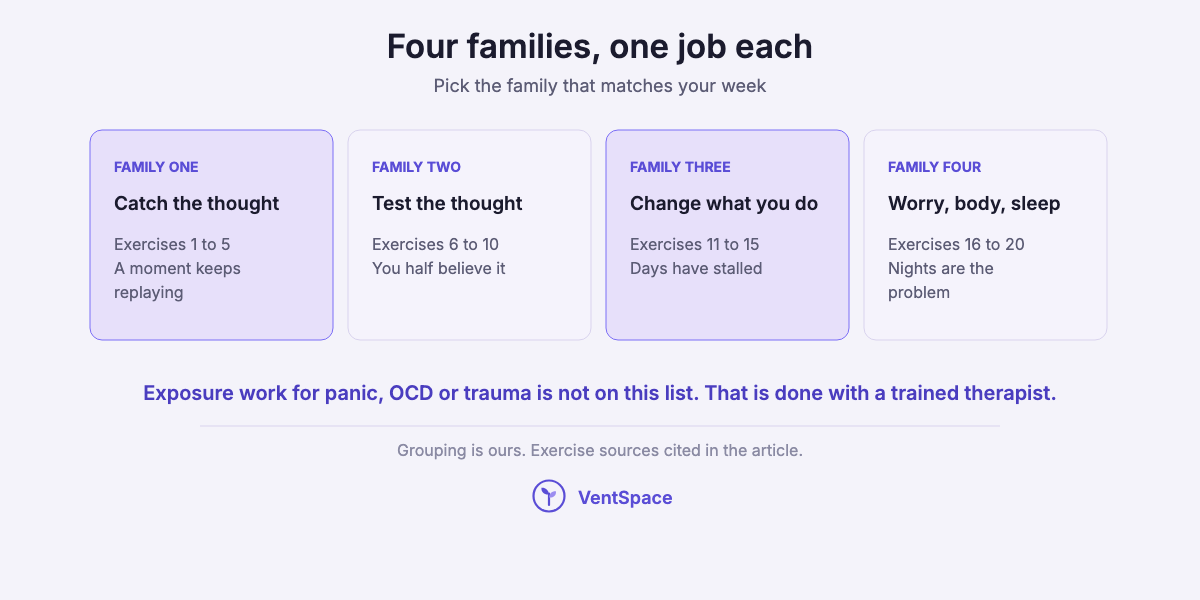
Why start with that? Because the families below answer different problems. A looping thought points to families one and two. A stalled week points to family three. Night worry and tension point to family four.
Quick Summary
Q: Which CBT exercise should I start with?
A: Start with the family that matches your week: catching and testing a thought if one keeps returning, changing what you do if days have stalled, and the worry and sleep exercises if nights are the problem.
Family one: catching the thought
Every CBT technique on this page starts with noticing. You cannot test a thought you have not caught.
1. The three-line catch
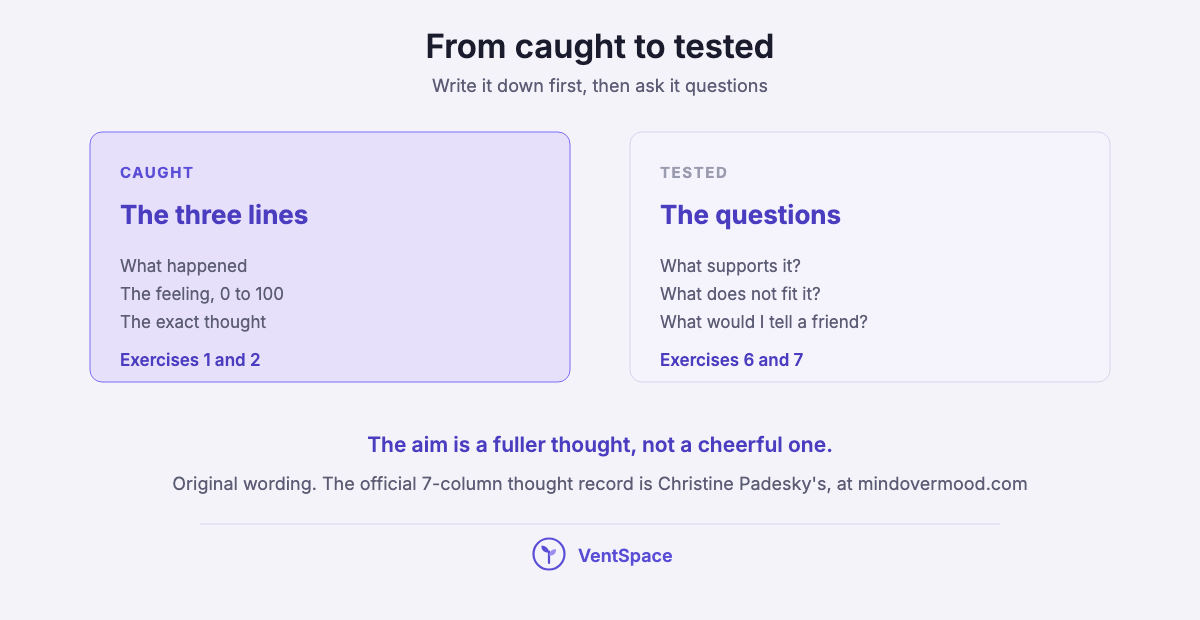
When a feeling lands hard, this exercise slows the moment into three parts: what happened, what you felt, and what went through your mind. That split is the first part of the thought records CBT therapists use. It is harder than it sounds, because the thought often arrives looking like a plain fact about the world. Can you write the thought as a sentence inside quotation marks? If you can, you have caught it. Nothing needs to change yet. Catching comes first, and changing comes later in the week.
Do this:
1. Within an hour of a sharp feeling, write one line: where you were and what happened, facts only.
2. Write a second line: the feeling, in one word.
3. Write a third line: the exact thought, in quotation marks, the way it sounded in your head.
4. Close the notebook. Do not argue with it today.
| Time | 3 minutes |
| You need | Paper or a notes app |
| Best for | A day where one moment keeps replaying |
| What it will not do | Change the feeling. It gives you something specific to work with later |
2. Rate the feeling first
Before you argue with a thought, find out how strong the feeling behind it is. This page asks you to rate it from 0 to 100. The number is not a score and it means nothing about you. It is a marker you compare against later, inside the same entry. If a feeling drops from 80 to 60 after you work on the thought, something moved. Did it? You will only know if the first number is written down. There may be more than one feeling in one moment. Name each one and rate each one separately.
Do this:
1. Take an entry from exercise 1.
2. Under the feeling, write every other feeling you can find in that moment.
3. Give each a number from 0 to 100 for how strong it was at the time.
4. Circle the strongest one. That is the one to work on first.
| Time | 2 minutes |
| You need | Your three-line catch |
| Best for | Moments that felt like a blur of everything |
| What it will not do | Measure anything outside your own entry. It is a self-rating for comparison, not an assessment |
3. Name the thinking trap
Some thoughts follow familiar shapes. David Burns’s book Feeling Good popularized a list of ten “cognitive distortions”, including all-or-nothing thinking, mind reading, the fortune teller error, should statements and labeling. Naming the shape is a way of treating the thought as a thought rather than as a verdict. Which shape does yours have? You do not need to be sure. A guess is enough to create a little distance. Keep the list short. Five names you remember beat ten you have to look up.
Do this:
1. Write these five on a card: all-or-nothing, mind reading, fortune telling, should, labeling.
2. Take the thought from your catch and read it slowly.
3. Write the name that fits best beside it, or two if it fits both.
4. Write one line in plain words: “This is my mind doing ___ again.”
| Time | 3 minutes |
| You need | A card or the back of your notebook |
| Best for | Thoughts you have had many times before |
| What it will not do | Prove the thought false. A thought can fit a trap and still be partly true |
4. The hour-by-hour log
This is the noticing exercise for days rather than thoughts. For a few days you write down what you did each hour and how your mood was, from 0 to 10. Behavioral activation, one of the two techniques that performed like full CBT, starts with exactly this kind of monitoring. What does the log show? It can show which hours are flat and which small things lifted the number, and those are the clues for family three. Keep the entries short. A word or two per hour is enough.
Do this:
1. Draw a column of hours from waking to bed, for three days.
2. Each hour, or at lunch and in the evening if hourly is too much, write what you were doing in two or three words.
3. Beside each one, rate your mood from 0 to 10.
4. On day four, circle the three highest numbers and the three lowest.
| Time | 5 minutes a day for three days |
| You need | One page per day |
| Best for | Weeks that feel the same all the way through |
| What it will not do | Tell you why you feel low. It shows patterns, not causes |
5. The downward arrow
Some thoughts sit on top of a bigger belief. This exercise, which Burns describes as the vertical arrow technique, asks one question again and again: if that were true, what would it mean? You follow the answers down until you reach a sentence about yourself or the world that feels old and heavy. That sentence may be the real thing you are arguing with. Is it something you would say out loud to anyone? This one can bring up painful beliefs quickly, so go slowly, and stop at any point that feels like too much.
Do this:
1. Write a thought from your catch at the top of a page.
2. Under it, write: “If that were true, what would it mean?” and answer in one line.
3. Ask the same question of that answer. Repeat three or four times.
4. Stop when the answer stops changing, or when it feels too heavy.
5. Underline the last line. Do not work on it today.
| Time | 10 minutes |
| You need | A quiet place and a page |
| Best for | A thought that seems small but hits hard |
| What it will not do | Change a long-held belief on its own. Beliefs like these are worth taking to a therapist |
Quick Summary
Q: What is the first step in CBT on your own?
A: Catching the thought. Write down what happened, the feeling and its strength, and the exact thought, before you try to change anything.
Family two: testing the thought
Once a thought is on paper, you can ask whether it holds up. The goal is not a cheerful replacement. It is a more complete version.
6. Questions to ask a thought
You can test a thought by asking it questions rather than arguing with it. On paper, a question gives the thought room to be partly wrong, which an argument rarely does. What would you have to know to be sure this thought is true? What have you seen that does not fit it? Has it ever been wrong before? The answers do not need to be kind. They need to be accurate. If a question produces nothing, skip it and move to the next one on the list.
Do this:
1. Take one caught thought.
2. Write and answer: “What is the evidence for this?”
3. Write and answer: “What is the evidence against it?”
4. Write and answer: “What would I say if I knew all of this about someone else?”
5. Write one fuller sentence that includes both sides.
| Time | 10 minutes |
| You need | Your catch from exercise 1 |
| Best for | A thought you half believe |
| What it will not do | Give you a new belief overnight. The fuller sentence may feel weak at first |
For a fuller version, the original 7-column thought record is Christine Padesky’s, from Mind Over Mood. Her site says it was “the first Thought Record to include evidence columns and an alternative/balanced thoughts column”, and it asks people to use the official form there rather than copies, which is why we have not reproduced it.
7. The friend test
David Burns calls a version of this the double-standard technique. You talk to yourself in a way you would never talk to a friend, and the gap is information. Picture someone you care about, in the same situation, saying your thought about themselves. What would you say back to them? Write that down, in the words you would use, and then read it as if it were addressed to you. It may sound too generous at first. Keep the parts that are also true, and drop the parts that are only kind.
Do this:
1. Write your thought, word for word.
2. Write a friend’s name above it, as if they had said it about themselves.
3. Write three sentences you would say to them.
4. Cross out their name and write yours.
5. Underline the one sentence you can believe a little.
| Time | 5 minutes |
| You need | Paper and one person in mind |
| Best for | Harsh self-talk after a mistake |
| What it will not do | Make the harsh voice go away. It gives you a second voice to set beside it |
8. Worst, best, most likely
When you are worried, the worst outcome can take up the whole page. This exercise makes you write the other two outcomes as well, so the worst case is no longer the only one on the page. Therapists sometimes call it decatastrophizing. What is the most likely outcome, honestly, given what usually happens? And if the worst did happen, what would you do in the first hour? That last question matters most. The answer may be more manageable than the dread suggested when you first wrote it down.
Do this:
1. Write the situation you are worried about in one line.
2. Write the worst outcome you can picture.
3. Write the best outcome you can picture.
4. Write the most likely outcome, based on what has happened before.
5. Under the worst one, write the first two things you would do if it came true.
| Time | 10 minutes |
| You need | A page split into three rows |
| Best for | Dread about a specific event coming up |
| What it will not do | Guarantee the worst will not happen. It makes the plan visible, not the future |
9. A small behavioral experiment
Some thoughts are predictions, and predictions can be tested. “If I ask, they will say no.” “If I leave early, everyone will notice.” You write the prediction, rate how sure you are, try a small, safe version, and write what happened. In a 2003 study of trainee CBT therapists who practiced both techniques on themselves, behavioral experiments were rated more powerful and compelling than thought records, and the author noted “the particular importance of the therapist’s role” in them (Bennett-Levy, Behavioural and Cognitive Psychotherapy). So keep yours small, and choose something that carries no real risk.
Do this:
1. Write the prediction as a sentence: “If I do X, then Y will happen.”
2. Rate how sure you are, from 0 to 100.
3. Pick the smallest safe test you can do this week, and do it.
4. Write what happened, and rate your prediction again.
| Time | 10 minutes to plan, plus the test |
| You need | One prediction and a low-stakes chance to test it |
| Best for | Social worries and “they will think” thoughts |
| What it will not do | Replace exposure therapy. Fears about panic, health, contamination or trauma belong with a therapist |
10. The positive data log
A belief like “I always get it wrong” ignores the days you did not. The positive data log, one of the methods Christine Padesky described for changing core beliefs, collects the evidence the old belief filters out. Each day you write down one small thing that fits a kinder, more accurate belief. It feels slow, and that is fine, because the point is the pile rather than any single entry. Which belief would you want evidence for? Choose one that is believable, not perfect. “I can handle some things” works better than “I am great”.
Do this:
1. Write the old belief at the top of a page.
2. Write a new, believable version beside it.
3. Each evening for two weeks, write one thing from that day that fits the new version.
4. At the end, read the whole list in one go.
| Time | 2 minutes a day for two weeks |
| You need | One page kept somewhere you will see it |
| Best for | A belief about yourself that has run for years |
| What it will not do | Erase the old belief. It builds a counterweight, slowly |
Quick Summary
Q: How do you challenge a negative thought in CBT?
A: Ask it questions on paper, compare it with what you would tell a friend, write the worst, best and most likely outcomes, and test predictions with a small, safe experiment.
Family three: changing what you do
When days stall, waiting to feel like it rarely works. Behavioral activation turns that around: you act first, in small steps, and notice what happens to your mood afterward.
11. The pleasure and mastery list
Low weeks shrink the list of things you do down to the essentials. This exercise rebuilds it with two kinds of activity: things that bring a little pleasure and things that bring a sense of getting something done. The mastery and pleasure technique is usually traced to Aaron Beck’s cognitive therapy for depression. A walk might be pleasure. Answering one email might be mastery. What used to give you either, before this stretch? Small counts here. Five minutes outside counts as an activity, and so does washing one pan.
Do this:
1. Draw two columns: pleasure and mastery.
2. List five small things in each, including ones you have stopped doing.
3. Mark each with how hard it would be this week: easy, medium, hard.
4. Circle two easy ones, one from each column.
| Time | 10 minutes |
| You need | Paper, and your hour-by-hour log if you have one |
| Best for | Weeks where everything feels like a chore |
| What it will not do | Make the activities feel good straight away. The mood often follows later, if at all |
12. Two activities in the calendar
A list is not a plan. This exercise puts two activities into a specific day and time, the way an appointment goes in. Behavioral activation was found more effective than control conditions on depression symptoms in a 2014 meta-analysis of 26 trials, though most of the studies were low quality and follow-up was short (Ekers and colleagues, PLoS One). Those were treatment trials. Doing it alone is a lighter version of the same idea, without the evidence attached. When will you do the first one? Pick a time, a place and a start cue.
Do this:
1. Take the two activities you circled in exercise 11.
2. Put each in your calendar with a day, a time and a place.
3. Rate your mood from 0 to 10 just before and just after.
4. Write one line afterward about what you noticed.
| Time | 5 minutes to plan, plus the activities |
| You need | A calendar you check every day |
| Best for | Days that slip away without anything in them |
| What it will not do | Work every time. Some activities will not lift the number, and that is still information |
13. The values pick
Some activities fill time without meaning anything. The revised brief behavioral activation manual by Carl Lejuez and colleagues organizes activities by life areas and values, so what you schedule connects to what matters to you. Ask yourself what kind of friend, worker, partner or neighbor you want to be. Then ask what one small action this week would look like from that person. Does it fit in a single afternoon? If not, shrink it until it does, because a smaller action that happens beats a bigger one that waits.
Do this:
1. Write four life areas that matter to you, such as relationships, work, health and home.
2. Under each, write one sentence about what you value there.
3. Under each value, write one action you could do in under an hour.
4. Schedule one of them this week.
| Time | 15 minutes |
| You need | Paper and a calendar |
| Best for | Feeling busy but empty |
| What it will not do | Settle big life questions. It finds one small step that points the right way |
14. Break it down to five minutes
A task that feels too big does not get started. Health guides call this successive approximation: you break the task into steps so small that the first one is almost silly. “Clean the apartment” becomes “clear the table.” “Write the report” becomes “open the file and write the title.” What is the first step that would take five minutes or less? Do only that, and decide afterward whether to do the next one. Stopping after the first step still counts as having done the exercise.
Do this:
1. Write the task you keep avoiding.
2. Break it into five to ten steps, each under fifteen minutes.
3. Shrink the first step until it takes five minutes or less.
4. Set a timer and do only that step.
5. Tick it off, then decide about step two.
| Time | 10 minutes to plan, 5 minutes to start |
| You need | Paper and a timer |
| Best for | A task that has sat untouched for days |
| What it will not do | Make the task enjoyable. It makes it startable |
15. Five-step problem solving
Some low moods sit on top of a real, practical problem. Problem solving turns the problem into a plan. Problem-solving therapy for adult depression showed effects comparable to other psychotherapies in a 2018 meta-analysis, at g = 0.34 in the nine trials with low risk of bias, as a therapy delivered in trials (Cuijpers and colleagues, European Psychiatry). The self-practice version is simpler. Which problem, if it moved even a little, would make the biggest difference this week? Start with that one, and keep it to something you can influence.
Do this:
1. Write the problem as specifically as you can, in one sentence.
2. Write every possible solution you can think of in five minutes, without judging any.
3. Pick one, and write its main upside and downside.
4. Plan the first step: what, when and where.
5. Next week, write how it went and pick again if needed.
| Time | 20 minutes |
| You need | Paper and one practical problem |
| Best for | Money, work or home problems that keep you up |
| What it will not do | Solve problems you cannot influence. For those, family four is a better fit |
Quick Summary
Q: What is behavioral activation?
A: A CBT technique where you schedule small, meaningful activities and track your mood before and after, instead of waiting until you feel like doing them.
Insight In a 2014 meta-analysis of 26 randomized trials and 1,524 people, behavioral activation beat control conditions on depression symptoms after treatment. The authors noted that study quality was low in most trials and follow-up periods were short (Ekers, Webster, Van Straten, Cuijpers, Richards and Gilbody, PLoS One).
Family four: worry, body, sleep and review
The last five are for the nights, the tension and the weekly look back. The review is the one that makes the other nineteen useful.
16. Worry postponement with an if-then plan
Worry postponement asks you to move worry to a set time each day instead of fighting it whenever it arrives. A 2025 randomized trial of 186 adults over 14 days found that adding a specific “if-then” plan to postponement cut daily worry by about 15 minutes compared with postponement alone, but none of the approaches improved sleep (McCarrick and colleagues, Psychology and Health). So the plan matters. What will you say to yourself when a worry shows up at 3 p.m.? Write that sentence now, before you need it, so it is ready to use.
Do this:
1. Choose a 15-minute worry time, the same each day.
2. Write your if-then plan: “If a worry comes, then I will write one word on my list and return to what I was doing.”
3. Keep the list with you during the day.
4. At worry time, go through the list. When the 15 minutes end, stop.
| Time | 15 minutes a day |
| You need | A small list and a timer |
| Best for | Worry that interrupts the whole day |
| What it will not do | Improve sleep, on the trial evidence. Pair it with exercise 19 for nights |
17. The can-I-act-on-it sort
Not all worries are the same kind. Some are about a problem you can do something about this week. Others are about things you cannot control or that may never happen. We found no trial that tested this sort on its own, so treat it as a sorting habit rather than a treatment. Which pile does your worry belong in? If you can act, it goes to exercise 15. If you cannot, it goes to worry time or to the worst, best and most likely page.
Do this:
1. Write down every worry on your mind, one per line.
2. Beside each, write A for “I can act on part of this” or N for “I cannot, right now.”
3. For each A, write the first small action and when you will do it.
4. Move every N to tomorrow’s worry-time list.
| Time | 10 minutes |
| You need | Paper and a pen in two colors, if you have them |
| Best for | A head full of worries all at once |
| What it will not do | Make the N pile disappear. It stops it from blocking the A pile |
18. Progressive muscle relaxation
Tension often builds without you noticing. Progressive muscle relaxation tightens and then releases one muscle group at a time, so you learn what letting go feels like. The American Academy of Sleep Medicine’s 2021 guideline lists it among relaxation methods it suggests as a single therapy for chronic insomnia, alongside abdominal breathing and autogenic training (Edinger and colleagues, Journal of Clinical Sleep Medicine). Where do you hold tension most: jaw, shoulders, hands? Start there. If you have an injury or pain in a muscle group, skip that group entirely.
Do this:
1. Sit or lie somewhere quiet.
2. Clench your hands into fists for about five seconds, then let go for about fifteen.
3. Move on to arms, shoulders, face, stomach, legs and feet, one group at a time.
4. Finish with three slow breaths and notice which areas feel different.
| Time | 15 minutes |
| You need | A quiet place, nothing else |
| Best for | Evenings when your body is still wound up |
| What it will not do | Work the first time for everyone. It is a skill that gets easier with practice |
19. The get-up rule for sleepless nights
Stimulus control is designed to break the link between your bed and being awake. The AASM guideline suggests it, and its instructions are to go to bed only when sleepy, get out of bed when unable to sleep, use the bed for sleep and sex only, wake at the same time every morning, and avoid daytime naps. The same review found that sleep hygiene alone was not identified as an effective single therapy. So the get-up rule does something a tidy bedroom does not. What will you do when you get up? Decide now, and keep it dull and dimly lit.
Do this:
1. Pick one fixed wake-up time for every day this week, weekends included.
2. Go to bed only when you feel sleepy, not just tired.
3. If you cannot sleep and it feels like a long time, get up and go to another room.
4. Do something quiet in dim light. Go back to bed when sleepy again.
| Time | Every night for two weeks |
| You need | A fixed wake time and a dull activity |
| Best for | Nights spent awake and worrying in bed |
| What it will not do | Replace a doctor. Long-running insomnia, snoring or shift work are worth raising with one |
20. The weekly review
CBT is built on trying something, then looking at what happened. In a 2010 meta-analysis of 23 studies and 2,183 people, how much of the agreed between-session work people did was associated with how therapy went, at r = .26 (Mausbach and colleagues, Cognitive Therapy and Research). That is a correlation from therapy, not proof that reviewing alone helps. But without a review, the other exercises become a pile of pages. What did you try this week, and what happened? Fifteen minutes on a set day is enough.
Do this:
1. Pick a day and time each week, and keep it.
2. Read back through the week’s entries.
3. Write three lines: what I tried, what happened, what surprised me.
4. Choose one exercise to keep and one to drop for next week.
| Time | 15 minutes a week |
| You need | The week’s entries |
| Best for | Anyone using more than one exercise |
| What it will not do | Tell you whether you need more help. If things are not improving, or getting worse, that is a reason to see someone |
Quick Summary
Q: What CBT techniques help with worry and sleep?
A: Worry postponement with a specific if-then plan, sorting worries into ones you can act on and ones you cannot, progressive muscle relaxation, and the stimulus-control rule of getting up when you cannot sleep.
Insight The 2021 American Academy of Sleep Medicine review stated that “Sleep hygiene alone was not identified as an effective single-component therapy” in the reports it examined, while it suggested stimulus control and relaxation therapy as single-component therapies (Edinger and colleagues).
All twenty side by side
| Exercise | What it is for | Time | Difficulty | Do it when |
|---|---|---|---|---|
| 1. The three-line catch | Catching the thought | 3 min | Easy | A moment keeps replaying |
| 2. Rate the feeling first | Knowing how strong it is | 2 min | Easy | Everything felt like a blur |
| 3. Name the thinking trap | Seeing the shape of a thought | 3 min | Easy | A familiar thought returns |
| 4. The hour-by-hour log | Seeing your days | 5 min a day | Easy | Weeks feel the same |
| 5. The downward arrow | Finding the belief underneath | 10 min | Hard | A small thought hits hard |
| 6. Questions to ask a thought | Testing it | 10 min | Medium | You half believe it |
| 7. The friend test | Softening self-talk | 5 min | Easy | After a mistake |
| 8. Worst, best, most likely | Facing dread | 10 min | Medium | Before a specific event |
| 9. A small behavioral experiment | Testing a prediction | 10 min plus test | Medium | “They will think” worries |
| 10. The positive data log | Building a new belief | 2 min a day | Easy | A belief that has run for years |
| 11. The pleasure and mastery list | Rebuilding your week | 10 min | Easy | Everything feels like a chore |
| 12. Two activities in the calendar | Acting before feeling like it | 5 min plus activities | Medium | Days slip away |
| 13. The values pick | Doing what matters | 15 min | Medium | Busy but empty |
| 14. Break it down to five minutes | Starting a stuck task | 15 min | Easy | A task sits untouched |
| 15. Five-step problem solving | Turning a problem into a plan | 20 min | Medium | A practical problem keeps you up |
| 16. Worry postponement | Containing daytime worry | 15 min a day | Medium | Worry interrupts the day |
| 17. The can-I-act-on-it sort | Sorting worries | 10 min | Easy | Many worries at once |
| 18. Progressive muscle relaxation | Releasing tension | 15 min | Easy | Your body is wound up |
| 19. The get-up rule | Nights awake in bed | Nightly | Hard | You lie awake worrying |
| 20. The weekly review | Learning from the week | 15 min a week | Easy | You use more than one exercise |
Where to keep the entries
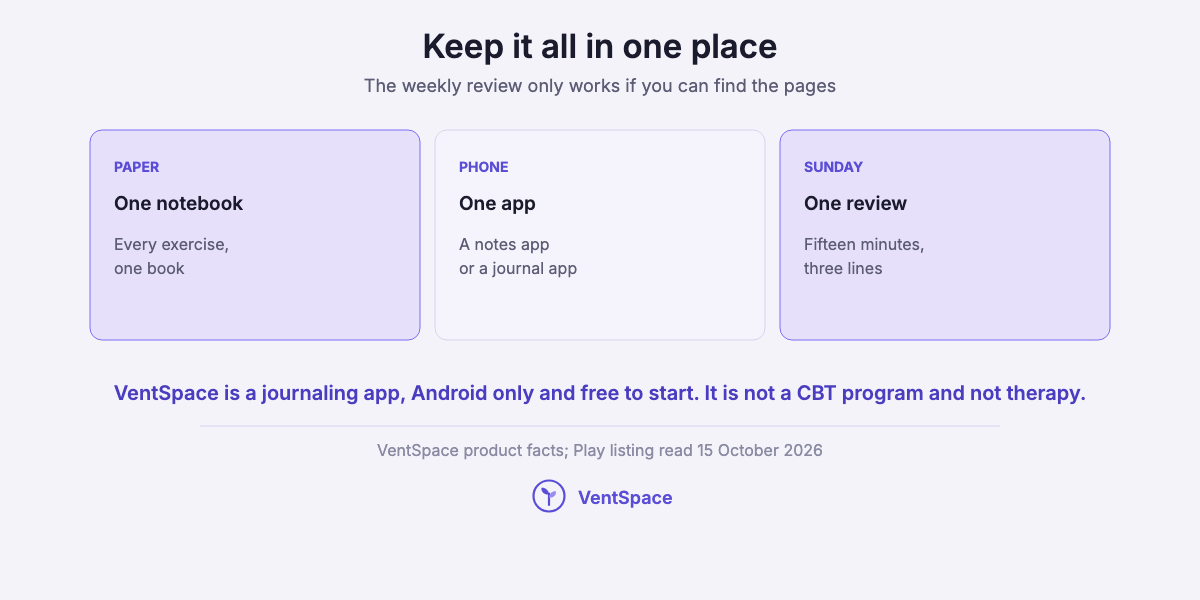
Most of these exercises produce a page, and the weekly review only works if the pages are in one place. A single notebook is enough. A notes app works too.
If you would rather keep them on your phone, VentSpace is a journaling app that turns what you write into a clear read on your life balance, plus small, doable next steps. It is ours, so read this as a declared interest. It is not a CBT program and not therapy, it is Android only and free to start as of October 2026, and there is no published evidence on its outcomes. Not on Android, or at a desk? VentSpace Live runs in your browser, free, with nothing to install. The exercises on this page work on paper, as they are.
For a wider look at what writing can and cannot do next to therapy, see therapy vs journaling.
Questions people ask
Can you do CBT on yourself?
You can practice CBT techniques on your own, and self-guided programs show moderate effects in trials, with a high risk of bias. That is not the same as CBT with a therapist, who helps you choose, pace and adjust the techniques. For anything more than a mild patch, a therapist is the better route.
Is CBT just positive thinking?
No. CBT asks for a more accurate thought, not a cheerful one. Several exercises here, like the questions in exercise 6, expect you to find evidence on both sides. And the B in CBT stands for behavioral: changing what you do, not only what you think.
How long does it take for CBT exercises to help?
We found no single figure we could stand behind for self-practice. Most exercises here are designed to be repeated over at least two weeks and looked at in a weekly review. If nothing has shifted after a few weeks, or things are getting worse, that is a reason to talk to someone.
What is a thought record?
A written page where you note a situation, the feeling and how strong it was, the thought, the evidence for and against it, and a fuller alternative. Exercises 1, 2 and 6 build one in pieces. The original 7-column version is Christine Padesky’s, available on the Mind Over Mood site.
Do I need a worksheet?
No. A blank page works for every exercise here. Worksheets are useful if they help you remember the steps, and the official ones are worth using over copies.
Two things to take with you
First, pick one family and one exercise, and do it for two weeks before you add another. The weekly review is what tells you whether it is worth keeping.
Second, this is practice, not treatment. If the difficulty is more than a mild patch, or it is not easing after a few weeks of trying, a CBT therapist is the real route. They will teach you these same techniques, and they will notice the things a page cannot. Start with one exercise this week and one look at the ABCT directory.
About this article

Written by
Sai Subramaniam
Founder, VentSpace
I write these guides because I have been where you are. I am working through my own hard seasons, and I share the things that actually helped me, so that anyone going through it has a steady companion close by instead of facing it alone. VentSpace is the app I built for exactly that: a journaling app that turns what you write into a clear read on your life balance, plus small, doable next steps toward feeling more like yourself.
This writing is honest and every claim is sourced, and it is not a substitute for professional care. If you are struggling, reaching out to a professional is a strong move, not a failure.
Explore VentSpaceTry VentSpace LiveHow this one was checked. Every factual claim traces to a named source, and the source is printed next to the claim rather than kept in a footnote. Quotes are pinned to the work they come from, with the year, the letter or the chapter where one exists. Where a widely repeated claim could not be traced, it was left out and the omission recorded. Where a figure is contested, both sides are printed.
No affiliate links, no paid placements, and nobody paid to appear here. Where we mention our own app, we say that it is ours, we state its limits, and we never position it as a substitute for care.
Reviewed: October 2026. Prices, platforms and product availability move quickly, and anything we could not verify at the time of writing is marked as unverified rather than turned into a number.
Corrections. If something here is wrong, we would rather know. Corrections are made in place, with a note saying what changed.