
“We tell ourselves stories in order to live.”
Joan Didion, The White Album, 1979
There is a particular hope that brings people to this comparison, and it is worth naming kindly, because most of us have held it. We have been writing things down for a while. Somebody has suggested, once or twice, that we might talk to someone. And we would quite like the notebook to count.
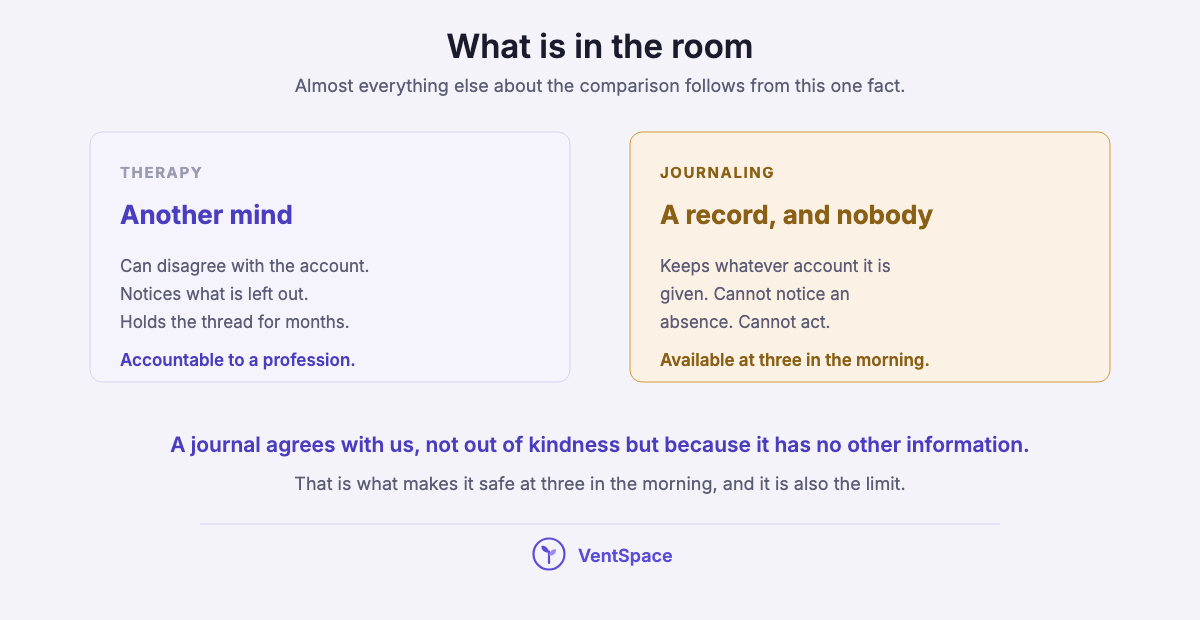
So here is the distinction, stated at the start rather than at the end. Therapy is a relationship with another mind. Journaling is a record with nobody in it. Nearly everything else about this comparison follows from that single structural fact, and almost none of it is about how serious our situation is.
That framing matters because the usual one is a hierarchy, with therapy at the top for the large difficulties and a journal underneath for the small ones. We think that is the wrong shape. They are two different jobs, and a person can need both in the same week.
One declaration before anything else. This page is published by a company that makes a journaling app. We are an interested party. We would rather say so than perform a neutrality we do not have.
The short version
The difference is structural, not a matter of severity. One has another mind in it. One does not.
The most investigated variable in psychotherapy research is the relationship, and a notebook cannot contain one.
A page cannot disagree with us. That is what makes it safe at three in the morning and what limits it.
Journaling’s own numbers are printed here in full, including the population where the effect was not statistically significant.
Therapy works, and the evidence for that is on a separate page rather than summarised away in a line here.
The two jobs stack. If you are weighing one against the other, the honest answer is usually both.
What therapy actually is
It is easy to describe therapy by its techniques, and that description turns out to explain less than we expect. Where researchers compare established therapies directly against one another, the differences are consistently small or absent, and what the approaches share is that two people meet regularly and one of them is paying attention to the other in a way almost nobody else in that person’s life is being paid to do.
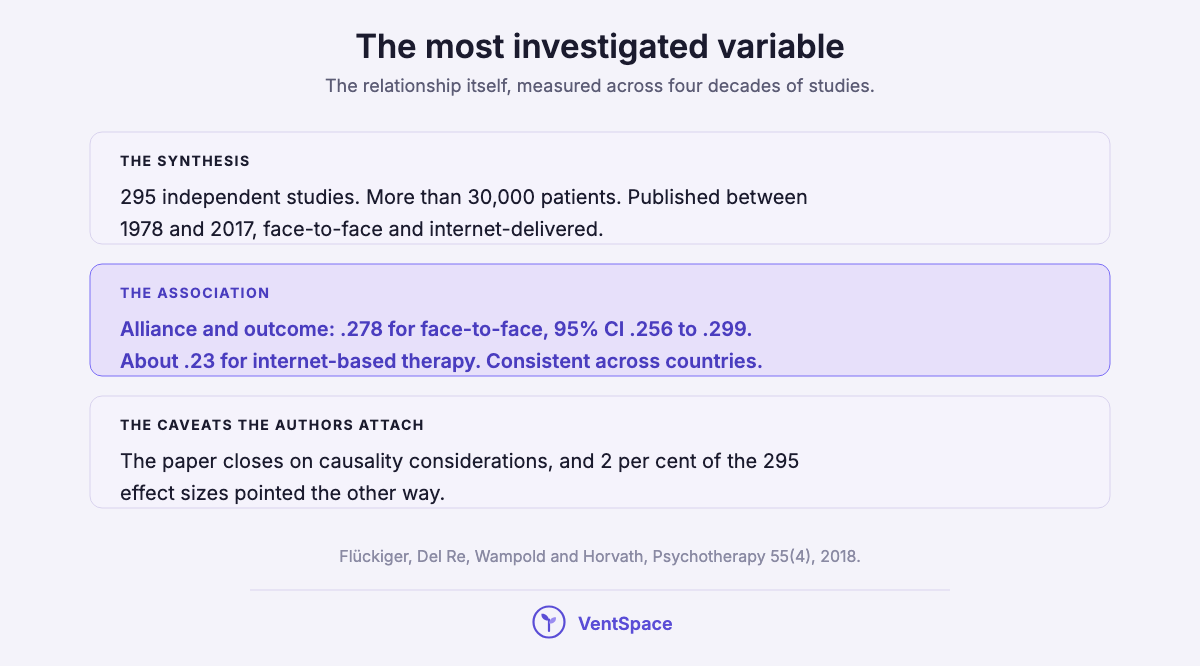
That relationship has a name in the literature. It is called the therapeutic alliance, and in 2018 Flückiger, Del Re, Wampold and Horvath pulled together 295 independent studies covering more than 30,000 patients, published across four decades, and found the association between the alliance and the outcome holding steady across measures, countries, treatment approaches and who was doing the rating.
That therapy helps is not in dispute here and we are not going to relitigate it in a paragraph. The outcome evidence, including the parts that are less flattering, is argued properly in our piece on whether therapy is worth it. What matters for this comparison is narrower. The best-evidenced active ingredient is a relationship, and a relationship is the one thing a page of writing cannot be.
Quick Summary
Q: What is the therapeutic alliance?
A: The working relationship between therapist and client, and one of the most investigated variables in psychotherapy research. A 2018 meta-analysis of 295 studies covering more than 30,000 patients found the association between alliance and outcome held consistently across treatment approaches, measures, patient characteristics and countries.
What journaling actually is
Journaling has no clinical definition, which surprises people who have been told it is evidence-based. What has been studied carefully is a narrower and stranger thing called expressive writing: a protocol in which participants write about a difficult experience for fifteen to twenty minutes, on three to five occasions, and then stop. The notebook we keep by the bed is not that. It is open-ended, it has no endpoint, and nobody has ever measured it.
What journaling is, honestly described, is a place to put an account of our life where it can be looked at again. That is a real and underrated thing. It is also, by design, a place where the account is never contested, and we will come back to that, because it is both the feature and the limit.
Quick Summary
Q: Is journaling the same as therapy?
A: No. Journaling has no clinical definition. The research most often cited for it concerns expressive writing, a short protocol of fifteen to twenty minutes on three to five occasions, which is a different activity from an open-ended habit. Journaling is a record of an account. Therapy is a relationship with someone who responds to it.
The two side by side
| Therapy | Journaling | |
|---|---|---|
| What is in the room | Another mind, trained and paying attention | An account of ours, and nobody |
| What it can notice | What we leave out, and the subject we approach and then move away from | What we chose to write down |
| When we hand it an account it does not believe | It asks about it | It records it |
| When it is available | At the appointed hour | At three in the morning, immediately |
| What it is accountable to | A profession, a licensing body, a person who can be asked | Us alone |
| Where the evidence points | A relationship as the most investigated correlate of outcome | A short protocol with modest effects that vary by who is writing |
What the research says is doing the work in therapy
The number itself is worth knowing, because it is unusually stable for this field. In the 2018 synthesis the overall alliance-outcome association for face-to-face psychotherapy was .278, with a confidence interval of .256 to .299, and the figure for internet-delivered therapy came out at roughly the same place, about .275 across 23 studies. Nothing in psychology is tidy, and this is about as close to tidy as the literature gets.
Two honest caveats belong with it, and they belong here rather than in a footnote. The first is that the authors close their paper on causality considerations, which is the careful way of saying that a good relationship and a good outcome travel together without the study being able to prove which one produced the other. The second is that 2 per cent of those 295 effect sizes pointed the other way. Most things that are true of thousands of people are not true of everyone, and a page that hid that would be asking us to trust it less.
Still, the shape of the finding is clear enough to organise a decision around. What the evidence keeps pointing at is not a technique we could copy into a notebook. It is the presence of somebody who is on our side and is nonetheless a separate person, with their own view of what we have just said, and who will still be there next Thursday holding both.
Quick Summary
Q: What makes therapy work?
A: The most consistently measured correlate of outcome is the alliance between therapist and client, with an association of about .278 in a 2018 meta-analysis of 295 studies. The authors treat causality carefully and note that a small minority of effect sizes ran the other way, but the relation holds across approaches, measures and countries.
Insight: the researchers' own framing
“The alliance continues to be one of the most investigated variables related to success in psychotherapy irrespective of theoretical orientation.” Flückiger, Del Re, Wampold and Horvath, Psychotherapy 55(4), 2018. Irrespective of theoretical orientation is the phrase to keep. Whatever school a therapist trained in, the relationship keeps turning up as the part that travels.
What a page cannot do, however well we write in it
A journal agrees with us. Not out of kindness, but out of physics: it has no other information. Whatever account we arrive with is the account it keeps, and if that account is subtly wrong, or self-flattering in a way we cannot see, or unfair to us in a way we have practised for years, the notebook will hold it in our own handwriting and hand it back next month looking like evidence.
It also cannot notice an absence, and absences are where a great deal lives. A therapist notices that we have mentioned our brother in every session and never once said anything about him. They notice the sentence we start and abandon. They notice the subject we approach with a joke each time. None of that is visible from inside, which is the entire problem, and it is not a problem that more pages will solve.
There is research on exactly this limit, and it is not sold by anyone. Timothy Wilson, in Strangers to Ourselves, argues that we operate on a plausible story about ourselves that is frequently out of step with what is actually driving us, that introspection past a certain point can do damage rather than good, and, most usefully here, that other people’s views of us are often more informative than our own. Tasha Eurich‘s work points the same way: writing in the Harvard Business Review in 2018, she reported that around 95 per cent of people believe they are self-aware while roughly 10 to 15 per cent met her team’s criteria for it. That criterion was the team’s own bespoke measure, and the work was reported in a magazine and a trade book rather than a peer-reviewed journal, which is worth saying out loud on a page arguing for outside perspective.
And there are things a journal cannot do at all. It cannot assess risk. It cannot change a prescription, refer anyone, notice deterioration, or do anything whatsoever in an emergency.
If things are heavier than this page assumes
If you are in crisis or thinking about harming yourself, please contact a crisis line now rather than writing. In the US you can call or text 988 for the Suicide and Crisis Lifeline. Outside the US, findahelpline.com will find the equivalent where you are. A doctor or a therapist is the right place for this, and reaching for one is not a failure of self-reliance.
Quick Summary
Q: What can a therapist do that a journal cannot?
A: Disagree with the account, notice what is being avoided rather than what is being said, hold the thread across months, and assess risk or act in an emergency. Research on self-knowledge suggests the outside view is precisely the part we are least able to supply for ourselves.
Insight: on the limits of looking inward
Timothy Wilson’s Strangers to Ourselves (Harvard University Press, 2002) argues that much of what drives us is not available to introspection, that we construct a plausible narrative in its place, and that other people’s observations of us are often more accurate than our own. It is the most useful argument for therapy that was not written by anybody with a practice to fill.
What a journal does that a therapist cannot
This is not a consolation prize and we would rather not write it as one. A journal is available at three in the morning, which is when a good deal of the difficulty actually happens, and it asks nothing of us before we begin: no appointment, no summary, no arranging of our face.
It takes the first version. The unedited one, the unfair one, the one we would not say to a professional in the first six weeks because we do not yet know them well enough to be that unflattering in front of them. There can be a long gap between what we bring to session four and what we finally say in session eleven, and the notebook is where the intervening version can exist without costing anybody anything.
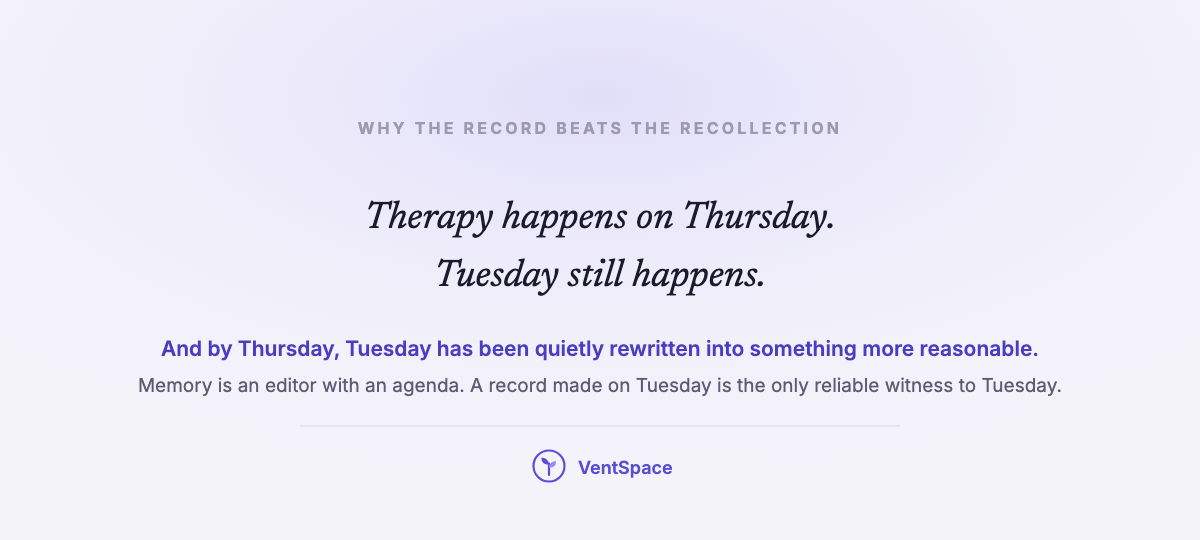
It holds the week that the hour cannot. Therapy happens on Thursday. Tuesday still happens, and by Thursday Tuesday has been quietly rewritten into something more reasonable, because memory is an editor with an agenda. A record made on Tuesday is the only reliable witness to Tuesday.
And it tolerates repetition. We can go over the same twenty minutes eleven times in a notebook and nobody is tired of us by the fourth, which matters, because the people who love us do get tired, and part of what we are protecting when we write is a friendship.
Quick Summary
Q: Is journaling worth doing if I am already in therapy?
A: It does a job the session cannot. It is available at the moment something happens rather than days later, it takes the unedited version, and it preserves the week in a form memory does not, which makes it a better witness than recollection when the session comes round.
Insight: why the record beats the recollection
The expressive-writing literature is built on people writing close to the experience rather than describing it afterwards. Baikie and Wilhelm’s 2005 review in Advances in Psychiatric Treatment describes the studied protocol as fifteen to twenty minutes on three to five occasions, and the writing is the thing being studied rather than the remembering.
The numbers on our own side, printed in full
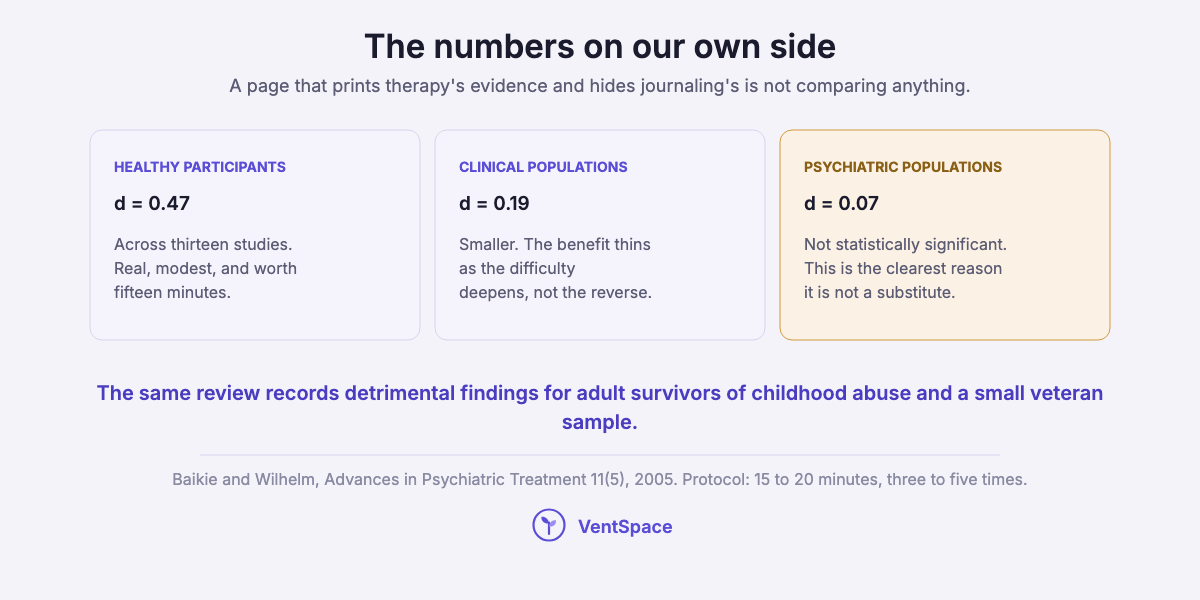
A page that prints therapy’s evidence and hides journaling’s is not comparing anything. So here is ours. In Baikie and Wilhelm’s review, expressive writing showed an effect size of about d = 0.47 in healthy participants across thirteen studies. In clinical populations it was about d = 0.19. In psychiatric populations it was d = 0.07, and not statistically significant. That 0.47 is an older pooling, and the larger ones since put the plain protocol anywhere from not significantly different from zero (Mogk and colleagues, thirty randomised trials, 2006) to moderate against a waiting list at long-term follow-up (Gerger and colleagues, 44 trials, 2022). The range is the finding.
Read in order, those three numbers say something that ought to change how anyone sells this. The benefit is largest for the people who are least unwell. Writing is a reasonable thing to do when life is difficult and we are broadly all right. The evidence for it thins precisely as the difficulty deepens, which is the opposite of the direction a substitute for therapy would need to run in.
There are also findings where writing did harm. The same review records detrimental effects for adult survivors of childhood abuse and for a small sample of veterans. Writing at length and alone about the worst thing that ever happened to us, with nobody in the room when we put the pen down, is not a small intervention, whatever the gentleness of the word journaling suggests. If that is the material, the honest recommendation is not a better prompt. It is doing it with a person.
Quick Summary
Q: Does journaling actually work?
A: Modestly, and unevenly. Pooled estimates for the studied protocol run from no significant effect to moderate. In one older pooling it was about 0.47 in healthy participants, 0.19 in clinical populations and 0.07 in psychiatric populations, where it was not statistically significant, and the same review records detrimental findings for adult survivors of childhood abuse and for a small veteran sample.
Insight: the figure that decides the argument
The expressive-writing effect in psychiatric populations was d = 0.07 and not statistically significant (Baikie and Wilhelm, Advances in Psychiatric Treatment 11(5), 2005). Every honest use of journaling sits above that line. It is the clearest single reason the notebook is not a substitute, and it comes from the literature that supports journaling rather than from anyone arguing against it.
How to tell which job you are asking for
This is not a readiness test and it is not a diagnostic. It asks nothing about how bad things are, which is a question no page can answer and which we have deliberately left to a different one. It asks about the task in front of us, which is a much smaller and more answerable thing.
- Does this account need holding, or does it need arguing with. Some nights we need somewhere to put it. Some months we need somebody to say that the story we keep telling does not quite add up.
- Has anything in it changed in six weeks. An account that has not moved has usually stopped being examined and started being rehearsed.
- Is there something we have been circling without writing down. The subject we have approached four times and left is not going to be reached alone.
- Is anyone else in this. If the difficulty involves other people, and most do, then a method with no other people in it is missing the material.
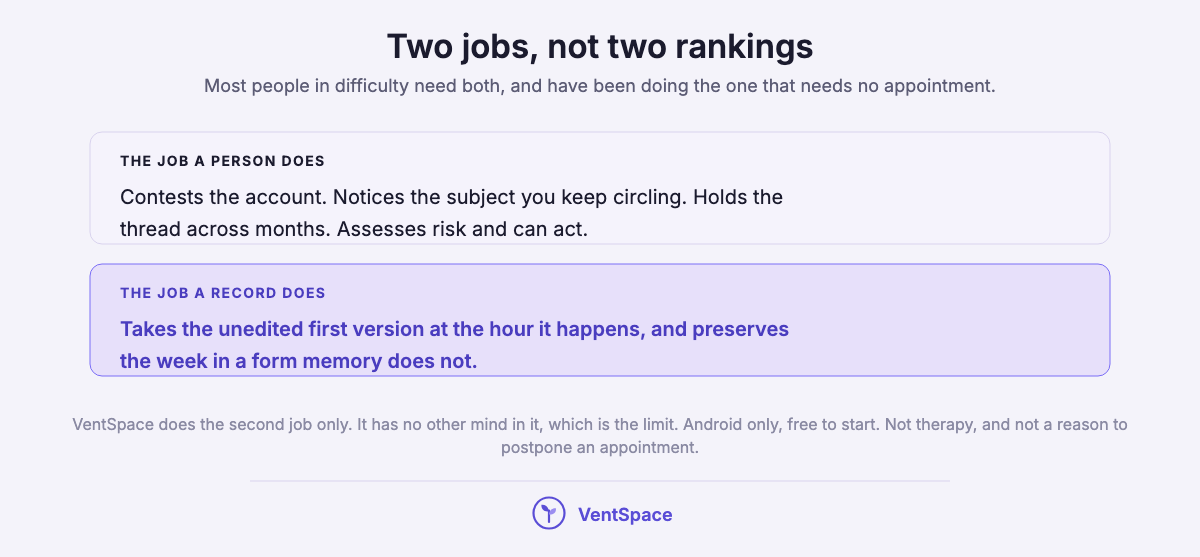
Two of those pointing outward is enough, and a mixed answer is not a failure of the test. Often we are asking for both jobs at once and have only been doing the one that needs no appointment.
Quick Summary
Q: How do I know whether I need therapy or just journaling?
A: Ask what the task needs rather than how severe things are. If the account needs holding, writing does that. If it needs contesting, has not changed in weeks, involves a subject you keep circling, or involves other people, those point toward a person. Both answers together are a normal result.
What to do in each case
If what you need is the outside view. Book the appointment before you feel ready, because readiness is not a state that arrives on its own and the first session is largely administrative anyway. Take three sentences with you, written down: what is happening, when it started, and what you want to be different. If you have been keeping a notebook, bring the two entries that embarrass you, since those are the ones where the material actually is. Therapy is a legitimate option and for a great many people it is the right one.
If what you need is somewhere to put the week. Write close to the event rather than in summary at the weekend, keep the entries short enough that you will do it again tomorrow, and reread last week’s on a Sunday for five minutes with one question in mind: what is different from the version I have in my head. That reread is the whole practice. Writing without it is storage.
Where our own product sits in that, stated plainly. VentSpace is the second of those two jobs and only the second. It is a journaling app that turns what you write into a clear read on your life balance, plus small, doable next steps, which makes it a between-sessions record in a form that survives being tired. It has no other mind in it, and by the argument of this whole page that is the limit rather than a feature we are shy about. It is not therapy, it does not assess anything, and it is not a reason to postpone an appointment. The practical limits: Android only, free to start. Not on Android, or at a desk? VentSpace Live runs in your browser, free, with nothing to install.
Where the line blurs
The two are not rivals in any real week. We can write on Tuesday, take Tuesday to a therapist on Thursday, and get more out of Thursday because the record existed. The notebook is not a shadow version of the session, it is the part of the material that would otherwise be lost.
And there is a less comfortable overlap. Some of us write in order not to say. The page accepts everything, never looks concerned, never follows up in a fortnight, and there is a kind of relief in that which can quietly become avoidance dressed as diligence. We have all done a version of this. One tell: the material that is truly difficult tends to be the material we have described most carefully and never once said out loud.
The reverse happens too, and should be said for balance. Some people talk about the same thing weekly for a year without ever writing a line, and the account stays exactly as it was, because nothing in a conversation forces us to commit to a version we can be shown later.
Quick Summary
Q: Can you do both therapy and journaling at the same time?
A: Yes, and the two fit together. Writing close to the event preserves material that memory smooths out before the session, and the session supplies the outside view that a record cannot. The risk to watch is writing as a way of not saying.
If you have not settled the first question yet, whether to go at all, that is a different decision and we treat it separately in do I need therapy.
Questions people ask
Can journaling replace therapy?
No, and the reason is structural rather than a matter of how serious things are. What the research keeps identifying as the active part of therapy is a relationship, and a notebook cannot contain one at any level of difficulty. The numbers point the same way: the effect of the studied writing protocol was largest in healthy participants and not statistically significant in psychiatric populations. Writing is worth doing. It is not the same object.
Is journaling a form of therapy?
Not in the sense the word therapy carries. There are structured therapeutic uses of writing that a clinician guides, and those sit inside a treatment relationship. A notebook kept alone is a practice rather than a treatment, and describing it as therapy borrows an authority it has not got.
Should I show my journal to my therapist?
You are not obliged to, and it is often useful to bring a small part of it rather than the whole thing. Two entries and a sentence about why you picked them will do more in a session than forty pages. The entries worth choosing are usually the ones you would rather not read out.
Is journaling enough on its own?
For an ordinary difficult stretch, it can genuinely help. As the difficulty deepens the evidence for it thins rather than strengthens, and there are groups for whom writing alone has been recorded as making things worse. That is the honest boundary, and if you are near it the answer is a person rather than a better system.
What do I do with what the writing brings up?
Whatever comes up in a notebook at midnight has nowhere to go by itself, which is the real gap in the practice. Some of it can be reread on Sunday and left there. Some of it is a message to a person you have been avoiding. And some of it is the reason to make an appointment, and noticing which is which is most of what rereading is for.
Two things to take
They are not two amounts of the same thing. One of them is a relationship with somebody who will disagree with us, and the other is a record of what we actually thought on the day, and a person in difficulty usually needs both of those rather than a winner between them.
And the honest part. An outside view takes weeks to be worth anything, and the early sessions of it are frequently uncomfortable rather than illuminating, because the first thing another person does with our account is fail to accept it. That discomfort is not a sign of a bad fit. It is generally the work starting, and it is the one thing the notebook, for all its patience, will never once put us through.
Keep writing. And say it to somebody.
About this article

Written by
Sai Subramaniam
Founder, VentSpace
I write these guides because I have been where you are. I am working through my own hard seasons, and I share the things that actually helped me, so that anyone going through it has a steady companion close by instead of facing it alone. VentSpace is the app I built for exactly that: a journaling app that turns what you write into a clear read on your life balance, plus small, doable next steps toward feeling more like yourself.
This writing is honest and every claim is sourced, and it is not a substitute for professional care. If you are struggling, reaching out to a professional is a strong move, not a failure.
Explore VentSpaceTry VentSpace LiveHow this one was checked. Every factual claim traces to a named source, and the source is printed next to the claim rather than kept in a footnote. Quotes are pinned to the work they come from, with the year, the letter or the chapter where one exists. Where a widely repeated claim could not be traced, it was left out and the omission recorded. Where a figure is contested, both sides are printed.
No affiliate links, no paid placements, and nobody paid to appear here. Where we mention our own app, we say that it is ours, we state its limits, and we never position it as a substitute for care.
Reviewed: October 2026. Prices, platforms and product availability move quickly, and anything we could not verify at the time of writing is marked as unverified rather than turned into a number.
Corrections. If something here is wrong, we would rather know. Corrections are made in place, with a note saying what changed. Updated 15 October 2026: the internet-therapy alliance figure is corrected to about .275 across 23 studies, the expressive-writing figure of 0.47 now sits inside the range later and larger studies give, the VentSpace description is corrected, an unsourced count of competing pages and several unsourced claims about what people and therapists do were removed, and an unrelated link was taken out.