
“the repetitious experience of a mind attempting to generate a feeling of security about the future, failing, then trying again and again and again.”
Oliver Burkeman, Four Thousand Weeks, 2021
You have told somebody the same story four times now, the same person probably, or the same two people in rotation, and last night you noticed halfway through that you were using the identical phrase you used on Sunday, and something in you went quiet and a bit embarrassed about it.
So here is the distinction. Venting gets it out. Journaling gets it out and then does something with what came out. That much every page on this subject agrees with, and it is also not the useful part, because the loop you are worried about does not live in the container. It lives in the account.
You can brood on paper as easily as out loud. That is not a figure of speech. It is what the research on this actually found, and the rest of the page is the evidence and a test you can run tonight against last week’s entry.
The short version
The container is not the variable. Speech is not the loop and paper is not the cure.
Rumination is two things, not one: brooding, which is the loop, and reflective pondering, which is not the loop but is not simply the healthy one either.
⭐ One of the five reflective-pondering items is “write down what you are thinking and analyze it.” Journaling is on the reflection factor, and the working clause is the second one.
Venting out loud has real evidence attached, and some of it is unflattering. So does writing, including findings where it made things worse.
The tell is the question word. Four of the five brooding items are why-or-what-am-I questions. None of the reflection items is.
The test is whether the account has changed since last week, and it takes five minutes.
What venting actually is
Venting has no clinical definition and does not need one. It is the thing you already do: saying the pressure out loud, or writing it down fast, with no plan at all for what happens next, and with nobody in the room being asked for advice, because advice is not what the exercise is for at any point. That is the point of it. The account comes out at the volume it has been sitting at.
And there is a hydraulic metaphor buried in the word, which is worth noticing because it does a lot of quiet work. Pressure, a vent, release. The metaphor says that the feeling is a fixed quantity in a sealed container and that letting some out leaves less inside, and that picture is so intuitive that most writing on the subject never examines it, which is a shame, because it has been tested. It does not hold up well.
Quick Summary
Q: What does venting mean?
A: Saying or writing out a feeling at full volume with no plan for what happens next. It has no clinical definition. The word carries a hydraulic metaphor, pressure released from a sealed container, and that metaphor is the part of it that the evidence does not support.
What journaling actually is
Journaling does not have a clinical definition either, which surprises people who have read a hundred times that it is evidence-based, because what has actually been studied, closely and for decades, is a much narrower thing called expressive writing: a protocol of fifteen to twenty minutes, three to five times, writing about a difficult experience, which is a specific instruction given to participants in a study rather than a description of the notebook sitting by your bed.
The distinction matters more than it sounds, because every number you have ever seen attached to journaling came out of the protocol, and the protocol is short, finite and aimed at one thing, whereas the habit is open-ended and aimed at whatever happens to be in your head that night. If you want the protocol question specifically, the site has a separate piece on expressive writing against ordinary journaling, and this page is about something else entirely, which is why either one of them can turn into a loop and what decides it.
Quick Summary
Q: Is journaling the same as expressive writing?
A: No. Expressive writing is a research protocol, typically fifteen to twenty minutes on three to five occasions, writing about a difficult experience. Journaling is an open-ended habit. The published effect sizes belong to the protocol, which is why they cannot be read straight across to a nightly notebook.
The two side by side
| Venting | Journaling | |
|---|---|---|
| What it is for | Getting the pressure out at the volume it is sitting at | Getting it out and then having something to look at |
| The first ten minutes | Relief, and it is genuine | Slower, often worse before it is better |
| By next week | The account is usually unchanged, because nothing recorded it | The account can change, if the entry gets reread |
| What the evidence measures | Anger and aggression after provocation. Closeness and internalizing symptoms in friendships | Effect sizes from a short protocol, not from a habit |
| Where it goes wrong | The fourth telling, to the same person, in the same words | The entry that is three pages of the same question |
| The tell | The listener’s face | Your own handwriting, last week, saying this exactly |
What venting does in the first ten minutes, and in the following week
The relief is real and it is short. Nobody should be talked out of the first part of this, because the first part works: saying the thing out loud to a person who does not interrupt is one of the few reliably decent experiences available on a bad Tuesday, and pretending otherwise is the kind of advice nobody takes.
The week is where it gets complicated. Brad Bushman ran the cleanest test of the hydraulic metaphor available, in 2002, and the design is worth having in your head: he angered participants, then had some of them hit a punching bag while thinking about the person who had angered them, some hit it while thinking about getting fit, and some do nothing at all. The venting group came out angriest. They were also the most aggressive afterwards, with the distraction group in the middle and the do-nothing group calmest of the three.
That finding gets overstated constantly, so here is the honest scope, which is narrower than the headlines: it is an anger experiment with a behavioural aggression outcome, and it says nothing whatsoever about crying on a friend about your week, which is a different act performed for a different reason. It tests one specific thing. What it tests is the belief that expression discharges the feeling, and on that narrow question the answer was no.
Then there is the friendship half. Amanda Rose named the pattern co-rumination in 2002, defining it as extensively discussing and revisiting problems, speculating about them and dwelling on the negative feelings, and in 608 children and adolescents she found something genuinely awkward, which is that co-rumination went with closer, higher-quality friendships and with more depression and anxiety, both at once, and that girls did more of it, which accounted for some of both. Those are children, and that limitation belongs in the sentence rather than in a footnote at the bottom, but the shape of the finding is still the thing worth taking away from it: the behaviour that makes you close to someone and the behaviour that keeps you in it are the same behaviour.
Quick Summary
Q: Is venting bad for you?
A: Not in itself. The immediate relief is real. The evidence complicates two things: a 2002 experiment found people who vented anger came out angrier and more aggressive than people who did nothing, and research on co-rumination in young people found that repeatedly revisiting problems with a friend went with both closer friendships and more symptoms of depression and anxiety.
Insight: the catharsis experiment, in the author's own framing
Bushman’s title asks whether venting anger feeds or extinguishes the flame, and the paper’s answer is that catharsis theory predicts one thing and the evidence shows another: rumination while venting increased anger and aggressive responding, and doing nothing at all was more effective than venting. Personality and Social Psychology Bulletin, 2002.
What writing does, including the part that rarely gets printed
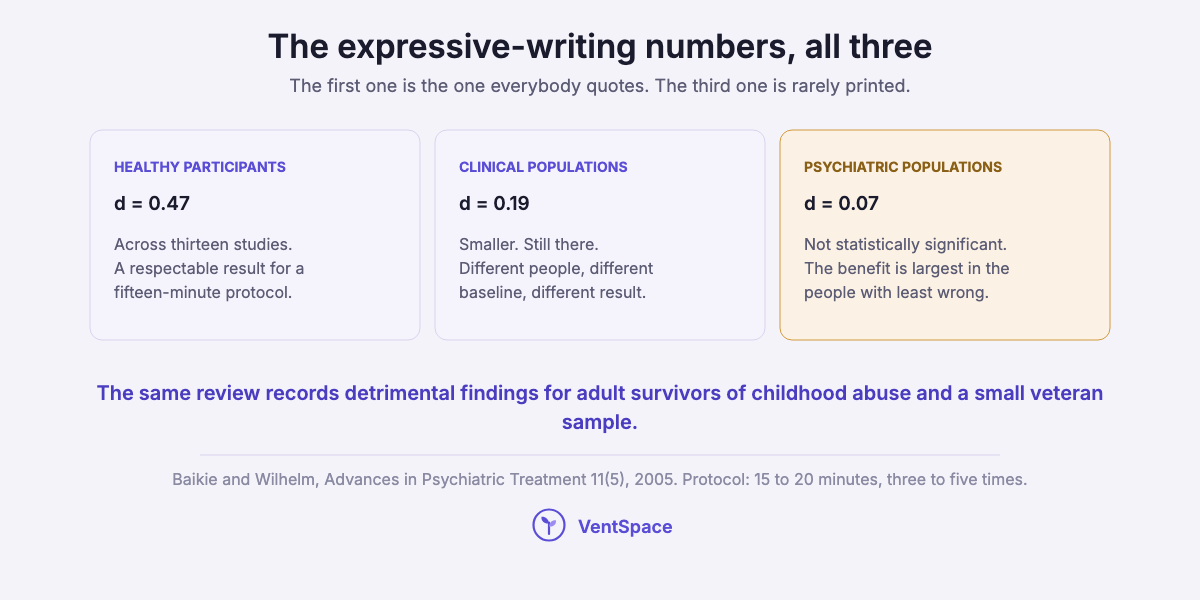
The numbers are real and they are smaller than you have been told, and Baikie and Wilhelm’s 2005 review in Advances in Psychiatric Treatment collects them in one place: expressive writing produced an effect size of about d = 0.47 in healthy participants across thirteen studies, which is a respectable finding for a fifteen-minute intervention and is the number everybody quotes. Larger and later poolings turn it into a range: from no significant effect across 30 randomised trials (Mogk and colleagues, 2006) to a moderate effect against a waiting list at long-term follow-up across 44 trials (Gerger and colleagues, 2022), where neutral writing did nearly as well. The 2005 review also keeps going. In clinical populations the figure was about d = 0.19. In psychiatric populations it was d = 0.07, and not statistically significant.
Read those three in order and the shape is uncomfortable: the benefit is largest in the people with least wrong, which is not an argument against writing at all but an argument against the sales pitch, one that reliably quotes the first number to somebody standing squarely in the situation the third number describes.
And there are findings where it did harm. The same review records detrimental effects for adult survivors of childhood abuse and for a small sample of veterans. Writing at length about the worst thing that ever happened to you, alone, in a room with nobody in it when you put the pen down, is not a small intervention whatever the word journaling suggests, and the literature contains the evidence that it can go badly.
If the thing you would be writing about is that heavy
Please do it with somebody rather than alone with a notebook. A therapist is the right answer here and going to one is not a failure of self-reliance. If you are in crisis or thinking about harming yourself, contact a crisis line now: in the US you can call or text 988 for the Suicide and Crisis Lifeline, and findahelpline.com will find the equivalent elsewhere. This page is not a substitute for either.
Quick Summary
Q: Does journaling actually work?
A: The studied version does, modestly, and unevenly. Expressive writing showed an effect size of about 0.47 in healthy participants, about 0.19 in clinical populations, and 0.07 in psychiatric populations, which was not significant. Larger later reviews put the overall effect anywhere from none to moderate. The same 2005 review records detrimental findings for adult survivors of childhood abuse and for a small veteran sample.
Insight: what the protocol was, before you compare yourself to it
The expressive-writing studies behind those effect sizes used fifteen to twenty minutes, on three to five occasions, writing about a difficult experience. Baikie and Wilhelm, Advances in Psychiatric Treatment 11(5), 2005. A nightly habit of unlimited length is a different activity, and no number in that literature was measured on it.
The loop is not in the medium, it is in the account
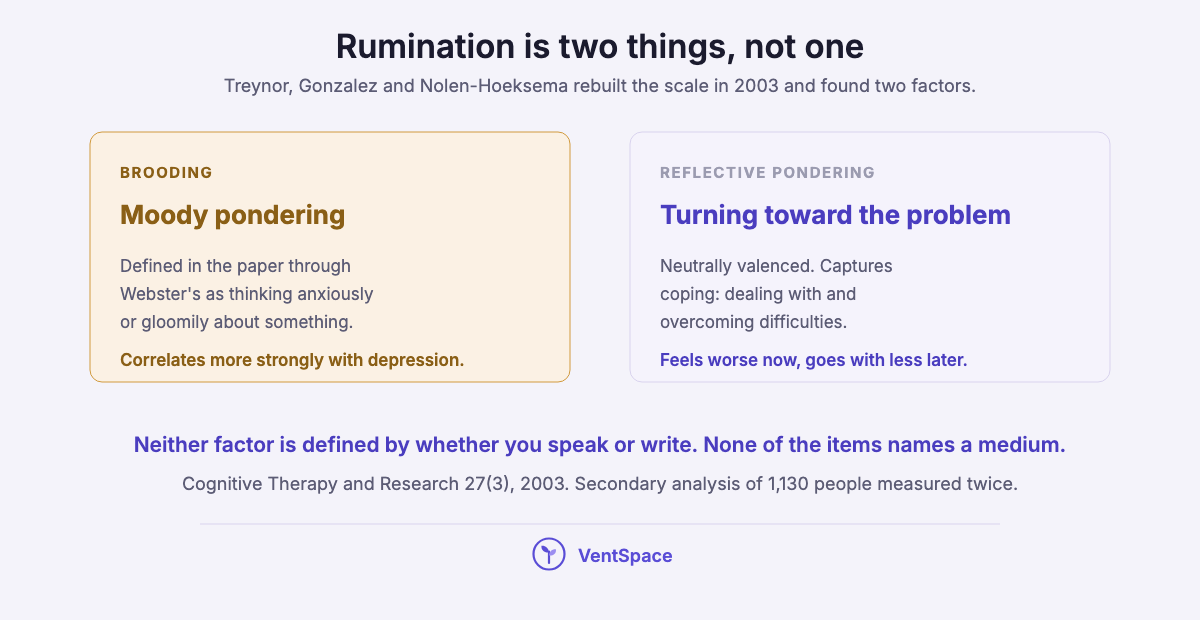
This part comes out of a single paper. In 2003, Wendy Treynor, Richard Gonzalez and Susan Nolen-Hoeksema took the standard rumination questionnaire apart and rebuilt it, stripping out the items that were measuring depression itself rather than the habit of dwelling on it, and what came back out of the analysis was not one thing. It was two.
The paper names them. Brooding, defined there through Webster’s as “moody pondering” and glossed as thinking anxiously or gloomily about something, and reflective pondering, described as neutrally valenced and as capturing coping, which the same paper defines as dealing with and attempting to overcome problems and difficulties. In their data, across 1,130 people measured twice, brooding correlated more strongly with depression than reflection did, and brooding was the one associated with a low sense of mastery and with chronic strain while reflection was not. Two components. One scale. They do not behave the same way.
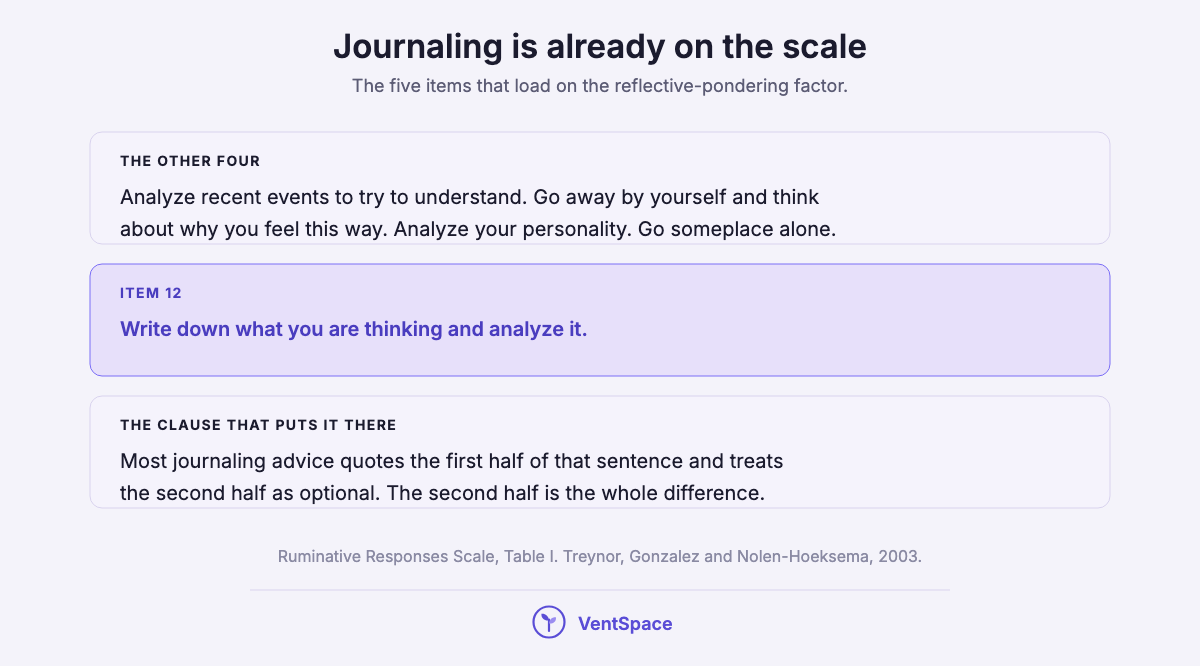
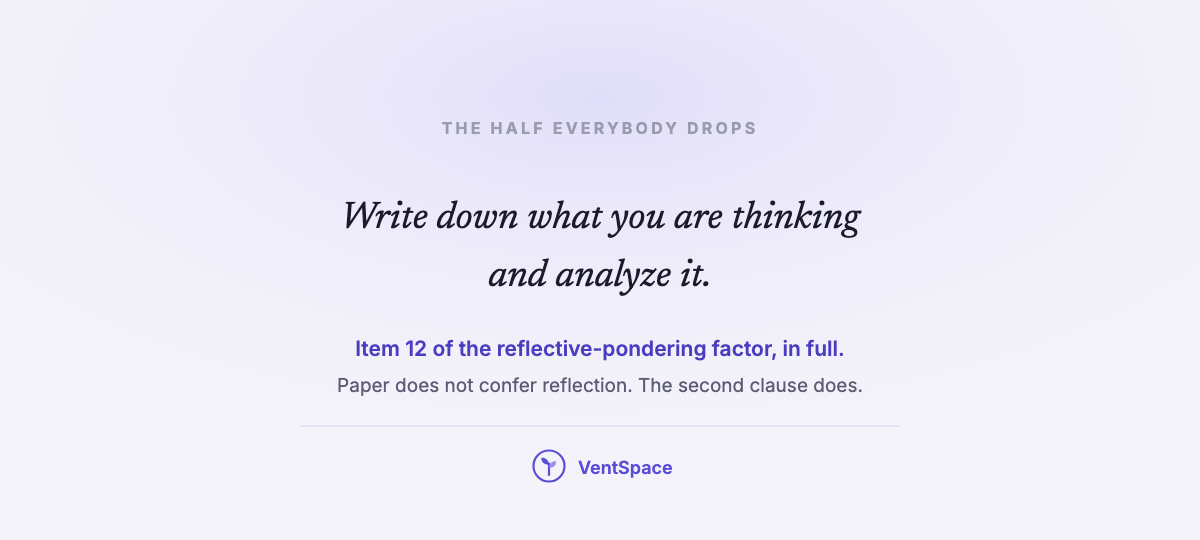
Now the detail that reorganises this entire comparison. The reflective-pondering factor has five items, and item twelve is “Write down what you are thinking and analyze it.” Journaling is not outside the rumination scale, watching the loop from a safe distance and immune to it, but sitting on the reflection half of that very scale, and it earns the position entirely because of the clause that comes after the comma in item twelve.
The five brooding items name no medium at all. “What am I doing to deserve this?” “Why do I always react this way?” “Why do I have problems other people don’t have?” “Why can’t I handle things better?” And thinking about a recent situation, wishing it had gone better. Every one of those can be done in a notebook. Most of them have been.
Quick Summary
Q: What is the difference between brooding and reflection?
A: They are the two factors that rumination splits into. Brooding is defined in the source paper as moody pondering, thinking anxiously or gloomily, and it correlates more strongly with depression. Reflective pondering is neutrally valenced and oriented to overcoming the problem. Neither is defined by whether you speak or write.
Insight: the honest half of the same paper
Reflection is not simply the good one. In the same analysis it is associated with more depression at the time and less depression later, and the later point was a year on. It is correlational, so it shows a pattern rather than a payback. Treynor, Gonzalez and Nolen-Hoeksema, Cognitive Therapy and Research 27(3), 2003. Anybody promising that reflecting will make tonight better has not read it.
Why the why-questions are the tell
Four of the five brooding items are questions, and they all start the same way. Why do I always. Why do I have. Why can’t I. What am I doing to deserve. Not one of the five reflection items is phrased that way. They are instructions to analyse, to go somewhere alone and think, to write it down and examine it.
That is not a coincidence and it is not an accident of wording, because a why-question about yourself asks for a cause that sits inside you, which is exactly the material you have the least reliable access to, and so the question has no stopping condition: you can produce answers all night, none of them checkable, each one slightly more damning than the last. Tasha Eurich put it plainly in the Harvard Business Review in January 2018, arguing that why is an ineffective self-awareness question because we do not have the access to our own motives that the question assumes.
What-questions about the situation behave differently. What happened. What did I do next. What would have to be true for this to be fine. Those run out. They terminate in facts, and a question that terminates cannot be the engine of a loop.
So the practical version of this entire article fits in one line. Count the question words in what you wrote last night.
Quick Summary
Q: How do I stop journaling from turning into a spiral?
A: Watch the question words. Why-questions about yourself have no stopping condition, which is what keeps an entry going in circles, and four of the five brooding items on the original rumination scale are phrased that way. What-questions about the situation terminate in facts, and an entry built on them ends.
Insight: the question-word finding, from the self-awareness research
Tasha Eurich’s work on self-awareness, reported in the Harvard Business Review on 4 January 2018, argues that “why” is an ineffective question for understanding yourself, because we lack the access to our own motives that the question assumes. Her recommendation is to trade it for “what”. It lines up exactly with which items sit on which factor.
How to tell which one you’re in
This is not a diagnostic and it is not a personality test, since brooding and reflection are patterns that were measured in a large sample rather than labels to be pinned on yourself, and nothing here can tell you which one you are, though what it can do is hand you something checkable, which beats a verdict.
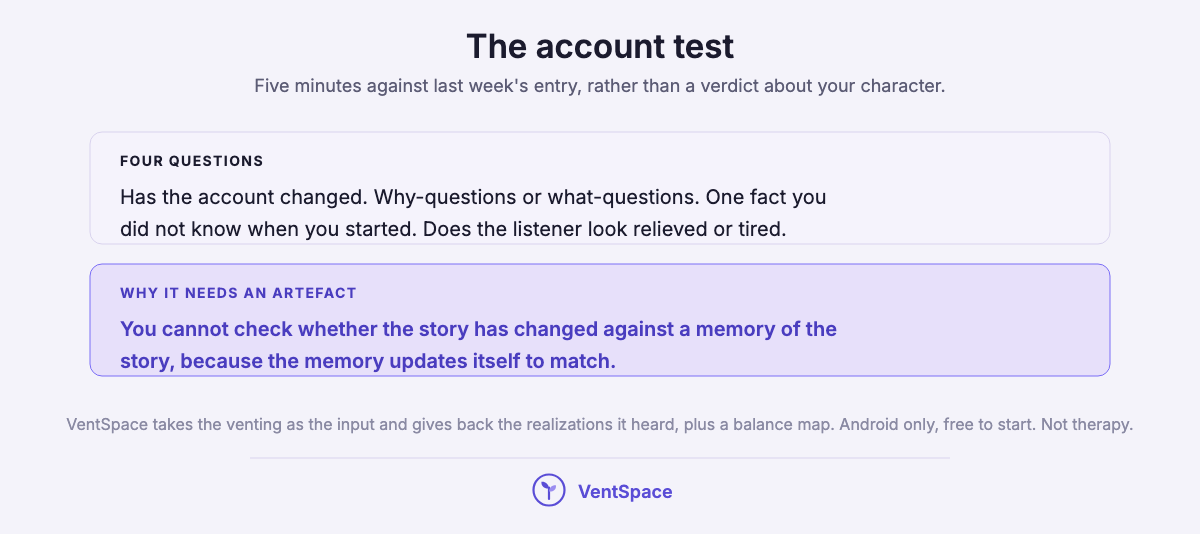
You need an artefact. Last week’s entry, or a text thread, or the memory of the last time you told somebody. Then four questions:
- Has the account changed. Same sentences in the same order, or is anything in it different from the version you had a week ago.
- Count the question words. Why-and-what-is-wrong-with-me, against what-happened and what-next.
- Is there one fact in there you did not know when you started. One is enough. Zero, three times running, is the finding.
- How does the listener look. Not whether they are kind. Whether they look relieved that something moved.
Mixed is the usual answer, because most entries contain both and most conversations start as one thing and turn into the other somewhere around the twenty-minute mark, so the useful reading is not which of the two categories you fall into on a given night. It is where in the hour the turn happened, and whether it happened at all.
Quick Summary
Q: Am I journaling or just venting?
A: Check the account rather than the activity. Reread last week’s entry and ask whether anything in it has changed, count the why-questions against the what-questions, and look for one fact you did not know when you started. The same hour can be both, and where the turn happens is more informative than the label.
What to do in each case
If you are venting. Keep it. Time it, and give it somewhere to land. Ten minutes at full volume with a clock running is the same relief with an edge on it, and the edge is that the clock forces the question of what comes after, which is where the whole difference lives. Then, whichever is easiest and least embarrassing to arrange, change one single thing about the fourth telling: tell it to somebody new, or write it instead of saying it, or say the whole thing in the past tense. Any of those disturbs the groove enough that the account has to be reassembled, and reassembling it is the entire mechanism.
If you are writing. Take the instruction from the scale itself and add the second clause. Write down what you are thinking, and analyse it. Concretely: three lines at the bottom of the entry, every time, no exceptions. What happened, in one sentence with no adjectives. What I did next. What would have to be true for this to be fine. That third one is the reflective move and it is the one people skip, because it is the only line that can produce an answer you did not want.
Therapy is one option in both cases and for plenty of people it is straightforwardly the right one, particularly if the account has not moved in months, and specifically if what you would be writing about sits in the territory where those detrimental findings sit.
Insight: the sentence to keep from the scale
Reflection item 12, on the reflection factor of the Ruminative Responses Scale: “Write down what you are thinking and analyze it.” Treynor, Gonzalez and Nolen-Hoeksema, 2003. Most journaling advice quotes the first half of that sentence and treats the second half as optional. It is the half that decides which factor you are on.
Where the line blurs
Some nights there is nothing to analyse and venting is correct, because the day was bad in a boring, external way, nothing about it is mysterious to anybody involved, and the honest response is to say it once at full volume, have a bath and go to bed, because turning that into a reflective exercise is not insight. It is homework, and it is the reason a lot of people quit journaling in week three.
And writing goes wrong in the other direction just as often, since three pages of why-do-I-always is not reflection because it is on paper, and it has an extra problem that speech does not: it is durable, so you can reread it, and rereading a loop is how a loop gets rehearsed into something that feels like a conclusion. A notebook can be a filing system for grievances. Kept for long enough, it becomes evidence in a case you are building against yourself.
The blurriest part is the timing, and the same 2003 paper is honest about it. Reflection goes with feeling worse now and better later. So the evening it works is the evening it does not feel like it worked, and the evening you come away lighter, unburdened and rather pleased with yourself may well have been the one where nothing in the account moved so much as an inch. That is an unhelpful piece of information and it is true, which is why the test in this article looks at an artefact from last week rather than at how you feel at the end of an entry.
Quick Summary
Q: Can venting and journaling both make things worse?
A: Yes, and they do it differently. Venting can rehearse an account without changing it, and the anger evidence shows expression does not reliably discharge the feeling. Writing can do the same thing durably, so the loop becomes rereadable. The common factor is an account that stays the same, not the medium.
Questions people ask
Is venting bad for you?
No, and the immediate relief is real rather than an illusion. What the evidence complicates is the belief that expression discharges the feeling. In Bushman’s 2002 experiment the people who vented their anger came out angrier and more aggressive afterwards than the people who did nothing at all, and the co-rumination research found that repeatedly revisiting problems with a friend tracks closeness and symptoms at the same time. Ten minutes of it is a good thing. The fourth identical telling is the part worth watching.
Is writing it down always better than saying it?
No, and this is the myth this page exists to correct. The container was never the variable. One of the five reflective-pondering items on the original rumination scale is writing down what you are thinking and analysing it, and every single one of the five brooding items can be performed in a notebook, at length, without changing a word of it. Paper does not confer reflection. The second clause does.
Why does journaling sometimes make me feel worse?
Two reasons, and they are different. The ordinary one is that reflection is associated with feeling worse in the moment and better later, so an entry that costs you an evening is behaving as the research would predict. The other is that expressive writing has recorded detrimental findings for some groups, including adult survivors of childhood abuse, in which case the honest answer is not a better prompt. It is doing this with a person.
Is it bad to vent to friends?
It is one of the better things available and it carries a cost worth knowing about, since co-rumination is associated with closer friendships and with more depression and anxiety in a study of 608 children and adolescents, so the finding does not transfer cleanly to adults and the shape of it is still instructive. Take turns. The version that goes wrong is the one where the same person hears the same account indefinitely, which the rumination literature also associates with support wearing thin.
Should I reread old entries?
Yes, and briefly, with a purpose. Rereading to check whether the account has changed is the whole test in this article, whereas rereading to sink back into the feeling is rehearsal, and the way to tell the two apart is time: five minutes with a specific question is the first one, forty minutes is the second.
If you want the population numbers rather than the mechanism, we computed how many Americans actually write for themselves on a given day, from the government’s own survey data: journaling statistics.
Related. What Is a Diary? And Why the Word Puts People Off.
Two things to take
Check the account, not the container. Whether it comes out of your mouth or out of the end of a pen decides almost nothing at all, and whether the sentences are the same ones you were using last week, in the same order, decides nearly everything about how the year goes. One fact you did not have before is a good night. Zero, three times running, is a pattern.
And the honest one. An account changes slowly. The first fortnight of watching yours will mostly show you that it has not moved, which is discouraging and is also the point of looking, because the alternative is another year of finding out nothing while feeling productive about it.
You already know the story by heart.
Find out what else is in it.
On the awkward matter of our own app’s name. A page arguing that venting alone goes in circles should answer for VentSpace. It is a journaling app that turns what you write into a clear read on your life balance, plus small, doable next steps, and it pulls named realizations out of your entries over time, which is one way of getting the turn this page is about. It is not therapy. Honest limits: Android only, free to start. Not on Android, or at a desk? VentSpace Live runs in your browser, free, with nothing to install. If your problem is the one in the detrimental findings above, it is not what you need and a therapist is.
About this article

Written by
Sai Subramaniam
Founder, VentSpace
I write these guides because I have been where you are. I am working through my own hard seasons, and I share the things that actually helped me, so that anyone going through it has a steady companion close by instead of facing it alone. VentSpace is the app I built for exactly that: a journaling app that turns what you write into a clear read on your life balance, plus small, doable next steps toward feeling more like yourself.
This writing is honest and every claim is sourced, and it is not a substitute for professional care. If you are struggling, reaching out to a professional is a strong move, not a failure.
Explore VentSpaceTry VentSpace LiveHow this one was checked. Every factual claim traces to a named source, and the source is printed next to the claim rather than kept in a footnote. Quotes are pinned to the work they come from, with the year, the letter or the chapter where one exists. Where a widely repeated claim could not be traced, it was left out and the omission recorded. Where a figure is contested, both sides are printed.
No affiliate links, no paid placements, and nobody paid to appear here. Where we mention our own app, we say that it is ours, we state its limits, and we never position it as a substitute for care.
Reviewed: October 2026. Prices, platforms and product availability move quickly, and anything we could not verify at the time of writing is marked as unverified rather than turned into a number.
Corrections. If something here is wrong, we would rather know. Corrections are made in place, with a note saying what changed. Updated 15 October 2026: we stopped calling reflection the adaptive or opposite half, since in the 2003 data it went with more low mood at the time and less a year later, added the wider range for expressive-writing effects, rewrote the note about our app so it describes a journaling app rather than voice, and removed claims about what other pages leave out.