
We nearly wrote this page the way most of them are written, and it is worth admitting why we stopped. The easy version is a list of sentences to finish, such as “I am enough because” with a blank after it, or “Ten things I love about myself.” Then we read the research on positive self-statements and could not write it with a straight face, because for the people most likely to search for self-esteem journaling prompts, that kind of sentence can make the evening worse.
So we started from a different definition. Self-esteem is not a mood we can talk ourselves into. It is a verdict we hold about our own worth, and like most verdicts it rests on evidence, some of it old, some of it misread. The forty-eight prompts below do not ask you to overturn the verdict tonight. They ask you to look at what it rests on. Have you ever written down what your worth depends on? Most of us never have.
Each prompt has a line on why it helps and a line on how to answer it. They are for adults who are capable at something and still privately think little of themselves. They are not a test, and nothing here gives you a score.
From Sai, who writes this blog
The short prompts are my personal favorites. Micro journaling can be more insightful than a long session at showing us things about ourselves.
The short version
– How much: one group, two or three prompts, about ten minutes.
– Which group: the one that matches today. Six situations are below.
– What to skip: affirmations you do not believe. The research says they can backfire.
– What to write instead: what is true, what is not true, and what the evidence is.
– Afterwards: reread once a week and look for what your worth keeps riding on.
How to actually use these
Two or three prompts a sitting, about ten minutes. Pick the group that matches the day you had: a setback, a loud inner critic, a comparison, an old message that came back. Answer two prompts in it, then close the notebook. A few evenings a week is plenty.
The named failure: writing compliments you do not believe. It is the first thing most of us try, and for the person who needs it most it tends to fall flat or sting. The second failure is answering ten prompts at once, which produces ten thin paragraphs and no realization. Two honest answers beat ten polite ones.
Skipping a night costs nothing. In the largest meta-analysis of this kind of writing, covering 146 randomized studies, how the sessions were spaced made no detectable difference to the effect. If the habit keeps stalling, our piece on journaling roadblocks goes through why.
Where to write. A paper notebook is free and private. A notes app works if your phone is what you have at night, and our comparison of digital and paper journaling goes through both. If you want the entries to add up to something you can see, VentSpace is one option. It is the app I built: a journaling app that turns what you write into a clear read on your life balance, plus small, doable next steps. It is Android only, free to start, and it is not therapy. Not on Android, or at a desk? VentSpace Live runs in your browser, free, with nothing to install.
The stop line: if a prompt starts producing a longer and longer list of what is wrong with you, stop mid-sentence. That is the prompt failing, not you.
Quick Summary
Q: How do you use self-esteem journaling prompts?
A: Two or three prompts from the group that matches your day, about ten minutes, a few evenings a week. Skip affirmations you do not believe, and stop if the writing turns into a list of faults.
Why these prompts are built this way
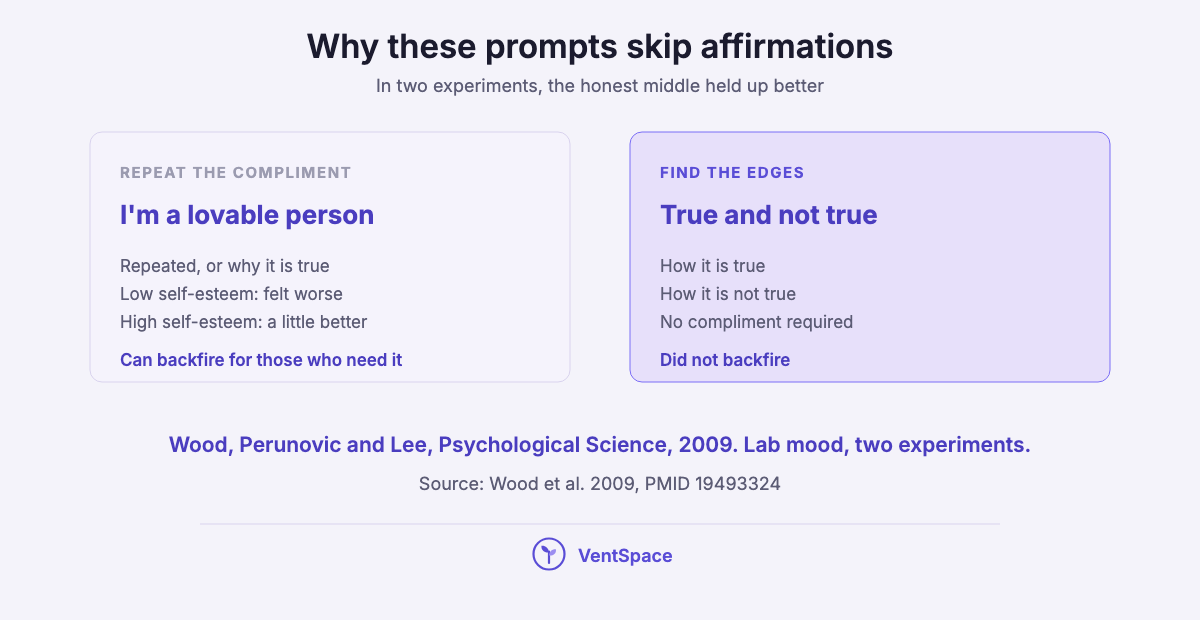
Positive self-statements are less reliable than their reputation. In 2009, the psychologists Wood, Perunovic and Lee noted that they “are widely believed to boost mood and self-esteem, yet their effectiveness has not been demonstrated.” Their two experiments found that participants with low self-esteem who repeated “I’m a lovable person”, or who focused on how it was true, felt worse than those who focused on how it was “both true and not true.” People with high self-esteem felt better, “but to a limited degree.” The authors’ summary is that such statements “may benefit certain people, but backfire for the very people who ‘need’ them the most.”
That is why the prompts here ask for evidence on both sides. None of them asks you to declare something you do not believe.
Worth that rides on results swings with them. In a daily study of 122 engineering and psychology students, Crocker and colleagues found self-esteem rose on days students got good grades and fell on days they got bad ones, and basing self-esteem on academic competence made the bad days hit harder. Group 1 is built on that.
A question gives the page somewhere to start. Across 146 randomized studies of expressive writing, studies whose instructions gave directed questions showed larger effects on psychological health than those that did not.
Insight In Wood’s experiments, the condition that did not backfire was not silence. It was letting people consider how the statement was both true and not true. An honest middle seems to be easier to live with than a compliment.
How these are grouped
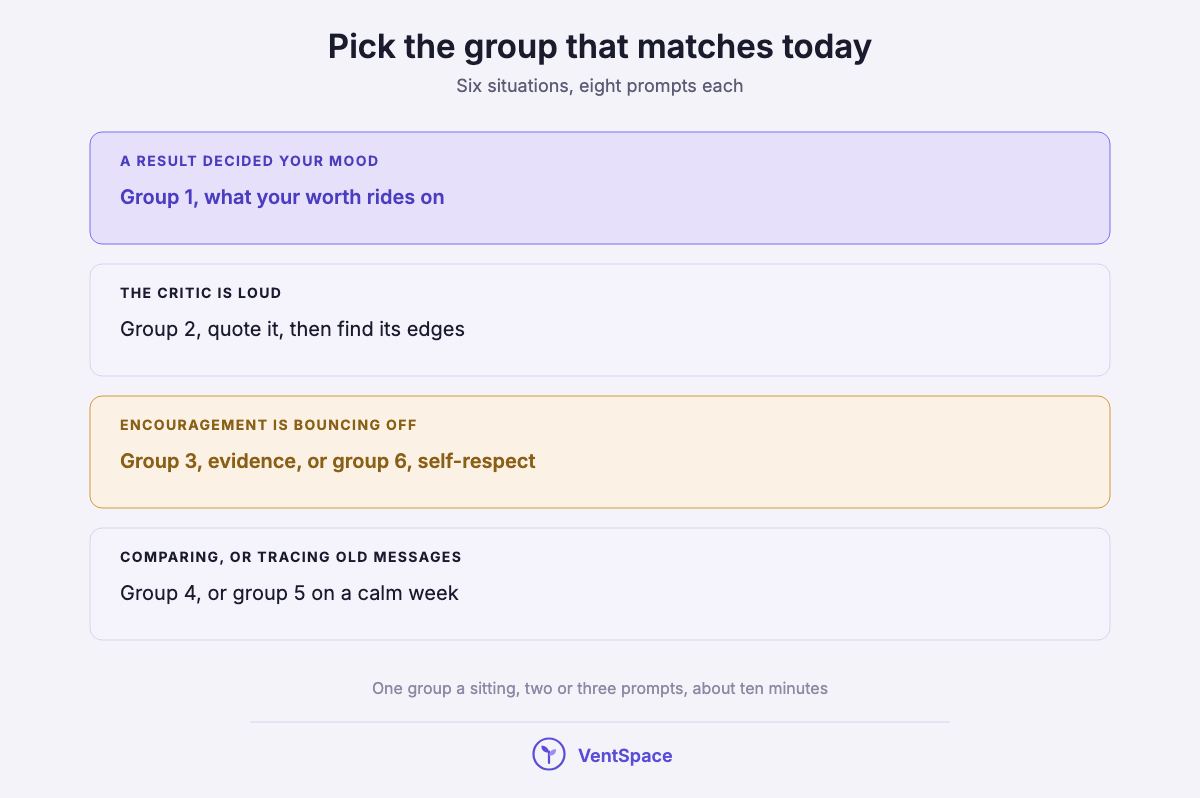
There are six groups, each named after a situation rather than a trait: when your worth rides on a result, when the critic is loud, when you need evidence, when you are comparing, when you trace where the verdict came from, and when you want to treat yourself with some respect. Read the names, pick the one you are in, and skip the rest. None of them is a diagnosis or a step on a ladder.
1. When your worth rides on today’s result
Some days one email, one grade or one comment decides how we feel about ourselves. These prompts look at what our worth is riding on, because a verdict staked on a single result moves every time that result does.
1.What result today changed how I felt about myself, and by how much?
Why this helps: naming the result shows what our worth was staked on today, which is usually something narrower than our whole life.
How to sit with it: one line for the result, then a rough number from one to ten for before and after. No explanation yet. Look at the gap.
2.What do I believe I have to keep doing to deserve to feel all right about myself?
Why this helps: most of us carry a private list of conditions we have never written down, and seeing them on paper makes them look less like laws.
How to sit with it: write the first three conditions that come, without editing. Then circle the one you would never ask of a friend.
3.If I lost the thing I am best at tomorrow, what would still be true about me?
Why this helps: worth that rests on one domain is fragile, and this asks what is left when that domain is taken away for a minute.
How to sit with it: answer this one on a short walk and write it down when you are back. Aim for three things that are not achievements.
4.When did I last feel fine about myself on a day nothing went well?
Why this helps: a day like that is proof that our worth does not depend entirely on results, and most of us have had one we have forgotten.
How to sit with it: give it two minutes of thought before writing. If no day comes, write that down plainly. It tells you something too.
5.Whose approval am I waiting for this week?
Why this helps: approval is one of the most common things self-worth gets staked on, and the waiting is easier to notice once it has a name.
How to sit with it: one name and one sentence on what you hope they will say. Then one sentence on what happens if they never say it.
6.What would I attempt if a bad outcome said nothing about my worth?
Why this helps: the things we avoid often show what we have staked our worth on, because a failure there would feel like a verdict.
How to sit with it: list two or three things, small or large. Do not plan any of them tonight. Only notice which one made you hesitate.
7.Which part of my life gets to decide how I feel about all of me?
Why this helps: one area, such as work, looks, money or a relationship, often gets a vote far bigger than its share, and the imbalance is easier to see written.
How to sit with it: draw a quick pie of how much each area decides your mood about yourself. Then a second pie of how much you think it should.
8.What did I do today that had nothing to do with being good at something?
Why this helps: kindness, curiosity and showing up are part of a person too, and a results-heavy week tends to leave them out of the count.
How to sit with it: one small act, described in two sentences. It can be as ordinary as listening to someone or making a meal.
Quick Summary
Q: What should I journal about when one bad result ruins my day?
A: Write what the result was, how far your mood about yourself moved, and what would still be true about you if that thing went away. A verdict staked on one result swings with it.
2. When the inner critic is talking
The critic rarely argues. It states. These prompts treat its sentences as claims to check rather than facts to accept or slogans to shout down, using the honest middle that did not backfire in Wood’s experiments.
9.What exactly did the critic say today, word for word?
Why this helps: a vague sense of being not good enough is hard to examine, while a single quoted sentence can be looked at, tested and sometimes laughed at.
How to sit with it: write the sentence in quotation marks, as if transcribing someone else. Then write the time of day it showed up.
10.In what ways is that sentence true, and in what ways is it not?
Why this helps: this is the shape that held up in the research. It does not ask you to deny the criticism, only to find its edges.
How to sit with it: two columns, true and not true, three items each at most. Use specific examples from this month, not your whole life.
11.Would I say this sentence to someone I respect, in these words?
Why this helps: the critic’s tone often gives it away, and hearing it aimed at someone else shows how much harsher it is than the facts require.
How to sit with it: rewrite the sentence as if speaking to a colleague you like. Keep any truth in it. Drop only the contempt.
12.What is the critic trying to protect me from?
Why this helps: harsh self-talk often tries to get ahead of rejection or failure, and seeing the motive can make the voice less convincing.
How to sit with it: finish the line “If I stopped criticizing myself about this, I am afraid that” in one go. Write it once. Do not argue with the answer.
13.When did this sentence first start sounding true to me?
Why this helps: many of the critic’s lines are older than the situation they show up in, and a date can make a lifelong truth look like a habit.
How to sit with it: a year or an age is enough. If it brings up something heavy, stop at the date and leave the rest for another day.
14.What would a fair witness say about the same event?
Why this helps: the critic only ever reports one side, and imagining a neutral observer brings back the facts it tends to leave out.
How to sit with it: describe the event in three flat sentences, as a camera would record it. No adjectives about yourself at all.
15.What has the critic predicted before that did not happen?
Why this helps: its forecasts are rarely checked, and a short record of the wrong ones weakens the next one a little.
How to sit with it: list up to three past predictions and what happened instead. Keep this page, because you will want to reread it.
16.What small thing would I do differently if this sentence were only partly true?
Why this helps: criticism that contains a grain of truth is useful once it is the right size, and a small change is how that grain gets used.
How to sit with it: one action, small enough to do this week. Write it as a plan, not a promise to become a better person.
Quick Summary
Q: How do I journal about my inner critic?
A: Quote its exact words, then write how the sentence is true and how it is not, with specific examples. Arguing back with compliments tends to fail. Finding the edges of the claim is gentler and more honest.
3. When you need evidence, not encouragement
On a low week, encouragement bounces off. Evidence is harder to dismiss. These prompts build a written record of competence, effort and recovery, so the verdict has something solid to weigh.
17.What is one thing I can do now that I could not do five years ago?
Why this helps: growth is invisible from the inside because we only ever see today’s version of ourselves, and a five-year gap makes it countable.
How to sit with it: pick something concrete, a skill, a habit, a conversation you can now have. Write how you learned it in two lines.
18.When did I recover from something I thought would flatten me?
Why this helps: a record of recoveries is better evidence about who we are than any single setback, and most of us forget our own.
How to sit with it: describe the low point in one sentence and the way back in three. Notice which part takes up more room.
19.What did I keep going on this month, even though it was hard?
Why this helps: persistence after failure was the important exception a major review found to its doubts about self-esteem, and noticing yours puts it on the record.
How to sit with it: name the task and the hardest moment. Then one line on what kept you going. A small thing counts.
20.What do people come to me for?
Why this helps: other people’s requests are an outside record of what we are good at, and it is harder to argue with than our own opinion.
How to sit with it: list three requests from the past month and who made them. Do not add any modesty or qualifiers to the list.
21.What did I handle well this week that nobody saw?
Why this helps: most competence is private, which is why it rarely makes it into the verdict we hold about ourselves.
How to sit with it: one example, written in the first person and in the past tense. Leave out “only” and “just”. Then close this prompt.
22.What is a compliment I dismissed, and what would it mean if it were accurate?
Why this helps: dismissing praise is often a reflex, and treating it as data for one minute lets it count without having to be believed fully.
How to sit with it: write the compliment and who said it. Then finish the sentence “If they were right, it would mean” and stop there.
23.What have I done that I would admire in someone else?
Why this helps: we often have a double standard, generous about other people’s efforts and stingy about our own, and this borrows the generous side.
How to sit with it: answer it about a friend first, in two lines, then about yourself in two lines. Compare the tone of the two.
24.What would my record look like if I wrote it as a reference letter?
Why this helps: a reference letter has to be specific and fair, which is the register a low verdict usually lacks.
How to sit with it: three sentences in the third person, the way a former manager or teacher might put it. Facts only, no flattery.
Quick Summary
Q: What are journal prompts for building self-esteem with evidence?
A: Write down what you can do now that you could not five years ago, what you recovered from, and what people come to you for. A written record is harder to dismiss than encouragement.
4. When you are measuring yourself against someone
Comparison is quick and rarely fair. We compare our inside to someone else’s outside, our worst day to their best photo. These prompts slow the comparison down long enough to see what it is made of.
25.Who did I compare myself to today, and on what exactly?
Why this helps: comparison usually feels total, but it is nearly always about one narrow thing, and naming the thing shrinks it.
How to sit with it: a name or a description, then the one dimension in a single word: money, looks, career, ease. Nothing more tonight.
26.What do I know for sure about their life, and what am I guessing?
Why this helps: most comparisons run on a guess filled in with our own fears, and separating knowledge from guesswork takes some of the force out of it.
How to sit with it: two short lists, known and guessed. If the guessed list is longer, write that observation at the bottom of the page.
27.What would I have to give up to have exactly what they have?
Why this helps: we compare against the highlight and forget the cost, and every life has one, even the ones that look easy.
How to sit with it: answer slowly, a minute of thought first. Then decide honestly whether you would make the trade. Either answer is fine.
28.What does this comparison tell me I want?
Why this helps: envy can be useful information about a want we have not admitted, which is more workable than a judgment about our worth.
How to sit with it: finish the sentence “I want more of” once. Then one small step toward it that has nothing to do with the other person.
29.Who might compare themselves to me, and on what?
Why this helps: we rarely see ourselves as anyone’s comparison point, and this reverses the angle for a moment without asking for pride.
How to sit with it: one person and one dimension. Write it plainly, without adding that they are wrong to. Then move on.
30.Which app, room or group sets off most of my comparisons?
Why this helps: comparisons cluster around particular places, and knowing the place gives us a choice that a general resolution to compare less does not.
How to sit with it: track it for three days with a mark each time, then write the place with the most marks. Decide one change, small.
31.How would I describe my own progress without mentioning anyone else?
Why this helps: progress described only against other people is never finished, while progress against our own past has a real starting point.
How to sit with it: three sentences comparing you this year with you last year. No names allowed. If one slips in, cross it out.
32.What do I have that I stopped noticing because I have had it a while?
Why this helps: comparison makes what we lack vivid and what we have invisible, and this pulls a few familiar things back into view.
How to sit with it: look around the room before answering. List three things, people or abilities, and one line on when you got each.
Quick Summary
Q: How do I stop comparing myself to others in my journal?
A: Do not try to stop. Slow the comparison down: who, on what exactly, what you know versus guess, and what it tells you that you want. Then describe your progress against your own past.
5. When you trace where the verdict came from
Skip this group on a hard week. These prompts look back at messages we were given about our worth, at home, at school or in the culture we grew up in. They are meant to be light. If one brings up something heavy, that is a conversation for a therapist or doctor, not a notebook.
33.What did my family seem to value most in a person?
Why this helps: the qualities a household praised often become the conditions we measure ourselves by, long after we have left that house.
How to sit with it: three words, then one memory for each that shows where the word came from. Keep it to what you saw.
34.What message about worth did I receive that I still repeat to myself?
Why this helps: some of our harshest lines are borrowed, and recognizing a borrowed sentence gives us the option of handing it back.
How to sit with it: write the message and who it came from, then one line on whether you would choose it today.
35.Who was the first person who made me feel capable?
Why this helps: the voices that built us up are part of the record too, and they are often drowned out by the louder critical ones.
How to sit with it: name them, then describe one specific moment. If you could thank them, write two lines you might say.
36.What did my culture or community tell me a worthwhile life looks like?
Why this helps: a cultural picture of success can quietly set the bar we keep failing to clear, without our ever having agreed to it.
How to sit with it: write the picture in four or five plain details. Then mark the details you want, and the ones you inherited.
37.Where do my own values and the values I was raised with disagree?
Why this helps: the gap between the two is often where self-esteem gets caught, because living by our own values can feel like failing someone else’s.
How to sit with it: write it as a short dialogue, three lines each, between what you were taught and what you now think. No winner needed.
38.If I drew a family tree of messages instead of names, what would it say?
Why this helps: it shows the inheritance in one picture, and patterns that repeat across a generation are easier to see on a page than in memory.
How to sit with it: draw it roughly, a phrase per person, such as “education is everything” or “never show weakness.” Five minutes, then stop.
39.What did I need to hear at twelve that nobody said?
Why this helps: the answer is often the exact sentence we still go looking for in other people’s approval, which makes it worth knowing.
How to sit with it: one sentence, written plainly. If it hurts to write, stop there and close the notebook. You have done enough with it.
40.Which inherited message do I want to keep, because it still serves me?
Why this helps: not everything we were given is a burden, and choosing what to keep makes the rest easier to set down.
How to sit with it: one message and one example from this year where it helped you. End this group of prompts on that.
Quick Summary
Q: What journal prompts help me understand where low self-esteem comes from?
A: Write the qualities your family valued, a message about worth you still repeat, and the first person who made you feel capable. Keep it light, and take anything heavy to a professional.
6. When you want to treat yourself like someone you respect
Respect is quieter than love and easier to start with. These prompts look at how we treat ourselves in practice: the promises we keep, the way we talk to ourselves, and what we allow.
41.What promise to myself did I keep this week, however small?
Why this helps: kept promises are evidence that we can be relied on, and most of us count the broken ones far more carefully.
How to sit with it: one promise, one line. If you kept none, write one tiny promise for tomorrow that you are sure you can keep.
42.Write about today’s hardest moment using “you” or your own name instead of “I”. What changes?
Why this helps: in one research group’s studies, people who spoke to themselves this way during stressful social tasks showed less distress than those who used “I”.
How to sit with it: five sentences in the second person, as if a calm friend were describing your day to you. Then reread it once.
43.Where did I let myself be treated in a way I would not accept for a friend?
Why this helps: what we allow from others often mirrors what we think we deserve, and naming one instance makes the standard visible.
How to sit with it: one example, written factually. Then one line on what you would want for a friend in the same spot. No action needed tonight.
44.What did I do today that took some courage, even if nobody noticed?
Why this helps: quiet courage, a hard email or saying no, is easy to discount, and it is exactly the kind of evidence a low verdict leaves out.
How to sit with it: finish the sentence “I showed courage by” about an effort, not an outcome. Two sentences at most, written in the past tense.
45.What do I need more of this week, and how would I give it to myself?
Why this helps: treating ourselves with respect is partly practical, and naming a need is the first step toward meeting it.
How to sit with it: one need in a single word, such as rest, company or quiet. Then one specific way to give it, with a day attached.
46.What would I write to myself during a past struggle, knowing how it turned out?
Why this helps: we know things now that we did not know then, and writing back to an earlier self lets us offer the fairness we needed.
How to sit with it: a short letter you will not send, to yourself at that time. Five sentences, with at least one practical piece of advice.
47.Which of my qualities would I miss most if it disappeared?
Why this helps: it asks what we value in ourselves without asking us to rank or praise it, and the answer is usually something modest and real.
How to sit with it: one quality, then one moment this month when it showed. Write the moment, not the quality, in detail.
48.What is one decision this week I made on my own terms?
Why this helps: acting on our own judgment, even on something small, is a form of self-respect, and recording it builds the habit of trusting ourselves.
How to sit with it: write the decision and what you weighed. Then one line on how it felt to choose without checking with anyone.
Quick Summary
Q: What are journal prompts for self-respect?
A: Record a promise to yourself you kept, describe a hard moment using “you” instead of “I”, and note one decision you made on your own terms. Respect shows up in practice more than in statements.
Insight Taking a step back from an experience has a measured effect on how intense it feels, but in two meta-analyses by Tali Moran and Tal Eyal it was weaker for self-conscious emotions (g = 0.29) than for basic ones (g = 0.64). Shame is a self-conscious emotion. If prompt 42 does not lift it much, that is the research being honest, not you failing.
What to do with what you wrote
One entry says little. A month of them can show what your worth keeps riding on. That pattern is the useful part of self-esteem journaling, and it only appears when we reread.
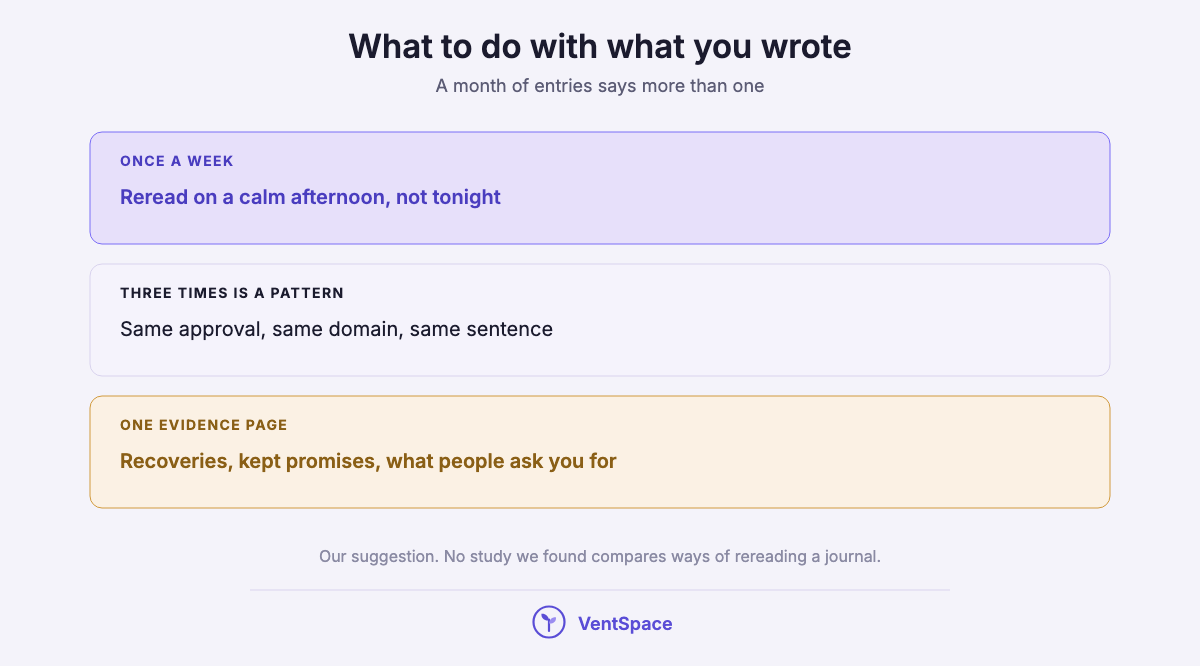
Reread once a week, on a calm afternoon. Rereading tonight’s entry tonight tends to restart it. A week of entries read at a distance shows the shape of the week instead of the heat of one bad day. That is our suggestion, not a finding: no study we found has compared ways of rereading a journal.
Look for anything that appears three times. The same person whose approval you wait for, the same domain that decides your mood, the same sentence from the critic. Three is a pattern. One is a day.
Keep a running page of evidence. Copy the best lines from groups 3 and 6 onto one page: recoveries, kept promises, things people come to you for. On a bad week, read that page instead of writing a new entry.
Analyze, do not relive. If you notice yourself rewriting the same list of faults in new words, close the notebook. Rereading helps when it moves toward a conclusion and hurts when it becomes another round of the critic.
Ask one question at the end of each month: is what my worth rides on a little wider than it was? If yes, it is working for you. If it is no for two months running, change the group or the time of day, or talk to someone, rather than trying harder.
Quick Summary
Q: Should I reread my self-esteem journal?
A: Yes, about once a week, looking for what appears three times. Keep a separate page of evidence to read on bad weeks, and stop rereading if it turns into a list of faults.
What journaling can and cannot do for self-esteem
The research on self-esteem has two halves, and both belong on this page. A major 2003 review led by Baumeister found the links between self-esteem and school performance modest, with good performance lifting self-esteem more than the reverse, and wrote: “We have not found evidence that boosting self-esteem (by therapeutic interventions or school programs) causes benefits.” The same review also wrote: “we are persuaded that high self-esteem does lead to greater happiness” and “Low self-esteem is more likely than high to lead to depression under some circumstances.” Both sentences are in the same paper.
Low self-esteem tends to come before low mood more than after it. A 2013 meta-analysis by Sowislo and Orth pooled 77 longitudinal studies and found the path from low self-esteem to later depression (β = −.16) was stronger than the path from depression to later self-esteem (β = −.08). It is prospective rather than experimental, and the authors write that self-esteem interventions “might be useful” if future research supports causality. In Crocker’s student study, self-esteem that swung from day to day predicted increases in depressive symptoms among students who were already more depressed.
This is where a notebook stops and a professional starts. Therapy is one option, and for a lot of people it is the right one. In a 2018 meta-analysis by Kolubinski and colleagues, cognitive behavioral therapy built for low self-esteem showed large improvements in weekly sessions (an effect size of 1.12) and smaller ones in one-day workshops (0.34), on self-report measures, across seven pooled studies. The authors add that it is unclear whether these treatments differ from those aimed at depression. Prompts can help you see what your worth rides on. A therapist can help you change it, with someone else in the room.
If you are struggling right now. If low mood, hopelessness or thoughts of not wanting to be here have lasted more than a couple of weeks, talk to a doctor or therapist. If you are in crisis or thinking about harming yourself, call or text 988 (Suicide & Crisis Lifeline, US), or find the number where you are at findahelpline.com. This article is not a substitute for that.
Quick Summary
Q: Can journaling improve self-esteem?
A: It can help you see what your self-worth rests on and keep a record of evidence. No study we found tests self-esteem journal prompts directly. For low self-esteem that is lasting or affecting your mood, therapy has measured results.
A two-week schedule you can copy
| Day | Group | Prompts |
|---|---|---|
| Mon, week 1 | 3. Evidence | 17, 18 |
| Tue | 1. Worth rides on results | 1, 2 |
| Wed | 6. Self-respect | 41, 44 |
| Thu | 2. Inner critic | 9, 10 |
| Fri | 3. Evidence | 20, 21 |
| Sat | 4. Comparison | 25, 28 |
| Sun | Reread the week | No new prompts |
| Mon, week 2 | 6. Self-respect | 42, 45 |
| Tue | 1. Worth rides on results | 3, 7 |
| Wed | Whichever matches the day | Two prompts |
| Thu | 2. Inner critic | 14, 15 |
| Fri | 3. Evidence | 22, 24 |
| Sat | Skip, or one prompt | Any |
| Sun | Reread both weeks, start the evidence page | The monthly question, early |
Group 5 is not on the schedule on purpose. Use it on a calm week, when you choose to.
If you only answer five
1.
Prompt 10: in what ways the critic’s sentence is true, and in what ways it is not.
2.
Prompt 2: what you believe you have to keep doing to deserve to feel all right.
3.
Prompt 18: when you recovered from something you thought would flatten you.
4.
Prompt 26: what you know about the person you compare yourself to, and what you are guessing.
5.
Prompt 41: a promise to yourself you kept this week.
Between them they cover the critic, the conditions, the evidence, the comparison and the self-respect, in about fifteen minutes.
Questions people ask
Do positive affirmations help self-esteem?
Not reliably, and possibly the reverse for the people who want them most. In two experiments, people with low self-esteem who repeated “I’m a lovable person” felt worse than those who considered how it was both true and not true. People with high self-esteem felt only a little better.
Do I have to love myself before I can raise my self-esteem?
No. Self-esteem moves with what your worth rides on and with the evidence you notice, and respect is an easier place to start than love. If warmth toward yourself is what you are after, our journaling prompts for self-love are built for that.
How long before self-esteem journaling makes a difference?
We cannot give you a timeline, and we found no source that does. A useful check is the monthly question above: is what your worth rides on a little wider than last month?
Is self-esteem the same as confidence?
No. Confidence is trust in what you can do, task by task. Self-esteem is the overall verdict on what you are worth. Being good at things does not settle the second, which our piece on self-esteem vs self-confidence goes into.
What if journaling makes me feel worse about myself?
Stop that prompt and switch to group 3 or 6, which build evidence rather than examine faults. If writing keeps leaving you feeling worse for days, or your mood has been low for weeks, talk to a doctor or therapist.
Start with one honest sentence
None of these prompts will make you believe something about yourself overnight, and we would distrust any that promised to. What they can do is move the verdict slowly onto better evidence, written in your own hand, one entry at a time.
So tonight, pick one sentence the critic said today. Write how it is true. Then write how it is not.
About this article

Written by
Sai Subramaniam
Founder, VentSpace
I write these guides because I have been where you are. I am working through my own hard seasons, and I share the things that actually helped me, so that anyone going through it has a steady companion close by instead of facing it alone. VentSpace is the app I built for exactly that: a journaling app that turns what you write into a clear read on your life balance, plus small, doable next steps toward feeling more like yourself.
This writing is honest and every claim is sourced, and it is not a substitute for professional care. If you are struggling, reaching out to a professional is a strong move, not a failure.
Explore VentSpaceTry VentSpace LiveHow this one was checked. Every factual claim traces to a named source, and the source is printed next to the claim rather than kept in a footnote. Quotes are pinned to the work they come from, with the year, the letter or the chapter where one exists. Where a widely repeated claim could not be traced, it was left out and the omission recorded. Where a figure is contested, both sides are printed.
No affiliate links, no paid placements, and nobody paid to appear here. Where we mention our own app, we say that it is ours, we state its limits, and we never position it as a substitute for care.
Reviewed: October 2026. Prices, platforms and product availability move quickly, and anything we could not verify at the time of writing is marked as unverified rather than turned into a number.
Corrections. If something here is wrong, we would rather know. Corrections are made in place, with a note saying what changed.