
“And thus ends all that I doubt I shall ever be able to do with my own eyes in the keeping of my journal, I being not able to do it any longer, having done now as long as to undo my eyes almost every time that I take a pen in my hand.” · Samuel Pepys, the last entry in his diary, 31 May 1669
Most of us know the scene. We open a drawer, or an app we forgot we had, and find a journal with three entries in it, the last one dated months ago. The handwriting is hopeful. The gap after it is not. And somewhere in the time it takes to close the drawer, we decide something about ourselves: that we lack discipline, that we are not the kind of person who keeps a journal. Is that what the empty pages mean?
It is not, and the research is unusually clear about why. When a large trial across fourteen hospitals in England randomized 854 new mothers, only 29.3% of those asked to write expressively for fifteen minutes on three days did it as instructed. That was a research protocol with a team behind it, and still most people did not complete it. Stopping is the ordinary outcome, not a personal one. Even Samuel Pepys, whose diary is still read three and a half centuries later, stopped, because he feared for his eyesight.
A journaling roadblock is a sign to reroute, not a reason to turn back. This guide names the seven roadblocks that stall most of us, helps you work out which one stopped you, and then gives five small steps that change the practice to fit your life, instead of asking you to change your character to fit the practice.
Quick Digest
– Why it stalls: the standard most of us fail against (every day, at length, forever) is not what the research used. A single missed day did not undo a habit in the best-known study.
– The seven roadblocks: the blank page, the perfect entry, no time, the wrong medium, no visible payoff, the reread spiral, and what comes up.
– The fix: name the one that stopped you last time, then change one thing about the practice. Five steps below.
– How long: health habits took a median of about two months in one review, with huge variation between people.
– When to stop: if writing leaves you markedly worse for a day or two, that is a signal, not progress.
Why a journaling habit stalls
“Never suffer an exception to occur till the new habit is securely rooted in your life.” · William James, The Principles of Psychology (1890)
Most of us were taught a version of James’s rule, and it is the rule that makes a stalled journal feel like a moral failure. James went further: “Each lapse is like the letting fall of a ball of string which one is carefully winding up; a single slip undoes more than a great many turns will wind again.” If that were true, every missed evening would cost us the whole ball.
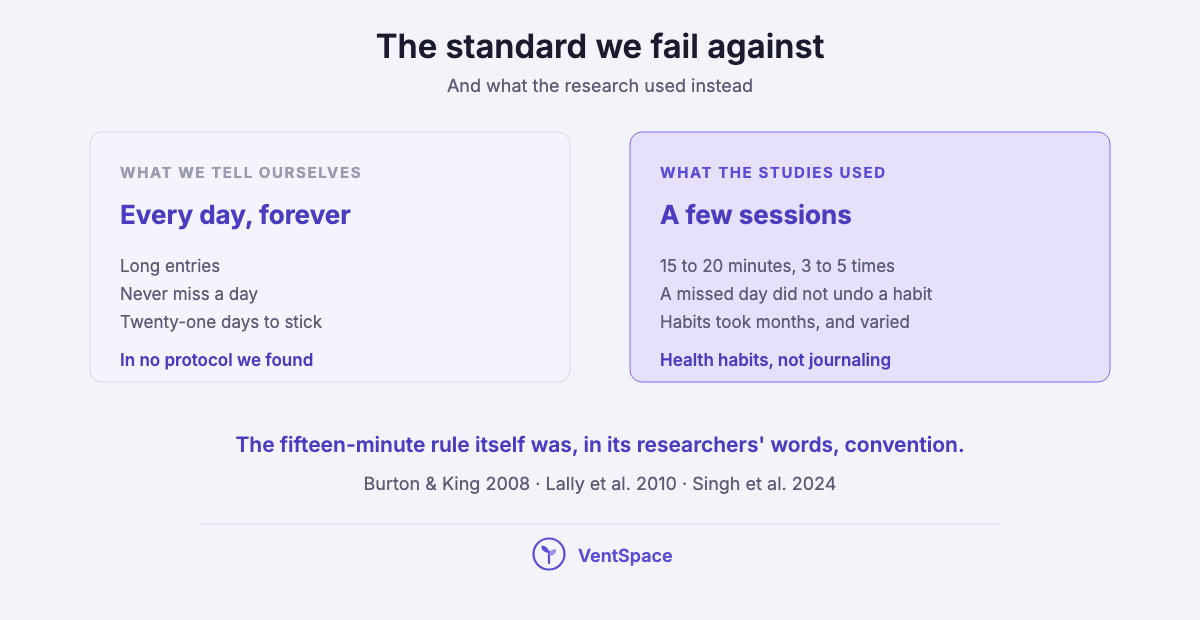
The evidence we now have is gentler. In a 2010 study, Phillippa Lally and colleagues followed 96 volunteers who each chose an eating, drinking or activity habit to do daily for twelve weeks. Their abstract is plain: “Missing one opportunity to perform the behaviour did not materially affect the habit formation process.” The time people took to reach their own plateau ranged from 18 to 254 days, the upper figure a model estimate beyond the study’s twelve weeks. Those were eating, drinking and activity habits, not journaling, but the principle is the one we need: a missed day is a missed day, not a reset.
The daily standard is not in the journaling research either. The writing studied in this literature is a protocol, typically 15 to 20 minutes on three to five occasions, not a practice kept every day forever. Two researchers who went looking for the basis of the fifteen-minute rule found it had been “driven primarily by convention rather than empirical evidence.” And in the largest meta-analysis of this kind of writing, how the sessions were spaced made no significant difference to the effect.
So the stall usually says something about the design, not about us. We set ourselves a form that no study used, failed to keep it on a week that had other plans, and read the failure as a verdict.
From Sai, who writes this blog
It’s funny how we stress and worry about our work’s daily and weekly check-ins, but we barely check in with ourselves for our own personal and emotional growth.
Quick Summary
Q: Why do I keep stopping journaling?
A: Usually because the practice was designed around a standard no study used: daily, long and indefinite. A single missed day did not materially affect habit formation in the best-known study, so a gap is a reason to redesign, not evidence that you lack discipline.
Insight From Joanne Frattaroli’s 2006 meta-analysis of 146 randomized studies, verbatim: “Spacing of disclosure sessions was not found to be a significant moderator for any of the effect size types.” No pattern of spacing, daily or otherwise, stood out in the pooled evidence.
The seven roadblocks, and how to tell which one is yours
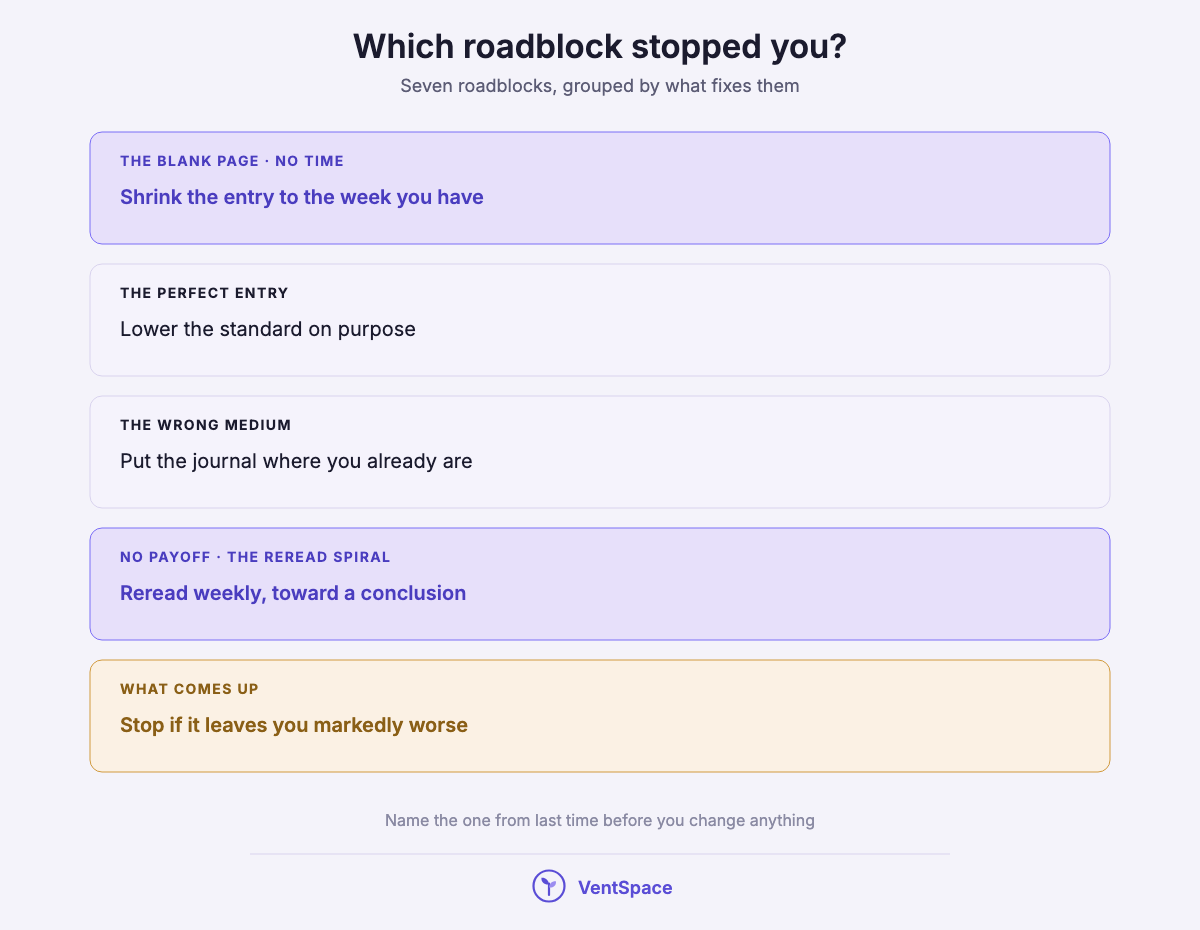
The seven roadblocks below are the ones that recur across the pages people find when they search this question, plus two those pages leave out, and they need different fixes, which is why one-size advice to “be consistent” fails so many of us. Read the seven and notice which one describes the last time you stopped, not the one that sounds most like a flaw.
1. The blank page
What it looks like: you open the journal, feel the size of the empty page, and close it again. Nothing seems worth writing, or everything does, and you cannot pick.
Why it happens: an open page asks two questions at once, what to write about and how to begin, and a tired mind often answers neither. The page is not the problem. The lack of a starting point is.
Fixed by: step 2, shrinking the entry until it fits.
2. The perfect entry
What it looks like: you only write when you have time to write well. Entries get crossed out, or never begun, because they would not read like the journal you imagined keeping.
Why it happens: we bring to a private page the standards we use for work that will be judged, and a journal written for an imagined reader quickly becomes a performance. The old version of this page put it plainly: a journal is meant to be a space where you can express yourself without judging yourself.
Fixed by: step 3, lowering the standard on purpose.
3. No time
What it looks like: you mean to write, every evening, and every evening something more urgent wins.
Why it happens: urgent tasks tend to win over ones that pay off slowly, and journaling is the slowest-paying task on most of our lists. A practice designed for twenty quiet minutes will lose to a week that has none.
Fixed by: step 2, shrinking the entry to the week you have.
4. The wrong medium
What it looks like: you love the idea of a notebook and never carry it, or you write on your phone and get pulled into everything else on it.
Why it happens: the medium decides whether the journal is in reach at the moment you have something to say. In the large meta-analysis, writing by hand, typing and talking did not significantly change the effect, so the right medium is whichever one you will reach for.
From Sai, who writes this blog
I prefer physical journals, but I use digital ones because of the privacy I get with them. The chances of someone reading my digital journal are much lower than my physical one. Conflicts like this can leave us with an option we might not prefer.
Fixed by: step 4, choosing the medium you will reach for.
5. No visible payoff
What it looks like: you kept it up for a few weeks, nothing seemed different, and the habit quietly lapsed.
Why it happens: where this kind of writing helps, the effect is small and slow. A 2023 meta-analytic review of 31 randomized studies, with about 4,000 participants, found a small effect on depression, anxiety and stress (g = −0.12) that showed up at follow-up rather than straight away. Looking for a change in week two is looking too early.
From Sai, who writes this blog
From my own experience, when our days are full of things that pay off instantly, it is hard to stay motivated for something like journaling, which pays off slowly.
Fixed by: step 5, making it give something back.
6. The reread spiral
What it looks like: you reread old entries and end up back inside the same bad week, writing the same complaint in new words.
Why it happens: writing can hold brooding as easily as it holds reflection. In rumination research, the brooding items are mostly why-questions like “Why can’t I handle things better?”, while one of the reflection items reads “Write down what you are thinking and analyze it.” The second half of that sentence is the difference. More on how this loop works in journaling vs venting.
Fixed by: step 5, rereading on a schedule and toward a conclusion.
7. What comes up
What it looks like: a few entries in, something heavy surfaced, an old grief or a fear, and the journal stayed closed after that.
Why it happens: writing about our lives brings up our lives, and wanting to step away from strong feelings is understandable. Sometimes stopping was a sound decision. This roadblock has its own section further down, because the honest answer is not always to push on.
Fixed by: the section “When the roadblock is what comes up”.
Quick Summary
Q: What are the most common journaling roadblocks?
A: The blank page, wanting every entry to be good, lack of time, a medium you do not reach for, no visible payoff, rereading that turns into a loop, and difficult feelings coming up. Each needs a different fix, so name yours first.
Insight In the trial that measured adherence, the authors note that “women enjoyed the writing and/or found it helpful even when it was upsetting.” Difficult and useful can be the same entry. Difficult and harmful can be too, which is why roadblock 7 gets its own section.
So which one stopped you last time?
How to get past yours: five steps
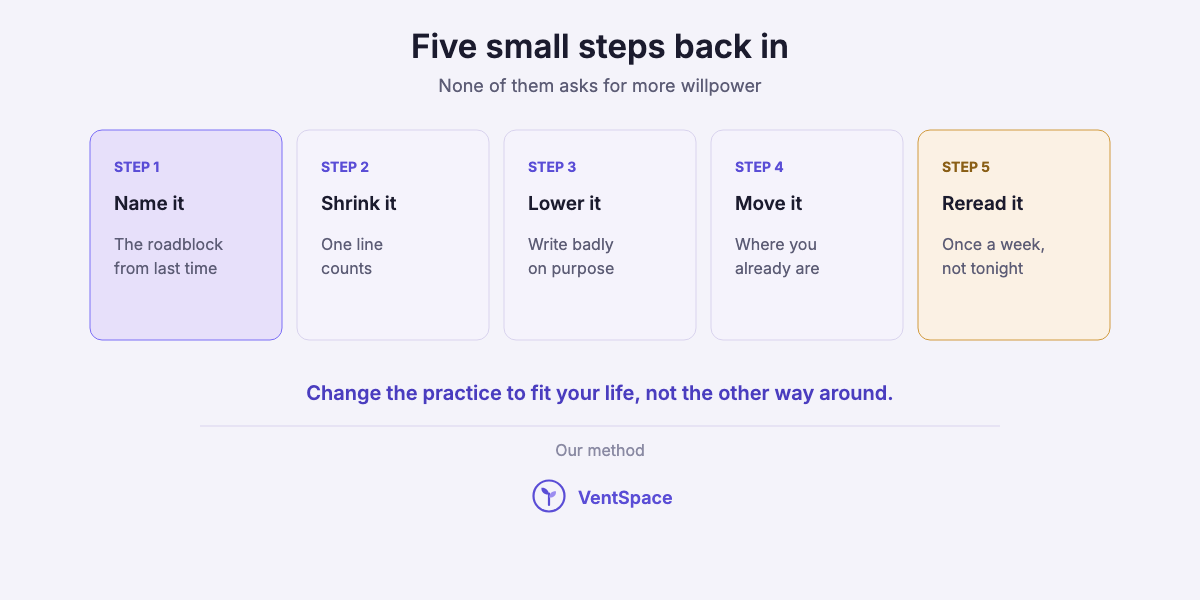
Five small changes cover the seven roadblocks. None of them asks for more willpower. Each changes the practice so that it fits the life it has to live in. Start with step 1, then go to the step your roadblock points to.
Step 1: Name the roadblock that stopped you last time
First action: write one line, today, that finishes the sentence that begins “The last time I stopped journaling, it was because”
Ask yourself:
- When did I write my last entry, and what was the week like?
- Did I stop deciding to stop, or did I drift?
- Which of the seven roadblocks sounds most like that week?
- Is it the same one as the time before?
Permission: you do not need a deep answer. One word, like “time” or “perfect”, is enough to choose the next step.
Step 2: Shrink the entry to the week you have
First action: decide on an entry so small it fits your worst day: one line, three bullet points, or one prompt. Write it now.
Ask yourself:
- How many minutes do I have on a bad evening, honestly?
- What is one question I could answer in a single line?
- Where in my day am I already sitting still: the bus, the kettle, the parking lot?
- Would a one-line entry still feel like it counts to me?
Permission: a short entry is a complete entry. The fifteen-minute rule was, in its researchers’ words, convention. If one line a day suits you, our guide to the one line a day journal covers that form, and if a prompt helps, our end of day journaling prompts are sorted by the kind of day you had. A prompts page for restarters, journal prompts for beginners, is being prepared now.
Step 3: Lower the standard on purpose
First action: write tonight’s entry badly on purpose. Misspell something. Leave a sentence unfinished. Then close the journal without rereading it.
Ask yourself:
- Who am I writing this for, if I am honest?
- What would I write if I knew nobody, including me, would read it tomorrow?
- Which part of an entry do I fuss over: spelling, neatness, sounding wise?
Permission: a journal does not have to be good. It has to be honest, and honest is often messy.
Step 4: Choose the medium you will reach for
First action: notice where you are when something worth writing occurs to you, and put the journal there: a notebook in the bag, a notes app on the home screen.
Ask yourself:
- Where am I when I most often want to write something down?
- Is my phone a help here or a distraction?
- Does privacy matter more to me than the feel of paper, or the other way around?
Permission: you can use both. Some people do, and the research does not crown either one. Our comparison of digital and paper journaling weighs them in detail. If you want an app that does something with what you write, VentSpace is one option: a journaling app that turns what you write into a clear read on your life balance, plus small, doable next steps. It is ours, it is Android only and free to start, and it is not therapy. Not on Android, or at a desk? VentSpace Live runs in your browser, free, with nothing to install. Paper is free too.
Step 5: Make it give something back
First action: put a recurring note in your calendar for one quiet afternoon a week labelled “reread”. Not every night, and not on the bad night itself.
Ask yourself:
- What has come up three times this week?
- Am I rereading to find a conclusion, or to feel the same thing again?
- Can I name one thing I do differently because of what I wrote this month?
Permission: if the answer to the last question is no, that is information about the design, not about you. Change the time, the length or the medium, and try again. This weekly reread is our suggestion, not a research finding: no study has compared ways of reviewing a journal.
Quick Summary
Q: How do I get back into journaling after stopping?
A: Name the roadblock that stopped you last time, then change one thing to fit it: shrink the entry, lower the standard, move the journal to where you are, or add a weekly reread. Write one line today rather than waiting for a fresh start.
Insight Lally and colleagues found that missing one opportunity “did not materially affect the habit formation process.” A restart can begin on any ordinary day, including today.
Pulling it all together
Step 1 gives you a word. Write the one roadblock that stopped you last time on the first page of whatever you write in next.
Step 2 gives you a size. Decide on the smallest entry you will accept, and write that size down too.
Step 3 gives you permission. Commit to one deliberately imperfect entry this week.
Step 4 gives you a place. Put the journal where you already are, and leave it there.
Step 5 gives you a reason. Put one weekly reread in your calendar and one monthly question beside it: what do I do differently because of this?
Quick Summary
Q: What is the simplest way to start journaling again?
A: Pick your roadblock, choose the smallest entry you will accept, write it somewhere you already are, and reread once a week. That is the whole plan.
When the roadblock is what comes up
Sometimes the journal stopped because it was doing something hard, and stopping was the right call. Writing about our lives can bring up grief, fear, old regret. That does not always mean we should push on.
If writing leaves you markedly worse for a day or two, treat that as a signal to stop, not as progress. We found no evidence for the idea that feeling worse means it is working. Try smaller, more recent material instead, or put the journal down for a while.
Some material is better taken to a person than to a page. In the research on expressive writing, it was detrimental for adult survivors of childhood abuse and in a small sample of eight veterans with PTSD. For trauma, the honest answer is a person: a therapist can do what a notebook cannot, which is respond. Therapy is one option. For a lot of people it’s the right one. Our page on therapy vs journaling explains how the two do different jobs.
If things feel heavier than this
If you are in crisis or thinking about harming yourself, please reach out now. In the United States you can call or text 988 for the Suicide and Crisis Lifeline. Outside the US, findahelpline.com lists the number where you are. This article is not a substitute for that.
Quick Summary
Q: What if journaling brings up painful feelings?
A: Feeling unsettled after an entry is common, but feeling markedly worse for a day or two is a signal to stop, not to push on. Write about smaller, more recent things, and take heavier material, especially trauma, to someone trained to help with it.
Questions people ask
Do I have to journal every day for it to count?
No. The studied form of this writing is a few sessions, not a daily practice, and how sessions were spaced made no significant difference in the largest meta-analysis. Write when you can. A missed day is not a reset.
What should I write when I have nothing to say?
One line about one thing that happened, or the answer to a single question. Prompts help here because they give the page a starting point. Our end of day journaling prompts are one place to start.
Is it better to journal on paper or digitally?
Neither has been shown to be better. Writing by hand, typing and talking did not significantly change the effect across 146 randomized studies. Choose the one you will reach for, or use both.
How long does it take to build a journaling habit?
We found no study that measured it for journaling. In a 2024 review of health habits like exercise and drinking water, the median was about two months, with individuals ranging from four days to 335. The popular 21-day figure has no study behind it that we could find.
Why does journaling sometimes make me feel worse?
Writing about difficult things can be unsettling, and rereading can turn into a loop. If it leaves you markedly worse for a day or two, stop, shrink the material, and consider talking to a therapist. That is a sensible response, not a failure.
In a nutshell
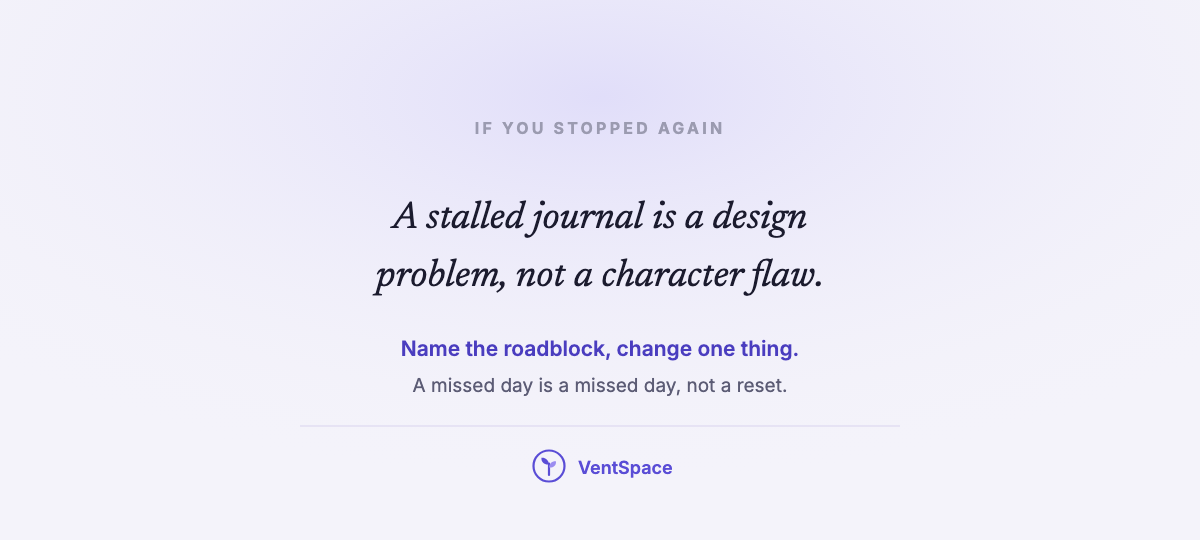
First, a stalled journal is a design problem, not a character flaw. Name the roadblock, change one thing, and write one line. The rule that every lapse unwinds the whole ball was never as true as we were told.
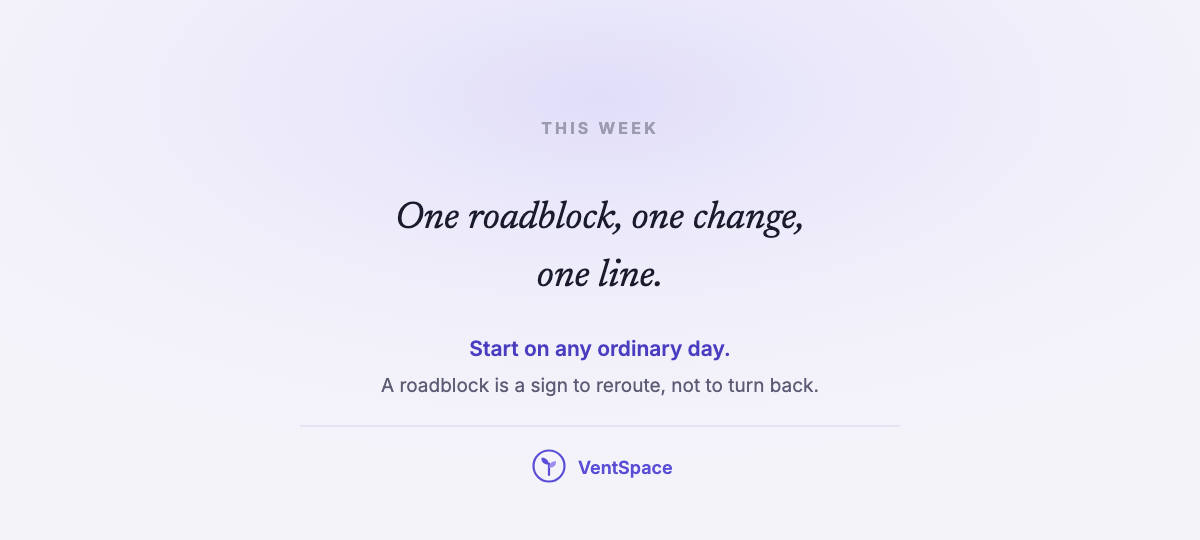
Second, this takes months, not weeks, and it varies more than anyone admits. In the review of health habits, the median was around two months and some people took most of a year. If your journal stalls again in the meantime, that is not the end of the road. It is a sign to reroute, and the drawer will still be there.
About this article

Written by
Sai Subramaniam
Founder, VentSpace
I write these guides because I have been where you are. I am working through my own hard seasons, and I share the things that actually helped me, so that anyone going through it has a steady companion close by instead of facing it alone. VentSpace is the app I built for exactly that: a journaling app that turns what you write into a clear read on your life balance, plus small, doable next steps toward feeling more like yourself.
This writing is honest and every claim is sourced, and it is not a substitute for professional care. If you are struggling, reaching out to a professional is a strong move, not a failure.
Explore VentSpaceTry VentSpace LiveHow this one was checked. Every factual claim traces to a named source, and the source is printed next to the claim rather than kept in a footnote. Quotes are pinned to the work they come from, with the year, the letter or the chapter where one exists. Where a widely repeated claim could not be traced, it was left out and the omission recorded. Where a figure is contested, both sides are printed.
No affiliate links, no paid placements, and nobody paid to appear here. Where we mention our own app, we say that it is ours, we state its limits, and we never position it as a substitute for care.
Reviewed: October 2026. Prices, platforms and product availability move quickly, and anything we could not verify at the time of writing is marked as unverified rather than turned into a number.
Corrections. If something here is wrong, we would rather know. Corrections are made in place, with a note saying what changed.