
End of day journaling is not a report on whether the day was good enough. It is a way of finishing it. Most of us end our days without ever closing them: the meeting, the argument, the small kindness at lunch all come home with us, unsorted, and some of them are still talking at eleven o’clock. A few lines written when the day’s work is done can put the day down somewhere, so that what happened becomes something we noticed rather than something we keep reliving.
The forty-two end of day journaling prompts below are sorted by the kind of day it was, because on most evenings we know what today felt like long before we know which theme we want. Each prompt carries a line on why it helps and a line on how to answer it.
From Sai, who writes this blog
I consider journaling as letting a mental load off. The day goes onto the page, and I do not have to keep carrying it around in my head.
The short version
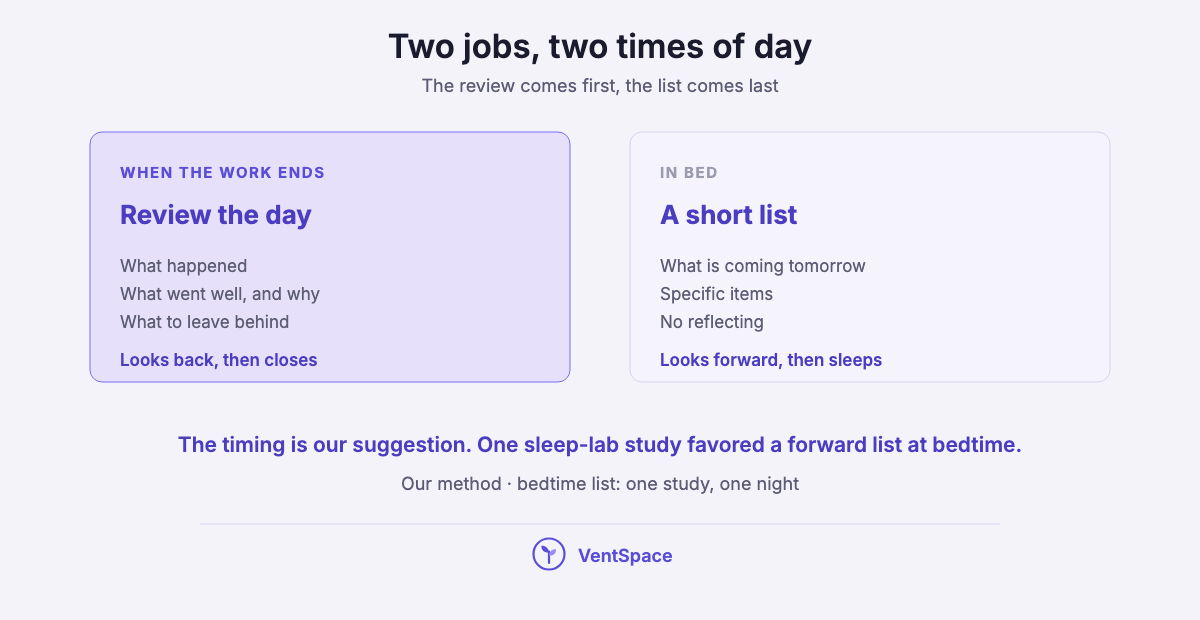
– When: at the close of the day’s work or early in the evening, not in bed. Bedtime suits a short list of what is coming, which is a different job.
– How much: one group, two or three prompts, about ten minutes.
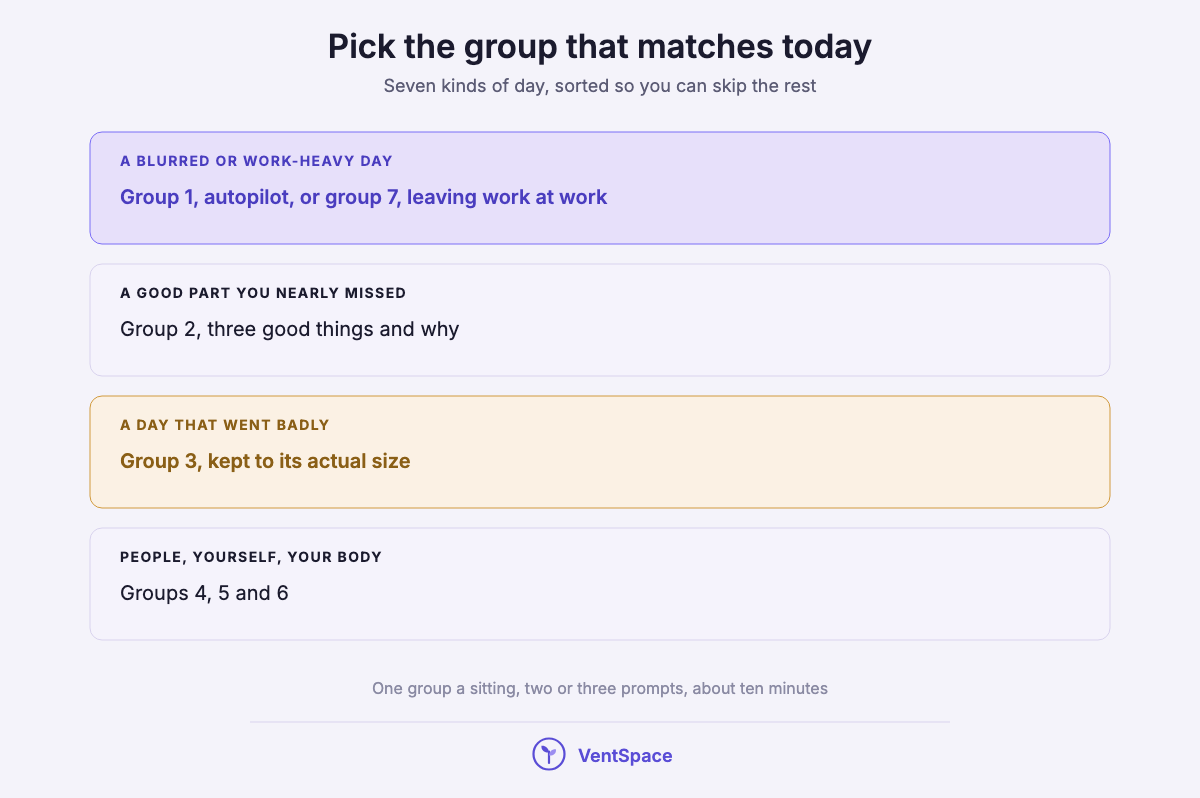
– Which group: the one that matches today. Seven kinds of day are below.
– Bad days: write what happened and what is next, at its actual size. Skip the why-me questions.
– Afterwards: reread once a week, not every night, and look for what repeats.
How to actually use these
Write when the day ends, not when you go to sleep. For most of us that is the end of the workday, the commute home, or the first quiet half hour of the evening. A review looks backwards, and we suspect it does its best work while there is still some evening left to move on into. That is our suggestion, not a finding. The last minutes in bed are better spent on a short list of what is coming tomorrow: one sleep-lab study, a single night with young adults, found that people who wrote that kind of list fell asleep faster than people who wrote about what they had already done. Our evening journal prompts page, which is being prepared now, is built around it.
One group a sitting, two or three prompts, about ten minutes. Pick the group that matches the day you had. If the day was mixed, take one prompt from each of two groups. Then close the notebook.
The named failure: answering ten at once. Ten prompts in one evening produce ten short paragraphs and no realization. They also turn a small habit into homework, and homework is the first thing we drop on a tired night. Two good answers beat ten thin ones.
Skipping a night costs nothing. In the largest meta-analysis of this kind of writing, covering 146 randomized studies, how the sessions were spaced made no detectable difference to the effect. There is no debt to catch up on. Come back to it the next evening you have, and see why the habit stalls for so many of us in our piece on journaling roadblocks.
Where to write. Paper is free and asks nothing of you. A notes app works if your phone is the thing you have at the end of the day, and our comparison of digital and paper journaling goes through both. If you want somewhere that does something with what you write, VentSpace is one option: a journaling app that turns what you write into a clear read on your life balance, plus small, doable next steps. It is ours, it is Android only and free to start, and it is not therapy. Not on Android, or at a desk? VentSpace Live runs in your browser, free, with nothing to install.
The stop line: if a prompt about a hard day starts pulling you further in rather than closing it, stop mid-sentence. That is a signal to put the notebook away, not to push on.
Quick Summary
Q: When should you do end of day journaling?
A: When the day’s work ends or early in the evening, for about ten minutes, two or three prompts from one group. Keep the last minutes in bed for a short list of what is coming tomorrow.
Why writing the day down does anything
The best-known version of this practice is an exercise called three good things, and its record is more interesting than the posters make it sound. In 2005, Martin Seligman, Tracy Steen, Nansook Park and Christopher Peterson ran a random-assignment, placebo-controlled study online with 577 adults, visitors to the website for Seligman’s book Authentic Happiness. People in one group were asked to “write down three things that went well each day and their causes every night for one week.” The placebo group was asked to do something close to it: “journaling for one week about early memories.” Three good things raised happiness and lowered depressive symptoms for six months, and the people who kept doing it on their own after the week were the ones who benefited most. Of the 577, 411 completed every follow-up.
Then the replications complicated it, usefully. When Mongrain and Anselmo-Matthews repeated the study in 2012 with a better control, the exercises produced lasting increases in happiness, “as did the positive placebo.” In 2017 a web-based re-examination by Woodworth and colleagues found the effects “indistinguishable from those of the placebo control.” The honest reading is that turning our attention to something good about our own life seems to help a little, and the exact exercise may matter less than the looking.
A study of working days points the same way. In a three-week field study, Joyce Bono and colleagues reported in 2013 that “a brief, end-of-workday positive reflection led to decreased stress and improved health in the evening.”
Quick Summary
Q: Does end of day journaling work?
A: Modestly. Writing down what went well, and why, has a long research record, but two replications found a matched placebo did as well. The evidence is for looking at the day, not for any one set of questions.
Insight In Seligman’s 2005 study, the placebo exercise was itself a kind of journaling: writing about early memories for a week. That is worth remembering on the nights we worry we are doing this wrong. The research gives no reason to think there is one correct form.
How these are grouped
There are seven groups, each named after a kind of day: one that went by on autopilot, one with a good part we nearly missed, one that went badly, one that was mostly other people, one that showed us something about ourselves, one that is still in our body, and one where work has followed us home. Read the names, pick the day you had, and skip the rest. None of the groups is a diagnosis, and none of them is a step on a ladder.
1. When the day went by on autopilot
Some days leave almost nothing behind. We know we were busy and cannot say what with, and the blankness can feel worse than a bad day. These prompts start with plain facts, because a day we can describe is a day we were present for, even late.
1.What are three things that happened today, in the order they happened?
Why this helps: a sequence of plain events is often the quickest way back into a day that felt like nothing, and order brings back details a summary skips.
How to sit with it: three lines, no adjectives. Morning, middle, end. If you get stuck, open your calendar or the photos you took today.
2.What did I do today that I will not remember next week?
Why this helps: most of a life is made of days like this one, and noticing one ordinary hour gives the ordinary days some of their weight back.
How to sit with it: pick something small: a walk to the car, a lunch, a phone call. Describe it in two sentences, as if to someone who was not there.
3.When today did I feel most like myself, even for a minute?
Why this helps: an autopilot day still usually has one moment when we surfaced, and finding it tells us what we were missing the rest of the time.
How to sit with it: give it one minute of thought before writing. Note the time, the place and who was there. If nothing comes, write that, and stop.
4.What took more of my time today than I expected?
Why this helps: the hours that disappear are where a blurred day went, and naming them is more useful than a vague sense that time was wasted.
How to sit with it: estimate roughly, no tracking app needed. One line for the task and one for what it pushed out of the day.
5.What did I see today that I would not have noticed a year ago?
Why this helps: it asks us to look at the day with fresh eyes, and the answer can say something about how we have changed without our deciding to.
How to sit with it: answer on a short walk if you can, then write it down when you are back. One observation is enough. It can be tiny.
6.If today had a title, what would it be?
Why this helps: a title forces a small judgment about what the day was mostly about, which is often the thing an autopilot day hides from us.
How to sit with it: write the first title that comes, cross it out, then write a second, more honest one. Keep it under eight words.
Quick Summary
Q: What should I journal about when nothing happened today?
A: Start with plain facts: three things that happened, in order. Then find the one moment you felt most like yourself. A blurred day usually has one, and it is easier to see on paper.
2. When something went well and you nearly missed it
Good parts of a day are easy to lose, because they rarely demand anything of us. These prompts borrow the shape of the three good things exercise, including the part most versions leave out: asking why it went well. A good thing with a cause attached is something we can look for again.
7.What are three things that went well today, and why did each one happen?
Why this helps: this is the original three good things wording, and the “why” is the half people skip. A cause turns luck into something we can repeat.
How to sit with it: three lines for the things, then one line under each starting with “because”. Five minutes at most. Small counts as much as large.
8.What went better than I feared it would?
Why this helps: we can spend the morning dreading something and then forget to notice that it was fine, which leaves the dread unchallenged for next time.
How to sit with it: name the thing, then write what you expected in one line and what happened in one line. Look at the gap between them.
9.Who made today easier, and do they know?
Why this helps: kindness from other people is one of the good things we most often let pass without a word, to them or to ourselves.
How to sit with it: write the name and the act. If they do not know, decide whether to tell them tomorrow. A one-line message counts.
10.What did I do today that I am quietly pleased about?
Why this helps: we tend to record our failures in detail and our competence not at all, and the second record is the one we need on hard weeks.
How to sit with it: answer in the first person and without qualifiers. No “only” and no “just”. One sentence, then close this prompt.
11.What small thing brought me some ease today, apart from people?
Why this helps: the old version of this page called these silent companions: a warm room, a song, the light at five o’clock. They are easy to overlook.
How to sit with it: look around the room you are in before you answer. Write one object or place and what it did for you today.
12.What part of today would I happily live again?
Why this helps: choosing a part to repeat is more concrete than rating the day, and it says something about what we want more of.
How to sit with it: pick a stretch of ten minutes to an hour. Describe it in present tense, as if it were happening now. Stop at five sentences.
Quick Summary
Q: What is the three good things journal exercise?
A: Each evening, write three things that went well that day and why each one happened. In the original study it was done for one week. The “why” is the part most versions leave out.
Insight Seligman’s team asked people to give “a causal explanation for each good thing,” not only to list it. The cause is what a good thing needs if we are going to recognize the next one.
3. When the day went badly, kept to its actual size
A bad day wants to be written about, and it also wants to grow. Rumination research splits repetitive thinking into two kinds: brooding, whose questionnaire items are mostly why-questions like “Why do I always react this way?”, and reflection, whose items include “Write down what you are thinking and analyze it.” The difference is the second half of that sentence. These prompts keep to what happened and what comes next, and none of them asks what is wrong with us. For more on how writing turns into a loop, see journaling vs venting.
13.What happened, in two sentences, as a neutral witness would describe it?
Why this helps: a bad day grows each time we retell it, and two flat sentences are often closer to its real size than the version in our head.
How to sit with it: no adjectives, no motives, no “always”. Write it as a camera would record it. If it takes more than two sentences, cut.
14.What part of it was mine, and what part was not?
Why this helps: a bad day often gets carried as entirely our fault or entirely someone else’s, and the honest split is usually somewhere in between.
How to sit with it: two short columns, mine and not mine. Three items in each at most. Leave anything uncertain off both lists for tonight.
15.What is one thing I can do about it tomorrow, and one thing I cannot?
Why this helps: separating what we can change from what we cannot stops the evening becoming a rehearsal of things no amount of thought will move.
How to sit with it: one line for each. Make the action small enough to do before lunch. For the other, write “not mine to fix” beside it.
16.What would I say to a friend who had this exact day?
Why this helps: we are often kinder to others than to ourselves, and borrowing that voice for a minute can show us how harsh our own one has been.
How to sit with it: write it as a short note to the friend, then reread it once, slowly, as if it had been addressed to you.
17.What was the hardest moment, and what did I do in the next ten minutes?
Why this helps: the minutes after a hard moment show how we coped, and they are usually more competent than the memory of the moment suggests.
How to sit with it: give the hardest moment one sentence and the next ten minutes three. Notice which part takes up more of the page.
18.Is this a day I need to write about, or a day I need to put down?
Why this helps: not every bad day benefits from being written up. Some are better closed quickly, and choosing deliberately is itself a way of ending it.
How to sit with it: answer in one word. If the answer is “put down”, write the date, the word “closed” and shut the notebook.
Quick Summary
Q: How do I journal about a bad day without making it worse?
A: Write what happened at its actual size, what part was yours, and one thing you can do tomorrow. Avoid why-me questions, which are the brooding half of rumination, and stop if the writing is pulling you further in.
Insight Across 24 randomized trials that compared the two, people in the general population who wrote about something painful reported more negative and less positive emotion afterwards than people who wrote about something good, and there was no difference between the groups on the mood and stress symptom scales the trials measured. A heavy feeling after a hard entry is to be expected, and it is one more reason to keep the entry short.
4. When the day was mostly other people
Some days are made almost entirely of other people: their requests, their moods, their kindness. These prompts look at the day through the people in it, without asking us to judge them or ourselves.
19.Who did I spend the most time with today, and how did I feel afterwards?
Why this helps: the people who fill our days are not always the ones we would choose, and the after-feeling is honest information about how each one sits with us.
How to sit with it: name up to three people, with one feeling word beside each. Do not explain the words tonight. Look at them again on the weekend.
20.Was there a conversation today I wish had gone differently?
Why this helps: a single exchange can color a whole evening, and putting it on the page in one piece keeps it from replaying in fragments.
How to sit with it: write what they said and what you said, in one line each. Then one line on what you would change. Do not draft a reply tonight.
21.Who did I think about today but not contact?
Why this helps: the people who cross our minds without our reaching out are often the ones a small message would mean most to.
How to sit with it: write the name and the reason they came to mind. Decide whether to send a short message tomorrow. Either answer is fine.
22.When was I most myself with someone today?
Why this helps: the company we are most at ease in is worth knowing by name, because tired weeks pull us toward whoever is nearest instead.
How to sit with it: answer about a single moment, not a whole relationship. Where were you, what was said, and what made it easy?
23.Where did I say yes today when I meant no?
Why this helps: an unwanted yes is one of the clearest records of what we can and cannot carry, and it is easier to see at the end of the day.
How to sit with it: name one, without blaming the person who asked. Then write what that yes cost you in time or energy, in a single line.
24.What did someone teach me today, without meaning to?
Why this helps: other people show us things all day by example, and most of it is gone by evening unless we catch it.
How to sit with it: think of one person’s habit, phrase or way of handling something. Write it down, and whether you want to borrow it.
Quick Summary
Q: What are good journal prompts about the people in my day?
A: Who you spent the most time with and how you felt afterwards, a conversation you wish had gone differently, and where you said yes but meant no. Keep it about moments, not verdicts on people.
5. When the day showed you something about yourself
Every so often a day shows us something: a value we kept without thinking, a strength we forgot we had, a habit we would rather not have. These prompts are for those days. They ask what we noticed, which is easier to answer honestly than who we are.
25.Did I make a choice today, big or small, that matched what I care about?
Why this helps: values are easier to see in choices than in statements, and one matching choice is better evidence than any list of principles.
How to sit with it: name the choice and the thing you care about, in one line each. If no choice matched, write the closest miss instead.
26.When was I so absorbed in something today that I lost track of time?
Why this helps: the old version of this page asked this one, and with reason. The things that absorb us are clues to what we are drawn toward.
How to sit with it: describe what you were doing and what made it absorbing: the difficulty, the company, the place. Three sentences at most.
27.What advice would I give the person I was this morning?
Why this helps: we know more at night than we did at breakfast, and this turns that knowledge into something usable rather than regret.
How to sit with it: write it as one sentence addressed to “you this morning”. Keep it practical, the kind of thing you could act on tomorrow.
28.What did I do today out of habit that I would not choose on purpose?
Why this helps: a habit noticed is one we can decide about, and evenings are when the day’s automatic choices are easiest to look back on.
How to sit with it: one habit, one line. Then one line on what you would rather do instead. No resolution needed, only the noticing.
29.What did I avoid today, and what was I avoiding it for?
Why this helps: avoidance usually protects us from something specific, and naming that thing is often more useful than forcing the task.
How to sit with it: answer in two parts: the task, and the feeling it would have brought. Keep it to what you noticed, not a theory about yourself.
30.What is one thing I understand better tonight than I did this morning?
Why this helps: it closes the day on something gained rather than something lost, and the gain is usually small and real.
How to sit with it: it can be about a person, a task or yourself. One sentence. If nothing comes after two minutes, leave it blank and close.
Quick Summary
Q: What are end of day journal prompts for self-reflection?
A: Ask what choice today matched what you care about, when you lost track of time, and what advice you would give yourself this morning. Concrete answers about the day work better than big questions about who you are.
6. When the day is still in your body
Some days stay in the shoulders, the jaw or the stomach long after they end. These prompts start from the body and stay there, describing what we feel rather than explaining it. They make no claim about what the body knows, only that it is one more record of the day.
31.Where in my body is today sitting right now?
Why this helps: a day often leaves a physical trace before we have words for it, and locating it gives the evening a starting point.
How to sit with it: close your eyes for one minute and move your attention from your feet upward. Write where you notice tension, and one word for it.
32.Where do I feel at ease, even a little?
Why this helps: we notice tension readily and ease rarely, and finding one comfortable spot keeps the entry from becoming a list of complaints.
How to sit with it: after prompt 31, look for the opposite: warmth, looseness, rest. Describe it in one or two plain sentences, without any interpretation.
33.What sound from today is still in my head?
Why this helps: sounds carry mood without our noticing, a laugh, an alarm, a voice, and naming one can explain why the evening feels the way it does.
How to sit with it: write the sound and where you heard it. Then one line on the feeling that came with it. No more than that.
34.When today was I hungry, tired or thirsty and kept going anyway?
Why this helps: a body ignored all day often explains a bad mood better than anything that happened, and it is the easiest cause to fix tomorrow.
How to sit with it: a quick list with the times. Then circle the one that would have been easiest to look after. Plan nothing more.
35.If today’s mood were the weather, what would it be?
Why this helps: an image can say what a feeling word cannot, and it is easier to write honestly when we are not naming emotions directly.
How to sit with it: one line: the weather, and how it changed across the day. Then, if you like, one line on what moved it.
36.What would help my body most in the next hour?
Why this helps: it turns noticing into one small act of care, which is a gentler way to end a long day than another hour of thinking.
How to sit with it: write it, then go and do it: a glass of water, a shower, ten minutes lying down. Then close the notebook.
Quick Summary
Q: What are body scan journal prompts for the end of the day?
A: Notice where today is sitting in your body and where you feel at ease, then name one thing that would help your body in the next hour. Describe what you feel, and leave the explaining for another day.
7. When the workday needs to stay at work
For many of us, the end of the day is the end of work, and work does not always stop when we leave it. These prompts are for closing the workday on purpose. In a three-week field study, a brief positive reflection at the end of the workday was followed by less stress and better health that evening, and the authors counted detachment from work among the outcomes. For prompts aimed at getting more done, see our productivity journaling prompts.
37.What did I finish at work today?
Why this helps: a workday rarely ends with a sense of completion, and naming what is done gives the day an edge it otherwise lacks.
How to sit with it: list everything finished, however small: an email, a call, a decision. Do this before you leave your desk, if you can.
38.What went well at work today, and what made it go well?
Why this helps: this is the end-of-workday version of three good things, and the cause is the part we can bring back to work tomorrow.
How to sit with it: two or three items, a cause under each. Five minutes. Write it at the end of the workday, before the commute home.
39.What is still open, and where have I written it down?
Why this helps: an open task we have not written anywhere follows us home, while one that sits on a list can wait until the morning.
How to sit with it: move every open item onto tomorrow’s list, then write “on the list” here. Do not start solving them in the journal.
40.What did work ask of me today that it should not have?
Why this helps: some evenings are heavy because the day crossed a line, and noticing the pattern over a week gives us something concrete to raise.
How to sit with it: one line, factual: what was asked, and when. No action tonight. Look at the week of these on Friday.
41.What part of today’s work do I want to leave here?
Why this helps: choosing what not to carry home is easier than trying to stop thinking about work in general, which rarely works.
How to sit with it: write it in one sentence, then physically close the notebook or the laptop. Treat that as the end of the workday.
42.What will I do in the first hour at home that has nothing to do with work?
Why this helps: detachment comes more easily with something to move toward, and a plan for the evening gives the workday a clear end.
How to sit with it: something specific and small: cooking, a walk, a call. Write it, then do it before checking anything from work.
Quick Summary
Q: What should I write at the end of the workday?
A: What you finished, what went well and why, and where every open task now lives. Then decide one thing to do in the first hour at home that has nothing to do with work.
Insight Bono and colleagues found that positive events and negative events each contributed independently to stress, blood pressure, physical symptoms, mental health and detachment from work. Writing down what went well is not a way of denying a bad day. It is a separate thing worth doing on the same day.
What to do with what you wrote
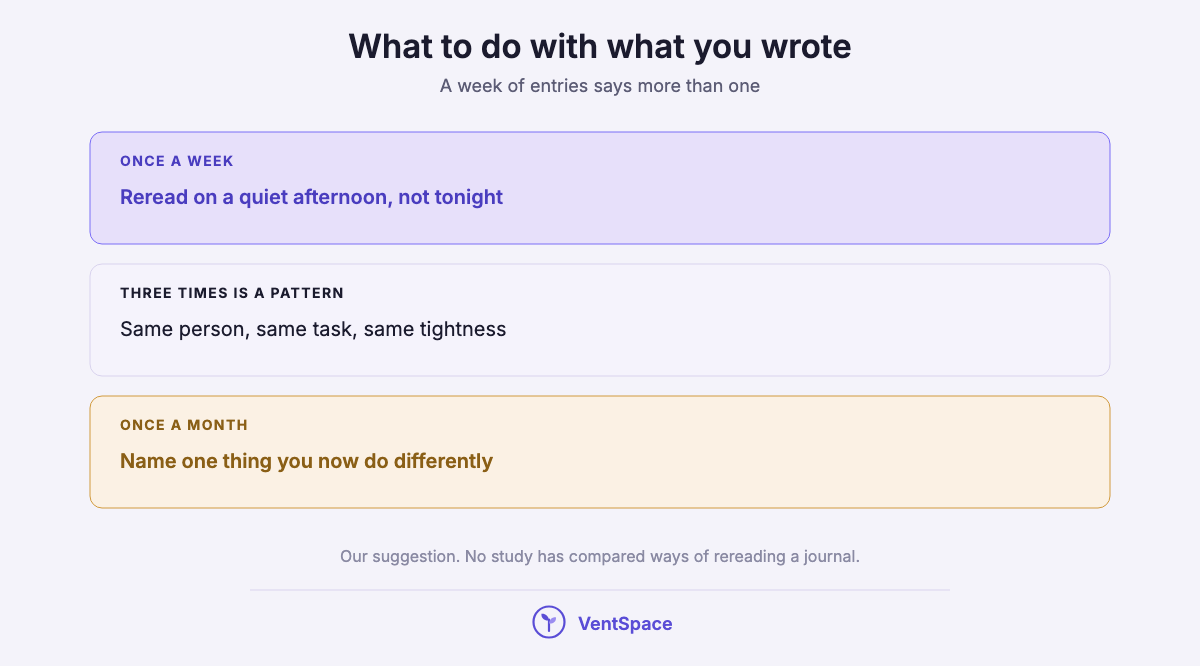
A single entry says little. Seven of them can say a great deal. The point of end of day journaling is not the paragraph we wrote on Tuesday, it is what repeats between Tuesday, Thursday and Sunday. That repetition is where we learn something, and it is the half almost nobody writes about.
From Sai, who writes this blog
When I read back through my past journal entries, I understood that I had been chasing pleasure and excitement since 2021. I could see patterns and yearnings from years before, and where I had improved and where I still needed to.
Reread once a week, not every night. Rereading tonight’s entry tonight tends to restart it. Rereading a week of entries on a quiet afternoon lets us see the shape of the week instead of the heat of one day. That is our suggestion: there is no study comparing ways of reviewing a journal, so this is judgment, not evidence.
Look for anything that appears three times. The same person in group 4, the same task in group 7, the same tightness in the shoulders. Three is a pattern. One is a day.
Analyze, do not relive. Rereading is useful when it moves toward a conclusion, and unhelpful when it becomes another why-me. If you notice yourself rewriting the same bad day in new words, close the notebook. The reflection item in the rumination research ends with “and analyze it” for a reason.
Ask one question at the end of each month. Can I name one thing I now do differently because of what I wrote? If the answer is yes, it is working for you. If it is no for two months running, change the group, the time of day, or the medium, rather than trying harder.
When to stop. If a few minutes of writing about your days leaves you feeling markedly worse for a day or two, treat that as a signal to stop, not as progress. If low mood or lost sleep lasts for weeks, talk to a doctor first. Therapy is one option, and for a lot of people it is the right one. If you are in crisis or thinking about harming yourself, call or text 988 in the United States, or find the number where you are at findahelpline.com. This article is not a substitute for that.
Quick Summary
Q: Should I reread my journal entries?
A: Yes, about once a week rather than nightly, looking for anything that appears three times. Once a month, ask whether you can name one thing you now do differently because of what you wrote.
A two-week schedule you can copy
| Day | Group | Prompts |
|---|---|---|
| Mon, week 1 | 1. Autopilot | 1, 3 |
| Tue | 2. Went well | 7 |
| Wed | 7. Workday | 37, 39, 42 |
| Thu | 4. Other people | 19, 23 |
| Fri | 6. In your body | 31, 36 |
| Sat | 5. About yourself | 25, 27 |
| Sun | Reread the week | No new prompts |
| Mon, week 2 | 7. Workday | 38, 41 |
| Tue | 2. Went well | 8, 9 |
| Wed | Whichever matches the day | Two prompts |
| Thu | 1. Autopilot | 4, 6 |
| Fri | 5. About yourself | 28, 30 |
| Sat | Skip, or one prompt | Any |
| Sun | Reread both weeks | The monthly question, early |
Group 3 is not on the schedule on purpose. Use it on the evenings that need it, in place of whatever the table says.
If you only answer five
1.
Prompt 7: three things that went well today, and why each happened.
2.
Prompt 13: what happened, in two sentences, as a neutral witness would put it.
3.
Prompt 27: the advice you would give the person you were this morning.
4.
Prompt 39: what is still open, and where you have written it down.
5.
Prompt 31: where in your body today is sitting right now.
Between them they cover the good part, the hard part, what we learned, what carries over and how the day feels, in about fifteen minutes.
Questions people ask
What is the difference between morning and end of day journaling?
Morning journaling looks forward: what the day holds and how you want to meet it. End of day journaling looks back at the day you had: what happened, what went well, what to leave behind. Both are useful, and they do different jobs.
How long should end of day journaling take?
About ten minutes for two or three prompts is plenty, in our view. If you enjoy it, write longer. If ten minutes feels like too much on a tired night, one prompt is a complete entry.
Do I have to journal every night for it to work?
No. In the largest meta-analysis of this kind of writing, how sessions were spaced made no detectable difference to the effect. A few evenings a week is a reasonable rhythm, and a missed night is not a broken habit.
Will end of day journaling help me sleep?
We cannot promise that, and pages that do are usually citing nothing. The one sleep-lab study on bedtime writing found that a short list of tomorrow’s tasks helped people fall asleep faster than writing about the day they had, in one night with young adults. That is why this page suggests reviewing the day earlier in the evening. If sleep has been poor for weeks, talk to a doctor.
Does writing about a bad day make it worse?
It can feel worse in the moment, and in trials comparing the two, writing about something painful felt heavier than writing about something good, without a difference in depression, anxiety or stress. Keep it short, keep to what happened and what is next, and stop if the writing pulls you further in.
Two things to take with you
First, reviewing the day is a way of finishing it, not reliving it. Do it when the day’s work ends, keep it to a few lines, and keep the bad parts at their actual size.
Second, the looking matters more than the questions. The research does not reward any perfect set of prompts. It rewards the habit of noticing something true about our own day. Most of our days are ordinary, and an ordinary day, written down once, becomes one we were there for.

About this article

Written by
Sai Subramaniam
Founder, VentSpace
I write these guides because I have been where you are. I am working through my own hard seasons, and I share the things that actually helped me, so that anyone going through it has a steady companion close by instead of facing it alone. VentSpace is the app I built for exactly that: a journaling app that turns what you write into a clear read on your life balance, plus small, doable next steps toward feeling more like yourself.
This writing is honest and every claim is sourced, and it is not a substitute for professional care. If you are struggling, reaching out to a professional is a strong move, not a failure.
Explore VentSpaceTry VentSpace LiveHow this one was checked. Every factual claim traces to a named source, and the source is printed next to the claim rather than kept in a footnote. Quotes are pinned to the work they come from, with the year, the letter or the chapter where one exists. Where a widely repeated claim could not be traced, it was left out and the omission recorded. Where a figure is contested, both sides are printed.
No affiliate links, no paid placements, and nobody paid to appear here. Where we mention our own app, we say that it is ours, we state its limits, and we never position it as a substitute for care.
Reviewed: October 2026. Prices, platforms and product availability move quickly, and anything we could not verify at the time of writing is marked as unverified rather than turned into a number.
Corrections. If something here is wrong, we would rather know. Corrections are made in place, with a note saying what changed.