
Most of us keep a voice for ourselves that we would never use on anyone else. A friend who misses a deadline hears that it happens. We, missing the same deadline, hear that we are hopeless, that we always do this, that other people manage. The voice is so familiar that we rarely notice it, and so harsh that if we heard it aimed at someone we loved, we would step in. Journaling prompts for self love are a way of stepping in on our own behalf: catching the voice on paper, and answering it as we would answer for a friend.
The forty-two prompts below are sorted by the situation we are in when the voice gets loud, from a mistake we keep replaying to a week spent looking after everyone but ourselves. Each carries a line on why it helps and a line on how to answer it. If you came here wanting to feel better about your worth and achievements, our self-esteem journaling prompts are closer to that. This page is about how we treat ourselves.
The short version
– When: after a hard moment, or once or twice a week at a quiet time.
– How much: one group, one or two prompts, ten minutes or less.
– Start here: write down the exact sentence your inner critic used most recently, then rewrite it as you would say it to a friend.
– Skip: affirmations you do not believe. Write something true and kind instead.
– Stop: if a prompt pulls you further down rather than steadying you.
How to actually use these
One prompt at a time, right after the moment if you can. The best time to answer a self-love prompt is soon after the voice has spoken: after the email you regret, after the mirror, after the comparison. The words are still fresh, and fresh words are easier to catch exactly. If that is not possible, a quiet ten minutes once or twice a week works too.
Ten minutes or less. Most of these prompts ask for two or three sentences. A self-love entry that runs for an hour has usually turned into something else, often a long case against ourselves.
The named failure: answering the whole list in one sitting. Twenty prompts about how we treat ourselves, answered on one evening, can become twenty pages of examining every flaw. That is the opposite of what we came for. One prompt, answered gently, is a complete entry.
Write privately, and do not tidy it. These entries are not for anyone else. Spelling, grammar and fairness to yourself in the first draft do not matter. The second sentence, the kinder one, is where the effort goes.
If it gets heavy, stop. Some of these prompts touch the way we judge ourselves, and on a bad week that can pull us lower instead of steadying us. If you finish a prompt feeling worse for more than a short while, put it down and do something ordinary and physical. If the harsh voice is old, loud or constant, talking to a therapist is a strong move, not a failure: therapy is one option, and for a lot of people it is the right one. If you are in crisis or thinking about harming yourself, call or text 988 in the United States, or find the number where you are at findahelpline.com. This article is not a substitute for that.
Quick Summary
Q: How do you use self-love journal prompts?
A: Answer one prompt soon after a hard moment, or once or twice a week, for ten minutes or less. Write the critic’s words exactly, then the kinder reply. Stop if the writing pulls you lower.
Why being kind on paper does anything
Self-love is mostly a matter of how we respond when things go wrong. Kristin Neff, the researcher who developed the idea of self-compassion, describes it as a reversal: “Self-compassion simply involves doing a U-turn and giving yourself the same compassion you’d naturally show a friend when you’re struggling or feeling badly about yourself.” She sets out three elements, each with its opposite: self-kindness against self-judgment, common humanity against isolation, and mindfulness against over-identification. The groups below follow those pairs.
The harsh half may matter more than the kind half. The questionnaire most of this research uses contains both kinds of item: being kind to ourselves, and reverse-scored items about self-criticism, isolation and over-identifying with our own thoughts. In a 2024 meta-analysis of 16 studies in young people, Peter Muris and colleagues found the kind half had “a modest protective effect” on anxiety and depression, while the self-critical half had “a large (and significantly stronger) vulnerability effect.” The studies were in young people, and researchers still disagree about how the scale should be scored. But it suggests that, on paper, catching the attack may matter as much as adding praise.
Kindness toward ourselves and self-esteem are not rivals. A 2023 meta-analysis of 76 studies and 35,537 people found the two strongly related (r = 0.65) and called them “complementary concepts.”
Quick Summary
Q: What is self-love, in practice?
A: Responding to your own mistakes and hard moments the way you would respond to a friend’s: kindly, as part of being human, and without letting one moment become the whole story.
Insight Structured self-compassion programs, tested in 27 randomized trials, moved self-criticism by a moderate amount. Those were programs, not journal prompts, and their numbers do not describe what any page of prompts does. What they suggest is the tone a set like this should be written in: kind, not punishing.
How these are grouped
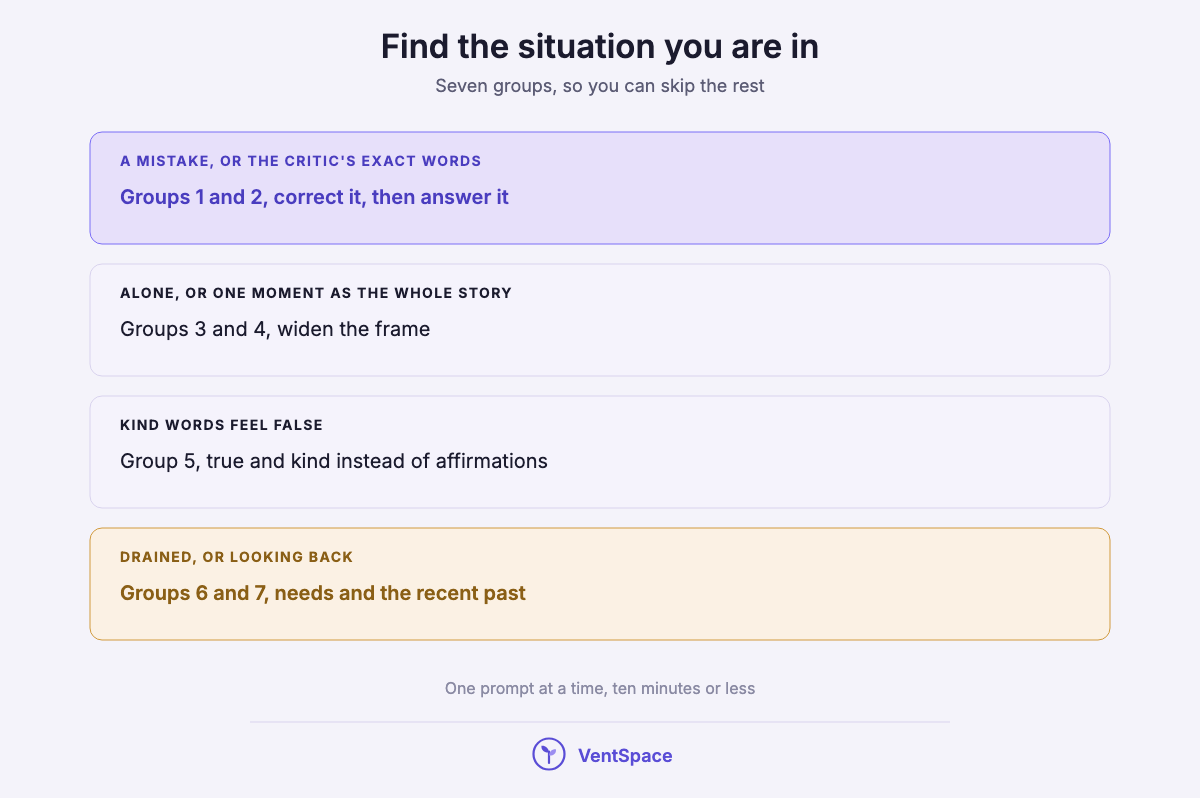
There are seven groups, each named for a situation: after a mistake we keep replaying, when the critic has the exact words, when it feels like we are the only one, when one bad moment becomes the whole story, when kind words feel false, when we have been looking after everyone but ourselves, and when we think about who we used to be. Find the situation you are in and skip the rest. None of them describes what kind of person you are.
1. After a mistake you keep replaying
A mistake ought to end when it is over, and instead many of us replay it for days, each time with a harsher commentary. We tend to believe the commentary keeps us from repeating it. In four experiments, the psychologists Breines and Chen found the opposite tendency: people led to take a self-compassionate view of a weakness or a failure showed more motivation to improve, and in one experiment “spent more time studying for a difficult test following an initial failure.” These prompts are for correcting the mistake without punishing the person who made it.
1.What happened, in two plain sentences, with no verdict on me?
Why this helps: the replay usually comes with a judgment attached, and separating the event from the verdict lets us see how big the mistake was.
How to sit with it: write it as a neutral colleague would describe it. No “stupid”, no “always”. If the second sentence turns into a verdict, cross it out and try again.
2.What would I say to a friend who made exactly this mistake?
Why this helps: we are usually wiser and gentler about other people’s errors, and borrowing that voice for a minute shows how differently we treat ourselves.
How to sit with it: write it as a short note to the friend, using their name. Then read it back slowly, replacing their name with yours.
3.What was I trying to do when this went wrong?
Why this helps: most mistakes come from a reasonable intention handled imperfectly, and remembering the intention gives us back some credit the replay takes away.
How to sit with it: one line on what you meant to do. One line on what got in the way. Leave out anything you cannot know for sure.
4.What is one thing I can do to put it right, or to do it differently next time?
Why this helps: a kind response to a mistake still includes a correction, and naming one keeps self-compassion from turning into excusing.
How to sit with it: keep it small and specific: an apology, a check, a reminder. If nothing can be done, write “nothing to fix, only to learn” and stop.
5.How long have I been carrying this, and what is it costing me?
Why this helps: replaying has a price in sleep, mood and attention, and seeing the cost written down can make it easier to put the mistake down.
How to sit with it: count roughly in days, then list two things the replay has taken from you this week. Do not try to stop it tonight.
6.What would “done with this” look like?
Why this helps: a mistake without an ending keeps reopening, and describing an ending gives us something to move toward rather than another round of the same scene.
How to sit with it: write it in the past tense, as if you had already put it down. Two or three sentences, then close the notebook.
Quick Summary
Q: How do I stop replaying a mistake?
A: Write what happened without a verdict, what you would say to a friend who did the same, and one thing you can do to put it right. A kind response still includes the correction. It just leaves out the punishment.
2. When the critic has the exact words
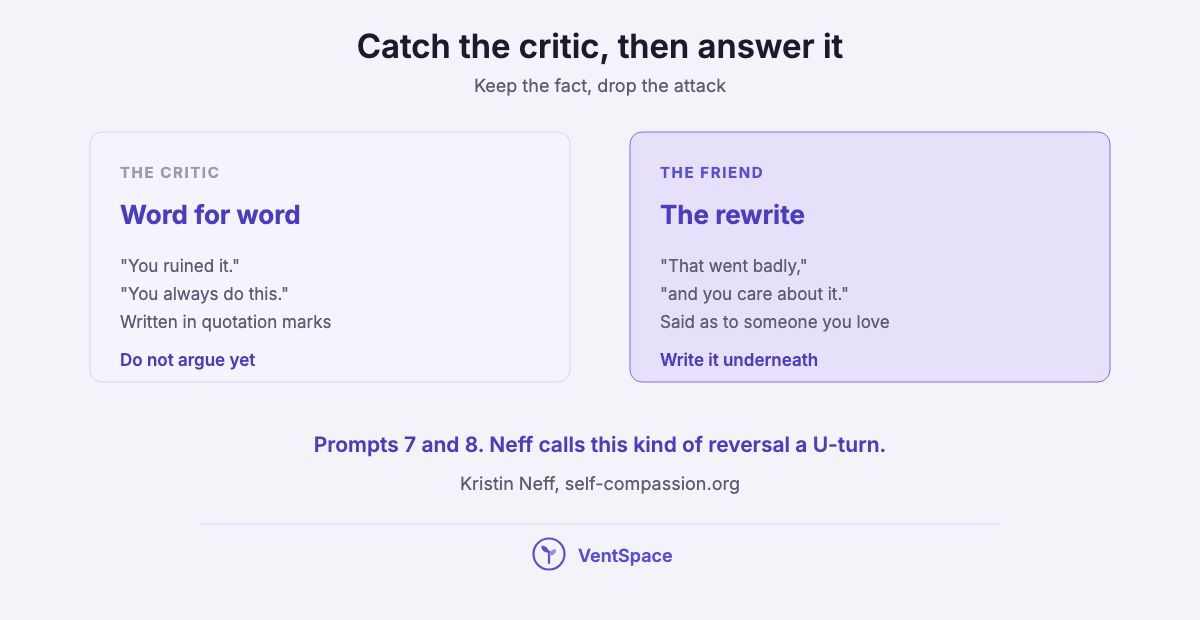
The inner critic tends to speak in phrases we have heard before, sometimes for years. We rarely write them down, so they stay vague and powerful. These prompts record the critic word for word, then answer it the way Neff suggests: as we would speak to a friend. The aim is not to argue the critic into silence. It is to hear a second voice next to it.
7.What exactly did my inner critic say to me today, word for word?
Why this helps: a sentence on paper is easier to look at than a feeling, and the exact words often sound harsher, and less true, once they are outside us.
How to sit with it: write it in quotation marks, as if transcribing someone else. Include “always” and “never” if they were there. Do not answer it yet.
8.Rewrite that sentence as I would say it to a friend in the same situation.
Why this helps: this is the U-turn in practice, and the friend version usually keeps the fact and drops the attack on character.
How to sit with it: keep what is true and lose the insult. “You ruined it” might become “That went badly, and you care about it.” Write it under the original.
9.Whose voice does my critic sound like?
Why this helps: a critic often borrows its tone from a teacher, a parent or an old workplace, and noticing the borrowing can loosen its authority a little.
How to sit with it: answer in one line, without blaming anyone. If no one comes to mind, describe the tone instead: cold, sarcastic, tired.
10.What is my critic trying to protect me from?
Why this helps: a harsh voice often has a frightened purpose, such as avoiding failure or rejection, and seeing that purpose changes how we answer it.
How to sit with it: write one guess, then answer the fear directly, in one kind sentence, as you would reassure a nervous friend.
11.When did the critic turn out to be wrong?
Why this helps: the critic’s predictions are rarely checked, and one remembered time it was wrong is real evidence against its certainty.
How to sit with it: find one specific occasion. Write what the critic predicted and what happened, one line each. One is enough.
12.If my critic and my kindest friend were both in the room, what would my friend say back?
Why this helps: it puts a second voice into a conversation that usually has only one, which is often all that is needed to change its tone.
How to sit with it: write it as a short exchange, three lines each. Let the friend have the last word, and keep the friend specific and real.
Quick Summary
Q: What are journal prompts for the inner critic?
A: Write the critic’s sentence word for word, then rewrite it as you would say it to a friend: keep the fact, drop the attack. Ask whose voice it sounds like, what it is protecting you from, and when it has been wrong.
3. When it feels like you are the only one
Neff describes a particular trick of a hard moment: the sense, as she puts it, “as if ‘I’ were the only person in the world having this painful experience.” We look around and see people managing, and conclude that the struggle is a defect peculiar to us. These prompts widen the frame. They do not ask us to feel better about the difficulty, only to see that it is shared.
13.How many other people, right now, are probably feeling something like this?
Why this helps: a private struggle feels unique, and estimating how common it is, even roughly, reminds us we are having a human experience, not a personal failure.
How to sit with it: do not look up a number. Picture a city, an office, a school, and write a rough guess and one sentence on who they might be.
14.Who do I know who has been through something similar?
Why this helps: we usually know someone, and remembering that they came through it, imperfectly, is often more convincing than any general reassurance.
How to sit with it: name one person and what they went through. Note what you thought of them at the time. It was probably not contempt.
15.What would I think of a stranger who told me they felt this way?
Why this helps: a stranger has no history with us to judge, so our reaction to them is often the clearest sign of how fair we are being to ourselves.
How to sit with it: imagine them across a table. Write your first honest reaction, then notice how far it is from what you have been saying to yourself.
16.Which part of this feeling comes from comparing myself with people I only see from the outside?
Why this helps: we compare our inside with other people’s outsides, and naming the comparison shows how uneven the evidence is.
How to sit with it: name one person or feed. Write what you see of them and one thing you cannot see. Then consider closing the app for the evening.
17.Who could I tell a small part of this to, without needing them to fix it?
Why this helps: isolation is the opposite of common humanity in Neff’s framing, and telling one person a small part is the most direct answer to it.
How to sit with it: write a name and one sentence you might say. You do not have to send it. Writing it is already a step out of the room.
18.What would I want someone else who feels this to know?
Why this helps: advice we give to an unseen other often contains what we most need to hear, and writing it lets us hear it in our own voice.
How to sit with it: write it as a short message to someone you will never meet. Four or five sentences. Then read it as if it were addressed to you.
Quick Summary
Q: What should I journal when I feel like the only one struggling?
A: Estimate how many people feel something similar right now, remember someone who came through it, and write what you would want another person in your place to know. Then read it as if it were for you.
4. When one bad moment becomes the whole story
A remark at work, a bad photo, a sharp word to someone we love, and by evening it has become a story about who we are. Neff calls this over-identification. The alternative she describes is a balanced approach to our pain, “so that we neither suppress or exaggerate it.” Rumination research points the same way: brooding is made mostly of why-questions about ourselves. These prompts keep the moment its actual size and avoid asking why we are like this.
19.What happened, and what story have I added to it?
Why this helps: the event and the story about our character arrive together, and separating them on the page shows how much of the weight is the story.
How to sit with it: two columns: what happened, and what I concluded about myself. Keep the first column to facts a camera could record.
20.Is this one moment, or is it the whole of me?
Why this helps: the question sounds obvious on paper, and that is the point: it is the obvious answer the feeling hides from us.
How to sit with it: answer in one word first, then one sentence. If the answer is “the whole of me”, write three other things that were also true today.
21.What else happened today, or this week, that this moment is leaving out?
Why this helps: a bad moment pushes everything else out of view, and listing the rest restores some proportion without denying the bad part.
How to sit with it: list five ordinary things, good, neutral or dull. Do not argue with the bad moment. Just put it back among the others.
22.How will I see this in a month?
Why this helps: distance in time often shrinks a moment that feels enormous tonight, and imagining that distance can borrow a little of it now.
How to sit with it: write two sentences as yourself a month from now, describing this week briefly and kindly. Do not make it falsely cheerful.
23.What am I feeling, in one word, without explaining it?
Why this helps: naming a feeling without building a case around it is the mindful half of Neff’s pair, noticing the pain without being swallowed by it.
How to sit with it: one word only. Then one line on where you feel it in your body. Stop there, even if more explanations are waiting.
24.What would be a fair sentence about this, neither harsh nor falsely kind?
Why this helps: balance is the aim, not praise, and a fair sentence is one we can believe on a bad night, which a cheerful one often is not.
How to sit with it: draft it, then test it: would a friend who knows you well agree with it? Adjust until they would.
Quick Summary
Q: How do I stop one mistake from defining me?
A: Separate what happened from the story you have added about yourself, list what else was true this week, and write one fair sentence about it that a friend who knows you would agree with.
5. When kind words feel false
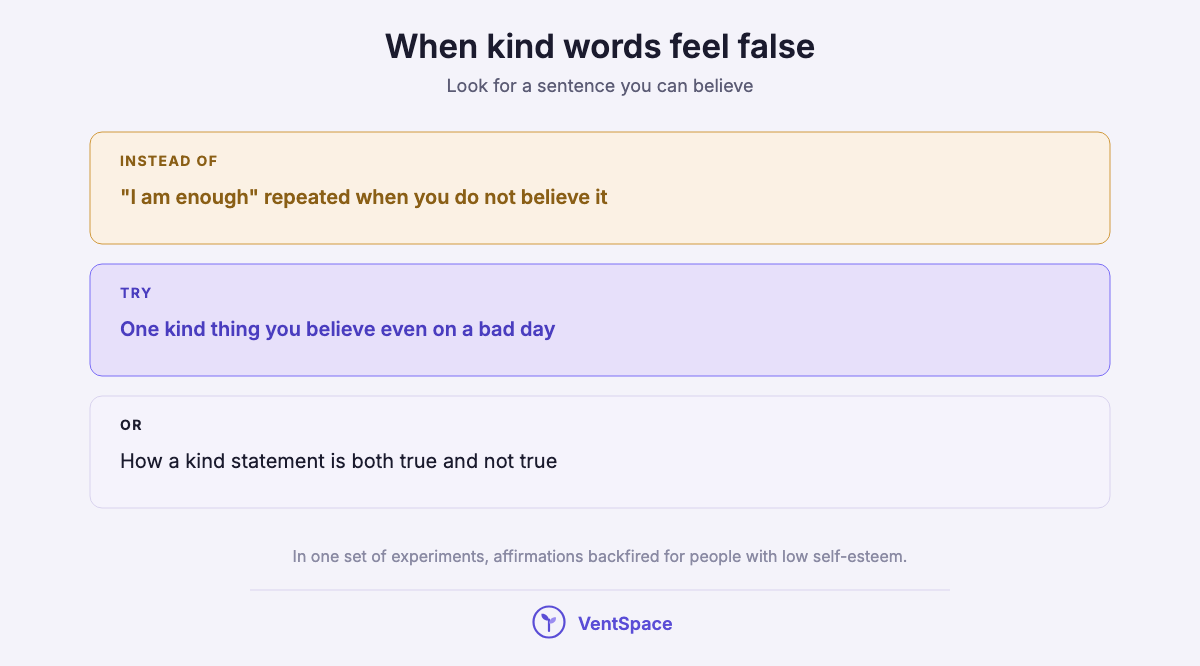
Many self-love pages suggest affirmations: “I am enough”, “I am lovable.” For some of us they help. For others they ring hollow, and there is a reason. In experiments by the psychologists Wood, Perunovic and Lee, people with low self-esteem who repeated “I’m a lovable person” felt worse than those who did not, while people with high self-esteem felt better, “but to a limited degree.” Those who considered how the statement was both true and not true did not feel worse. These prompts look for things that are both kind and believable.
25.What is one kind thing about me that I believe is true, even on a bad day?
Why this helps: a small belief we hold beats a large one we reject, and starting from what we already accept avoids the argument an affirmation can start.
How to sit with it: keep it modest: “I turn up for my friends”, “I try.” If nothing comes, write what someone else has said that you half believe.
26.Which part of a kind statement can I accept, and which part can I not, yet?
Why this helps: it borrows the version that did not backfire in the experiments: considering how a statement is both true and not true.
How to sit with it: pick a statement such as “I am doing my best”. Write one way it is true and one way it is not. Leave both standing.
27.What have I done recently that I would admire in someone else?
Why this helps: we notice decent behavior in others and overlook it in ourselves, and describing our own as if it were theirs makes it easier to credit.
How to sit with it: describe it in the third person, using your own name, as a friend might tell it. Three sentences. No modesty, no exaggeration.
28.What is something kind someone said to me that I brushed off?
Why this helps: compliments we deflect are often accurate, and writing one down gives it a second hearing without our having to agree yet.
How to sit with it: write the words as close to exact as you can, who said them and when. Do not argue with them on the page.
29.What would “good enough” mean for me this week?
Why this helps: self-love often fails against a standard nobody could meet, and naming a reachable bar is kinder and more honest than declaring we are perfect.
How to sit with it: three plain lines describing an ordinary good-enough week. Then check whether you would accept that bar for a friend.
30.Write one sentence about yourself that is true and kind, and that you could say out loud.
Why this helps: this replaces the affirmation with something we can stand behind, which is what the backfire finding suggests matters for many of us.
How to sit with it: draft three versions, then pick the plainest. Say it aloud once. If it makes you wince, soften it until it does not.
Quick Summary
Q: Do affirmations work for self-love?
A: For some people. In one set of experiments, people with low self-esteem felt worse after repeating “I’m a lovable person.” Write a sentence that is true and kind instead, one you could say out loud without wincing.
6. When you have been looking after everyone but yourself
Some weeks we give our attention, time and patience to everyone around us, and by the end there is nothing left for ourselves, not even sympathy. Self-love in these weeks is less about how we speak to ourselves than about what we let ourselves have. These prompts ask what we need, and whether we have been allowing it.
31.What do I need right now that I have not given myself?
Why this helps: needs we postpone for others tend to go unnamed, and naming one is the first step to treating it as reasonable.
How to sit with it: answer in one word first, such as rest, food, quiet or company. Then one line on the smallest way to meet it today.
32.Who have I looked after this week, and who has looked after me?
Why this helps: the two lists are often uneven, and seeing the imbalance on paper is more useful than a vague sense of being drained.
How to sit with it: two short lists with names. Do not judge either list. Just look at the length of each for a minute before you move on.
33.What did I say yes to this week that I wanted to say no to?
Why this helps: an unwanted yes is one of the clearest records of where our own needs got set aside, and it is easier to see afterwards than in the moment.
How to sit with it: name one, without blaming the person who asked. Then write the no you would have liked to say, kindly, in one sentence.
34.What would I tell a friend who was this tired?
Why this helps: we give friends permission to rest that we withhold from ourselves, and writing the permission down lets us read it as our own.
How to sit with it: write the advice as a short note to a named friend. Then pick one line from it to follow this evening.
35.What small comfort could I give myself today without earning it first?
Why this helps: many of us ration comfort as a reward, and a comfort given freely, however small, is a direct act of kindness toward ourselves.
How to sit with it: something specific and small: a walk, a bath, ten minutes with a book. Write it, then do it before the evening ends.
36.What is one thing I could hand back, delay or drop this week?
Why this helps: looking after ourselves sometimes means doing less for others, and choosing one thing on paper makes it more likely to happen.
How to sit with it: pick one obligation. Write who would need to know and the sentence you would use. Decide by tomorrow whether to say it.
Quick Summary
Q: What are self-care journal prompts for when I am drained?
A: Name one need you have not met, compare who you have looked after with who has looked after you, and choose one small comfort to give yourself today without earning it first.
7. When you think about who you used to be
Looking back can bring regret: the choices we made, the person we were a few years ago. These prompts are for the recent and ordinary past, the version of us from last year or the one before. They are not for digging into painful childhood experiences alone. If an old memory surfaces that feels too heavy, stop, and consider exploring it with a therapist rather than on the page.
37.What did I not know a few years ago that I know now?
Why this helps: much regret comes from judging a past self by knowledge they did not have yet, and naming the gap makes the judgment less fair and easier to drop.
How to sit with it: pick one decision. Write what you knew then and what you know now, a line each. Notice the difference before you judge.
38.What would I say to myself from three years ago, if I could?
Why this helps: speaking to a past self tends to bring out a gentler voice than speaking about them, and that gentleness can carry over to the present.
How to sit with it: write it as a short letter you will not send, five or six sentences. Start with something you understand about them now.
39.What did my past self do that got me here, which I rarely credit?
Why this helps: we often blame our past selves for problems and forget to credit them for the effort that brought us this far.
How to sit with it: list three things they did that you benefit from now, however small: a course finished, a hard conversation, a move.
40.What regret am I ready to put down, even partly?
Why this helps: some regrets keep teaching us something and some have finished their work, and choosing which is which is a form of forgiving ourselves.
How to sit with it: name one regret. Write what it taught you in one sentence, then “I can put this down now” if it is true. If not, leave it.
41.What is a happy memory where I felt safe and liked, at any age?
Why this helps: the old version of this page asked a version of this, and it is worth keeping. A memory of being liked is part of our history the critic leaves out.
How to sit with it: pick a memory that feels good, not complicated. Describe the place, the people and one detail. Skip this one if nothing gentle comes.
42.What kind of person am I trying to become, and how would that person treat me today?
Why this helps: it turns the past and future toward the present, and asks how the self we hope to be would speak to the self we are tonight.
How to sit with it: two sentences on who you are trying to become, then one on how they would treat you right now. Try doing that one thing.
Quick Summary
Q: How do I forgive my past self in a journal?
A: Write what you did not know then that you know now, what your past self did that you benefit from, and a short letter to them you will not send. Keep to the recent past, and leave heavy childhood material for a therapist.
What to do with what you wrote
Reread once a week, not every day. A weekly reread lets us see how the critic’s sentences change over time, rather than reopening tonight’s. That is our suggestion: there is no study comparing ways of reviewing a journal, so this is judgment, not evidence.
Keep a page of the critic’s sentences and their rewrites. Over a month, that page shows which accusations come back and which rewrites we have started to believe. A sentence that appears three times is a pattern worth a longer look, perhaps with someone else.
Expect some entries to sting. In trials that compared the two, writing about something painful felt heavier in the session than writing about something positive, with no difference on the symptom scales the trials measured. A reread that stings a little is to be expected. One that leaves you feeling much worse for a day or two is a reason to stop and talk to someone.
Analyze, do not relive. Rumination research separates brooding, mostly why-questions about ourselves, from reflection, which includes “Write down what you are thinking and analyze it.” If rereading starts to feel like a trial with you as the defendant, close the notebook. Our piece on journaling vs venting goes further into the difference.
Ask one question at the end of each month. Has the way I speak to myself changed at all, even in one situation? If yes, that is the work happening. If not after two months, try a different group, or a different medium, rather than more pages.
Where to write it. Paper is free and private, and our comparison of digital and paper journaling goes through the options. If you would like your entries to come back to you as something you can use, VentSpace is one option: a journaling app that turns what you write into a clear read on your life balance, plus small, doable next steps. It is ours, it is Android only and free to start, and it is not therapy. Not on Android, or at a desk? VentSpace Live runs in your browser, free, with nothing to install.
Quick Summary
Q: What should I do with my self-love journal entries?
A: Reread weekly, keep a running page of the critic’s sentences and your rewrites, and look for what repeats. Once a month, ask whether the way you speak to yourself has changed in even one situation.
A two-week schedule you can copy
| Day | Group | Prompts |
|---|---|---|
| Mon, week 1 | 2. The critic’s words | 7, 8 |
| Wed | 1. A mistake | 1, 2 |
| Fri | 5. Kind words feel false | 25 |
| Sun | 6. Everyone but yourself | 31, 35 |
| Mon, week 2 | 2. The critic’s words | 10, 11 |
| Wed | 3. The only one | 13, 18 |
| Fri | 4. The whole story | 19, 24 |
| Sun | Reread the two weeks | Then prompt 30 |
Groups 1 and 4 are for the days that need them. Use them in place of the table after a hard moment. Group 7 is for a quiet weekend, not a bad night.
If you only answer five
1.
Prompt 7: what your inner critic said today, word for word.
2.
Prompt 8: that sentence, rewritten as you would say it to a friend.
3.
Prompt 13: how many other people are probably feeling something like this right now.
4.
Prompt 19: what happened, and what story you have added to it.
5.
Prompt 30: one sentence about yourself that is true, kind and sayable out loud.
Between them they cover the attack, the answer, the sense of being alone, the size of the moment and a kind sentence we can believe, in about fifteen minutes.
Questions people ask
Do affirmations work?
For some people, and less for the people who feel they most need them. In experiments by Wood and colleagues, people with low self-esteem who repeated “I’m a lovable person” felt worse than those who did not. A sentence that is true and kind, and that you can believe, is the safer choice.
Will being kind to myself make me lazy?
The research points the other way. In Breines and Chen’s experiments, people led to take a self-compassionate view of a failure or weakness showed more motivation to improve, and in one experiment studied longer after failing a test. Kindness here still includes correcting the mistake.
What is the difference between self-love and self-esteem?
Self-esteem is mostly how we rate ourselves. What this page calls self-love is closer to how we treat ourselves, especially after things go wrong. A large meta-analysis found the two strongly related and called them complementary, not rivals. For prompts on worth and confidence, see our self-esteem journaling prompts.
What if I cannot think of anything kind to write?
Then write something fair instead: what happened, at its real size, without a verdict. Fairness is a kindness on a bad night. Prompts 1, 19 and 24 are built for exactly that. If nothing kind has come for weeks, talk to a doctor or a therapist.
How often should I do self-love journaling?
Once or twice a week, or after a hard moment, is plenty, in our view. One prompt is a complete entry. For more ways to look after yourself on a hard day, our guide to self-compassion exercises for difficult days and our piece on how to love yourself more go further.
A second voice
We will probably never silence the critic entirely, and that may not be the point. Most of us did not learn to speak to ourselves this way on purpose, and we will not unlearn it in an evening. What a journal can do is give the critic a reply: a second voice on the page, slower and kinder, that keeps the facts and leaves out the cruelty. In time we may find we hear it without writing it down. Until then, it helps to keep a pen nearby, and to remember that the friend we would defend so readily is sitting where we are.
About this article

Written by
Sai Subramaniam
Founder, VentSpace
I write these guides because I have been where you are. I am working through my own hard seasons, and I share the things that actually helped me, so that anyone going through it has a steady companion close by instead of facing it alone. VentSpace is the app I built for exactly that: a journaling app that turns what you write into a clear read on your life balance, plus small, doable next steps toward feeling more like yourself.
This writing is honest and every claim is sourced, and it is not a substitute for professional care. If you are struggling, reaching out to a professional is a strong move, not a failure.
Explore VentSpaceTry VentSpace LiveHow this one was checked. Every factual claim traces to a named source, and the source is printed next to the claim rather than kept in a footnote. Quotes are pinned to the work they come from, with the year, the letter or the chapter where one exists. Where a widely repeated claim could not be traced, it was left out and the omission recorded. Where a figure is contested, both sides are printed.
No affiliate links, no paid placements, and nobody paid to appear here. Where we mention our own app, we say that it is ours, we state its limits, and we never position it as a substitute for care.
Reviewed: October 2026. Prices, platforms and product availability move quickly, and anything we could not verify at the time of writing is marked as unverified rather than turned into a number.
Corrections. If something here is wrong, we would rather know. Corrections are made in place, with a note saying what changed.