
Social anxiety is usually described as a fear of people. It is closer to a fear of being seen by them: of blushing while someone watches, of the pause that goes on too long, of saying the ordinary thing in a way that sounds odd, and then of carrying the conversation home and replaying it until midnight. Most of us know some version of this. For some of us it decides which invitations we accept, whether the camera goes on, and how long we rehearse a two-line order before stepping up to the counter.
From Sai, who writes this blog
I have been there. There were times when I felt my self-esteem was non-existent.
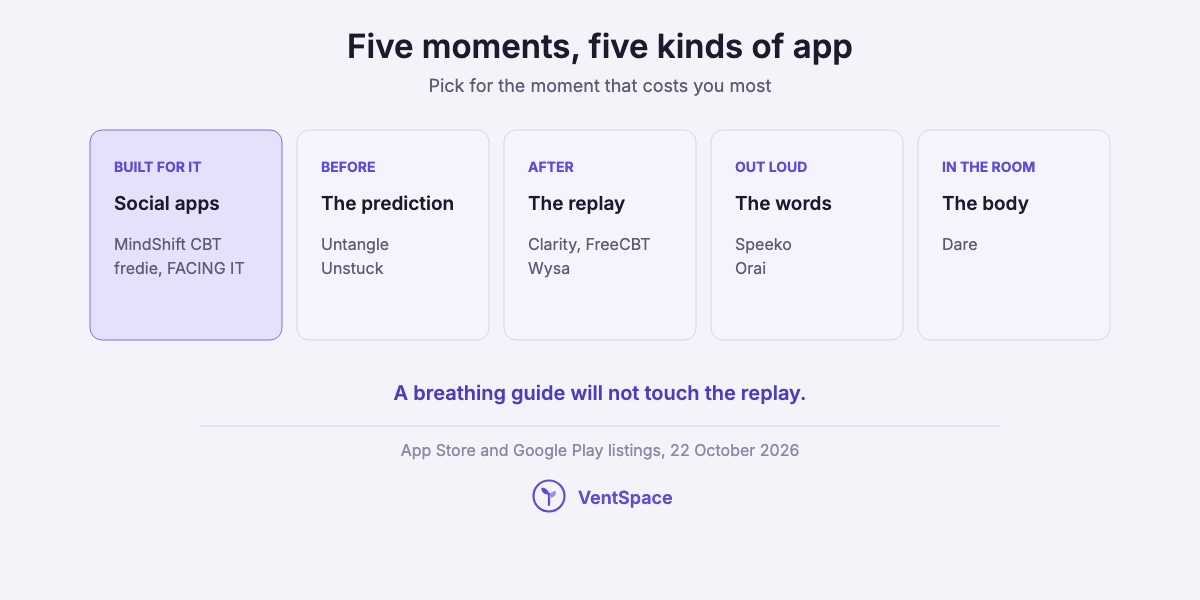
That is not a failing of character, and it is worth being precise about what kind of help a phone can offer. The fear has several moments: walking in, being in the room, finding the words, the body taking over, and the replay afterwards. An app built for one of those moments will do little for another. So this page sorts eleven apps for social anxiety by the moment each one works on, checks every one of them on the stores today, and says plainly what has, and has not, been published about them.
Quick Digest
– Built around social anxiety: MindShift CBT (free), fredie and FACING IT. FACING IT has not been updated since early 2023.
– Testing what you fear will happen: Untangle and Unstuck, which both include exposure tools.
– The replay afterwards: Clarity, FreeCBT and Wysa, for catching and weighing the thoughts.
– Rehearsing the words: Speeko and Orai, AI speaking coaches. Speeko needs iOS 18.2 on an iPhone.
– The body in the room: Dare, for the racing heart and the urge to leave.
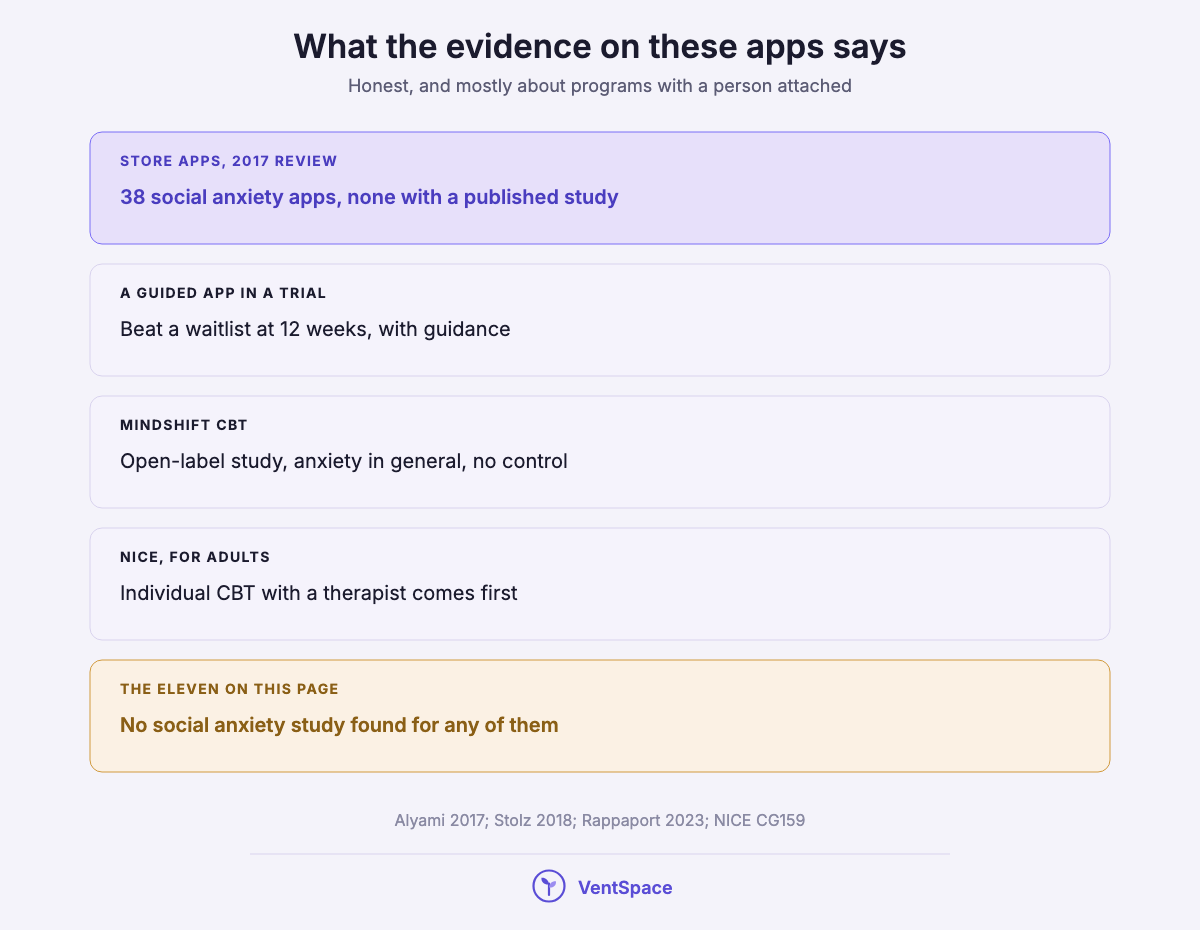
– Evidence: a systematic review found no store app for social anxiety with a published effectiveness study, and we found no social anxiety study for any of these eleven. MindShift’s study covers anxiety in general. NICE’s first choice for adults is individual CBT with a therapist.
– Names to check first: the CharisMe listing now carries a different app, and Sanvello and Youper are no longer on Apple’s store.
Social anxiety apps at a glance
Built around social anxiety
- MindShift CBT: free, no purchases, with a fear ladder and a thought journal.
- fredie: a social skills coach, now on the listing that used to carry CharisMe.
- FACING IT: daily social challenges and an AI coach, last updated in 2023.
Testing the prediction
- Untangle: thought records that ask you to test whether a prediction came true.
- Unstuck: an exposure journal and an AI “fear finder”.
The replay afterwards
- Clarity: thought records and thinking traps, with an optional AI journal.
- FreeCBT: a free, open-source three-column thought diary.
- Wysa: a chatbot with CBT-inspired exercises, including one for difficult conversations.
Rehearsing the words
- Speeko: AI feedback on how you speak, plus roleplays that include small talk.
- Orai: AI feedback on presentations, interviews and meetings.
The body in the room
- Dare: audio guides for panic and anxiety in places like restaurants and meetings.
If you need help right now
If you need help right now
If you are in crisis or thinking about harming yourself, please reach out now. In the United States, call or text 988 for the Suicide and Crisis Lifeline, or text HOME to 741741 for the Crisis Text Line. Outside the US, findahelpline.com lists the number where you are. An app is not built for that moment, and a person is.
How did we judge them?
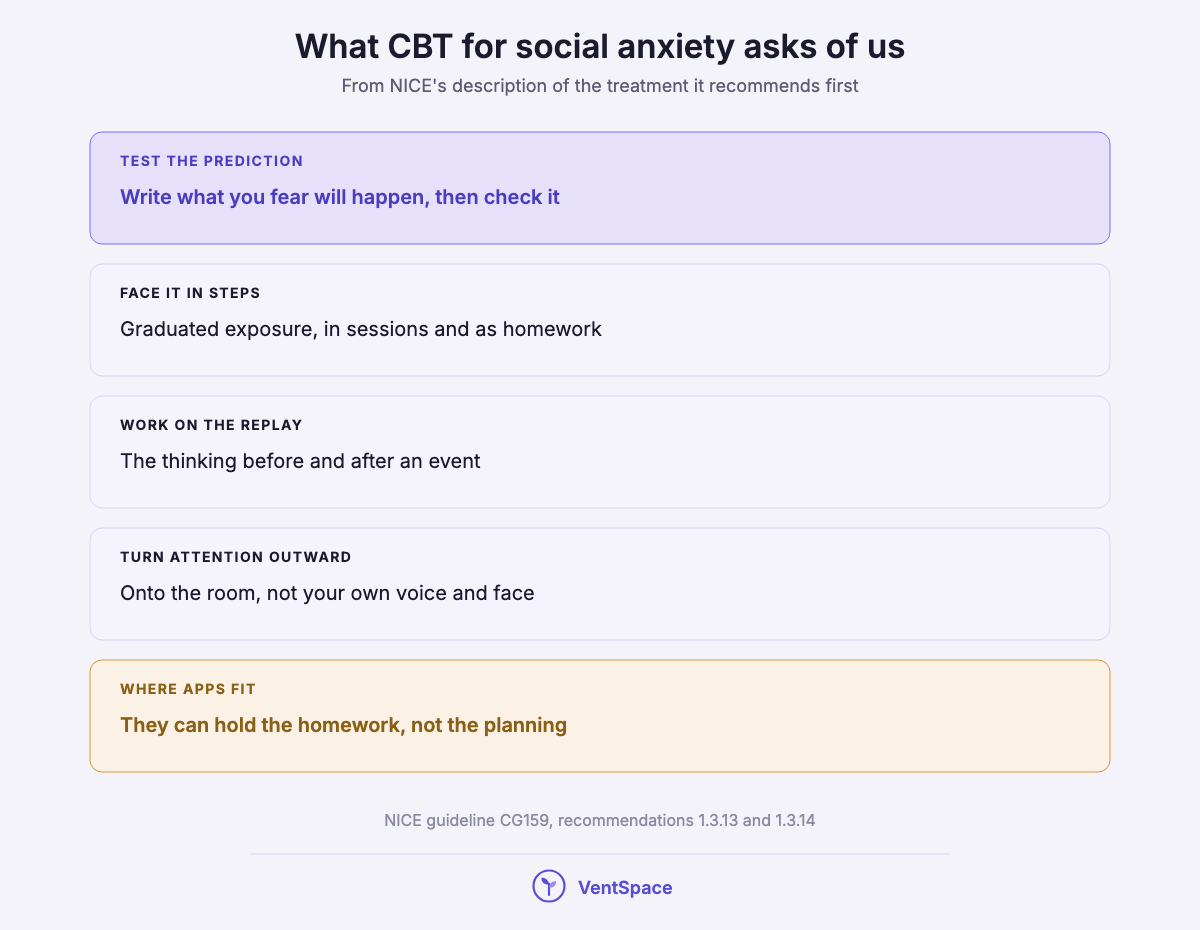
We judged every app against what CBT for social anxiety contains, because that is the treatment England’s National Institute for Health and Care Excellence (NICE) recommends first for adults, and its guideline spells out the parts. The Clark and Wells version includes learning how the fear works, exercises showing what self-focused attention and safety behaviors cost us, training attention outward onto the room, behavioral experiments that test a feared prediction, and work on the replay before and after an event. The Heimberg version adds “graduated exposure to feared social situations, both within treatment sessions and as homework”.
- Which part of that work does the app ask of you? Testing a prediction, facing a situation in steps, weighing a thought, or rehearsing. An app that asks for none of it is a different kind of tool.
- Is it built for social situations, or general anxiety? Both can help. We say which is which.
- What has been published about this app? Not about CBT in general. We searched Europe PMC for each one on 22 October 2026.
- What does it cost, and is it maintained? Prices from Apple’s in-app purchase list, which shows at most ten items, so a range may be incomplete. Update dates from both stores.
Nobody paid to be on this page, there are no affiliate links, and our own app is not on the list, because it is not a social anxiety tool. We also left out meditation apps. NICE’s guideline says not to routinely offer mindfulness-based interventions to treat social anxiety disorder, which is a statement about treatment, not about whether a calming app is pleasant to use.
Quick Summary
Q: How do I know if a social anxiety app does more than calm me down?
A: Check whether it asks you to test a feared prediction, face situations in small steps, or work on the replay afterwards. Those are parts of the CBT that NICE recommends for social anxiety. Then look for a published study of that specific app.
Insight When researchers screened 1,154 apps and reviewed the 38 that addressed social anxiety, they concluded that “none of the apps identified have had studies on their effectiveness published” (Alyami and colleagues, Evidence-Based Mental Health, 2017). The listings have grown since. The evidence for most of them has not.
Apps built around social anxiety
These three name social situations as their subject. One is free and studied for anxiety in general, one is a polished social skills course, and one has been left standing since 2023.
MindShift CBT
MindShift CBT is free, with no subscriptions, and its listing names “social anxiety” among the problems it covers, alongside worry, panic and phobias. It offers a thought journal, a fear ladder for facing situations in steps, guided meditations and a community forum. The app’s own website says it was “originally developed in partnership with Anxiety Canada”, and Anxiety Canada’s website now says that “as of April 1, Anxiety Canada has officially ceased operations and is no longer available.” The app is still on both stores, published by 247 Labs Inc.
| Type | Free CBT toolkit with a fear ladder |
| Platforms | iOS (15.1 or later) and Android, both updated 19 September 2026 |
| Price | Free. No in-app purchases on either store (22 Oct 2026) |
| Best for | People who want a free place to plan small steps |
| Published evidence | An open-label study of 380 adults with anxiety of any kind, over 16 weeks, with no control group, reported less anxiety (d = 0.61). A grant from Anxiety Canada supported the lead author (Rappaport and colleagues, 2023, corrected in 2024 on a quality-of-life score) |
| Pros | Free. A published study of the app itself, which we read |
| Cons | The study was not of social anxiety specifically. Its original nonprofit partner has closed |
Who it’s for: people who want to build a ladder of situations, from easiest to hardest, without paying.
In practice: put three rungs on the ladder this week, starting with one you could do tomorrow.
Verdict: the best free starting point, with a study that covers anxiety broadly rather than this fear.
fredie
fredie, from the Berlin company Sentou UG, is a social skills coach: lessons and exercises on small talk, saying no, letting people in and having deeper conversations, with progress tracking. Its listing says it draws on CBT, mindfulness and interpersonal therapy, and it states plainly that the app “is not a substitute for professional therapy.” It sits on the same Apple and Google Play listings that carried CharisMe, the app this page used to rank first, and its Apple purchase list still includes an item called “charisme premium”.
| Type | Social skills course with daily exercises |
| Platforms | iOS (15.0 or later) and Android, updated in September 2026 |
| Price | Free download. Weekly $4.49 to $4.99, monthly $8.90 to $14.99, yearly $49.99 to $79.99 on Apple’s listing (22 Oct 2026) |
| Best for | People whose worry is mostly about what to say |
| Published evidence | No trial of the app found (Europe PMC, 22 Oct 2026) |
| Pros | Specific social situations, exercises meant for the same day |
| Cons | Subscription. A skills frame can skip the fear underneath the skill |
Who it’s for: people who freeze on small talk and want a structured way to practice it.
In practice: take one exercise into one real conversation, then note what happened, not how it felt.
Verdict: the most polished social-specific course here, with no study of its own. Our page on what happened to CharisMe covers the change of name.
FACING IT
FACING IT describes itself as “Your AI Coach that helps to overcome Social Anxiety”, with daily challenges for situations such as public speaking, dating and work, breathing and mindfulness exercises, and an AI chat called Eden. Its listing says it was built with Ph.D. psychologists and uses techniques from CBT, acceptance and commitment therapy and exposure therapy. The concern is age: the Apple version was last updated on 15 February 2023, and the Android one on 29 December 2022.
| Type | Social anxiety challenges with an AI chat |
| Platforms | iOS (13.0 or later) and Android |
| Price | Free download. Apple’s purchase list shows $3.99 a month or $29.99 a year, while the listing text says $4.99 and $39.99 (22 Oct 2026) |
| Best for | People who want a daily nudge toward one small social action |
| Published evidence | No trial of the app found (Europe PMC, 22 Oct 2026) |
| Pros | Built for social anxiety, with exposure tracking |
| Cons | Not updated in over three years. Two different prices on one listing |
Who it’s for: people who like a small daily challenge and accept that the app is not being maintained.
In practice: check the price shown at checkout before you subscribe, since the listing gives two.
Verdict: the right idea, left unattended, and the reason we no longer rank it near the top.
Quick Summary
Q: Is there an app made specifically for social anxiety?
A: Yes. FACING IT and fredie are built around social situations, and MindShift CBT names social anxiety among the problems it covers. MindShift is free and the only one of the three with a published study, which looked at anxiety in general.
Insight In the MindShift study, improvements “were unrelated to the frequency with which participants used the MindShift app” (Rappaport and colleagues, Journal of Mood and Anxiety Disorders, 2023). Without a control group, the study cannot say what caused the change. It does suggest there is no need to treat a missed day as a failure.
Apps for testing the prediction
Much of social anxiety runs on a forecast: they will notice my hands, I will run out of things to say, they will think less of me. These two apps ask you to write the forecast down and then check it against what happened, which is close to the behavioral experiments in NICE’s description of CBT.
Untangle
Untangle, from Resiliens, offers mood and thought journaling, a skills library and an AI coach named Tara. Its listing describes recording automatic thoughts, challenging them, and testing “whether your predictions come true”, and its skills library includes exposure, grounding and worry exercises. It describes Tara as a self-help skills coach rather than a therapist, and says the coach surfaces resources such as the 988 Lifeline when they might help.
| Type | CBT skills app with prediction testing and an AI coach |
| Platforms | iOS (15.1 or later) and Android, updated in October 2026 |
| Price | Free download. $9.99 a month or $49.99 for six months on Apple’s listing (22 Oct 2026) |
| Best for | People who want to test a social prediction and record the result |
| Published evidence | No trial of the app found (Europe PMC, 22 Oct 2026) |
| Pros | Prediction testing is built into the thought record |
| Cons | Subscription after the trial. Not specific to social situations |
Who it’s for: people who want to write “they will think I am boring” before a lunch and check it afterwards.
In practice: write the prediction and how sure you are, go, then write what happened within the hour.
Verdict: the closest thing here to a behavioral experiment you can carry, without a study of its own.
Unstuck
Unstuck offers a thought journal, a savoring journal and an exposure journal, plus an “AI Fear Finder” meant to identify the fears an exposure should target, according to its listing. The same listing makes figures its centerpiece, including “81% of people with moderate to severe anxiety see an improvement after just one month”, with no source given.
| Type | CBT journaling app with an exposure journal |
| Platforms | iOS (15.6 or later) and Android, both updated in October 2026 |
| Price | Free download. $5.99 to $9.99 a month and $39.99 to $69.99 a year among Apple’s items (22 Oct 2026) |
| Best for | People ready to log graded steps toward a feared situation |
| Published evidence | No trial found (Europe PMC, 22 Oct 2026). The listing’s percentages carry no citation |
| Pros | A dedicated place for exposure steps, beside thought work |
| Cons | Unsourced outcome claims. Exposure work is best planned with a therapist |
Who it’s for: people who want to record each step up a ladder and see the record grow.
In practice: keep each step small enough that you will do it this week, and log it the same day.
Verdict: a useful exposure log, sold with numbers we could not trace.
Quick Summary
Q: Can an app help with exposure for social anxiety?
A: Some apps give you a place to plan and log small steps toward a feared situation, such as Unstuck’s exposure journal and MindShift’s fear ladder. None of the apps we checked has a published study of that feature, and exposure is best planned with a therapist.
Insight NICE’s description of the Heimberg model of CBT includes “graduated exposure to feared social situations, both within treatment sessions and as homework” (NICE guideline CG159, 2013). The homework half is the part an app can hold. The planning half is where a person helps most.
Apps for the replay afterwards
The conversation ends and the second conversation starts, the one in our heads, where every pause is examined. NICE’s description of CBT for social anxiety includes work on that before-and-after rumination. These three apps help us catch the thoughts and weigh them, though none is written for social situations alone.
Clarity
Clarity, from Inquiry Health, is built around reframing thoughts and spotting cognitive distortions, with mood check-ins, an AI-assisted journal and an AI chatbot, according to its listing. On Google Play it appears as “Clarity – CBT Thought Diary”. It is a general CBT tool, so the social part is what you bring to it.
| Type | CBT thought-record journal with optional AI |
| Platforms | iOS (17.0 or later) and Android, updated in October 2026 |
| Price | Free download. Pro Mode from $9.99 to $69.99 on Apple’s listing (22 Oct 2026) |
| Best for | People who replay conversations and want to name the thinking trap |
| Published evidence | No trial of the app found (Europe PMC, 22 Oct 2026) |
| Pros | A full thought record, kept tidy over time |
| Cons | Needs iOS 17. Pro pricing varies widely on the same listing |
Who it’s for: people whose evenings fill with “why did I say that”.
In practice: write one record the night of the event, naming the trap, such as mind reading.
Verdict: the fullest thought record here, with nothing social-specific built in.
FreeCBT
FreeCBT is an open-source thought diary for what its listing calls “the three column technique”: record an automatic thought, check it against a list of cognitive distortions, and write an alternative. It is a fork of an earlier app, Quirk, and has no purchases and no AI.
| Type | Minimal three-column thought diary |
| Platforms | iOS (15.1 or later) and Android |
| Price | Free. No in-app purchases on either store (22 Oct 2026) |
| Best for | People who want the plainest possible record of a replay |
| Published evidence | No trial of the app found (Europe PMC, 22 Oct 2026) |
| Pros | Nothing to buy and nothing between you and the record |
| Cons | Last updated in October 2025, by one developer |
Who it’s for: people who want to write the thought down and check it, with no extras.
In practice: after a hard conversation, write the one sentence you keep replaying, then a fairer version.
Verdict: the paper sheet, made portable, maintained by a single person.
Wysa
Wysa is a chatbot whose listing describes self-help techniques “inspired from” CBT and DBT, plus meditations, with paid options for human coaching. Among its tools the listing names exercises “to build skills in having difficult conversations”. It also carries a figure, “93% of the people who talk to Wysa find it helpful”, with no source.
| Type | AI chatbot with CBT-inspired exercises |
| Platforms | iOS (15.0 or later) and Android, updated in October 2026 |
| Price | Free download. Premium $4.99 to $99.99, guided support from $29.99 a week, among Apple’s items (22 Oct 2026) |
| Best for | People who find typing to a bot easier than filling in a form |
| Published evidence | England’s NICE says Wysa “should only be used as part of a research study that has been approved by an ethics committee” for adult depression (HTG675). No study of Wysa for social anxiety found (Europe PMC, 22 Oct 2026) |
| Pros | Low effort to start. A route to a human coach if you pay |
| Cons | Chat-led, so less of the weighing is yours. Unsourced listing figure |
Who it’s for: people who want to talk a replay through before writing it down.
In practice: use it to draft the fairer thought, then write that thought in your own words.
Verdict: an easy door in, rated research-only by NICE for depression.
Quick Summary
Q: Is there an app for overthinking after social situations?
A: Thought-record apps such as Clarity and FreeCBT, and the Wysa chatbot, help you catch the replayed thought and weigh it. None is built for social situations alone, and none has a published study of that use.
Insight NICE lists “modification of problematic pre- and post-event processing” among the parts of individual CBT for social anxiety (CG159, recommendation 1.3.13). The replay is not a side effect we are meant to put up with. It is one of the things the treatment works on.
Apps for rehearsing the words
Sometimes the fear is concentrated in one kind of speaking: the presentation, the interview, the toast. These two AI coaches listen while you practice and give feedback on delivery. They are speaking tools rather than anxiety tools, and that is both their use and their limit.
Speeko
Speeko is an AI speech coach that, according to its listing, gives feedback on “pace, filler words, tone, pauses” and offers “Convos”, AI roleplays for job interviews, difficult conversations and small talk. It also has short lessons and exercises for building a daily speaking habit.
| Type | AI speaking coach with conversation roleplays |
| Platforms | iOS (18.2 or later) and Android |
| Price | Free download with free exercises. $24.99 a month, $79.99 to $99.99 a year on Apple’s listing (22 Oct 2026) |
| Best for | People who want to rehearse small talk or an interview out loud |
| Published evidence | No trial of the app found (Europe PMC, 22 Oct 2026) |
| Pros | Roleplays include small talk, not only speeches |
| Cons | Needs iOS 18.2, which rules out older iPhones. The highest monthly price of the two speaking coaches |
Who it’s for: people who want a low-stakes place to say the first line out loud.
In practice: rehearse the opening of one real conversation you have coming up, then have it.
Verdict: useful rehearsal, best as a step toward the real conversation rather than instead of it.
Orai
Orai is an AI public speaking coach for presentations, speeches, interviews, meetings and pitches. Its listing says it gives feedback on “filler words, pace, clarity, energy, confidence, and conciseness”, with transcripts, playback and progress over time.
| Type | AI public speaking coach |
| Platforms | iOS (16.6 or later) and Android |
| Price | Free download. $12.99 a month, $49.99 a year, or $99.99 lifetime on Apple’s listing (22 Oct 2026) |
| Best for | People whose fear centers on presenting |
| Published evidence | No trial of the app found (Europe PMC, 22 Oct 2026) |
| Pros | A lifetime option. Transcripts you can reread |
| Cons | Presenting only. Feedback on delivery can feed self-monitoring if we fixate on it |
Who it’s for: people with a talk, pitch or interview on the calendar.
In practice: record one run, read the transcript once, then practice to a friend rather than the app.
Verdict: good for one specific dread, and narrow beyond it.
Quick Summary
Q: Is there an app to practice talking to people?
A: Speeko offers AI roleplays that include small talk and interviews, and Orai coaches presentations. They give feedback on delivery, not on anxiety, and they work best as a rehearsal before a real conversation.
Insight NICE’s description of CBT for social anxiety includes “systematic training in externally focused attention” (CG159, 1.3.13). Delivery scores pull our attention inward, onto our own voice. Rehearse with them, and then let the score go when the real person is in front of you.
Apps for the body in the room
For some of us the hardest part is physical: the heat in the face, the racing heart, the urge to leave the table. Dare is a general anxiety and panic app, not a social one, but its listing names social settings among the moments it is designed for.
Dare
Dare, from BMD Publishing and based on the book DARE, offers hundreds of audio guides, a mood journal and, for subscribers, breathing exercises, peer support groups and live group sessions, according to its listing. It lists moments such as “dining out” and “public speaking”, calls itself an “evidence-based training program” and says it is approved by ORCHA, an organization that reviews health apps.
| Type | Audio-led anxiety and panic program |
| Platforms | iOS (15.4 or later) and Android, updated in 2026 |
| Price | Free download with free audios. Subscriptions $9.99 to $69.99, plus $16.99 one-off packs, on Apple’s listing (22 Oct 2026) |
| Best for | People whose fear shows up as panic in public places |
| Published evidence | No trial of the app found (Europe PMC, 22 Oct 2026). “Evidence-based” is the listing’s own word |
| Pros | Large free audio library. Built for moments in public |
| Cons | Not social-specific. Many prices on one listing |
Who it’s for: people who want a guide in one ear for the walk into a crowded room.
In practice: listen to one guide before the event, not during the conversation itself.
Verdict: steady company for the body, best paired with one of the thought or ladder apps above.
Quick Summary
Q: Which app helps when social anxiety feels physical?
A: Dare is built for panic and anxiety in public moments, with free audio guides. It is not specific to social situations, and its “evidence-based” label is the listing’s own description, not a published study of the app.
Insight NICE’s guideline says: “Do not routinely offer mindfulness-based interventions or supportive therapy to treat social anxiety disorder” (CG159, 1.6.3). Calming the body can make a room survivable. The guideline’s first choice is the work that changes what we expect from the room.
Names you will see, and should check first
Several apps that other roundups still recommend for social anxiety are renamed, closed or restricted. We checked each on 22 October 2026.
- CharisMe: the Apple and Google Play listings that carried it now show fredie, from Sentou UG. Our page on what happened to CharisMe sets out what changed.
- Sanvello: Apple’s store returns no listing for it, and its old App Store page shows an error. One roundup updated on 15 October 2026 still recommends it.
- Youper: Apple’s store returns no listing. Our Youper page covers its closure.
- Woebot: its Apple listing says “you’ll need an access code from your provider, employer or other Woebot Health partner.”
- FACING IT: still on both stores, but not updated since early 2023, as noted above.
Quick Summary
Q: Is the CharisMe app still available?
A: Not under that name. Its Apple and Google Play listings now carry fredie, a social skills coach from Sentou UG, and fredie’s Apple purchase list still includes an item named “charisme premium”.
All eleven side by side
| App | Moment | Price (22 Oct 2026) | Platforms | Published evidence | The watch-out |
|---|---|---|---|---|---|
| MindShift CBT | Built for it | Free | iOS 15.1+, Android | Open-label study, anxiety in general | Original nonprofit closed |
| fredie | Built for it | Weekly from $4.49 | iOS 15+, Android | None found | Subscription |
| FACING IT | Built for it | $3.99/mo on Apple | iOS 13+, Android | None found | Not updated since 2023 |
| Untangle | The prediction | $9.99/mo | iOS 15.1+, Android | None found | Not social-specific |
| Unstuck | The prediction | $5.99 to $9.99/mo | iOS 15.6+, Android | None found | Unsourced listing figures |
| Clarity | The replay | Pro from $9.99 | iOS 17+, Android | None found | Needs iOS 17 |
| FreeCBT | The replay | Free | iOS 15.1+, Android | None found | One developer |
| Wysa | The replay | Premium from $4.99 | iOS 15+, Android | NICE research-only (depression) | Chat-led |
| Speeko | The words | $24.99/mo | iOS 18.2+, Android | None found | Needs iOS 18.2 |
| Orai | The words | $12.99/mo | iOS 16.6+, Android | None found | Presenting only |
| Dare | The body | From $9.99 | iOS 15.4+, Android | None found | Not social-specific |
What can an app do for social anxiety, and what can it not?
An app can hold the plan and the record: the ladder of situations, the prediction written before, the result written after, the thought caught at midnight. That is useful work, and we should not dismiss it. What the evidence does not show is that any store app does it well enough to stand on its own.
Some context first, offered so the reader knows how common this is, not to put a label on anyone. The US National Institute of Mental Health estimates that 7.1% of US adults had social anxiety disorder in the past year and 12.1% at some point in their lives, figures from a national survey run between 2001 and 2003.
The strongest evidence is for programs with a person attached. In a trial of 150 people who met the diagnostic criteria, a guided internet CBT program delivered by smartphone app beat a waitlist after 12 weeks (d = 0.89), about as well as the same program on a computer, and the gains held at three months (Stolz and colleagues, Journal of Consulting and Clinical Psychology, 2018). That was a research program with guidance, not one of the store apps above. When NICE describes self-help for adults who decline CBT, it means a CBT self-help book used over three to four months with about three hours of support from a practitioner.
For adults, NICE’s first recommendation is individual CBT developed specifically for social anxiety, up to 14 sessions over about four months in the Clark and Wells version. If booking that call is itself the frightening part, that is worth saying out loud to the person who answers. It is an ordinary thing for them to hear. Our guide to whether therapy is worth it sets out what therapy can promise, and our list of therapy apps covers services that connect you to a person. If things feel acute, the crisis lines near the top of this page are the place to start.
Quick Summary
Q: Can an app replace therapy for social anxiety?
A: No study shows that. A guided smartphone program has worked in a trial, but store apps for social anxiety have no published effectiveness studies, and NICE recommends individual CBT with a therapist first for adults.
Insight After testing the same guided program by app and by computer, Stolz and colleagues concluded that “ICBT can be delivered effectively using smartphones” (2018). The word that matters in the trial is guided. The program came with a person checking in.
How do you pick one?
Pick by the moment that costs you most, not by the longest feature list. Then use one app for two weeks before adding another.
- You avoid situations and want to start facing them: MindShift CBT’s fear ladder, free, or Unstuck’s exposure journal.
- You are sure of what people will think: Untangle, to write the prediction down and check it.
- The replay keeps you up: FreeCBT for the plainest record, Clarity for a fuller one, Wysa if talking it through is easier.
- You do not know what to say: fredie for small talk, Speeko to rehearse a real conversation out loud.
- A presentation is coming: Orai, then practice once in front of a person.
- Your body takes over in public: Dare, alongside one of the thought apps.
- You have a therapist, or are about to: ask which app, if any, they would like your ladder or records in.
For how these apps fit beside meditation apps, trackers and chatbots in general, see our guide to the six kinds of mental health app.
Quick Summary
Q: What is the best app for social anxiety?
A: It depends on the moment. For facing situations in steps, MindShift CBT is free. For testing predictions, Untangle. For the replay, FreeCBT or Clarity. For what to say, fredie or Speeko. None has a published study for social anxiety itself.
Questions people ask
What is the best free app for social anxiety?
MindShift CBT and FreeCBT have no purchases at all, as of 22 October 2026. MindShift is the one that names social anxiety and includes a fear ladder. Dare and Speeko have free tiers.
Can an app cure social anxiety?
No app has shown that, and none of the eleven here has a published study for social anxiety. The treatment with the strongest evidence is CBT developed for social anxiety, which NICE recommends first for adults, and an app can carry the homework between sessions.
Is MindShift CBT still available?
Yes, on both stores as of 22 October 2026, free and published by 247 Labs Inc. Anxiety Canada, which the app’s website names as its original development partner, says on its own website that it has ceased operations.
What happened to the CharisMe app?
Its Apple and Google Play listings now carry fredie, a social skills coach from Sentou UG. Our CharisMe page sets out what changed and what to use now.
Are meditation apps good for social anxiety?
They can make a hard day calmer. NICE’s guideline says mindfulness-based interventions should not be routinely offered to treat social anxiety disorder, so we did not list meditation apps here.
Two things to take with you
First, match the app to the moment. A breathing guide will not touch the replay, and a thought diary will not get you through the door. Name the moment that costs you most, and choose for that.
Second, an app holds the plan, and the plan is still ours to carry out. The ladder only works when we climb a rung, and the prediction only shrinks when we check it against what happened. None of us gets to stop being seen. What we can do is find, in small steps, that being seen is survivable.
If writing about the rest of your week would help alongside whichever of these you choose, VentSpace is a journaling app that turns what you write into a clear read on your life balance, plus small, doable next steps. Prefer to try it on your laptop first? VentSpace Live runs in your browser, free, with nothing to install. It is not a social anxiety tool, and it is not a substitute for any of the help above.
About this article

Written by
Sai Subramaniam
Founder, VentSpace
I write these guides because I have been where you are. I am working through my own hard seasons, and I share the things that actually helped me, so that anyone going through it has a steady companion close by instead of facing it alone. VentSpace is the app I built for exactly that: a journaling app that turns what you write into a clear read on your life balance, plus small, doable next steps toward feeling more like yourself.
This writing is honest and every claim is sourced, and it is not a substitute for professional care. If you are struggling, reaching out to a professional is a strong move, not a failure.
Explore VentSpaceTry VentSpace LiveHow this one was checked. Every factual claim traces to a named source, and the source is printed next to the claim rather than kept in a footnote. Quotes are pinned to the work they come from, with the year, the letter or the chapter where one exists. Where a widely repeated claim could not be traced, it was left out and the omission recorded. Where a figure is contested, both sides are printed.
No affiliate links, no paid placements, and nobody paid to appear here. Where we mention our own app, we say that it is ours, we state its limits, and we never position it as a substitute for care.
Reviewed: October 2026. Prices, platforms and product availability move quickly, and anything we could not verify at the time of writing is marked as unverified rather than turned into a number.
Corrections. If something here is wrong, we would rather know. Corrections are made in place, with a note saying what changed.