
“Repeating positive self-statements may benefit certain people, but backfire for the very people who “need” them the most.” · Joanne V. Wood, W. Q. Elaine Perunovic and John W. Lee, Psychological Science, 2009
You have probably tried the mirror. You stood there and said the sentence, I am enough or I love myself, and some part of you answered back, flatly, that it was not true. The sentence felt like a lie, and the lie made the day worse. Why did it make things worse?
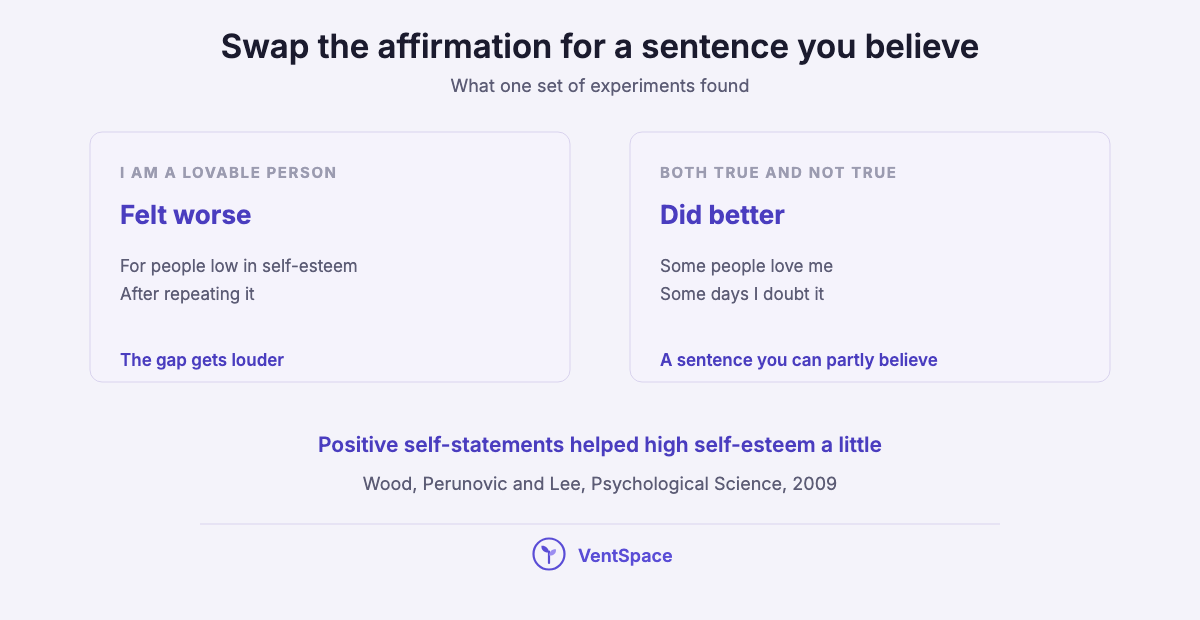
There is a study about exactly that moment. In 2009, the psychologists Joanne Wood, Elaine Perunovic and John Lee asked people to repeat the sentence “I’m a lovable person”. People with high self-esteem felt a little better afterward. People with low self-esteem felt worse than people who never said it. The advice that every list gives first was, in their experiments, a step backward for the readers who needed it most.
So this guide starts somewhere else. Not with a better sentence to say into the mirror, but with the sentence you already say to yourself the moment something goes wrong. That one is real, you say it every day, and it is the place where loving yourself more starts.
The short version
Loving yourself is a way of treating yourself, not a feeling you have to summon. The test is how you talk to yourself after a mistake.
Affirmations can backfire. In one set of experiments, people low in self-esteem felt worse after repeating “I’m a lovable person”.
Turn down the attack before you turn up the praise. In the research on the scale most of this field uses, the self-critical half was the stronger signal.
Going easier on yourself does not have to make you lazy. In one of four experiments, people prompted toward self-compassion after a failure studied longer for the next test.
Five steps, starting tonight, and the first one takes five minutes and a pen.
What does it mean to love yourself?
“Self-compassion simply involves doing a U-turn and giving yourself the same compassion you’d naturally show a friend when you’re struggling or feeling badly about yourself.” · Kristin Neff, “What is Self-Compassion?”, self-compassion.org
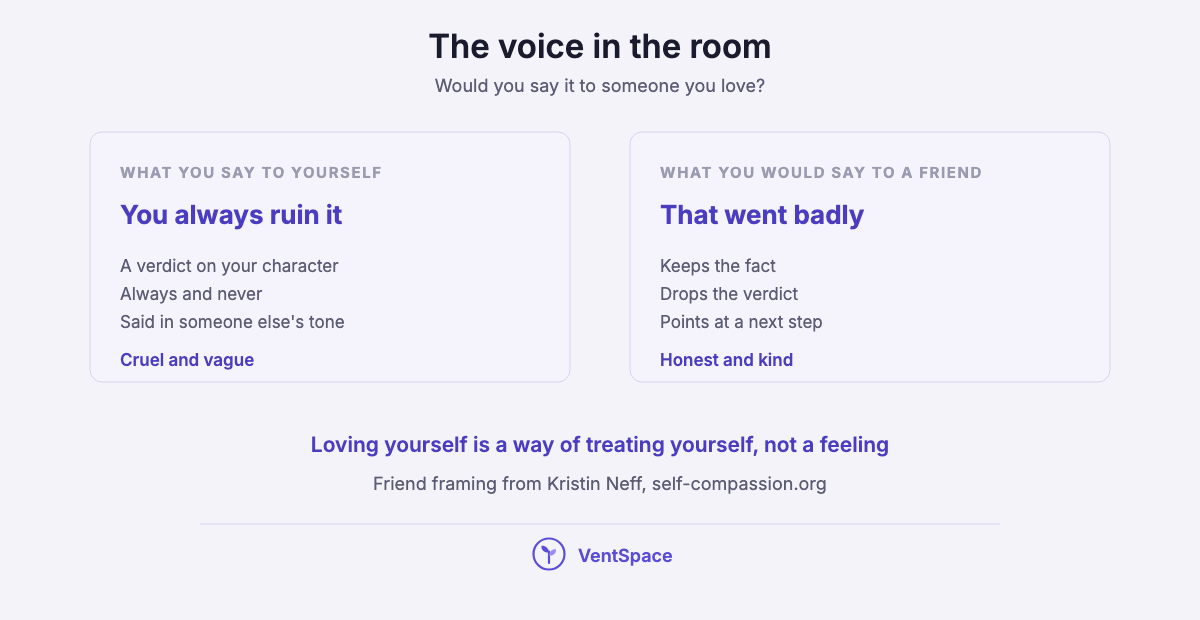
Loving yourself means treating yourself on a bad day roughly the way you would treat someone you love on theirs. It is a direction your behavior points, not a warm feeling you are supposed to wake up with. You can do it while you still dislike plenty about yourself.
That matters, because the popular version of self-love is a feeling. Feel good about yourself. Believe you are worthy. Be confident. When the feeling does not come, which it usually does not when you search for this at night, the advice has nothing left to give you except more of the same instruction.
There is an older idea underneath the popular one, and it is self-esteem: how highly you rate yourself. A newer idea, self-compassion, is the one Kristin Neff’s research is built on, and it asks a different question. Not how good am I? but how do I treat myself when I am not good? For years the two were sold as rivals, with self-compassion as the healthier replacement.
The pooled evidence is calmer than that. A 2023 meta-analysis by Peter Muris and Henry Otgaar, across 76 studies and 35,537 people, found the two correlate at r = 0.65, relate to wellbeing and to psychological problems at similar sizes, and each explain a little that the other does not. Worth knowing: Muris and Otgaar are also the principal critics of how self-compassion is usually scored, so their paper is peer-reviewed and part of an argument at the same time. Neff and Roos Vonk’s 2009 studies found one difference that holds up as interesting. Self-esteem went with narcissism and self-compassion did not, and self-compassion went with less comparing yourself to others and less turning things over about yourself. On happiness, the two came out about equal.
So you do not have to choose. What you can change this week is the second one, because it is a way of behaving, and behavior can be practiced.
Here is the picture to hold for the rest of this page. Imagine the voice in the room: the one that speaks first, in your head, when you drop something, miss something or say the wrong thing. Now imagine it said those exact words, in that exact tone, to someone you love. Would you let it?
Quick Summary
Q: What does it mean to love yourself?
A: It means treating yourself after a mistake or on a hard day roughly the way you would treat someone you care about, rather than feeling good about yourself all the time. Research treats self-esteem and self-compassion as overlapping but complementary, and the treating part is the one you can practice.
Insight: Peter Muris and Henry Otgaar, Psychology Research and Behavior Management (2023), from a meta-analysis of 76 studies and 35,537 participants: “Self-esteem and self-compassion displayed relations of a similar magnitude to measures of well-being and psychological problems, and both concepts accounted for unique variance in these measures once controlling for their shared variance. Self-esteem and self-compassion can best be seen as complementary concepts.”
Why can’t you just tell yourself you are worth it?
“We have not found evidence that boosting self-esteem (by therapeutic interventions or school programs) causes benefits.” · Roy F. Baumeister, Jennifer D. Campbell, Joachim I. Krueger and Kathleen D. Vohs, Psychological Science in the Public Interest, 2003
Because a sentence you do not believe can make you feel worse, not better. That is the uncomfortable finding behind the mirror moment, and it is the part every ranking list leaves out.
Wood and her colleagues started with a survey and confirmed what you would guess: people often use positive self-statements and believe they work. Then they ran two experiments. People with low self-esteem who repeated “I’m a lovable person”, or who were asked to focus on how the sentence was true, ended up feeling worse than people who did neither. They also felt worse than people asked to think about how the sentence was both true and not true. Those with high self-esteem got a small lift from the sentence, “but to a limited degree”, in the authors’ words.
Why would a kind sentence hurt? The authors’ own conclusion is the one at the top of this page, and it is careful: these statements “may benefit certain people”. Our reading, not theirs, is that when the gap between the sentence and what you believe is wide, saying the sentence mostly reminds you of the gap.
The wider research on self-esteem points the same way, with an important second half. A major 2003 review led by Roy Baumeister found no evidence that programs to boost self-esteem cause benefits. The same review was persuaded that high self-esteem does lead to greater happiness, and that low self-esteem is more likely than high to lead to depression under some circumstances. Both halves are in one paper, and both matter here. Feeling better about yourself is worth wanting. Repeating that you feel better is not the route.
One more thing, because that finding gets misread. It is about self-esteem-boosting programs, not about therapy. If disliking yourself has gone on a long time and is reaching your sleep, your work or the people around you, a therapist is a legitimate place to take it. Therapy is one option. For a lot of people it’s the right one.
Quick Summary
Q: Do positive affirmations help you love yourself?
A: Not reliably. In two experiments, people with low self-esteem felt worse after repeating “I’m a lovable person”, while people with high self-esteem felt slightly better. A sentence you can partly believe works better than one you cannot.
Insight: Joanne Wood, Elaine Perunovic and John Lee, Psychological Science (2009): “Two experiments showed that among participants with low self-esteem, those who repeated a positive self-statement (“I’m a lovable person”) or who focused on how that statement was true felt worse than those who did not repeat the statement or who focused on how it was both true and not true.”
The attack matters more than the praise
“I’m not strong enough, I’m weak, inconsistent.” · a participant in Brazil, quoted in Oliver C. Robinson and colleagues, Emerging Adulthood, 2025
The questionnaire most of this research uses measures two things, and the self-critical half carries the stronger signal. So the first job is not to add kindness. It is to notice the attack and turn it down.
The line at the top of this section is the attack in its plainest form, and it is common. In a 2025 study by Oliver Robinson and colleagues of 2,247 people aged 18 to 29 in eight countries, describing a crisis in early adulthood, negative self-evaluation was the most frequent internal feature in four of the eight national samples, ahead of confusion and doubt.
The Self-Compassion Scale has items about being kind to yourself, and reverse-scored items about three other things: self-criticism, feeling alone in it, and getting swallowed by your own thoughts. In a 2024 meta-analysis of 16 studies by Peter Muris, Iris Fernández-Martínez and Henry Otgaar, the kind half had a modest protective relationship with anxiety and depression, and the self-critical half had a substantially stronger relationship with having them.
If you are struggling right now. If disliking yourself has turned into feeling worthless or hopeless, or you are thinking about harming yourself, please contact a crisis line now. In the US, call or text 988 (Suicide & Crisis Lifeline). Anywhere else, findahelpline.com lists free, confidential services by country. This guide is not a substitute for that.
Three honest limits travel with that finding. The studies were in young people, not adults, so it may not hold for you at 30. Whether the two halves belong in one score is a live argument in print between Neff and the authors above, and we have read only the critics’ papers. And it is correlation, so it cannot say which comes first.
The same caution covers the strongest numbers in this field. A 2019 meta-analysis by Madeleine Ferrari and colleagues pooled 27 randomized trials of structured self-compassion programs and found moderate drops in self-criticism (g = 0.56) and depression (g = 0.66), and a large drop in rumination (g = 1.37). Those are total-score results, with the dispute above attached, and they come from structured programs, often facilitated, not from anything you can read on a page. They tell you the direction is worth taking. They do not tell you what five steps on a website will do.
Why might the attack be getting louder? One possible piece is the standard you are attacking yourself against. Thomas Curran and Andrew Hill analyzed 164 samples of 41,641 college students in the US, Canada and the UK between 1989 and 2016, and found all three kinds of perfectionism they measured rose steadily. Sai, who wrote the first version of this page in 2022, put the cost plainly: “Aiming for perfection is the easiest way to hate yourself.”
Before the next section, answer these in a line each:
- What did the voice in the room say the last time you made a mistake?
- Would you say that sentence, in that tone, to a friend?
- Whose standard is it measuring you against?
Quick Summary
Q: Should I focus on being kinder to myself or on being less self-critical?
A: Start with less self-critical. In a 2024 meta-analysis of studies in young people, the self-critical half of the self-compassion scale was more strongly linked to anxiety and depression than the kind half was protective. The research is in youths and its scoring is disputed, so treat it as a sensible order, not a law.
Insight: Thomas Curran and Andrew Hill, Psychological Bulletin (2019), on 41,641 college students in three countries between 1989 and 2016: “Overall, in order of magnitude of the observed increase, the findings indicate that recent generations of young people perceive that others are more demanding of them, are more demanding of others, and are more demanding of themselves.”
Will you get lazy if you stop being hard on yourself?
“These findings suggest that, somewhat paradoxically, taking an accepting approach to personal failure may make people more motivated to improve themselves.” · Juliana Breines and Serena Chen, Personality and Social Psychology Bulletin, 2012
In the experiments that tested it, no. People nudged toward self-compassion after a failure tried harder afterward, not less.
This is the fear that keeps the attack running. If I go easy on myself, I will stop trying. It feels like the critic is the engine, and switching it off means coasting. Does the evidence agree?
Juliana Breines and Serena Chen ran four experiments to find out. Compared with people placed in a self-esteem condition or a control, people prompted toward self-compassion were more likely to believe a weakness could change, more motivated to make amends after doing something wrong, and spent more time studying for a difficult test after failing the first one. In the fourth experiment they also reported more motivation to change a weakness they had named.
The honest ceiling: we read the abstract, not the full paper, so we cannot give you the sample sizes or the size of the effects, and four experiments from one research team are a start, not a settled answer. What it does settle is narrower and still useful. The belief that you need the attack to keep improving was tested, and the tests did not support it.
So what was the attack doing, if not motivating you? Maybe it was keeping you braced for the next failure. Maybe it was the voice of someone who used to say it out loud. You do not have to know which to start turning it down.
Quick Summary
Q: Does being kind to yourself make you less motivated?
A: In four experiments by Breines and Chen (2012), people prompted toward self-compassion after a failure or a mistake were more motivated to improve and studied longer after failing a test. One research team, and the effect sizes were not available to us, but the evidence points away from the fear.
Insight: Kristin Neff, “What is Self-Compassion?”, self-compassion.org, on why kindness is not the same as giving up: “Instead of mercilessly judging and criticizing yourself for various inadequacies or shortcomings, self-compassion means you are kind and understanding when confronted with your failings – after all, who ever said you were supposed to be perfect? You may try to change in ways that allow you to be more healthy and happy, but this is done because you care about yourself, not because you are worthless or unacceptable as you are.”
So where do you start?
How to love yourself more, in five steps
“Treat yourself the way you treat the people you love.” · Sai Subramaniam, founder of VentSpace, in the first version of this page, 2022
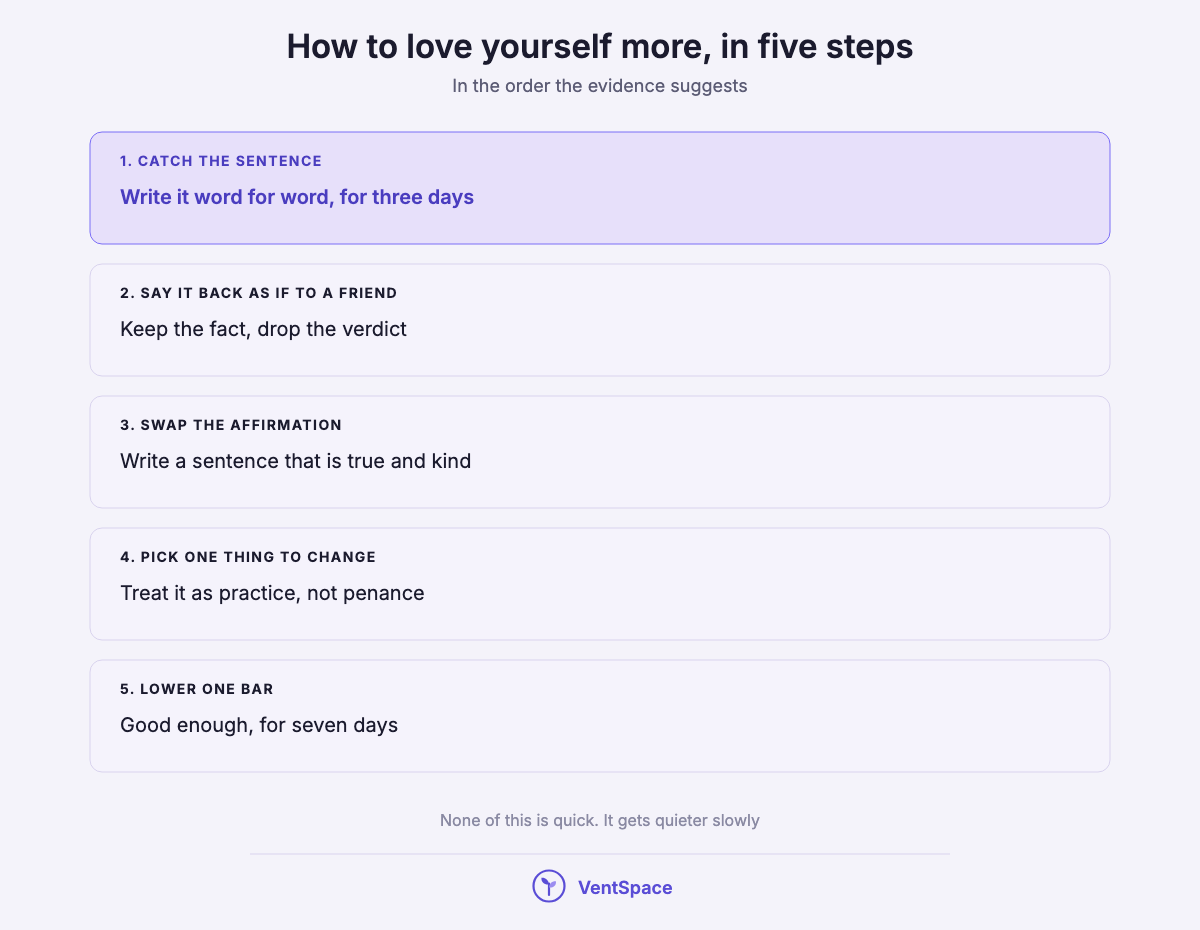
Five steps, each small enough to start today, in the order the evidence suggests. Catch the attack, answer it the way you would answer a friend, replace the sentence you cannot believe, pick one thing to change as practice, and lower one bar. Grab a notebook or open your notes app. You will need it for the first three.
1. Catch the sentence you say after a mistake
Write down, word for word, the next thing the voice in the room says when something goes wrong. Not a summary. The exact words, including the swearing, the “always” and the “you idiot”. Written down, it can look harsher on paper than it sounds in the head.
Do this for three days. You are not trying to change anything yet. You are collecting evidence, the way you would if a friend asked you to listen to how their boss talks to them.
Ask yourself, for each sentence:
- What had just happened?
- Is the word “always” or “never” in it?
- Whose voice does it sound like?
- Would anyone who loves you say this to you?
Do not panic about how many you collect. A long list is not a verdict on you. It is the raw material for step 2.
2. Say it back as if to a friend
Take one sentence from step 1 and rewrite it as you would say it to a friend in the same situation. This is the move Kristin Neff’s own first exercise is built around, under the title “How would you treat a friend?”. The friend version is usually still honest. It just stops being cruel.
“You idiot, you always ruin things” becomes something like “That went badly, and you are upset because you care about it.” Notice what the rewrite keeps. It keeps the fact. It drops the sentence about your character.
Questions to answer as you rewrite:
- What would I say to a friend who did exactly this?
- What tone would I use, and how loud?
- Which part of the original sentence is true, and which part is a verdict?
- What would I want them to do next?
Be honest, no one is judging you here. If the friend version feels fake, keep it plainer. Plain and kind beats warm and unbelievable, which is the whole lesson of the next step.
3. Swap the affirmation for a sentence you can believe
Replace any affirmation you do not believe with a sentence that is true and kind at the same time. In Wood’s experiments, the people with low self-esteem who did better were the ones asked to consider how a positive statement was both true and not true. Use that. Instead of “I am lovable”, try “Some people love me, and some days I find that hard to believe.” Instead of “I am enough”, try “I am doing more than the voice in the room gives me credit for.”
Write two of these. Put one where you will see it in the morning, and keep the other for the moment after a mistake.
Ask yourself:
- Do I believe this sentence at least a little?
- Is anything in it a promise I cannot keep?
- Does it name something true about today?
If a sentence makes you feel worse when you read it, retire it. That is a finding, not a failure.
4. Pick one thing to change, and treat it as practice
Choose one thing about yourself you would like to change, and work on it the way you would coach a friend, not the way you would punish an enemy. Loving yourself more does not mean pretending you have nothing to change. Sai’s 2022 version of this page made that point first: “You can’t just pretend that you love yourself if you actually don’t.” His suggestion was a to-be list: the traits you wish you had, with a small effort toward one of them.
Keep it to one. Write it down as a practice, not a deadline: “Two evenings a week I will put my phone in another room after 10pm.” When you miss one, use step 2 on yourself. Breines and Chen’s people tried harder after failing when they were kind about it, and that is the habit you are building.
Questions to answer:
- What is the one change I would most like to see in a year?
- What is the smallest version of it I could do this week?
- What would I say to a friend who missed it once?
- Who would notice if I kept at it?
Do not overthink which one to pick. Any honest one will do. You can change it next month.
5. Lower one bar this week
Pick one place where your standard is set at perfect, and set it at good enough for seven days. The email that gets rewritten five times. The workout that only counts if it is an hour. The room that has to be spotless before anyone visits. Write the old bar and the new bar side by side, and keep to the new one for a week.
This step can be the hardest to keep, because the high bar can feel like who you are. That is worth noticing. In Curran and Hill’s data, the bar rose across 27 years of college students, which suggests some of yours may not be yours at all.
Ask yourself:
- Where does a good-enough version cost me nothing anyone would notice?
- Who set this bar, me or someone else?
- What would I do with the time it frees?
You are allowed to find this uncomfortable. The discomfort is part of the step, not a sign you are doing it wrong.
Quick Summary
Q: How do I start loving myself more?
A: Write down the exact sentence you say to yourself after a mistake, rewrite it the way you would say it to a friend, replace affirmations you do not believe with sentences that are true and kind, pick one thing to change as practice, and lower one perfectionist bar for a week.
Insight: Kristin Neff, “What is Self-Compassion?”, self-compassion.org, on why the friend test helps: “Self-compassion requires taking a balanced, mindful approach to our suffering so that we neither suppress or exaggerate it. Treating ourselves like we would a friend means we step outside our usual way of looking at things, putting our own situation into better perspective.”
Pulling it all together
The five steps are one loop, not five projects. You catch the voice in the room, you answer it like a friend, and you keep doing that while you work on one thing and drop one bar.
Step 1, catching the sentence, is the one everything else rests on. Commit to it: “For three days, I write down the first thing I say to myself after a mistake.”
Step 2, the friend version, turns each caught sentence into a kinder one that keeps the fact. Commit: “Each evening I rewrite one sentence from today.”
Step 3, the believable sentence, replaces the affirmation that felt like a lie. Commit: “I write two sentences that are true and kind, and put one on my mirror.”
Step 4, one change as practice, gives the critic’s energy somewhere useful to go. Commit: “I pick one small change and do it twice this week.”
Step 5, one lowered bar, takes away some of the fuel. Commit: “For seven days, one task gets a good-enough version.”
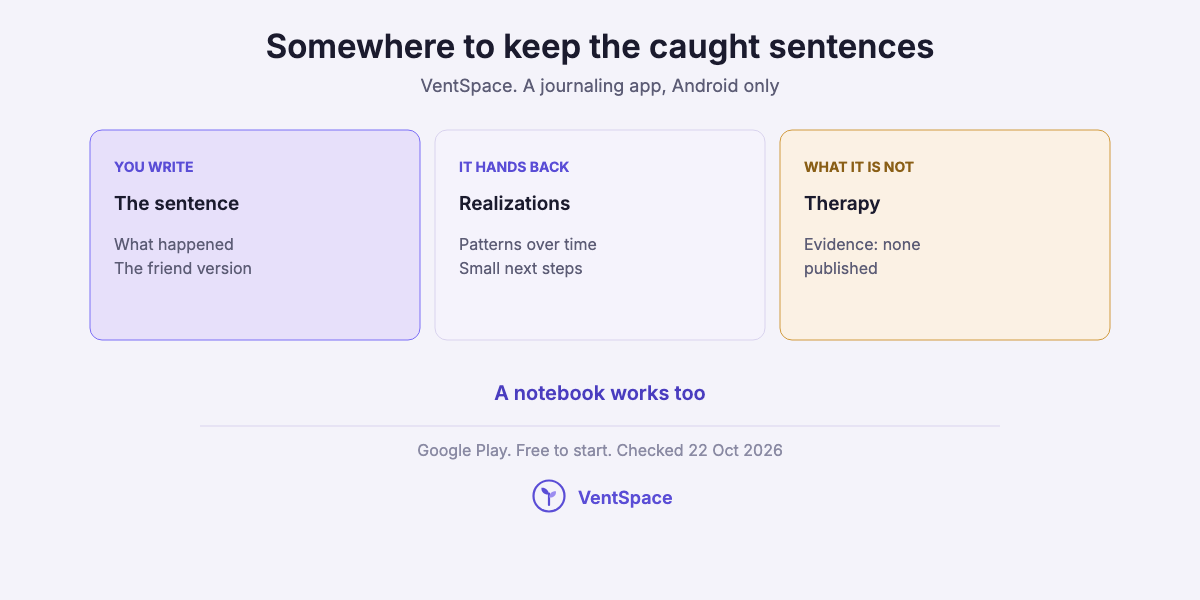
After a few weeks of step 1, the caught sentences may start to repeat, and the repeats are the interesting part: the same words after the same kind of mistake, often in the same borrowed voice. A notebook shows you that if you reread it. So does VentSpace, a journaling app that turns what you write into a clear read on your life balance, plus small, doable next steps. It is free to start, Android only as of October 2026, and it is not therapy. Not on Android, or at a desk? VentSpace Live runs in your browser, free, with nothing to install.
If you want a gentler set of things to do on a day when even step 1 feels like too much, our page of self-compassion exercises for difficult days is built for that day. And if you would rather write to a set of questions, there are journaling prompts for self-love.
Questions people ask
Is loving yourself selfish?
Not in the sense this page means. Treating yourself the way you would treat a friend after a mistake takes nothing from anyone else. Sai’s original page argued for putting yourself first on a few important things, such as not staying in a job or relationship that keeps hurting you, and that is a different thing from putting yourself first at everyone else’s expense.
Do affirmations work?
Not for everyone, and possibly worst for the people who reach for them most. In Wood, Perunovic and Lee’s 2009 experiments, people low in self-esteem felt worse after repeating “I’m a lovable person”, while people high in self-esteem felt slightly better. A sentence you can partly believe, such as one that is both true and kind, is the safer swap.
Can you love yourself too much? Is self-love the same as narcissism?
The research separates the two. In Neff and Vonk’s 2009 studies, self-esteem was associated with narcissism and self-compassion was not. The version of self-love on this page, treating yourself fairly after a failure, is the self-compassion kind. It does not require believing you are better than anyone.
How do I forgive myself?
Sai’s original page opened its forgiveness section with a line that still lands: “Immediately after you read that word, someone came to your mind. Right?” Sometimes the someone is you. Treat the thing you did the way step 2 treats a caught sentence: keep the fact, drop the verdict, and if it involved someone else, consider what making amends would look like. Our page on forgiveness goes further. If the weight of it is heavy or old, a therapist can help with the harder ones.
Do gratitude and helping other people help?
A little, and the effects are honest-sized. The largest meta-analysis of gratitude practices, published in PNAS in 2025 across 145 papers and nearly 25,000 people, found a small effect on wellbeing (g = 0.19), no difference by how many sessions people did, and effects no larger than other positive activities. A 2018 meta-analysis led by Oliver Scott Curry, pooling 27 studies and 4,045 people, found that performing acts of kindness had a small-to-medium effect on the doer’s wellbeing (δ = 0.28). Both are about how you feel rather than how you see yourself, and both are easy to test this week. Our gratitude list has ideas.
When should I talk to someone about disliking myself?
When it has gone on a long time and is reaching your sleep, your work or your relationships, or when the voice in the room has turned into feeling worthless or hopeless. A doctor, counselor or therapist is a legitimate first step, not a last resort. Our page on whether you need therapy walks through it. If you feel unsafe, call or text 988 in the US, or find a local line at findahelpline.com.
In a nutshell
Two things to take with you.
First, the order matters. Turn down the attack before you try to turn up the praise. The sentence you already say to yourself after a mistake is a better place to start than any sentence you could say into a mirror.
Second, the honest timeline: this takes months of noticing, not a week of trying, and nobody can honestly give you a number. The voice in the room gets quieter slowly, and some weeks it will not get quieter at all. Those weeks still count toward it.
Tonight, catch one sentence. Tomorrow, write it the way you would say it to a friend.
About this article

Written by
Sai Subramaniam
Founder, VentSpace
I write these guides because I have been where you are. I am working through my own hard seasons, and I share the things that actually helped me, so that anyone going through it has a steady companion close by instead of facing it alone. VentSpace is the app I built for exactly that: a journaling app that turns what you write into a clear read on your life balance, plus small, doable next steps toward feeling more like yourself.
This writing is honest and every claim is sourced, and it is not a substitute for professional care. If you are struggling, reaching out to a professional is a strong move, not a failure.
Explore VentSpaceTry VentSpace LiveHow this one was checked. Every factual claim traces to a named source, and the source is printed next to the claim rather than kept in a footnote. Quotes are pinned to the work they come from, with the year, the letter or the chapter where one exists. Where a widely repeated claim could not be traced, it was left out and the omission recorded. Where a figure is contested, both sides are printed.
No affiliate links, no paid placements, and nobody paid to appear here. Where we mention our own app, we say that it is ours, we state its limits, and we never position it as a substitute for care.
Reviewed: October 2026. Prices, platforms and product availability move quickly, and anything we could not verify at the time of writing is marked as unverified rather than turned into a number.
Corrections. If something here is wrong, we would rather know. Corrections are made in place, with a note saying what changed.