
You probably came to Think Like a Monk the way most people did, through a thirty-second clip on a Tuesday night, a quote card a friend reposted, or a coworker who would not stop talking about it over lunch, and when you opened it, the book delivered exactly what its title promised: a calling, detachment, silence, and the mind pictured as a chariot pulled by horses. Monk, all the way down.
Here is the odd part. When you hold each lesson up against the research, the ones that sound most like a monastery tend to have the least behind them, and the ones that sound almost boring, stop venting when you are angry, do one thing at a time instead of five, notice where your money went last month, are the ones with studies, experiments and meta-analyses quietly standing behind them.
The plain ones hold up.
That is not a knock on the book. Jay Shetty’s Think Like a Monk (2020) is readable and generous, it is organized in three parts, Let Go, Grow and Give, and it changed how at least one person who writes for this site spends his days, so this page keeps the lessons, says plainly which ones have evidence behind them and which are the book’s own view, and gives you one small thing to try for each one this week. Twelve lessons. One verdict each.
From Sai, who writes this blog: why this page exists (2022)
Jay Shetty’s book Think Like a Monk helped me in countless ways, from identifying my personal values to understanding what passion and purpose are, and it changed the way I live. From trying meditation, to getting away from ego, judgment and negativity, to finally being able to be grateful. These are my notes and the lessons I learned from it.
The 12 lessons at a glance
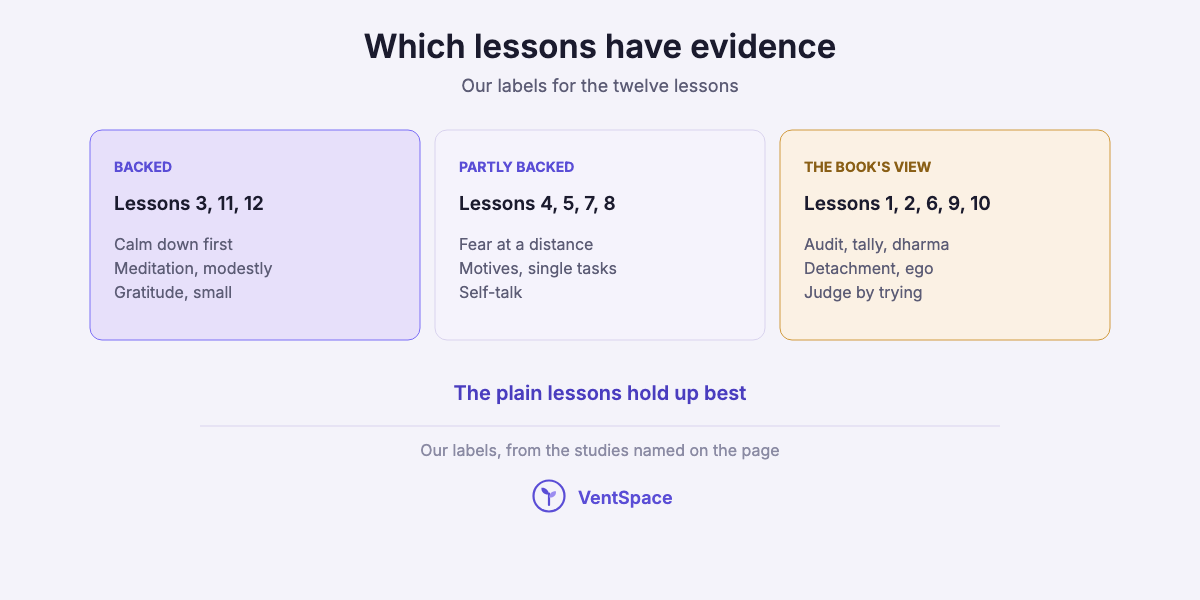
- 1. Audit where your time and money go: the book’s view. Your calendar and bank statement are your values in practice.
- 2. Count your negative remarks for a week: the book’s view. A tally makes a habit visible.
- 3. Stop venting to cool down: backed. Calming down works, revving up does not.
- 4. Get specific about your fear: partly backed. Name it, then hold it at arm’s length.
- 5. Check the motive behind a goal: partly backed. Fear, desire, duty or love.
- 6. Ask the two dharma questions: the book’s view. Did you enjoy doing it, and did anyone value the result?
- 7. Do one thing at a time: partly backed. Switching between tasks has a measured cost.
- 8. Talk to your mind like a person: partly backed. Distance changes how a hard moment feels.
- 9. Run a small detachment experiment: the book’s view. One habit, one week, not a fast.
- 10. Notice when ego wants to be seen as better: the book’s view. Better and seen-as-better are different goals.
- 11. Meditate, expecting small effects: backed. Real, modest, and not a replacement for treatment.
- 12. Practice gratitude without the daily pressure: backed. Small effects, and doing more of it did not help.
The short version
The plain lessons hold up best. Calming down instead of venting, single-tasking and modest meditation have research behind them.
The monastery lessons are the book’s view. Dharma, detachment and the ego chapter are worth trying, but no study tests them.
Leave out the extremes. We skip fasting, a month of silence and the book’s four-type quiz, and say why.
Start with one. The decision aid below matches a lesson to what you keep running into.
How we judged them
Each lesson got the same four questions, because a list of book lessons with no verdicts is just a summary, and summaries of this book are already everywhere, on summary apps, in podcast episodes and in carousel posts that turn every chapter into five pastel slides with no way of telling which idea has anything behind it. Ours have verdicts.
- What does the book say? In plain words, from Sai’s notes taken while reading it. We paraphrase rather than quote, apart from one line.
- What does the evidence say? Backed means an experiment or meta-analysis supports the lesson. Partly backed means related research supports part of it. The book’s view means we found no study, so judge it by trying it.
- Can you start it this week? If not, we shrink it until you can.
- What is the watch-out? Every lesson has one. Some have two.
Part one: Let go
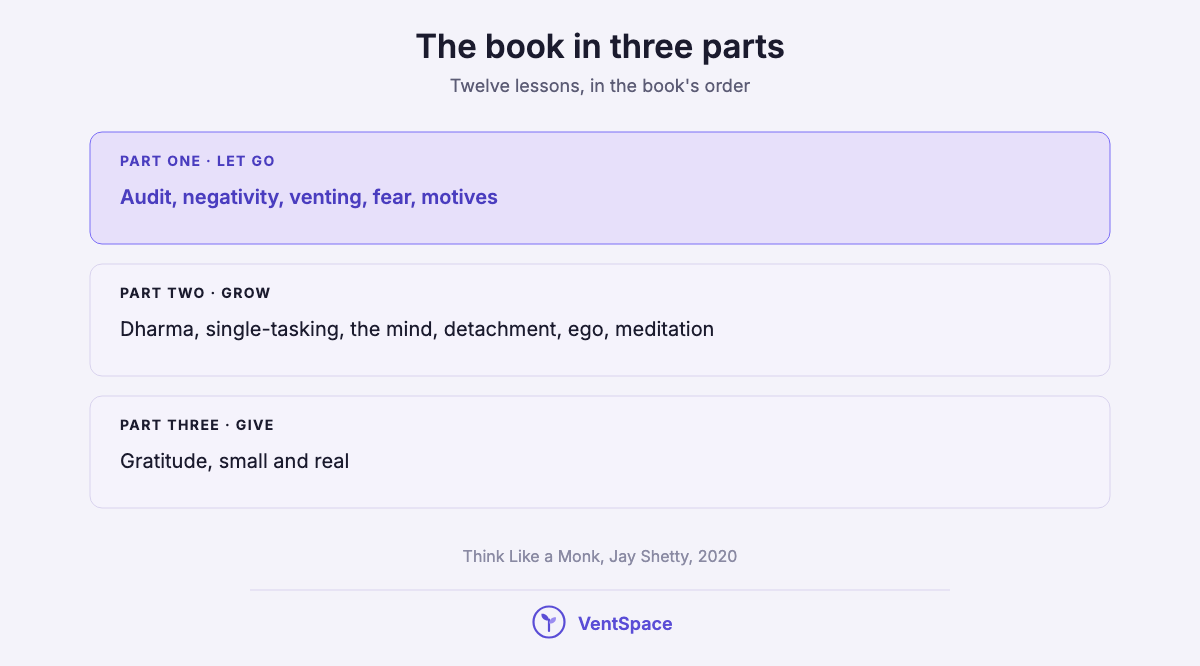
The first part of the book is about clearing space: other people’s expectations, negativity, fear and muddled motives. It is the most practical third of the book, and it holds the single best-evidenced lesson on this page.
1. Audit where your time and money go
The book’s first move is an audit, and it is a good one. Shetty asks you to look at where your spare time and your money go, then compare that with what you say you value. Most of us carry around a flattering story about our priorities, the one where family comes first and health matters and the side project is important, and then the calendar and the bank app tell a different, less flattering story about Thursday nights and delivery fees. That gap is the point. It stings a little.
| From the chapter | Identity |
| The book’s idea | Your values show up in how you spend spare time and money, and other people’s opinions crowd out your own |
| What the evidence says | The book’s view. We found no study testing this audit |
| Try this | Write last week’s evenings and last month’s ten biggest purchases on one page. Circle anything you would not choose again |
| Watch out for | Treating every gap as a moral failure. Some spending is rent, and some evenings are recovery |
Who it’s for: anyone who says “I don’t have time” about the things they say matter most. Our guide to self-awareness has a longer version of this exercise.
In practice: the useful finding is usually one specific evening or one forgotten subscription. Not a life overhaul.
Verdict: a plain, honest start, and the right first lesson.
2. Count your negative remarks for a week
Shetty suggests keeping a tally of every negative remark you make for a week, with the goal of bringing the number down. He treats negativity as contagious, spreading through complaint and gossip, and recommends spending most of your time with people who lift you (he puts it at 75%). The tally is the part you can do. It is a small mark on a note on your phone each time you complain about the commute, criticize someone who is not in the room, roll your eyes at a coworker’s message, or predict out loud that something will go badly, kept for seven days without trying to change anything yet. Then you count.
| From the chapter | Negativity |
| The book’s idea | Negativity spreads between people, and counting your own makes it visible enough to reduce |
| What the evidence says | The book’s view. We found no study of this tally. The 75% split is the book’s figure, not a research finding |
| Try this | A note on your phone. One mark per negative remark, for seven days. Read the total on Sunday |
| Watch out for | Aiming at zero. The book sets zero as the goal. A complaint about something unfair is information, and swallowing every one is its own problem |
Who it’s for: anyone who suspects their group chat runs on complaint.
In practice: the count tends to cluster around one person, one place or one time of day, and that cluster is the finding.
Verdict: worth one week. Not a purity test.
3. Stop venting to cool down
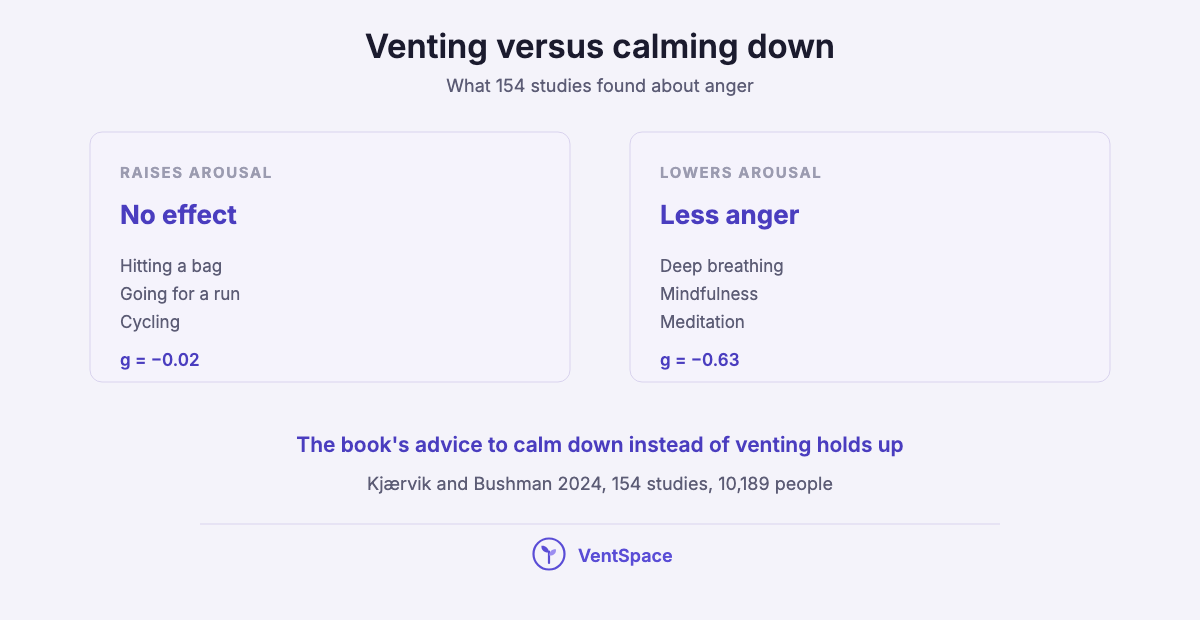
This is the lesson with the strongest evidence on the page. The book gets it right. Shetty writes that blowing off steam does not reduce anger, while calming activities such as slow breathing do. The research agrees, and has only grown stronger since the book came out. In a classic 2002 experiment by the psychologist Brad Bushman, angry participants who hit a punching bag while thinking about the person who had angered them ended up angrier and more aggressive than people who did nothing at all. In 2024, Kjærvik and Bushman pooled 154 studies and 10,189 participants. Activities that lowered arousal, like deep breathing, mindfulness and meditation, reduced anger and aggression (g = −0.63). Activities that raised it, like hitting a bag or going for a run, made no difference overall (g = −0.02).
| From the chapter | Negativity |
| The book’s idea | Venting keeps anger going, calming down lets it pass |
| What the evidence says | Backed. One experiment (Bushman 2002) and a meta-analysis of 154 studies (Kjærvik and Bushman 2024) |
| Try this | Next time you are angry, five minutes of slow breathing before you speak, text or post |
| Watch out for | Confusing venting with talking it through. Telling a friend what happened, calmly, is a different act from rehearsing your fury |
Who it’s for: anyone who believes they need to “get it out” before they can calm down. Writing it down is different again, and our page on journaling versus venting covers where the line falls.
In practice: the urge to vent feels like pressure building in a pipe that has to be released somewhere, through a rant, a slammed door or a long message you send at midnight, but the research says anger behaves less like pressure and more like a fire that grows each time you feed it. Let it burn down.
Verdict: the best lesson in the book. Start here.
4. Get specific about your fear
Shetty asks you to build a relationship with your fear: sit with it, ask what you are afraid of, and keep digging until you reach the root. Then he does something useful. He tells you to see fear as something you are experiencing, not something you are, the same way “I am angry” is different from “I am feeling anger.” When Sai did this exercise in 2022, here is what he found.
From Sai: my fear, in my 2022 notes
Not being good enough. The fear of being humiliated and the fear of being a failure. Maybe that shows up as my need to work out and to have a cool social media profile. It is mostly about how people perceive me. But my root fears influence my decisions, and I want my decisions to be based on my values.
Notice the last sentence. The point of naming a fear is not to make it disappear. It is to catch it in the act, when it is quietly deciding which job you apply for, which photo you post, which conversation you avoid and which invitation you turn down, and to give the decision back to what you value. Fear stays. It just stops driving. The distancing half has some support. In seven studies of 585 people, Ethan Kross and colleagues found that people who talked to themselves in the second person or by name, rather than as “I”, showed less distress under social stress. That is not a study of fear in general, but it is close to what Shetty is asking for.
| From the chapter | Fear |
| The book’s idea | Find the root fear, then treat it as something passing through you, not part of your identity |
| What the evidence says | Partly backed. Self-distancing language reduced distress in lab studies of social stress (Kross et al. 2014) |
| Try this | Write “What am I afraid of here?” and answer three times, each answer one level deeper. Then rewrite the last answer starting with your own name |
| Watch out for | Digging alone into something heavy. If panic or a painful memory keeps coming back, that is worth talking through with a doctor or therapist |
Who it’s for: anyone whose big decisions keep getting made by a feeling they have never named.
In practice: the root fear is often about how you are seen, as it was in Sai’s notes. That is common and nothing to be embarrassed about.
Verdict: a strong exercise with partial evidence. Do it on paper, not at 2 a.m.
5. Check the motive behind a goal
The book names four motivations behind what we do: fear, desire, duty and love. Fear drives you to avoid failing. Desire chases things you think will make you happy. Duty acts out of gratitude and responsibility. Love acts because you care about someone. Shetty’s argument is that fear and desire wear you out, while duty and love sustain you, and that the thing we want is usually the feeling we think it will bring, not the thing itself.
The desire half has research next to it. A 2014 meta-analysis by Dittmar and colleagues, across 259 samples, found that people who put more weight on money and possessions reported lower well-being, with correlations around −.19. That is correlational and modest, and it says nothing about duty or love. But it points the same way.
| From the chapter | Intention |
| The book’s idea | Ask why you want something until you hit fear, desire, duty or love, and favor the last two |
| What the evidence says | Partly backed. Materialistic values go with lower well-being, modestly (Dittmar et al. 2014). The four-motive scheme itself is the book’s |
| Try this | Pick one goal you are chasing. Write “I want this because ___” three times, each time going one layer deeper |
| Watch out for | Deciding a goal is shallow because desire is in it. Most goals have mixed motives, and money pays rent |
Who it’s for: anyone who got the promotion, the apartment or the follower count and felt oddly flat.
In practice: most goals turn out to have two or three motives tangled together, the raise you want because rent went up, because your parents would be proud, and because you would finally feel like you had made it, and the useful question is not which motive is pure but which one is steering. Name that one.
Verdict: a sharp question to ask of any goal. The scheme is tidier than real life.
Quick Summary
Q: What are the main lessons in part one of Think Like a Monk?
A: Audit where your time and money go, count your negative remarks for a week, calm down instead of venting, name your fears and hold them at a distance, and check whether a goal is driven by fear, desire, duty or love. The venting lesson has the strongest research behind it.
Insight: Kjærvik and Bushman, after pooling 154 studies in Clinical Psychology Review (2024): “These findings do not support the ideas that venting anger or going for a run are effective anger management activities.” Their alternative is calming down, which is what the book recommends too.
Part two: Grow
The middle of the book is where it turns most monk-like, with purpose, routine, the mind, detachment, ego and meditation, and it is also where the evidence thins out, which is not a reason to skip it but a reason to read it the way you would read advice from a wise friend rather than a doctor. Curious, not obedient.
6. Ask the two dharma questions
Dharma is the book’s central idea. Shetty describes it as the meeting point of what you are naturally good at and love doing with what the world needs, and he treats finding it as the way to a fulfilled life. We are not going to tell you that you have a calling waiting to be found. No study we know of shows that. But inside the chapter, underneath the language of dharma and destiny, sit two plain questions that are worth keeping, because you can answer them about any ordinary week, the meetings and errands and dinners included, without first having to know who you are meant to be.
For each activity you did this week, the book asks: Did you enjoy the process? Did anyone value the result?
The chapter also offers a quiz that sorts readers into four types it calls varnas (Guide, Leader, Creator and Maker). We leave it out. Our pages do not hand readers a type, and the word itself names the four classes of the social order described in Hindu texts, which is more than a personality label.
| From the chapter | Purpose |
| The book’s idea | Your dharma combines your passion, your skill and what is useful to others, and living it brings fulfillment |
| What the evidence says | The book’s view. The two questions are observable. The promise of fulfillment is not tested |
| Try this | List ten things you did this week. Mark each with two ticks, one for “I enjoyed doing it”, one for “someone valued it”. Look at the ones with both |
| Watch out for | Waiting to find the one true answer before changing anything. A small shift in how you spend a week is more useful than a perfect calling you never test |
Who it’s for: anyone stuck on “what am I meant to do with my life.”
In practice: the double-tick list is often surprising, because the things with both ticks tend to be small and easy to overlook, a conversation where you helped someone think something through, a spreadsheet you fixed that saved a colleague an afternoon, a paragraph someone thanked you for, rather than the grand passion you were hoping to find. Small counts.
Verdict: keep the questions. Hold the rest lightly.
7. Do one thing at a time
The routine chapter is a grab bag. Some of it works. Wake up early. Stay off your phone first thing. Start with T.I.M.E., Shetty’s acronym for thankfulness, insight, meditation and exercise. Write down tomorrow’s three tasks the night before. Do the same thing at the same time and place. And, the one with research behind it, single-task. Switching back and forth between tasks has a cost. In a set of four experiments in 2001, Rubinstein, Meyer and Evans found that alternating between tasks added time, and the cost grew as the tasks got more complex.
| From the chapter | Routine |
| The book’s idea | Routines root you, and doing one thing fully beats doing several halfway |
| What the evidence says | Partly backed. Task switching has a measured time cost in lab experiments (Rubinstein et al. 2001). We found no study of the T.I.M.E. routine itself |
| Try this | One 45-minute block tomorrow. One task, phone in another room, notifications off |
| Watch out for | Copying a monk’s morning onto a life with kids, shifts or a commute. A routine you can keep beats an ideal one |
Who it’s for: anyone who ends the day busy and unable to name what they finished.
In practice: the single-task block is the part that survives real life, the school run, the late shift, the baby who did not sleep and the inbox that was full before you woke up, because it asks for forty-five minutes and not a new identity. The 5 a.m. alarm is optional.
Verdict: take the single-tasking. Treat the rest of the routine as a menu.
8. Talk to your mind like a person
Shetty describes two minds: a monkey mind that wants instant gratification, and a monk mind that can train it. His advice is to treat your mind as something separate from you, almost like a friend you can reason with, to talk back to self-defeating thoughts, and to rate each worry from one to ten before deciding whether it deserves your evening. It sounds like a metaphor. It is one. But talking to yourself as if from outside has some support. Kross’s studies found that small shifts in the words people use for themselves during a stressful moment changed how they handled it.
| From the chapter | The mind |
| The book’s idea | You are not your mind. Give it supervision, kindness and the occasional firm answer |
| What the evidence says | Partly backed. Non-first-person self-talk reduced distress under social stress (Kross et al. 2014). The monkey-and-monk picture is the book’s |
| Try this | When a worry arrives tonight, rate it from one to ten and write one sentence to yourself using “you”, as a friend would |
| Watch out for | Talking to yourself like a drill sergeant. The book says friend, and the studies used a neutral voice, not a harsh one |
Who it’s for: anyone whose inner voice is louder and meaner than anyone they know.
In practice: the rating does most of the work. Plenty of 3s stop pretending to be 9s once they are written down, and the 9s, the rare ones that are about your health, your money or someone you love, finally get the attention they deserved instead of competing for it with a slightly awkward email you sent at four o’clock.
Verdict: a useful picture with a real mechanism under part of it.
9. Run a small detachment experiment
Shetty’s idea of detachment is not owning nothing. It is that nothing owns you. The monks he describes go to real extremes to test this, traveling with no shelter, food or money, fasting for a full day, and going a month without speaking, all as ways of finding out who they are once the comforts, the conversation and even the meals are taken away. Most of us will not. The book suggests readers try smaller versions: giving up TV, the phone, alcohol, sweets or gossip for a while, noticing what you reach for, then swapping in something better.
We leave out the fasting and the month of silence. Fasting can be risky for people with health conditions, during pregnancy or with a history of disordered eating, and a month without speaking is not a practice to start alone.
| From the chapter | The mind (detachment) |
| The book’s idea | Testing life without something shows you how much it controls you |
| What the evidence says | The book’s view. We found no study of this kind of experiment |
| Try this | Pick one habit you reach for without thinking. Drop it for seven days, and note each time you reach for it and what you were feeling |
| Watch out for | Turning it into a test of willpower. If dropping it makes you feel worse every day, stop and look at why |
Who it’s for: anyone who suspects a habit has become automatic.
In practice: the notes about what you were feeling when you reached for it are usually more useful than whether you lasted the week. Bored? Lonely? Tired?
Verdict: a decent self-experiment at a small size. Not at a monk’s size.
10. Notice when ego wants to be seen as better
The ego chapter makes one distinction that is worth the price of the chapter: ego does not want to be better, it wants to be seen as better. Shetty describes ego as a mask that makes us perform knowledge, success and confidence, and that tries to lift us by putting others down through judgment. You will recognize the move. Correcting someone in a meeting who did not need correcting, mentioning the trip or the title or the school before anyone asked, or telling a story where you come off slightly smarter than you were, all of which feel like confidence in the moment and look like something else from across the table. We all do it.
| From the chapter | Ego |
| The book’s idea | Ego seeks recognition and comparison. Humility earns respect instead of demanding it |
| What the evidence says | The book’s view. We found no study testing the chapter’s claims |
| Try this | For three days, notice each time you want credit for something. Write what you wanted them to think of you |
| Watch out for | Shame. Wanting to be seen is human. The point is noticing, not punishing it |
Who it’s for: anyone who replays conversations to check how they came across.
In practice: the list of “what I wanted them to think” is short and repetitive. That helps.
Verdict: a sharp mirror. Use it gently.
11. Meditate, expecting small effects
The book returns to meditation more than once, in the fear chapter, the routine and a section of its own, and Sai’s notes stress one honest line: meditation may show you what you would rather not see. That line matches the research better than most of what is said about meditation online, where a few minutes a day is sold as the answer to stress, sleep, focus, relationships and career all at once, by apps and influencers who rarely mention what the trials compared it against. The trials are humbler. A 2014 review led by Goyal pooled 47 trials and 3,515 people. Mindfulness programs produced small to moderate improvements in anxiety (0.38 at eight weeks), depression (0.30) and pain (0.33), and there was no evidence they beat active treatments like medication, exercise or other behavioral therapies.
| From the chapter | Meditation, and the fear and routine chapters |
| The book’s idea | Breath and stillness let you see yourself clearly, including the parts you avoid |
| What the evidence says | Backed, modestly. Small to moderate effects on anxiety, depression and pain, not better than active treatments (Goyal et al. 2014) |
| Try this | Ten minutes of breath-counting for five days. When you lose count, start again at one |
| Watch out for | Using meditation in place of care you need. If meditation brings up something distressing that does not settle, stop and talk to a professional |
Who it’s for: anyone curious about meditation who has been oversold on it.
In practice: the first week is mostly noticing how often your mind wanders. That is the practice. Not failure.
Verdict: worth doing for what it is. Modest, real, and not magic.
Quick Summary
Q: What are the main lessons in part two of Think Like a Monk?
A: Ask whether you enjoy an activity and whether others value it, do one thing at a time, talk to your mind like a person, test a habit by dropping it for a week, notice when you want to be seen as better, and meditate with modest expectations. Single-tasking and meditation have the most research behind them.
Insight: Goyal and colleagues, after reviewing 47 meditation trials in JAMA Internal Medicine (2014): “Clinicians should be aware that meditation programs can result in small to moderate reductions of multiple negative dimensions of psychological stress.” Small to moderate is the honest size of it, and it is still worth having.
Part three: Give
The book’s last part covers gratitude, relationships and service. Sai’s 2022 notes cover gratitude, so that is the lesson here. It is the most researched idea in the book, and the research is more modest than the book’s tone.
12. Practice gratitude without the daily pressure
Gratitude runs through the whole book, from the first thing you think in the morning to the T.I.M.E. routine. Shetty treats it as the foundation of giving. It helps. A little. The largest meta-analysis so far, published in PNAS in 2025, pooled 145 papers and 24,804 people and found a small effect on well-being (g = 0.19). Two details matter. How many gratitude sessions people did made no difference to the effect. And gratitude exercises did no better than other positive activities.
| From the chapter | Gratitude (part three) |
| The book’s idea | Gratitude is the base of a giving life, and a daily habit worth building |
| What the evidence says | Backed, small. g = 0.19 across 145 papers, no dose effect, no better than other positive activities (PNAS 2025) |
| Try this | Once this week, write a short note to someone thanking them for something specific. Send it or keep it |
| Watch out for | Using gratitude to argue yourself out of a real problem. You can be grateful and still need something to change |
Who it’s for: anyone who wants a gentle practice and does not need it to transform anything.
In practice: a specific thank-you to a specific person, the colleague who covered your shift or the neighbor who brought the package in, often feels more alive than a list of five things you were supposed to be grateful for, written half asleep out of habit because an app sent a reminder. That is our observation, not a finding.
Verdict: worth doing, at whatever frequency suits you. Daily is optional.
Quick Summary
Q: What does Think Like a Monk say about gratitude, and does it work?
A: The book treats gratitude as the base of a giving life. The largest meta-analysis of gratitude exercises found a small benefit to well-being, no extra gain from doing more sessions, and no advantage over other positive activities.
Insight: The authors of the 2025 PNAS meta-analysis of gratitude interventions, on how gratitude compares: “effect sizes for gratitude interventions were not significantly different from those for other positively valenced activities”. Gratitude works about as well as other kind things you could do for yourself, which is a reason to pick the one you will keep doing.
All twelve, side by side
| # | Lesson | Chapter | Evidence | Time to try | Watch out for |
|---|---|---|---|---|---|
| 1 | Audit time and money | Identity | The book’s view | 20 min | Treating rent as a moral failure |
| 2 | Count negative remarks | Negativity | The book’s view | 1 week | Aiming at zero |
| 3 | Calm down instead of venting | Negativity | Backed | 5 min | Confusing venting with talking |
| 4 | Get specific about fear | Fear | Partly backed | 15 min | Digging alone into heavy material |
| 5 | Check the motive | Intention | Partly backed | 10 min | Calling every desire shallow |
| 6 | The two dharma questions | Purpose | The book’s view | 15 min | Waiting for a perfect calling |
| 7 | One thing at a time | Routine | Partly backed | 45 min | Copying a monk’s morning |
| 8 | Talk to your mind | The mind | Partly backed | 5 min | A harsh inner voice |
| 9 | Small detachment test | The mind | The book’s view | 1 week | Willpower contests, fasting |
| 10 | Ego wants to be seen | Ego | The book’s view | 3 days | Shame |
| 11 | Meditate | Meditation | Backed, modest | 10 min | Replacing care you need |
| 12 | Gratitude | Gratitude | Backed, small | 10 min | Explaining away real problems |
Which lesson to start with
Pick by what keeps happening to you, not by which lesson sounds wisest. One is enough.
- If you get angry and then say things you regret: lesson 3. Five minutes of slow breathing first.
- If you are busy all day and finish nothing: lesson 7. One single-task block tomorrow.
- If your choices feel driven by something you cannot name: lessons 4 and 5, on paper.
- If you do not know what you want from work: lesson 6, the double-tick list.
- If your inner voice is harsh: lesson 8, one sentence to yourself as “you”.
- If you want something calm and steady: lesson 11 or 12.
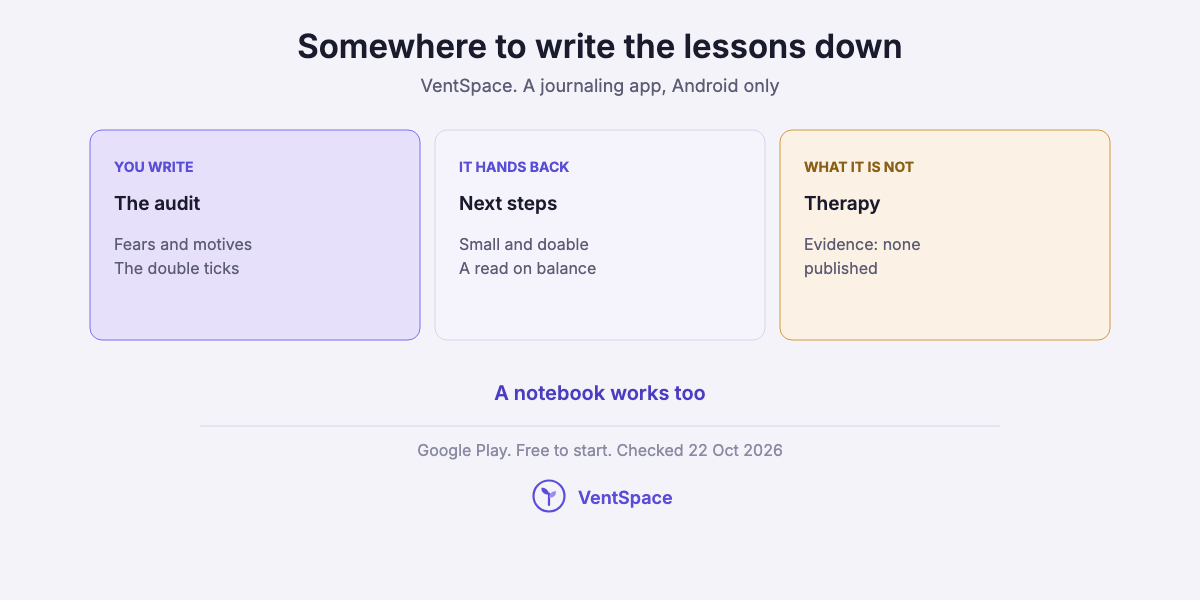
Lessons 1, 4, 5 and 6 all need somewhere to write. A notebook is fine. VentSpace is another option: a journaling app that turns what you write into a clear read on your life balance, plus small, doable next steps. It is free to start, Android only as of October 2026, and it is not therapy or a substitute for one. Not on Android, or at a desk? VentSpace Live runs in your browser, free, with nothing to install.
Questions people ask about Think Like a Monk
Is Think Like a Monk worth reading?
For most people, yes, as long as you read it as a collection of practices to try on your own week rather than a set of proven claims, and as long as you notice when a chapter’s confidence runs ahead of what anyone has tested, which happens most in the chapters about purpose, detachment and the mind. Its best lessons, calming down instead of venting, single-tasking and modest meditation, line up with research. Its most monk-like ones, dharma and detachment, are the book’s view and are better tested on your own week than taken on faith.
Does venting help you let go of anger?
No, and the book is right about this. Hitting a punching bag while thinking about the person who angered you made people angrier in Bushman’s 2002 experiment, and a 2024 meta-analysis of 154 studies found that calming activities reduced anger while arousing ones did not. Talking a problem through calmly with someone is a different thing from venting, and it is not what these studies tested.
Was Jay Shetty really a monk?
In the book’s introduction, Shetty writes that “Three years after I moved to Mumbai, my teacher, Gauranga Das, told me he believed I would be of greater value and service if I left the ashram and shared what I’d learned with the world.” A 2024 Guardian investigation reported that he spent considerable time as a monk at Bhaktivedanta Manor, an ashram outside London, and less in India than his books suggest. His lawyers told the paper he lived as a monk from 2010 to 2013 and trained in both India and the UK, and Gauranga Das said he was primarily based in India after his first three months. The article was amended after a legal complaint from Shetty. We judge the lessons on their evidence, which is what this page does. Our older page on lessons from Jay Shetty covers his wider talks.
What is dharma in Think Like a Monk?
In the book, dharma is the meeting point of what you love doing and are good at with what is useful to others, and Shetty presents living it as the route to fulfillment. That promise is the book’s view. The part you can test is simpler: for each thing you do this week, did you enjoy the process, and did anyone value the result?
What is the T.I.M.E. morning routine?
It is Shetty’s acronym for thankfulness, insight, meditation and exercise, a way to start the day on purpose rather than on your phone. We found no study of this routine itself. Meditation and gratitude have modest evidence, covered in lessons 11 and 12. The package as a whole is the book’s suggestion.
How long before these lessons make a difference?
The book does not promise a timeline. Neither do we. Lesson 3 can change one argument tonight. Lessons 1, 2 and 9 take a week to produce anything to look at. The meditation trials mostly reported results at eight weeks, which is a fair guide for anything that depends on practice.
The plain ones hold up
Strip away the robes and the incense and Think Like a Monk is a book about attention, about where yours goes on an ordinary weekday, what that costs you in anger and money and half-finished work, and what changes when you start choosing where to put it instead of letting the phone, the group chat and the old fears choose for you. The plainest lessons hold up best. Calm down first. Do one thing. Check the money.
The rest is worth trying, as long as you treat it as an experiment and not a creed. Pick one lesson. Give it a week.
About this article

Written by
Sai Subramaniam
Founder, VentSpace
I write these guides because I have been where you are. I am working through my own hard seasons, and I share the things that actually helped me, so that anyone going through it has a steady companion close by instead of facing it alone. VentSpace is the app I built for exactly that: a journaling app that turns what you write into a clear read on your life balance, plus small, doable next steps toward feeling more like yourself.
This writing is honest and every claim is sourced, and it is not a substitute for professional care. If you are struggling, reaching out to a professional is a strong move, not a failure.
Explore VentSpaceTry VentSpace LiveHow this one was checked. Every factual claim traces to a named source, and the source is printed next to the claim rather than kept in a footnote. Quotes are pinned to the work they come from, with the year, the letter or the chapter where one exists. Where a widely repeated claim could not be traced, it was left out and the omission recorded. Where a figure is contested, both sides are printed.
No affiliate links, no paid placements, and nobody paid to appear here. Where we mention our own app, we say that it is ours, we state its limits, and we never position it as a substitute for care.
Reviewed: October 2026. Prices, platforms and product availability move quickly, and anything we could not verify at the time of writing is marked as unverified rather than turned into a number.
Corrections. If something here is wrong, we would rather know. Corrections are made in place, with a note saying what changed.