
Last updated: October 2026.
“no evidence that loss framing is more effective than gain framing”
Hallsworth, List, Metcalfe and Vlaev, field experiments with 200,000+ UK taxpayers, Journal of Public Economics (2017).
The ad is live, the CTR sits near 1%, and the team’s fix is a new headline. Someone pulls up a list of persuasion triggers. Someone else rewrites the copy in PAS. Two weeks later the CTR is still near 1%, and nobody can say whether the copy, the audience or the offer was the problem.
Copy works when the message fits a specific buyer’s problem, and the frameworks and persuasion principles only shape how that message is said. Here’s the reason. When 100 published psychology findings were re-run with high power, 36% replicated and the effects came back about half the size (Open Science Collaboration, Science, 2015). A copy rule built on the other 64% costs you test cycles. A message aimed at the wrong buyer costs you the whole budget, however well it’s written.
This guide covers the job in the order it happens: message-market fit and ICP research, the frameworks in circulation and what each is good for, which persuasion findings replicated and by how much, writing for ads, landing pages and email, and testing copy on the platforms that can measure it. Everything is written for someone who owns a budget and has to defend the next test.
Quick Digest
– Fit comes first: a sharper ICP changes targeting and message at once, and that’s where the large CTR moves come from.
– Frameworks are structure: AIDA, PAS, BAB, the 4 Ps and Schwartz’s awareness stages help you order a message. None has controlled evidence that it beats another order, and AIDA’s famous origin story is disputed.
– Persuasion research, sorted: descriptive social norms hold up in a 200,000-person field test. Choice overload, ego depletion, priming and the average “nudge” shrank to near zero on re-testing.
– Five steps: research the buyer’s words, match the awareness stage, write for the surface, use only the levers that held, and test where the platform can measure it.
– One table near the end lists what stopped being true, with dates.
How we know
Sources: the Open Science Collaboration’s 100-study replication (2015), Many Labs 1 (36 samples, 6,344 participants, 2014), the 23-lab ego depletion replication (N = 2,141, 2016), the choice overload meta-analysis (50 experiments, N = 5,036, 2010), the bias-corrected nudge re-analysis (PNAS, 2022), the UK tax-letter field experiments (200,000+ people, 2017), NN/g eyetracking (500+ participants over 13 years, 2020), and Akinori Iwamoto’s 2024 paper on the origin of AIDA. Platform rules come from Google Ads Help and LinkedIn Marketing Solutions Help, opened on 29 October 2026.
The limit: almost none of the persuasion research tested ad or landing-page copy. Its transfer to your account is an inference, which is why every lever here still goes through your own test. The first-party example is one account, and its targeting changed along with its copy.
Copy is a fit problem before it’s a writing problem
Most copy that underperforms is aimed at the wrong buyer, or at the right buyer at the wrong stage. No headline formula fixes that, because the problem sits upstream of the words: who sees the ad, what they already know, and what they need to hear before they’ll act.
Message-market fit means three things are true at once. The ad reaches people who have the problem. The copy names the problem in their words, not the company’s. And the offer matches how far along they are: a buyer still defining the problem won’t book a demo, and a buyer comparing vendors won’t download a beginner’s guide.
B2B makes this harder in a specific way. In 6sense’s 2025 survey of about 4,000 B2B buyers (self-reported, from a vendor that sells into this problem), buyers made first contact about 61% of the way through the process, and 94% had already ranked vendors before they talked to anyone. Most of the persuading happens in copy the buyer reads alone: ads, landing pages, comparison pages, emails. So the ICP work isn’t a sales exercise, it’s the copy brief.
What ICP research gives the copywriter:
- The trigger: the event that makes a company start looking (a new hire, a failed audit, a funding round, a tool that broke).
- The words: how buyers describe the problem in calls, reviews and support tickets, before they learn the category name.
- The objection: the reason a qualified buyer says no, which is usually the line the landing page most needs.
- The job title split: the person who feels the problem and the person who signs often need different ads.
In one B2B account I ran (Clarifai, an AI infrastructure company, July 2025 to May 2026, solo), CTR on Google and LinkedIn went from about 1% to 3 to 4% and above after ICP research, ABM targeting and message fit. Before that, the account chased bottom-of-funnel commercial terms with almost no search volume, which skipped the stage where B2B buyers vet vendors. That’s one account, and targeting changed along with the copy, so the copy’s share of the lift can’t be separated out. My read: the copy improved because the ICP did, not because of a formula.
For B2C at scale the split is different. The audience is broad and the platform’s targeting does more of the finding, so the copy itself becomes the targeting: each creative angle pulls a different slice of buyers. The fit question is the same. Only the place you answer it moves.
Fix the buyer before the headline.
Quick Summary
Q: What is message-market fit in copywriting?
A: It’s when the copy reaches people who have the problem, describes it in their own words, and makes an offer that matches how far along they are. In B2B most buyers rank vendors before first contact, so the ad and landing-page copy do most of the persuading.
Insight
“Thirty-six percent of replications had statistically significant results”
Open Science Collaboration, Estimating the reproducibility of psychological science, Science (2015). It’s the reason this guide treats buyer research as the reliable input and persuasion rules as hypotheses.
The frameworks are structure, and their origins are mostly lore
“There is no evidence indicating that Lewis invented the prototype of AIDA in or around 1898.”
Akinori Iwamoto, The origin of AIDA: Who invented and formulated the AIDA model?, Japan Marketing History Review (2024).
Copywriting frameworks are ordering heuristics: they tell you what to say first, not what will persuade. None of the ones below has a controlled study showing that its order beats another order. That doesn’t make them useless. A checklist for structure is worth having when you’re writing 15 headlines at 9pm. It makes them tools for drafting, not models of how buyers decide.
The origin stories are shakier than the guides suggest. AIDA is routinely credited to E. St. Elmo Lewis in 1898, an attribution that became common after Edward K. Strong’s 1925 book on selling. Iwamoto’s 2024 paper traced the early sources and credits Arthur Frederick Sheldon and Frank H. Dukesmith instead. PAS, BAB and the 4 Ps come out of the direct-response tradition with no single documented originator we could trace, and their letters vary from one source to the next.
| Framework | What it orders | Good for | Weak for | Origin, as far as it can be traced |
|---|---|---|---|---|
| AIDA (Attention, Interest, Desire, Action) | Hook, relevance, want, ask | Checking a landing page or long ad has every part, in order | Short ads, where there’s room for one idea | Commonly credited to E. St. Elmo Lewis (1898) via Strong (1925). Iwamoto (2024) credits Sheldon and Dukesmith |
| PAS (Problem, Agitate, Solution) | Pain, consequence, fix | Short ads and email openers for problem-aware buyers | Unaware buyers, who don’t recognise the problem yet. “Agitate” is where copy tips into manipulation | Direct-response tradition, no documented originator |
| BAB (Before, After, Bridge) | Current state, desired state, how to get there | Outcome-led products where the “after” can be shown | Products whose “after” can’t be shown honestly | Direct-response tradition, no documented originator |
| 4 Ps (Promise, Picture, Proof, Push) | Claim, visualised result, evidence, ask | Sales pages and long emails that have real proof | Any page without proof, since the third P becomes invented | Direct-response tradition. Versions differ, including the letters |
| Schwartz’s five awareness stages (unaware, problem aware, solution aware, product aware, most aware) | Which message to lead with | Choosing the angle per audience and channel | Writing the copy itself | Eugene Schwartz, Breakthrough Advertising (1966) |
| 4 U’s (Useful, Urgent, Unique, Ultra-specific) | Headline checks | Subject lines and headline variants | Body copy | Copywriting training tradition, no primary traced |
Schwartz’s stages do the most work in practice, because they decide the message rather than its order. A problem-aware buyer needs the problem named. A product-aware buyer needs a reason to choose you now. The same PAS ad shown to both will be right for one and wrong for the other.
Pick the stage, then the framework.
Quick Summary
Q: Which copywriting framework works best: AIDA, PAS or BAB?
A: None has controlled evidence that it outperforms the others. They’re ordering checklists. Choose by length and buyer: PAS for short copy to problem-aware buyers, BAB when the outcome can be shown, AIDA or the 4 Ps to check long pages. Decide the awareness stage first.
Insight
“Frank H. Dukesmith and Arthur Frederick Sheldon-not Lewis-contributed decisively to the formulation of AIDA.”
Akinori Iwamoto, Japan Marketing History Review, vol. 3, no. 2 (2024), from the abstract. Even the most-cited framework’s origin is a 1925 retelling.
Most persuasion claims shrank when they were re-tested
“Replication effects were half the magnitude of original effects, representing a substantial decline.”
Open Science Collaboration, Estimating the reproducibility of psychological science, Science (2015).
Only a few persuasion findings have survived large replications, and most of the “triggers” in copy listicles aren’t among them. The test for this guide: an effect counts if a preregistered multi-lab replication, a meta-analysis that corrects for publication bias, or a large field experiment backs it. Everything else is a hypothesis for your own test.
What held up, and how strongly:
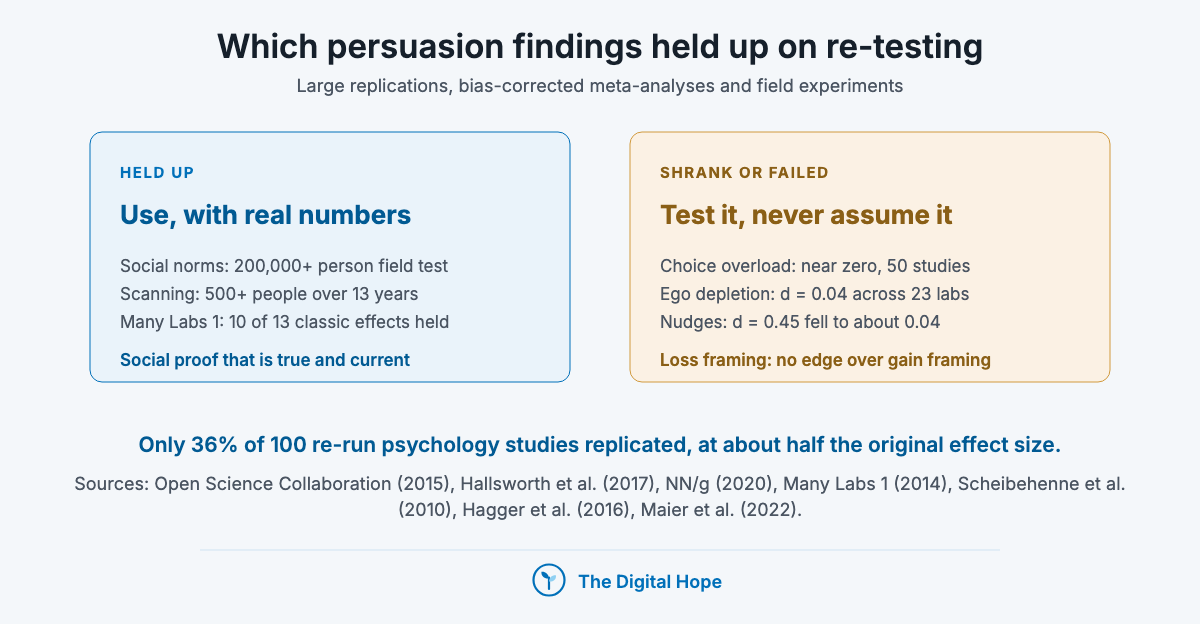
- Descriptive social norms. In two UK field experiments with 200,000+ taxpayers (Hallsworth and colleagues, 2017), telling people what most others do raised payment rates, and descriptive norms beat injunctive ones (“most people pay on time” beat “you should pay on time”). It’s the strongest persuasion evidence in this guide, from government letters to people who owed money.
- Scanning. NN/g’s eyetracking work, 500+ participants over 13 years (2020 summary), keeps finding that people “still primarily scan, rather than read” web pages. Full reading is rare.
- Most classic lab effects, with exceptions. Many Labs 1 re-ran 13 classic effects across 36 samples and 6,344 participants (2014). 10 replicated consistently, 1 weakly, and 2 failed.
What shrank or failed:
- Loss framing. In the same 200,000-person tax study, there was no evidence that loss framing beat gain framing. “Don’t miss out” is not reliably stronger than “get”.
- Priming. The two failures in Many Labs 1 were both priming effects (flag and currency priming), the basis of a lot of “subconscious” copy advice.
- Choice overload. The famous jam study did not generalise: a meta-analysis of 50 experiments (N = 5,036) found a mean effect of “virtually zero” (Scheibehenne and colleagues, 2010), with large variation between studies.
- Decision fatigue. Ego depletion failed a 23-lab preregistered replication (N = 2,141), with d = 0.04 and a confidence interval that includes zero (Hagger and colleagues, 2016).
- “Nudges” as a class. Across 200+ studies the pooled effect was d = 0.45, but after correcting for publication bias the estimate fell to about 0.04 (Maier and colleagues, PNAS, 2022). Some individual nudges may still work. The average doesn’t.
| Claim you’ll see | Status | Magnitude | What to do with it |
|---|---|---|---|
| “Show what most people do” | Held in a large field test | Raised payment rates in 200,000+ people. Descriptive beat injunctive | Use real, current numbers about real customers |
| “People scan, they don’t read” | Held across 13 years of eyetracking | Qualitative and heatmap, n 500+ | Front-load every section and bullet |
| “Loss framing beats gain framing” | Not supported in the field | No difference found | Test both, assume neither |
| “Fewer options always convert better” | Meta-analytic mean near zero | 50 experiments, N = 5,036 | Decide option count on clarity, then test |
| “Readers run out of willpower” | Failed a 23-lab replication | d = 0.04, CI includes zero | Don’t build page order on it |
| Subtle priming | Failed in Many Labs 1 | 2 of 13 effects failed, both priming | Drop it |
| “Nudges lift conversion” | Average near zero after bias correction | 0.45 before, about 0.04 after | Treat each as an untested hypothesis |
| Decoy pricing | Contested in the literature | No settled estimate | Neither assert nor refuse it, test it |
Scarcity and urgency sit in the same place: no replicated estimate for marketing copy, and a legal line where the claim is false. A countdown that resets or a “3 left” that’s always 3 is a false claim, not a lever.
Lean on the effects that survived.
Quick Summary
Q: Which persuasion techniques are backed by research?
A: Descriptive social norms have the strongest evidence, from a 200,000-person field experiment, and people’s tendency to scan web pages is consistent across 13 years of eyetracking. Choice overload, ego depletion, priming and the average nudge shrank to near zero when re-tested, and loss framing did no better than gain framing in the field.
Insight
“People still primarily scan, rather than read”
Kate Moran, Nielsen Norman Group, How People Read Online: New and Old Findings (5 April 2020), summarising five eyetracking studies over 13 years. The page holds this finding, not the “79% scan” figure older guides attribute to it.
So the research narrows what to rely on. The rest is method.
How to write copy that holds up: five steps
Five steps, in the order a campaign is built. Each has a first action in a tool you already use, a check you can run on your own draft, and the condition under which you’d skip it.
1. Research the buyer’s words before you write
The first action: pull the last 20 closed-won and 20 closed-lost deals from the CRM and read the notes, then open the search terms report in Google Ads for the last 90 days. Copy every phrase a buyer used to describe the problem into one sheet, unedited.
The buyer’s phrasing is the copy’s raw material. Calls and search terms show the words people use before they learn the category name, which is the language problem-aware buyers search and click on. Reviews of your product and competitors’ add the objection and the outcome they cared about.
What to pull, by source:
- Sales calls and CRM notes: the trigger, the objection, the words.
- Search terms report: what people typed when they found you, including the queries you’d never have bid on.
- Review sites and support tickets: the result buyers describe in their own words, and what they complained about in alternatives.
- Ad platform demographics (LinkedIn’s company and job-title breakdowns): who clicked, compared with who you meant to reach.
Check your research:
- Can you name the trigger event in one sentence?
- Do you have the top objection in a buyer’s own words?
- Is there a phrase buyers use that appears nowhere on your site?
- Are the people clicking the people who buy?
When to skip it: never fully. If you have no sales history, run five buyer interviews and read 50 search queries in the category instead.
2. Match the message to the awareness stage, then pick the framework
The first action: for each audience and channel, write one line: “This audience is [stage], so the ad leads with [problem / solution / reason to choose us now].” Use Schwartz’s five stages.
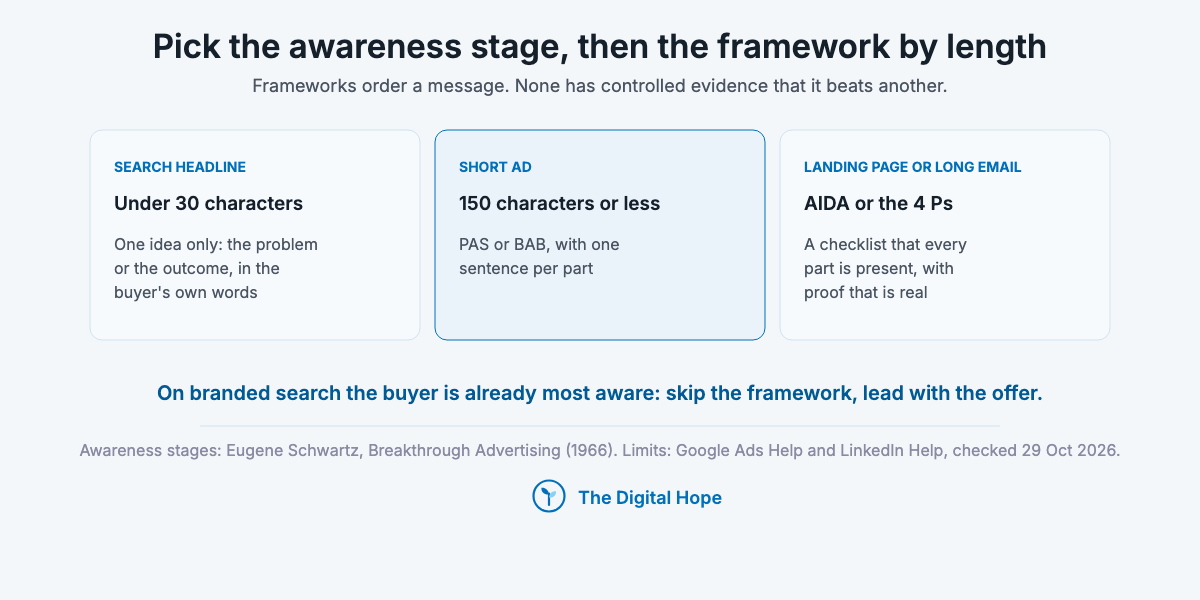
The stage decides the opening line. Cold LinkedIn audiences and broad keywords are mostly problem aware at best. Retargeting lists and branded searches are product aware or most aware. A comparison keyword (“X vs Y”) is solution aware: the buyer knows the category and is choosing.
Then choose the framework by length:
- Under 30 characters (a search headline): one idea, usually the problem or the outcome in the buyer’s words.
- An ad of 150 characters or less: PAS or BAB, one sentence per part.
- A landing page or long email: AIDA or the 4 Ps as a checklist that every part is present, with proof that’s real.
Check your message:
- Does the first line make sense to someone at the stage you wrote down?
- Does any ad ask for a demo from an audience that doesn’t yet know the problem?
- If you swapped your brand for a competitor’s, would the copy still be true?
When to skip it: only when the search is branded and the buyer is already most aware. Lead with the offer and the next step.
3. Write for the surface: ads, landing pages and email are different jobs
The first action: before writing, open the format spec for the placement and write the character limits at the top of the draft.
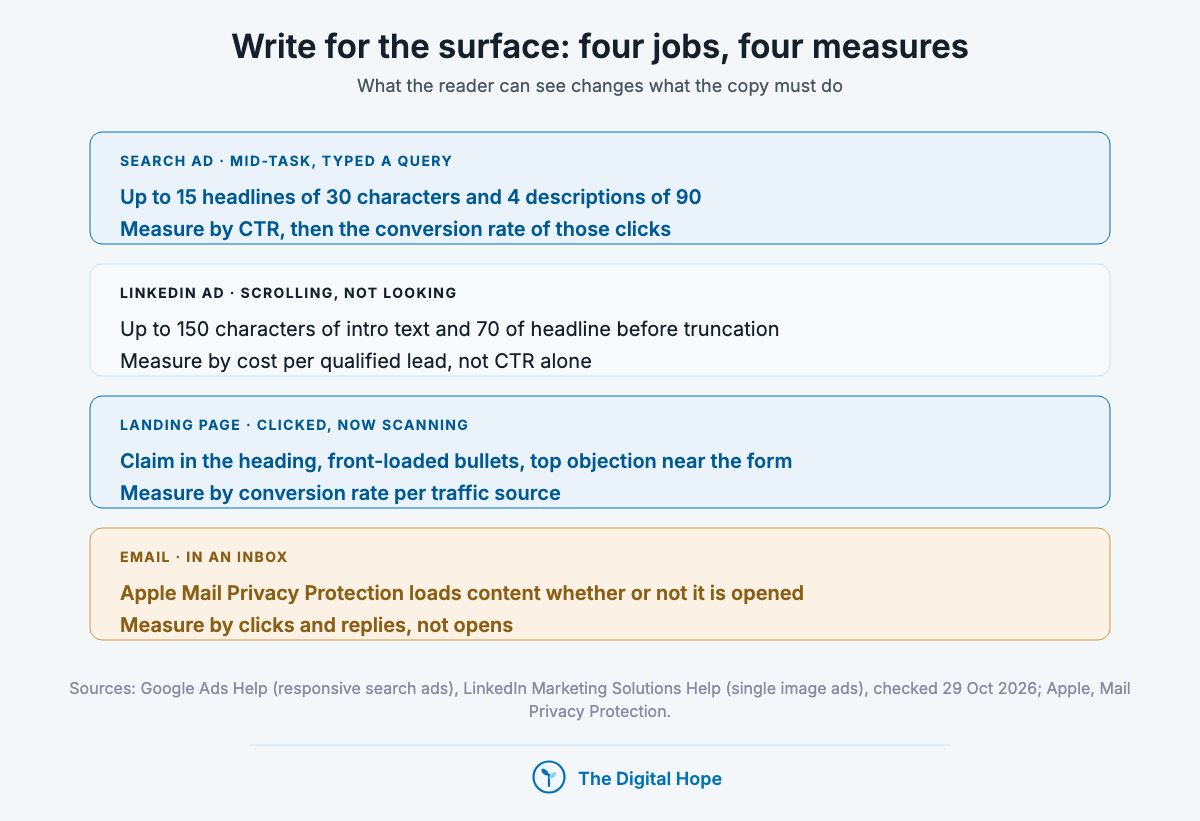
Ads are written in pieces the platform assembles. Google’s responsive search ads take up to 15 headlines of 30 characters and 4 descriptions of 90, and Google says it will “test the most promising ad combinations” over time (Google Ads Help, checked 29 October 2026). So each headline has to stand on its own and still read well next to any other. Google’s own tip: “Try writing the first 3 headlines as if they’ll appear together in your ad.” On LinkedIn, the single image ad spec recommends up to 150 characters of introductory text and 70 for the headline to avoid truncation (3,000 and 200 are the maximums). The first 150 characters are the ad.
Landing pages are read by scanners. Answer the buyer’s question in the first screen, put the claim in the heading, and front-load every bullet, because the NN/g work shows people scan before they commit to reading. Put the top objection from step 1 where the scan lands, close to the form.
Email is read one person at a time, and measured badly. Apple’s Mail Privacy Protection downloads email content in the background whether or not the person opens it, so opens can’t judge a subject line if you have many Apple Mail users on the list. Judge subject lines on clicks. Subject lines, structure and calls to action are covered in depth in our email copywriting guide.
| Surface | The reader’s state | What the copy must do | Measure it by |
|---|---|---|---|
| Search ad | Mid-task, typed a query | Repeat the query’s intent and give one reason to click | CTR, then conversion rate of the clicks |
| Social or LinkedIn ad | Scrolling, not looking | Stop the right person in the first line, filter out the wrong one | CTR and cost per qualified lead, not CTR alone |
| Landing page | Clicked, now scanning | Confirm the promise, answer the objection, make the next step obvious | Conversion rate by traffic source |
| In an inbox, choosing what to open | Earn the open honestly, then one action | Clicks and replies, not opens |
Check your draft:
- Does every search headline make sense paired with any other?
- Does the LinkedIn ad work if only the first 150 characters show?
- Does the landing page answer the top objection without scrolling past it?
When to skip it: never. The surface changes what the reader can see, and that changes the copy.
4. Use only the persuasion levers that held up
The first action: list every persuasion claim in the draft (urgency, scarcity, social proof, “most popular” labels) and mark each real and current or remove.
Use descriptive social proof with real numbers. “Teams at [real number] hospitals use this” is the strongest lever in the research, as long as it’s true, current and checkable. Since 14 August 2024, the US FTC’s final rule bans fake and AI-generated reviews and testimonials, and buying fake followers or views to inflate influence. A made-up “Join 10,781 businesses” line is now a legal risk as well as a credibility one.
Be careful with competitor names in ads. Google’s Limited ad serving policy says ads that reference other brands “may confuse users”, and impressions can be limited for advertisers Google hasn’t yet qualified, without any ad being disapproved. A young account running competitor-name copy fits that description.
Drop the levers that failed. No “decision fatigue” page order, no subtle priming, no loss framing assumed to win, no option count cut on the jam study’s say-so.
Check your levers:
- Is every number in a social-proof line from a current, checkable source?
- Is every scarcity or deadline line true as written?
- Would the claim survive a buyer asking “how do you know”?
When to skip it: never in regulated categories (health, finance, legal), where the platforms’ own policies add restrictions on top of these.
5. Test copy where the platform can measure it
The first action: pick one variable (the headline angle, the opening line or the offer) and set up the platform’s own experiment, not a before-and-after comparison.
Use the platform’s split, because before-and-after confounds everything. Google Ads custom experiments share the original campaign’s traffic and budget between a control and a treatment arm, and offer cookie-based or search-based splits for Search (Google Ads Help, checked 29 October 2026). LinkedIn A/B tests run for at least two weeks and at most 90 days, and show a “Duplicate winner” option only when there’s a clear winner. On Meta, ads that are too similar can be treated as one and flagged “Creative limited”, so test different angles, not near-copies of one ad.
Condition: budget decides what you can test.
- Low budget (a B2B account at a few thousand dollars a month): test angles, not words. One problem-led ad against one outcome-led ad, run to the platform’s minimum, judged on qualified leads.
- High budget (a B2C account running hundreds of ad sets): test creative angles in parallel, let the platform’s distribution show which angle buyers respond to, and retire fatigued creative on cost per result.
Judge the winner on the right number. CTR tells you the copy found attention. It doesn’t tell you it found buyers. In B2B, read cost per qualified lead or pipeline before you call a winner, because the copy that pulls the most clicks often pulls the wrong job titles. For which metric triggers which change, see our ads optimisation playbook.
Check your test:
- Is only one variable different between the arms?
- Will the test run long enough for the platform to call it?
- Is the success metric a buyer outcome, not just a click?
When to skip it: only when traffic is too thin to reach the platform’s minimum. Then make one deliberate change, note the date, and read the result over a month.
Quick Summary
Q: How do you write copy that converts?
A: Research the buyer’s own words from calls and search terms, match the message to how aware they are, write for the surface (ads in pieces, landing pages for scanners, email judged on clicks), use only levers that held up such as real social proof, and test one variable in the platform’s own experiment, judged on qualified leads.
Insight
“Try writing the first 3 headlines as if they’ll appear together in your ad.”
Google Ads Help, About responsive search ads, checked 29 October 2026. The platform assembles the ad, so each piece has to work alone and in combination.
Pulling it all together
Step 1, the buyer’s words: read 40 deals and 90 days of search terms, and put the trigger, the objection and the buyer’s phrasing in one sheet.
Step 2, the stage: write one line per audience naming its awareness stage and what the ad leads with, then choose a framework by length.
Step 3, the surface: write the format limits at the top of the draft, and measure each surface by the number that fits it.
Step 4, the levers: keep social proof that’s real and current, delete anything resting on choice overload, priming or decision fatigue.
Step 5, the test: one variable, the platform’s own split, judged on qualified leads rather than clicks alone.
What stopped being true
These were standard copywriting advice and stopped holding on dates you can check. None of them belongs in a current brief.
| What | When | Primary source |
|---|---|---|
| “Fewer options always sell more” (the 2000 jam study) | Meta-analysis of 50 experiments found a mean near zero, 2010 | Scheibehenne, Greifeneder and Todd, Journal of Consumer Research |
| Copy built on “decision fatigue” | Failed a 23-lab preregistered replication, 2016 | Hagger and colleagues, Perspectives on Psychological Science |
| Subtle priming as a copy lever | Flag and currency priming failed in Many Labs 1, 2014 | Klein and colleagues, Many Labs |
| “Nudges reliably lift response” | Average fell from 0.45 to about 0.04 after bias correction, 2022 | Maier and colleagues, PNAS |
| “Loss framing beats gain framing” | No difference in a 200,000-person field test, 2017 | Hallsworth and colleagues, Journal of Public Economics |
| “79% of users scan, 16% read word by word” | A 1997 figure not on NN/g’s current page, 2020 | Nielsen Norman Group, How People Read Online |
| Writing expanded text ads for Google Search | No new or edited expanded text ads from 30 June 2022 | Google Ads Help, About text ads |
| Leaving Google to auto-create responsive search ads | Automatically created RSAs stopped on 26 January 2026 | Google Ads Help, auto-apply recommendations |
| Judging subject lines on open rate | Apple Mail Privacy Protection loads email content whether or not it’s opened | Apple, Mail Privacy Protection |
| Invented customer counts and testimonials | FTC final rule banning fake reviews and testimonials, announced 14 August 2024 | US Federal Trade Commission |
Frequently asked questions
What is copywriting in marketing? Copywriting is writing the words that ask a reader to act: ads, landing pages, emails, product pages. In practice it starts with research into who the buyer is and how they describe the problem, then a message matched to what they already know.
What are the main copywriting frameworks? AIDA (Attention, Interest, Desire, Action), PAS (Problem, Agitate, Solution), BAB (Before, After, Bridge), the 4 Ps (Promise, Picture, Proof, Push) and the 4 U’s for headlines, plus Eugene Schwartz’s five awareness stages from 1966. They’re ordering checklists with no controlled evidence that one beats another.
Who invented AIDA? It’s usually credited to E. St. Elmo Lewis in 1898, but that attribution traces to a 1925 book, and a 2024 paper by Akinori Iwamoto found no evidence for it. It credits Arthur Frederick Sheldon and Frank H. Dukesmith.
Does scarcity or urgency work in ads? There’s no replicated estimate for marketing copy, and a false deadline or stock count is a misleading claim. A real deadline is fine to state. Test it against an outcome-led version rather than assuming it wins.
Does fewer choices increase conversions? Not as a rule. The jam study is famous, but a meta-analysis of 50 experiments found an average choice-overload effect of virtually zero, with large variation. Decide the number of options on clarity and test it.
How long should I run a copy test? As long as the platform needs to call it. LinkedIn’s A/B tests run at least two weeks and up to 90 days, and Google’s experiments split traffic and budget between arms over the dates you set. With thin traffic, test bigger differences in angle, not single words.
In a nutshell
Copy wins on fit first and craft second. Research the buyer’s words, match the awareness stage, and use frameworks to order the message, not to find it. Lean on the few persuasion findings that survived replication, mainly real social proof and writing for people who scan, and test everything else. That holds for a B2B account at a few thousand dollars a month and a B2C account at hundreds of thousands. What changes is what you can test: angles on a small budget, many creatives in parallel on a large one.
Expect a quarter, not a week, and no guarantee. ICP research and a first round of tests take weeks before the copy is judged on qualified leads, and some offers don’t fit any message. What would change this advice: new preregistered replications showing scarcity, decoys or loss framing working in commercial settings, or platforms reporting copy tests on pipeline by default.
About this article

Written by
Sai Subramaniam
SEO, GEO and Paid Ads Manager · 8+ years in growth marketing
I have run SEO, paid media and ABM for B2B AI companies, consumer apps and live-entertainment brands, from a solo operator at an AI infrastructure company to a team of 20 recovering a million-visitor site after a Google update. I write these guides from that work, and every number in them carries its source.
See my portfolioConnect on LinkedInHow this one was checked. Every number traces to a named source with its dataset and period, and every platform feature, policy or limit cites the platform’s own documentation with the date it was verified. Where the author’s own results appear, they are labelled as one account’s results, with the budget and context, not as a rule.
No affiliate links and no paid placements. Tools are named because they are what practitioners use, not because anyone paid to appear here.
Reviewed: October 2026. Ad platforms and search features change every few months; anything we could not verify at the time of writing is marked as unverified rather than turned into a number.
Corrections. If something here is wrong or has changed since, we would rather know. Corrections are made in place, with a note saying what changed.