
“By editing an ad, ad set or campaign during the learning phase, you reset learning and delay our delivery system’s ability to optimise.”
Meta Business Help Centre, “About the learning phase”, checked 29 October 2026
Optimization is what you do once the ads are already running: one campaign is beating its target and you want more of it, and another is up 30% on cost per result since Friday and asking you to touch something. That is the whole job, in two halves. Scale what works without breaking it, and react correctly when something stops working.
Both halves run on one law: every metric points at one level of the account, and a change made before the data clears the platform’s own floor usually costs more than it earns. A budget increase on a winner is an edit like any other. CTR points at the ad or the keyword, CPM at the auction and the audience, conversion rate at the landing page and the tracking. The platforms publish how much data their systems need before results settle, and those floors decide when you may act, whether the move is a fix or a scale-up.
This playbook covers both halves on Meta, Google Ads, TikTok and LinkedIn: how to read a metric and when to wait, ten signals that something broke with the level to act at, how to scale a winner vertically and horizontally, and the signs that scaling has stopped paying. Then a weekly cadence and how to let alerts watch the account for you. Consumer (B2C) and business (B2B) accounts get separate verdicts where the answer flips.
How we know
Platform rules: Meta Business Help Centre, Google Ads Help, TikTok Business Help Center and LinkedIn Help pages on learning, significant edits, budgets, fatigue, impression share and testing, each opened on 29 October 2026 and named where used.
Independent data: Haus’ 640 Meta incrementality experiments (July 2025) for test timing, Meta’s Q2 2026 results for auction prices, Dreamdata’s 2026 B2B journey data. Each is named with its limits.
First-party: accounts I ran, labelled where they appear. Each is one account, n=1.
What this cannot tell you: the right CPM, CTR or ROAS for your account. No benchmark we found published its dataset, period and method, so the thresholds here are the platforms’ own rules and your own history.
The short version
Find the level first: a metric tells you where to look, not what to change.
Respect the floor: Meta wants about 50 results in the week after a significant edit, Google says Smart Bidding learning never lasts more than 7 days but results take 1 to 2 conversion cycles to settle.
Do not act on noise: at 25 conversions a week, a 20% swing is ordinary counting noise.
Do not act inside the lag: conversions still arriving are not a drop.
Judge B2B on the qualified stage, never on cost per lead alone.
Scale only what is real: two complete periods above target and above the floor, then one budget step at a time or the winner copied sideways.
Watch the margin, not the average: when CPA rises faster than spend, the last step stopped paying.
Every metric points at one level of the account
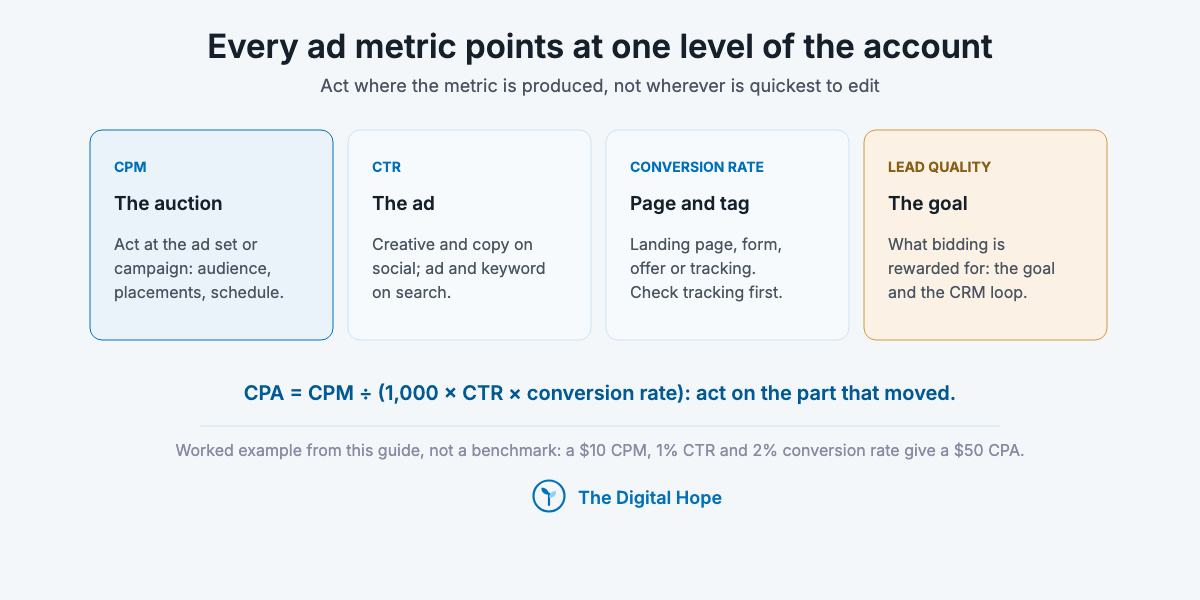
Each metric is produced at one level of the account, so the fix belongs at that level and nowhere else. Cost per acquisition is not a metric you can act on directly. It is arithmetic built from three others:
CPA = CPM ÷ (1,000 × CTR × conversion rate).
A worked example, not a benchmark: at a $10 CPM, a 1% CTR and a 2% conversion rate, a click costs $1 and a conversion costs $50. If CPA rises to $60, one of those three moved, and each lives somewhere different.
| Metric | Where it is produced | The level you act at |
|---|---|---|
| CPM (cost per 1,000 impressions) | The auction: who you target, where, and when | Ad set or campaign (audience, placements, schedule), after checking the market |
| CTR (click-through rate) | The ad against the person or the query | Ad (creative, copy) on social, ad and keyword on search |
| Frequency | Budget against audience size | Ad set (audience, budget), then a new ad concept |
| CPC (cost per click) | CPM divided by CTR | Whichever of the two moved |
| Conversion rate | The landing page, the offer and the tag | Landing page, form, offer, or tracking |
| CPA and ROAS | All of the above, plus the conversion definition | The component that moved |
| Lead quality | What the bidding is rewarded for | The conversion goal and the CRM feedback loop |
The same law shows up in every kind of account:
- A Meta prospecting ad set with a rising CPM and a flat CTR: the ad is fine, the auction or the audience changed.
- A TikTok ad group with a flat CPM and a falling CTR: the creative is wearing out.
- A Google Search campaign with a stable CTR and a falling conversion rate: look at the landing page and the conversion tag before the keywords.
- And in one B2B account I ran (Forage AI, web data for AI, $1,500 a month, 2026), people searching for a service provider engaged at 62% against 18% for the category’s head term in GA4. That gap is a keyword-level signal, and the fix was keyword selection, not bids. Engagement is not pipeline: [FIRST-PARTY, n=1].
Find the level before the lever.
Quick Summary: how to read ad metrics before optimizing
Q: Which ad metric should I act on first when performance drops?
A: Break CPA into CPM, CTR and conversion rate, and act on the one that moved, at the level that produces it. CPM points at the auction and audience, CTR at the ad or keyword, conversion rate at the landing page and tracking.
Insight: Meta's own fatigue rule is a cost rule, not a frequency rule
Meta’s Help Centre page on creative fatigue, checked 29 October 2026, shows “Creative limited” when an ad’s cost per result is above your past ads but under twice as much, and “Creative fatigue” at twice or more. It counts every recent exposure of the image or video, including other campaigns from your Page. Meta publishes no frequency number, so a fixed “cap at 3” is a rule of thumb.
The platform’s learning floor decides when you may act
“Learning status never lasts more than 7 days.”
Google Ads Help, “About Smart Bidding learning”, checked 29 October 2026
Every bidding system needs a minimum of results before its delivery settles, and an edit inside that window restarts the count on Meta and TikTok. The floors differ by platform, and so do the edits that reset them. This is the table to check before you change anything:
| Platform | Published floor | What resets it | What does not | Source, checked 29 Oct 2026 |
|---|---|---|---|---|
| Meta | About 50 results in the week after the ad set’s last significant edit. Shops ads: 17 website purchases and 5 through Meta | Any change to targeting, creative or optimization event, adding an ad, pausing 7 days or more, changing bid strategy. Budget, bid or cost goal changes depending on size: $100 to $101 is unlikely to reset, $100 to $1,000 may | Advantage+ campaign budget shifting spend between ad sets, an edit to one ad set (its siblings keep learning), adding a new ad set | Meta Business Help Centre, learning phase and significant edits pages |
| Google Ads | “Learning” status lasts at most 7 days. Results take 1 to 2 conversion cycles to settle. Judge over the longer of 2 conversion cycles or 2 weeks, and over at least 30 conversions (50 for Target ROAS) | A new or reactivated bid strategy, adding or removing campaigns, ad groups or keywords from it, a significant conversion goal change | Changes to budgets, targets, creatives, location or audience settings | Google Ads Help, Smart Bidding learning and About Smart Bidding |
| TikTok | Volatility “typically” starts to decline after about 25 results or 7 days | Pausing, edits that retrigger learning (TikTok does not list them), unreasonable budgets or creative volumes | Not published | TikTok Business Help Center, “Learning Phase”, updated June 2026 |
| No published learning threshold found. A/B tests run a minimum of 2 weeks and a maximum of 90 days | Not published | Not published | LinkedIn Help, A/B test results |
Read the Meta rows on its learning phase page and its significant edits page, and the Google rows on its Smart Bidding learning page, before you plan a week of edits.
Two things in that table change how you work:
- On Meta, every new ad is a significant edit. Launching creative into a learning ad set resets it, so batch new ads into one launch rather than three across the week.
- On Google, budget and target changes do not restart learning, but Google still asks you not to change targets repeatedly within one conversion cycle, because the system needs a cycle to respond.
If an ad set cannot reach the floor, Meta labels it “Learning limited”, which its Help Centre says “isn’t a penalty”. Its listed fixes are structural: combine ad sets, widen the audience, raise the budget or the cost control, or choose a more frequent optimization event, such as add to basket instead of purchase.
The floor sets the calendar, not the swing.
Quick Summary: Facebook ads learning phase and Google Ads learning period
Q: How long should I wait before changing a campaign in learning?
A: On Meta, until the ad set has about 50 results in the week after its last significant edit. On Google, judge Smart Bidding over the longer of 2 conversion cycles or 2 weeks. TikTok says volatility starts to fall after about 25 results or 7 days. LinkedIn publishes no learning threshold.
Insight: the same edit means different things on different platforms
Meta treats a new ad or a targeting change as a significant edit that restarts learning. Google’s Help page says changes to “budgets, targets, creatives, or targeting settings” do not trigger its Learning status, while adding keywords to a bid strategy does. A habit carried from one platform to the other is the commonest way to reset a campaign by accident.
Four things make a normal week look like a broken account
“Small fluctuations over time don’t necessarily indicate that action is needed.”
Google Ads Help, “About impression share”, checked 29 October 2026
Most metric swings are noise, lag, the market or a changed definition, and none of the four is fixed by editing the account. Check all four before you touch anything.
1. The sample is too small. Conversions are counts, and counts wobble by roughly the square root of the number. This is counting arithmetic, not a platform figure:
- 25 conversions a week: a swing of about 5, or 20%, is ordinary.
- 100 conversions a week: about 10, or 10%.
- 400 conversions a week: about 20, or 5%.
A B2B account with 8 qualified leads a week can see that number halve or double with nothing wrong. Below the platform floor, act only on large, sustained moves.
2. The conversions have not arrived yet. Purchases land days after the click, and qualified leads weeks after. Google’s own impression share data can take 24 to 48 hours to update, and a sales cycle in a B2B account runs far longer than any attribution window. Yesterday’s CPA is always worse than it will be next week. Compare complete periods only.
3. The market moved, not your account. Meta reported its average price per ad up 12% year on year in Q2 2026, with impressions up 14% (Meta investor results, 29 July 2026). That is a blended global figure, not your CPM, but part of a rising CPM is the auction. Seasonal peaks do the same: compare against the same weeks last year, not last week.
4. The definition changed. Meta stopped returning 7-day and 28-day view windows in its reporting API on 12 January 2026, and since March 2026 counts only link clicks as click-through. A dashboard spanning either date compares two different things. Our Facebook ads conversions playbook covers both dates.
My read: write down which of the four you ruled out before every change. If you cannot rule them out, the change waits a week.
Quick Summary: when not to change your ads
Q: When should I not make changes to an ad campaign?
A: During learning, below the platform’s conversion floor, inside the conversion lag, during a known seasonal swing, and across a reporting definition change. In those cases the metric moved without anything in the account being wrong.
Insight: a real answer takes about a month
Haus’ 640 Meta incrementality experiments (published July 2025, large ecommerce brands averaging $14M a year on Meta) ran 18.6 days on average, plus an 8.8-day window after the ads stopped, and some still came back inconclusive. If a controlled test with that budget needs about four weeks, a three-day read of a dashboard is not evidence. Haus sells testing, and its customers chose to test.
So here is what each signal means, and what to do about it.
The decision table: ten signals, where to act, and when to wait
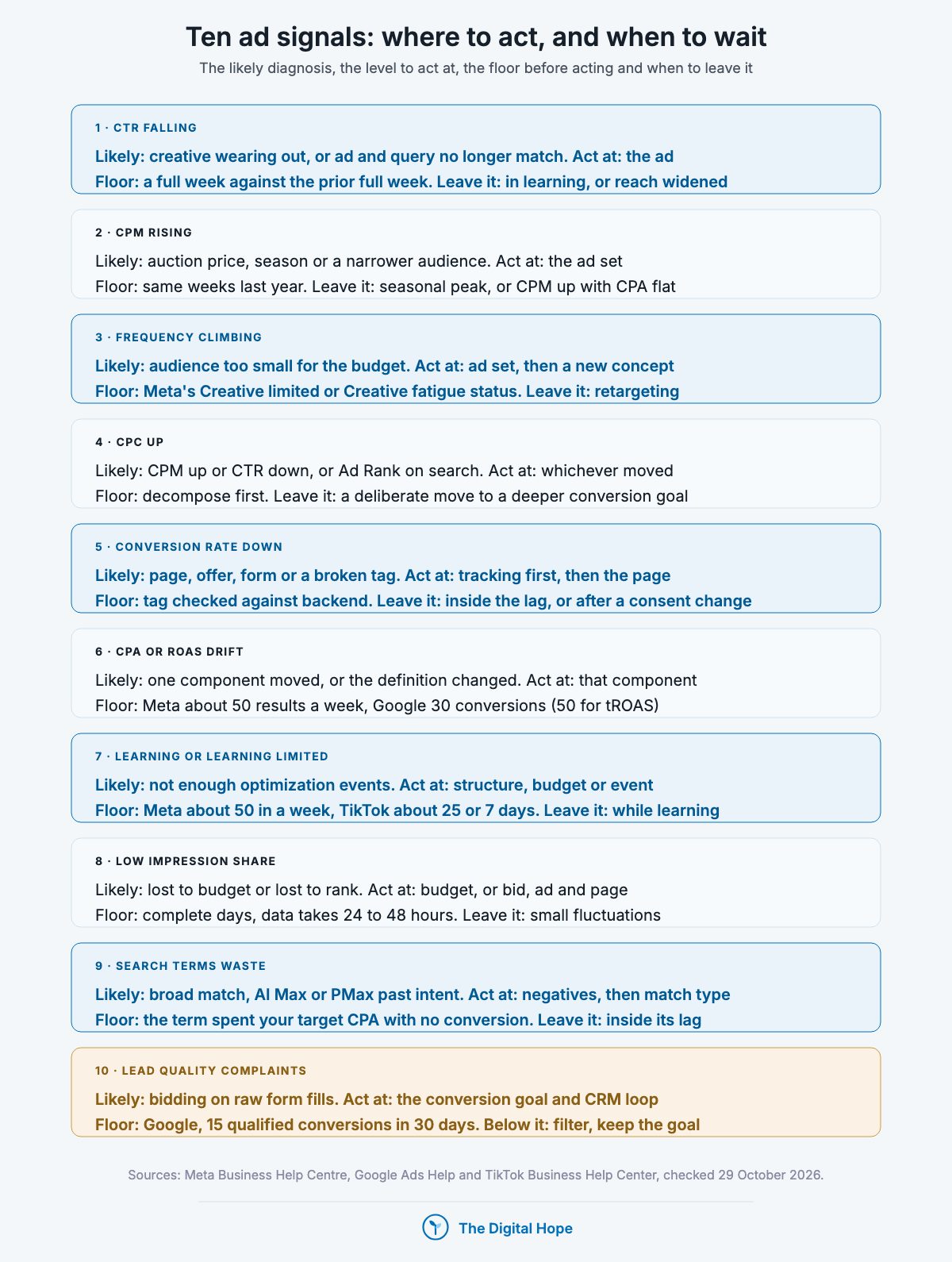
Each signal has one most likely cause, one level to act at, a minimum of data before acting, and cases where the right move is nothing. The table is the summary. The sections under it give the detail and where B2C and B2B split.
| Signal | Most likely diagnosis | Act at | Floor before acting | Do not touch when |
|---|---|---|---|---|
| CTR falling | Creative wearing out, or ad and query no longer match | Ad (social), ad and keyword (search) | A full week against the prior full week | In learning, or placements and expansion widened the audience |
| CPM rising | Auction price, season, narrower audience | Ad set: audience, placements | Same weeks last year, plus the platform’s price trend | Seasonal peak, or CPM up with CPA flat |
| Frequency climbing | Audience too small for the budget | Ad set, then a new ad concept | Meta’s “Creative limited” or “Creative fatigue” status | Retargeting, where repeat exposure is the design |
| CPC up | CPM up or CTR down (arithmetic), or Ad Rank on search | Whichever moved | Decompose before acting | A deliberate move to a deeper conversion goal |
| Conversion rate down | Landing page, offer, form, or a broken tag | Tracking first, then the page | Tag verified, platform compared with backend | Inside the conversion lag, or after a consent change |
| CPA or ROAS drift | One component moved, or the definition changed | The component that moved | Meta about 50 results a week. Google 30 conversions (50 for tROAS) over 2 cycles or 2 weeks | Within a cycle of an edit, in a known season |
| Learning or Learning limited | Not enough optimization events | Campaign structure, budget, event | Meta about 50 in a week. TikTok about 25 or 7 days | While learning: no edits |
| Low impression share | Lost to budget or lost to rank | Budget (campaign) or bid, ad and page (rank) | Complete days, data takes 24 to 48 hours | Small fluctuations, or terms you should not buy |
| Search terms waste | Broad match, AI Max or PMax reaching past intent | Keyword: negatives, then match type | A term has spent your target CPA with no conversion | The term is still inside its conversion lag |
| Lead quality complaints | Bidding on raw form fills | Conversion goal and CRM loop | Google: 15 qualified conversions in 30 days | Below the floor: filter, do not switch goals yet |
1. CTR falling
Diagnosis: on Meta and TikTok, the ad is wearing out on the people seeing it. On search, the ad no longer matches the queries, often because matching widened.
Act at: the ad. On social, launch a materially different concept, not a resize. On search, read the search terms first, then the ad copy.
Floor: a full week against the previous full week, same weekdays.
Do not touch: while the ad set is learning. Check placements first on LinkedIn, where Audience Network is switched on automatically for new single image, carousel, document and video ad sets, and Audience Expansion wherever it is available (LinkedIn Help, checked 29 October 2026), and a falling CTR can be the audience changing rather than the ad.
2. CPM rising
Diagnosis: the auction got more expensive (season, competition, Meta’s price per ad up 12% in Q2 2026), or the audience narrowed.
Act at: the ad set, and only after checking the market. Widen the audience or open placements if the audience is small.
Floor: the same weeks last year, and two complete weeks this year.
Do not touch: when CPM rose but CPA held. You are paying more for impressions that convert better, which is fine.
3. Frequency climbing
Diagnosis: the budget is too large for the audience, or one ad is carrying most of the spend.
Act at: the ad set (audience size or budget), then the ad.
Meta’s own signal is the Delivery column: “Creative limited” when cost per result is above your past ads, “Creative fatigue” at twice or more.
Floor: the status, plus a cost per result trend over a full week.
Do not touch: retargeting and small B2B account lists, where seeing the ad several times is the point. Judge those on cost per result, not frequency.
4. CPC up
Diagnosis: CPC is CPM divided by CTR, so on social one of those two moved. On search, competition, Ad Rank or wider matching.
Act at: whichever component moved. Never “fix CPC” directly by lowering a bid on social.
Floor: decompose before acting.
Do not touch: after you moved to a deeper conversion goal. A campaign bidding toward qualified leads should pay more per click than one bidding toward any form fill.
5. Conversion rate down
Diagnosis: in order of how often to check them: the tag stopped firing, consent changed what is counted, the landing page or form broke, the offer changed, the traffic mix shifted.
Act at: tracking first. Open Google Tag Manager preview or Meta’s Events Manager and confirm the conversion fires once. Then the page.
Floor: platform conversions compared with backend orders or CRM records for the same days.
Do not touch: inside the conversion lag, and never change bids to “fix” a tracking break. A bidding system starved of conversions it cannot see will bid itself down.
6. CPA or ROAS drift
Diagnosis: one of CPM, CTR or conversion rate moved, or the conversion definition changed.
Act at: the component, using the decomposition above. Your floor for ROAS is your breakeven: 1 divided by gross margin (at a 40% margin, 2.5). That is arithmetic, not a benchmark.
Floor: Meta about 50 results in a week after the last significant edit. Google about 30 conversions (50 for Target ROAS) over the longer of 2 conversion cycles or 2 weeks.
Do not touch: within one conversion cycle of your last edit, or in a known seasonal swing.
7. Learning or Learning limited
Diagnosis: the ad set cannot collect enough optimization events.
Act at: the structure. Combine ad sets, raise the budget, or move to a more frequent event, as Meta’s Help Centre lists.
Floor: Meta about 50 results in the week after the last significant edit. TikTok about 25 results or 7 days.
Do not touch: an ad set that is learning normally. The fix for Learning limited is fewer, bigger ad sets, not more edits.
8. Low impression share
Diagnosis: Google splits it. Search lost IS (budget) is the share of time your ads did not show because the budget ran out, and is reported at campaign level only. Search lost IS (rank) is the share lost to Ad Rank (Google Ads Help, checked 29 October 2026).
Act at: budget for the first, bid, ad relevance and landing page for the second.
Floor: complete days. Google says the data can take 24 to 48 hours to update.
Do not touch: when the lost impressions are on terms you should not buy. In a small B2B account, low impression share on research queries is often the right setting.
9. Search terms waste
Diagnosis: broad match, AI Max or Performance Max is matching queries outside buying intent. Google describes AI Max as adding keywordless matching to Search campaigns, and in one agency’s early read of about 30,000 AI Max search terms, almost none of the impressions converted (PPC Land, August 2025).
Act at: the keyword. Add negatives, then tighten match type, because negatives only stop waste you have already paid for once. Performance Max has accepted campaign-level negative keyword lists since 2025 (Google Ads Help, 7 August 2025).
Floor: my working rule, not a platform one: a term that has spent your target CPA with no conversion is a negative candidate.
Do not touch: terms still inside their conversion lag, and anything containing your brand or product name without checking it first.
10. Lead quality complaints
Diagnosis: the campaign bids toward any form fill, so it finds the cheapest people who fill forms. LinkedIn’s lead generation objective defaults to plain leads unless a Conversions API integration sends qualified leads back (LinkedIn Help, checked 29 October 2026).
Act at: the conversion goal and the CRM loop. Send the qualified stage back as a conversion.
Floor: Google’s guidance for bidding on qualified or converted leads asks for at least 15 conversions in the last 30 days, ideally within 7 days of the ad interaction (Google Ads Help, checked 29 October 2026).
Do not touch: below that floor, keep the shallow goal and filter instead: tighter keywords, a qualifying question, exclusions. Do not judge on one sales rep’s week.
One cut I made on this logic: in the same B2B account, Demand Gen reported 101 clicks that produced 2 site visits in GA4, so I cut it. That was right for a $1,500 monthly budget in one quarter, not a verdict on the format: [FIRST-PARTY, n=1].
Quick Summary: ad optimization decision rules
Q: What should I change when an ad metric gets worse?
A: Change the level the metric points at, once the data clears the platform’s floor: creative for CTR, audience and market checks for CPM, tracking then landing page for conversion rate, negatives for search terms waste, and the conversion goal for lead quality.
Insight: why B2B lead bidding rarely reaches its floor
Google’s guidance for qualified-lead bidding wants 15 conversions in 30 days and a conversion within about 7 days of the click. An opportunity stage in a long B2B sales cycle rarely meets either. The deepest stage that clears the floor is the one to bid toward, and everything below it is judged in the CRM, not in the ad platform.
That is the reacting half. The other half starts when the numbers are good.
Scaling a winner: prove it, then grow it up or out
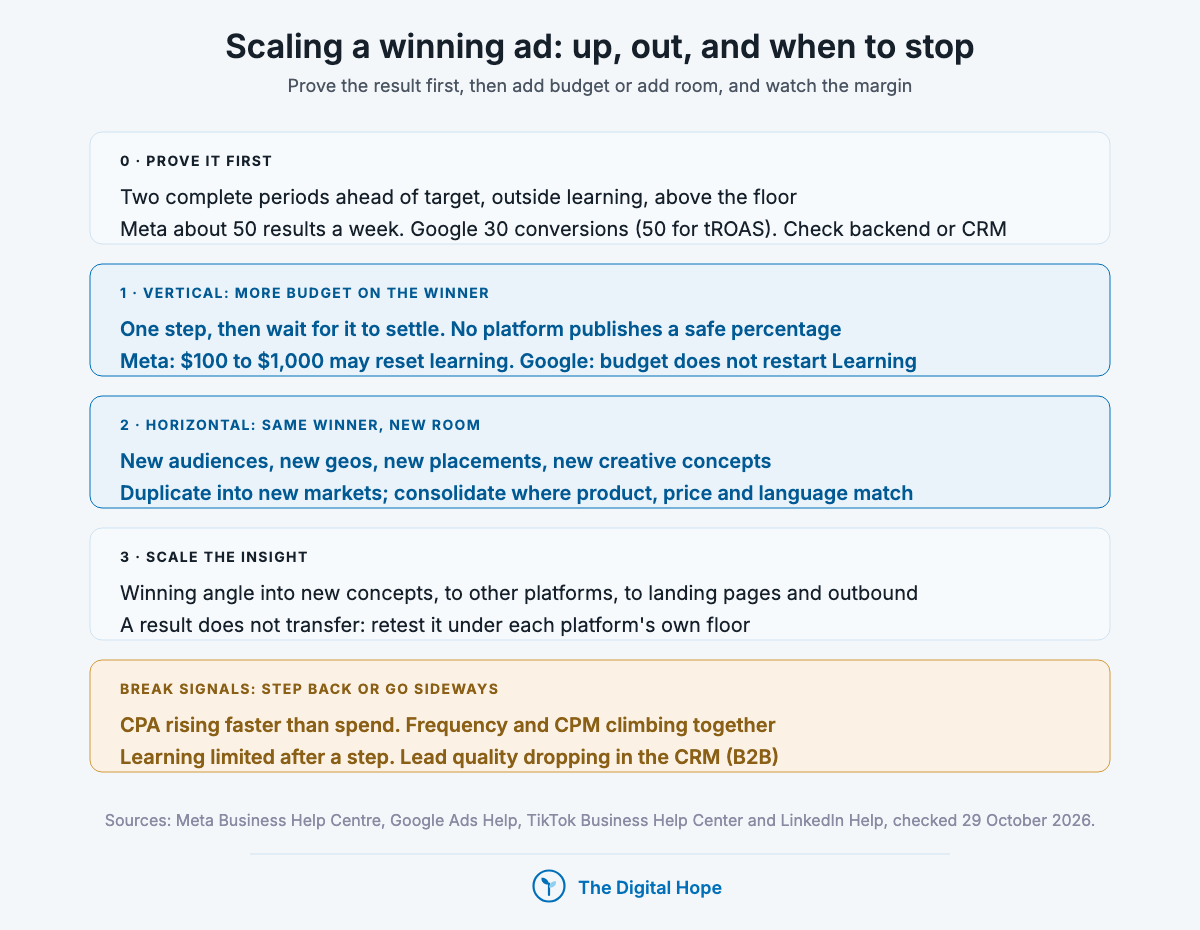
Scaling is a change like any other, so it waits for the same floors: prove the result is real, add budget in steps the platform can absorb, then grow sideways into new audiences, markets and concepts once one ad set stops taking money efficiently. The work has five parts, and the last is knowing when to stop.
1. Check the result is real before you scale it
A winner earns more budget only when it passes three checks:
- Enough conversions to be past noise. At 25 conversions a week a 20% swing is counting noise, so a “winner” at that volume can be one lucky week. Look for the result above the platform’s floor: about 50 results in a week on Meta, 30 conversions (50 for Target ROAS) on Google.
- Stable over complete periods. Two complete weeks ahead of target, outside learning, with no seasonal peak or reporting change inside the window. In B2B, two complete conversion cycles. One great Tuesday is not a trend.
- Incremental, not only reported. Platform reporting credits the ad with some conversions that would have happened anyway. In Haus’ 640 Meta experiments (July 2025), Meta’s own reporting flattered Advantage+ by about 12 points against measured lift. Haus sells that testing, so read it as direction. Before a large budget step, check the platform’s numbers against backend revenue or CRM stages, and on big budgets run a holdout or lift test.
The condition: a store or app usually clears the floor at the purchase or install event within weeks. A B2B account judging on sales-accepted leads may need a month or more, so scale on the deepest stage that clears the floor and confirm it in the CRM before the second step.
2. Vertical scaling: more budget on what already works
Vertical scaling raises the budget on the campaign or ad set that is winning. It is the fastest route and the one most likely to disturb what made the result. Here is what each platform documents, checked 29 October 2026:
| Platform | What a budget increase does to learning | Source |
|---|---|---|
| Meta | Budget changes “may or may not” be significant edits depending on size: $100 to $101 is unlikely to reset learning, $100 to $1,000 may. With Advantage+ campaign budget, a campaign budget change can reset several ad sets at once. Meta advises against frequent budget changes | Meta Business Help Centre, learning phase and significant edits pages |
| Google Ads | Budget and target changes do not put Smart Bidding back into “Learning”, but results take 1 to 2 conversion cycles to settle, and Google asks you not to change targets repeatedly within one cycle | Google Ads Help, “About Smart Bidding learning” |
| TikTok | Lists “unreasonable budget setting” among the things to avoid during learning, with no number | TikTok Business Help Center, “Learning Phase”, updated June 2026 |
| No learning reset published. Daily spend can run up to 100% above the daily budget on a given day, capped at seven times the daily budget in a week | LinkedIn Help, “Campaign and ad set budgets” |
“Raise budgets 20% a day” is practitioner folklore. None of the four platforms publishes a percentage, and Meta’s own example jumps from a 1% change to a 900% one. My working rule, not a platform one: raise in one step you can judge, and let it clear the floor before the next. On Meta that is one budget step, then about a week of results. On Google, one step per conversion cycle.
- On Google, budget only helps where budget was the limit. Search lost impression share (budget) shows how often the ads did not show because the money ran out. If the share is lost to rank instead, the bid, the ad and the landing page are the lever.
- On LinkedIn, judge a budget step on the week, because one day can spend up to twice the daily amount.
3. Horizontal scaling: the same winner, more room
When one ad set stops absorbing budget at a CPA you can afford, grow sideways. Each route is a new cell with its own learning phase:
- New audiences: a broader or lookalike audience on Meta, a new job function, seniority or company size on LinkedIn, a new keyword theme on Google.
- New geos: a new country or region as its own campaign when price, language, currency or dates differ.
- New placements: placements you excluded. On LinkedIn, run Audience Network as its own test cell rather than inherit it.
- New creative concepts: Meta’s creative diversification guidance (November 2024) recommends launching new ads weekly and putting 20 to 30% of budget into testing them, and warns that creatives which look too alike can be treated as one ad. Scale by idea, not by resize.
Duplicate or consolidate. A duplicated ad set is a new ad set, so on Meta it starts its own learning while its siblings keep theirs. That makes duplication the clean way into a new market. Consolidation does the opposite: Meta lists combining ad sets as a fix for Learning limited, and Google advises consolidating to pool conversion data. Consolidate where product, price and language match; split where they do not. On LinkedIn, a finished A/B test shows a “Duplicate winner” button only when one variant clearly wins.
In one live-events account I ran (Star Entertainment, touring concerts, December 2024 to March 2025), over 1,000 ad sets ran on manual location targeting across Europe, the US, the UK, Asia and Australia. Every show had its own city and date, which is the case where one consolidated campaign does not fit. That is a structure note, not a return figure: [FIRST-PARTY, n=1].
4. Scale the insight, not only the budget
A winning ad tells you something about the buyer, and that insight scales further than the ad. Budget grows one ad set. The insight can grow the whole funnel:
- Turn the winning angle into new creative. Name what won (the problem, the proof, the opening line) and build three new concepts around it.
- Carry the audience or message to another platform. A message that wins on Meta becomes a TikTok concept or a Google headline. A search term that converts names the problem a LinkedIn ad should lead with. Retest it there under that platform’s floor, because results do not transfer on their own.
- Feed it into landing pages and outbound. The page should say what the winning ad said. In B2B, the accounts and segments that respond hand off to outbound, and a sharper ICP improves targeting and messaging everywhere downstream.
In one B2B AI infrastructure account I ran (Clarifai, July 2025 to May 2026), the account had chased only bottom-of-funnel terms with almost no search volume. I built top, mid and bottom-of-funnel campaigns that fed each other: conversion and retargeting data fed the mid-funnel, content downloads fed the bottom. Over that period, led by video, Google Ads clicks went from about 17,000 to 255,000 and signups from 801 to 5,457. A signup is a low-friction conversion, so this says nothing about a demo-request funnel: [FIRST-PARTY, n=1].
5. The signs scaling is breaking, and what to do
Judge the extra money, not the average. A worked example, not a benchmark: weekly spend goes from $1,000 to $1,500 and conversions from 20 to 24. Average CPA moved from $50 to $62.50, which looks tolerable, but the extra $500 bought 4 conversions at $125 each. If that marginal CPA is above what a conversion is worth to you, the step did not pay.
| Sign | What it means | What to do |
|---|---|---|
| CPA rising faster than spend | The extra budget buys conversions at a much higher marginal cost | Step back to the last stable budget, then scale horizontally |
| Frequency and CPM climbing together | The audience is saturating | Widen the audience or launch a new concept. On Meta, watch for “Creative limited” or “Creative fatigue” |
| Learning limited after a step | The structure is too thin for the budget or the event | Consolidate ad sets or move to a more frequent event. Stop stepping |
| Lead quality dropping (B2B) | The bigger budget reached cheaper, less qualified people | Send the qualified stage back as the conversion, tighten targeting, judge in the CRM |
| Lost IS (budget) near zero, spend flat (Google) | Budget is no longer the constraint | Work on bid, ad, page or new keywords. More budget will not spend |
For B2C, budget steps, new geos and creative volume are where scale usually comes from, and the ceiling is creative supply and auction price. For B2B, the audience is finite: a list of a few thousand accounts saturates long before the budget does, so scale comes from new segments, new channels and the outbound handoff, and the test is qualified pipeline in the CRM, not cost per lead.
Prove it, step it, then widen it.
Quick Summary: how to scale ads that are working
Q: How do I scale a winning ad campaign without breaking it?
A: Confirm the result over two complete periods above target and above the platform’s floor, then raise budget one step at a time and let each step settle. When the ad set stops absorbing budget, scale horizontally into new audiences, geos, placements and concepts, and stop when marginal CPA passes what a conversion is worth.
Insight: no platform publishes a safe budget percentage
Meta’s significant edits page gives $100 to $101 as unlikely to reset learning and $100 to $1,000 as one that may, and nothing between. Google says budget changes do not trigger Learning at all. TikTok asks only that budgets be reasonable, and LinkedIn publishes no learning rule. The “20% a day” rule fills a gap the platforms left open, so treat it as one practitioner’s step size, not a threshold.
A weekly optimization cadence in five steps
One fixed weekly order keeps you from editing the same campaign three times on noise. Each step starts with one action in a named tool. Monthly, add one controlled test.
1. Monday: confirm the data is real before reading it
Open Events Manager on Meta and Goals, then Conversions, in Google Ads, and check every money event fired in the last seven days. Then compare platform conversions with backend orders or CRM records for the same days.
- Did every conversion action record events every day?
- Is the gap between platform and backend within its usual range?
- Did anyone change the tag container, the consent banner or the site last week?
Why this comes first: in one live-events account I ran (Star Entertainment, touring concerts, December 2024 to March 2025, over €500K a month on Meta), tickets sold on an external ticketing site and Meta never received a purchase event, so the only result it could learn from was the click. No ROAS from that account is reported here, because Meta never saw a sale: [FIRST-PARTY, n=1].
Condition: if tracking broke, stop. Every later step reads numbers you cannot trust.
2. Tuesday: read each signal at its level, against complete periods
In Ads Manager or Google Ads, compare the last full 7 days with the previous full 7 days and the same week last year, broken down by campaign, ad set and ad. Decompose any CPA move into CPM, CTR and conversion rate.
- Which component moved, and at which level?
- Is the ad set or bid strategy in learning?
- Which of the four normal-week causes (sample, lag, market, definition) did you rule out?
- Which campaign has beaten its target for two complete periods above the floor, and is ready for one budget step?
Condition: in a B2B account under about 30 conversions a month, read two-week or four-week windows instead.
3. Wednesday: clear search terms and placements
Open the search terms report in Google Ads (and the Performance Max search terms view), sort by cost, and mark every term that has spent your target CPA without converting. On LinkedIn, check the Audience Network and expansion settings on every live campaign.
- Which terms are outside buying intent?
- Which terms are inside their conversion lag and must wait?
- Should a match type tighten instead of adding one more negative?
Condition: skip the LinkedIn half if you deliberately run Audience Network as a test cell.
4. Thursday: rotate creative by concept, only where the status says so
In Ads Manager, filter the Delivery column for “Creative limited” and “Creative fatigue”, and on TikTok sort ads by cost per result over 14 days. Replace only those, with a concept that is materially different.
- How many distinct concepts are live, counted by idea, not file?
- Will the new ads go into an ad set that is learning? Batch them into one launch.
- Is the fatigued ad still cheaper than its replacement? Meta suggests keeping the original running.
Condition: on Meta, every new ad is a significant edit, so launch once a week, not daily.
5. Friday: log every change with its kill date
Open a shared change log and write, for every change this week, budget steps included: what, at which level, why, the floor it waits for, and the date you will judge it. Make at most one change per level per campaign per week.
- Could you tell next Monday which change caused which move?
- Does every change have a date to judge it, after its learning floor?
- Is one test running this month with a control and an end date?
Condition: a large account with an analyst team can run more changes in parallel if each is isolated in its own campaign or experiment.
Pulling it together. Monday, prove the conversions are real or stop. Tuesday, name the level and rule out the four normal-week causes in writing. Wednesday, cut search terms that spent your target CPA without converting. Thursday, replace only the ads Meta or your cost data flags as fatigued, in one batch. Friday, log each change with the date you will judge it. If you do one thing this week, do Monday.
Quick Summary: a weekly PPC optimization routine
Q: How often should I optimize my ad campaigns?
A: Review weekly in a fixed order: tracking, signals by level, search terms and placements, creative fatigue, then a change log with judgment dates. Change at most one thing per level per campaign per week, and add one controlled test a month.
Let alerts watch the signals, and keep the spend decisions human
“Silent failure is the default failure mode.”
Frederick Vallaeys, co-founder of Optmyzr, Search Engine Journal, 2 September 2026
Alerts and agents are good at watching every campaign every hour. Deciding what to change is still a human job, because a wrong write costs money at machine speed. The useful split:
| Let automation do it | Keep it human |
|---|---|
| Compare today with the same weekday in past weeks and email on a break | Moving budget between campaigns |
| List search terms that crossed your spend-without-conversion rule | Adding negatives that contain a brand or product name |
| Flag “Creative fatigue”, “Learning limited” and lost impression share | Changing a bid strategy or conversion goal |
| Alert when a conversion action records zero for a day | Pausing a campaign or ad set |
| Draft the weekly change log | Anything that spends money or publishes |
Here is what the platforms give you for free, as of October 2026:
- Google’s Account Anomaly Detector script compares today so far with the average for the same weekday over past weeks, ignores the most recent 3 hours because that data is still arriving, and emails once per alert type per day. Google’s anomaly detector documentation covers the setup.
- GA4 custom insights allow up to 50 alerts per property, with a “has anomaly” condition that lets Google set the threshold (Google Analytics Help, checked 29 October 2026).
- Google Ads auto-apply can already change bids, keywords, match types and remove negatives it judges redundant if you switch it on (Google Ads Help, checked 29 October 2026). In one 2023 case published by Optmyzr, an auto-applied recommendation removed an account’s brand keyword. Check what auto-apply is allowed to touch before you add another agent.
In the B2B team I run, agents built on Claude watch the account for negative-keyword candidates and send anomaly alerts, and the decisions stay with a person. I have no time-saved or error-rate figure for that setup yet: [FIRST-PARTY, n=1].
My read: start read-only. Give an agent one narrow job, an approval step for anything that spends, and a log a person reads every week.
Automate the watching, not the deciding.
Quick Summary: ad account anomaly alerts and automation
Q: Should I automate ad optimization?
A: Automate the watching: anomaly alerts against the same weekday, search term lists, fatigue and learning flags. Keep budget moves, bid strategy and goal changes, pauses and brand-related negatives with a person, behind an approval step.
Insight: one practitioner's confidence gate
Nils Rooijmans, who builds Google Ads agents for clients, described on Optmyzr’s PPC Town Hall (August 2026) starting with approval on everything, then letting negative keyword suggestions apply alone only above a self-scored 85% confidence, with every action logged. It is one practitioner’s threshold, not a benchmark, and the useful part is the shape: one job, a gate, a log.
B2C and B2B read the same signal differently
The same signal means different things when the buyer is a consumer buying today and when it is a company buying in six months. The floors are the same. Whether you can reach them is not.
| B2C (store, app, events) | B2B (lead generation, sales-led) | |
|---|---|---|
| Reaches the learning floor? | Usually, at the purchase or install event | Rarely at the qualified stage. Often only at form fill |
| Conversion lag | Hours to days | Weeks to months |
| What to judge on | Backend revenue against breakeven ROAS | Qualified leads, opportunities, pipeline in the CRM |
| Review window | Weekly | Two to four weeks |
| Frequency | A fatigue signal in prospecting | Often intended on a small account list |
| Main risk | Creative fatigue and auction price | Cheap leads the sales team rejects |
| Where scale comes from | Budget steps, new geos, creative volume | New segments, new channels, the outbound handoff |
For B2C, the weekly cadence runs as written, and the decision table’s floors are reachable at the purchase event. For B2B, stretch the review window, bid toward the deepest stage that clears 15 conversions in 30 days on Google, and judge everything below it in the CRM.
In one B2B AI infrastructure account I ran (Clarifai, July 2025 to May 2026), a free-signup funnel went from about $1,000 to under $4 per signup, and the account was managed to sales-accepted leads at about $25 to $30, not to signups alone. A free signup is a low-friction conversion, so this says nothing about a demo-request funnel: [FIRST-PARTY, n=1]. For the search side of the same budget decision, see SEO vs paid search.
Same signal, different clock.
Quick Summary: B2B vs B2C ad optimization
Q: How is B2B ad optimization different from B2C?
A: B2B accounts rarely reach learning floors at the qualified stage and convert weeks later, so they need longer review windows and CRM-based judgment. B2C accounts usually reach the floor at the purchase event and can be reviewed weekly against breakeven ROAS.
Insight: how long a B2B journey runs
Dreamdata’s 2026 LinkedIn benchmarks, built on 3.5 million B2B customer journeys mostly from software companies, put the average at about 281 days from a first LinkedIn impression to revenue. Dreamdata sells attribution and does not publish its model, so treat the number as direction. No ad platform’s attribution window comes close to it.
What stopped being true
| What | When | Primary source |
|---|---|---|
| Broad match modifier as its own match type | Folded into phrase match, February to July 2021 | Google Ads Help, answer 10286719 |
| LinkedIn lead campaigns optimizing for leads only | Qualified leads goal with Conversions API data, April 2025 | LinkedIn Help, answer a422440 |
| Performance Max with no negative keywords and no search terms | Campaign-level negative lists and search terms for all PMax, 2025 | Google Ads Help, 7 August 2025 |
| Interest and behaviour exclusions on Meta | Removed, announced 21 January 2025 | Meta for Developers, 21 January 2025 |
| 7-day and 28-day view windows in Meta’s reporting API | No longer returned, 12 January 2026 | Meta for Developers, 16 October 2025 |
| Any click counted as a Meta click-through | Link clicks only, March 2026 | Meta for Business, 3 March 2026 |
| Responsive search ads created by Google auto-apply | Auto-creation stopped, 26 January 2026 | Google Ads Help, answer 10279006 |
| Offline conversion uploads through the Google Ads API | Moved to the Data Manager API, 15 June 2026 | Google Ads Help, answer 15713840 |
Questions people ask about ad optimization
Does a 20% budget increase reset Meta’s learning phase?
Meta publishes no percentage. Its Help Centre says budget changes “may or may not be significant, depending on the magnitude”, with $100 to $101 unlikely to reset learning and $100 to $1,000 likely to. The 20% figure is a practitioner rule of thumb. Raise in one step you can judge, and let it settle before the next.
How do I scale Facebook ads without breaking what works?
Prove the result first, then step the budget or go sideways. Look for two complete weeks ahead of target with about 50 results a week, raise the budget once and wait about a week, and when cost per result rises faster than spend, duplicate the winner into a new audience, market or concept instead.
How long should I wait before judging a new campaign?
Until it clears the platform’s floor and a full conversion cycle has passed. On Meta that is about 50 results in the week after the last significant edit. On Google, the longer of 2 conversion cycles or 2 weeks.
What is a good frequency for Facebook ads?
Meta publishes none. Its fatigue status compares an ad’s cost per result with your past ads: above them is “Creative limited”, twice or more is “Creative fatigue”. Use that, not a fixed cap.
Should I pause an ad that is “Learning limited”?
No, change the structure instead. Meta says Learning limited “isn’t a penalty” and lists combining ad sets, widening the audience, raising budget or bid, and a more frequent optimization event as fixes.
How do I know if an A/B test result is real?
Use the platform’s experiment tool and its minimum run. LinkedIn’s A/B tests run at least two weeks and show a winner only when one is clear, as its A/B test results page explains. Google recommends judging Smart Bidding over periods with at least 30 conversions.
In a nutshell
Optimization is two jobs on running ads: scale what works and fix what breaks, and both wait for the same floors. Meta’s floor is about 50 results in a week, Google asks for 1 to 2 conversion cycles, and controlled tests in Haus’ data ran close to four weeks. Scale a winner only after two complete periods above target, one budget step at a time, then sideways into new audiences, markets and concepts, and stop when the marginal CPA passes what a conversion is worth. Fix a broken signal at the level it points to, after ruling out noise, lag, the market and a changed definition.
This playbook holds for accounts where the platform can see the conversion. If tracking is broken, or a B2B account cannot reach any floor at a stage that matters, fix the measurement first, because until then every metric points at the wrong level. A platform publishing much lower learning floors, or one ad platform’s reporting matching controlled lift tests, is what would change this call.
If you would rather have someone look at your account, that is what I do in a consultation.
About this article

Written by
Sai Subramaniam
SEO, GEO and Paid Ads Manager · 8+ years in growth marketing
I have run SEO, paid media and ABM for B2B AI companies, consumer apps and live-entertainment brands, from a solo operator at an AI infrastructure company to a team of 20 recovering a million-visitor site after a Google update. I write these guides from that work, and every number in them carries its source.
See my portfolioConnect on LinkedInHow this one was checked. Every number traces to a named source with its dataset and period, and every platform feature, policy or limit cites the platform’s own documentation with the date it was verified. Where the author’s own results appear, they are labelled as one account’s results, with the budget and context, not as a rule.
No affiliate links and no paid placements. Tools are named because they are what practitioners use, not because anyone paid to appear here.
Reviewed: October 2026. Ad platforms and search features change every few months; anything we could not verify at the time of writing is marked as unverified rather than turned into a number.
Corrections. If something here is wrong or has changed since, we would rather know. Corrections are made in place, with a note saying what changed.