
“The impact of iOS overall as a headwind on our business in 2022 is on the order of $10 billion.”
David Wehner, Meta’s chief financial officer, on the Q4 2021 earnings call, as reported by Business Insider on 3 February 2022. Meta called the figure an estimate.
On Meta in 2026, the advertiser no longer builds the audience. Meta’s delivery system does. Since October 2025, sales, app and lead campaigns are built in a single Advantage+ setup. Meta’s ad retrieval system, Andromeda, picks a few thousand candidate ads for each person out of tens of millions. So what is left for you to steer with?
Two inputs decide most of the result: the conversion signal you send Meta, and the creative you give it. Creative as the main input is Meta’s own stated direction in its April 2025 guidance, the signal is what its Conversions API exists to carry, and Andromeda, which Meta described in December 2024, was built to choose between creatives at scale. Whether Meta’s automation also earns you more profit than a manual setup is a separate question, and the largest independent test set says not by default.
This playbook covers what holds on Meta in October 2026: why the signal decides more than the targeting, how to read Advantage+ claims, what the 2026 conversion definitions mean for your reports, and a five-step setup for a consumer brand selling online. A short section covers B2B lead generation, where the rules differ, and a single table near the end lists the tactics that no longer apply.
How we know
Mechanics and dates: Meta’s own developer, business and engineering posts, each named where it is used, checked on 29 October 2026.
Independent data: one vendor dataset, Haus, 640 Meta incrementality experiments run since early 2024 with large ecommerce brands averaging $14M a year on Meta. It is the largest published test set we found, and it is still one vendor that sells testing.
First-party: two accounts I ran, labelled where they appear. Each is one account, n=1.
What this cannot tell you: what your account will do. No Meta CPA, CPM or ROAS benchmark we found published its dataset, size, period and method, so none appears here.
The short version
Fix the signal before the campaign: the pixel plus the Conversions API, deduplicated, on the event that makes you money.
Start in Advantage+, and keep a control. In Haus’ 640 tests, manual campaigns returned more incremental revenue for 58% of brands tested head to head.
Creative is the steering wheel: distinct concepts, not twenty versions of one ad.
Your 2026 numbers use new definitions. Since March 2026 click-through means a link click, so a 2025 dashboard is not comparable.
Judge B2B on pipeline, not cost per lead.
Meta can only learn from the conversions it can see
“App Tracking Transparency requires apps to get the user’s permission before tracking their data across apps or websites owned by other companies.”
Apple, on the iOS 14.5 release, 26 April 2021
Meta’s delivery system learns from the conversions you send it, and since iOS 14.5 on 26 April 2021 it sees fewer of them by default. The browser pixel misses whatever the browser or the device does not let it record. The Conversions API sends the same events from your server to Meta, and Meta’s setup flow asks you to confirm the two streams are “deduplicated and matched correctly”.
The law is simple. No signal, no learning. It shows up the same way in every kind of account:
- A store sending purchases through the pixel only: Meta learns from the purchases the browser let through, and nothing else.
- A store sending them through the pixel and the Conversions API, deduplicated: Meta learns from the fuller set, once, without counting a sale twice.
- An app that bids toward installs: Meta learns to find people who install, which is a different person from the one who pays.
- And in one live-events account I ran, Meta learned from clicks only, because it never saw a sale.
That last account is the one I would flag to anyone running events. At Star Entertainment (touring concert productions in Europe, the US, the UK, Asia and Australia, December 2024 to March 2025, more than €500K a month on Meta), tickets sold on an external ticketing site, and Meta never received a purchase event. It could not bid toward buyers or report revenue, so the campaigns ran on manual location, age and interest targeting, and the only result Meta could learn from was the click. That is also why no ROAS from that account appears on this page: [FIRST-PARTY, n=1].
If your checkout lives on someone else’s platform (ticketing, a marketplace, a booking engine), ask whether it can pass purchase events back to Meta before you spend. If it cannot, your campaigns are traffic campaigns, whatever their objective says.
Fix the signal first.
Quick Summary: why tracking decides Facebook ads conversions
Q: Why do Facebook ads stop converting when tracking breaks?
A: Meta bids toward the people most like those who converted, so it needs to see the conversion. Since iOS 14.5 the pixel alone misses events. Send key events through the Conversions API as well, and confirm in Events Manager that duplicates are removed.
Insight: what Meta's own documentation does not say
Meta’s Conversions API documentation, checked on 29 October 2026, describes a server-to-server connection between an advertiser’s marketing data and Meta’s systems, with a one-click setup for pixel users and a step to verify deduplication. It does not publish a deduplication window or a target Event Match Quality score. Vendor figures for both conflict, so treat any “aim for a score of X” advice as a vendor’s rule of thumb.
Advantage+ is the default, and whether it beats manual is still a test
Since October 2025, Meta builds sales, app and lead campaigns in a single Advantage+ setup, so the automated path is where you start. Meta says its streamlined Advantage+ sales setup lowered cost per acquisition 9% on average (April 2025), and publishes no method for that figure. The largest independent dataset we found does not support “automation wins” as a default.
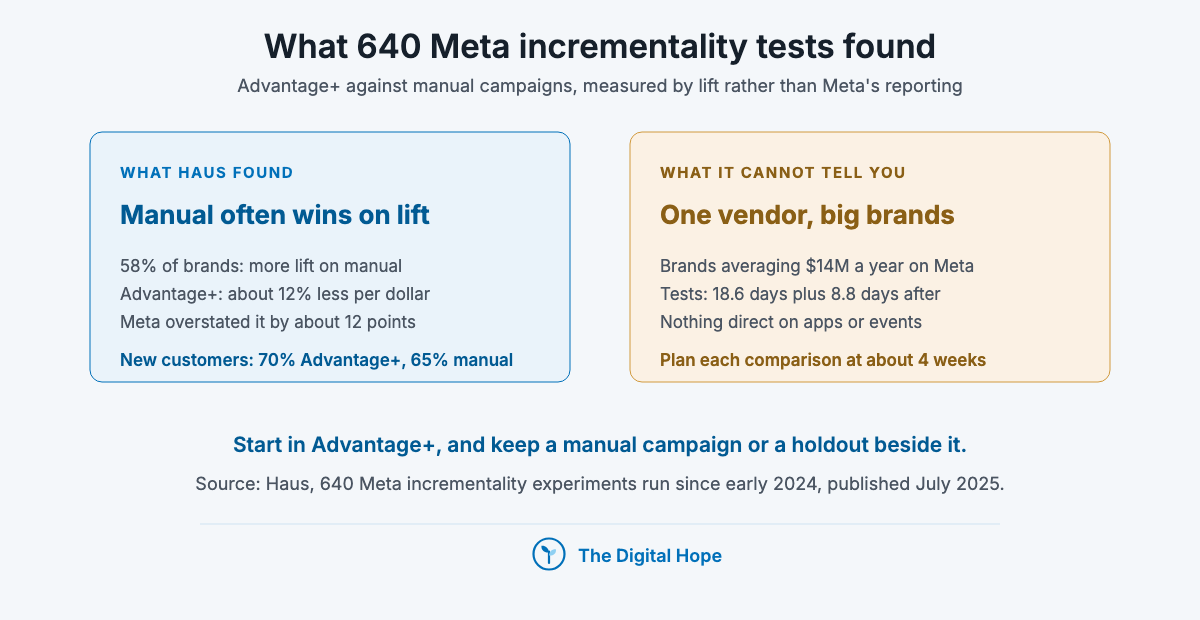
Here’s the evidence. In Haus’ 640 Meta incrementality experiments (published July 2025, brands averaging $14M a year on Meta, mostly ecommerce):
- 58% of brands tested head to head saw higher incremental return on manual campaigns than on Advantage+.
- Advantage+ returned about 12% less incremental revenue per dollar from direct-to-consumer sales, at 18% lower daily spend.
- Meta’s own reporting overstated Advantage+ by about 12 points against the measured lift.
- Advantage+ did reach a higher share of new customers, 70% against 65% for manual.
The strongest case against reading this as “go manual”: Meta’s systems keep moving. In a later Haus analysis, Meta’s incremental attribution setting went from losing to standard attribution (0.80x, July 2024 to June 2025) to beating it (1.26x, July 2025 to June 2026), although Haus does not state how many tests sit behind those ratios. Manual campaigns also run on the same Andromeda retrieval stage, and a small account cannot afford a holdout at all.
My read: the automation is the default, not the proof. The useful question is what to hold back as a control, and the answer depends on the account.
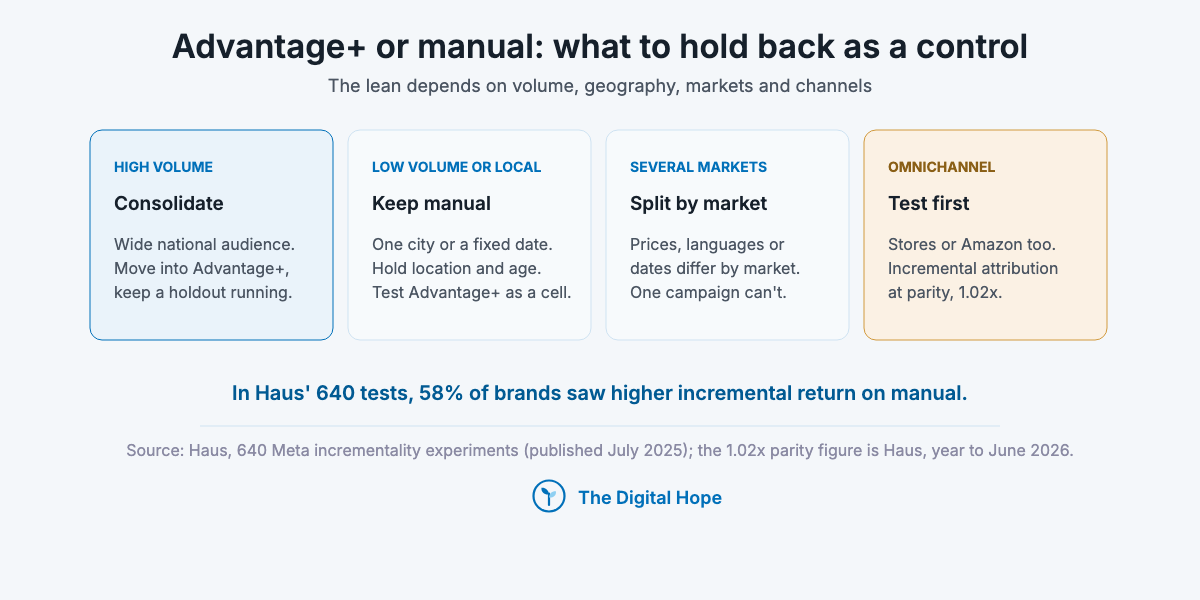
| Your situation | Lean | Why |
|---|---|---|
| High conversion volume, wide national audience, plenty of creative | Consolidate into Advantage+ and keep a manual cell or a geographic holdout | The system has enough data to learn, and the holdout tells you whether it is earning its credit |
| Low volume, tight geography or a fixed end date (a single-city show, a local service) | Keep manual location and age controls, and test Advantage+ as one cell | Automated audiences expand, which costs most when the buyer pool is small and local |
| Several markets with different prices, languages or dates | Separate campaigns by market | One consolidated campaign cannot respect different offers |
| Omnichannel brand selling in stores or on Amazon too | Test incremental attribution before switching to it | Haus found it at parity for omnichannel brands (1.02x) in the year to June 2026 |
Automation earns its place in a test, not a setup screen.
Quick Summary: Advantage+ vs manual on Meta
Q: Is Advantage+ better than manual campaigns on Facebook?
A: Not by default. In Haus’ 640 experiments, 58% of brands saw higher incremental return on manual, and Meta’s reporting overstated Advantage+ by about 12 points. Start in Advantage+, because it is now Meta’s default setup, and keep a manual campaign or a holdout running as the comparison.
Insight: what the Haus data is, and is not
Haus ran treatment and control experiments averaging 18.6 days, plus an 8.8-day window after the ads stopped, and measured direct-to-consumer return against Meta’s 7-day click, 1-day view reporting. Its customers are large ecommerce brands that chose to test, so the results say nothing direct about apps, events or small budgets. It is the best evidence published, and it is one vendor.
Your 2026 conversion numbers use new definitions
“Meta updated click-through attribution to only include conversions that happened after a click on an ad link.”
Jon Loomer, “How Meta Ads Attribution Works in 2026”, 10 March 2026
A conversion on Meta in 2026 is counted on narrower terms than a year earlier, so any comparison across the two changeover dates compares two different things. Meta’s reporting API returns 1-day view, and 1-day, 7-day and 28-day click, since 12 January 2026. Since March 2026, a click-through conversion means someone clicked the link, and conversions after a like, share or save are reported separately as engage-through. The video engaged-view threshold is 5 seconds.
For a website conversion ad set in 2026, Jon Loomer documents the default as 7-day click, 1-day view and 1-day engage-through, with 1-day click as the other click option. Billing did not change. Meta’s stated aim for the March change, in its click attribution announcement, was closer agreement with tools like Google Analytics.
Where the two dates show up in practice:
- Dashboards built on API connectors show a step on 12 January 2026 if they pulled longer view windows.
- Client and CFO reports that compare 2025 click-through with 2026 click-through count likes and saves in one year and not the other.
- Marketing mix models fed with Meta’s view-through data have a series that changes definition mid-history.
None of this means sales fell. Vendor blogs claiming “15 to 40% fewer conversions” after January 2026 publish no sample or method, and they mix up attributed conversions with real ones.
One more thing moves your numbers without moving your account: the market. Meta reported its average price per ad up 12% year on year in Q2 2026, with impressions up 14%. That is a blended global figure, not your CPM, but part of a rising CPM is the auction, not your ads.
The honest counterweight: Haus found click-only reporting under-reports Meta’s real effect by about 15% in its tests, so leaving out view-through entirely under-credits video-heavy and upper-funnel campaigns. Use 7-day click as the comparison line, and calibrate it with a lift or geo test when budget allows.
Annotate both dates before you compare anything.
Quick Summary: Facebook attribution window in 2026
Q: What attribution window should I use on Meta in 2026?
A: Report on 7-day click, which since March 2026 counts link clicks only. Meta’s reporting API returns 1-day view and 1, 7 and 28-day click since 12 January 2026, so mark both dates on any chart that compares 2025 with 2026.
Insight: what Meta changed and what it did not
Meta’s 3 March 2026 announcement moved likes, shares and saves out of click-through and into engage-through for website and in-store conversions, and extended engage-through to all formats. Billing stayed the same. Meta also cited a figure on Reels purchase conversions to justify the change, with no method published, so it is not repeated here.
So here is the setup, in the order it should happen.
The playbook: five steps for a consumer brand selling online
This playbook is for a consumer (B2C) advertiser whose checkout Meta can track, with enough sales each week for the system to learn. Each step starts with one action in a named tool. If you generate leads for a sales team, read the B2B section after the steps first.
1. Check what Meta can see before you touch a campaign
Open Events Manager, select your purchase event, and confirm it arrives from both the browser pixel and the Conversions API with duplicates removed. Meta’s Conversions API documentation covers the setup. Everything after it depends on this.
- Does every event that makes you money arrive from both the pixel and the Conversions API?
- Does Events Manager show those events as deduplicated?
- Does each purchase carry its value and currency?
- If checkout happens on another company’s site, does any purchase reach Meta at all?
Skip nothing here. If the last answer is no, stop and fix it, because every later step assumes Meta can see the sale.
2. Bid toward the event that pays, and know your breakeven
Write down your gross margin and divide 1 by it. That is your breakeven ROAS: at a 40% margin it is 2.5, and below that line each sale loses money before overheads. This is arithmetic, not a benchmark. There is no “good ROAS” for Meta in general, only yours.
Then choose the event Meta bids toward. The cheapest event to buy is rarely the one that pays. In one consumer AI app I ran (ChatPDF, August to November 2024), campaigns bid toward installs and US installs cost $0.10 to $0.50 on the platforms’ own reporting. Monetisation came later and did not perform well. That is an install cost, not a customer cost: [FIRST-PARTY, n=1].
- Which event is closest to revenue while still happening often enough for Meta to learn from it?
- Does that event carry a value, so Meta can tell a big order from a small one?
- What is your breakeven ROAS, written down where the team can see it?
Condition: bidding toward installs works when nearly every install turns into money, as in an ad-funded app. For subscription or in-app purchase apps, bid toward an early value event instead.
3. Start in Advantage+, and hold back a control
In Ads Manager, build the sales campaign in the Advantage+ setup, then run a manual campaign or a geographic holdout beside it with a fixed end date. Write the end date and the decision rule down before launch. Meta’s Advantage+ campaign migration note explains how existing shopping and app campaigns map to the single setup.
Use the audience controls you have. You can exclude your own custom audiences, such as recent buyers, when you want new customers rather than repeat orders, and employer exclusions sit at account level. Location and age are the controls that matter most for a local or dated offer.
- What share of budget sits in the control, and for how long?
- Which number decides the test: backend revenue, new customers, or Meta-reported purchases?
- Are recent buyers excluded where the campaign’s job is new customers?
Condition: below the budget where a holdout can reach a readable result, compare Advantage+ weeks with your own backend sales by week, and accept that the read is rough.
4. Feed it distinct creative concepts, not variants
List every live ad and group them by concept: the idea, the angle, the person on screen. Twenty ads that share one idea are one concept.
Meta’s November 2024 guidance asks for at least 20 diversified ads per sales campaign, new ads every week, and 20 to 30% of budget on testing them. It was written for the shopping campaign type that the single Advantage+ setup absorbed, so treat the numbers as Meta’s advice rather than a tested optimum. Meta flags “Creative limited” or “Creative fatigue” in the Delivery column when ads look too alike, as its creative differentiation guide describes, and it publishes no similarity threshold, so ignore agency “keep it under 40%” scores.
Check the AI creative enhancements switched on at ad level. In June 2026, REI said Meta had auto-enrolled it in an AI personalisation feature that altered a product image, and the distorted ad ran for about a week. Organic posts that already earned attention are a cheap source of new concepts; our guide to organic social media marketing covers how they get reach.
If creators make your ads, run them as partnership ads and disclose the relationship. Under the FTC’s revised Endorsement Guides (June 2023), the brand shares the disclosure duty, and the platform’s label alone may not be enough.
- How many distinct concepts are live, counted by idea rather than by file?
- Which AI creative enhancements are on, and has anyone looked at what they changed?
- Is every creator ad labelled and disclosed?
Condition: if you run a small team, 20 new concepts a week is out of reach. A few concepts that differ are worth more than thirty resizes of one, because Meta says near-identical ads can be treated as one ad. Set the monthly number to what your team can make.
5. Read results on the 2026 definitions, then calibrate with a test
In your reporting tool, annotate 12 January 2026 and mid-March 2026, set 7-day click as the comparison window, and line it up weekly against backend orders. The gap between the two is your working correction until a test replaces it.
- Do any charts compare 2025 and 2026 across either date without a note?
- How far apart are Meta-reported purchases and backend orders each week?
- When could the budget support a lift or geo test, and who owns it?
Condition: unless you sell only on your own site, backend website sales under-count too, because some of the effect lands in stores or on marketplaces. The test is the tiebreaker, not either dashboard.
Pulling it together. Start in Events Manager and do not leave until every money event arrives deduplicated: write that down as done or not done. Then write your breakeven ROAS next to the event Meta bids toward. Launch in Advantage+ with a dated control and one decision rule. Count your live ads by concept, not file, and switch off any AI enhancement nobody has reviewed. Finally, annotate the two 2026 dates and put a weekly backend comparison on the calendar. If you do only one of these this week, do the first.
Quick Summary: Facebook ads strategy for conversions in 2026
Q: What is the best Facebook ads strategy for conversions in 2026?
A: Fix tracking first (pixel plus Conversions API, deduplicated), bid toward the event that pays against your own breakeven ROAS, start in Advantage+ with a control, feed it distinct creative concepts, and read results on the 2026 definitions with a lift test when budget allows.
Insight: the cost of a click is not the cost of a customer
When the US National Association of Realtors tested Meta’s Advantage+ audience against its standard targeting, The Close reported in October 2026 that cost per landing page view fell 29% across 432,000 views. No lead or client cost was reported. Cheaper traffic is easy to show. Whether it is cheaper revenue is the question most published tests leave open.
If you sell to businesses, lead generation on Meta works differently
For B2B lead generation, the conversion that pays is a qualified lead or a closed deal, often weeks or months after the click and recorded in your CRM, so a Meta campaign that only sees form fills learns to find form-fillers. Everything above about signal applies twice over.
Cheaper clicks are not cheaper accounts. In Dreamdata’s 2026 benchmarks (3.5 million B2B customer journeys, mostly software companies), Meta’s average CPC was €1.60 against €5.98 on LinkedIn, yet the cost per company influenced was €128.70 on Meta against €70.11 on LinkedIn. Dreamdata sells B2B attribution and does not publish its attribution model, and “influenced” is association, not cause.
My read: if your CRM can send the qualified-lead stage back to Meta as an event, through the Conversions API’s offline events, bid toward that stage rather than the raw form. If it cannot, judge Meta on the pipeline it sources, not its cost per lead. For the search side of the same budget decision, see SEO vs paid search.
Worth it if Meta can see the qualified lead.
Quick Summary: Facebook ads for B2B lead generation
Q: Do Facebook ads work for B2B lead generation?
A: They can, if Meta learns from qualified leads rather than raw form fills. Meta clicks are cheaper than LinkedIn’s in Dreamdata’s 2026 data (€1.60 vs €5.98), but cost per company influenced was higher (€128.70 vs €70.11). Judge it on pipeline, not cost per lead.
What stopped being true
| What | When | Primary source |
|---|---|---|
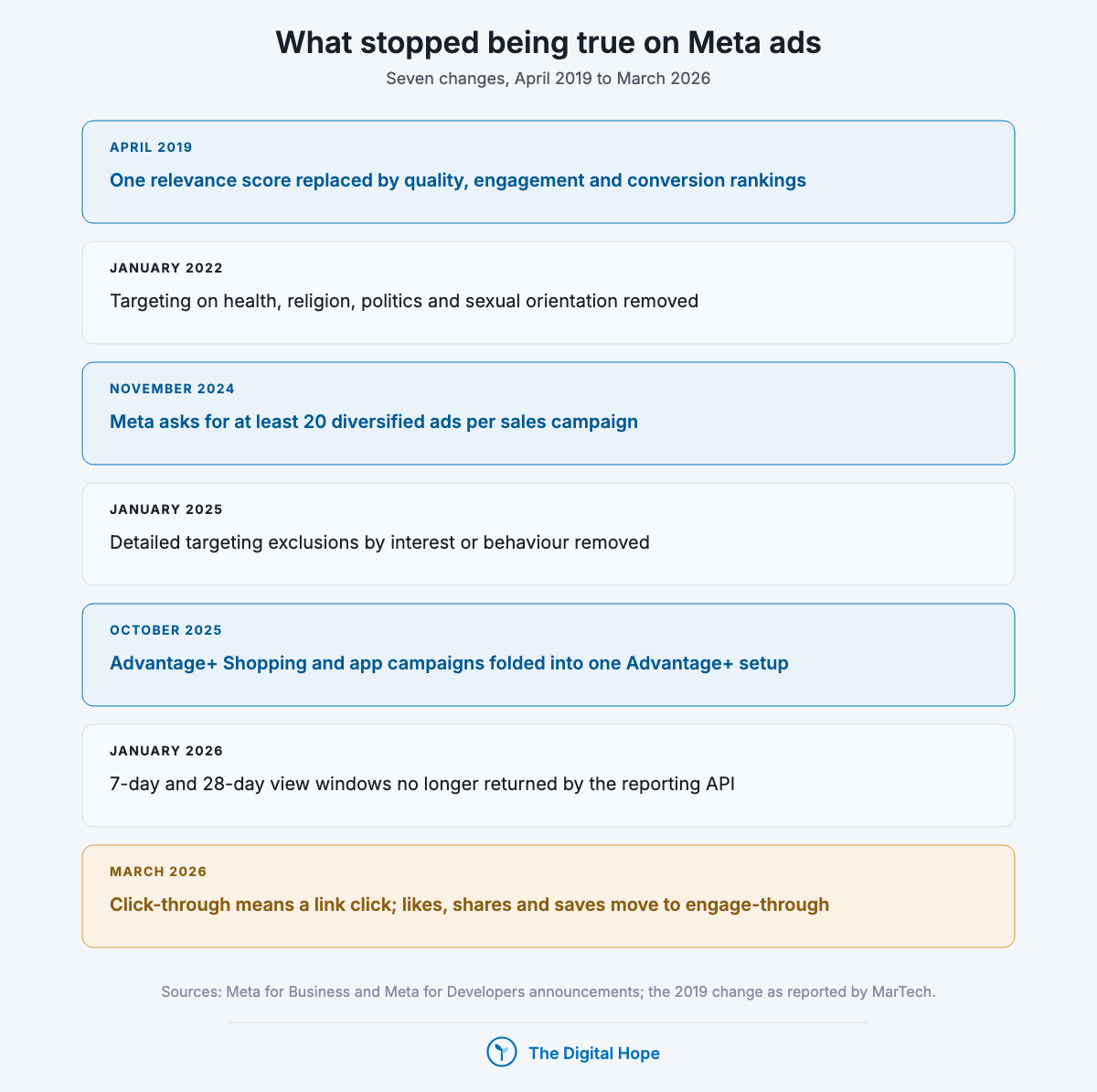
| A single relevance score per ad (replaced by quality, engagement rate and conversion rate rankings) | After 30 April 2019 | Facebook’s announcement, as reported by MarTech, March 2019 |
| Detailed targeting on health, religion, politics or sexual orientation | Removed 19 January 2022 | Meta for Business, 9 November 2021 |
| Detailed targeting exclusions by interest or behaviour | Removed, announced 21 January 2025 | Meta for Developers, 21 January 2025 |
| A handful of ads per ad set as the norm | Meta asks for at least 20 diversified ads per sales campaign, 19 November 2024 | Meta for Business, 19 November 2024 |
| Advantage+ Shopping and app campaigns as separate types | Folded into one Advantage+ setup, 8 October 2025 (Marketing API v24) | Meta for Developers, 8 October 2025 |
| 7-day and 28-day view windows in the reporting API | No longer returned, 12 January 2026 | Meta for Developers, 16 October 2025 |
| Any click counted as a click-through | Link clicks only, March 2026 | Meta for Business, 3 March 2026 |
Questions people ask about Facebook ads conversions
Do I still need the Meta pixel if I use the Conversions API?
Yes, in most setups. Meta’s guidance is to send key events through both and confirm in Events Manager that duplicates are removed, so each sale is counted once.
What is a good ROAS for Facebook ads?
There is no defensible general number. None of the benchmark pages we checked published a dataset, size, period and method. Your floor is your breakeven ROAS: 1 divided by your gross margin, measured on a stated attribution window.
How many ads should a Meta sales campaign have?
Meta’s own guidance is at least 20 diversified ads, refreshed weekly (November 2024). What counts is distinct concepts: Meta can treat near-identical ads as one, so twenty resizes of one idea do not meet it.
Which audiences can I still exclude on Meta?
Your own custom audiences, such as customers or site visitors, plus employer exclusions at account level. Use them when you want new customers rather than repeat buyers.
How long should an Advantage+ versus manual test run?
About four weeks. Haus’ Meta experiments averaged 18.6 days plus an 8.8-day window after the ads stopped, and some still came back inconclusive.
In a nutshell
Fixing the signal is setup work you do once. Knowing whether Advantage+ beats your manual setup takes about a month per test. Haus’ tests averaged 18.6 days plus an 8.8-day window after the ads stopped, so plan each comparison at roughly four weeks, and expect some to come back inconclusive.
This playbook holds for consumer brands whose sale Meta can see. If Meta cannot see your conversion, as in the concert account above, fix that first, because until then every campaign is a traffic campaign. Meta rewards the advertiser who sends the cleanest signal and the most distinct creative. A 2026 dataset showing Advantage+ ahead of manual on incremental return is the result that would change this call.
If you would rather have someone look at your account, that is what I do in a consultation.
About this article

Written by
Sai Subramaniam
SEO, GEO and Paid Ads Manager · 8+ years in growth marketing
I have run SEO, paid media and ABM for B2B AI companies, consumer apps and live-entertainment brands, from a solo operator at an AI infrastructure company to a team of 20 recovering a million-visitor site after a Google update. I write these guides from that work, and every number in them carries its source.
See my portfolioConnect on LinkedInHow this one was checked. Every number traces to a named source with its dataset and period, and every platform feature, policy or limit cites the platform’s own documentation with the date it was verified. Where the author’s own results appear, they are labelled as one account’s results, with the budget and context, not as a rule.
No affiliate links and no paid placements. Tools are named because they are what practitioners use, not because anyone paid to appear here.
Reviewed: October 2026. Ad platforms and search features change every few months; anything we could not verify at the time of writing is marked as unverified rather than turned into a number.
Corrections. If something here is wrong or has changed since, we would rather know. Corrections are made in place, with a note saying what changed.