
“A campaign is the highest-level organizational structure within an ad account and should represent a single objective.”
Meta for Developers, Marketing API overview, checked 29 October 2026
Most ad accounts that waste money are not badly targeted. They are badly layered. The budget sits at the level where it fights itself, the platform is told to find form-fillers when the business needs buyers, and twenty ads that say the same thing are counted as twenty tests. Which level is the problem in yours?
Every ad account has three levels, and each one controls a different decision. The campaign decides what the platform is paid to find. The ad set (an ad group on Google and TikTok) decides who it looks among, where, and with how much money. The ad decides what the person sees. Meta, Google, TikTok and LinkedIn all build accounts this way, under different names, and all four learn from the conversion you name at the top. Get the top decision wrong and nothing below it can repair it.
This guide walks the three levels in order, says what matters at each and what does not, covers the tracking that sits underneath all of them, and then the funnel: how TOFU, MOFU and BOFU campaigns hand audiences and conversion data to each other. Where a consumer (B2C) account and a business-to-business (B2B) account need different answers, each gets its own.
How we know
Mechanics and dates: each platform’s own documentation (Meta for Developers, Google Ads Help, TikTok Business Help Center, LinkedIn Help), checked on 29 October 2026 and named where used.
Independent data: Haus’ 640 Meta incrementality experiments (published July 2025), Dreamdata’s 2026 B2B benchmarks (3.5 million customer journeys) and a peer-reviewed study of 663 Facebook experiments. Each is named with its limits.
First-party: accounts I ran, labelled where they appear. Each is one account, n=1.
What this cannot tell you: what your account will do. No public CPC, CPA or ROAS benchmark we found published its dataset, period and method, so none appears here.
The short version
Campaign: one objective and one conversion event, the one closest to revenue that still happens often enough to learn from.
Ad set: split only where the platform cannot infer the difference itself: market, language, price, funnel stage.
Ad: distinct concepts, not variants. For B2B the copy does part of the targeting.
Tracking: browser tag plus a server-side or offline feed on every platform you pay, or the platform learns from clicks.
Funnel: in B2B, top, middle and bottom of funnel feed each other. A bottom-of-funnel-only account starves.
The same three levels exist on every platform, under different names
“Starting in October 2025, Campaign Manager will rename two out of its four entities: Campaign group and Campaign.”
LinkedIn Help, Campaign Manager naming update, checked 29 October 2026
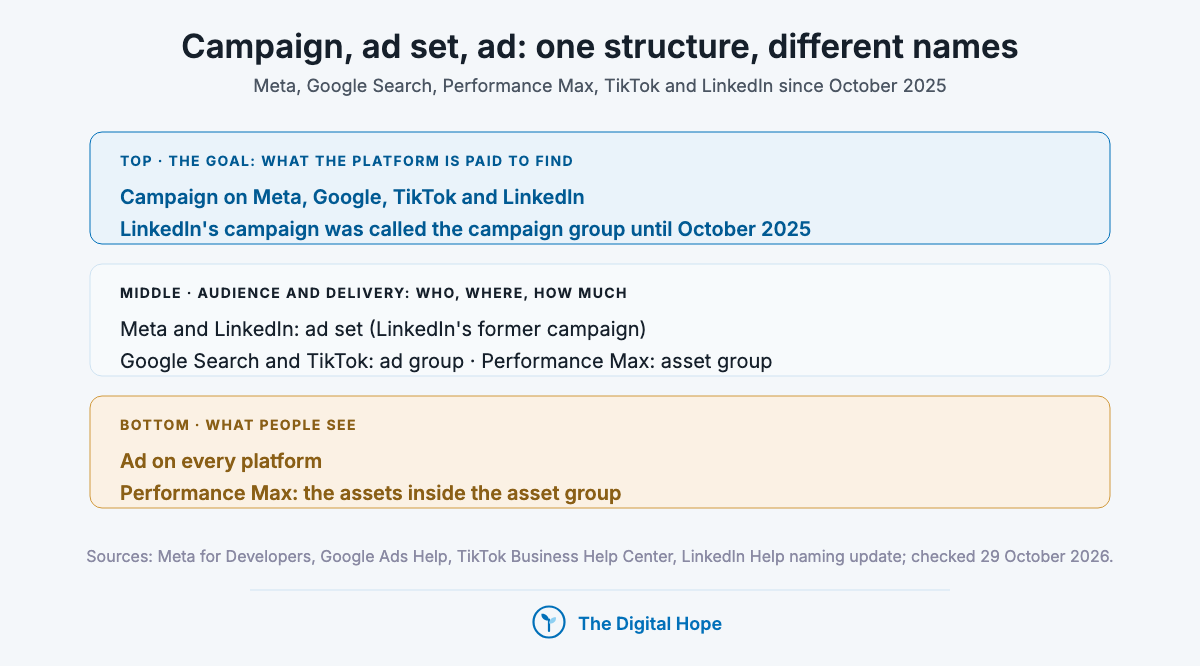
Meta, Google, TikTok and LinkedIn all use a three-level structure: a container for the goal, a middle level for audience and delivery, and the ad itself. The names differ, and since October 2025 LinkedIn uses Meta’s words: what was a campaign group is now a campaign, and what was a campaign is now an ad set, as LinkedIn’s naming update explains.
| Level | Meta | Google Search | Google Performance Max | TikTok | LinkedIn (since Oct 2025) |
|---|---|---|---|---|---|
| Top: the goal | Campaign | Campaign | Campaign | Campaign | Campaign (was campaign group) |
| Middle: audience and delivery | Ad set | Ad group | Asset group | Ad group | Ad set (was campaign) |
| Bottom: what people see | Ad | Ad | Assets inside the asset group | Ad | Ad |
The names line up. The controls do not. Here is where each decision sits as of October 2026:
| Decision | Meta | TikTok | ||
|---|---|---|---|---|
| Objective | Campaign | Campaign (goal and campaign type) | Campaign | Campaign and ad set |
| Budget | Campaign (Advantage campaign budget) or ad set | Campaign, or a budget shared across campaigns | Campaign (Campaign Budget Optimization) or ad group | Campaign or ad set |
| Conversion event and bidding | Ad set (performance goal) | Campaign (conversion goals and bid strategy) | Ad group (optimization goal) | Ad set |
| Audience and placements | Ad set | Campaign (locations, networks) and ad group (keywords) | Ad group | Ad set |
| Creative and copy | Ad | Ad, or assets in a Performance Max asset group | Ad | Ad |
The one that catches people is Google. Budgets sit on the campaign, never on the ad group, so two ad groups that need different money need different campaigns. Meta, TikTok and LinkedIn let you choose.
Learn the map once.
Quick Summary: campaign vs ad set vs ad
Q: What is the difference between a campaign, an ad set and an ad?
A: The campaign sets the objective, and often the budget. The ad set (an ad group on Google and TikTok) sets the audience, placements, schedule and the conversion the platform bids toward. The ad is the creative and copy. LinkedIn adopted the campaign and ad set names in October 2025.
Insight: why old LinkedIn instructions now read wrong
LinkedIn’s help page on the October 2025 change keeps “ad account” and “ad” as they were and renames only the two middle entities. A LinkedIn guide that tells you to “set the budget on the campaign group” is describing what LinkedIn now calls the campaign. Agency templates, naming conventions and reporting connectors built before the change may still use the old labels, so check which level a column really refers to.
Campaign level: the conversion you name decides what the platform learns to find
“used for bidding as long as the standard goal they are part of is used for bidding.”
Google Ads Help, on primary conversion actions, checked 29 October 2026
At campaign level, two choices matter more than everything else in the account: the objective, and the conversion event the platform bids toward. On Google, only primary conversion actions drive bidding, and secondary actions are reported in the “All conversions” column without steering bids, per Google’s page on primary and secondary conversion actions. Meta and TikTok set the event one level down, on the ad set or ad group, but the rule is the same.
The platform finds more of whatever you count. It shows up the same way in every kind of account:
- A store that counts add-to-cart: the platform finds people who add to cart, many of whom never pay.
- A B2B company that counts every form fill: the platform finds form-fillers. LinkedIn’s Lead Gen objective bids toward plain leads unless qualified-lead data comes back through its Conversions API (LinkedIn Help, checked 29 October 2026).
- A B2B company that counts the sales-qualified stage: the platform aims at buyers, but Google asks for about 15 conversions in 30 days, ideally within 7 days of the click, before bidding on qualified leads.
- And in one consumer AI app I ran (ChatPDF, August to November 2024), campaigns bid toward installs, and US installs cost $0.10 to $0.50 on the platforms’ own reporting. Monetisation came later and did not perform well. That is an install cost, not a customer cost: [FIRST-PARTY, n=1].
Pick the event closest to revenue that still clears the volume floor. That is the most important sentence at this level.
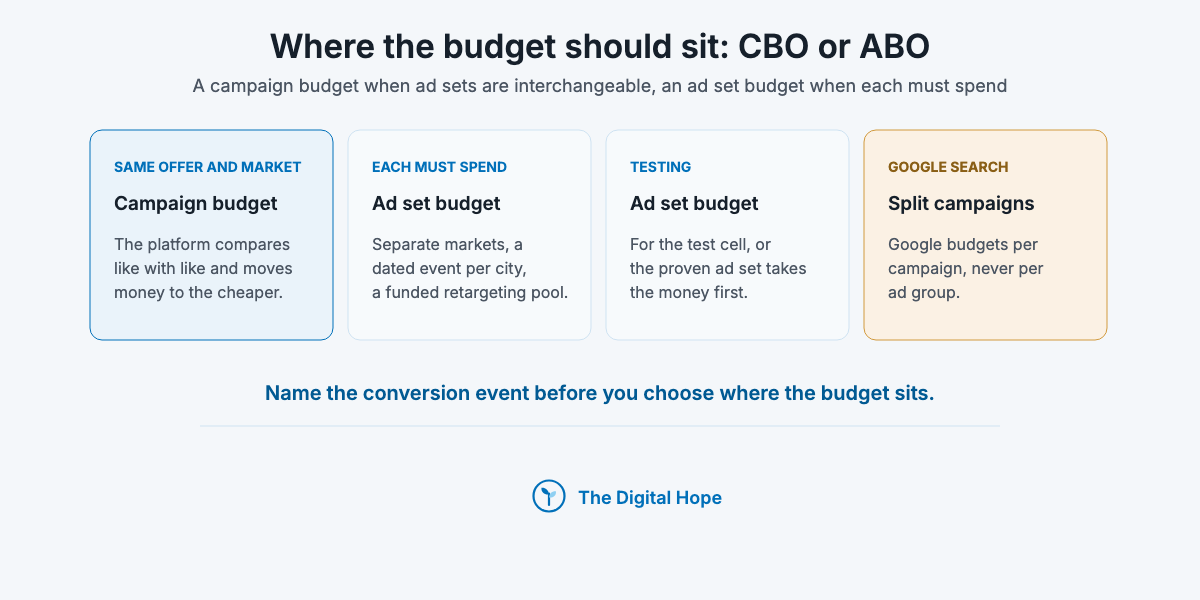
Budget is the second campaign-level choice, and it matters less than the forums suggest. A campaign-level budget (Meta’s Advantage campaign budget, which practitioners still call CBO, and TikTok’s Campaign Budget Optimization) lets the platform move money between ad sets toward the cheapest results. An ad set budget (ABO) holds each ad set to the amount you set, and Meta’s ad set budget sharing lets up to 20% of a daily budget move between ad sets. Google has no ad group budgets at all: it budgets per campaign, or across campaigns with a shared budget.
| Your situation | Lean | Why |
|---|---|---|
| Ad sets that share an offer, price and market | Campaign budget (CBO) | The platform can compare like with like and shift money to the cheaper result |
| Ad sets that must each spend: separate markets, a dated event per city, a retargeting pool you want funded | Ad set budget (ABO), or separate campaigns | A campaign budget will starve the smaller or pricier ad set, which may be the one that matters |
| Testing new creative or audiences against a proven ad set | Ad set budget for the test cell | Otherwise the proven ad set takes the money before the test can read |
| Google Search with intent tiers that need fixed spend | Separate campaigns per tier | Google cannot split one campaign’s budget by ad group |
What does not matter at campaign level: the campaign name, as far as the platform’s delivery goes. Names matter to you, in reporting, so make them say objective, market and funnel stage.
Name the event before the budget.
Quick Summary: CBO vs ABO
Q: Should I use CBO or ABO?
A: Use a campaign budget (CBO) when the ad sets are interchangeable, same offer, market and price, so the platform can shift money to the cheaper result. Use ad set budgets (ABO) when each ad set must spend, such as separate markets, a dated event or a test cell. On Google, budgets live on the campaign only.
Insight: what Google asks before you bid on lead quality
Google’s guidance on high-quality leads, checked on 29 October 2026, offers “qualified lead” and “converted lead” goals, but asks for at least 15 conversions in the last 30 days, ideally landing within about 7 days of the ad interaction, and daily offline uploads. A B2B sale that closes in months rarely meets that at the opportunity stage, which is why the qualified-lead or sales-accepted stage is usually the deepest event a small account can bid on.
Ad set level: audience and placements are hints now, so split only what the platform cannot infer
“All ads contained within an ad set should also have the same targeting and optimization goal.”
Meta for Developers, Marketing API overview, checked 29 October 2026
The ad set is where you tell the platform where to look, how wide, and on which surfaces. On Meta it holds budget (if you chose ABO), schedule, targeting, placements and the performance goal, per Meta’s Marketing API overview. TikTok’s ad group holds placement, audience, budget, schedule, optimization goal and bidding method (TikTok Business Help Center, updated February and June 2025). LinkedIn’s ad set holds objective, targeting, bidding, budget and schedule.
Audience inputs have become suggestions. Meta removed detailed targeting exclusions by interest and behaviour (announced 21 January 2025) and has built sales, app and lead campaigns in a single Advantage+ setup since October 2025. TikTok’s Smart+ runs one AI campaign where you supply KPIs, creative, geography and language. So what is still worth splitting?
- Market, language and currency: the platform cannot sell a German price in English to a UK buyer, so these get their own ad sets or campaigns.
- Funnel stage: a retargeting pool and a cold audience need different messages and often different budgets.
- Hard business limits: a single-city event, a delivery radius, an age-restricted product.
- Placements, for B2B: in one account I ran on about $1,500 a month (Forage AI, B2B web data, 2026), Demand Gen reported 101 clicks that produced 2 site visits, so I cut it: [FIRST-PARTY, n=1].
For B2C at scale, broad audiences with creative-led delivery are the sensible default, and interest audiences are test cells. For B2B, every default that widens reach starts switched off: LinkedIn’s Audience Network and Audience Expansion are on by default for new ad sets (LinkedIn Help), and Google recommends “All Google channels” for Demand Gen, which includes the Display Network (Google Ads Help, checked 29 October 2026). Switch them on later as a measured test, not at launch.
What does not matter at ad set level: fine audience slicing for a consumer offer with plenty of conversions. Ten interest ad sets with the same creative split the learning ten ways.
Split by business reality, not by guesswork.
Quick Summary: what to set at ad set level
Q: What should I control at the ad set or ad group level?
A: Market, language, funnel stage and hard business limits, plus placements for B2B. For consumer accounts with volume, keep audiences broad and let creative do the sorting. For B2B, switch off LinkedIn Audience Network, Audience Expansion and Demand Gen’s automatic channels at launch.
Insight: what one placement test showed, and what it cannot
In 2023 a LinkedIn ads agency founder, Gabriel Ehrlich, ran about $200 through a campaign with Audience Network on and tracked 105 visitors, of whom he judged 81 to be bots. It was one small test, three years old, by an agency that sells LinkedIn management, so it proves nothing about Audience Network today. It does show why the first report to read on a B2B account is the on-network versus off-network split.
Ad level: creative is the steering input, and in B2B the copy does part of the targeting
At ad level, the decision that matters is how many genuinely different ideas you give the platform. Meta’s retrieval system, Andromeda, which Meta described in December 2024, narrows tens of millions of candidate ads to a few thousand per ad request, and Meta’s own guidance since April 2025 treats creative diversification as the main input. Meta’s November 2024 playbook asked for at least 20 diversified ads per sales campaign, new ads weekly, and 20 to 30% of budget on testing them.
Near-identical ads count as one. Meta says creatives that are too similar can be treated as the same ad and flags “Creative limited” or “Creative fatigue” in the Delivery column, with no similarity threshold published. Twenty resizes of one idea is one concept.
For B2B, the copy is a filter as well as a pitch. When the audience cannot be drawn tightly, the ad has to tell the wrong people to keep scrolling: name the role, the problem and the price band. In one B2B account I ran (Clarifai, AI infrastructure, July 2025 to May 2026), click-through rate on Google and LinkedIn rose from about 1% to 3 to 4% after ICP research, account-based targeting and message fit were reworked together: [FIRST-PARTY, n=1]. That was one account, and the targeting changed at the same time, so the copy alone did not cause it.
Two B2B formats need judging differently. LinkedIn’s Thought Leader Ads run only on awareness and engagement objectives (LinkedIn Help, checked 29 October 2026), so judge them by who engaged and what those accounts did next, never by cost per lead.
What does not matter at ad level: the number of files. Count concepts: the idea, the angle, the person on screen.
Give it ideas, not copies.
Quick Summary: what matters at ad level
Q: How many ads should an ad set have?
A: Enough distinct concepts for the platform to choose between. Meta’s own guidance is at least 20 diversified ads per sales campaign, refreshed weekly (November 2024), and it can treat near-identical ads as one. A small team should ship fewer ideas that differ rather than many variants of one.
Insight: what Andromeda changed about the ad level
Meta’s December 2024 engineering post describes Andromeda as the retrieval stage that picks a few thousand candidate ads per request out of tens of millions, and reports gains in recall and ads quality on selected segments. It does not publish what makes two creatives “different enough”. Treat any agency similarity score as that agency’s rule of thumb, and judge diversity by idea, not pixels.
Tracking sits under all three levels, and without it the platform learns from clicks
“App Tracking Transparency requires apps to get the user’s permission before tracking their data across apps or websites owned by other companies.”
Apple, on the iOS 14.5 release, 26 April 2021
Every level above depends on one thing: the platform seeing the conversion. Since iOS 14.5 on 26 April 2021, the browser tag alone misses events, so every major platform now pairs it with a server-side or offline feed:
| Platform | Browser tag | Server or offline feed | What the feed adds |
|---|---|---|---|
| Meta | Meta pixel | Conversions API | Server events, deduplicated against the pixel |
| Google tag | Enhanced conversions (web), enhanced conversions for leads | Hashed first-party data matched to signed-in accounts, and CRM outcomes tied to the original click | |
| Insight Tag | Conversions API | Server and CRM events, including qualified leads | |
| TikTok | TikTok pixel | Events API | Server events from your own systems |
Meta’s Conversions API documentation describes a server-to-server connection and asks you to confirm events are deduplicated. For B2B, the offline feed is the one that matters most, because the sale happens in the CRM. Google’s enhanced conversions for leads page says offline conversion and lead uploads moved to the Data Manager API from 15 June 2026, so an integration built on the old Google Ads API route needs checking.
No signal, no learning. In one live-events account I ran (Star Entertainment, touring concert productions, December 2024 to March 2025, more than €500K a month on Meta), tickets sold on an external ticketing site and Meta never received a purchase event. It could not bid toward buyers or report revenue, so the campaigns ran on manual location, age and interest targeting and the platform could only learn from the click: [FIRST-PARTY, n=1].
If you advertise to people in the EEA, the UK or Switzerland, Google requires consent to be collected and passed through consent mode, or personalised ads and remarketing for those users are lost. Enhanced conversions only send data for users whose consent allows ad user data.
What does not matter here: chasing a perfect match score. Meta publishes no target Event Match Quality and no deduplication window, so get every money event arriving deduplicated and move on.
Fix the signal before the structure.
Quick Summary: tracking for performance marketing
Q: What tracking does a performance marketing account need?
A: A browser tag plus a server-side or offline feed on every platform you pay: Meta pixel and Conversions API, Google tag and enhanced conversions, LinkedIn Insight Tag and Conversions API, TikTok pixel and Events API. For B2B, send CRM stages back, or the platform learns from form fills.
Insight: what consent mode does and does not recover
Google’s consent mode documentation, checked on 29 October 2026, says that in basic mode a visitor who declines sends Google nothing at all, while advanced mode sends cookieless pings that feed a model for that advertiser, subject to a data threshold. Modelled conversions are estimates, not recovered data, and a small site may not reach the volume where modelling switches on.
The funnel: TOFU, MOFU and BOFU work as one system that hands data down
“The 95% figure is not meant to be a precise rule.”
John Dawes, Ehrenberg-Bass Institute, on the 95:5 rule (johndawes.info)
The funnel is not three separate campaigns. It is one system where each stage builds the audience or the data the next stage needs. Top of funnel (TOFU) reaches people who do not know you yet. Middle of funnel (MOFU) retargets the ones who engaged. Bottom of funnel (BOFU) asks the warmest people to buy, book or sign up. The handoff is mechanical:
- TOFU builds the pools: video viewers, site visitors and page engagers become retargeting audiences. Google keeps “your data” segment members for up to 540 days, and LinkedIn website retargeting runs 30 to 180 days depending on the range you choose (Google Ads Help, LinkedIn Help, checked 29 October 2026).
- MOFU turns attention into a signal: a content download, a demo video watched, a free signup. Those conversions seed the BOFU audiences and lookalikes.
- BOFU closes, and sends the outcome back: the purchase or the qualified lead goes back to every platform through the tracking feeds above, so the top of the funnel learns which people turned into buyers.
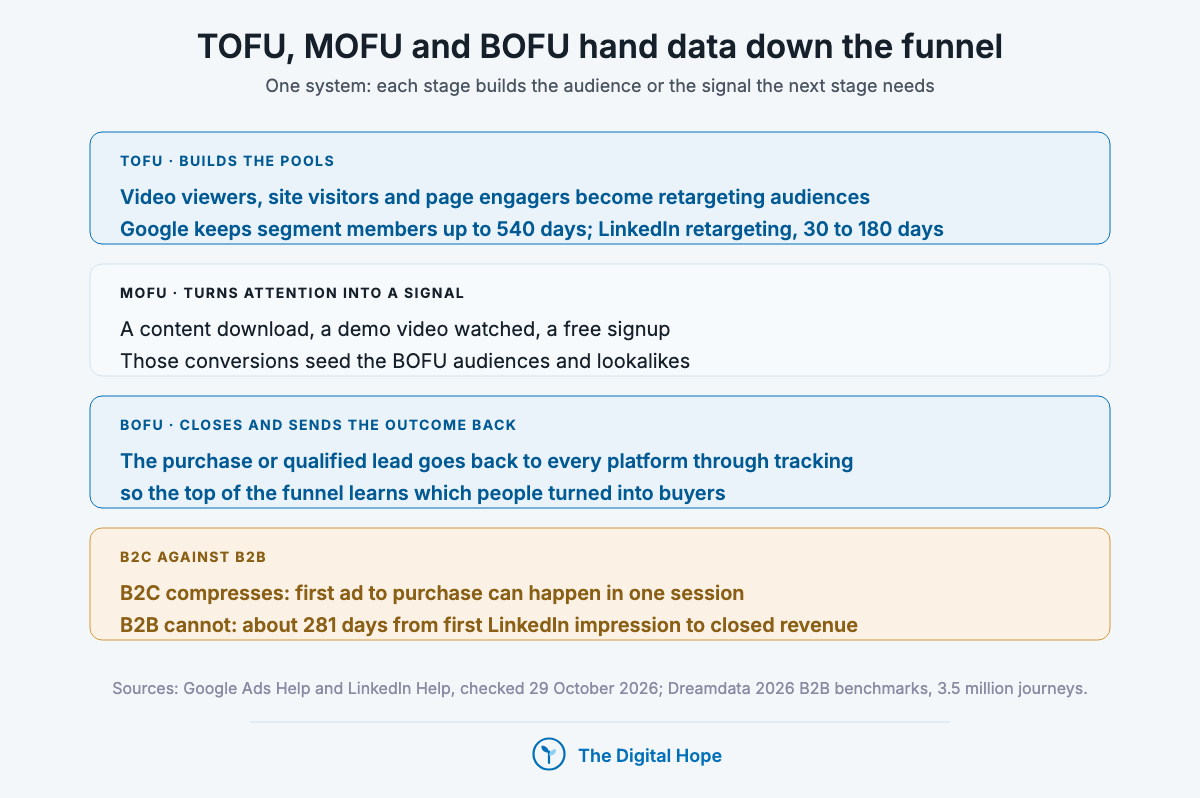
For B2C, the funnel compresses. The buyer can go from first ad to purchase in a session, and the platform sees the sale within days, so fewer and larger campaigns can learn. In Haus’ 640 Meta experiments, Advantage+ reached a 70% share of new customers against 65% for manual, but 58% of brands tested head to head saw higher incremental return on manual. Keep a separate retargeting budget only when the account is big enough to prove it adds sales a holdout would not.
For B2B, the funnel cannot compress, because the buyer is not in market most of the time. In Dreamdata’s 2026 dataset of 3.5 million B2B journeys, the time from a first LinkedIn ad impression to closed revenue was about 281 days. An account that only buys bottom-of-funnel commercial terms finds the few people already shopping, and those terms barely have volume.
In one B2B account I ran (Clarifai, AI infrastructure, July 2025 to May 2026), the account had chased bottom-of-funnel commercial terms only. I rebuilt it as a full funnel: video-led TOFU on Google Video and Demand Gen, retargeting and conversion data feeding the middle, and content downloads feeding the bottom, with the developer community treated as a brand and pipeline asset. Cost per signup went from about $1,000 to under $4, with sales-accepted leads at about $25 to $30: [FIRST-PARTY, n=1]. Signup was free and self-serve, a low-friction conversion, and the product had market fit, which a setup cannot supply.
My read: below the budget that can fund three stages, BOFU plus retargeting is the floor, not the plan. On a small B2B budget, LinkedIn earns its place there as Thought Leader Ads and retargeting rather than as the prospecting engine.
A full funnel feeds itself.
Quick Summary: TOFU, MOFU, BOFU in paid media
Q: How do TOFU, MOFU and BOFU campaigns work together?
A: TOFU builds audiences (viewers, visitors), MOFU turns them into a signal (downloads, signups) and BOFU converts them and sends the outcome back to the platforms. In B2C the funnel can run in one automated campaign. In B2B, a bottom-of-funnel-only account starves, because few buyers are in market at once.
Insight: how much of a B2B market is buying right now
Dawes derived the 95:5 rule from an assumed five-year supplier switching cycle and calls it a heuristic. Forrester’s May 2025 survey of B2B martech buyers put the in-market share nearer 15% to 30%, varying by category and by vendor, from stated switching intent rather than purchases. Either way, most of the market is not buying this quarter, which is the case for funding the top of the funnel.
So here is how to set an account up, in the order the decisions depend on each other.
The playbook: five steps to structure a performance marketing account
This playbook works for a new account or a rebuild, on any of the four platforms. Each step starts with one action in a named tool, and each has a condition note for when to change it.
1. Name the conversion and confirm the platform can see it
Open the conversions screen in each platform (Meta Events Manager, Google Ads Goals, LinkedIn Campaign Manager conversions, TikTok Events Manager) and write down the one event that makes you money. Then check that it arrives from both the browser tag and the server or offline feed.
- Is the money event a primary conversion on Google, and the performance goal on Meta and TikTok?
- Does it arrive from both the tag and the server or CRM feed, without double counting?
- Does it carry a value, so the platform can tell a big order from a small one?
- If checkout or booking happens on another company’s site, does anything reach the platform at all?
Condition: for B2B, if the qualified stage happens fewer than about 15 times a month, bid on the nearest earlier stage that does, and keep the qualified stage as a secondary conversion for reporting.
2. Build one campaign per objective, then decide where the budget lives
In the campaign setup screen, choose one objective, then decide campaign budget (CBO) or ad set budget (ABO) using the table in the campaign section. Write the decision rule next to it.
- Is every campaign named with its objective, market and funnel stage?
- Are any ad sets that must spend sitting under a campaign budget that can starve them?
- On Google, does each intent tier that needs fixed money have its own campaign?
Condition: if you sell to consumers and run Performance Max, keep Search or Shopping as a comparison. For low-volume B2B lead generation, start with Search and Demand Gen rather than Performance Max, because the B2B account rarely has the conversion volume the automation needs.
3. Split ad sets only where the business differs
In Ads Manager or Campaign Manager, list every ad set and write next to it the one thing that makes it different: market, language, funnel stage, or a hard limit. Merge any whose only difference is a guessed interest.
- Does each ad set have a reason the platform could not infer by itself?
- For B2B, are Audience Network, Audience Expansion and automatic Demand Gen channels off?
- Do retargeting ad sets exclude people who already bought or converted?
Condition: for a consumer account with plenty of conversions, fewer and broader ad sets let the platform learn faster. A dated local event is the exception: keep location and age tight.
4. Fill each ad set with distinct concepts for its stage
Group your live ads by idea, the angle and the person on screen, and count concepts rather than files. Then map each concept to a funnel stage: TOFU ads earn attention, MOFU ads prove, BOFU ads ask.
- How many distinct concepts are live in each ad set?
- Does the B2B copy name the role, the problem or the price band, so the wrong people self-select out?
- Which AI creative enhancements are switched on, and has anyone looked at what they changed?
Condition: a small team cannot make 20 concepts a week. Three ideas that differ beat thirty resizes of one.
5. Wire the handoff, then judge each stage on its own job
In each platform’s audience manager, build the retargeting pools from TOFU engagement, the BOFU audiences from MOFU conversions, and connect the CRM so the final outcome flows back. Put a review date on the calendar.
- Is each stage judged on its own job: TOFU on reach into the right audience, MOFU on the signal it creates, BOFU on cost per sale or qualified lead?
- Are platform-reported conversions compared each week with orders or CRM stages?
- When could the budget support a holdout or geo test, and who owns it?
Condition: if the budget cannot fund all three stages, run BOFU plus retargeting and add TOFU as soon as the bottom stage pays back.
Pulling it together. Start in the conversions screen of every platform and do not leave until the money event arrives through both the tag and the server or CRM feed. Then build one campaign per objective and write down why each budget sits where it does. Cut the ad sets down to the ones with a business reason to exist. Count your ads by concept, not file, and give each stage its own kind of ad. Finally, wire the audiences and the CRM outcome between stages and put a weekly comparison against backend numbers on the calendar. If you do one thing this week, do the first.
Quick Summary: how to structure an ad account
Q: What is the right ad account structure for performance marketing?
A: One campaign per objective and conversion event, budget placed where it cannot starve an ad set that must spend, ad sets split only by market, language, stage or hard limits, distinct creative concepts per stage, and tracking that sends the final outcome back to every platform.
Insight: why the platform's own report cannot settle the funnel question
In a peer-reviewed study of 663 Facebook advertising experiments (Gordon, Moakler and Zettelmeyer, Marketing Science, 2023), non-experimental methods estimated lower-funnel lift at roughly five times what the experiments measured, even with thousands of features per user. Retargeting looks best in exactly the reports that over-credit it. Only a holdout tells you whether a stage adds sales.
What stopped being true
| What | When | Primary source |
|---|---|---|
| LinkedIn “campaign groups” holding “campaigns” | Renamed campaigns holding ad sets, October 2025 | LinkedIn Help, Campaign Manager naming update |
| Broad match modifier (+keyword) as its own Google match type | Folded into phrase match, February to July 2021 | Google Ads Help, phrase match and broad match modifier changes |
| Smart Shopping and Local campaigns on Google | Upgraded to Performance Max from July 2022 | Google Ads Developer Blog, July 2022 |
| Meta detailed targeting exclusions by interest or behaviour | Removed, announced 21 January 2025 | Meta for Developers, 21 January 2025 |
| A handful of ads per ad set as the norm on Meta | At least 20 diversified ads per sales campaign, 19 November 2024 | Meta for Business, 19 November 2024 |
| Advantage+ Shopping and app campaigns as separate types | Folded into one Advantage+ setup, 8 October 2025 | Meta for Developers, 8 October 2025 |
| Google Video Action campaigns | Retired into Demand Gen, final campaigns by April 2026 | Google Ads Help, Video Action campaigns upgrade |
| Google offline conversion uploads through the Google Ads API | Moved to the Data Manager API from 15 June 2026 | Google Ads Help, enhanced conversions for leads |
Questions people ask about campaign structure
Does Google Ads have ad sets?
Not by that name. Search campaigns use ad groups, which hold keywords and ads, and Performance Max uses asset groups, which hold assets, audience signals and up to 50 search themes. Budgets sit on the campaign, never on the ad group.
Is CBO better than ABO?
Neither is better in general. A campaign budget suits ad sets that are interchangeable, and ad set budgets suit ad sets that must each spend. Meta also lets up to 20% of an ad set’s daily budget be shared with other ad sets.
Do I still need separate retargeting campaigns?
It depends on the buyer. For B2C at scale, a separate retargeting campaign has to prove it adds sales a holdout would not, because platform reports over-credit retargeting. For B2B, retargeting is the middle of the funnel and usually earns its own budget.
What is a good ROAS for performance marketing?
There is no defensible general number. None of the benchmark pages we checked published a dataset, period and method. Your floor is your breakeven ROAS: 1 divided by your gross margin, so at a 40% margin it is 2.5.
Is top-of-funnel advertising worth it on a small B2B budget?
Only once the bottom pays back. Start with BOFU and retargeting, then add TOFU, because in B2B most of the market is not buying this quarter and the bottom alone runs out of people.
In a nutshell
Setting the structure takes a day. Knowing whether it works takes weeks for a consumer account and quarters for B2B. Google asks for about 15 conversions in 30 days before bidding on qualified leads, a Meta structure test needs about four weeks (Haus’ experiments averaged 18.6 days plus an 8.8-day window after the ads stopped), and Dreamdata measured about 281 days from a first LinkedIn impression to B2B revenue. Plan the review dates to match.
This structure holds when the platform can see the conversion that pays. If it cannot, as in the concert account above, fix tracking first, because until then every campaign is a traffic campaign whatever its objective says. A platform change that lets advertisers set the conversion per ad, or that removes the middle level entirely, is what would change this map.
If you would rather have someone look at your account, that is what I do in a consultation.
For the next layer down, see the Facebook ads conversions playbook for Meta in detail, and SEO vs paid search for how to split budget between the two by buyer type.
About this article

Written by
Sai Subramaniam
SEO, GEO and Paid Ads Manager · 8+ years in growth marketing
I have run SEO, paid media and ABM for B2B AI companies, consumer apps and live-entertainment brands, from a solo operator at an AI infrastructure company to a team of 20 recovering a million-visitor site after a Google update. I write these guides from that work, and every number in them carries its source.
See my portfolioConnect on LinkedInHow this one was checked. Every number traces to a named source with its dataset and period, and every platform feature, policy or limit cites the platform’s own documentation with the date it was verified. Where the author’s own results appear, they are labelled as one account’s results, with the budget and context, not as a rule.
No affiliate links and no paid placements. Tools are named because they are what practitioners use, not because anyone paid to appear here.
Reviewed: October 2026. Ad platforms and search features change every few months; anything we could not verify at the time of writing is marked as unverified rather than turned into a number.
Corrections. If something here is wrong or has changed since, we would rather know. Corrections are made in place, with a note saying what changed.