
“The subject line must accurately reflect the content of the message.”
US Federal Trade Commission, “CAN-SPAM Act: A Compliance Guide for Business” (read 29 October 2026)
Last updated: October 2026.
A subject line test comes back with a clear winner on opens, the team rolls it out, and the clicks don’t move. “Open rates would have naturally trended from 20% to 60% naturally when iOS added Mail Privacy Protection,” one email marketer wrote on Hacker News in February 2023, replying to a post about a boosted open rate. So which number tells you the copy worked?
Not the open. Apple’s Mail Privacy Protection downloads remote content, tracking pixel included, whether or not the person engages with the email, and in Litmus’s September 2026 data (1.5 billion+ tracked opens) Apple Mail accounted for 76.56% of opens. For most lists, the open is now a record of Apple’s servers, not of a reader.
An email is written for one click, and judged on clicks and replies. This guide covers the writing side of that: the subject line and preview text, one job per email, a body built for people who scan, the persuasion research that holds up in email and the popular claims that don’t, CTAs, and how to test copy when your list is small. List building, consent and inbox placement live in the email list building guide.
How we know: Apple’s Mail Privacy Protection page and Google’s email sender guidelines, both read on 29 October 2026. The FTC CAN-SPAM compliance guide (penalty figure updated January 2024). Two vendor datasets with published methods: Litmus email client share (1.5 billion+ opens, September 2026) and MailerLite benchmarks (3.6 million campaigns from 181,000 accounts, December 2024 to November 2025). Peer-reviewed field experiments and replications: Sahni, Wheeler and Chintagunta (2018, three companies, millions of recipients), Hallsworth and colleagues (2017, 200,000+ people), and the replication projects cited by name below. The limit: the field experiments ran outside your list and, in one case, outside email, so treat every effect here as a hypothesis for your own test, not a forecast.
Quick Digest
– Stop judging copy on opens: Apple’s prefetching inflates them, so subject line winners picked on opens are mostly noise.
– One job per email: one reader, one click, one landing page, written down before the subject line.
– Subject line and preview text are one unit: a truthful promise the body keeps, checked on a phone before sending.
– Lean only on research that replicated: descriptive social proof and a recipient’s name have field evidence. Scarcity tricks, loss framing and “fewer choices” do not hold as rules.
– The CTA names the result of the click, and in B2B the reply is often the better CTA.
– Small lists can’t detect small lifts: at a 2% click rate you need about 3,800 recipients per version to see 2% become 3%.
The open rate can’t judge your copy anymore
“Protect Mail Activity downloads remote content in the background by default.”
Apple, “Mail Privacy Protection & Privacy” (read 29 October 2026)
Opens no longer measure reading for most lists, so they can’t tell you which subject line or body worked. Clicks, replies and what happens after the click can.
The mechanism is plain. An “open” is a tracking pixel loading. For an Apple Mail user with Mail Privacy Protection on, Apple loads that pixel whether or not anyone reads, so every protected recipient looks like an opener. Litmus’s September 2026 report puts Apple Mail at 76.56% of 1.5 billion+ tracked opens, Gmail at 16.10% and Outlook desktop at 3.48%. Litmus notes the Apple share is inflated by the same prefetching, which is the point.
The vendors that publish open benchmarks say the same. MailerLite’s 2025 benchmarks (3.6 million campaigns, 181,000 accounts, December 2024 to November 2025) report a 43.46% open rate, a 2.09% click rate and a 6.81% click-to-open rate, and MailerLite states its open figure is not adjusted for Apple’s prefetching and points readers to click rate instead.
What goes wrong when a team keeps reading opens:
- Subject line tests: the “winner” is decided by which version happened to land in more Apple inboxes.
- Send-time tests: a jump gets credited to Tuesday morning when it was prefetching.
- Re-engagement flows: inactive Apple users look active, so “no opens in 90 days” never fires for them.
- Click-to-open rate: its denominator is opens, so it shrinks as phantom opens grow, and it misleads in the other direction.
The condition that splits this is the list. For B2C and creator lists, Apple-heavy by construction, treat opens as a rough alarm only: a sudden collapse at one mailbox provider usually means a delivery problem, not a copy problem. For B2B lists of corporate addresses that skew to Outlook and Gmail, opens from non-Apple clients still carry some signal, but even there a subject line test should be decided on clicks.
Opens are a smoke alarm now.
Quick Summary
Q: Is open rate still a good way to measure email copy?
A: No, for most lists. Apple’s Mail Privacy Protection loads tracking pixels whether or not the email is read, and Apple Mail made up 76.56% of tracked opens in Litmus’s September 2026 data. Judge copy on click rate, replies and downstream conversions, and use opens only as a rough deliverability alarm.
Insight MailerLite’s own 2025 benchmark report, built on 3.6 million campaigns, publishes a 43.46% open rate and in the same breath tells readers that click rate is the more reliable indicator because opens are inflated by Apple’s privacy feature. When the company publishing the open benchmark tells you not to trust it, the case is closed for copy decisions.
Persuasion research that holds up in email, and popular claims that don’t
“No evidence that loss framing is more effective than gain framing.”
Hallsworth, List, Metcalfe and Vlaev, Journal of Public Economics 148 (2017), on randomised tax letters sent to more than 200,000 people
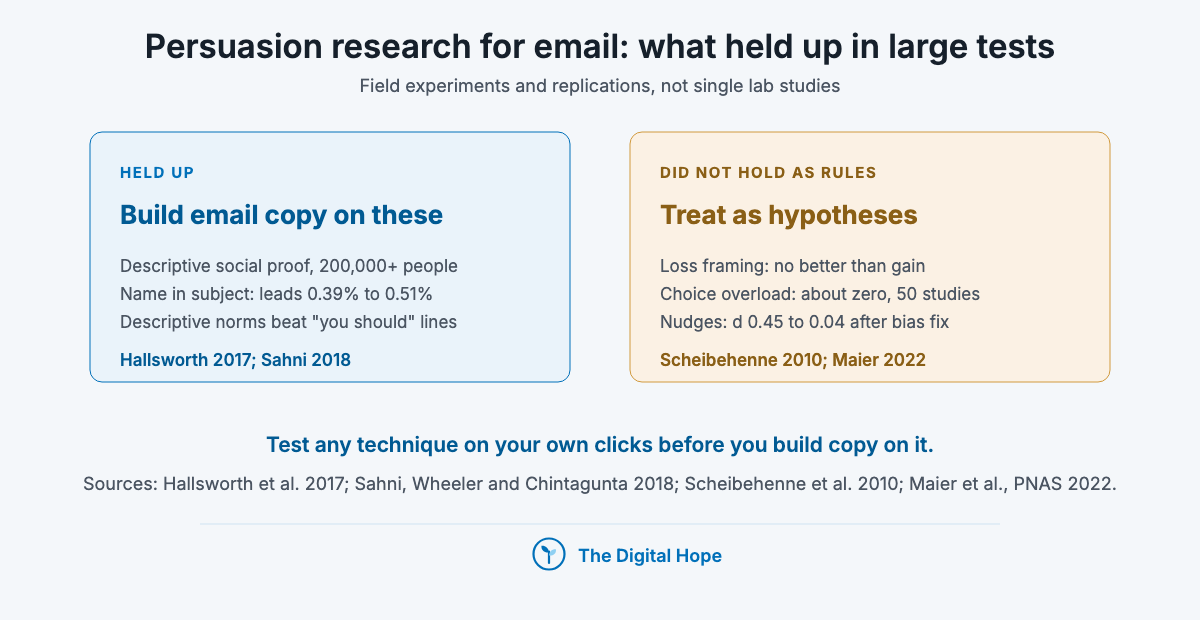
Only a few persuasion effects have survived large field tests or replication, and those are the ones worth building email copy on. The rest are hypotheses at best.
Here’s the reason to be strict. When the Open Science Collaboration re-ran 100 published psychology findings with high power (Science, 2015), 36% replicated as significant and effect sizes came out about half the original size. Copywriting advice draws heavily on that literature, often on single studies from before the replication projects.
| Claim you will see | What the research found | What to do in email |
|---|---|---|
| “Telling people what others do persuades” | Descriptive norm lines (“most people pay on time”) raised payment rates in two field experiments with 200,000+ UK taxpayers, and beat injunctive “you should” lines (Hallsworth et al., 2017) | Use specific, true social proof (your real reader count, stated as a number), never invented counts |
| “Personalising with the reader’s name works” | Adding the recipient’s name to the subject line raised leads from 0.39% to 0.51% (about 31%) and cut unsubscribes from 1.2% to 1.0% in a randomised field experiment, part of studies with three companies and millions of recipients (Sahni, Wheeler, Chintagunta, Marketing Science, 2018) | Test the name in the subject line, judged on clicks, and only when the data is clean |
| “Loss framing beats gain framing” | No better than gain framing in the same 200,000-person test (Hallsworth et al., 2017) | Write the clearer version, and test both if it matters |
| “Fewer choices always convert better” | A meta-analysis of 50 experiments (N = 5,036) found a mean choice-overload effect of virtually zero (Scheibehenne, Greifeneder, Todd, 2010) | One CTA per email is about focus, not a choice-overload law |
| “Readers run out of willpower” (decision fatigue) | A 23-lab preregistered replication (N = 2,141) found d = 0.04, with a confidence interval that includes zero (Hagger et al., 2016) | Don’t build copy on it |
| “Subtle cues prime the reader” | Flag and currency priming failed in Many Labs 1 (36 samples, 6,344 participants, 2014) | Drop subliminal word tricks |
| “Nudges lift conversions” | After correcting for publication bias, the pooled nudge effect fell from d = 0.45 to about 0.04 (Maier et al., PNAS, 2022) | Treat any single nudge as untested until your own test says otherwise |
Two cautions keep this honest. The tax letters went to people who already owed money, and the name experiment ran before Apple’s prefetching distorted opens, so the transfer to your list is an inference. That is why the leads figure, not the open figure, is the one quoted above. The full argument on frameworks and the persuasion literature lives in the copywriting guide. This page applies it to email only.
Scarcity and urgency are a special case. A real deadline (“registration closes Friday at 17:00 CET”) is information and belongs in the copy. An invented one is a deceptive claim, and under CAN-SPAM a subject line must reflect the message’s content, with penalties of up to $53,088 per violating email (FTC, figure updated January 2024).
True and specific beats clever.
Quick Summary
Q: Which persuasion techniques work in email?
A: The ones with field or replication evidence: specific descriptive social proof (a 200,000-person field test, 2017) and the recipient’s name in the subject line (a randomised field experiment that raised leads about 31%, 2018). Loss framing, choice reduction as a rule, decision fatigue and priming did not hold up in large tests, so treat them as hypotheses at most.
Insight Maier and colleagues re-analysed more than 200 nudge studies in PNAS (2022) and, after correcting for unpublished null results, estimated the average effect at about 0.04, while noting that individual interventions vary. For an email team the practical reading is narrow: a technique’s popularity says nothing about its effect on your list, and your own clicks are the only test that counts.
So here is how to write the email.
How to write an email that gets clicked, in five steps
“People still primarily scan, rather than read.”
Kate Moran, Nielsen Norman Group, “How People Read Online: New and Old Findings” (5 April 2020)
Each step below starts with something you can do in your email platform today, and each says when to skip it. The steps assume your sending setup already meets the mailbox providers’ rules. If you haven’t checked that, fix it first, because copy changes are wasted on mail that is rejected or filtered.
1. Give the email one job, and write it down before the subject line
First action: in the campaign notes field of your email platform (Mailchimp, Klaviyo, HubSpot, Kit, whichever you send from), write one line: who this is for, the one click you want, and the page that click lands on.
One email, one job means one primary action. A product launch email asks for the demo. A newsletter issue asks for the read of one lead article. Everything else in the email either supports that click or moves to a later send.
- Who on the list is this for, and who should be excluded from this send?
- What is the single click, and does its landing page continue the email’s promise?
- What would a reply look like if the reader wrote back?
- If the reader clicks nothing, what did the email still tell them?
Skip it only when the email is a curated digest whose job is a choice of links. Even there, pick the lead link and put it first.
If the job doesn’t fit in one line, it is two emails.
2. Write the subject line and preview text as one unit
First action: send a test to your own phone and read the inbox row as a stranger would: sender name, subject line and the preview text beside it, nothing else.
The inbox row is the ad for the email. The sender name says who it is from, the subject line makes the promise, and the preview text adds the second half of it. Write them together, so the preview text extends the subject line instead of repeating it. Set the preview text deliberately in your platform, and check on the test send that no stray “View in browser” line took its place.
The promise has to match the body. That is a legal rule as well as a craft one: the FTC’s CAN-SPAM guide says the subject line must accurately reflect the content, and there is no business-to-business exemption. A curiosity subject line that the body doesn’t pay off earns the click once and the unsubscribe after.
On length, there is no admissible benchmark. Figures for an ideal word or character count circulate without a dataset behind them, and the cut-off varies by client and screen. Read the test send on the smallest phone you can find and front-load the words that carry the promise.
On personalisation, there is real evidence. The recipient’s name in the subject line raised leads by about 31% in one randomised field experiment (Sahni et al., 2018). The condition: test it only when the first-name data is clean. A merge field that renders as “Hi FNAME” or a company name in the first-name slot costs more than the name earns.
- Does the subject line make a promise the first screen of the body keeps?
- Does the preview text add information, or repeat the subject line?
- Would the sender name be recognised by someone who signed up three months ago?
- Is anything in the row untrue, inflated or dated wrongly?
Skip the name test if you never collected first names, or if they were filled in by scraping. Fix the data before the copy.
Write the row, then the email.
3. Build the body for a reader who scans
First action: read your draft with only the first line of each paragraph visible. If those lines alone don’t carry the argument and the ask, rewrite them.
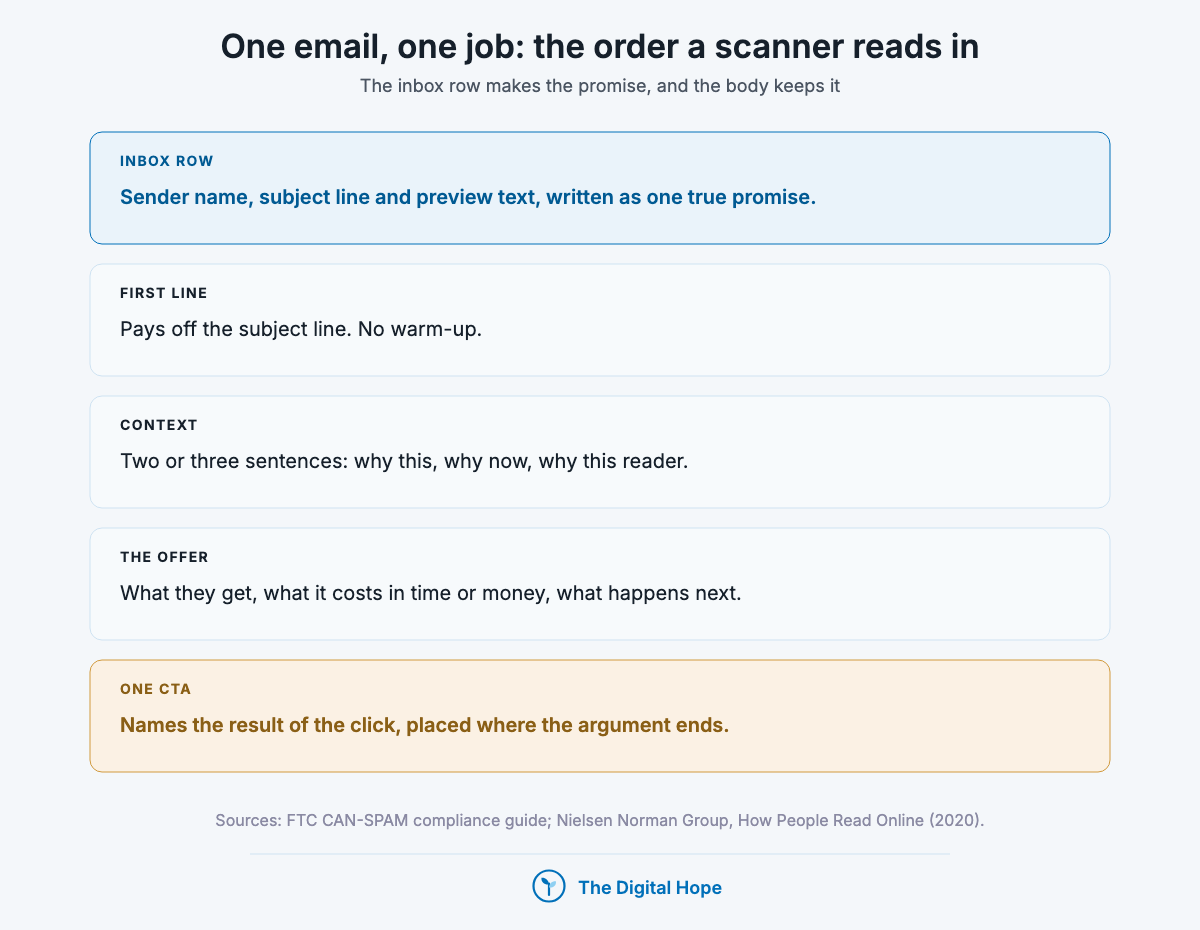
People scan email the way they scan web pages. Nielsen Norman Group’s eyetracking work (five studies, 500+ participants over 13 years) keeps finding that full reading is rare. So the body has a fixed order:
- The first line pays off the subject line. No warm-up, no “hope you’re well” in a marketing email.
- Context in two or three sentences: why this, why now, why this reader.
- The offer, stated plainly: what they get, what it costs in time or money, what happens next.
- One CTA, placed where the argument ends, and repeated at the bottom of a long email.
Bold the phrases a scanner needs, keep paragraphs to two or three lines on a phone, and read the email out loud before sending. Anything you stumble over, the reader skips.
The condition here is the email type. A promotional email should fit on one or two phone screens. A newsletter built on a long read can run long, as long as the lead item and its link sit in the first screen. For B2B, a plain-text email from a named person should read like that person wrote it, with no images and no design.
- Can someone who reads only the first lines tell what you want them to do?
- Is every claim sourced, every number dated, every name spelled right?
- Is there anything a reader in a different country would read differently?
Skip the structure only when the email is a one-line operational message (“your report is ready”). Say the thing and link it.
Short paragraphs, first lines first.
4. Write the CTA as the result of the click
First action: rewrite your button text so it names what happens after the click (“See the 12-page benchmark”, “Pick a demo slot”), then check the landing page delivers exactly that.
A CTA is a promise about the next screen. “Learn more” and “Click here” promise nothing. A CTA that names the result lets the reader decide before clicking, which loses the curious and keeps the interested. That trade is worth it, because a click that bounces from a mismatched page counts as a click and produces nothing.
One primary CTA per email. Repeating the same link as a button and a text link is fine. Two different asks split attention and make the test unreadable, since you can’t tell which offer won.
For B2B lists, the reply is often the better CTA. For a list of buyers in a considered purchase, “Reply with your team size and I’ll send the right version” starts a conversation that a click never does. Replies are also a quality signal that no prefetching can fake. The condition: someone must read and answer the replies within a working day, or the CTA burns trust.
For B2C lists, the click is the CTA. Replies at scale need support staffing, and the outcome you measure is the purchase or the sign-up after the click.
- Does the button text name the result of the click?
- Does the landing page’s headline match the CTA’s wording?
- If the CTA is a reply, who answers, and by when?
Skip the CTA only when the email is a service message with nothing to ask. Don’t invent one.
The CTA is the email’s one job, in four words.
5. Test with the list you have, and measure clicks and replies
First action: before your next A/B test, look up how many recipients each version will get and your usual click rate, then check the table below to see what size of lift that test can detect.
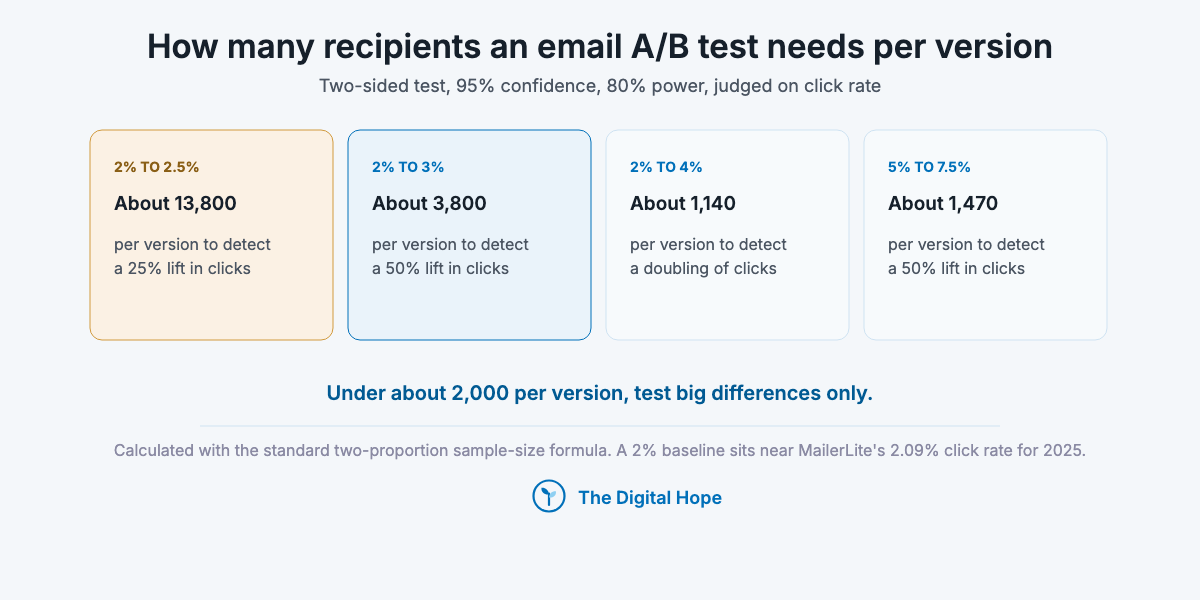
Small lists can’t detect small lifts. This is arithmetic, not a vendor claim. At a 2% click rate, which is close to MailerLite’s 2.09% for 2025, a standard two-version test at 95% confidence and 80% power needs roughly:
| Baseline click rate | Change you want to detect | Recipients needed per version |
|---|---|---|
| 2% | to 2.5% (a 25% lift) | about 13,800 |
| 2% | to 3% (a 50% lift) | about 3,800 |
| 2% | to 4% (a doubling) | about 1,140 |
| 5% | to 7.5% (a 50% lift) | about 1,470 |
Calculated with the standard two-proportion sample-size formula (two-sided, alpha 0.05, power 0.80). Your platform’s test tool may use a different method, so its “winner” can appear sooner and be wrong more often.
The decision rules by list size:
- Under about 2,000 per version: don’t split-test subject line wording. Test big differences only (a different offer, a reply CTA against a click CTA, plain text against designed), and repeat the same test over three or four sends before you call it.
- Between about 2,000 and 15,000 per version: test changes you’d expect to move clicks by half or more, and decide on clicks.
- Above that: subject line and preview text tests become readable on clicks. Keep a holdout for anything you call a lasting win.
What to measure, in order:
1. Click rate on the primary link, per send, compared with your own last ten sends rather than an industry table.
2. Replies, counted by hand or by a label in your inbox, for B2B and founder-led lists.
3. Downstream conversions from the click (demo booked, purchase, sign-up), read in GA4 through UTM parameters on every link.
4.
Guardrails: unsubscribe rate and spam complaints. Google’s email sender guidelines set a spam rate ceiling of 0.3% for bulk senders, with 0.1% as the target, and a copy change that lifts clicks while pushing complaints toward that line is a loss.
My read: if you send to a small list, the most useful “test” is a consistent log: one row per send with the job, the subject line, the CTA, clicks, replies and conversions. Patterns show up in that log after ten or fifteen sends that no single A/B test on 800 people can show.
A test too small to detect the change is a coin toss.
Quick Summary
Q: How do you write an email that gets clicked?
A: Give it one job written down before you start, write the subject line and preview text as one truthful promise, build the body so the first lines carry the argument, make the CTA name the result of the click (or ask for a reply in B2B), and judge it on clicks, replies and conversions with a test large enough to detect the change.
Insight In the Sahni, Wheeler and Chintagunta experiment (Marketing Science, 2018), the recipient’s name lifted opens from 9.05% to 10.80% and leads from 0.39% to 0.51%. Their data predates Apple’s prefetching, yet the authors still reported leads, the outcome after the click. Even a 31% lift in leads was a difference of 0.12 percentage points, which is why they needed a list of that size to see it.
What stopped being true
| What used to be true | What changed, and when | Primary source |
|---|---|---|
| An open meant someone looked at the email | Apple Mail Privacy Protection loads remote content whether or not the email is opened. Apple Mail was 76.56% of tracked opens in September 2026 | Apple, Mail Privacy Protection page, and Litmus, Email Client Market Share, September 2026 |
| Subject line A/B tests could be decided on opens | The same prefetching makes open-based winners unreliable for Apple-heavy lists | Apple, as above, and MailerLite benchmarks, December 2025 |
| “No opens in 90 days” identified inactive subscribers | Protected Apple users register opens without reading, so they never look inactive | Apple, as above |
| Avoiding “spam trigger words” was the main way to reach the inbox | Gmail and Yahoo set authentication and spam-complaint thresholds for bulk senders from 1 February 2024 | Google, email sender guidelines, and Yahoo Sender Hub |
| An unsubscribe link in the footer was enough | One-click unsubscribe headers required for bulk marketing mail from February 2024 (Gmail, Yahoo) | Google, email sender guidelines, and IETF RFC 8058 |
| Non-compliant bulk mail went to spam at worst | Gmail began rejecting non-compliant bulk mail in November 2025 | Google Workspace Admin Help, email sender guidelines FAQ |
| A CAN-SPAM penalty figure quoted in an older guide | Up to $53,088 per violating email, inflation-adjusted, updated January 2024 | FTC, CAN-SPAM compliance guide |
Pulling it all together
One job. Before the next send, write the reader, the click and the landing page in one line in the campaign notes.
One inbox row. Send a test to your phone and rewrite the sender name, subject line and preview text until they make one true promise.
First lines first. Read the draft with only the first line of each paragraph showing, and rewrite until those lines carry the ask.
A CTA that names its result. Rename the button after what happens next, and match the landing page headline to it. For B2B, try one send with a reply CTA and someone ready to answer.
Tests sized to the list. Check the table before any A/B test, and if you have a small list, start the one-row-per-send log today.
Clicks, replies and conversions. Put UTM parameters on every link, read results in GA4, and stop reporting opens as the copy metric.
Frequently asked questions
What makes a good email subject line? A specific, truthful promise that the body keeps, written together with the preview text and checked on a phone. Under CAN-SPAM the subject line must reflect the message’s content. The recipient’s first name has field evidence behind it when the data is clean.
How long should an email subject line be? No published dataset with a stated method gives an ideal length that holds across lists, and the visible cut-off depends on the client and screen. Front-load the words that carry the promise and read the test send on a small phone.
What is preview text, and does it matter? It is the line shown next to or under the subject line in the inbox. Treat it as the second half of the subject line: set it yourself, make it add information, and check that no “View in browser” text took its place.
Is a good open rate 20%, or 40%? Neither is a meaningful target now. MailerLite’s 2025 data shows a 43.46% average open rate and says itself that it is inflated by Apple’s prefetching. Compare your click rate with your own recent sends instead.
Do spam trigger words send email to spam? Not as the main mechanism. Since February 2024 Gmail and Yahoo filter bulk mail on authentication and complaint rates, which the email list building guide covers. Misleading copy still matters, because it drives complaints.
Should every email have only one call to action? One primary action, yes, for a readable result and a focused email. The reason is focus and measurement, not a law of choice: the “fewer choices” effect averaged virtually zero across 50 experiments.
In a nutshell
Write every email for one click and judge it on clicks and replies. The subject line and preview text make one true promise, the first lines of the body keep it, and the CTA names what happens next. Persuasion earns a place only where it held up in large tests: specific social proof and a clean first name, not invented scarcity or loss framing.
Give it ten to fifteen sends before you trust a pattern. On a list of a few thousand, single A/B tests can only detect large differences, so the log of sends is where the real answer appears, usually over two to three months of regular sending. What would change this call is a reliable, published way to separate human opens from machine opens across all mail clients, which does not exist as of October 2026.
About this article

Written by
Sai Subramaniam
SEO, GEO and Paid Ads Manager · 8+ years in growth marketing
I have run SEO, paid media and ABM for B2B AI companies, consumer apps and live-entertainment brands, from a solo operator at an AI infrastructure company to a team of 20 recovering a million-visitor site after a Google update. I write these guides from that work, and every number in them carries its source.
See my portfolioConnect on LinkedInHow this one was checked. Every number traces to a named source with its dataset and period, and every platform feature, policy or limit cites the platform’s own documentation with the date it was verified. Where the author’s own results appear, they are labelled as one account’s results, with the budget and context, not as a rule.
No affiliate links and no paid placements. Tools are named because they are what practitioners use, not because anyone paid to appear here.
Reviewed: October 2026. Ad platforms and search features change every few months; anything we could not verify at the time of writing is marked as unverified rather than turned into a number.
Corrections. If something here is wrong or has changed since, we would rather know. Corrections are made in place, with a note saying what changed.