
“We are for the most part more lonely when we go abroad among men than when we stay in our chambers.” · Henry David Thoreau, Walden (1854)
It is a weeknight and nothing is wrong, exactly. There are names in your phone, a group chat that pinged an hour ago, people at work who would say hello if you passed them. And still there is no one you could call right now and say how the day went. You scroll, you put the phone down, you pick it up again. Why is it that we can be surrounded by people and still feel this alone?
The people who study this have a precise answer, and it is gentler than the one we usually give ourselves. The US Surgeon General’s 2023 advisory on social connection defines loneliness as a distressing experience that comes from a gap between the connection we want and the connection we have. It is not a count of friends. It is a measure of distance between two things, and that distance can open up in a crowded room as easily as in an empty apartment.
That definition changes what we can do about it. If loneliness were only a shortage of people, the cure would be more people, and if you are reading this, you may already have tried it. If it is a gap, the work is to find out which connection is missing and to build toward it in small, specific steps. This guide covers what loneliness is, how common it is, why it happens, why the usual advice often misses, and then five steps you could begin this week.
The short version
Loneliness is a gap, not a headcount. It is the distance between the connection you want and the connection you have.
It is common and it is not a verdict on you. About one in four US adults feels lonely at least sometimes, and the young feel it more than the old.
It is a signal, not a flaw. Researchers have proposed that loneliness evolved to tell us our ties to others are frayed.
“Meet more people” is weaker advice than it sounds. In randomized trials, merely creating more chances for contact did not reliably reduce loneliness.
Five steps. Name the missing connection, catch the prediction that keeps you home, send one specific invitation, put one recurring thing on the calendar, and spend some time alone on purpose.
If you are struggling right now. If loneliness has turned into feeling hopeless, or you are having thoughts of harming yourself, please contact a crisis line now rather than reading on. In the US, call or text 988 (Suicide & Crisis Lifeline). Anywhere else, findahelpline.com lists free, confidential services by country. This page is not a substitute for that, and we would rather you closed this tab and called.
What is loneliness?
“What sort of space is that which separates a man from his fellows and makes him solitary?” · Henry David Thoreau, Walden (1854)
Loneliness is a subjective, distressing experience that comes from feeling isolated or from lacking meaningful connection, where “lacking” means a gap between the connection you want and the connection you have. That is a close paraphrase of the glossary in the Surgeon General’s 2023 advisory, and the important word in it is the last one. Loneliness lives in the gap. It is not measured by how many people we know, how often we go out or whether we live alone. It is measured by the distance between what we long for and what we have.
This is why so many of us are confused by our own loneliness. We look at our lives from the outside, count the friends, the family, the colleagues, and conclude that we have no right to feel this way. But the count was never the point. Someone with three close friends can feel the gap sharply if none of them is the person they can tell the hard thing to. Someone with few people can feel almost none of it, because what they have matches what they want.
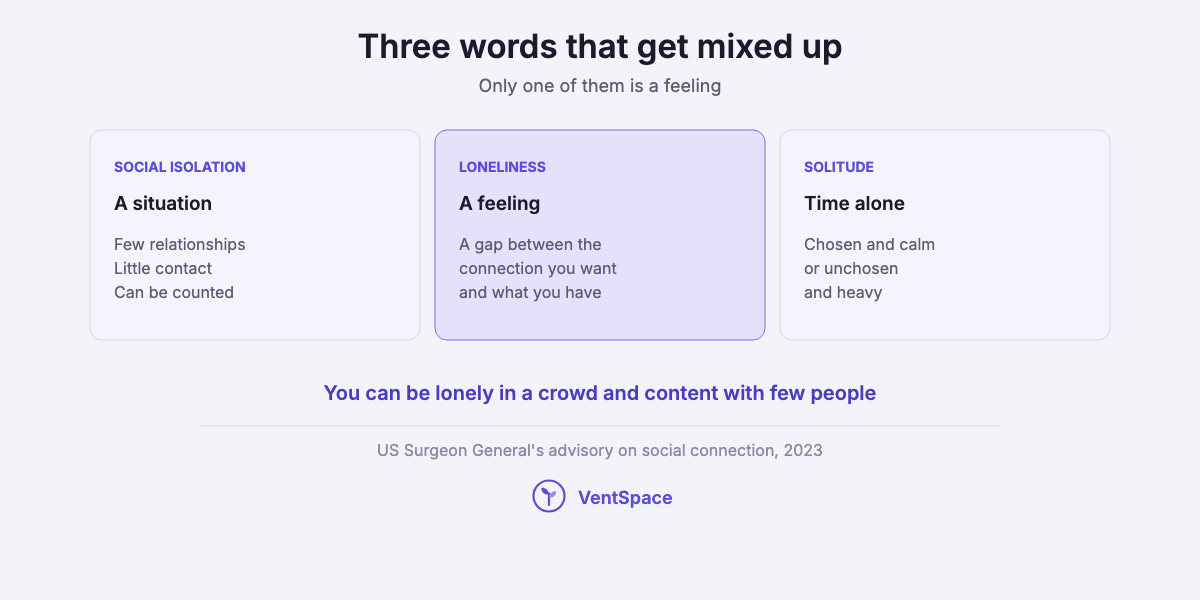
The advisory is careful to separate loneliness from a neighboring idea that is often mistaken for it. Social isolation is objective: few relationships, few roles, few groups, little contact. Loneliness is subjective: an internal state. The two often travel together, and they are not the same thing. A third word belongs beside them, because it is the one we are most often told to swap loneliness for.
| Word | What it describes | The everyday version |
|---|---|---|
| Social isolation | An objective situation: few relationships and little contact | “I don’t see anyone from Monday to Friday” |
| Loneliness | A subjective feeling: a gap between the connection you want and the connection you have | “I see people all week and nobody really knows me” |
| Solitude | Time alone, which can be chosen and calm, or unchosen and heavy | “I took the afternoon for myself” or “I’ve been on my own all weekend again” |
The sociologist Robert Weiss, writing in 1973, added a distinction that helps with the most common version of the puzzle. He separated emotional loneliness, the absence of one close attachment, from social loneliness, the absence of a wider circle to belong to, and he argued that one cannot stand in for the other. A busy social life does not fill the space where a confidant should be, and a devoted partner does not replace a circle of friends. That is why the feeling can persist in lives that look full. Something specific is missing, and more of something else does not reach it.
Quick Summary
Q: What is loneliness?
A: Loneliness is a distressing feeling that comes from a gap between the connection you want and the connection you have. It is different from social isolation, which is objectively having few relationships or little contact. You can be lonely with many people around you, and content with very few.
Insight: The US Surgeon General’s advisory on social connection (2023) draws the line in its own words: “Social isolation and loneliness are related, but they are not the same. Social isolation is objectively having few social relationships, social roles, group memberships, and infrequent social interaction. On the other hand, loneliness is a subjective internal state.” The second sentence describes a calendar. The third describes a feeling, and only the feeling is loneliness.
How common is loneliness, and does it mean something is wrong with you?
“Younger people reported more loneliness than the middle-aged.” · Manuela Barreto and colleagues, Personality and Individual Differences (2021)
Loneliness is common, it touches every age group, and in the large surveys it is highest among young adults rather than the old. The CDC’s 2024 National Health Interview Survey asked US adults one question about it, and our own analysis of the survey’s public data file found that about 4.9% said they feel lonely always or usually, and 23.7% at least sometimes. Two independent analyses of the same file report the same overall figures. By our count the frequent figure was 6.3% for adults aged 18 to 29, the highest of any adult age group, against 4.0% for adults 65 and over. Fewer than half of Americans under thirty said they never feel lonely.
England measures it in a similar way. In the government’s Community Life Survey for 2024/25, with more than 175,000 responses, 7% of adults said they feel lonely often or always, and the rate was highest among 16 to 24 year olds (9%) and lowest among 65 to 74 year olds (4%). In the same survey, 95% said there is at least one person they could really count on to listen if they needed to talk. The survey does not tell us whether the lonely people are inside that 95%, so we cannot claim it. What it does show is that, across a whole country, having someone available and feeling connected are measured as two different things, which is what the gap definition predicts.
You may have seen much larger numbers, some of them over half the population. They are usually not wrong, they are measuring something different. A long questionnaire scored with a cut-off will classify far more people as lonely than a single question asking how often you feel it. That is a difference in instruments, not a sudden collapse in how we live, and it is one reason we have not put a dramatic figure at the top of this page.
The more useful finding, for anyone wondering whether their loneliness says something about them, came from one of the largest studies ever run. The BBC Loneliness Experiment gathered answers from 46,054 people in 237 countries, islands and territories. Loneliness was higher among younger people, among men and in more individualistic cultures. But age, gender and culture together explained only about 2% of the differences in who felt lonely. The sample chose itself, so it is not representative. Even so, it is hard to read that number as anything other than this: loneliness is not a fact about a type of person. It is something that happens to people of every kind, in particular stretches of their lives.
It is also taken seriously for a reason, and we should say it once and plainly. A 2010 review of 148 studies and 308,849 people found that those with stronger social relationships had about a 50% greater likelihood of survival over the follow-up periods, and a 2016 review of 16 long-term datasets found poor social relationships associated with a 29% higher risk of heart disease and a 32% higher risk of stroke. Both are observational. Both sets of authors are clear that nobody has yet shown that treating loneliness prevents these outcomes. A figure about a population says nothing about your own body, and we offer it only so that you know the people who study this do not consider it a small thing.
Quick Summary
Q: Is it normal to feel lonely?
A: Yes. In the 2024 US National Health Interview Survey, about one in four adults said they feel lonely at least sometimes, and the rate was highest among adults under 30. Age, gender and culture together explain only a small share of who feels lonely, so loneliness is not a sign that something is wrong with you as a person.
Insight: Manuela Barreto and colleagues, describing the BBC Loneliness Experiment in Personality and Individual Differences (2021): “Using those data, we analysed the frequency of loneliness reported by 46,054 participants aged 16–99 years, living across 237 countries, islands, and territories, representing the full range of individualism-collectivism cultures”. The breadth is the point. Loneliness turned up everywhere they looked, in every age group and every kind of culture.
Why loneliness happens
“We have proposed that the awareness of loneliness evolved to serve as a signal that one’s connections to others are frayed or broken” · John Cacioppo, Stephanie Cacioppo and Dorret Boomsma, Cognition and Emotion (2014)
Loneliness happens when the connection we have falls short of the connection we need, and researchers have proposed that the feeling exists to tell us so. The psychologists John and Stephanie Cacioppo, with Dorret Boomsma, suggested that loneliness may have evolved as an unpleasant state that, like hunger, thirst and pain, pushes us to change something. They describe it as a signal that our ties to others are frayed, and they are careful to call it a proposal rather than a proven fact. An earlier version of this page said loneliness is a biological drive like hunger. That went further than the researchers did, and we have corrected it.
Thinking of it as a signal is a kindness we can offer ourselves. A signal is not a flaw. It does not mean we are broken or unlikable. It means some part of us has noticed a gap and is asking us to do something about it. The pain is real, and it is also information.
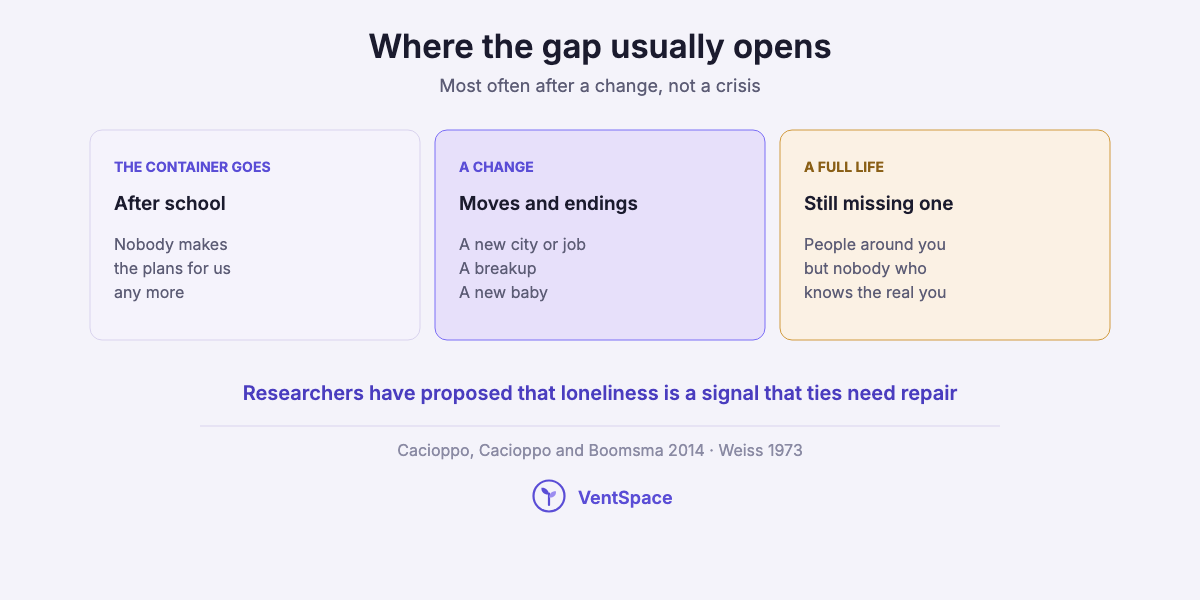
What tends to open the gap is often not a dramatic event but a change in the structure of our lives. School and college hand us people. We are placed in the same rooms at the same times, week after week, and friendship grows in that repetition without anyone having to arrange it. Adult life removes the container. Work, moves, relationships, children and money pull people in different directions, and from then on friendship runs on someone choosing to make the plan. Interviews with psychiatric outpatients in Stockholm about how they became lonely capture it precisely, and their words travel further than their sample. “As a grown‐up, it is more difficult, everybody has their group that they belong to already,” one said. Another described the slow version: “Friends stopped calling me, I don’t know why.”
Moves and transitions open the gap fastest, because they remove the structure and the people at once: a new city, a new country, the end of college, a breakup, a new job, a new baby, retirement. If yours is a move, our guide to overcoming loneliness in a new city goes into that situation in detail.
And sometimes the gap is inside a full life, the emotional kind Weiss described. We have people, we can name them, and there is still nobody who knows the version of us we keep to ourselves. That is not ingratitude and it is not a paradox. It is the most ordinary shape loneliness takes, and it is the hardest to talk about, because from the outside our lives look fine.
Quick Summary
Q: What causes loneliness?
A: Loneliness comes from a gap between the connection you want and the connection you have. It often opens after a change in the structure of life, such as a move, graduation, a breakup or a new job, and it can also appear in a busy life when one close, confiding relationship is missing. Researchers have proposed that the feeling evolved as a signal that our ties to others need repair.
Insight: In a 2025 study in the Scandinavian Journal of Psychology, Landquist and colleagues interviewed 15 psychiatric outpatients in Stockholm about how they became lonely, so their words describe one group rather than everyone. One of them put the adult version in two lines: “I always come up with suggestions for what we can do. No one else takes the initiative… I give up.” Most of us have been on one side of that sentence or the other.
Why the usual advice often misses
“Among studies that used the latter design, the most successful interventions addressed maladaptive social cognition.” · Christopher Masi, Hsi-Yuan Chen, Louise Hawkley and John Cacioppo, Personality and Social Psychology Review (2011)
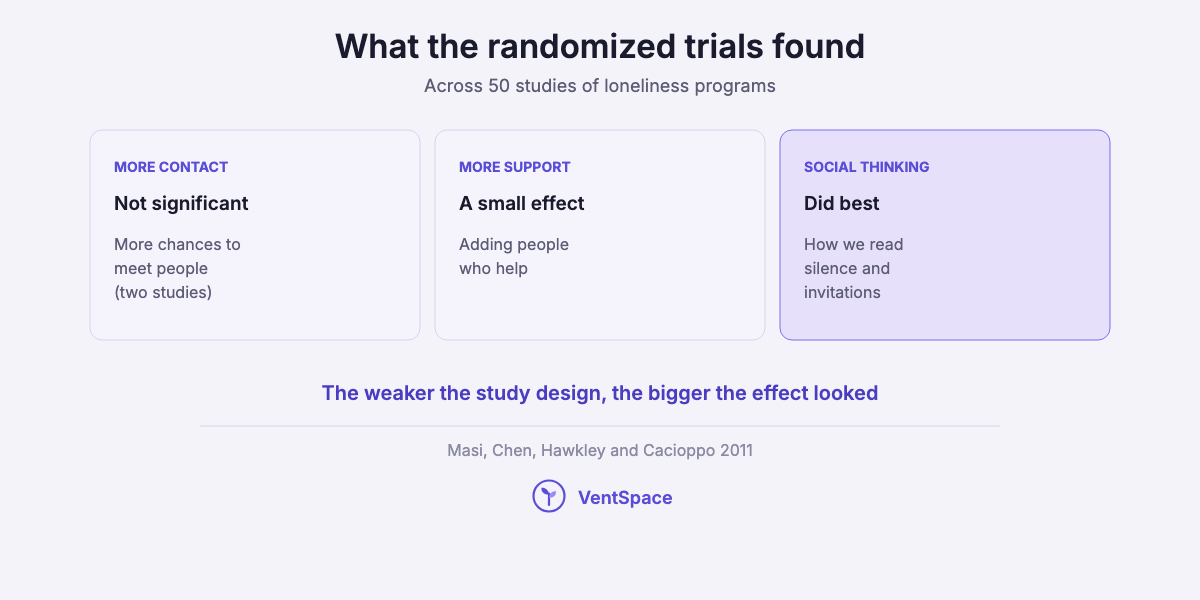
The most common advice for loneliness, to get out and meet more people, has surprisingly thin support in controlled trials. In 2011, Christopher Masi and colleagues pooled 50 studies of programs designed to reduce loneliness. They noticed something every honest reader should know: the weaker the study design, the bigger the effect looked. Studies with no comparison group reported the largest improvements. In the randomized trials, the only kind that controls for people feeling better over time, the average effect was small.
Inside those randomized trials, the type of program mattered. Programs that only increased opportunities for social contact did not produce a significant reduction in loneliness, and neither did social skills training, though each of those results rests on just two studies, so the evidence is thin rather than settled. Programs that added social support did a little better. The programs that did best worked on social cognition, the researchers’ term for how people read social situations. As we understand it, that covers the expectations we bring into a room, the conclusions we draw from silence and the predictions we make about rejection.
This fits what lonely people describe when asked why they stay home. In interviews with 27 older adults in northern Germany, published in 2025, the researchers found that the main personal barriers were shame and anxiety, alongside health and transport. One participant explained why they did not go to the peer meetings available to them: “I have inhibitions, I don’t think you would do that. I also have no positive idea that anything good could await me there.” Another, in a different study, asked: “Why am I not good enough?”
None of this means loneliness is in our heads or that we have been thinking about it wrongly. It would be cruel and untrue to tell a lonely person to just change their mindset, and the finding is a small effect in a subgroup of studies, not a prescription. It means something narrower. When we have been lonely for a while, we start to expect that reaching out will go badly, and that expectation quietly makes the decision for us. The invitation goes unsent, the event goes unattended, and the silence that follows seems to prove the prediction right. A list of clubs does not touch that loop. Noticing it might.
Quick Summary
Q: Why doesn’t meeting more people cure loneliness?
A: Because loneliness is a gap in a particular kind of connection, not a shortage of contact. In a 2011 analysis of 50 studies, randomized programs that only created more chances to meet people did not significantly reduce loneliness, while programs that worked on how people interpret social situations did best. Those results rest on few trials, so they are a strong hint rather than a rule.
Insight: Karina Goetz and colleagues, summarizing interviews with 27 older adults in the International Journal of Qualitative Studies on Health and Well-being (2025): “Barriers were intra-individual factors such as shame and anxiety, their own health-related situation, and the public transportation situation.” Shame comes first on their list. What keeps most of us home is not a lack of places to go but what we expect to feel when we get there.
So where does that leave us on an ordinary evening?
How to cope with loneliness, in five steps
“Heritability is sometimes confused with genetic determinism, but these are not equivalent concepts.” · John Cacioppo, Stephanie Cacioppo and Dorret Boomsma, Cognition and Emotion (2014)
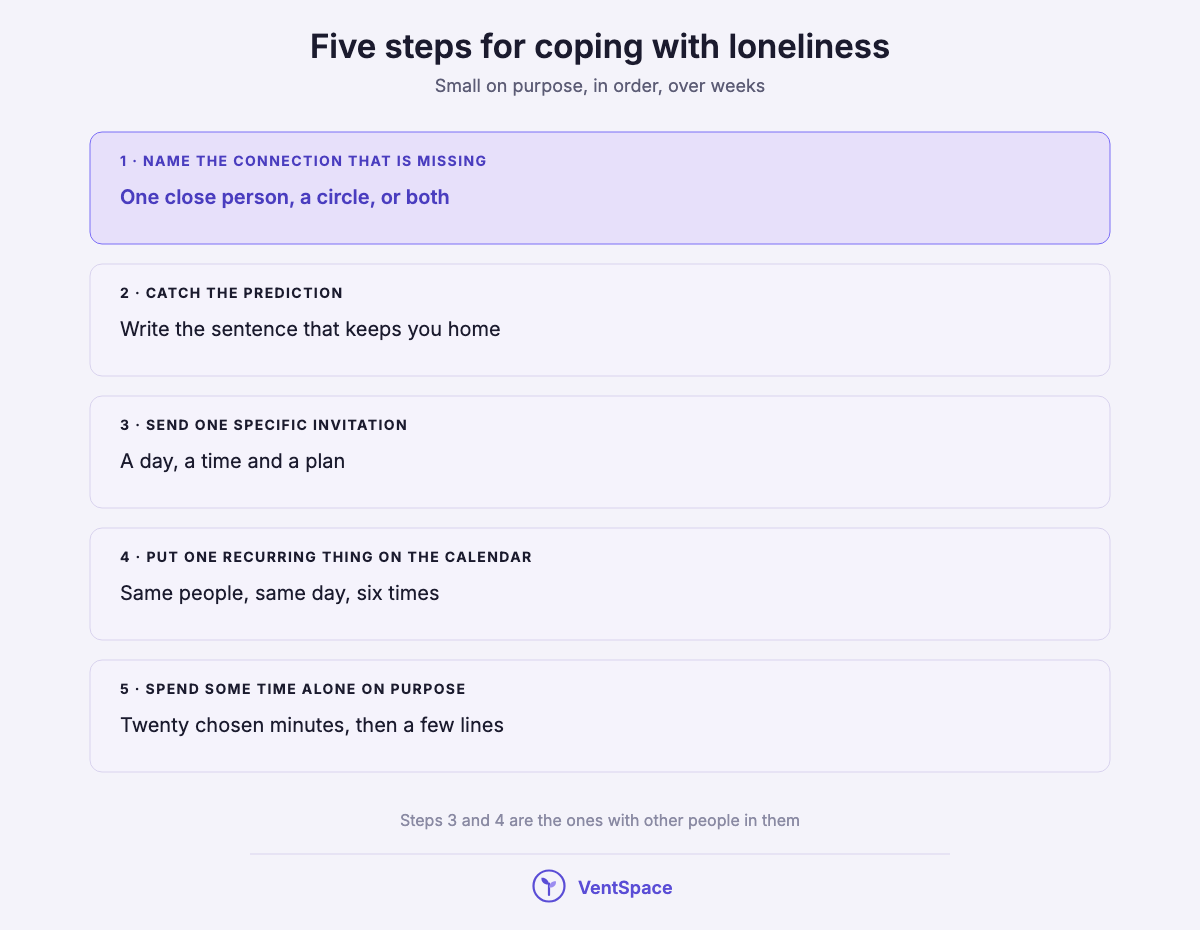
The steps below are small on purpose. The researchers who studied the biology of loneliness were at pains to say that nothing in it means a person’s loneliness is fixed, and the line above is theirs. What follows is built from the trial evidence and from what lonely people say gets in their way: find the gap, check the prediction, reach one person, build one routine, and use time alone on your own terms. Do them in order, over weeks rather than in one night.
1. Name the connection that is missing
Take a page and draw two columns: the people you see in an ordinary week, and the kind of connection you wish you had. Do not write “more friends”. Write something you could recognize if it happened: someone to tell the bad news to first, someone to eat dinner with on a Thursday, a group that would notice if you stopped coming. The first column is often longer than we expect. The second column is where the gap is.
Answer these in a line each:
- Who did I talk to this week, and which of those conversations left me feeling known?
- Is there one person I would call first with good news, or with bad news?
- Am I missing one close person, or a wider circle, or both?
- When do I feel it most: late at night, on weekends, at work, in a crowd?
- What would one ordinary week look like if the gap were a little smaller?
There are no wrong answers here, and nobody else will read this page.
What we are doing is turning a fog into a shape. “I am lonely” is a feeling that seems to have no edges. “I have no one to tell things to first” or “I have no group that meets without me arranging it” is a gap with edges, and a gap with edges can be worked on. Weiss’s two kinds of loneliness help here. If what is missing is one close person, more acquaintances will not reach it. If what is missing is a circle, one devoted friendship will not fill it either.
2. Catch the prediction before it decides for you
The next time you think about reaching out and decide not to, write down the exact sentence that made the decision. It is usually short and certain: “they’re busy”, “they’ll say no”, “I’ll have nothing to say”, “they only put up with me”. Write it as you heard it in your head, then write one line underneath: what happened the last time you tested it?
Answer these honestly:
- What do I expect will happen if I send the message?
- What is the evidence for that, and what is the evidence against it?
- If a friend told me this prediction, what would I say to them?
- Have I been reading silence as rejection, when it might just be someone else’s busy week?
- What is the smallest version of reaching out that I could survive going badly?
You do not have to believe the new answer yet. You only have to notice the old one.
This is the step the trials point to most clearly, and it is also the one that can feel most like blame, so we want to be careful with it. The prediction is not a character flaw. It is what any of us learns after a run of unanswered messages or a bad season. It was formed by experience, and it can be revised by experience, one small test at a time. Doing this alone is possible, and doing it with someone trained is often easier. Therapy is one option here, and for a lot of people it is the right one, especially if the loneliness has lasted months or sits alongside low mood. Our page on whether you need therapy walks through how to tell, without a checklist.
3. Send one specific invitation to one specific person
Choose one name from step 1 and send one message today that has a day, a time and a plan in it. Not “we should catch up sometime”. Something like: “I’m going to the Saturday market at ten, want to come and get coffee after?” A specific invitation is easier to say yes to, and it removes the work of deciding from the other person.
Before you send it:
- Who is the one person I would most like to see in the next two weeks?
- What is a plan small enough that it costs them almost nothing to accept?
- Can I name a day and a time rather than “sometime”?
- If they say no, what will I suggest instead?
You are allowed to be the one who asks.
From Sai, who writes this blog: the invitation I learned to send
We had a ton of friends in school and college, then we graduated, started adult life, and the circle started falling apart. In school and college we are made to be in the same place and make plans. In the real world, no one is going to do it for us. We have to be the person who arranges things.
So don’t ask them, “What are you doing this weekend? Want to hang out?” Invite them: “Hey, we’re going hiking this weekend. Would be nice if you could join us.” That way they know the plan is happening with or without them.
You are not tricking anyone. You are trying to reach old friends who are stuck in their own cycle of work and worries. It’s good for them too.
What Sai’s version does well is take the pressure off the yes. “Would be nice if you could join us” is easier to answer than “do you want to spend time with me?”, because it is about a plan rather than about you. It also helps with the thing the Stockholm interviews describe, the person who always suggests and eventually gives up. If you are that person, it is worth saying so to one friend, plainly: “I’ve realized I’m usually the one who makes plans, and I’d love it if sometimes you did.” That sentence is not a complaint. It is information your friend may not have.
4. Put one recurring thing with people in it on the calendar
Pick one thing that happens on a fixed day, every week or every other week, with the same people, and commit to going for six sessions before you judge it. A class, a run club, a choir, a volunteer shift, a standing dinner with one friend on the first Friday of the month. The point is not the activity. The point is repetition, the thing school and college gave us without our asking: seeing the same faces often enough that something can grow.
Choose it with these:
- What did I enjoy doing with other people before life got busier?
- Is there something that meets at the same time and place every week?
- Could one friendship become a standing date rather than an occasional one?
- What would make it easy to keep going on the weeks I don’t feel like it?
Pick something you would be glad to do even on a quiet week. It does not have to be impressive.
We should be honest about the evidence. Creating more opportunities to meet people did not reliably reduce loneliness in the trials, so a recurring thing is not a cure, and joining something will not by itself close the gap. What it can do is give step 3 somewhere to happen. A face you see every Tuesday is a person you can eventually invite for coffee, and an invitation is much easier when it is not the first conversation. Sai’s 2022 version of this was a small system for keeping track of the people who matter: a note of when you last spoke to each of your closest people, so that reaching out becomes a habit rather than a mood. It is a small idea, and it fits alongside this step.
5. Spend some time alone on purpose, and write down what you find
Choose twenty minutes this week to be alone deliberately, with the phone in another room, doing one thing you would choose for yourself. A walk, a meal cooked properly, a book, an instrument, a drawing. Afterward, write a few lines about what came up while you were alone: what you thought about, who you missed, what you noticed you wanted.
Afterward, ask:
- Did that time feel chosen, or did it feel like more of the same?
- What thoughts or people came up when it was quiet?
- What do I enjoy doing on my own that I had forgotten about?
- What did I notice I wanted from other people?
If it felt hard, that is useful too. Write that down.
There is a difference between being alone and being lonely, and this step works only with the first kind. Time alone is not automatically restful. In four experiments published in 2018, Thuy-vy Nguyen, Richard Ryan and Edward Deci found that fifteen minutes alone turned the volume down on strong feelings in both directions, calming when people were agitated and flattening when they were not, and that solitude led to relaxation when people actively chose to be alone. Their participants were undergraduates, so we hold this as a direction rather than a rule. That is why the instruction is to choose the time, and why it is twenty minutes rather than a weekend.
“I have never felt lonesome, or in the least oppressed by a sense of solitude, but once, and that was a few weeks after I came to the woods, when, for an hour, I doubted if the near neighborhood of man was not essential to a serene and healthy life.” · Henry David Thoreau, Walden (1854)
Even Thoreau, the patron saint of solitude, had his hour of doubt. Many of us have weeks of it.
From Sai, who writes this blog: what being alone taught me
Trust me, as an international student alone in another country, spending countless hours every day by myself, I can vouch for this. It can be painful at first. You might not want to listen to all the horrible feelings coming at you. But it can help. Listen to them. Be uncomfortable. Journal and understand yourself.
Not a writer? Voice note it to yourself. Open your messaging app or your voice recorder and say it out loud.
Sai’s experience is his, and it was not instant. Writing it down records what you found. It does not replace the person you found you were missing, and the page you write is best used as the starting point for steps 1 and 3.
One more thing belongs in this step, because it fills so many of our quiet evenings. Scrolling is not a moral failure, and it is often the cheapest thing available at the end of a long day. It is still worth knowing that in a 2018 University of Pennsylvania study, 143 undergraduates were randomly assigned either to use social media as usual or to limit Facebook, Instagram and Snapchat to 10 minutes each per day for three weeks. The limited group reported significant decreases in loneliness and depression. It was one university, one age group and three apps, and reviews of ordinary social media use find small and mixed effects overall, so we hold it loosely. A smaller dose for a few weeks is an easy experiment to run on yourself.
If you did not choose to be alone, much of what is written about solitude does not apply to you, and we do not want to pretend it does. If you are alone because of a move, an illness, a loss or a life that narrowed without your permission, this step is not a request to learn to enjoy it. It is just twenty minutes to notice what you want, so that steps 1 to 4 have something to aim at. The steps that involve other people matter more for you, not less.
Pulling it all together
The five steps are one path. Step 1 finds the gap, step 2 clears the path to it, steps 3 and 4 build toward it, and step 5 tells you what you want to build. They work best in order, over several weeks.
Step 1 turns a vague feeling into a named gap. Committed action: tonight, write the two columns and circle the one connection you most want.
Step 2 catches the prediction that has been deciding for you. Committed action: the next time you talk yourself out of reaching out, write the sentence down before you put the phone away.
Step 3 reaches one person. Committed action: send one invitation with a day, a time and a plan before the end of this week.
Step 4 gives friendship a container again. Committed action: pick one recurring thing and put the next six dates in your calendar.
Step 5 uses time alone on your own terms. Committed action: choose twenty minutes this week, phone in another room, and write three lines afterward.
Quick Summary
Q: What is the best way to cope with loneliness?
A: Start by naming which connection is missing, then notice the predictions that stop you reaching out. Send one specific invitation to one person, put one recurring activity with people in it on your calendar, and spend short, chosen periods alone. If loneliness lasts for months or comes with low mood, talking to a therapist is a legitimate next step.
Insight: Christopher Masi and colleagues, describing what they set out to measure in Personality and Social Psychology Review (2011): “Qualitative reviews have identified four primary intervention strategies: 1) improving social skills, 2) enhancing social support, 3) increasing opportunities for social contact, and 4) addressing maladaptive social cognition.” Steps 3 and 4 draw on the second and third. Step 2 leans on the fourth, because that is where the randomized trials pointed.
Questions people ask about loneliness
Is it normal to feel lonely even when you have friends?
Yes, and it is one of the most common forms loneliness takes. Loneliness is defined as a gap between the connection you want and the connection you have, not as a shortage of people. In England’s Community Life Survey, 95% of adults said they had at least one person they could count on to listen, while 7% said they feel lonely often or always. Having friends and feeling known by them are two different things.
Is loneliness a biological drive like hunger?
Not as a proven fact. Researchers including John and Stephanie Cacioppo have proposed that loneliness may have evolved as an unpleasant signal, comparable to hunger, thirst and pain, that tells us our ties to others are frayed. They present it as a hypothesis. An older version of this page stated it as fact, and we have corrected it. The same researchers stress that biology does not make anyone’s loneliness permanent.
Do pets help with loneliness?
They may help some people, but the evidence is mixed. A 2022 systematic review of 24 observational studies found that pet owners tended to be less socially isolated, but that studies before the COVID-19 pandemic showed no overall link between owning a pet and lower loneliness, while studies after it mostly did. A pet can be good company. It is not a substitute for the human connection you identified in step 1.
Does social media make loneliness worse?
It can, for some people. In a 2018 University of Pennsylvania study of 143 undergraduates, those randomly assigned to limit Facebook, Instagram and Snapchat to 10 minutes each per day for three weeks reported significant decreases in loneliness and depression, while a comparison group kept using them as usual. That is one small study of young adults, so the honest advice is to try using less for a few weeks and notice how you feel.
When should I talk to someone about loneliness?
If it has lasted for months, if it comes with low mood or hopelessness, or if it is getting in the way of sleep, work or eating, it is worth talking to a doctor or a therapist. Therapy is one option, and for a lot of people it is the right one, because the predictions in step 2 are easier to test with someone trained beside you. If you are thinking of harming yourself, call or text 988 in the US, or find your local line at findahelpline.com.
Can loneliness affect your health?
Large reviews have found that weaker social relationships are associated with shorter survival and with higher rates of heart disease and stroke. These studies are observational, so they show a link rather than proof of cause, and nobody has yet shown that treating loneliness prevents these illnesses. A population figure says nothing about any one person’s health, but it does mean loneliness deserves to be taken seriously.
In a nutshell
Loneliness is not a verdict on who you are. It is a gap, and gaps can be measured, named and slowly narrowed.
Two things to take with you. First, the gap is specific: it is usually one kind of connection that is missing, and the work starts when we can say which one. Second, the honest timeline: nobody can tell you how long this takes, and even the best randomized programs produced small average effects. Expect weeks of small, repeated steps rather than a sudden change, and count each invitation you send as progress, whatever the answer.
Who is the one person you could write to this week?
Loneliness is heavy to carry, and you do not have to sort it all out at once. If writing down what you are missing and who you want to reach would help you get to step 3, VentSpace is a journaling app that turns what you write into a clear read on your life balance, plus small, doable next steps. It is free to start and Android only as of October 2026, and it is not a person, so let it point you toward the people. Not on Android, or at a desk? VentSpace Live runs in your browser, free, with nothing to install.
About this article

Written by
Sai Subramaniam
Founder, VentSpace
I write these guides because I have been where you are. I am working through my own hard seasons, and I share the things that actually helped me, so that anyone going through it has a steady companion close by instead of facing it alone. VentSpace is the app I built for exactly that: a journaling app that turns what you write into a clear read on your life balance, plus small, doable next steps toward feeling more like yourself.
This writing is honest and every claim is sourced, and it is not a substitute for professional care. If you are struggling, reaching out to a professional is a strong move, not a failure.
Explore VentSpaceTry VentSpace LiveHow this one was checked. Every factual claim traces to a named source, and the source is printed next to the claim rather than kept in a footnote. Quotes are pinned to the work they come from, with the year, the letter or the chapter where one exists. Where a widely repeated claim could not be traced, it was left out and the omission recorded. Where a figure is contested, both sides are printed.
No affiliate links, no paid placements, and nobody paid to appear here. Where we mention our own app, we say that it is ours, we state its limits, and we never position it as a substitute for care.
Reviewed: October 2026. Prices, platforms and product availability move quickly, and anything we could not verify at the time of writing is marked as unverified rather than turned into a number.
Corrections. If something here is wrong, we would rather know. Corrections are made in place, with a note saying what changed.