
We may know the evening. Dinner with the friends we have known since school or a first job, the same table, the same stories retold with small improvements. It is lovely, and on the walk home there is a quieter feeling underneath. We know their job, their partner’s name and how their parents are. We do not know what they are afraid of this year.
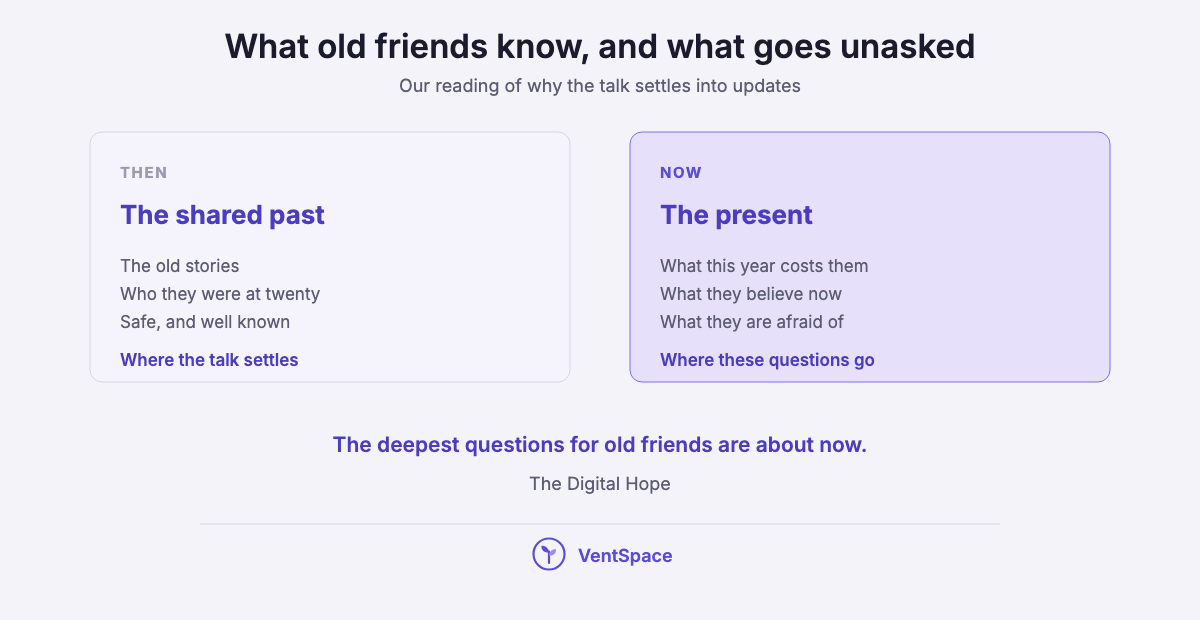
In our reading, old friends can know each other’s past better than each other’s present. The history is shared and safe, so the conversation settles there. These deep questions to ask your friends are built for that gap: 72 of them, in seven groups from light to brave, each with a line on why it is worth asking.
The short version
Ask about now, not then. The present is what goes unasked.
One or two questions per meeting is plenty. This is not a quiz.
Answer every question you ask, at the same depth. That is the whole rule.
Give an easy way out, and take the answer you get.
If a question opens something heavy, put the list away and listen.
How to actually use these
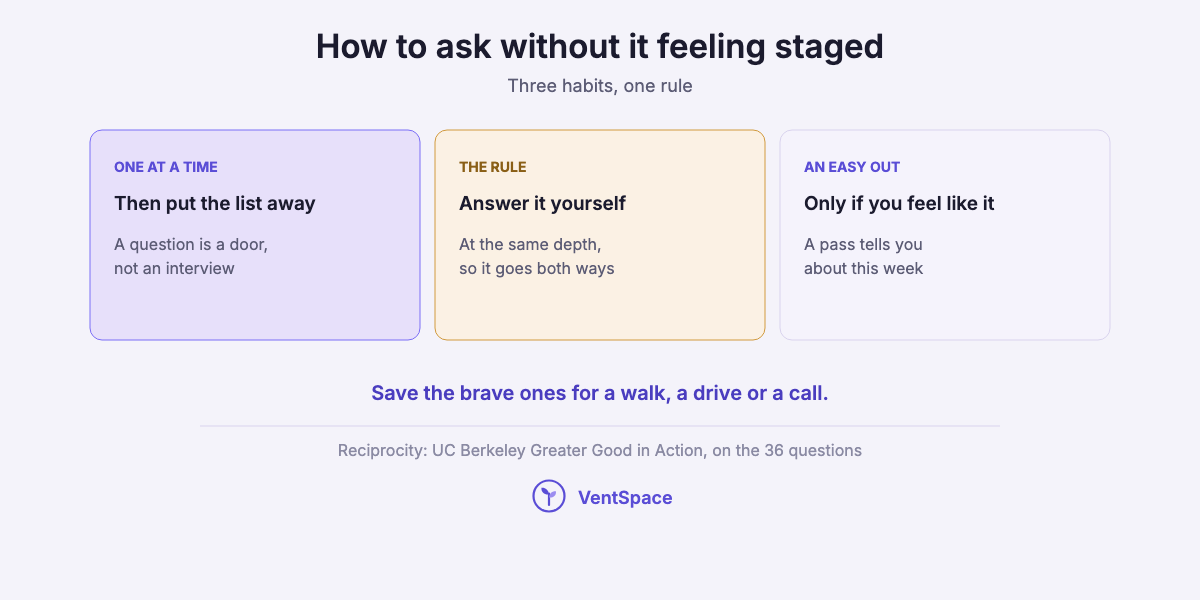
Use one or two at a time, in your own words, then put the list away. A question is a door. Six in a row turns a friend into an interviewee.
Answer every question you ask, at the same depth. UC Berkeley’s Greater Good in Action, describing the research behind the famous 36 questions, gives the reason: they “encourage us to open up at the same time and at a similar pace as our partner, reducing the likelihood that the sharing will feel one-sided.” (That research paired strangers in a lab, not old friends. The same page says the exercise “has a reputation for making people fall in love”, which is a reputation, not a finding, and the 1997 paper behind it described its results as “preliminary findings”.) Our questions that turn an acquaintance into a friend use the same rule for newer friendships.
Bring it in plainly and give an out: “Can I ask you something I’ve been wondering about? Only if you feel like it.” A friend who passes has not failed the friendship. They have told you something about this week.
Match the setting to the group. The lighter groups work over text. The brave ones belong on a walk, a drive or a call. With a group of friends, offer a question to the table and never go around in a circle. The six-week schedule below spaces it out.
Quick Summary: how to ask a friend a deep question
Q: How do you ask a friend a deep question without it being awkward?
A: Ask one at a time, in your own words, and give an easy out. Answer it yourself at the same depth, and save the heaviest questions for a walk, a drive or a call.
If a question opens something heavy
When a question lands on something your friend has been carrying alone, the list has done its job. Listen more than you speak, resist fixing, and ask what would help: “Do you want ideas, or do you want me to be here for this?” It is fine to say, “We can leave this for another time.”
If it is bigger than a friend can hold, a therapist is an ordinary next step, for them or for you. If your friend talks about harming themselves or not wanting to be here, do not carry it alone. In the US, call or text 988, the 988 Suicide & Crisis Lifeline, whose guidance reads: “Contact 988 at any time for help if a friend is struggling.” Elsewhere, findahelpline.com lists local lines.
Who you are now, not who you were
The lightest. They work over text and quietly update the version of your friend you carry around.
1.What’s been on your mind most this month, outside of work?
Not your calendar, your head. We may know their schedule. This asks what they think about in the shower.
2.What are you into right now that I don’t know about?
Old friends can be working from our hobbies of five years ago. This invites the one we picked up since.
3.What does a good Saturday look like for you these days?
The answer can show how a life has changed shape, especially after a move, a partner or a child.
4.Who’s new in your life that I haven’t met yet?
Not a test of loyalty. It tells you who else is in their world now, and gives you a way to meet them.
5.What can you do now that you couldn’t when we met?
Being asked about our growth by someone who knew us before it is a generous thing.
6.What’s a small thing that’s made this year better?
A soft way in that can lead somewhere real, because the small good things sit next to the hard ones.
7.Is there a part of your life you think I’d be surprised by?
An open door that lets them choose what to show you. If they say no, that is an answer too.
8.What’s a song, book or show that feels like it was made for this year of your life?
What we return to can say what we are working through. Ask what it was about it.
9.What part of your week do you look forward to most?
Simple, and it shows where their energy goes now, which may not be where it went when you met.
10.What’s something you’ve started caring about that surprised you?
Something we only start caring about later can say a lot about who we are becoming. Ask what changed.
11.If you described your life right now in one sentence, what would it be?
A compressed answer can be more honest than a long update, and it tells you where to ask next.
What this year is asking of you
A little heavier. These ask what is going on rather than what has happened. Save them for a call or an unhurried coffee.
12.What has this year asked of you that you didn’t see coming?
A plain way past the update. Ask it and then wait, because the first answer may be the polite one.
13.What’s weighing on you that wouldn’t come up when we just catch up?
Long friendships can be good at news and bad at weight. This asks about the weight.
14.Is there something you’ve been wanting to talk about and haven’t found the moment for?
It hands them the moment, which some of us wait a long time for.
15.What’s taking more out of you than it should?
It gives permission to admit a thing is draining without having to justify why.
16.How are you, really, underneath the “busy”?
“Busy” can be the shared shorthand of adult friendship. This asks, gently, what it covers.
17.Is there someone you can fall apart in front of these days?
Not a request to be that person. It tells you whether they have someone, which is worth knowing.
18.What’s something you’re worried about that feels too small to mention?
The small worries can be the ones we skip with old friends, and they add up.
19.Is there a decision you’re sitting on?
A decision can sit unspoken for months. A friend who asks can make it speakable.
20.What would make the next few months easier for you?
It turns concern into something practical, and sometimes the answer is something you can help with.
21.What are you proud of this year that nobody has noticed?
Quiet achievements can go uncelebrated between busy friends. Noticing one is a small act of friendship in itself.
22.Where do you feel most like yourself at the moment?
It finds the parts of a hard year that are still working, which is useful for both of you to know.
The story we share, seen again
Old friends hold each other’s history. These questions take the shared story out and look at it from where you both stand now.
23.What’s a time from our past you’d love to relive for an afternoon?
The moments that mattered to them may not be the ones we would pick. That difference is worth hearing.
24.Back when we met, what did you think mattered most, and were you right?
Asked by someone who was there, this lands differently than it would from anyone else.
25.What’s changed in your life that you think I haven’t caught up with?
A gentle way to update the picture without either of you having to defend it.
26.What do you think has kept us friends all this time?
Adapted from a question on StoryCorps’ list of great questions. It names what you have and may never have said.
27.Was there a time you nearly drifted away from me, and what brought you back?
Some long friendships have a quiet near-miss. Naming it can be more tender than painful.
28.What’s something from our past you see differently now?
Shared stories harden into one version. This lets each of you add the part the other never knew.
29.Who were you when we first met, in your own words?
We each carry a picture of the other at twenty. This asks for theirs, not yours.
30.Is there something that happened back then that you never told me about?
Asked lightly, with an out, it can open a story that has been waiting years. Answer it too.
31.What’s a story about us that you tell other people?
The stories a friend tells about you show what they treasure, and you may never have heard this one.
32.Which of our old plans do you still think about?
Long friendships can carry unfinished plans. One of them might still be possible, and saying so is a start.
What has changed between us
These are about the friendship, not about either person’s flaws. Ask them when things feel good, not in the middle of a hurt.
33.How has our friendship changed since we were younger?
Friendships change shape with jobs, partners and cities. Naming the change is not a complaint.
34.What do you get from our friendship now that’s different from before?
Friends give us different things at different ages. This asks what yours gives them this decade.
35.Is there a subject we used to talk about that’s quietly dropped out, and do you miss it?
Not an accusation. Topics can drift out of long friendships quietly, and this is one way they come back.
36.How do you prefer to stay in touch these days?
A practical question that can fix more than a heart-to-heart does. Some people want calls, some want voice notes.
37.What would make it easier for us to tell each other hard things?
It makes honesty a shared project rather than a test, and invites a small, specific answer.
38.What’s a recent time we spent together that you’d like more of?
Recent closeness is the useful kind. It tells you what to do more of.
39.Is there a part of your life you wish I asked about more?
The most practical question in this group. Take notes, mentally, and ask about it next time.
40.What do you hope our friendship looks like in ten years?
With an old friend, a question about ten years from now becomes a small promise rather than a fantasy.
41.What’s one thing about how we do this friendship that you’d keep forever?
Naming what works protects it. It is the warm counterweight to the questions about what has changed.
42.When life gets full, how should we keep in touch so it doesn’t slip?
A plan for the busy years can stop a friendship drifting without either of you ever deciding it should.
What you believe now that you didn’t before
Values can shift slowly, without anyone announcing it. These ask what has moved.
43.What’s an opinion you held strongly when we met that you’ve let go of?
It shows the person they are becoming, and gives you permission to admit your own changes.
44.What matters more to you now than it used to?
Priorities can rearrange themselves after a move, a loss or a child. This asks which ones rose, and when.
45.What matters less to you now?
The quieter half of the last question. The things we let go of say as much as the things we keep.
46.What do you think about differently now than you did at the last big birthday?
Age thresholds are a natural place to compare notes, and old friends can cross them close together.
47.What do you think people get wrong about the life you’re living?
It lets them describe their life from the inside, which old friends may never have heard.
48.Who do you admire now that you wouldn’t have admired ten years ago?
Admiration is a map of what we want to become. This shows how theirs has moved.
49.What’s a belief from your family that you’ve kept, and one you’ve dropped?
It touches roots without asking anyone to judge their family. Answer it yourself first if it helps.
50.What does a good life look like to you now?
The big question, asked last in this group so it has something to stand on.
51.What do you think you’ll believe in ten years that you don’t believe yet?
A guess about their own growth can show what they are already moving toward, quietly.
52.What’s a question you’re still trying to answer for yourself?
Some of the best conversations start from a friend’s open question rather than their settled answers.
What you want next
Old friends can hear about plans only after they have happened. These ask before.
53.What’s a hope you’ve been keeping quiet in case it doesn’t happen?
It invites the hopeful thing we can hide from everyone, including the friends who would cheer for it.
54.Is there something you want to try but feel too old, too busy or too tied down for?
It names the usual reasons out loud, which can make them smaller.
55.If you could press pause on one part of your life for a few months, which part would it be?
It asks, sideways, what is costing the most. It is a gentler way to ask what someone needs a break from.
56.What would you like the next five years to feel like, rather than look like?
It moves the question from plans to texture, which is a different kind of answer.
57.Is there something you want to change that you’d like help sticking to?
It offers your company in a change, not your advice, which can be the more welcome of the two.
58.What’s a place you still want to go, and would you want company?
Light on purpose, and every so often the answer turns into the next trip you take together.
59.Who do you want to be closer to in the next few years?
It can open a conversation about family, a partner or another friend, and sometimes about you.
60.What do you hope stays the same, whatever else changes?
A good question to end a long conversation on, because it lands on what someone values most.
61.What’s one thing you’d like to have done by the next time we sit down and catch up?
It turns a nice evening into a reason to see each other again.
The brave ones, for when you have both answered a few
Ask these only when the conversation has already gone somewhere real, and only one. Answer it yourself, at the same depth.
62.What’s the fear that’s been loudest for you this year?
The question the opening scene was missing. Ask it gently and expect a pause.
63.Who knows you best right now, and how did they get there?
It asks about closeness without asking about you. The answer may tell you a lot about this year.
64.Is there something you’ve never told me but would like to?
Adapted from StoryCorps’ list. Offer it with an out, and be ready to go first if they hesitate.
65.What’s something you’ve forgiven yourself for, or are still trying to?
Self-forgiveness is not an everyday subject between friends. Go slowly, and do not offer verdicts.
66.Has there been a stretch lately when you felt more alone than you let on?
A heavy question that old friends are well placed to hear. Listen to the end before saying anything.
67.What do you wish you’d said to someone, while you still could?
It may bring up loss. If it does, follow their lead and let the list go.
68.What part of yourself do you hide from most people?
Only for the friends who have already seen a lot. It asks for trust, so offer some of your own first.
69.If I could take one thing off your plate this month, what would it be?
It turns care into an offer with edges, which can be easier to accept than a general “let me know”.
70.What would you want me to know about you, if this were our last long conversation for a while?
Adapted from StoryCorps’ list. A softened version of its “very last conversation” question, with room for what someone most wants said.
71.What’s a part of your life you’ve never felt able to explain to anyone?
Only with care. It asks for trust, so let them set the pace and answer as partly as they like.
72.What’s something you’re working on in yourself that you’d like a friend to know about?
It invites the private effort that friends may not see, and that a friend can quietly support once they know.
Why old friends run out of questions
In our reading, we stop asking because we assume we already know. In a series of experiments, Michael Kardas, Amit Kumar and Nicholas Epley found, as their abstract reports, that conversations between strangers “felt less awkward, and created more connectedness and happiness, than the participants themselves expected”, and that people were especially prone to overestimate how awkward deep conversations would be (Journal of Personality and Social Psychology, 2022). With close friends, people’s predictions were more accurate. Letter writers similarly “overestimated how awkward recipients would feel” when thanking someone (Kumar and Epley, Psychological Science, 2018). None of this promises a question will go well. It suggests our hesitation is not a perfect guide.
Quick Summary: why deep talk feels risky
Q: Why does asking a close friend a deep question feel so awkward?
A: Partly because people expect deep talk to be more awkward than it turns out, at least with strangers. With close friends, predictions were more accurate, so the evidence is a nudge, not a promise.
A six-week schedule
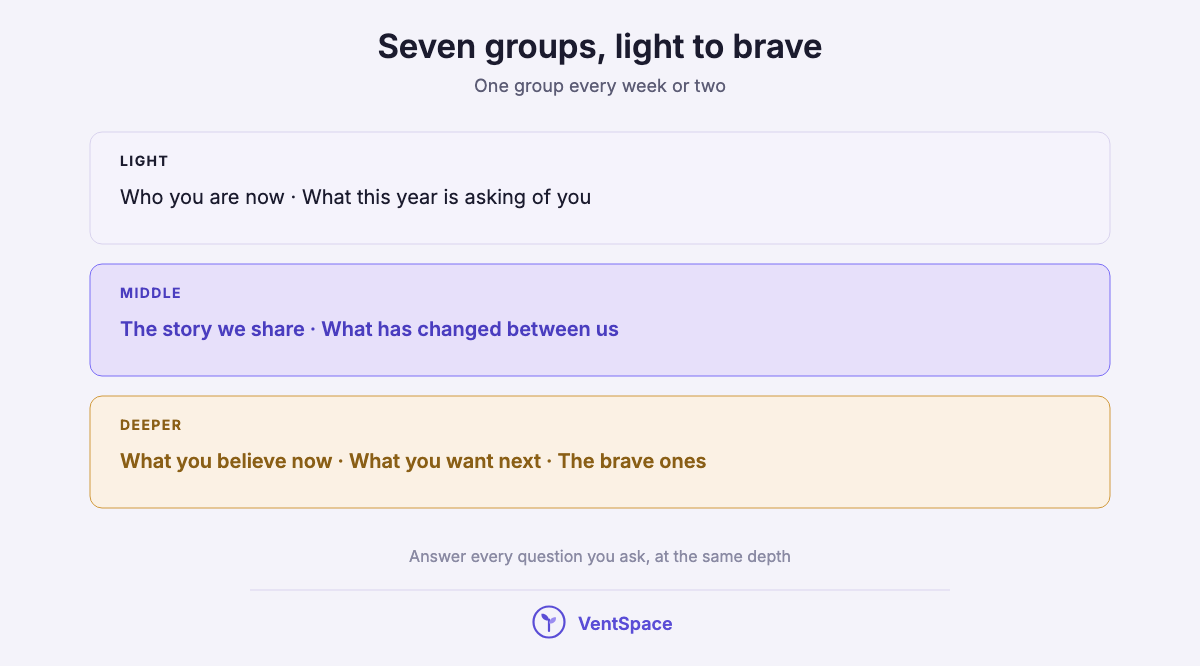
One group every week or two. Swap the order freely.
| Week | Group | How many | Where it works best |
|---|---|---|---|
| 1 | Who you are now | 1–2 | Over text or a quick call |
| 2 | What this year is asking of you | 1 | A coffee or a walk |
| 3 | The story we share, seen again | 1–2 | Dinner, or the next reunion |
| 4 | What has changed between us | 1 | Somewhere unhurried, on a good day |
| 5 | What you believe now / What you want next | 1–2 | A long drive or a walk |
| 6 | The brave ones | 1 | In person or a call, after some of the others |
If you only ask five
- 1. What’s been on your mind most this month, outside of work? Past “busy”.
- 13. What’s weighing on you that wouldn’t come up when we just catch up? The one long friendships skip.
- 26. What do you think has kept us friends all this time? Warm, without a speech.
- 39. Is there a part of your life you wish I asked about more? Tells you what to ask next.
- 66. Has there been a stretch lately when you felt more alone than you let on? Heavy, and old friends are well placed to hear it.
Keeping what you learn
Writing down afterward what a friend said lets the next conversation pick up the thread. If that helps, VentSpace is a journaling app that turns what you write into a clear read on your life balance, plus small, doable next steps. It is ours, free to start, and on Google Play for Android as of October 2026. Not on Android, or at a desk? VentSpace Live runs in your browser, free, with nothing to install. It is not a substitute for a person, and the point of writing it down is the next time you see them.
Questions people ask about deep questions for friends
Can I ask these over text?
Yes, the lighter ones. Save the brave ones for a call or in person, where you can hear how the answer is landing.
What if my friend doesn’t want to answer?
Take the answer you get and move on warmly. Passing is information about this week, not a verdict on the friendship.
Are these different for a best friend?
Not the questions, the pace. You may reach the braver groups sooner. The rule is the same.
What if a question brings up something serious?
Put the list away and listen. If it is more than a friend can hold, a therapist is an ordinary next step. If your friend talks about harming themselves, call or text 988 in the US or find a local line at findahelpline.com.
One question, one friend
Old friends are not used up. We have mostly stopped asking. The history is safe, so we stay in it.
So choose one friend, and one question from this page that you would like to hear them answer. The friendship has been there for years. It can bear one real question.
About this article

Written by
Sai Subramaniam
Founder, VentSpace
I write these guides because I have been where you are. I am working through my own hard seasons, and I share the things that actually helped me, so that anyone going through it has a steady companion close by instead of facing it alone. VentSpace is the app I built for exactly that: a journaling app that turns what you write into a clear read on your life balance, plus small, doable next steps toward feeling more like yourself.
This writing is honest and every claim is sourced, and it is not a substitute for professional care. If you are struggling, reaching out to a professional is a strong move, not a failure.
Explore VentSpaceTry VentSpace LiveHow this one was checked. Every factual claim traces to a named source, and the source is printed next to the claim rather than kept in a footnote. Quotes are pinned to the work they come from, with the year, the letter or the chapter where one exists. Where a widely repeated claim could not be traced, it was left out and the omission recorded. Where a figure is contested, both sides are printed.
No affiliate links, no paid placements, and nobody paid to appear here. Where we mention our own app, we say that it is ours, we state its limits, and we never position it as a substitute for care.
Reviewed: October 2026. Prices, platforms and product availability move quickly, and anything we could not verify at the time of writing is marked as unverified rather than turned into a number.
Corrections. If something here is wrong, we would rather know. Corrections are made in place, with a note saying what changed.