
“for as it is not one swallow or one fine day that makes a spring, so it is not one day or a short time that makes a man blessed and happy.” · Aristotle, Nicomachean Ethics, Book I
Someone asks us, at a dinner or in a job interview or late at night, what we want from life, and somebody in the room says “to be happy”. Everyone nods, because it sounds like the one answer nobody could argue with. And yet many of us know the strange experience Sai described when he first wrote this page in 2022: having most of what we were told to want, a good weekend just behind us, and still feeling that something is missing. If happiness is the obvious goal, why is it so hard to say what it is?
Part of the answer is that we use one word for two different things. Psychologists have studied happiness from two directions for a long time. One tradition, the hedonic one, defines well-being “in terms of pleasure attainment and pain avoidance”. The other, the eudaimonic one, “focuses on meaning and self-realization”, as Richard Ryan and Edward Deci put it in a 2001 review in the Annual Review of Psychology. Sai’s 2022 version of this page reached the same split in plainer words. He called the two kinds excitement and satisfaction.
This guide takes that split seriously. It explains what happiness is, why the exciting kind fades so quickly, and why aiming straight at feeling happy can backfire. Then it turns Sai’s original exercise into five small steps, so that by the end you have, in his phrase, your happiness compass in your hands.
Quick Digest
Happiness is two things under one word: how our days feel, and how we judge our life when we stop to think about it.
Excitement (pleasure, novelty, a good night out) feeds the first. It comes easily and fades quickly.
Satisfaction (what is meaningful to us, often slow and effortful) feeds the second. It comes slowly and tends to last.
Aiming straight at feeling happy can backfire. In one study, people who valued happiness more felt less of it when life was going well.
Avoiding unpleasant feelings narrows the good ones too. Much of what we do “for fun” is avoidance in disguise.
The five steps below start with a list of ten things that make you happy, written today.
What is happiness?
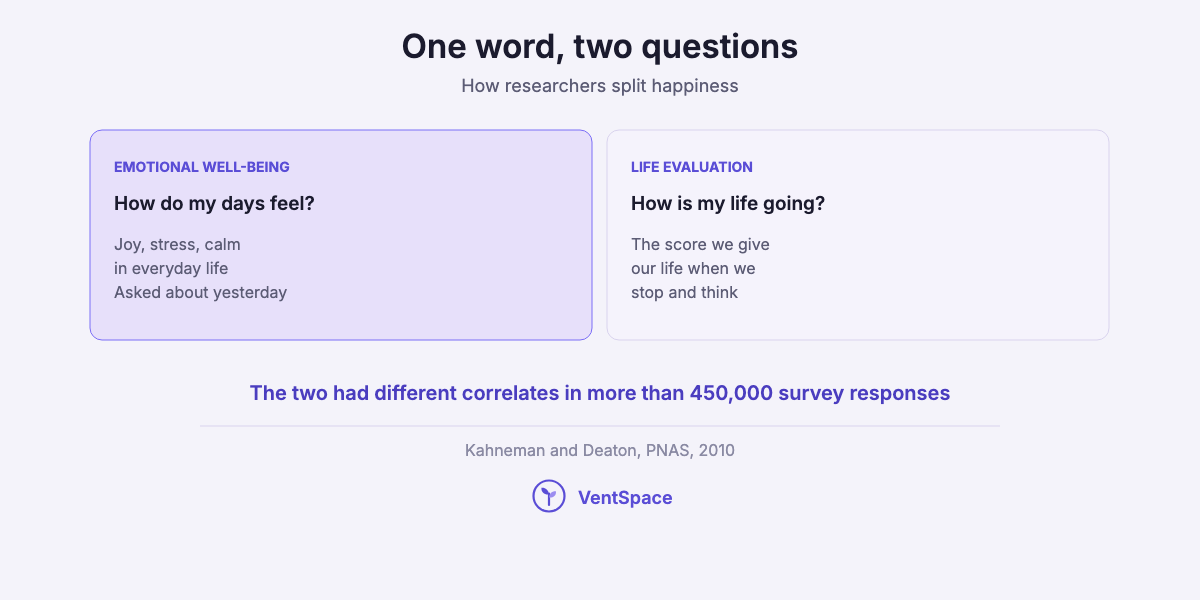
Happiness, as psychologists use the word, is how we feel and think about our own lives. One handbook definition puts it plainly: “Subjective well-being consists of a person’s cognitive and affective evaluations of his or her life” (Diener, Oishi and Lucas, Oxford Handbook of Positive Psychology, 2009). Affective means feelings: the joy, stress and calm of an ordinary Tuesday. Cognitive means judgment: what we conclude when someone asks whether our life is going well.
These two can come apart, and that is the first thing worth knowing. In 2010, Daniel Kahneman and Angus Deaton analyzed more than 450,000 responses to a daily Gallup survey of US residents and treated them separately. They called the first emotional well-being, the feel of yesterday, and the second life evaluation, the score we give our life when we think about it. They found the two had different correlates: income and education went more with life evaluation, while health, caregiving, loneliness and smoking were relatively stronger predictors of daily emotions (Proceedings of the National Academy of Sciences, 2010).
So when we ask “am I happy?”, we are often asking two questions at once. Do my days feel good? And does my life, taken as a whole, seem worth what I am putting into it? It is entirely possible to answer yes to one and no to the other. A month of parties can feel wonderful and leave the second question untouched. A hard year raising a child or building something can feel exhausting day to day and still score high when we step back. Much of the confusion we carry about happiness comes from expecting one answer to cover both.
Quick Summary
Q: What is happiness?
A: In psychology, happiness usually means subjective well-being: how we feel in our daily lives and how we judge our lives as a whole. The two are related but different, and research finds they have different correlates, which is why a pleasant life and a satisfying one are not always the same life.
Insight: Kahneman and Deaton, PNAS (2010), defining the two halves: “Emotional well-being refers to the emotional quality of an individual’s everyday experience–the frequency and intensity of experiences of joy, stress, sadness, anger, and affection that make one’s life pleasant or unpleasant. Life evaluation refers to the thoughts that people have about their life when they think about it.”
The two kinds: excitement and satisfaction
“To be truly happy is a question of how we begin and not of how we end, of what we want and not of what we have.” · Robert Louis Stevenson, “El Dorado” (1881)
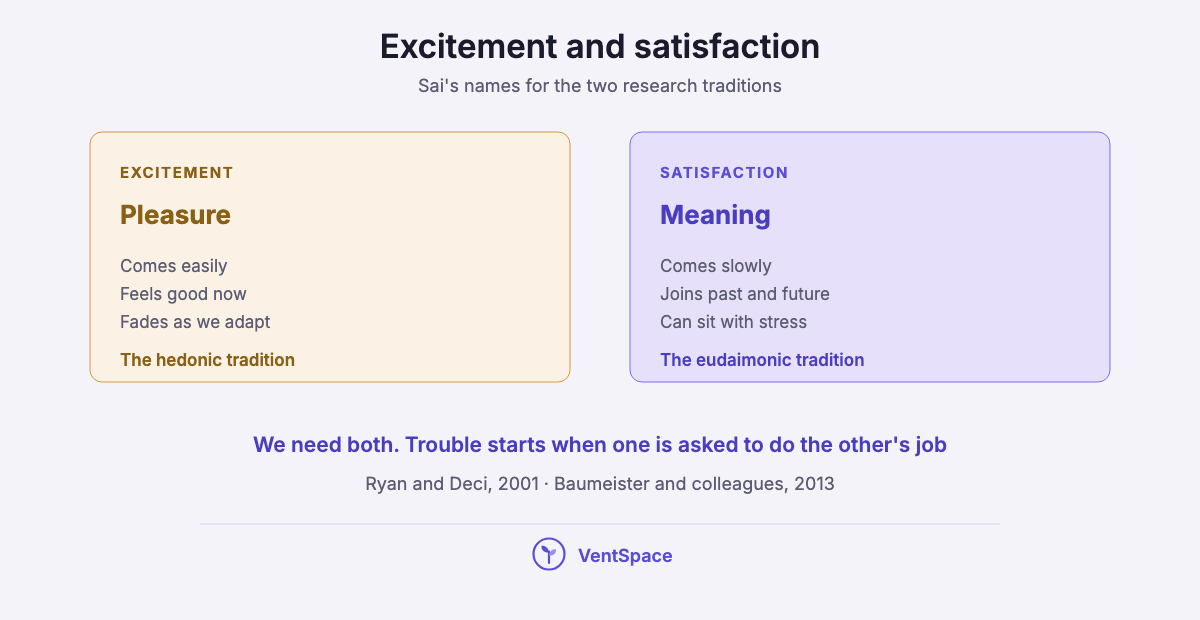
Excitement is the happiness of pleasure and novelty, and satisfaction is the happiness of meaning. The first maps onto the hedonic tradition and the second onto the eudaimonic one. We need both. The trouble starts when we expect the first to do the work of the second.
Sai’s 2022 description of excitement is hard to improve: “the last time you let go of everything and just drove away and camped with your friends”. A vacation, a night out, a first date, a new purchase. These make us feel alive, and there is nothing shallow about enjoying them. Satisfaction is quieter. It is the feeling of having done something that matters to us: caring for someone, making something, getting better at a hard thing over years. It rarely arrives in a single evening.
Research on the difference between a happy life and a meaningful one gives this distinction some edges. In a large survey, Roy Baumeister, Kathleen Vohs, Jennifer Aaker and Emily Garbinsky found that “Satisfying one’s needs and wants increased happiness but was largely irrelevant to meaningfulness.” Happiness, as their measures captured it, was “largely present-oriented”, while meaning involved “integrating past, present, and future.” Happiness was linked to being a taker, meaning to being a giver. And, most usefully for anyone who has felt guilty about a hard but worthwhile stretch of life, higher worry, stress and anxiety were linked to higher meaningfulness but lower happiness (Journal of Positive Psychology, 2013). The study is a survey, so it shows what goes together, not what causes what.
That last finding names something many of us feel and rarely say. The things that matter most to us are often not the things that feel best on a given day. A meaningful week can be a stressful one. That does not mean we are doing it wrong. It may mean we are doing the kind of thing that satisfaction is made of.
Quick Summary
Q: What are the two kinds of happiness?
A: Researchers distinguish hedonic happiness (pleasure, enjoyment, feeling good) from eudaimonic happiness (meaning, growth, living by what matters). Sai’s plainer names are excitement and satisfaction. Survey research links getting what we want to happiness, and giving, thinking across past and future, and even some stress to meaning.
Insight: Baumeister, Vohs, Aaker and Garbinsky, Journal of Positive Psychology (2013): “Being happy and finding life meaningful overlap, but there are important differences… Happiness was largely present-oriented, whereas meaningfulness involves integrating past, present, and future. For example, thinking about future and past was associated with high meaningfulness but low happiness.”
Why excitement fades, and why chasing happiness backfires
“Ask yourself whether you are happy, and you cease to be so.” · John Stuart Mill, Autobiography (1873)
Excitement fades because we adapt to good things, and chasing happiness directly can backfire because the chase itself sets us up for disappointment. Both are worth understanding, because together they explain the strange emptiness of a life with plenty of good times in it.
First, adaptation. Psychologists call it hedonic adaptation, “the process by which individuals return to baseline levels of happiness following a change in life circumstances,” in Richard Lucas’s definition (Current Directions in Psychological Science, 2007). A new car or a promotion is exactly this kind of change, and adaptation is the name for the lift it gives us thinning out. That is the part everyone has heard. The part that is heard less often is Lucas’s correction. Large panel studies following people over years found that some events, including divorce, the death of a spouse, unemployment and disability, were associated with lasting changes in well-being, and that people differ a great deal in how much they adapt. His conclusion: “happiness levels do change, and adaptation is not inevitable.” We are not stuck at a fixed setting. But we are also not built to stay lifted by the same pleasure for long.
Second, the chase. In two studies, Iris Mauss and colleagues looked at what happens when people place a high value on being happy. In the first, women who valued happiness more reported lower happiness when their lives were low in stress, which is to say, when things were going well. In the second, women who were nudged to value happiness reacted less positively to something designed to make them happy, and the effect ran through their disappointment at their own feelings (Emotion, 2011). Both studies used women only, so we should hold the finding carefully. But it describes something recognizable. When we treat every good moment as a test of whether we are happy enough, the good moment is quietly turned into an exam, and few of us enjoy exams.
Mill reached the same place by a harder road. After the mental crisis he dates to the autumn of 1826, he concluded that happiness “was only to be attained by not making it the direct end.” Ask the question too often, and the feeling slips away while we are measuring it.
Quick Summary
Q: Why doesn’t happiness last?
A: We adapt to good changes, so the lift from most pleasures fades, although research shows adaptation is not inevitable and some changes last. Aiming straight at feeling happy can also backfire: in two studies of women, valuing happiness highly was linked to feeling less happy at the very moments things were going well.
Insight: Mauss, Tamir, Anderson and Savino, Emotion (2011): “valuing happiness could be self-defeating, because the more people value happiness, the more likely they will feel disappointed. This should apply particularly in positive situations, in which people have every reason to be happy… Paradoxically, therefore, valuing happiness may lead people to be less happy just when happiness is within reach.”
What avoidance has to do with it
A lot of what we do to feel better is done to avoid feeling worse, and that kind of avoidance tends to narrow the good feelings along with the bad ones. This was the heart of Sai’s 2022 page, and it is the part most writing on happiness leaves out.
He asked two questions, and they are worth reading slowly. What are the unpleasant feelings or thoughts in your life? And what do you do every day to avoid them? Then he offered a list, for anyone having trouble being honest with themselves:
- Overworking in order to avoid feeling insignificant
- Working out in order to avoid feeling fat or ugly
- Staying in a toxic relationship in order to avoid feeling lonely
- Staying in an unsatisfying job to avoid feeling inadequate
- Trying to impress everyone in order to avoid feeling like a loser
None of these activities is bad in itself. Work, exercise and relationships can all be sources of real satisfaction. The question is what they are for. When we do something mainly to keep a feeling away, we tend to need more of it, and it tends to give us less.
Psychologists have a name for the habit underneath. Experiential avoidance is the attempt to avoid or escape unpleasant inner states: thoughts, feelings, bodily sensations. It is a central idea in Acceptance and Commitment Therapy, which is a therapy and works with a therapist, not a self-help trick. In one study that tracked people for 21 days, Todd Kashdan and colleagues found that more experiential avoidance went with fewer positive daily experiences, fewer positive events, more negative ones, and more negative feelings (Behaviour Research and Therapy, 2006). It is a correlation, but it fits the shape Sai noticed: the effort to never feel bad can leave us feeling less of everything. Our guide to ignoring problems goes further into avoidance as an everyday habit.
When it is more than a question of happiness. Feeling flat or empty for a weekend, or after a big event, is common. If the emptiness has lasted for weeks, and it is reaching your sleep, your work, or your interest in things you used to care about, that is worth talking through with a doctor or a therapist. Our page on whether you need therapy may help you decide. If you are having thoughts of harming yourself, please call or text 988 in the US, the 988 Suicide & Crisis Lifeline, or find a local line at findahelpline.com.
Quick Summary
Q: How does avoidance affect happiness?
A: When we organize our days around avoiding unpleasant feelings, we often lose positive experiences too. In a 21-day study, people higher in experiential avoidance reported fewer positive daily experiences and more negative ones. Noticing what an activity is for is a first step.
Insight: Kashdan, Barrios, Forsyth and Steger, Behaviour Research and Therapy (2006), on what experiential avoidance went with over three weeks of daily records: it “was associated with diminished daily positive affective experiences and healthy life appraisals, diminished frequency of positive events and more frequent negative life events, and greater negative affective experiences.”
So where does the compass point?
Five steps toward the kind of happiness that lasts
“Aiming thus at something else, they find happiness by the way.” · John Stuart Mill, Autobiography (1873)
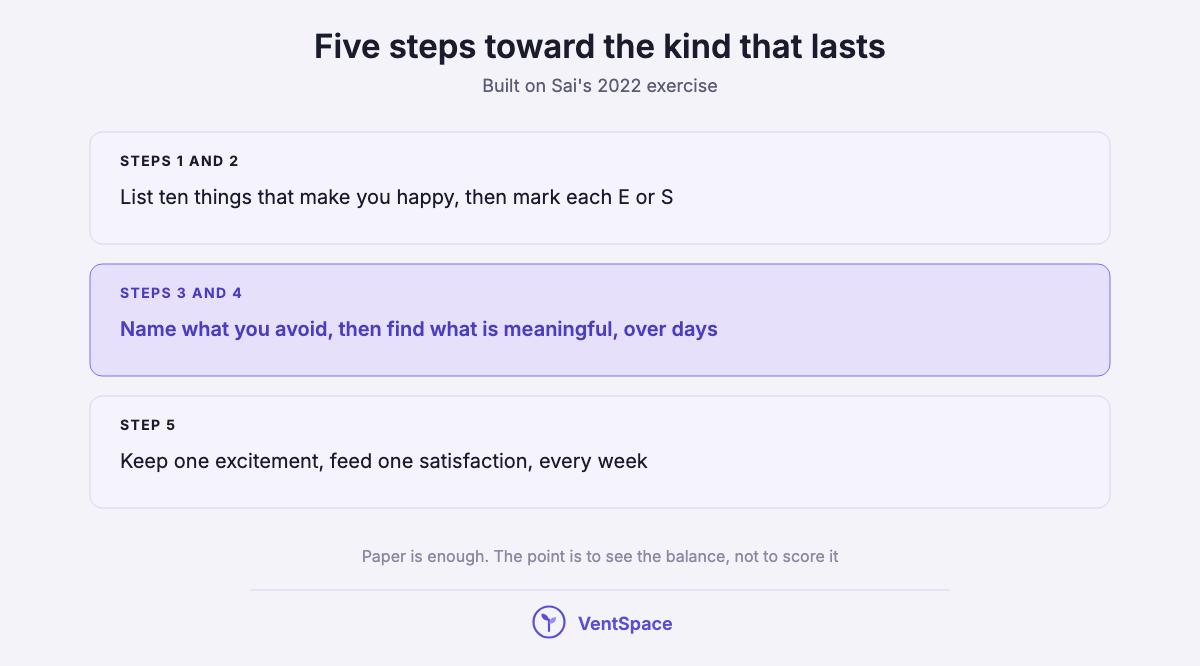
These steps come from the exercise Sai wrote in 2022, with a little more structure around them. They will not make anyone happier on their own, and nothing here is a promise. What they can do is show you, on paper, which parts of your life are excitement, which are satisfaction, and which are avoidance, so that your next choices are made with your eyes open.
1. Write down ten things that make you happy
Take a sheet of paper and number it one to ten. Give yourself two minutes. Write the first ten things that come to mind that make you happy, big or small. Sai’s original instruction was simple: think of ten, and do not read on until you have.
- Which came to mind first?
- Which ones involve other people?
- Which ones did you last do more than a month ago?
- Was it hard to reach ten, or hard to stop?
There are no wrong answers on this list. A bowl of noodles belongs next to your family if it came to mind.
2. Sort them into excitement and satisfaction
Next to each item, write an E or an S. E for excitement: it feels good while it lasts, it is often new or intense, and it fades. S for satisfaction: it matters to you, it often took effort, and the good feeling outlasts the moment. Some items will be both. Mark those E/S.
- How many of each did you get?
- Which S items took you years to build?
- Which E items do you keep going back to, hoping for the old feeling?
If your list comes out lopsided, that is fine. It is information, not a grade.
3. Name what you are avoiding
Write Sai’s two questions at the top of a fresh page. What are the unpleasant feelings or thoughts in my life? What do I do every day to avoid them? Then look back over your day since you woke up and list anything you did mainly to keep a feeling away.
- Is anything on your happy list also on this one?
- Which feeling comes up most?
- What would it cost you to feel it for ten minutes instead of avoiding it?
Be honest, and be kind about it. We all avoid some things. The point is to see it, not to stop it today.
4. Find what is meaningful to you, and give it days
Write one question and leave it open for a few days: what do I do that is genuinely satisfying and meaningful to me? Sai’s advice was to read it twice before answering, and to take hours or days if you need to. Add to the page whenever something occurs to you.
From Sai, who writes this blog: his answer in 2022
“When it comes to me, writing to help people out of their problems is deeply meaningful and satisfying. Spending time with family and being in a truly meaningful relationship is on the list as well.” He noticed that the things that satisfy us rarely come easily, and named being a parent and building a company that resonates with your core principles as examples that take years.
- When did you last lose track of time doing something worthwhile?
- Who are you glad to have helped, and how?
- What would you keep doing even if nobody noticed?
Do not rush this one. If the page stays half-empty for a week, that is an honest result, not a failure.
5. Keep the excitement, but stop asking it to carry everything
Look at your E items and pick one you will keep enjoying without guilt this week. Then look at your S items and pick one small action that feeds it: a call, an hour of practice, a page written. Put both in your calendar.
- What would a week look like with one of each?
- Which excitement are you asking to fill a gap it cannot fill?
- What is the smallest step toward one satisfaction?
Excitement is not the enemy. As Sai put it, having excitement in life is always a necessity. It only becomes a problem when a whole life is organized around it.
Insight: John Stuart Mill, Autobiography (1873), on the theory he formed after his crisis: “Those only are happy (I thought) who have their minds fixed on some object other than their own happiness; on the happiness of others, on the improvement of mankind, even on some art or pursuit, followed not as a means, but as itself an ideal end. Aiming thus at something else, they find happiness by the way.”
Pulling it all together
“tho’ I never arrived at the perfection I had been so ambitious of obtaining, but fell far short of it, yet I was, by the endeavour, a better and a happier man than I otherwise should have been if I had not attempted it” · Benjamin Franklin, Autobiography
The five steps are one path: see what makes you happy, sort it, notice what you are running from, find what matters, and give it a little room each week. Here is how they join up, with one thing to write down today for each.
Your list of ten is the raw material. Write it today, in two minutes, before you think too hard.
The sort shows the balance between excitement and satisfaction in your life as it is now. Write how many E and how many S you got.
The avoidance page shows where some of your time is going. Write the one feeling that came up most.
The meaningful page is your compass. Write the one thing on it that you most want more of.
The week puts the compass to use. Write the one small action you will take for it.
If you would like somewhere to work through the satisfaction question over several days rather than in one sitting, VentSpace is a journaling app that turns what you write into a clear read on your life balance, plus small, doable next steps. It is ours, free to start and Android only as of October 2026. Not on Android, or at a desk? VentSpace Live runs in your browser, free, with nothing to install. Paper works too. Our gratitude list and our guide to finding joy in the simple things are good companions on the excitement side, and turning your values into daily habits picks up where step 5 leaves off.
Insight: Richard Lucas, Current Directions in Psychological Science (2007), on whether any of this can change: “Although inborn factors certainly matter and some adaptation does occur, events such as divorce, death of a spouse, unemployment, and disability are associated with lasting changes in SWB. These recent studies also show that there are considerable individual differences in the extent to which people adapt. Thus, happiness levels do change, and adaptation is not inevitable.”
Questions people ask about happiness
Is happiness the same as pleasure?
No, pleasure is one part of it. Researchers distinguish hedonic happiness, which is about pleasure and feeling good, from eudaimonic happiness, which is about meaning and living by what matters. Survey research finds the two overlap but have different ingredients, so a life full of pleasure can still feel like it is missing something.
Does money buy happiness?
It is more complicated than the famous $75,000 figure. A 2010 study by Kahneman and Deaton found that daily emotional well-being stopped rising at around $75,000 a year. In 2023, Matthew Killingsworth, Daniel Kahneman and Barbara Mellers reanalyzed the question together and found that this flattening held “only for the least happy people”, while among happier people happiness kept rising with income (PNAS, 2023). Money matters, and it matters differently for different people.
Is 40% of happiness under your control?
That figure is widely repeated and poorly supported. It comes from a 2005 model that split happiness into roughly 50% genes, 10% circumstances and 40% intentional activity. Nicholas Brown and Julia Rohrer re-examined it and concluded there is “little empirical evidence for the variance decomposition” behind it (Journal of Happiness Studies, 2020). Happiness can change, as Lucas’s work shows, but no one can tell you what share of it is yours to move.
Is it bad to want to be happy?
No, but watching it too closely can backfire. In two studies of women, valuing happiness highly was linked to feeling less happy when life was going well, through disappointment at their own feelings. Wanting a good life is fine. Grading every evening on how happy it made us is where the trouble starts.
Can you be happy all the time?
Not in the excitement sense, and that is how we are made. We adapt to pleasures, so the lift fades. Satisfaction behaves differently: it can sit underneath ordinary and even hard days. Expecting constant good feelings tends to turn normal flat stretches into evidence that something is wrong.
What if I feel empty even when my life looks good?
You are not alone, and it is worth paying attention to. Sometimes it is the excitement-without-satisfaction pattern this page describes, and the steps above can help you see it. If the emptiness has lasted weeks and is affecting your sleep, work or interest in things, talk to a doctor or therapist. That is an ordinary next step, not a dramatic one.
In a nutshell
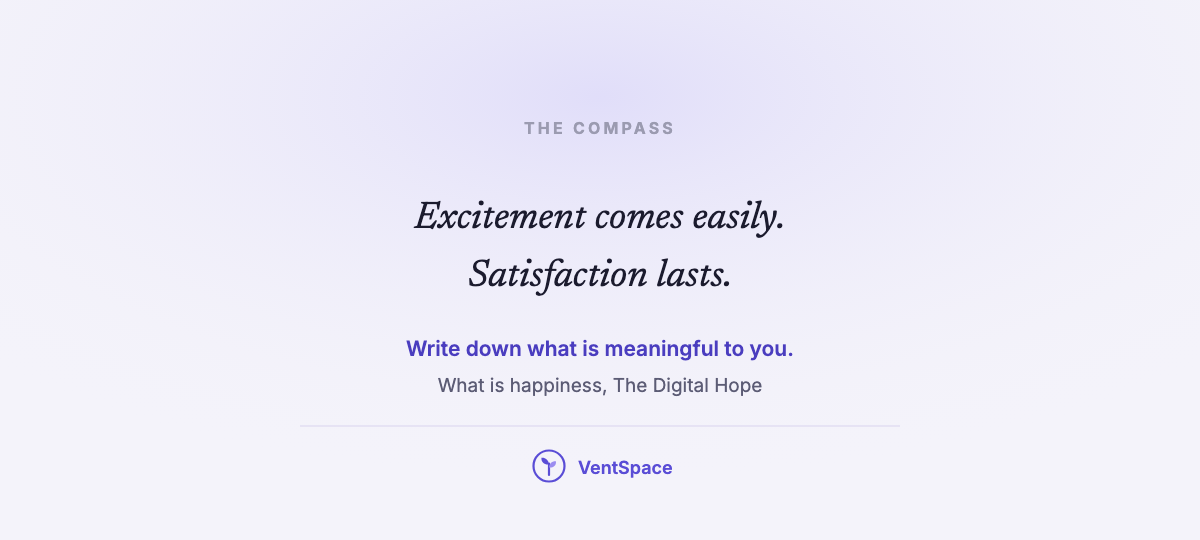
First, happiness is two things: how our days feel, and how we judge our lives. Excitement feeds the first and fades. Satisfaction, from what is meaningful to us, feeds the second and tends to stay. We need both, and the second is the one most of us are short of.
Second, satisfaction does not arrive in a weekend. Sai’s own examples, raising a child, building a company, writing to help people, take years, and the steps above are the start of a long walk, not a shortcut. Excitement comes easily and does not last. Satisfaction does not come easily, and it lasts. The compass is already in your hands.
About this article

Written by
Sai Subramaniam
Founder, VentSpace
I write these guides because I have been where you are. I am working through my own hard seasons, and I share the things that actually helped me, so that anyone going through it has a steady companion close by instead of facing it alone. VentSpace is the app I built for exactly that: a journaling app that turns what you write into a clear read on your life balance, plus small, doable next steps toward feeling more like yourself.
This writing is honest and every claim is sourced, and it is not a substitute for professional care. If you are struggling, reaching out to a professional is a strong move, not a failure.
Explore VentSpaceTry VentSpace LiveHow this one was checked. Every factual claim traces to a named source, and the source is printed next to the claim rather than kept in a footnote. Quotes are pinned to the work they come from, with the year, the letter or the chapter where one exists. Where a widely repeated claim could not be traced, it was left out and the omission recorded. Where a figure is contested, both sides are printed.
No affiliate links, no paid placements, and nobody paid to appear here. Where we mention our own app, we say that it is ours, we state its limits, and we never position it as a substitute for care.
Reviewed: October 2026. Prices, platforms and product availability move quickly, and anything we could not verify at the time of writing is marked as unverified rather than turned into a number.
Corrections. If something here is wrong, we would rather know. Corrections are made in place, with a note saying what changed.