
“A growth hacker is a person whose true north is growth. Everything they do is scrutinized by its potential impact on scalable growth.”
Sean Ellis, “Find a Growth Hacker for Your Startup” (Startup Marketing blog, 26 July 2010)
Last updated: October 2026.
A team copies a referral bonus from a famous case study. Signups jump for six weeks, then slide back toward where they were, and the quarter’s plan was built on the jump. Either the tactic was wrong, or it was never the thing that made the original company grow.
Andrew Chen named the pattern in his essay “The Law of Shitty Clickthroughs” (2012): “Over time, all marketing strategies result in shitty clickthrough rates.” His evidence is thin but vivid. The first banner ad, on HotWired in 1994, debuted at a 78% clickthrough rate, set against a 0.05% Facebook average in 2011. Novelty wears off, competitors copy, and scale reaches people who care less.
Growth that lasts comes from a loop, not a tactic: a system in which each cohort of users, partners or content produces the input that brings in the next cohort. A tactic is one input, and it decays once copied. A loop reinvests its own output, so it compounds until something in the loop breaks. This guide defines the loop against the funnel, walks through the four loop types with the condition each needs, takes apart one integration loop I ran at JustWatch, separates what held from 2010s growth hacking from what was survivorship storytelling, and ends with five steps to find and measure a loop in your own business.
How we know: primary documents read on 29 October 2026: Sean Ellis’s July 2010 post, Andrew Chen’s clickthrough essay, Drew Houston’s Dropbox “Startup Lessons Learned” slides (April 2010 data), Google Search Central’s spam policies (updated 28 August 2026), LinkedIn’s User Agreement (effective 3 November 2025) and newsroom post of 12 March 2026, and Instagram’s promotion guidelines. One randomized field experiment on AI Overviews (Agarwal and Sen, revised 2026). First-party: two programmes I worked on, JustWatch (Nov 2022 to Nov 2023) and Clarifai (Jul 2025 to May 2026), each n=1 and labelled. The limit: published growth cases are survivors. Nobody publishes the loops that failed, so no dataset here can tell you how often a loop works.
Quick Digest
– A funnel spends its input. A loop reinvests its output: new users, content or partners produce the next round of acquisition.
– Four loop types: content, product and integration, referral and community, and paid. Each needs one condition to be true.
– The headline case: a widget and API programme at JustWatch reached 200+ partners and 2M+ followed, branded links in a year [FIRST-PARTY, n=1].
– What held from growth hacking: experiments, one growth metric, and the idea of a loop. What did not: the named hacks, retold without a baseline.
– Measure a loop by step: cycle time, conversion at each step, and output per cohort, read monthly for decay.
– The honest timeline: two to three quarters before a loop shows whether it compounds.
A funnel spends its input, a loop reinvests its output
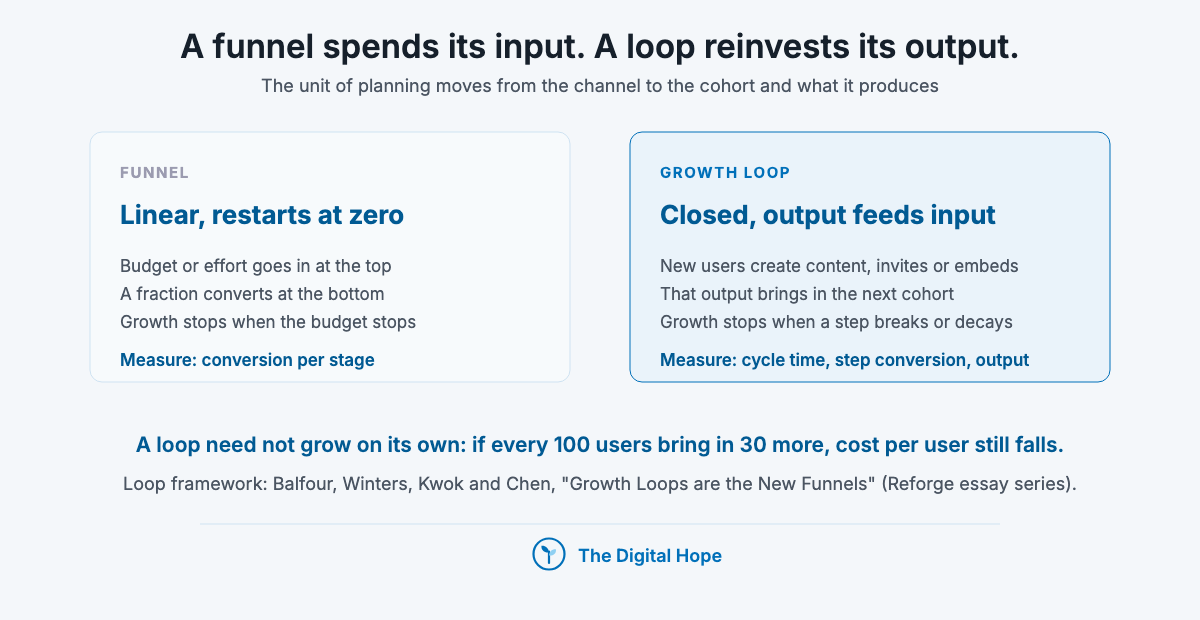
A growth loop is a closed system in which the output of one cohort becomes the input that acquires the next. A funnel is linear: money or effort goes in at the top, some fraction converts at the bottom, and the process starts again from zero. A loop has no bottom. The user who signs up writes the review that ranks, invites the colleague, or embeds the widget that brings the next user.
The vocabulary comes from a Reforge essay series co-written by Brian Balfour, Casey Winters, Kevin Kwok and Andrew Chen, titled “Growth Loops are the New Funnels”. It is a framework, not a dataset, and it is worth using for one reason: it changes the question a team asks. A funnel team asks where people drop out. A loop team asks what each new user produces, and whether that output brings in another user.
| Dimension | Funnel | Loop |
|---|---|---|
| Shape | Linear, top to bottom | Closed, output feeds input |
| What stops growth | The budget or effort stops | A step in the loop breaks or decays |
| Unit of planning | The channel | The cohort and what it produces |
| What you measure | Conversion per stage | Cycle time, conversion per step, output per cohort |
| Who owns it | Usually marketing | Marketing, product and partnerships together |
Three numbers describe any loop:
- Cycle time: how long one turn takes, from a user arriving to the next user they bring in.
- Step conversion: the share that passes each step (signs up, creates something, shares it, the next person acts).
- Output per cohort: how many new users one cohort of 100 brings in. Above 100 the loop grows on its own. Below it, the loop still lowers your cost per user, which is where most real loops sit.
The viral coefficient (invites sent per user, times the share of invites that convert) is the referral version of output per cohort. A coefficient of 0.3 is not a failure. It means every 100 users you pay for bring in 30 you didn’t.
The loop is the unit. The channel is a step.
Quick Summary
Q: What is the difference between a growth loop and a funnel?
A: A funnel is linear: input goes in at the top, a fraction converts, and the process restarts from zero. A growth loop is closed: what one cohort of users produces (content, invites, embeds, revenue) becomes the input that acquires the next cohort, so growth compounds until a step in the loop breaks.
Insight Andrew Chen’s law, “Over time, all marketing strategies result in shitty clickthrough rates,” is the strongest argument for loops over tactics. A tactic is a fixed input that the market learns to ignore. A loop keeps producing fresh input, because each cohort creates it. Chen’s own evidence is two data points (a 1994 banner ad and a 2011 average), so read it as a named mechanism, not a measured decay rate.
Four loop types, and the one condition each needs
“Link spam is the practice of creating links to or from a site primarily for the purpose of manipulating search rankings.”
Google Search Central, Spam policies (last updated 28 August 2026)
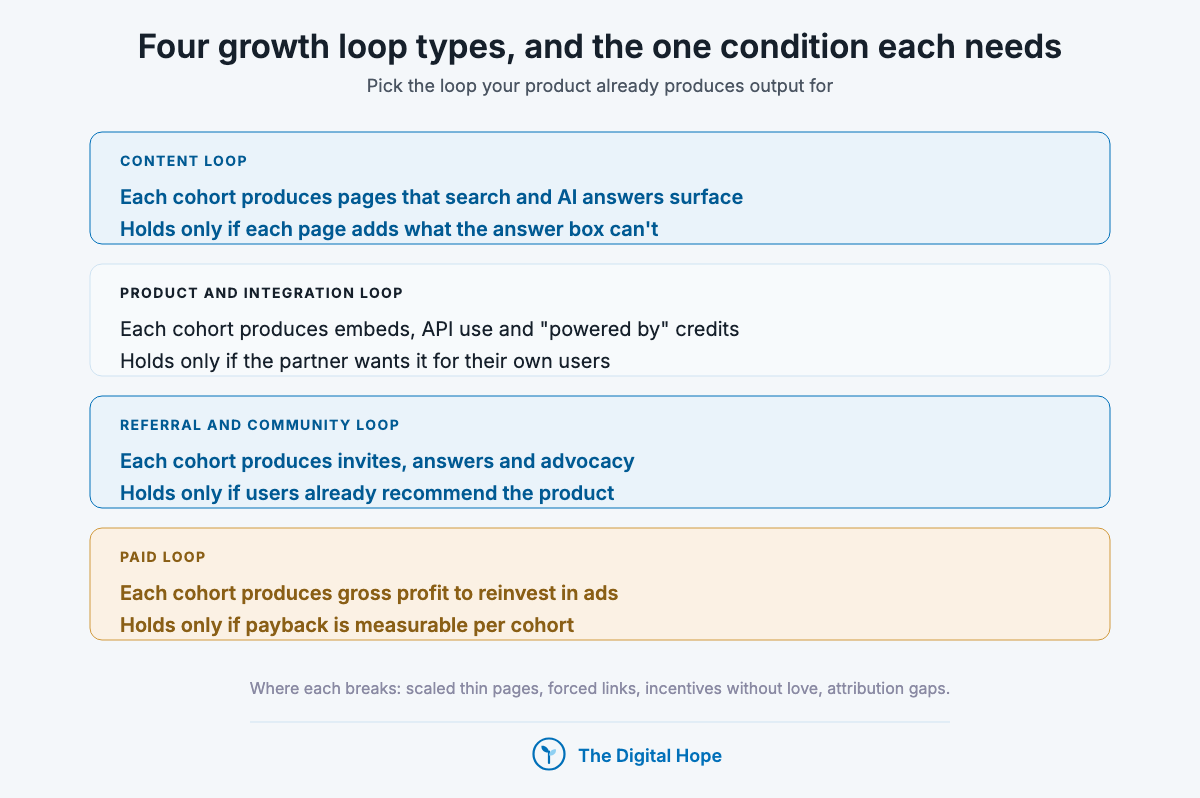
There are four common loop types: content, product and integration, referral and community, and paid. Each one works only when one condition holds, and the condition is where most copied loops fail.
The buyer splits the choice. For B2C products with many users, referral and content loops usually carry most of the weight. For B2B with a few hundred target accounts, integration, community and paid loops matter more, because a buying group rarely arrives through one person’s invite. If you sell to businesses, count accounts in the loop, not users.
Content loops: users or the team create pages that bring in the next users
A content loop turns what users or your team create into pages that search and AI answers surface. Reviews, Q&A threads, public templates and user profiles are the classic forms. A new user creates a page, the page earns search traffic, and some of that traffic signs up and creates the next page.
The condition: each page must add something a searcher can’t get from the answer box. Google added scaled content abuse to its spam policies on 5 March 2024, aimed at many pages made mainly to rank, whoever or whatever produced them. And the clicks per page are falling: in a randomized field experiment by Agarwal and Sen (revised 2026), AI Overviews cut organic clicks by 39.8%. A content loop that worked on 2019 click-through rates turns slower now, so model it on today’s numbers.
For the system behind the content itself, see the guide to content marketing as a system.
Product and integration loops: the product travels to where the next user is
An integration loop puts your product, data or brand inside someone else’s product, so their users meet you there. Embeddable widgets, public APIs, “powered by” credits, marketplace apps and shared documents all work this way. The partner gets something useful for their users. You get exposure, and on the web, a link.
The condition: the partner must want the integration even if search engines did not exist. Google’s spam policies name “keyword-rich, hidden, or low-quality links embedded in widgets that are distributed across various sites” as link spam. They do not name widgets as such. The difference is whether the embed serves the partner’s readers or only your rankings. The JustWatch case below is this loop type.
Referral and community loops: users bring users, and the community recruits
A referral loop pays existing users, in product value or money, to bring in new ones. The best-documented case is Dropbox. Drew Houston’s “Startup Lessons Learned” slides say a “Referral program w/ 2-sided incentive permanently increased signups by 60%”, and that in the trailing 30 days to April 2010, users sent 2.8 million direct referral invites. The reward was storage, the thing the product sells, which kept the cost close to zero and attracted people who wanted the product.
A community loop is slower and harder to count. Members answer each other’s questions, those answers become public content, the content brings in new members, and some members become customers or advocates. At Clarifai, an AI infrastructure company where I ran SEO and ads from July 2025 to May 2026 [FIRST-PARTY, n=1], we treated the developer community as a brand and enterprise-pipeline asset, not a side channel. The developer audience sat inside a full funnel in which top, mid and bottom-of-funnel ads fed each other, so community activity counted as brand and as early pipeline, not only as signups. Over that period, as part of a full-funnel rebuild, cost per signup fell from about $1,000 to under $4. I can’t separate the community’s share of that from the ads, the content and the targeting changes running at the same time.
The condition for both: it works only when users already like the product enough to put their name on it. A referral bonus on a product people don’t recommend buys a spike, then decays.
Paid loops: revenue from new users funds the next round of ads
A paid loop reinvests the gross profit from new customers into the ads that acquire the next ones. It is the loop most teams already run without calling it one. It compounds only when payback (the months until a customer’s gross profit covers what you paid to acquire them) is shorter than your cash allows you to wait.
The condition: you must be able to measure payback per cohort. Since iOS 14.5 (Apple, 26 April 2021), apps must ask permission before tracking users across other companies’ apps and sites, so platform-reported cohorts on iOS are partial. Read payback from your own revenue data by acquisition month, not from the ad platform. Unless gross profit covers acquisition cost within the months your cash allows, the loop shrinks with every turn. For how campaign structure feeds this, see performance marketing fundamentals, and for the Meta side, the Meta ads conversion playbook.
| Loop type | What each cohort produces | The condition | Where it breaks |
|---|---|---|---|
| Content | Pages that search and AI answers surface | Each page adds what the answer box can’t | Scaled thin pages, falling click rates |
| Product and integration | Embeds, API use, “powered by” credits | The partner wants it for their own users | Keyword-rich or forced links, partner churn |
| Referral and community | Invites, answers, advocacy | Users already recommend the product | Incentive without love, undisclosed rewards |
| Paid | Gross profit to reinvest | Payback measurable per cohort | Attribution gaps, rising CPMs |
Pick the loop your product already produces output for. For B2B with a few hundred target accounts, that is usually integration or paid. For B2C with many users, it is usually referral or content.
Quick Summary
Q: What are the main types of growth loops?
A: Content loops (users or the team create pages that bring in new users), product and integration loops (your product or data lives inside a partner’s product), referral and community loops (users bring users), and paid loops (revenue from new customers funds the next ads). Each needs one condition, such as partners wanting the integration or payback being measurable.
Insight Houston’s slide puts the Dropbox incentive in one line: “Referral program w/ 2-sided incentive permanently increased signups by 60%” (Dropbox, “Startup Lessons Learned”, April 2010 data). The word that matters is two-sided. Both people got storage, the thing the product sells, so the reward selected for users who wanted the product rather than users who wanted a reward.
Case: the JustWatch widget programme as an integration loop
“Keyword-rich, hidden, or low-quality links embedded in widgets that are distributed across various sites.”
Google Search Central, Spam policies, examples of link spam (last updated 28 August 2026)
JustWatch is a streaming guide. From November 2022 to November 2023 I led its SEO and widget product team [FIRST-PARTY, n=1]. The asset was data other sites wanted: where a film or show was streaming, kept current. We packaged it as an embeddable widget and an API that partner sites placed on their pages, and ran outreach to put it in front of them.
The loop, written as a sentence: a partner embeds the widget because it helps its readers decide what to watch, every page that carries the widget shows a branded credit and a followed link, those links and the brand exposure bring search visibility and visitors, and the visibility makes JustWatch the name the next partner already knows when outreach arrives.
What moved in one year:
- 200+ partners embedded the widget or used the API.
- 2M+ followed, branded links, a “powered by JustWatch”-style credit inside the widget.
- Anchors diversified away from one fixed string, never keyword-rich, never sponsored or nofollow.
- Around the same period, the site grew from about 22M to 50M+ monthly users. That is a team result, from product, content and SEO together, and the starting figure is from my portfolio (my LinkedIn profile says 25M).
Why it worked as a loop and not a link campaign. The partner’s reason to embed had nothing to do with links. Each new partner page put the brand in front of readers who were deciding what to watch, which is the moment the product exists for. And every partner made the next pitch easier, because the outreach could point to sites the prospect already respected.
What this does not prove. It is one company with a data asset most businesses don’t have. Link counts from widgets inflate fast, because every page carrying the widget adds a link, so 2M+ links came from far fewer linking domains. I can’t separate the widget’s effect on rankings or traffic from the product and content work running at the same time. The link-safety detail (why branded, followed and diversified is the line Google’s policy draws) is in the off-page SEO guide, and the full story is on my portfolio.
The condition: this loop is open to you when you own data or a tool other sites want on their pages. Without that, a widget is a link scheme with extra steps.
Partners embed value, not links.
Quick Summary
Q: How can a widget or API work as a growth loop?
A: A partner embeds your widget because it helps their readers, each embed shows your brand and links back, the visibility and links bring visitors and search presence, and that recognition makes the next partner easier to sign. At JustWatch (Nov 2022 to Nov 2023, one programme) this reached 200+ partners and 2M+ followed, branded links in a year.
Insight Google’s policy wording is the design brief for any widget loop. It names “keyword-rich, hidden, or low-quality links embedded in widgets that are distributed across various sites” (Spam policies, updated 28 August 2026), so the three tests are the inverse: a visible, branded credit, in a widget of real quality, placed by a partner who chose it. A loop that fails any of the three is building on a policy violation.
What held from 2010s growth hacking, and what was survivorship
The discipline held. The named hacks mostly did not. Ellis’s July 2010 post describes the job as testing ideas and “being analytical enough to know which tested growth drivers to keep and which ones to cut.” That part is a testing discipline, and it is how the best growth teams still work.
What held, with the reason:
- One growth metric above the rest. Ellis’s “true north” line is still the cleanest test of whether a team is a growth team.
- Experiments with a kill rule. Testing ideas and cutting the losers is cheaper than defending them.
- Loops over campaigns. Every durable case from that era, Dropbox’s storage referrals among them, is a loop once you draw it.
- Channel decay. Chen’s law is the most useful sentence the period produced, because it tells you every tactic has an expiry date.
What was survivorship storytelling. The canon retells a short list of winners: a referral bonus, a signature line in outgoing email, a clever cross-posting integration. The stories have no baseline and no denominator. We hear about the company whose referral programme lifted signups 60%, not the hundreds whose programme lifted nothing, and the same tactic copied in 2026 meets users who have seen it a thousand times. The Dropbox slide is a primary source, which makes it unusually good evidence. It still describes one product with one incentive in one year.
My read: treat a famous case as a description of a loop, not a recipe. Ask what each cohort produced in that case, whether your users produce the same thing, and what condition made it work then. The answer to the last question is usually the part that no longer holds.
Copy the loop, never the hack.
Quick Summary
Q: Does growth hacking still work?
A: The discipline does: one growth metric, cheap experiments with a rule for cutting losers, and loops in which users or partners create the next acquisition. The named hacks from 2010s case studies mostly do not, because they decay once copied and the stories were told without a baseline or the failures.
Insight Chen’s essay states the mechanism in one line: “Over time, all marketing strategies result in shitty clickthrough rates.” It explains both halves of the verdict. The named hacks were strategies, so they decayed. The loops survived because they were not a fixed strategy at all: each cohort produced fresh input, so there was less for the market to learn to ignore.
Here is how to find one in your own business.
How to find and measure a growth loop in five steps
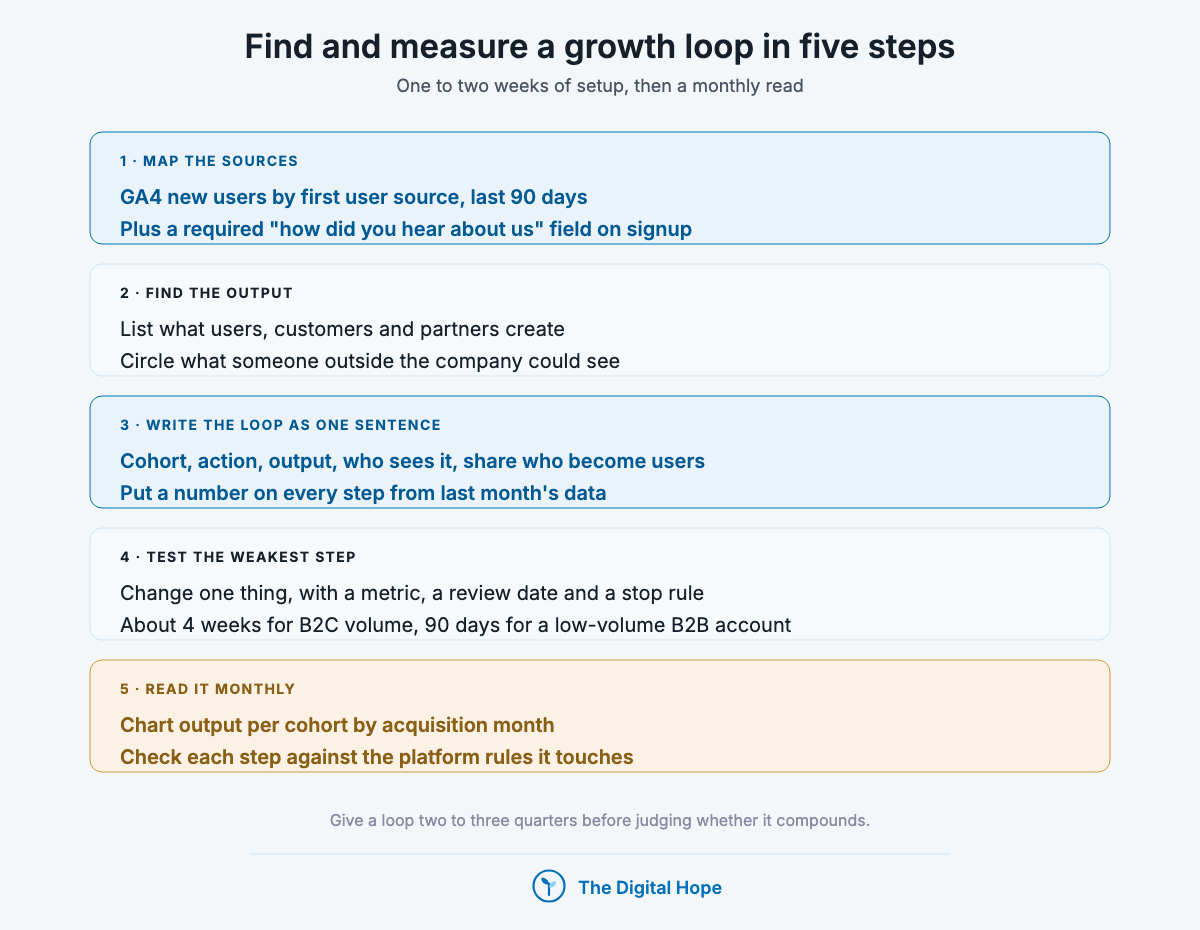
Start from what your users already produce, not from a loop you admire. The steps below take one to two weeks of setup and then a monthly read.
1. Map where your new users came from
First action: in GA4, open Reports, then Acquisition, then User acquisition, set the last 90 days, and export new users by first user source. Then add a required “How did you hear about us?” field to your signup or demo form, because word of mouth, communities and AI answers rarely show up as a clean source.
- Which sources bring users who stay past their first month?
- What share of new users name a person, a partner site or a community?
- Which branded searches in Search Console grew without a campaign behind them?
Don’t trust one report here. The gaps between them are the clue.
2. Find the output that could become an input
First action: list everything a user, customer or partner creates while using your product, and next to each, write who outside your company could see it. Reviews, shared files, public profiles, embeds, integrations, answers in a forum, invoices sent to clients.
- Which output is already public, or could be with the user’s permission?
- Which output would a partner want on their own pages?
- Which output carries your brand without anyone adding it?
If you find nothing on the list that is visible outside your company, a paid loop is the honest place to start.
3. Write the loop as one sentence and measure each step
First action: write the loop as “[cohort] does [action], which produces [output], which [next person] sees, and [share] of them [become a user]”, then put a number on every step from last month’s data. This is where most loops turn out to have one step nobody measures.
- How long does one full turn take, in days?
- What is the conversion at each step, and which is lowest?
- How many new users do 100 users produce in one cycle?
A rough number on every step beats a precise number on one.
4. Run it as an experiment with a kill date
First action: pick the weakest step, change one thing (the incentive, the embed, the share prompt, the landing page), and write down the metric, the date you’ll judge it and the result that would make you stop. Ellis’s original point was cutting the drivers that don’t work, so write the cut rule before you start. For B2C volume, four weeks is often enough to read a step. For B2B accounts with a few dozen signups a month, give it 90 days unless the step converts weekly.
- What output per cohort would make this worth a second quarter?
- What would make you stop in four weeks?
- Who owns each step, given that loops cross marketing, product and partnerships?
Most experiments fail. That is the method working.
5. Read the loop monthly for decay and for policy
First action: set a monthly review that charts output per cohort by acquisition month, and checks each step against the platform rules it touches. Decay shows up as each new cohort producing less than the last.
- Is output per cohort falling, and at which step?
- Does any step depend on a link, an invite or a reward that a platform policy now limits? Check Google’s spam policies, LinkedIn’s User Agreement and Instagram’s promotion guidelines for the step in question.
- If you reward referrals, are the rewards disclosed where referrers post about you? The US FTC’s revised Endorsement Guides (revised 2023) treat an incentive as a material connection to disclose.
A loop that stops compounding is a funnel again.
Quick Summary
Q: How do you find and measure a growth loop?
A: Map where new users came from (GA4 plus a “How did you hear about us?” field), list what users already produce that others could see, write the loop as one sentence with a number on each step, test the weakest step with a kill date, and chart output per cohort monthly for decay and policy risk.
Insight Houston’s slides give the Dropbox loop a measurable output: 2.8 million direct referral invites in the 30 days to April 2010 (Dropbox, “Startup Lessons Learned”). That is the kind of number step 3 asks for. Most teams that run referral programmes cannot say how many invites their users sent last month, which means they cannot say whether the loop is turning.
What stopped being true
| What | When | Primary source |
|---|---|---|
| Keyword-rich followed links inside distributed widgets as a link tactic | Named as link spam in Google’s spam policies (current version 28 August 2026), and bought or passed link credit neutralised since the December 2022 link spam update | Google Search Central |
| Many thin pages as a content loop | Scaled content abuse added to Google’s spam policies, 5 March 2024 | Google Search Central |
| Engagement pods and “comment for the PDF” to spread a post on LinkedIn | LinkedIn said it is targeting engagement bait and pods, 12 March 2026 | LinkedIn Newsroom |
| Automated invitation, messaging and scraping tools as a LinkedIn growth loop | Prohibited by LinkedIn’s User Agreement section 8.2, effective 3 November 2025 | LinkedIn User Agreement |
| “Tag three friends to win” giveaways | Instagram’s promotion guidelines bar asking people to tag content inaccurately (read 29 October 2026) | Instagram Help Center |
| Reading paid-loop payback from platform-reported cohorts on iOS | App Tracking Transparency from iOS 14.5, 26 April 2021 | Apple |
Pulling it all together
Map the sources. Export 90 days of new users by first source in GA4, and add the self-reported source field to signup this week.
Find the output. Write the list of what users and partners create, and circle the one item someone outside the company would see.
Write the sentence. Put the loop in one sentence and a number on every step, from last month’s data.
Test the weakest step. Change one thing, with a metric, a review date and a stop rule written before launch.
Read it monthly. Chart output per cohort by acquisition month, and check every step against the platform rule it touches.
Frequently asked questions
What is growth hacking? Growth hacking is an experiment-led approach to growth, named by Sean Ellis in July 2010: one growth metric, many cheap tests, and keeping only the drivers that work. Today the useful core of it is usually called growth loops and experimentation.
What is a growth loop? A growth loop is a closed system in which what one cohort of users produces (content, invites, embeds, revenue) becomes the input that acquires the next cohort. It differs from a funnel, which is linear and restarts from zero each time.
Is a viral coefficient above 1 needed for a loop to work? No, that is a myth. A coefficient above 1 means the loop grows on its own, which almost no product sustains. A loop at 0.3 still means every 100 users you acquire bring in 30 more, which lowers cost per user.
Are widget backlinks against Google’s guidelines? Not as such. Google’s spam policies (updated 28 August 2026) name keyword-rich, hidden or low-quality links in widgets distributed across sites. A visible, branded credit in a widget partners choose to embed for their readers is a different thing, as the JustWatch case shows.
Do referral programmes still work? They work when users already recommend the product and the reward is something the product sells. They decay when the incentive is the main reason to share. In the US, rewards should be disclosed where referrers post, per the FTC’s Endorsement Guides (revised 2023).
How long does a growth loop take to show results? Long enough for several cycles to complete. With a cycle time of a few weeks, expect two to three quarters before you can tell whether output per cohort is holding, rising or decaying.
In a nutshell
Growth that lasts comes from a loop, not a tactic. Find what your users or partners already produce, check that someone outside your company would want it, and measure every step of the turn. Copy the structure of a famous loop only when it fits your product, never the hack that was retold about it.
Give a loop two to three quarters before you judge it. The first quarter maps and measures the steps, and the next one or two show whether each cohort brings in as many users as the last. If output per cohort falls three months running, fix the weakest step before adding a new channel. What would change this call is a platform rule that closes the step your loop depends on, which is why the monthly read includes the policies.
About this article

Written by
Sai Subramaniam
SEO, GEO and Paid Ads Manager · 8+ years in growth marketing
I have run SEO, paid media and ABM for B2B AI companies, consumer apps and live-entertainment brands, from a solo operator at an AI infrastructure company to a team of 20 recovering a million-visitor site after a Google update. I write these guides from that work, and every number in them carries its source.
See my portfolioConnect on LinkedInHow this one was checked. Every number traces to a named source with its dataset and period, and every platform feature, policy or limit cites the platform’s own documentation with the date it was verified. Where the author’s own results appear, they are labelled as one account’s results, with the budget and context, not as a rule.
No affiliate links and no paid placements. Tools are named because they are what practitioners use, not because anyone paid to appear here.
Reviewed: October 2026. Ad platforms and search features change every few months; anything we could not verify at the time of writing is marked as unverified rather than turned into a number.
Corrections. If something here is wrong or has changed since, we would rather know. Corrections are made in place, with a note saying what changed.