
“We have various systems that understand how pages link to each other as a way to determine what pages are about”
Google Search Central, “A guide to Google Search ranking systems” (last updated 10 Dec 2025)
Last updated: October 2026.
Someone else’s website says your name. Sometimes it links to you. Sometimes it only mentions you. Sometimes you paid for it to be there. Those three cases look alike in a backlink tool, and Google and the AI answer engines treat them differently.
Off-page SEO is everything other sites, people and platforms say about you that you do not fully control. Think of each link or mention as a reference. Google still reads links to understand what pages are about, and PageRank is still listed as one of its core ranking systems (Dec 2025). AI answers add a second reader, one that seems to pay attention to who names your brand, linked or not.
This guide covers the whole job: what counts as a reference, whether links still matter, how brand mentions show up in AI answers, what Google’s link spam policy forbids, five ways to earn references that last, how to judge link quality without treating Domain Authority as a Google metric, and one programme I ran that earned links from 200+ partner sites in a year.
How we know
Sources: Google Search Central documentation (spam policies, ranking systems guide, qualifying outbound links, all checked 29 Oct 2026), Search Console Help (Links report, disavow tool), Google’s December 2022 link spam announcement, and studies from Ahrefs (75,000 brands), Semrush with Growth Memo (3,981 AI appearances) and Peec AI (30M cited sources).
Period: December 2022 to October 2026. Studies older than 12 months are marked as dated points.
First-party: one labelled programme I ran (JustWatch, Nov 2022 to Nov 2023), n=1.
What the data cannot tell you: Google does not publish how much any link or mention is worth, and the mention studies are correlational. Big brands get mentioned more and cited more, so the studies cannot show which causes which.
Quick Digest
– Off-page SEO = references from outside your site: links, unlinked brand mentions, reviews and profiles.
– Links still count: Google lists link analysis and PageRank among its core ranking systems (Dec 2025).
– Bought links can count for nothing: Google says SpamBrain neutralises them and their credit is lost (Dec 2022).
– Mentions matter for AI answers: branded web mentions correlated 0.664 with AI Overview visibility, backlinks 0.218 (Ahrefs, May 2025, dated, correlational).
– Five methods that last: audit, reclaim unlinked mentions, publish data worth citing, build partnerships, earn editorial placements.
– Domain Authority is a Moz score, not a Google one. Use it to compare prospects, never as a target.
What off-page SEO is, and what counts as a reference
“Link spam is the practice of creating links to or from a site primarily for the purpose of manipulating search rankings.”
Google Search Central, Spam policies for Google web search (last updated 28 Aug 2026)
Off-page SEO is the work of earning references to your site and your brand on pages you do not own. On-page SEO is what you write and mark up yourself, covered in the on-page SEO guide. Technical SEO is whether crawlers can reach and read it, covered in website optimization for search and AI crawlers. Off-page is what the rest of the web says back.
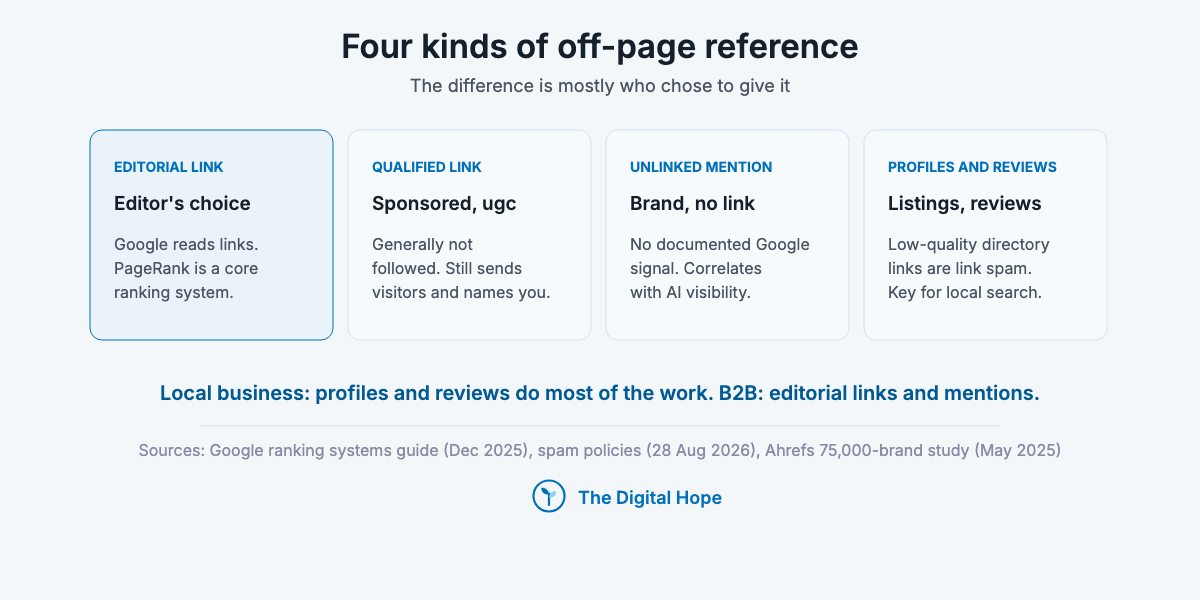
Four kinds of reference do almost all the work. They are not equal, and the difference is mostly about who chose to give it.
| Reference | What it is | What Google documents | What it does for AI answers |
|---|---|---|---|
| Editorial link | Another site links to you because the page is useful to its readers | Google uses links to understand what pages are about and lists PageRank as a core system (ranking systems guide, Dec 2025) | Helps the page get crawled, indexed and ranked, which Google’s AI features draw on |
| Qualified link (rel=”sponsored”, “ugc” or “nofollow”) | A paid, user-generated or untrusted link, labelled as such | Paid placements should carry rel=”sponsored”. Links with these values “will generally not be followed” (Google, Dec 2025) | Still sends visitors and still names you on the page |
| Unlinked mention | Your brand, product or founder named in text, no link | We found no Google page that treats an unlinked mention as a ranking signal (checked 29 Oct 2026) | Mentions correlated more strongly with AI Overview visibility than links did (Ahrefs, May 2025, dated) |
| Profiles and reviews | Business profiles, marketplace listings, review sites, directories | Low-quality directory and bookmark links are named as link spam (Aug 2026). Review rules sit with Google Maps policy | Assistants lean on review and community sites for “best X” answers |
The condition that decides your mix is buyer type. If you run a local business, profiles and reviews do most of the off-page work, and that has its own rules in local SEO tips. If you sell B2B or considered purchases, editorial links and mentions on the sites your buyers read carry the weight. If you are a publisher, links to individual articles matter more than mentions of the brand.
Quick Summary
Q: What is off-page SEO?
A: Off-page SEO is earning links and brand mentions on websites you do not own: editorial links, qualified (paid or user-generated) links, unlinked mentions, and profiles and reviews. Google uses links to understand and rank pages, and AI answer engines appear to weigh how often a brand is named across the web.
Insight
The useful question about any reference is who chose it. An editor who links because the page helps their readers gives you something Google is built to read. A link you placed, paid for or required is something Google’s spam policy is built to discount.
Do links still matter?
“Ranking may change as spammy links are neutralized and any credit passed by these unnatural links are lost.”
Google Search Central blog, December 2022 link spam update (14 Dec 2022)
Yes. Links are still part of how Google ranks pages, but only the ones it decides to trust. Google’s ranking systems guide names link analysis systems and PageRank as part of its core ranking systems and says PageRank has changed a lot since launch (last updated 10 Dec 2025). That is the strongest first-party statement Google makes on the subject, and it is a current one.
Here’s the catch. Since December 2022, Google has said its SpamBrain system detects both sites that buy links and sites that pass outgoing links, and neutralises them. There is no manual action, no warning in Search Console. The credit stops.
That changes the economics of every link source:
- Editorial links from relevant sites: the kind the system is built to count.
- Links from paid packages and networks: the kind it is built to find, so the money can buy nothing.
- Links you placed yourself in comments, profiles and directories: named as link spam in Google’s policy (Aug 2026), so expect them to count for little.
- And at JustWatch, where I ran a widget programme, the links that held were branded links inside a product partners wanted to embed (case below).
My read: links did not stop mattering. Cheap links stopped mattering, and the line between cheap and earned is the line Google’s spam policy draws.
The condition: in highly competitive niches (casino, payday loans, some affiliate verticals), practitioners still see aggressive link buyers ranking, and one Hacker News commenter wrote in October 2026 that casino budgets for link building “are effectively bottomless”. That is a risk some operators accept, not a strategy this guide recommends. Detection rates are not published, so nobody outside Google can tell you the odds. Unless you can afford to lose the domain, do not copy it.
Earned links work. Bought links are a bet.
Quick Summary
Q: Do backlinks still matter for SEO?
A: Yes. Google lists link analysis and PageRank among its core ranking systems (Dec 2025). But since December 2022 Google says SpamBrain neutralises links from sites that buy or sell them, so their credit is lost. Earned editorial links from relevant sites are the ones that count.
Insight
Neutralised is not the same as penalised. A site can spend a year buying links, see no manual action, and conclude it is safe, when the links were ignored. The absence of a penalty is not evidence that a link is working.
Brand mentions and their role in AI answers
AI answer engines name brands, and the brands they name are the ones the web already talks about. That makes unlinked mentions a real off-page asset for the first time, even though Google has not documented them as a ranking signal.
Three studies sketch the pattern.
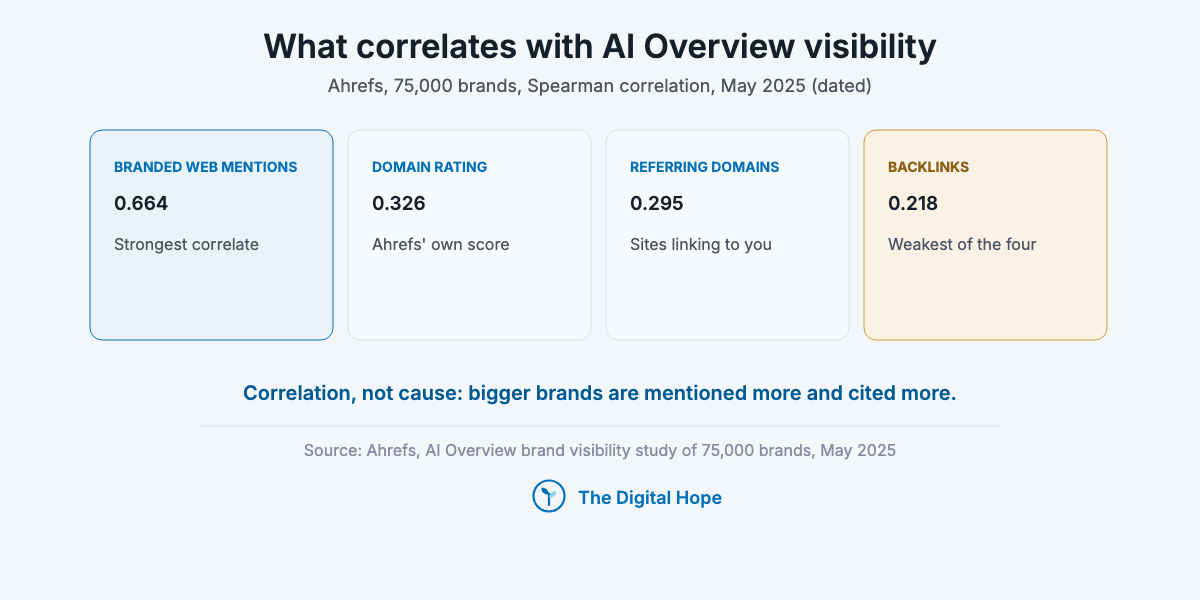
- Mentions over links: across 75,000 brands, branded web mentions correlated 0.664 with AI Overview visibility, Domain Rating 0.326, referring domains 0.295 and backlinks 0.218 (Ahrefs, May 2025, Spearman correlation, dated). Bigger brands are mentioned more and cited more, so this does not show cause.
- Citations and mentions split: in 3,981 AI appearances across 115 prompts, 74.9% linked a brand’s page, 38.3% named the brand, and only 13.2% did both (Semrush and Growth Memo, Jun 2026). A link in an AI answer is not the same as being named in it.
- Where the mentions come from: two 2026 vendor studies found Reddit, YouTube and LinkedIn among the domains AI answers cite most. Peec AI’s study of 30M cited sources across five engines put them in its top five (Mar 2026). Ahrefs measured Reddit at 16.8% of ChatGPT’s top-source citations in the US (Sep 2026).
What this means in practice: a mention on a site your buyers read is worth earning even with no link, because it is one more place an engine can learn who you are. Comparison prompts (“best X for Y”) named brands about 2.4 times as often as informational ones in the same Semrush study, so B2B and considered purchases feel this most. The full AI-search side is in how AI is changing SEO.
The condition: do not manufacture mentions. Google’s AI optimization guide (Jul 2026) lists seeking inauthentic mentions among the tactics that do not help, and fake accounts break every platform’s rules. A paid mention needs a disclosure, and a paid link needs rel=”sponsored”.
Earn the mention. Label anything you paid for.
Quick Summary
Q: Do brand mentions without links help SEO?
A: For AI answers, they appear to. Brands mentioned more across the web showed up more in AI Overviews in Ahrefs’ 75,000-brand study (May 2025, correlational). Google has not documented unlinked mentions as a ranking signal for classic search, so treat them as an AI-visibility asset and a source of future links.
Insight
Track mentions and citations as two numbers. In the Semrush and Growth Memo data, most AI appearances linked a page without naming the brand, and a smaller share named it without a link. A report that counts only one misses most of the other.
Semrush and Growth Memo, “The Ghost Citations Study”, 9 June 2026
What Google’s spam policies forbid
“Keyword-rich, hidden, or low-quality links embedded in widgets that are distributed across various sites”
Google Search Central, Spam policies, link spam examples (last updated 28 Aug 2026)
Google forbids links that exist mainly to manipulate rankings, however they were made. The spam policies page (last updated 28 Aug 2026) names the patterns. They are listed here so you can recognise them in a proposal or an audit, not so you can run them.
| Pattern Google names as link spam | What it looks like in an outreach email |
|---|---|
| Buying or selling links for ranking purposes, including goods, services or free products exchanged for a link | “Guaranteed DA 50+ placement, $150 per link” |
| Excessive link exchanges and partner pages made only to cross-link | “I’ll link to you if you link to me” |
| Automated programs or services that create links | “500 backlinks in 24 hours” |
| Requiring a link in terms of service or a contract without letting the other site qualify it | A partnership contract with a mandatory followed footer link |
| Advertorials, guest posts or press releases with keyword-rich anchor links that pass ranking credit | A sponsored article with three exact-match keyword links |
| Low-quality directory and bookmark links | Bulk submission to hundreds of directories |
| Keyword-rich, hidden or low-quality widget links, and widely distributed footer or template links | A free widget whose code embeds “best cheap car insurance” as a followed link |
| Forum comments with keyword links in the post or signature | A signature line of keyword links under “Thanks, great info” |
Three newer policies sit next to link spam. All three were added on 5 March 2024 and stay in the policy today.
- Expired domain abuse: buying an old domain and repurposing it mainly to manipulate rankings, including redirecting it.
- Site reputation abuse: third-party pages placed on a strong host site to borrow its ranking strength. Google clarified on 19 Nov 2024 that the host’s oversight does not make it compliant.
- Scaled content abuse: many pages made mainly to rank, whether written by people, AI or both. It matters here because “content made to attract links” at volume can fall under it.
What is allowed. Google says buying and selling links “is a normal part of the economy of the web” for advertising and sponsorship. Paid is fine. Paid and unlabelled is the problem. Mark it rel=”sponsored”, as Google’s qualify outbound links page asks (last updated 10 Dec 2025), and nofollow is still accepted.
The condition: guest posts, PR and partnerships are all legitimate. They turn into link spam when the anchor text is chosen for rankings, when the link is the point of the deal, or when the volume only makes sense as a ranking play.
Name it, label it, or skip it.
Quick Summary
Q: What links are against Google’s guidelines?
A: Google’s spam policies (Aug 2026) name buying or selling links for ranking, excessive link exchanges, automated link building, links required by contract, advertorials and guest posts with keyword-rich anchors, low-quality directories, keyword-rich widget and footer links, and forum signature links. Paid links are allowed if marked rel=”sponsored”.
Insight
The widget line in Google’s policy is about the link, not the widget. A widget that partners embed because it helps their readers is a product. A widget whose real job is to carry a keyword-rich followed link is link spam that happens to have a user interface.
Here is how to earn references that count.
How to earn links and mentions: five methods, in order
“In most cases, Google can assess which links to trust without additional guidance, so most sites will not need to use this tool.”
Search Console Help, Disavow links to your site (checked 29 Oct 2026)
These methods assume a site with something worth referencing. Each starts with a first action in a named tool, says when to skip it, and ends with three questions for your team. They run from cheapest to most expensive.
1. Audit the references you already have
First action: open Search Console, Links report, and export Top linking sites, Top linked pages and Top linking text. The Links report shows a sample, not every link, and it does not say which links are nofollow (Search Console Help, checked 29 Oct 2026). It is still the only list that comes from Google.
Read it for three things. Which pages earn links on their own (those are your linkable assets). Which anchor text dominates (a profile of exact-match keywords is a warning sign). Which linking sites you do not recognise.
Do not disavow by reflex. Google says you should use the disavow tool only if you have a considerable number of spammy, artificial or low-quality links and they have caused, or likely will cause, a manual action. Random spam links from scraper sites are the normal background of the web. Check Search Console’s Manual actions report before you touch anything.
When to skip it: if you run a new site with fewer than a few dozen linking domains, skip the anchor analysis and go to step 3.
- Which five pages earn the most links without us asking?
- Is any anchor text an exact-match keyword we would never use naturally?
- Do we have a manual action, yes or no?
One hour, once a quarter.
2. Turn unlinked mentions into links
First action: search Google for your brand name in quotes, excluding your own site (“yourbrand” -site:yourdomain.com), and list every page from the last 12 months that names you without linking. Add your product names and founder’s name as separate searches.
Most of these are easy asks. The writer already chose to mention you. A short note that says what the link would help their readers find, sent to the person who wrote the page, is the whole method. Fix wrong mentions too: an outdated description of your company is a reference an AI answer may repeat.
The condition: this works best for brands that already get talked about: a funded startup, a product with users, a founder who speaks at events. If you are a new brand with no mentions, start at step 3.
- Which publications mention us without linking?
- Is the description of our company in those mentions still correct?
- Who on the team sends these notes, and how often?
Ask once. Do not chase.
3. Publish one asset worth citing, then pitch it (digital PR)
First action: list three numbers only your company can produce: product usage, a survey of your customers, prices you track, a dataset you already collect. Pick the one a journalist in your category would quote.
Digital PR is publishing original data or expertise and getting it in front of the people who write about your category. The asset earns the link. The pitch only makes sure the right writers see it. A statistics page, an annual report built on your own data, a free tool, or an expert comment on a news story all work this way. Google’s own guidance on AI search asks for content that is original and first-hand, so the same asset feeds AI answers too.
Broken-link and resource-page outreach belong here as well: find pages in your niche that link to a resource that no longer exists, and offer yours if it truly replaces it. At JustWatch, our data and broken-link campaigns converted at about 3% of outreach [FIRST-PARTY, n=1, Nov 2022 to Nov 2023]. That is one programme with a strong data asset behind it, so treat it as a ceiling for comparison, not a target.
When to skip it: if you cannot name one original number, fix that first. A pitch for a rewritten list of other people’s statistics rarely lands.
- What do we measure that nobody else publishes?
- Which ten writers covered our category in the last six months?
- Would we be proud to see this asset quoted with our name on it?
One good asset beats ten pitches.
4. Build partnerships and integrations that carry your name
First action: list every partner, integration, customer and supplier that could show your brand on their site: integration directories, “powered by” credits, case studies, embeddable tools, data feeds.
Partnerships produce links as a side effect of a real relationship. An integration page, a joint case study, a widget or an API that partners embed because it helps their users: each carries your brand where your buyers already are. This is the method that scaled furthest in the programme in the case below.
Keep the links clean. Use branded anchors (“powered by” your brand name), vary them, and never make a followed keyword link a condition of using the tool. Google’s policy lists requiring a link as part of a contract without letting the other site qualify it as link spam, so give partners that choice in writing.
The condition: this needs a product or data other sites want. If you run a services business with no embeddable asset, use the customer and partner pages route instead.
- Which partners already use our product or data on their site?
- Could any of them embed something useful with our name on it?
- Is any partner link a condition of the deal?
Build the product. The links follow.
5. Earn editorial placements: guest contributions, podcasts and expert sourcing
First action: pick two publications and two podcasts your buyers follow and pitch one idea each that only you could write or say, with a number from step 3.
Contributing to other publications is legitimate when the audience is the point. Write for readers, use your brand name or a plain URL as the link, and accept a nofollow or sponsored label if the site uses one. Guest posting at volume with keyword anchors is the version Google names as link spam. Podcasts, conference talks and expert quotes in journalists’ stories earn mentions even when they earn no link at all.
When to skip it: if the only reason to write the post is the link, skip it. The test is whether you would still do it with a nofollow link.
- Would we write this piece if the link were nofollow?
- Does the publication’s audience overlap with our buyers?
- Is the anchor our brand name or a keyword?
Write for their readers, not for your rankings.
Quick Summary
Q: What are the best backlink strategies now?
A: Audit what you have in Search Console’s Links report, turn unlinked mentions into links, publish original data and pitch it (digital PR), build partnerships and integrations that carry your brand, and earn editorial placements where the audience is the point. Label anything paid with rel=”sponsored”.
Insight
Every method above passes one test: would the other site want this reference if search engines did not exist? If the answer is yes, it is the kind of link Google is built to count and the kind of mention an AI answer is likely to repeat.
Case: 2M+ links from a widget programme at JustWatch
JustWatch is a streaming guide. I led its SEO and widget product team from November 2022 to November 2023 [FIRST-PARTY, n=1]. The asset was data partners wanted: where a film or show was streaming, kept up to date.
What we did: we packaged that data as an embeddable widget and an API that partner sites could place on their pages, and ran outreach to put it in front of them. Alongside it, data and broken-link campaigns ran at about 3% conversion.
What moved: 200+ partners and 2M+ backlinks in one year.
How the links were set up, because it decides whether this is safe to copy:
- Followed, not sponsored or nofollow.
- Branded, a “powered by JustWatch”-style credit, not a keyword such as “watch movies online”.
- Anchors diversified away from one fixed string.
- Inside a widget partners chose to embed because it served their readers.
That is the opposite of the pattern Google’s policy names, which is keyword-rich, hidden or low-quality widget links.
What this does not prove. It is one company with a data asset most businesses do not have. Link counts from widgets inflate fast, because every page that carries the widget adds a link, so 2M+ backlinks came from far fewer linking domains. I cannot separate the effect of these links on rankings from the content and product work running at the same time. The full story is on my portfolio.
The condition: this works only when you own data or a tool other sites want on their pages. Without that, a widget is a link scheme with extra steps.
Quick Summary
Q: Are widget backlinks safe?
A: They can be, if the widget is useful to the sites that embed it and the link is branded rather than keyword-rich. In one programme I ran (JustWatch, Nov 2022 to Nov 2023), branded followed links in an embeddable widget earned links from 200+ partners. Google’s spam policy names keyword-rich, hidden or low-quality widget links as link spam.
Insight
Count linking domains, not links, when you report a widget or partnership programme. Two million links from a few hundred sites is a partnership story. Two million links from two million sites would be a different, and much less likely, one.
Measuring link quality without treating Domain Authority as a Google metric
“Domain Authority is not a Google ranking factor and has no effect on the SERPs.”
Moz, as quoted by Search Engine Journal (10 Jan 2023)
Domain Authority (DA) is a score Moz calculates from its own link index to compare sites. Moz says Google does not use it. Google staff have said the same more than once. Domain Rating (Ahrefs) and Authority Score (Semrush) are the same kind of thing: each vendor’s estimate from each vendor’s crawl.
That is why a DA drop rarely means what it seems to. A vendor score moves when the vendor’s index or model changes, when you lose links, or when other sites gain them. None of those is Google re-rating your site.
What to check instead, in this order:
1.
Search Console Performance: check whether non-branded clicks or impressions fell in the same weeks. If not, nothing Google-side happened.
2.
Search Console Links report: check whether a top linking site disappeared.
3.
Manual actions report: check for one. If there is none, Google has not penalised your links.
4. Google’s confirmed updates (our dated log): check whether one rolled out on those dates.
Use the vendor scores for one job: comparing prospects. When you have a list of 50 sites to pitch, DA or DR helps sort it. Never set it as a goal, a KPI or a price basis. Link sellers price by DA because it is easy to show, not because Google reads it.
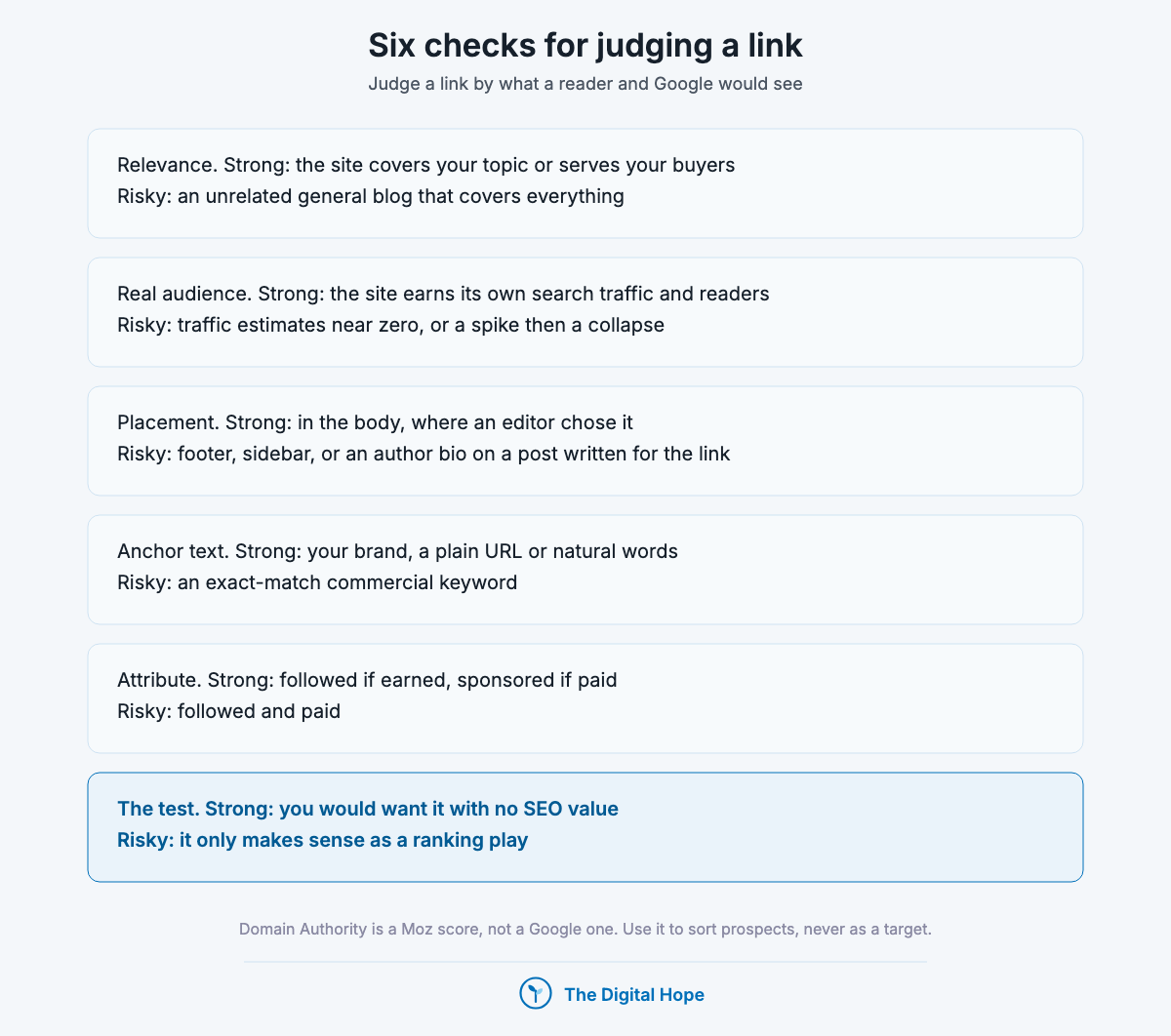
Judge a link by what a reader and Google would see.
| Check | Strong reference | Weak or risky reference |
|---|---|---|
| Relevance | The site covers your topic or serves your buyers | Unrelated “general” blog that covers everything |
| Real audience | The site earns its own search traffic and readers | Third-party traffic estimates near zero, or a sudden spike then collapse |
| Placement | In the body, where an editor chose it | Footer, sidebar, author bio on a post written for the link |
| Anchor text | Your brand, a plain URL, or natural words | Exact-match commercial keyword |
| Attribute | Followed if earned, sponsored if paid | Followed and paid |
| The test | You would want it with no SEO value | It only makes sense as a ranking play |
The condition: if you run a small site, a handful of relevant editorial links outweighs any number of high-DA generic ones. If you are a large brand, the quality question shifts to mentions on the sites buyers and AI answers trust.
Compare with DA. Decide with judgement.
Quick Summary
Q: Is Domain Authority a Google ranking factor?
A: No. Domain Authority is a Moz score built from Moz’s own link index, and Moz says it is not a Google ranking factor. A DA drop usually reflects a change in Moz’s index or model or a lost link. Check Search Console clicks, the Links report and manual actions instead.
Insight
A useful audit question for any link you are offered: if this site’s DA were hidden, would you still want the link? If the only argument for it is the number, the number is the product being sold.
What stopped being true
One table, because none of these deserves a section.
| What stopped being true | When it changed | Primary source |
|---|---|---|
| Bought links either help you or get you a manual penalty | Google said SpamBrain neutralises bought and passed links, and their credit is lost | 14 Dec 2022, Google Search Central blog, December 2022 link spam update |
| rel=”nofollow” is the only way to label a link | rel=”sponsored” and rel=”ugc” introduced, and sponsored is now preferred for paid links | Sep 2019, Google Search Central blog · qualify outbound links page, 10 Dec 2025 |
| Affiliate links can pass ranking credit unlabelled | Link spam update asked for rel=”sponsored” on affiliate links | 26 Jul 2021, Google Search Central blog |
| Buying an expired domain and redirecting it passes its strength | Expired domain abuse added to the spam policies | 5 Mar 2024, Google Search Central blog |
| A strong host site can carry third-party pages if it oversees them | Site reputation abuse, clarified to apply regardless of oversight | 5 May 2024 (live), 19 Nov 2024 (clarified), Google Search Central blog |
| Blog comments, profile links, directories and bookmark sites build authority | Named in the link spam examples (low-quality directory and bookmark links, forum signature links) | Spam policies page, last updated 28 Aug 2026 |
| Disavow toxic links as routine hygiene | Google says most sites will not need the disavow tool | Search Console Help, checked 29 Oct 2026 |
| Domain Authority is Google’s trust score | Never true. Moz says DA is not a Google ranking factor | Moz via Search Engine Journal, 10 Jan 2023 |
Pulling it all together
Method 1 is the audit: export the Links report this week and note your top linked pages and your anchor profile.
Method 2 is reclaiming: run the brand search and send five notes to writers who mentioned you without a link.
Method 3 is the asset: choose the one number only you can publish and build a page around it.
Method 4 is partnerships: list every partner who could show your brand, and fix any link that is a condition of the deal.
Method 5 is placements: pitch two publications and two podcasts your buyers follow, with the number from method 3.
Measurement runs alongside all five: report linking domains and branded mentions next to non-branded clicks, and use DA only to sort prospects.
FAQ
What is the difference between on-page and off-page SEO?
On-page SEO is what you control on your own pages: content, titles, headings, internal links. Off-page SEO is what other sites say about you: links, brand mentions, reviews and profiles. Technical SEO, the third part, is whether crawlers can reach and read your site.
Is Domain Authority a Google ranking factor?
No, and this is the most common off-page myth. Domain Authority is Moz’s own score, built from Moz’s link index, and Moz says it has no effect on Google’s results. Use it to compare sites you might pitch, not as a target.
Why did my Domain Authority drop?
Usually because Moz’s index or model changed, you lost some links, or other sites gained them. Check Search Console clicks, the Links report and the Manual actions report. If clicks held, nothing changed on Google’s side.
Are guest posts against Google’s guidelines?
Not in themselves. Guest posts with keyword-rich anchor links that pass ranking credit, especially at volume, are named as link spam in Google’s spam policies (Aug 2026). A guest post written for the publication’s readers, with a branded or labelled link, is legitimate.
Do nofollow links help SEO?
Google says links marked nofollow, sponsored or ugc will generally not be followed (Dec 2025), so do not count on them for rankings. They still send visitors and still name your brand on the page, which matters for AI answers.
Do unlinked brand mentions help?
For AI answers, they appear to: mentions correlated more strongly with AI Overview visibility than links did in Ahrefs’ May 2025 study of 75,000 brands, though that does not show cause. Google has not documented them as a ranking signal for classic search. They are also your easiest future links.
In a nutshell
The honest timeline: an audit takes an afternoon and a reclaimed mention can turn into a link within weeks, but a reference profile that moves rankings and AI answers takes quarters. The JustWatch programme took a full year to reach 200+ partners, with a data asset most companies do not have. Judge off-page work over quarters, and expect most pitches to get no reply.
When this guide does not apply: if you are a local business, reviews and your business profile do more off-page work than links, and they have their own policy traps. If your site has a technical or content problem, no amount of links will fix it, so start with the SEO audit checklist.
If you would rather have someone audit your link profile and build a digital PR plan around your data, that is what I do in a consultation.
About this article

Written by
Sai Subramaniam
SEO, GEO and Paid Ads Manager · 8+ years in growth marketing
I have run SEO, paid media and ABM for B2B AI companies, consumer apps and live-entertainment brands, from a solo operator at an AI infrastructure company to a team of 20 recovering a million-visitor site after a Google update. I write these guides from that work, and every number in them carries its source.
See my portfolioConnect on LinkedInHow this one was checked. Every number traces to a named source with its dataset and period, and every platform feature, policy or limit cites the platform’s own documentation with the date it was verified. Where the author’s own results appear, they are labelled as one account’s results, with the budget and context, not as a rule.
No affiliate links and no paid placements. Tools are named because they are what practitioners use, not because anyone paid to appear here.
Reviewed: October 2026. Ad platforms and search features change every few months; anything we could not verify at the time of writing is marked as unverified rather than turned into a number.
Corrections. If something here is wrong or has changed since, we would rather know. Corrections are made in place, with a note saying what changed.