
“optimizing for generative AI search is optimizing for the search experience, and thus still SEO.”
Google Search Central, AI optimization guide (last updated 10 July 2026)
Last updated: October 2026.
A buyer asks ChatGPT for the five best tools in your category, and your brand is not on the list. Your rankings are fine. Your Search Console clicks are flat. But the answer the buyer read never named you, and nothing in your standard SEO report would tell you that it happened.
Generative engine optimization (GEO) is the work of getting your pages and your brand onto that list. Every AI answer engine builds a shortlist of sources before it writes a word: Google’s AI Overviews and AI Mode, the Gemini app, ChatGPT search, Perplexity and Microsoft Copilot. Google’s own guidance calls this SEO. That is true for the inputs. The scoreboard is new.
This guide covers the whole job: what GEO is, how each engine builds its shortlist, the five things that put you on it, what Google says does not help, how to measure it with four instruments, and one account where AI citations went from zero.
How we know
Sources: Google Search Central documentation (AI optimization guide, AI features, common crawlers, all checked 29 Oct 2026), OpenAI’s and Perplexity’s crawler documentation, Microsoft’s Bing Webmaster blog (10 Feb 2026), Google Analytics Help, and studies from Ahrefs (4M cited AI Overview URLs; 15,000 assistant prompts; 75,000 brands; 137,210 domains), Semrush with Growth Memo, and Vercel with MERJ.
Period: May 2024 to October 2026. Studies older than 12 months are marked as dated points.
First-party: one labelled account I ran (Clarifai), n=1, with its measurement method stated.
What the data cannot tell you: most citation studies are correlational. They show which pages get cited, not why, and no engine publishes its selection rules.
Quick Digest
– GEO = getting cited or named in AI answers. Google says the inputs are the same as SEO (Jul 2026). The surfaces and the measurement are different.
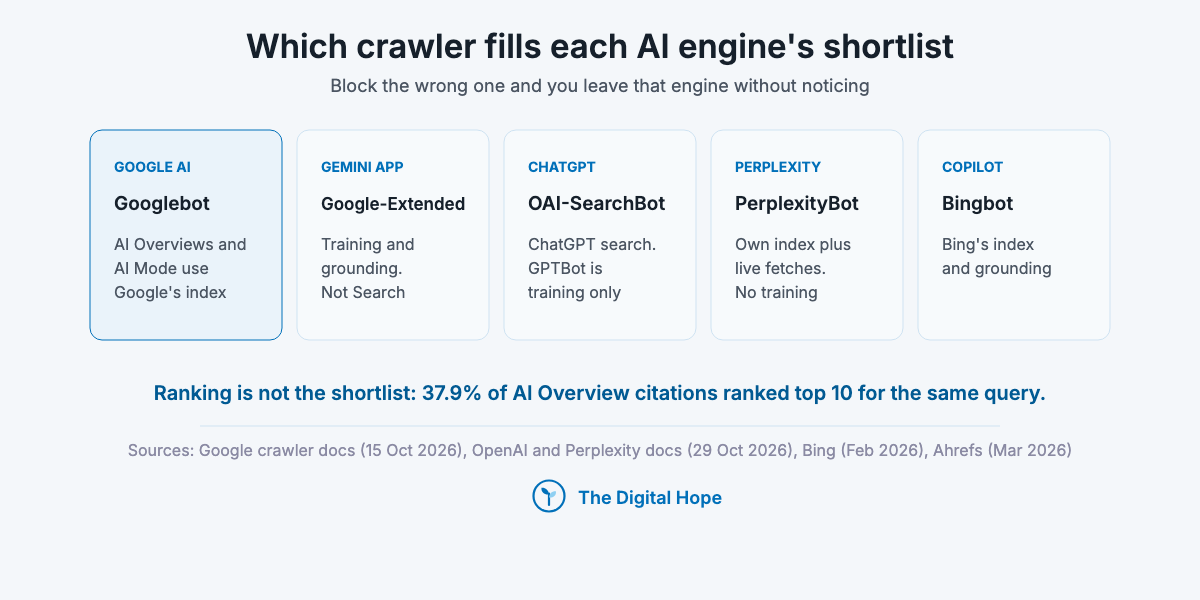
– Each engine has its own crawler and index: Google’s index for AI Overviews, AI Mode and Gemini, OAI-SearchBot for ChatGPT search, PerplexityBot for Perplexity, Bing for Copilot.
– Ranking is not the shortlist: 37.9% of AI Overview citations ranked top 10 for the same query (Ahrefs, Mar 2026).
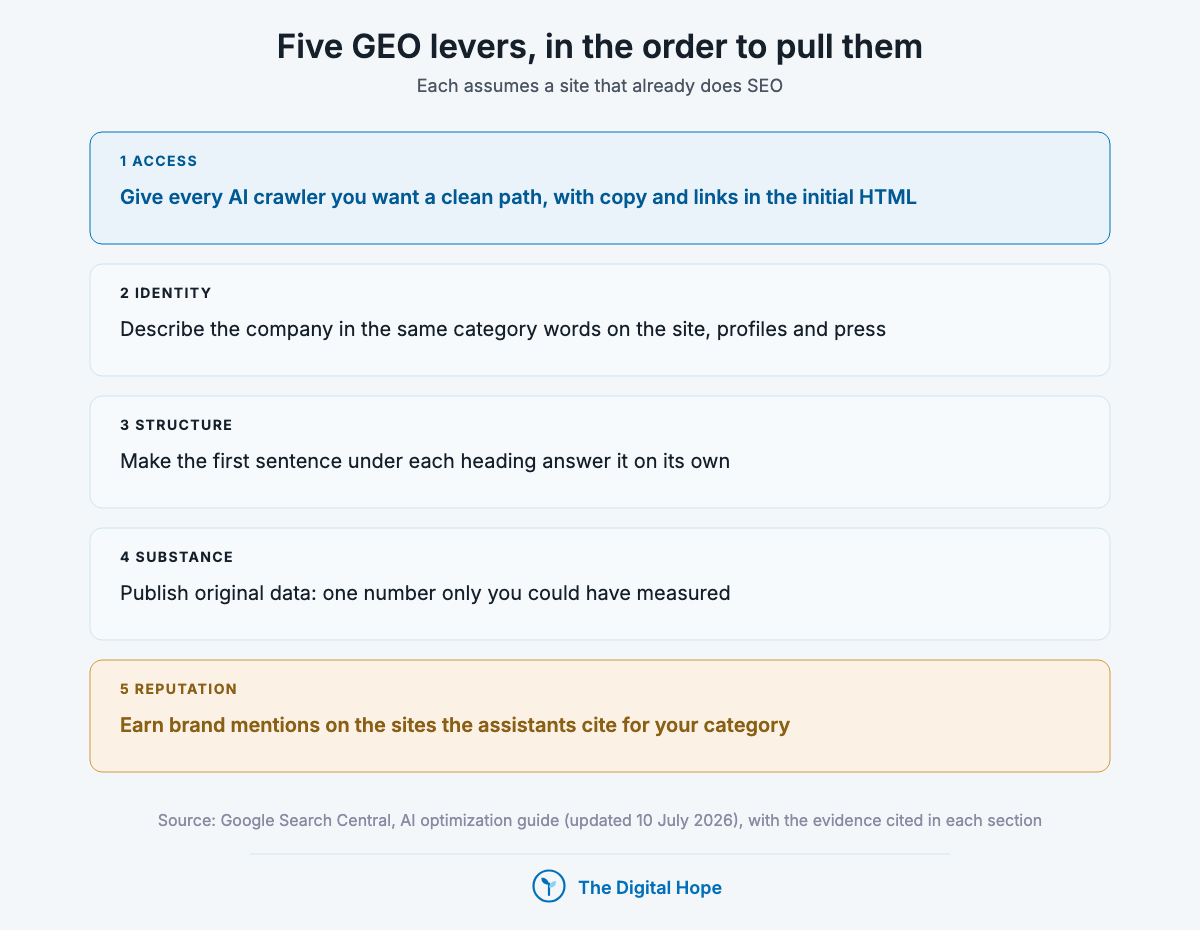
– Five levers: crawler access, entity and topical authority, liftable structure, original data, earned brand mentions.
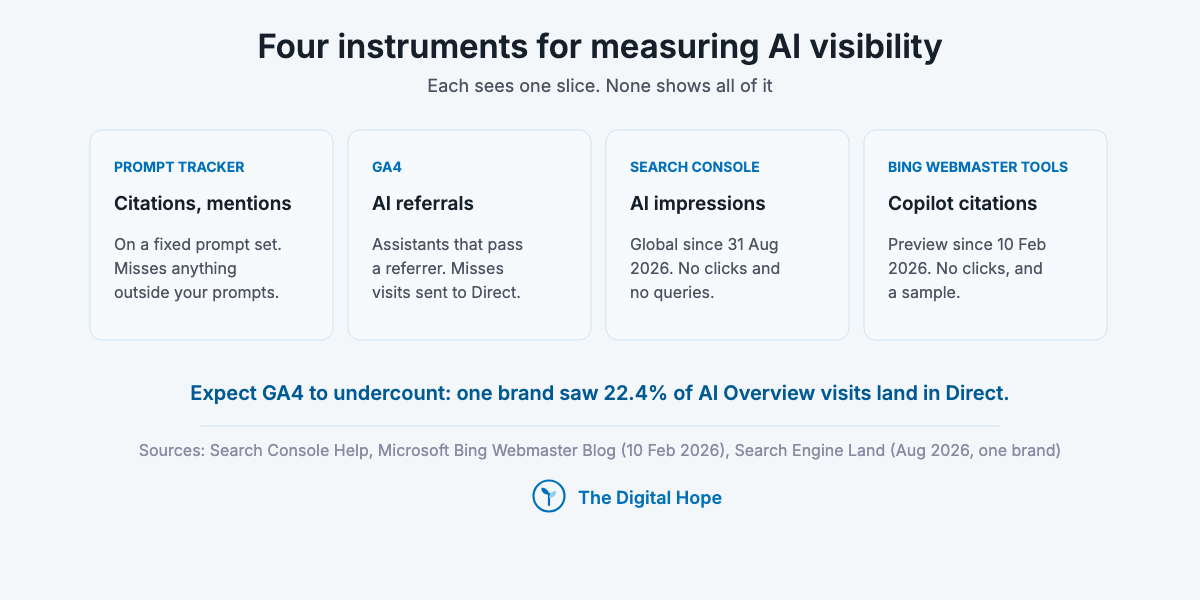
– Measure with four instruments: a prompt tracker, GA4 AI referrals, Search Console AI impressions, Bing Webmaster Tools AI Performance.
What GEO is, and why it is not a separate discipline
“There are no additional requirements to appear in AI Overviews or AI Mode, nor other special optimizations necessary.”
Google Search Central, “AI features and your website” (last updated 10 Dec 2025)
GEO is making your content eligible to be retrieved, cited and named by AI answer engines. The outcome is not a blue link in position three. It is a citation (your URL as a source), a mention (your brand named in the answer), or both.
The inputs are the SEO you already know. A page has to be crawlable, indexed and worth quoting. Google’s AI optimization guide treats GEO and AEO as SEO and says work aimed at its AI features is work on the search experience (Jul 2026). Microsoft’s rewritten Bing Webmaster Guidelines took the same line in February 2026, describing GEO as content eligibility for grounding in AI answers, with no guarantee of citation, as Search Engine Journal reported on 27 Feb 2026.
Three things are different, and they are why GEO deserves its own page:
- More engines, more crawlers. ChatGPT and Perplexity run their own bots. Blocking the wrong one removes you from an engine without anyone noticing.
- The unit of selection is smaller. An engine lifts a passage, a number or a brand name, often for a query you never targeted.
- The scoreboard is separate. Rankings, clicks and citations move independently. Search Console’s AI report shows impressions only, and no Google report shows AI clicks on their own.
The condition that decides how much GEO matters to you is query type. For B2B and considered purchases, the risk is the shortlist: buyers ask an assistant which vendors to look at. For informational publishers, the risk is the answer itself replacing the click. Whether that makes SEO worth funding is a different question, answered in Is SEO Dead? What the Click Data Says.
Quick Summary
Q: What is generative engine optimization?
A: GEO is the work of getting your pages cited and your brand named in AI-generated answers from Google AI Overviews, AI Mode, Gemini, ChatGPT, Perplexity and Copilot. Google treats it as SEO (Jul 2026): the inputs are crawlability, indexing and content worth quoting. What changes is the number of engines and how you measure the result.
Insight
Count citations and mentions separately. In the Semrush and Growth Memo study of 3,981 AI appearances across 115 prompts (9 June 2026), 74.9% were citations, 38.3% were mentions, and only 13.2% were both. 61.7% linked a brand’s page without naming the brand. A report that tracks one of the two misses most of the other.
Semrush and Growth Memo, “The Ghost Citations Study”, 9 June 2026
How AI Overviews, AI Mode, Gemini, ChatGPT, Perplexity and Copilot choose sources
“issuing multiple related searches across subtopics and data sources”
Google Search Central, describing query fan-out in “AI features and your website” (last updated 10 Dec 2025)
Every engine retrieves before it writes. It runs one or more searches against an index, picks a shortlist of passages, and generates an answer from them. What differs is whose index, which crawler fills it, and which controls you have.
| Engine | Where its sources come from | The crawler or control that decides access | What the evidence says about selection |
|---|---|---|---|
| AI Overviews and AI Mode | Google’s search index. A page must be indexed and eligible for a snippet. One question fans out into several searches | Googlebot. nosnippet and max-snippet limit what AI features show. Google-Extended does not affect Search inclusion (Google crawler docs, 15 Oct 2026) | 37.9% of AI Overview citations ranked top 10 for the query and 31.0% ranked beyond 100 (Ahrefs, Mar 2026, 4M cited URLs) |
| Gemini app | Grounding on Google Search | Google-Extended governs whether your content is used for Gemini training and Gemini Apps grounding (Google crawler docs, 15 Oct 2026) | Gemini fetches cannot be separated from Googlebot in server logs (Ahrefs, Jun 2026) |
| ChatGPT search | OpenAI’s own search crawl plus pages fetched on a user’s request | OAI-SearchBot decides ChatGPT search visibility. GPTBot is training only. For ChatGPT-User, “robots.txt rules may not apply” (OpenAI crawler docs, checked 29 Oct 2026) | About 8% of ChatGPT’s cited URLs ranked in Google’s top 10 for the prompt, and ChatGPT showed the strongest lean toward newer pages (Ahrefs, Jul and Aug 2025, dated) |
| Perplexity | Perplexity’s own index plus live fetches | PerplexityBot surfaces and links sites and is not used for model training. Perplexity-User fetches on a user’s request and “generally ignores robots.txt rules” (Perplexity crawler docs, checked 29 Oct 2026) | 28.6% of Perplexity’s citations ranked in Google’s top 10, the highest overlap of four assistants (Ahrefs, Aug 2025, dated) |
| Microsoft Copilot | Bing’s index and grounding | Bingbot. Bing’s guidelines (Feb 2026) say NOARCHIVE keeps a page out of Copilot answers and grounding, and NOCACHE limits Copilot to URL, title and snippet, as reported by Search Engine Journal | Bing reports Copilot citations directly in Webmaster Tools, the only engine that does (Microsoft, 10 Feb 2026) |
Three patterns hold across engines.
- Rendering: in late 2024, Vercel’s crawler data showed OpenAI’s, Anthropic’s and Perplexity’s crawlers did not execute JavaScript. Gemini uses Google’s rendering. A page whose main copy loads by JavaScript is invisible to most of the shortlist builders.
- Brand signals: across 75,000 brands, branded web mentions correlated 0.664 with AI Overview visibility and backlinks 0.218 (Ahrefs, May 2025, dated, correlational). Bigger brands are mentioned more and cited more, so this does not show cause.
- Query type: comparative prompts (“best X for Y”) named brands about 2.4 times as often as informational ones (Semrush and Growth Memo, Jun 2026). That is where shortlists form.
My read: the engines reward the same things a good SEO programme builds, an indexable page, original information and a brand people talk about, but they reward them on more queries than the one you targeted, because one question becomes several searches. That is why a page can be cited for a query it does not rank for.
Quick Summary
Q: How do ChatGPT, Perplexity and Google’s AI choose which sources to cite?
A: Each runs searches against an index, then picks passages to ground its answer. Google’s AI Overviews, AI Mode and Gemini use Google’s index, ChatGPT relies on OAI-SearchBot, Perplexity on PerplexityBot, and Copilot on Bing. None publishes its selection rules. Citations overlap with top-10 rankings far less than most teams assume.
Insight
Not every AI fetch obeys robots.txt. Perplexity says its user-triggered fetcher “generally ignores robots.txt rules” because a user requested the page, and OpenAI says the same rules “may not apply” to ChatGPT-User. Robots.txt controls the search crawlers that build each index, not every request an assistant makes on a user’s behalf.
Perplexity and OpenAI crawler documentation, checked 29 Oct 2026
Here is how to get onto the shortlist.
How to do GEO: five levers, in the order to pull them
“Create the content yourself based on what you know about the topic.”
Google Search Central, AI optimization guide (last updated 10 July 2026)
These steps assume a site that already does SEO. Each starts with a first action in a named tool, says when to skip it, and ends with three questions for your team.
1. Open the door: give every AI crawler you want a clean path
First action: open your robots.txt and list every rule that names Googlebot, Google-Extended, OAI-SearchBot, GPTBot, PerplexityBot or Bingbot, then decide per crawler. Blocking OAI-SearchBot removes you from ChatGPT search answers, while blocking GPTBot only opts out of OpenAI training (OpenAI docs, checked 29 Oct 2026). Blocking Google-Extended does not remove you from Google Search.
Then check what the crawlers can read. In one controlled 2026 test on a 2,400-page site, AI crawlers followed 0% of links injected by JavaScript, while GPTBot crawled every HTML-linked page on day one (Search Engine Land, Aug 2026, one site). Your main copy and your internal links belong in the initial HTML. If you run a JavaScript framework, view the raw source of one page per template before anything else. Confirm your key pages are indexed in Bing as well as Google, because Copilot draws on Bing. The rendering and indexing detail sits in website optimization for search and AI crawlers.
When to skip part of it: if you sell the content itself and do not want it used for training, blocking GPTBot and Google-Extended is a reasonable call. Keep OAI-SearchBot and PerplexityBot open if you still want those engines to cite you.
- Which AI crawlers does robots.txt block today, and who decided that?
- Does each key page’s main copy appear with JavaScript switched off?
- Are our most important pages indexed in Bing Webmaster Tools?
Ten minutes. Do it first.
2. Make it obvious who you are and what you cover: entity and topical authority
First action: write one sentence that says what your company is, for whom, in the category words buyers use, and compare it with your homepage title, About page, LinkedIn page and the first line of your top five pages. If they describe five different companies, an engine will too.
An entity is a thing an engine can identify and describe: your brand, your product, your founder, your category. Engines lift a description from what the web says consistently.
Topical authority is coverage: a cluster of pages that answers the questions around one topic, linked to each other, so the site is the obvious source for that topic and not just for one keyword. Pick the two or three topics you want to be named for and build clusters there before touching anything else. The on-page side of this is in the on-page SEO guide.
The condition: this matters most when your category name is changing or you are moving into a new one. That was the whole problem at Clarifai (see the case below). If you are an established brand in a stable category, a consistency check is enough.
- Do our site, profiles and press describe us in the same category words?
- Which two or three topics do we want an assistant to name us for?
- Does each of those topics have a linked cluster of pages, or one lonely post?
Pick the topics before the pages.
3. Structure pages so a passage can be lifted whole
First action: take your top five informational pages and read only the first two sentences under each heading. If those sentences do not answer the heading on their own, rewrite them until they do.
An engine quotes a passage, not a page. State facts directly, near the top, with the number and its date in the same sentence. Search Engine Journal’s report of Bing’s February 2026 guidelines says Bing advises stating facts directly rather than implying them, focusing each URL on one topic and putting essential information near the top. Descriptive headings, short answer-first paragraphs, tables for comparisons and a prose FAQ do that work without any special markup. The writing method is in SEO content writing.
What this is not: Google says there is no need to break content into small chunks or rewrite it for AI (Jul 2026). Clear writing is the goal. Fragmenting a good page into 40-word blocks is not. If you only have time for one page, start with the one that already earns the most impressions in Search Console.
- Does the first sentence under each heading answer it without the rest of the page?
- Is every number on the page next to its source and date?
- Does each URL cover one topic, or three half-topics?
Rewrite openings, not whole pages.
4. Publish what no answer can build from the consensus: original data
First action: in Search Console, filter Performance to your top 20 informational pages and mark every one a competitor could rewrite tomorrow from the same sources. Those are the pages an AI answer can summarise without citing you.
Google’s guide asks for non-commodity content: first-hand experience and expert takes that go beyond common knowledge (Jul 2026). In practice that means your own data (product usage, a survey, a benchmark), first-hand tests with method and numbers, and named examples. A single sourced number that only you can publish gives an engine a reason to cite you instead of the consensus. Freshness is a weaker lever than people think: in Ahrefs’ July 2025 study of about 17 million citations, assistants cited content about 25.7% newer than organic results, but the average cited page was still close to three years old, and AI Overviews showed no preference for newer content (dated).
When to skip it: unless you publish informational or comparison pages, this lever can wait. Product and pricing pages need it least. Spend it on the informational and comparison pages where answers form.
- Which sentence on this page could only have come from us?
- Is there one number we measured ourselves?
- Could a journalist quote this page as a source?
Three pages, not thirty.
5. Earn brand mentions where buyers and assistants read
First action: ask ChatGPT, Gemini, Perplexity and Copilot the five shortlist questions your buyers ask (“best X for Y”, “X vs Y”), and write down every domain each answer cites. That list is your digital PR target list.
Branded web mentions were the strongest correlate of AI Overview visibility in Ahrefs’ 75,000-brand study (May 2025, correlational). They are earned through PR around original data, partnerships, integrations, reviews on the sites your category uses, and genuine community presence. Links still matter as the by-product of being worth mentioning. The link side is in backlink strategies.
The condition: this lever pays most for B2B and considered purchases, because comparative prompts name brands far more often than informational ones. Seeded forum posts and fake listicles are a policy risk with no published upside: Google’s AI guide says inauthentic mentions are not as helpful as they seem, and platforms ban fake accounts. If you sell a low-consideration product, start with accurate review profiles before you fund PR.
- Which publications and communities do the assistants cite for our category?
- Do we have one piece of original data a journalist could quote?
- Is any of our “mention building” something we would not disclose?
Mentions compound slowly. Start this quarter.
How to measure GEO: four instruments, no single source of truth
“The data shown represents a sample of overall citation activity.”
Microsoft, Bing Webmaster Blog, introducing AI Performance (10 Feb 2026)
No one report shows your AI visibility. Each instrument sees one slice. This is the stack I run on my own accounts [FIRST-PARTY]: PromptWatch for prompt tracking and citations, GA4 for AI-referral visits, Search Console for AI impressions, and Bing Webmaster Tools for Copilot data. PromptWatch is named because it is what I use. Any prompt tracker works the same way.
| Instrument | What it shows | What it cannot show |
|---|---|---|
| Prompt tracker (PromptWatch or similar) | Citations and mentions across ChatGPT, Gemini, Perplexity and others, for a fixed prompt set, over time | Anything outside your prompts. It is a sample you designed, so it compares only with itself |
| GA4 AI referrals | Sessions from assistants that pass a referrer, as their own channel | AI visits that arrive with no referrer. They land in Direct |
| Search Console AI impressions | How often your pages appeared in Google’s AI features in Search and Discover, by page, country, device and date. Global since 31 Aug 2026 | Clicks and queries. AI Overview and AI Mode clicks stay inside the Web search type |
| Bing Webmaster Tools AI Performance | Citations in Copilot and Bing’s AI summaries, cited pages and grounding queries. Public preview since 10 Feb 2026 | Clicks. Microsoft calls the data a sample |
Set up GA4 first, because it applies to past data. In Admin, create a custom channel group, add an “AI assistants” channel with a matches-regex condition on the source (chatgpt, gemini, copilot, claude, perplexity) and move it above Referrals. Google’s own Help page uses this example, custom groups apply to reports retroactively, and a standard property gets two custom groups (Google Analytics Help, checked 29 Oct 2026). Maintain the regex as new assistants appear.
Then turn on the Bing report. Verify the site in Bing Webmaster Tools and open AI Performance for total citations, cited pages and the grounding queries behind them (Microsoft’s announcement, 10 Feb 2026). It is the only first-party citation count any engine publishes.
Expect GA4 to undercount. One practitioner tracking a single brand found 22.4% of AI Overview visits landing in GA4’s Direct channel, not Organic (Search Engine Land, Aug 2026, n=1 brand). Read AI referrals as a floor. If you already run a custom channel group, add the AI rule to it rather than building a second one.
Report it next to what the business already trusts. Put AI impressions, AI citations and AI-referred sessions as rows beside non-branded clicks and conversions, and annotate the breaks: the Search Console AI report has no history before June to August 2026. If you report to a board, lead with non-branded clicks and conversions, then the AI rows. The full reporting checklist sits in the SEO audit checklist.
When to skip the paid tracker: a small site on a small budget should start with the three free instruments and add a prompt tracker only when someone will act on its numbers.
Quick Summary
Q: How do you measure AI search visibility?
A: Use four instruments together: a prompt tracker for citations and mentions on a fixed prompt set, a GA4 custom channel for AI-assistant referrals, Search Console’s AI report for impressions in Google’s AI features, and Bing Webmaster Tools’ AI Performance report for Copilot citations. Each misses something, and none shows AI clicks from Google.
Insight
Bing’s February 2026 guidelines, as reported by Search Engine Journal, say a fall in clicks does not always mean visibility dropped, and recommend tracking impressions and citation eligibility rather than click data alone. It is the first time an engine has told publishers in writing that clicks are no longer the whole scoreboard.
Search Engine Journal on Bing’s Webmaster Guidelines, 27 Feb 2026
Case: AI citations from zero at Clarifai
Clarifai is a B2B AI company I ran SEO and paid for as a solo operator from July 2025 to May 2026 [FIRST-PARTY, n=1]. The site was known for computer vision. The market it wanted to win was searching for AI infrastructure.
What changed: the site was repositioned from computer vision to AI infrastructure, with entity-led content built around the category, the product and the questions buyers ask in it. That is levers 2 and 4 above, pulled hard for ten months.
What moved:
- AI citations: zero to about 15,000 a month. Method: prompt tracking in PromptWatch on a fixed set of category prompts, counted monthly.
- Visits from AI engines: about 3,000 a month. Method: GA4 sessions attributed to AI-assistant referrers.
- Organic impressions: 3.2 million to 15.5 million in six months, average position 18.5 to 9.8. Method: Search Console.
What this does not prove. It is one account and one repositioning, with paid campaigns running at the same time, so I cannot separate which change produced the citations. A prompt tracker counts only the prompts it is given, so the 15,000 figure compares with itself over time, not with another brand. GA4 misses AI visits that arrive without a referrer, so 3,000 is a floor. The full story is on my portfolio.
The condition: this worked because the category was moving and the old positioning was wrong for it. A brand already well described in a stable category should expect slower, smaller movement from the same work. If you are repositioning, judge it in quarters, not weeks.
Quick Summary
Q: Can a B2B company grow AI citations from zero?
A: In one account I ran (Clarifai, Jul 2025 to May 2026), tracked AI citations went from zero to about 15,000 a month and AI-engine visits reached about 3,000 a month after the site was repositioned around AI infrastructure. It is one account, measured by prompt tracking and GA4 referrals, not a benchmark.
Insight
The method line matters more than the number. A citation count without its prompt set, tool and period cannot be compared with anything, which is why every first-party number on this page says how it was counted.
What Google says does not help
“You don’t need to create new machine readable files, AI text files, markup, or Markdown to appear in Google Search.”
Google Search Central, AI optimization guide (last updated 10 July 2026)
Google’s guide names the popular AI-search tactics and says its AI features do not need them (Google’s AI optimization guide, last updated 10 Jul 2026). One table, because none of these deserves a section.
| What you are told to do | What the evidence says | Primary source and date |
|---|---|---|
| Publish an llms.txt file | Google Search ignores AI text files. 97% of llms.txt files got zero requests in May 2026 across 137,210 domains (Ahrefs, 15 Jun 2026) | Google AI optimization guide, 10 Jul 2026 |
| Add special AI schema | “Structured data isn’t required for generative AI search.” Schema still matters for rich result eligibility | Google AI optimization guide, 10 Jul 2026 |
| Chunk or rewrite pages for AI | No requirement to break content into small pieces, no ideal length, no AI rewrite | Google AI optimization guide, 10 Jul 2026 |
| Seed mentions on forums and lists | Inauthentic mentions are not as helpful as they seem, and fake accounts break platform rules | Google AI optimization guide, 10 Jul 2026 |
| Block Google-Extended to leave AI Overviews | Google-Extended does not affect inclusion in Google Search. Snippet controls limit what AI features show | Google common crawlers doc, 15 Oct 2026 |
| Buy a tool that “sees Google’s AI data” | Google warns against tools that claim to use internal Google metrics. Trackers sample prompts | Google AI optimization guide, 10 Jul 2026 |
One condition on llms.txt: coding agents and documentation tools do fetch it, so if you sell a developer product, keeping one for your docs is cheap. It is not a visibility lever for search.
Quick Summary
Q: Does llms.txt or AI schema help you get cited in AI Overviews?
A: No, by Google’s own guidance (Jul 2026): pages need to be indexed and snippet-eligible, with no special files or markup. Ahrefs found 97% of llms.txt files were never requested in May 2026.
Insight
Google’s guide warns against tools that “claim to use “internal” Google metrics”. Every GEO tool on the market samples prompts from the outside, so read any vendor’s “AI visibility score” as an estimate on that vendor’s prompt set.
Google Search Central, AI optimization guide (last updated 10 July 2026)
Pulling it all together
Lever 1 is access: this week, confirm OAI-SearchBot, PerplexityBot and Bingbot can reach your key pages, and that the copy renders without JavaScript.
Lever 2 is identity: write the one-sentence description of your company and make your site and profiles match it.
Lever 3 is structure: rewrite the first two sentences under each heading on your top five pages so they answer on their own.
Lever 4 is substance: add one number only you could have measured to three informational pages.
Lever 5 is reputation: turn the domains the assistants cite for your category into this quarter’s PR list.
Measurement runs alongside all five: set up the GA4 AI assistants channel today, then check Search Console and Bing AI reports weekly and your prompt tracker monthly.
FAQ
Is GEO different from SEO?
Google says optimising for its AI features “is optimizing for the search experience, and thus still SEO” (Jul 2026). The inputs are the same. What is new is the number of engines, the crawlers you must allow, and measuring citations and mentions as well as rankings.
Is GEO the same as AEO or LLM SEO?
They are names for the same work. Google’s guide treats AEO and GEO as SEO, and Bing’s February 2026 guidelines use the term GEO. Pick one name for your reporting and keep it.
Do I need to rank on Google to be cited in AI answers?
Indexing and snippet eligibility are the requirement for Google’s AI features. Ranking top 10 helps but is not the rule: 37.9% of AI Overview citations ranked top 10 in Ahrefs’ March 2026 data, and about 12% of four assistants’ citations did in 2025.
Is llms.txt worth adding?
This is the most common GEO myth. Google ignores AI text files for Search, and Ahrefs found 97% of llms.txt files received no requests in May 2026. It is harmless and mainly useful for developer documentation.
Does blocking GPTBot remove me from ChatGPT?
No. GPTBot is OpenAI’s training crawler. OAI-SearchBot controls ChatGPT search visibility (OpenAI docs, checked Oct 2026).
Will AI-written content hurt my AI visibility?
Google allows AI-assisted content and asks publishers to fact-check it. The risk is scale without value: many generated pages made to rank can breach the scaled content abuse policy, however they were produced (Google, Oct 2026). And generated pages rarely carry the original data that gets cited.
In a nutshell
The honest timeline: crawler access can register within days, but citations built on entity work, original data and earned mentions take quarters. Clarifai took about ten months to go from zero to a steady monthly count, and that was with a repositioning that suited the market. Judge GEO over quarters, and expect the engines and the reports to change while you do.
When this guide does not apply: if your traffic is almost all navigational or transactional, or you sell the content itself and prefer to stay out of AI answers, most of the work here is optional. Crawler access and measurement still are not.
If you would rather have someone audit your AI search visibility and crawler setup, that is what I do in a consultation.
About this article

Written by
Sai Subramaniam
SEO, GEO and Paid Ads Manager · 8+ years in growth marketing
I have run SEO, paid media and ABM for B2B AI companies, consumer apps and live-entertainment brands, from a solo operator at an AI infrastructure company to a team of 20 recovering a million-visitor site after a Google update. I write these guides from that work, and every number in them carries its source.
See my portfolioConnect on LinkedInHow this one was checked. Every number names who measured it, on what data and when. Platform rules link to the platform’s own documentation with the date we checked it. My own results are labelled as one account and never presented as a rule.
No affiliate links, no paid placements. Tools are named because they are what the work uses, not because anyone paid.
Reviewed: October 2026. Search and AI features change monthly. Anything we could not verify was left out rather than estimated.