
“I have spent most of a decade building a useful resource, and Google AI overviews has killed my traffic.”
A site owner on Hacker News, 24 March 2026
Last updated: October 2026.
Your rankings held, your clicks fell, and someone in the budget meeting asked whether SEO is still worth paying for. It’s a fair question. Since Google rolled AI Overviews out to every US user on 14 May 2024, the same position earns fewer clicks, and a larger share of searches end on the results page.
SEO isn’t dead. It’s worth it where the searcher still needs your page to finish the job. Buying, booking, comparing vendors, finding a local business and checking a brand still end on a website. Simple informational questions increasingly don’t. A ranking now buys less traffic than it did, and it buys something new: a place in the AI answers that sit above the results.
This page is the business case: what the click data says, the four things SEO pays for now, where it still pays best, how to build the case in Search Console, and the KPIs that hold up in a budget review.
How we know
Sources: Google Search Central documentation (AI features, AI optimization guide, core updates, traffic-drop debugging) and the Search Console generative AI report announcement, all opened 29 Oct 2026, plus Microsoft’s Bing Webmaster blog (10 Feb 2026).
Studies: Ahrefs (300,000 keywords, Dec 2023 vs Dec 2025, and 4M AI Overview citations, Mar 2026), SparkToro with Similarweb (US, Jan to Apr 2026), a randomized field experiment by Agarwal and Sen (2026, not yet peer reviewed), Semrush with Growth Memo (3,981 AI appearances, Jun 2026), BrightLocal (1,002 US consumers, 2026) and one single-brand GA4 study (Sep 2025 to Jun 2026). Pew (Mar 2025) and Seer (2024 to 2025) appear only as dated points.
First-party: one B2B site I run (Forage AI), n=1, Search Console, March vs October 2026.
The limit: most click studies are correlational, and none can tell you what SEO is worth to your business. That depends on your query mix, which step 1 below measures.
Quick Digest
– SEO isn’t dead: search demand didn’t shrink, the click per ranking did. Position-one CTR on AI Overview keywords ran about 58% below forecast in Dec 2025 (Ahrefs).
– SEO now pays four ways: clicks where the query needs a site, citations in AI answers, pages that keep earning after spend stops, and non-branded demand.
– It pays best on transactional, branded, local and B2B comparison queries, and on original data. It pays least on simple informational questions.
– Build the case in five steps, starting with your own query mix in Search Console and a branded vs non-branded split.
– Report six KPIs, with AI impressions and citations next to clicks, never added to them.
Is SEO dead? No. A ranking earns fewer clicks, and search is still where demand starts
“optimizing for generative AI search is optimizing for the search experience, and thus still SEO.”
Google Search Central, AI optimization guide (last updated 10 July 2026)
No. Search demand hasn’t gone anywhere. What changed is how many clicks a ranking earns. On keywords with an AI Overview, Ahrefs found the top-ranking page’s click-through rate about 58% lower than forecast in December 2025 (300,000 keywords, desktop Search Console data). And the pages AI features cite are still found, indexed and judged by Google’s search systems.
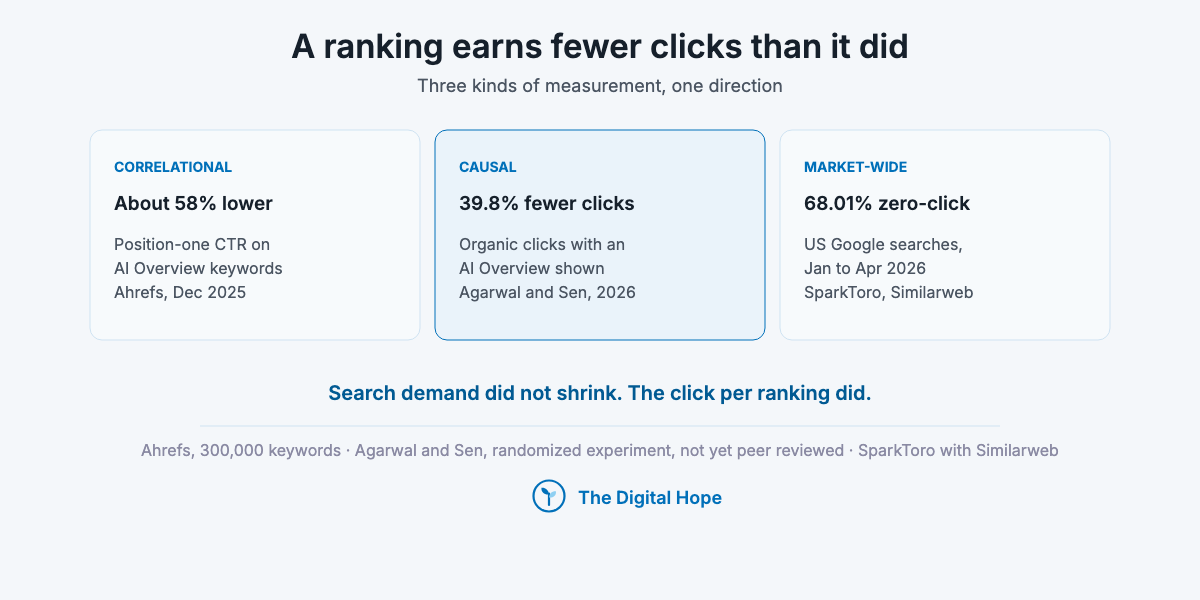
Three different kinds of measurement point the same way.
- Correlational: Ahrefs’ 300,000-keyword study associated an AI Overview with a roughly 58% lower CTR for position one (Dec 2025 vs Dec 2023). Its 2025 edition found 34.5%.
- Causal: a randomized field experiment by Saharsh Agarwal and Ananya Sen (revised 2026, not yet peer reviewed, reported by Search Engine Journal on 1 Jul 2026) found AI Overviews cut organic clicks by 39.8%, and the lost visits were no lower in quality than the ones that remained.
- Market-wide: SparkToro’s Similarweb data put zero-click US Google searches at 68.01% in January to April 2026, up from 60.45% in 2024, with the caveat that the two years use different panels.
- A dated point: in March 2025 browsing data from 900 US adults, Pew found people clicked a result in 8% of visits with an AI summary, against 15% without one.
Here’s the other half. Google said in May 2026 that AI Mode had passed one billion monthly users, yet SparkToro measured only 0.34% of US searches going to AI Mode in January to April 2026. Usage counts and share of searches are different measures. Meanwhile, Google’s own documentation says a page needs only to be indexed and eligible for a snippet to appear in AI Overviews or AI Mode (AI features and your website, last updated 10 Dec 2025). The way into AI answers on Google runs through SEO.
Both popular framings are wrong. “SEO is dead” ignores that AI features draw on indexed, ranking pages. “Nothing changed” ignores a click rate that fell by a third or more on the queries AI answers. The fundamentals hold. The payoff and the scoreboard changed.
Search didn’t shrink. The click did.
Quick Summary
Q: Is SEO dead because of AI search?
A: No. Search demand didn’t shrink, and Google’s AI Overviews and AI Mode cite pages that are indexed and snippet-eligible, which is SEO work. What fell is the click per ranking: about 40% fewer organic clicks with an AI Overview in a 2026 randomized experiment, and 68% of US Google searches ended without a click in early 2026.
Insight
When it launched AI Overviews in the US on 14 May 2024, Google said “the links included in AI Overviews get more clicks” than the same page as a traditional listing. That is a claim about the links that get included, per impression. Every independent study since, from Pew to Ahrefs to the Agarwal and Sen experiment, measures total clicks to results falling when an Overview appears.
Google, The Keyword, 14 May 2024
What SEO pays for now: four returns, and only one of them is a click
“There are no additional requirements to appear in AI Overviews or AI Mode, nor other special optimizations necessary.”
Google Search Central, AI features and your website (last updated 10 December 2025)
SEO now pays in four ways: clicks on queries that still need a website, citations and brand mentions inside AI answers, pages that keep earning after you stop spending, and a share of demand from people who don’t know your brand yet. A business case that counts only the first one undercounts the channel.
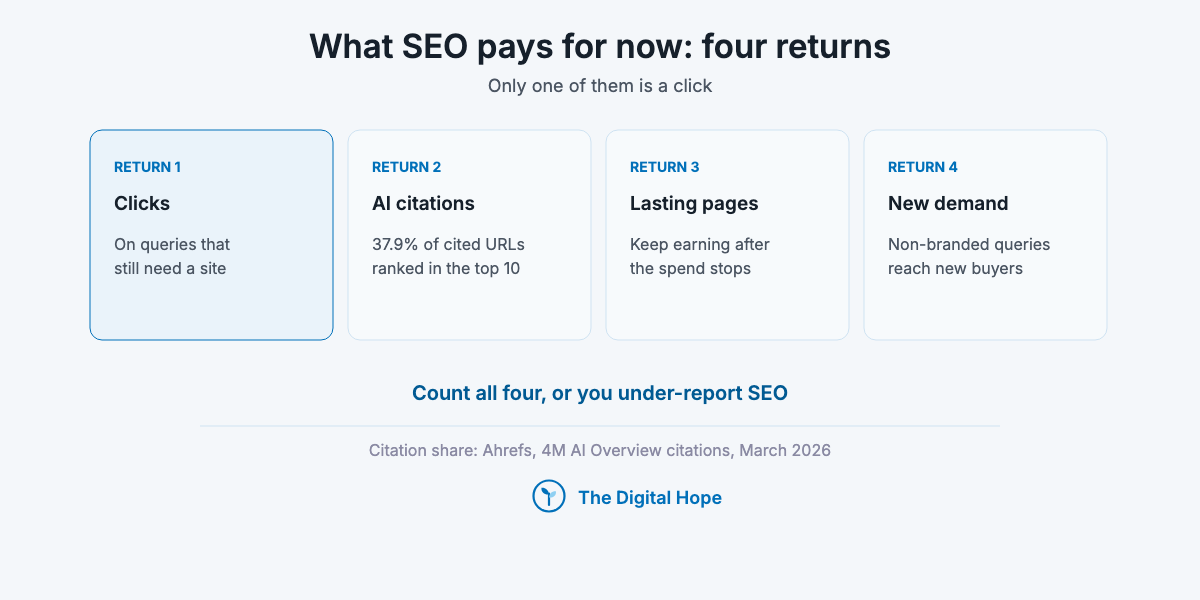
1. Clicks where the query still needs a site. In the Agarwal and Sen experiment, AI Overviews appeared on about 41% of queries and 53% of informational ones, while navigational and transactional queries showed no measurable change in clicks. The searcher who has to buy, book, sign up or log in still clicks.
2. Citations and mentions inside AI answers. Ranking is the entry ticket, not the whole rule. In Ahrefs’ March 2026 data on 4M AI Overview citations, 37.9% of cited URLs ranked in the top 10 for that exact query, and most of the rest ranked lower or not at all for it. And the credit comes in two forms: in Semrush and Growth Memo’s June 2026 study of 3,981 AI appearances, 74.9% were links to a page, 38.3% named the brand, and 61.7% linked a page without naming the brand. Track both.
3. Pages that keep earning after the spending stops. Paid traffic stops the day the budget does. A page that ranks keeps collecting impressions and clicks until a competitor or an update displaces it. That’s the compounding part of SEO, with one condition: pages decay, so the asset needs upkeep, and the case should budget for refreshes as well as new pages. For how to split money between the two channels, see SEO vs paid search.
4. Non-branded demand: people who don’t know you yet. Branded searchers already know you and would mostly find you anyway. Non-branded rankings are where SEO reaches new buyers, and they’re the line most total-traffic charts hide (step 2 below shows how much).
Seer’s 2024 to 2025 client data adds a hint, and only a hint: brands cited in an AI Overview kept more organic clicks than brands that weren’t (0.70% vs 0.52% CTR in Q3 2025, 42 clients), but the authors note citation may only reflect brand strength. It doesn’t show cause.
Count all four, or you under-report SEO.
Quick Summary
Q: What are the benefits of SEO now that AI answers sit on top of search?
A: Four: clicks on transactional, branded and local queries that still need a website, citations and brand mentions in AI answers from Google, ChatGPT, Perplexity and Copilot, pages that keep earning after spend stops, and reach into non-branded demand from buyers who don’t know you yet.
Insight
Citations and mentions are different returns. In the Semrush and Growth Memo study of 3,981 AI appearances across 115 prompts in 14 countries, comparative queries named a brand at a 43.3% rate, about 2.4 times the rate for informational queries. Buyers comparing vendors are where AI answers say your name.
Semrush and Growth Memo, “The Ghost Citations Study”, 9 June 2026
Where SEO still pays, and where it pays less
“It got even worse when AI overviews were released, so I didn’t even try to recover it.”
A Diamond Product Expert describing his own travel site, Google Search Central Help Community, 28 October 2026
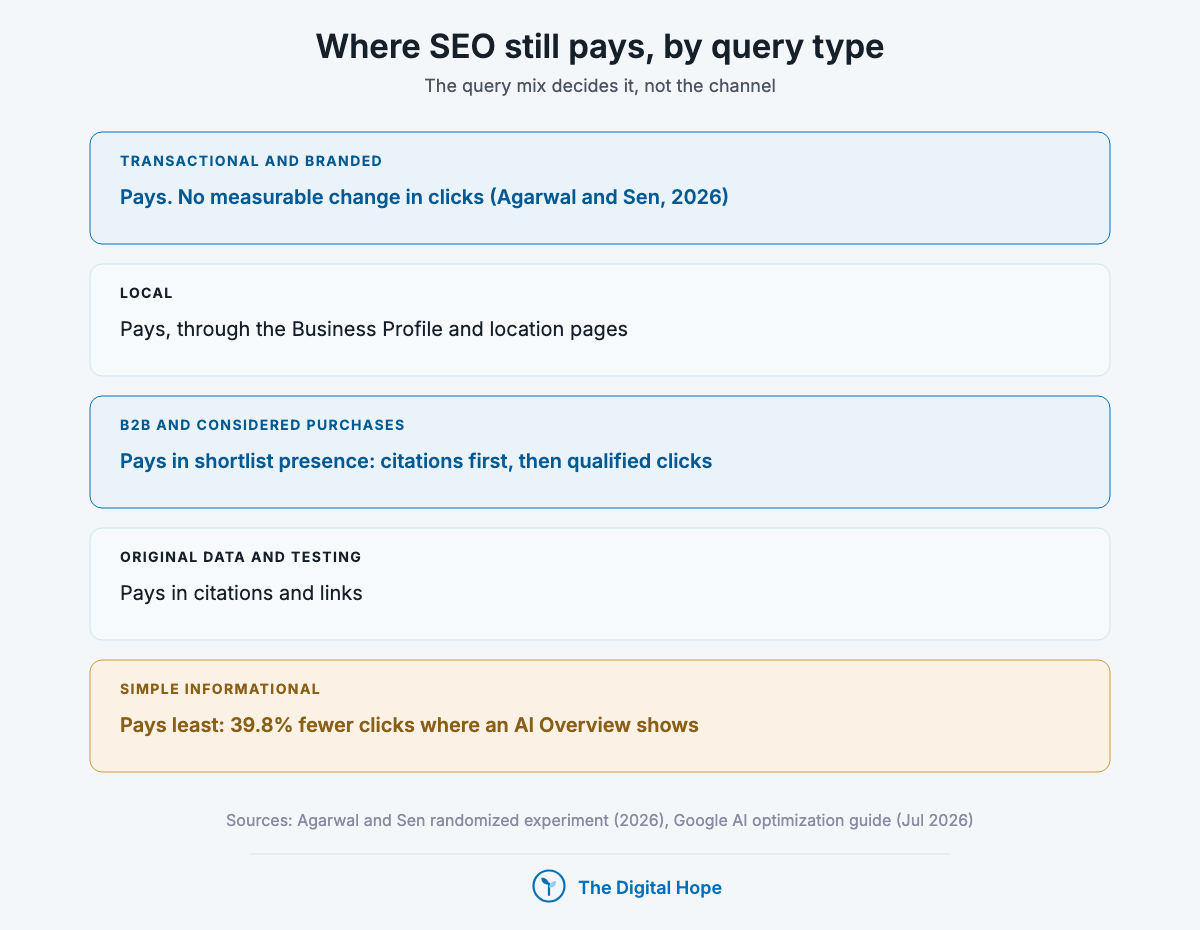
SEO pays best on queries where the searcher has to act on a site: transactional, branded and navigational searches, local searches, and B2B research where buyers compare vendors. It also pays on pages with original data. It pays least on simple informational questions that an AI Overview answers in full.
| Query type | What AI features do to it | Verdict for SEO spend |
|---|---|---|
| Transactional (buy, book, sign up) | No measurable change in clicks in the Agarwal and Sen experiment (2026) | Pays. Product, category and service pages first |
| Branded and navigational | No measurable change in the same experiment | Pays, but it’s demand created elsewhere. Protect it, don’t credit SEO with its growth |
| Local (service plus place, “near me”) | 71% of US consumers used Google for local recommendations, down from 83% a year earlier (BrightLocal 2026, n=1,002) | Pays, through the Business Profile and location pages. See local SEO |
| B2B and considered purchases | Comparative prompts named brands about 2.4 times as often as informational ones (Semrush and Growth Memo, Jun 2026) | Pays in shortlist presence: citations and mentions first, then fewer, better-qualified clicks |
| Original data and first-hand testing | Google’s AI optimization guide recommends original, first-hand, non-commodity content (Jul 2026) | Pays in citations and links. It’s what an AI answer can’t build from the consensus |
| Simple informational (“what is”, “how many”) | AI Overviews appeared on 53% of informational queries, with 39.8% fewer clicks (Agarwal and Sen, 2026) | Pays least in clicks. Fund it only where the page also earns citations or feeds a conversion path |
The condition that decides your answer is how your business makes money from a visit.
- For a B2B company, the buyer may never click the informational post, but the same buyer asks an assistant which vendors to shortlist. SEO is worth it if your pages are what the answers cite and your service pages rank for buying terms.
- For a local or consumer business, the transactional and local queries carry the revenue, and they’re the least affected. SEO is worth it if the site and Business Profile are built around those queries.
- For a publisher or affiliate site paid by the pageview, this is the hardest case. Informational traffic is exactly what AI answers absorb. SEO is worth it only if you move toward original data, testing and topics an answer can’t summarise.
The query mix decides it, not the channel.
Quick Summary
Q: Where is SEO still worth investing in?
A: On transactional, branded, local and B2B comparison queries, and on pages with original data, because the searcher still needs a website or the AI answer needs a source. It’s weakest for simple informational queries that an AI Overview answers in full, which hurts publishers paid by the pageview most.
Insight
Google lists the content its AI features favour in plain terms: original, first-hand and non-commodity. Its own guide says optimising for generative AI search “is optimizing for the search experience, and thus still SEO”, and warns against tools that claim access to internal Google metrics. The work that pays in AI answers is the same work that pays in rankings.
Google Search Central, AI optimization guide (last updated 10 July 2026)
The next section shows how to tell which of these describes your site, and how to prove it in a budget review.
How to build the business case for SEO: five steps
“There’s no guarantee that changes you make to your website will result in noticeable impact.”
Google Search Central, core updates guidance (last updated 10 December 2025)
Build the case from your own data, not from industry averages. Sort your queries by what the searcher has to do next, split branded from non-branded, annotate the measurement breaks, add AI visibility beside clicks, then fund the work in the order that protects the return. Each step starts in a named tool.
1. Sort your queries by what the searcher has to do next
First action: in Search Console, open Performance, set the last three months, and export the queries. Tag each of your top queries as transactional, branded, local, comparison or informational.
- Could an AI Overview answer this query fully in two sentences?
- Does the searcher need to buy, book, sign up, call or log in?
- Would a buyer ask an assistant to compare vendors for this?
- Does the query name a place, or imply one?
- Which landing page does it send clicks to, and does that page convert?
When to skip it: if the site is new and has almost no queries yet, tag the keyword list you plan to target instead. Rough tags are fine. You’re looking for the mix, not a perfect taxonomy.
2. Split branded from non-branded before you judge growth
First action: in the Search Console Performance report, add a query filter that excludes your brand name and its common misspellings, then compare clicks for both segments over the same weeks.
Total clicks can hide the result that matters. In one B2B site I run (Forage AI, web data for AI, Search Console, March 2026 vs 27 September to 24 October 2026), US non-branded clicks went from 51 to 151 per four weeks, and US ranking keywords from 3,063 to 7,008. Over the same weeks, total clicks stayed flat (927 to 919) because branded search fell, and impressions dropped from 208K to 132K as older posts decayed and the focus moved to US buyer terms. A total-clicks chart would have called it a flat period. One B2B site, one period: it shows why the split matters, not what SEO will do for you. The full story is on my portfolio.
- What share of your clicks is branded?
- Is non-branded growing while branded falls, or the reverse?
- Did branded move because of something outside SEO, such as less PR, fewer ads or a product change?
When to skip it: if your brand is barely searched yet, branded clicks are near zero and the split tells you little. Run it again in a quarter.
3. Annotate every measurement break before you compare periods
First action: in your reporting sheet, mark these dates on the timeline: 14 May 2024 (AI Overviews for all US users), mid-September 2025 (Google stopped supporting the 100-results parameter, desktop impressions fell and average position rose as a reporting artefact), 31 August 2026 (Search Console’s generative AI report reached all sites), and any consent banner or analytics change on your side.
Then use Google’s own first fork: if impressions and clicks both fell, look for updates, technical, security or spam causes, and if only clicks fell, Google says to review titles and snippets (debugging drops in Search traffic, last updated 10 Dec 2025). My read: on queries with an AI Overview, a clicks-only drop is often the results page, not your snippet. The full diagnostic order is in the SEO audit checklist, and the update history in Google algorithm updates.
- Does any period comparison cross mid-September 2025?
- Did impressions and clicks fall together, or clicks alone?
- Did anything change on your side, such as a migration, a consent banner or a tracking release?
When to skip it: never. A year-on-year chart without these notes is the most common way a good SEO quarter gets cut.
4. Report AI visibility next to clicks, never as clicks
First action: open Search Console’s generative AI performance report, which shows how often your pages appeared in Google’s AI features, with impressions and no clicks, for all sites since 31 August 2026 (Google’s announcement, 3 Jun 2026). Then open Bing Webmaster Tools’ AI Performance report, which counts citations in Copilot and Bing’s AI summaries from a sample of grounding queries, in public preview since 10 February 2026 (Bing Webmaster blog).
Clicks from AI Overviews and AI Mode are counted inside “Web” in Search Console, not separately. In GA4, AI assistant referrals need their own channel group, and some still arrive as Direct: one practitioner tracking a single brand (Sep 2025 to Jun 2026) found 22.4% of AI Overview visits landed in Direct, not Organic. Prompt-tracking tools sample prompts from the outside, so treat their scores as estimates. The full measurement stack is in the GEO guide.
- Are AI impressions rising while clicks are flat?
- Which pages are cited, and do they match the pages you’d want a buyer to read?
- Is your Direct channel growing in a way nothing else explains?
When to skip it: if almost all your search revenue is local or transactional, check these monthly rather than weekly. For B2B, where buyers shortlist in assistants, check them weekly.
5. Fund the work in the order that protects the return
First action: list this quarter’s SEO work under three heads, access, pages and reputation, and fund access first.
- Access: a page Googlebot or an AI crawler can’t reach or render earns neither clicks nor citations. That’s technical SEO.
- Pages: titles, headings, internal links and content that answer the query you tagged in step 1. That’s on-page SEO.
- Reputation: earned links, digital PR, brand mentions and original data, the off-site signals AI answers lean on. That’s off-page SEO.
When to change the order: if the site is technically clean, start with pages on the transactional and comparison queries from step 1. If you’re a publisher paid by the pageview, move new content budget toward original data and first-hand testing before anything else. Buying links is not a reputation line: Google’s systems have neutralised the credit from bought links since December 2022.
Fund access first, then pages, then reputation.
Quick Summary
Q: How do I prove SEO is worth it to my boss or client?
A: Use your own Search Console data: tag queries by what the searcher does next, split branded from non-branded clicks, annotate measurement breaks like the September 2025 impression change, and report AI impressions and citations beside clicks. Then fund technical access, page work and reputation in that order.
Insight
Google’s documentation says traffic from AI Overviews and AI Mode is “included in the overall search traffic in Search Console” under the Web search type. There’s no separate AI click line on Google’s side. Any report that claims to show Google AI clicks on their own is an estimate built outside Search Console.
Google Search Central, AI features and your website (last updated 10 December 2025)
The KPIs that matter now
Lead the report with non-branded clicks to pages that convert, conversions from organic landing pages, and AI impressions and citations, with branded demand as its own line and every measurement break annotated. Organic sessions stay on the report, below these, because on their own they hide the shift from clicks to citations.
| KPI | What it tells you | Where to read it | Watch-out |
|---|---|---|---|
| Non-branded clicks, by query type | New demand SEO reached | Search Console Performance, brand excluded | Small numbers at first. Read the trend over quarters |
| Conversions from organic landing pages | Whether the clicks are the right ones | GA4, by landing page | Some AI visits land in Direct (22.4% in one tracked brand) |
| Branded clicks and impressions | Demand created by PR, ads and product | Search Console, brand only | Moves with work outside SEO. Never credit SEO with it |
| AI impressions | How often your pages appear in Google’s AI features | Search Console generative AI report (all sites since 31 Aug 2026) | Impressions only, no clicks and no queries |
| AI citations and mentions | Presence in Copilot, ChatGPT and Perplexity answers | Bing Webmaster Tools AI Performance (preview since Feb 2026), a prompt tracker | Samples. Citations and brand mentions diverge, so track both |
| Rankings for target terms | Leading indicator for the lines above | Search Console average position, a rank tracker | Trackers are directional. Desktop data shifted in Sep 2025 |
The condition: for B2B, weight AI citations and non-branded clicks to buying pages most. For local and consumer businesses, weight conversions from transactional and local pages most. One KPI never carries the case alone.
Six lines, each with its watch-out.
Quick Summary
Q: What KPIs should an SEO report use now?
A: Non-branded clicks by query type, conversions from organic landing pages, branded demand as a separate line, AI impressions from Search Console, AI citations from Bing Webmaster Tools and a prompt tracker, and rankings for target terms as a leading indicator, with measurement breaks annotated.
Insight
Search Console’s generative AI report counts “How often URLs from your site appeared in generative AI features in Search and Discover”, broken down by page, country, device and date. It has no clicks and no queries. Read it as a visibility line next to clicks, and expect the numbers not to reconcile with the Web report.
Google Search Central blog, generative AI performance reports (3 June 2026, updated for the 31 August 2026 rollout)
Pulling it all together
Step 1 is the mix: this week, export three months of Search Console queries and tag your top ones by what the searcher does next.
Step 2 is the split: add a brand-excluded filter and chart non-branded clicks on their own line.
Step 3 is the timeline: mark May 2024, September 2025, August 2026 and your own tracking changes on every chart you’ll show.
Step 4 is the second scoreboard: add the Search Console AI report and Bing’s AI Performance report to the monthly deck, beside clicks.
Step 5 is the budget order: fund technical access, then pages for the queries that still need a site, then reputation and original data.
What stopped being true
One table, because none of these deserves a section.
| What stopped being true | When it changed | Primary source |
|---|---|---|
| Ranking first means getting the click | AI Overviews for all US users from 14 May 2024. Position-one CTR about 58% below forecast on AI Overview keywords, Dec 2025 | Google, The Keyword, 14 May 2024 · Ahrefs, 300,000 keywords, 4 Feb 2026 |
| About half of searches end without a click | 68.01% of US Google searches, Jan to Apr 2026, up from 60.45% in 2024 (different panels) | SparkToro with Similarweb, 8 Jun 2026 |
| Impressions and clicks rise together | AI features add impressions without clicks, and desktop impressions fell when the 100-results parameter stopped working | Google AI features doc, 10 Dec 2025 · Search Console reporting change, mid-Sep 2025 |
| Search Console shows AI search traffic as its own line | AI Overview and AI Mode clicks sit inside “Web”. The generative AI report shows impressions only, all sites from 31 Aug 2026 | Google Search Central blog, 3 Jun 2026 |
| Page Authority and Domain Authority are Google scores worth targeting | They were never Google’s. Moz says DA is not a Google ranking factor | Moz documentation, checked 29 Oct 2026 |
| Helpful content is a separate system to recover from | Folded into Google’s core ranking systems | Google helpful content documentation, 5 Mar 2024 |
| FAQ rich results win extra space in the results | No longer shown in Google Search | Google Search Central updates, 7 May 2026 |
FAQ
Is SEO dead because of ChatGPT and AI Overviews?
No, and this is the most common myth on the topic. Google’s AI Overviews and AI Mode cite pages that are indexed and snippet-eligible, and Google’s own guide calls optimising for them “still SEO” (Jul 2026). What fell is clicks per ranking: about 40% fewer organic clicks with an AI Overview in a 2026 randomized experiment.
Is SEO worth it for a small business?
For a local business, usually yes, because local and transactional queries are the least affected and 71% of US consumers used Google for local recommendations in BrightLocal’s 2026 survey. The work sits in the Business Profile and a few strong service and location pages, not in a blog.
How long does SEO take to pay off?
There’s no fixed timeline. Google says changes can take effect in days but “it could take several months”, and that there’s no guarantee of a noticeable impact (core updates guidance, Dec 2025). Judge it over quarters, on non-branded clicks and conversions.
Should I move my SEO budget to Google Ads?
It depends on the buyer and the query, and paid stops the day the budget does. The decision rule by buyer type is in SEO vs paid search.
Do AI citations replace clicks as the goal?
No. Report them beside clicks. In a June 2026 study of 3,981 AI appearances, 61.7% linked a page without naming the brand, so citations, mentions and clicks are three different lines.
Is GEO a separate budget from SEO?
Google treats it as SEO, and the same indexable, original, well-linked pages earn both rankings and citations. What’s new is the measurement and the extra crawlers to allow. The how is in the GEO guide.
In a nutshell
The honest timeline: SEO pays over quarters, not weeks, and Google offers no guarantee that any change will move results. Expect fewer clicks per ranking than three years ago, and judge the channel on non-branded clicks, conversions and AI visibility together.
When SEO isn’t worth it: if your revenue depends on pageviews from simple informational questions, and you can’t add original data or first-hand testing, the click base is shrinking under you. Everywhere the searcher still needs a site to finish the job, it’s worth it.
If you would rather have someone look at your search and AI visibility data before the next budget review, that’s what I do in a consultation.
About this article

Written by
Sai Subramaniam
SEO, GEO and Paid Ads Manager · 8+ years in growth marketing
I have run SEO, paid media and ABM for B2B AI companies, consumer apps and live-entertainment brands, from a solo operator at an AI infrastructure company to a team of 20 recovering a million-visitor site after a Google update. I write these guides from that work, and every number in them carries its source.
See my portfolioConnect on LinkedInHow this one was checked. Every number traces to a named source with its dataset and period, and every platform feature, policy or limit cites the platform’s own documentation with the date it was verified. Where the author’s own results appear, they are labelled as one account’s results, with the budget and context, not as a rule.
No affiliate links and no paid placements. Tools are named because they are what practitioners use, not because anyone paid to appear here.
Reviewed: October 2026. Ad platforms and search features change every few months; anything we could not verify at the time of writing is marked as unverified rather than turned into a number.
Corrections. If something here is wrong or has changed since, we would rather know. Corrections are made in place, with a note saying what changed.