
“Google’s automated ranking systems are designed to prioritize helpful, reliable information that’s created to benefit people, and not content that’s created to manipulate search engine rankings.”
Google Search Central, “Creating helpful, reliable, people-first content” (page last updated 5 October 2026)
Last updated: October 2026.
Two people, a calendar that is always three weeks behind, and a target of fifty posts a quarter. The drafts come back fluent and correct, and they read like the ten pages already ranking. “I was tired of spending 20+ hours a week on content marketing,” one founder wrote on Hacker News in June 2025, launching an AI tool to fix it. The fix on offer is usually more AI, or less of it.
Neither, on the evidence. About half of new English web articles are now mostly machine-written, by Graphite’s November 2024 measure of 43,000 Common Crawl articles, so a fluent draft is the floor, not an edge. Google’s own line is about purpose, not the tool: its spam policies target pages made at scale mainly to rank, whoever or whatever wrote them, and since 1 October 2026 its AI guidance asks publishers to fact-check AI content by hand, titles and meta descriptions included.
For a small team, content marketing pays when it runs as a system: each page adds something a model can’t, gets checked before it ships, and is maintained after it ships. This guide builds that system: what the strategy has to decide, why AI moved the edge, then five steps from goal to distribution, the content research tools that answer each question, and how to refresh and measure the library.
How we know: Google Search Central documentation read on 29 October 2026 (helpful content guidance updated 5 October 2026, generative AI guidance updated 1 October 2026, spam policies updated 28 August 2026, the Search Console generative AI report announced June 2026). Two large vendor studies with published methods: Graphite (43,000 articles, 2020 to May 2025) and Ahrefs (about 600,000 ranking pages for 100,000 keywords, July 2025). First-party results from two B2B accounts I ran in 2025 and 2026, labelled where they appear. The limit: the studies are correlational and look only at pages that exist or rank, and no published dataset measures content decay with a stated method, so this page gives you none.
Quick Digest
– The strategy is a set of decisions: one goal, one metric, the audience’s questions, and what each page will add that the ranking pages don’t.
– AI changed where the edge is: drafts are cheap, so the value is the human layer (first-party data, a tested opinion, a real example) and the fact-check.
– Five steps: goal and metric, question research with the right tools, a topic and cluster map, an editorial workflow with a human gate, and distribution planned before writing.
– The library is part of the system: refresh, merge or retire old pages before they drag the new ones down.
– Measure beyond clicks: non-branded search, AI impressions, assisted conversions and what buyers say brought them.
– The honest timeline: two quarters before the pattern is readable.
A content marketing strategy is a set of decisions, not a calendar
“At its core, your content marketing strategy is your “why.””
Content Marketing Institute, “Developing a Content Marketing Strategy” (read 29 October 2026)
A content marketing strategy is the written set of decisions behind what you publish: the business goal content serves, the audience and the questions they ask, the topics you will own, how a page gets made and checked, where it goes after publishing, and how you will know it worked. The content calendar is the output of those decisions, not a substitute for them.
The distinction matters most on a small team. If you have one to three people, there is no slack for pages that don’t serve the goal, so every decision a calendar skips gets paid for later in rework. Here’s the reason the calendar-first approach fails: it answers “what do we publish on Tuesday” before anyone has answered “who is this for and what will they do next”.
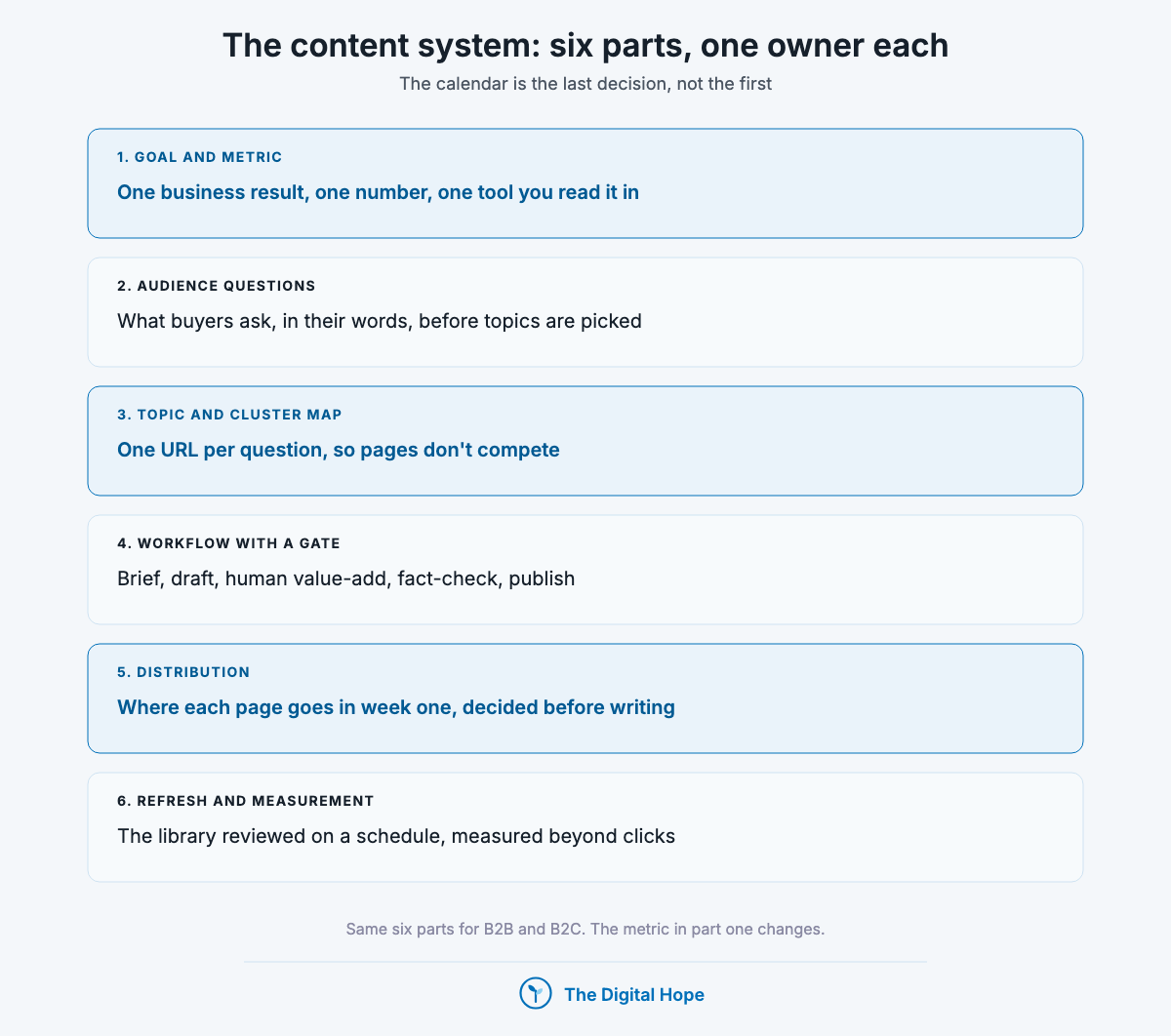
The system has six parts, and each one is a decision someone owns:
- Goal and metric: one business result, one number, one tool you read it in.
- Audience questions: what buyers ask, in their words, researched before topics are picked.
- Topic and cluster map: one URL per question, so pages don’t compete with each other.
- Workflow with a gate: brief, draft, the human value-add, the fact-check, publish.
- Distribution: where each page goes in its first week, decided before it is written.
- Refresh and measurement: the library reviewed on a schedule, measured on more than clicks.
The condition that splits this is the buyer. For B2B teams selling a considered purchase, the goal is usually pipeline, the audience is a buying group, and the content that matters most often never gets a trackable click. For B2C brands and publishers, the goal is often traffic or sign-ups, and search and social reach are measurable directly. Same six parts, different metric in the first one.
A calendar is the last decision, not the first.
Quick Summary
Q: What is a content marketing strategy?
A: It is the written set of decisions behind what you publish: one business goal and its metric, the audience and their questions, the topics you will own, how pages are made and checked, how they are distributed, and how the library is refreshed and measured. The content calendar comes out of those decisions.
Insight “Do you have an existing or intended audience for your business or site that would find the content useful if they came directly to you?” Google Search Central, “Creating helpful, reliable, people-first content” (updated 5 October 2026). Google puts the audience question first in its self-assessment, before anything about search, which is the right order for the strategy too.
AI made drafts cheap, so the edge moved to what the human adds
“It is critical to manually factcheck and review all AI-generated content for accuracy and trustworthiness before publishing.”
Google Search Central, “Google Search’s guidance on using generative AI content on your website” (updated 1 October 2026)
AI-assisted content is allowed on Google, and it is now ordinary. What decides whether it works is what the human adds and whether someone checks it. Google’s generative AI guidance extends that check to titles, meta descriptions, structured data and image alt text, all of which can appear in Search results.
The law, stated once: a page earns its place by adding something the ten ranking pages don’t have. AI fluency is not that something. Three data points, from different angles, plus one account:
- Volume: Graphite’s analysis of 43,000 English articles found AI-generated articles passed human-written ones in November 2024, and the share stopped rising after about May 2024, by its detector’s measure.
- Rankings: Ahrefs scored about 600,000 top-20 pages for 100,000 keywords in July 2025 and found a correlation of 0.011 between a page’s share of AI-detected text and its position, which is no meaningful link. Only 4.6% of ranking pages were fully AI and 13.5% fully human, and 81.9% were mixed.
- Policy: Google’s spam policies name generating many pages with generative AI “without adding value for users” as scaled content abuse, and since March 2024 the policy covers content made by automation, by people or by both.
- One account: at Clarifai, a B2B AI infrastructure company where I was the solo SEO and ads manager (July 2025 to May 2026), I published 3 to 4 AI-assisted articles a week with rankings stable. That is one site with no comparison arm, so it shows the pace is possible, not that it is safe everywhere.
Read the Ahrefs number carefully. It covers pages that already rank, so it cannot show the AI pages that never ranked or were demoted. It is observational and does not show cause. What it does rule out is the simple story that Google detects AI text and pushes it down.
What the human adds, in practice, is one of four things per page: first-party data (your numbers, your customers’ words), a tested opinion with the condition it holds under, a real example with a date, or a better structure for the reader’s decision than the current results offer. If a page has none of the four, the model could have written it for anyone, and Google’s test is aimed at exactly that page.
Fluency is the floor now.
Quick Summary
Q: Does Google penalise AI content?
A: Not as such. Google’s guidance allows AI-assisted content but asks for manual fact-checking, including titles, meta descriptions and alt text (updated 1 October 2026), and its spam policies target pages generated at scale without adding value, whatever made them. Among pages that already rank, Ahrefs found no meaningful link between AI share and position (July 2025).
Insight Google’s spam policies (updated 28 August 2026) give “Using generative AI tools or other similar tools to generate many pages without adding value for users” as an example of scaled content abuse, next to scraping feeds and stitching content from other pages. The test is purpose and added value. No page count or publishing rate is published as a threshold.
So the system has to be built around the human layer, and the check.
How to run content marketing as a system in five steps
“Consider evaluating your content in terms of “Who, How, and Why” as a way to stay on course with what our systems seek to reward.”
Google Search Central, “Creating helpful, reliable, people-first content” (updated 5 October 2026)
Write one goal and its metric, research the questions your audience asks with tools matched to each question, map topics so each question has one URL, run every page through a workflow with a human value-add and a fact-check, and plan distribution before writing. Each step starts with a first action in a named tool.
1. Write one goal and the metric that proves it
First action: open your plan document and write one sentence: “By [date], content will [goal], measured by [metric] in [tool].” The tool is Search Console, GA4 or your CRM, and it should be the one your finance lead would accept. If you sell B2B with a sales team, the metric is usually opportunities where content was touched, or answers to “how did you hear about us” on the demo form, because the content that convinces a buying group often never produces a tracked click.
- Which business result would make a quarter of content worth two people’s time?
- Which dashboard number could rise while that result stays flat?
- Who reads the metric, and on which day of the month?
- What happens to the plan if the number hasn’t moved by the date?
One goal is enough for two quarters, unless the business itself changes direction.
2. Research the questions before the topics, with the content research tools that answer each one
First action: export the last 90 days of queries from the Search Console Performance report, then pull ten recent sales call notes or support tickets and highlight every question a buyer asked in their own words. Topics come out of questions, not the other way round.
Content research tools are only useful when you match each one to the question it can answer. No single tool answers all six, and every tool that reads Google’s results carries two caveats, both covered in the table at the end of this page: the 100-results parameter stopped working in mid-September 2025, and rank-tracking vendors reported inaccurate (“poisoned”) Google results from October 2026, which Ahrefs put at 5% to 20% of results depending on the data provider.
| The question | Tool category that answers it | Tools practitioners use | The honest limit |
|---|---|---|---|
| What do buyers ask, in their own words? | First-party conversations and community threads | Sales call recordings and notes, support tickets, Reddit, Quora, Hacker News, niche Slack and Discord communities | Communities over-represent the loudest users, and they are not a sample of your buyers |
| Which of those questions get searched, and how are they phrased? | Question and keyword tools | Semrush (Keyword Magic Tool, question filter), Ahrefs Keywords Explorer, AlsoAsked, AnswerThePublic, Google’s own People Also Ask and autocomplete | Volumes are modelled estimates, long-tail questions often show no volume, and both Google-result caveats above apply |
| What are buyers asking AI assistants? | AI assistants used for research, and prompt tracking | ChatGPT, Perplexity, Gemini, Google AI Mode, PromptWatch | Answers vary between runs and users, and none of these gives you search volume |
| Where does my audience spend attention, and who do they trust? | Audience intelligence | SparkToro, YouTube and LinkedIn search, the newsletters and podcasts your customers name on calls | Panel-based estimates, thin for narrow B2B roles |
| What already exists, and what is missing from it? | SERP and content analysis | Reading the top ten by hand, Semrush Topic Research, Ahrefs Content Explorer, BuzzSumo for most-shared content | Shares and links show what got attention, not what the reader needed |
| What does my own site already answer, or nearly answer? | Your own data | Search Console Performance report (queries and pages), GA4 site search | Shows only queries you already appear for |
SEO audit, rank tracking and technical crawlers are a different job. They tell you whether pages can be found and where they rank, not what to write. That checklist, with its own tool choices, is in the SEO audit checklist.
- Which five questions did buyers ask on calls this month that your site doesn’t answer?
- Which of them does Search Console already show you appearing for, below the first page?
- Which questions return forum threads or videos in Google, rather than articles?
- What do two AI assistants answer when you ask your buyers’ top question, and who do they cite?
Questions first, tools second.
3. Build the topic and cluster map so each question has one URL
First action: in a spreadsheet, write one row per buyer question from step 2, then group them under the problems they belong to. Each problem gets one pillar page that answers it end to end, and each sub-question gets either its own page or a section on the pillar. The rule that matters: one question, one URL. Two pages answering the same question split the little demand it has.
On an established site, map the existing URLs first. Put every live post into the sheet against the question it answers before planning anything new, and mark the overlaps. For a site with years of posts, the map usually shows near-duplicates to merge before it shows gaps to fill. On a young site, where the gaps outnumber the pages, the gaps are the work, so map forward. If you can’t tell which kind of site you have, compare the count of live posts with the count of buyer questions: more posts than questions means merge first. How each page is then written for search is covered in SEO content writing.
- Which questions belong to the same problem, and which page owns that problem?
- Do two of your live pages answer the same question?
- Which question has no page, and does anyone search for it or ask it on calls?
- Where should each cluster page link to the pillar, and back?
The map is the strategy made visible.
4. Run every page through a workflow with a human value-add and a fact-check
First action: write your workflow as five named stages with an owner each: brief, draft, value-add, fact-check, publish. The brief names the question, the reader, the first-party material the page will use and the pages it links to. The draft can be AI-assisted, but only when the value-add and fact-check stages have named owners. The value-add stage adds one of the four things from the section above. The fact-check covers every number, every quote and every platform claim, plus the title, meta description and alt text, which Google’s October 2026 guidance names.
Put the check on the thing that fails most. In AI-assisted drafts that is usually invented specifics: a statistic with no source, a quote nobody said, a feature that was renamed. A useful rule is no number without a named source, dataset and period in the same sentence, and anything that fails it is cut, not softened.
One account: at Forage AI, a B2B web data company, the content pipeline I run with Claude agents publishes about 50 posts a quarter, and blog traffic rose 127% from Q1 to Q3 2026. That is one site with a deliberate refocus on US buyer terms over the same period, so it shows a small team can hold that pace with a gate, not that the pace caused the growth.
- What does this page add that the top three results don’t?
- Who checks each number against its source, and when?
- Is the title and meta description true to the page, word for word?
- What is the kill date if the page doesn’t earn impressions in 90 days?
The gate is the part you can’t skip.
5. Plan distribution before you write
First action: for the next page in the calendar, write three lines in its brief before drafting: where it goes in week one (your email list, your social accounts, the sales team), which community conversation it answers, and who will link to it or cite it. Unless a page has an answer to at least one of the three, it is a weaker candidate than one with all three.
Owned channels first. Your email list is the one audience no platform can re-rank, and building it is covered in email lead generation. On social, platforms now test each post on non-followers and widen it on its own performance, so cut the page into posts that stand alone rather than link posts that say “new blog”. How that works on Instagram, TikTok and YouTube is in the organic social media marketing guide. For B2B, send the page to sales with the one question it answers, because a page a rep sends after a call is distribution that reaches the buying group directly.
Communities, with care. Answer the question where it is asked, as a named person, and link only when the page answers it better than a reply can. Google’s SEO Starter Guide (updated 10 December 2025) lists social media promotion among ways to be discovered and warns that “you can overdo promoting your site and actually harm it”. Whether LinkedIn reduces reach for posts with links is unproven either way, so if you post links on LinkedIn, test it in your own account and judge it on clicks, not impressions.
- Which email segment gets this page, and in which week?
- Which three posts can be cut from it that make sense without the click?
- Which open thread or recent sales call does it answer?
- Who would cite it, and what would make it worth citing?
Distribution is part of the brief.
Quick Summary
Q: How do you build a content marketing strategy step by step?
A: Write one goal and the metric that proves it, research buyer questions with tools matched to each question, map topics so each question has one URL, run every page through a brief, draft, value-add, fact-check and publish workflow, and plan distribution in the brief before writing.
Insight “Are you writing to a particular word count because you’ve heard or read that Google has a preferred word count? (No, we don’t.)” Google Search Central, “Creating helpful, reliable, people-first content” (updated 5 October 2026). Length is an output of the question, not a target, which is why the brief names the question and the value-add rather than a word count.
Refresh before you publish more: the library is part of the system
“Are you changing the date of pages to make them seem fresh when the content has not substantially changed?”
Google Search Central, “Creating helpful, reliable, people-first content” (updated 5 October 2026)
Older pages tend to lose visibility, and new posts can hide the loss. Total impressions fall while the dashboard shows a new post doing well, so the library has to be reviewed on its own schedule. Refreshing means substantive change: new facts, a retired claim removed, a better answer. A new date on an unchanged page is the thing Google’s own checklist asks you about.
One account: at Forage AI (B2B, 2026), Search Console impressions fell from 208K to 132K between March and the four weeks to 24 October 2026, and total clicks stayed flat at 927 to 919, while the blog itself grew. Older posts were decaying and the focus had moved to US buyer terms at the same time, so the two causes can’t be separated in this one account. My read: growth in new posts and decay in old ones run in parallel, and only one of them shows up in a “blog traffic” chart.
There is no decay rate to plan against. The figures that circulate (“82% of posts decay within two years”, a fixed weekly decay percentage) don’t trace to a published study with a sample and method, so this page gives none. Measure your own: compare each page’s clicks for the last three months against the same three months a year earlier.
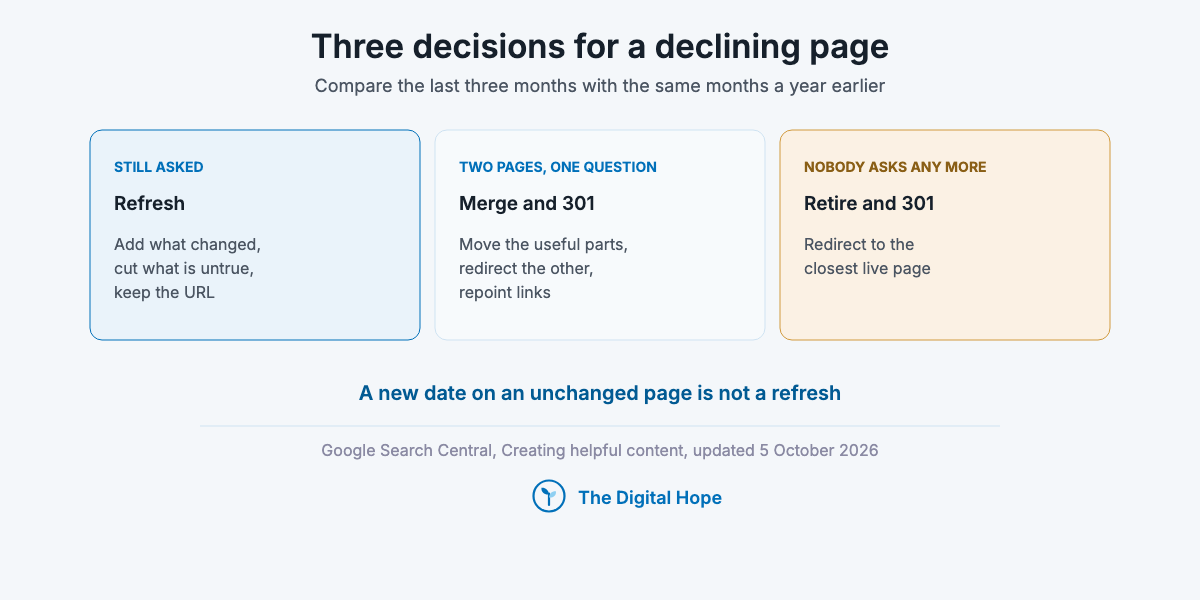
Three decisions per declining page:
- Refresh when the page answers a question people still ask and the decline came from newer, better answers. Add what changed, cut what is no longer true, keep the URL.
- Merge and 301 when two pages answer the same question. Move the useful parts into the stronger URL, redirect the other, and repoint internal links.
- Retire and 301 when nobody asks the question any more, or the page was a dated news round-up that can’t be kept true. Redirect to the closest live page.
The condition is the site’s age. If you have years of posts, refresh, merge and redirect before scaling new pages. If you run a young site, publish new. Neither rule has method-bearing evidence behind it yet, so treat it as a working call, and measure the result page by page.
Fix the library before you add to it.
Quick Summary
Q: Should you refresh old content or publish new content?
A: On a site with years of posts, refresh, merge or retire declining pages first, judged by comparing each page’s clicks with the same period a year earlier. On a young site, publish new. A refresh means substantive change, not a new date, which Google’s helpful-content checklist asks about directly.
Insight In Ahrefs’ July 2025 study of about 17 million URLs cited by AI assistants, AI Overviews and Google’s organic results, chat assistants cited content about 25.7% newer than Google’s organic results, while AI Overviews did not prefer newer content, and the author warned against changing dates without changing the content. Freshness helps in some surfaces, but only real freshness.
Measure what content produces, not only what it ranks for
Content is measured on four layers: non-branded search, AI visibility, assisted conversions and what buyers tell you. Clicks alone undercount it, because a growing share of discovery happens in AI answers with no click, and B2B buyers often research for weeks before filling in a form.
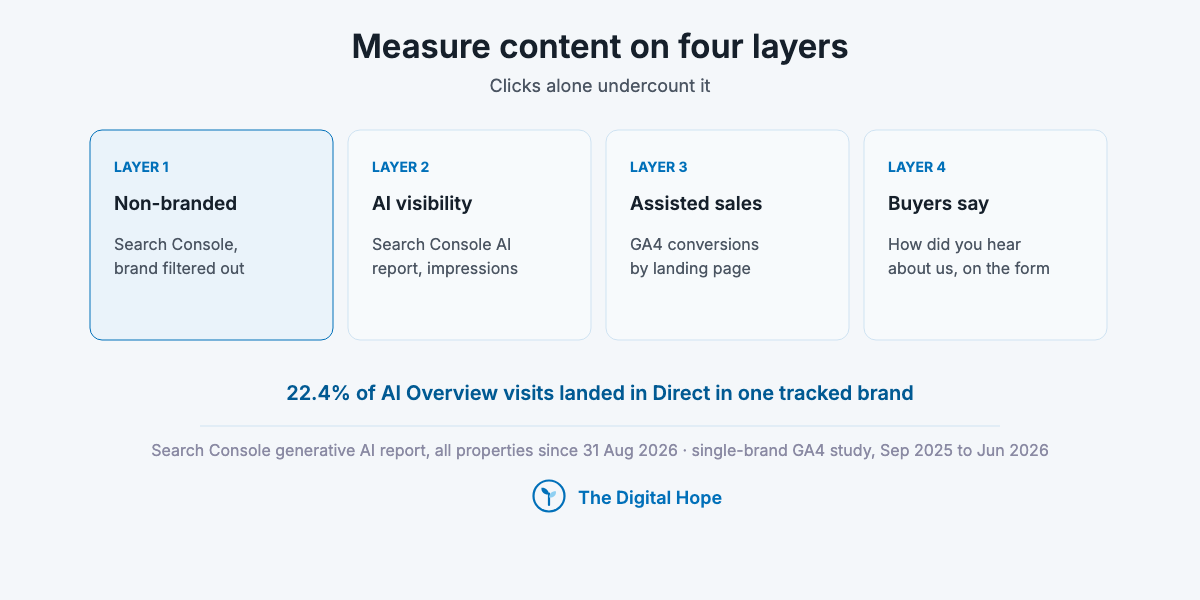
Split branded from non-branded in Search Console. Branded clicks measure demand content may have created, non-branded clicks measure content finding new people. Filter the Performance report by queries containing your brand name and read the two lines separately, or a fall in branded searches can hide growth everywhere else.
Read AI visibility where Google reports it. Since 31 August 2026 every property has Search Console’s generative AI performance report, which shows how often your pages appeared in Google’s AI features, as impressions only, with no clicks and no queries. Traffic from AI Overviews and AI Mode is counted inside the “Web” search type in the main report. Bing Webmaster Tools has offered an AI Performance report for Copilot citations in public preview since 10 February 2026. If you want ChatGPT and Perplexity numbers, read referral sessions in GA4 and track a fixed prompt set over time.
Know where the numbers break:
- AI visits can land in Direct. One practitioner tracking a single brand in GA4 from September 2025 to June 2026 found 22.4% of AI Overview visits attributed to Direct, not Organic.
- Search Console comparisons across mid-September 2025 show falling desktop impressions and rising average position as a reporting change, after Google stopped supporting the 100-results parameter.
- GA4 attribution has three models since November 2023 (data-driven and two last-click variants), so “content-assisted” conversions depend on which one your report uses.
For B2B, add the field nobody else will. A free-text “How did you hear about us?” on the demo or contact form catches the podcast, the post a colleague sent and the article read three weeks earlier. It is self-reported and messy, and it still names channels no dashboard sees. For B2C and publisher sites, sign-ups or revenue per landing page in GA4 usually carry most of the signal.
Clicks are one layer of four.
Quick Summary
Q: How do you measure content marketing?
A: On four layers: non-branded clicks in Search Console (read separately from branded), AI visibility (Search Console’s generative AI report, impressions only, since August 2026, plus GA4 referrals), conversions content assisted in GA4, and what buyers say brought them, captured in a form field.
Insight One practitioner’s GA4 tracking of a single brand from September 2025 to June 2026, reported by Search Engine Land, found AI Overviews drove 7.53% of organic sessions and that about a fifth of those visits were credited to Direct instead. It is one brand, and the same tracking fragment also fires on featured snippets, but it shows why AI traffic needs its own check rather than a channel report.
What stopped being true
| What | When | Primary source |
|---|---|---|
| Publishing AI or templated pages at volume because “Google can’t tell” | Scaled content abuse policy added, covering content made by automation, people or both, 5 March 2024 | Google Search Central blog and spam policies (updated 28 August 2026) |
| Separate “helpful content updates” to recover from | The helpful content system became part of core ranking, March 2024 | Google Search Central, ranking systems guide |
| Low-quality, unoriginal pages holding their positions | Google said the March 2024 core update cut such content in results by 45% | Google, The Keyword, April 2024 |
| AI content needing only a light read | Manual fact-checking now explicitly includes titles, meta descriptions, structured data and alt text | Google generative AI guidance, updated 1 October 2026 |
| Writing to a word count such as “2,000+ words” | Google says it has no preferred word count | Google helpful content guidance, updated 5 October 2026 |
| Changing a post’s date to look fresh | Named in Google’s self-assessment questions | Google helpful content guidance, updated 5 October 2026 |
| Search Console impressions and average position comparable across any dates | Desktop impressions fell and average position rose after the 100-results parameter stopped working, mid-September 2025 | Google statement via Search Engine Roundtable (secondary) |
| Rank-tracker data as ground truth | Vendors reported inaccurate (“poisoned”) Google results, 5% to 20% by provider, October 2026 | Semrush and Ahrefs statements via Search Engine Land (secondary) |
| Measuring content in Universal Analytics | UA stopped processing data on 1 July 2023 and access ended on 1 July 2024 | Google Analytics Help |
| First-click, linear and position-based attribution for content | Removed from GA4, November 2023 | Google Analytics Help |
| “Comment YES for the PDF” to distribute content on LinkedIn | LinkedIn said it is reducing engagement bait and making engagement pods ineffective, 12 March 2026 | LinkedIn Newsroom |
Pulling it all together
One goal, one metric. Write the sentence with a date, a number and the tool you will read it in, and send it to whoever signs off on the time.
Questions before topics. Export 90 days of Search Console queries, highlight ten buyer questions from calls or tickets, and match each to the tool category that can answer it.
One question, one URL. Map every live page against a question before adding new ones, and mark the merges.
A workflow with a gate. Name the owner of each of the five stages, and make the fact-check cover title, meta description and alt text.
Distribution in the brief. For the next page, write where it goes in week one before anyone drafts it.
The library on a schedule. Once a quarter, compare each page’s clicks with the same period a year earlier and decide refresh, merge or retire.
Four layers of measurement. Add the “How did you hear about us?” field this week, and start reading branded and non-branded clicks separately.
Frequently asked questions
What is a content marketing strategy? It is the written set of decisions behind what you publish: the business goal and its metric, the audience and their questions, the topics you will own, the workflow that makes and checks each page, distribution, and how the library is refreshed and measured. The calendar is the output of those decisions.
How is a content strategy different from a content plan or calendar? The strategy decides why and for whom. The plan turns that into topics and owners for a period, and the calendar puts dates on the plan. A team with a calendar and no strategy publishes on time and can’t say what it achieved.
Does Google penalise AI-generated content? No, not because it is AI. Google’s guidance allows AI-assisted content and asks for manual fact-checking, including metadata (updated 1 October 2026), and its spam policies target many pages generated without adding value, whoever made them. The risk is volume without added value, not the tool.
What are the best content research tools? The ones matched to the question: first-party calls and community threads for the buyer’s own words, question and keyword tools such as Semrush, Ahrefs, AlsoAsked and AnswerThePublic for what gets searched, AI assistants for what buyers ask there, SparkToro for where the audience spends attention, and Search Console for what your site already answers. Rank tracking and audits are a separate job.
How often should a small team publish? As often as your budget lets every page pass the value-add and the fact-check. No published study gives a rate that works across sites, and Google publishes no page-count threshold. In one B2B account I ran in 2026, about 50 posts a quarter with a human gate held up, which is one site, not a target.
Is content decay a fixed percentage? No. The decay rates that circulate don’t trace to a published study with a sample and method. Measure your own pages against the same period a year earlier in Search Console.
In a nutshell
Content marketing pays when it runs as a system, not a publishing rate. Each page answers one buyer question, adds something a model can’t, passes a fact-check that covers the title and meta description too, and goes out with a distribution plan. The old pages get the same attention as the new ones.
Give it two quarters before you judge it. One quarter builds the map, the workflow and the first pages, and the second shows whether non-branded clicks, AI impressions and buyer answers move. If nothing moves after two quarters, change the questions you are answering before you change the pace. What would change this call is Google publishing a rate or volume signal for AI-assisted content, which it has not done as of October 2026.
If you would rather have someone look at your content library and Search Console with you, that is what I do in a consultation.
About this article

Written by
Sai Subramaniam
SEO, GEO and Paid Ads Manager · 8+ years in growth marketing
I have run SEO, paid media and ABM for B2B AI companies, consumer apps and live-entertainment brands, from a solo operator at an AI infrastructure company to a team of 20 recovering a million-visitor site after a Google update. I write these guides from that work, and every number in them carries its source.
See my portfolioConnect on LinkedInHow this one was checked. Every number traces to a named source with its dataset and period, and every platform feature, policy or limit cites the platform’s own documentation with the date it was verified. Where the author’s own results appear, they are labelled as one account’s results, with the budget and context, not as a rule.
No affiliate links and no paid placements. Tools are named because they are what practitioners use, not because anyone paid to appear here.
Reviewed: October 2026. Ad platforms and search features change every few months; anything we could not verify at the time of writing is marked as unverified rather than turned into a number.
Corrections. If something here is wrong or has changed since, we would rather know. Corrections are made in place, with a note saying what changed.