
“I think that I cannot preserve my health and spirits, unless I spend four hours a day at least” · Henry David Thoreau, Walking (1862)
It is early evening and the running shoes are by the door, where they have been for three weeks. We know, in the abstract, that a walk would help. We have read it in articles, heard it from doctors, seen it in the faces of people who come back from the park looking lighter than when they left. And yet the evening fills with other things, and the shoes stay where they are. Why is the one thing everyone agrees on so hard to do?
Part of the answer is that we have been given the wrong picture of exercise. We tend to think of it as a personality, something that belongs to disciplined, sporty people with gym memberships, rather than as a dose: something with a size, a kind and a frequency, which works in small amounts and does not ask us to become anyone else. Thoreau needed four hours a day for his health and spirits. The research suggests the rest of us need far less than that to notice a difference.
This guide sets out what exercise does for mental health and how strong the evidence is, which kinds have the best support, how much is enough, why it is so hard to start when we feel low, and then five small steps for this week.
The short version
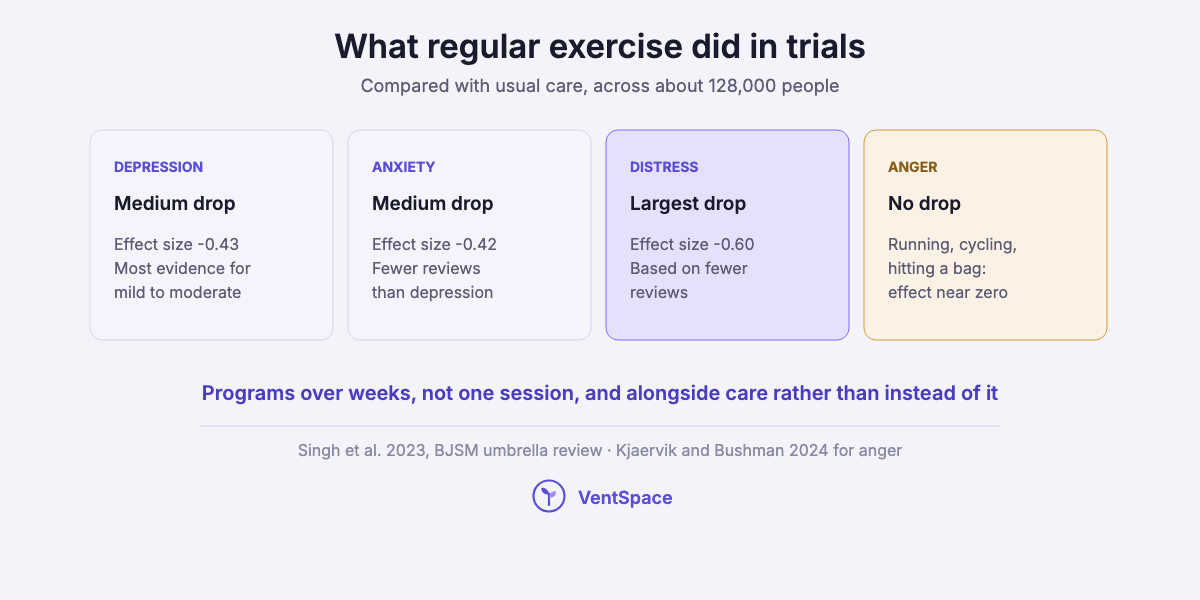
Exercise has a real, medium-sized effect on mental health. Across about 128,000 people in randomized trials, it reduced symptoms of depression, anxiety and distress compared with usual care.
Walking or jogging, yoga and strength training had the best results for depression in a 2024 network meta-analysis, and harder sessions did better.
Less than the guideline still counts. Half the recommended amount was linked to an 18% lower risk of depression.
It does not burn off anger. Calming activities reduced anger, while running and other arousing activities did not.
It works alongside care, not instead of it. Start small, build up over weeks, and talk to a professional if low mood lasts.
| What you want help with | What the research found | How strong the evidence is |
|---|---|---|
| Depression | Medium reductions, with walking or jogging, yoga and strength training leading | Many trials, but most of low quality |
| Anxiety | Medium reductions in symptoms | Many trials, fewer reviews than depression |
| Stress and distress | The largest average effect of the three | Fewer reviews |
| Staying well | Less depression among more active people, even below the guideline | Large cohorts, observational |
| Anger | Running and other arousing activities did not reduce it | One large meta-analysis |
| Well-being without a diagnosis | Moderate gains, largest when combined with a psychological program | 183 trials |
If you are struggling right now. If you are feeling hopeless, or having thoughts of harming yourself, please contact a crisis line now rather than reading on. In the US, call or text 988 (Suicide & Crisis Lifeline). Anywhere else, findahelpline.com lists free, confidential services by country. In an emergency, call 911 or your local emergency number. Exercise is not a substitute for that help.
What is the role of exercise in mental health?
“A sedentary life is the real sin against the Holy Spirit. Only those thoughts that come by walking have any value.” · Friedrich Nietzsche, Twilight of the Idols (1889), Maxims 34 (trans. Anthony M. Ludovici)
Exercise plays a real but limited role in mental health: regular physical activity reduces symptoms of depression, anxiety and psychological distress by a medium amount, and it works best as one part of looking after ourselves rather than as a cure on its own.
The largest summary of the evidence is a 2023 umbrella review led by Ben Singh, which pooled 97 reviews of 1,039 randomized trials and about 128,000 people. Compared with usual care, physical activity had medium effects on depression, anxiety and distress. The authors note that the reductions for depression and anxiety are “comparable to or slightly greater than” the effects observed for psychotherapy and medication in other studies.
That sentence is easy to misread, so it is worth slowing down on. It does not mean a jog can replace treatment. Most of the evidence concerned mild-to-moderate symptoms, and the authors rated 77 of the 97 reviews as critically low in quality. What it does mean is that we are not talking about a nice extra. We are talking about one of the better-studied things a person can do for their mind, and one that is free.
Nietzsche, who was answering Flaubert’s claim that one can only think and write sitting down, overstated the case, as he liked to. We do not need to believe that every thought worth having comes on foot. It is enough to know that some of our steadiness does.
Quick Summary
Q: What is the role of exercise in mental health?
A: Regular exercise reduces symptoms of depression, anxiety and psychological distress by a medium amount, according to a 2023 umbrella review of more than 1,000 trials. Its effects were comparable to or slightly greater than those of therapy and medication in other studies, mostly for mild-to-moderate symptoms. It works best alongside other care, not as a replacement.
Insight: Ben Singh and colleagues, in the British Journal of Sports Medicine (2023): “The effect size reductions in symptoms of depression (−0.43) and anxiety (−0.42) are comparable to or slightly greater than the effects observed for psychotherapy and pharmacotherapy (SMD range=−0.22 to −0.37).” The comparison is across different studies, not head-to-head trials, which is why it supports adding exercise to care rather than swapping one for the other.
What exercise does for how you feel
“Exercise is an effective treatment for depression, with walking or jogging, yoga, and strength training more effective than other exercises, particularly when intense.” · Michael Noetel and colleagues, BMJ (2024)
Exercise lowers symptoms of depression, anxiety and stress, is linked to a lower risk of becoming depressed, and can improve sleep and how we feel on the day, but it does not reduce anger, and the evidence is strongest for programs that run over weeks. Here is what each finding says, and where it stops.
Low mood and the risk of depression
Some of us are not depressed and want to stay that way. For this question, the best evidence comes from following large groups of people over years. In a 2022 meta-analysis led by Matthew Pearce, 15 studies followed 191,130 adults for at least three years. People who did half the recommended amount of activity had an 18% lower risk of depression than people who did none. Those who did the full recommended amount had a 25% lower risk, and beyond that the extra benefit tapered off and became less certain.
Two details in that finding are kind to us. The biggest gains came at the lowest levels of activity, in the step from nothing to something. And the authors’ own conclusion is that there are significant mental health benefits “even at levels below the public health recommendations.”
We should be honest about what kind of evidence this is. These are observational studies: they show that more active people became depressed less often, not that the activity alone caused it. People who feel well may also find it easier to move. The researchers estimated that 11.5% of depression cases might have been prevented if less active adults had met the recommendations, but that is a model, not a measurement. It is a reason to begin, not a promise about any one of us.
Depression
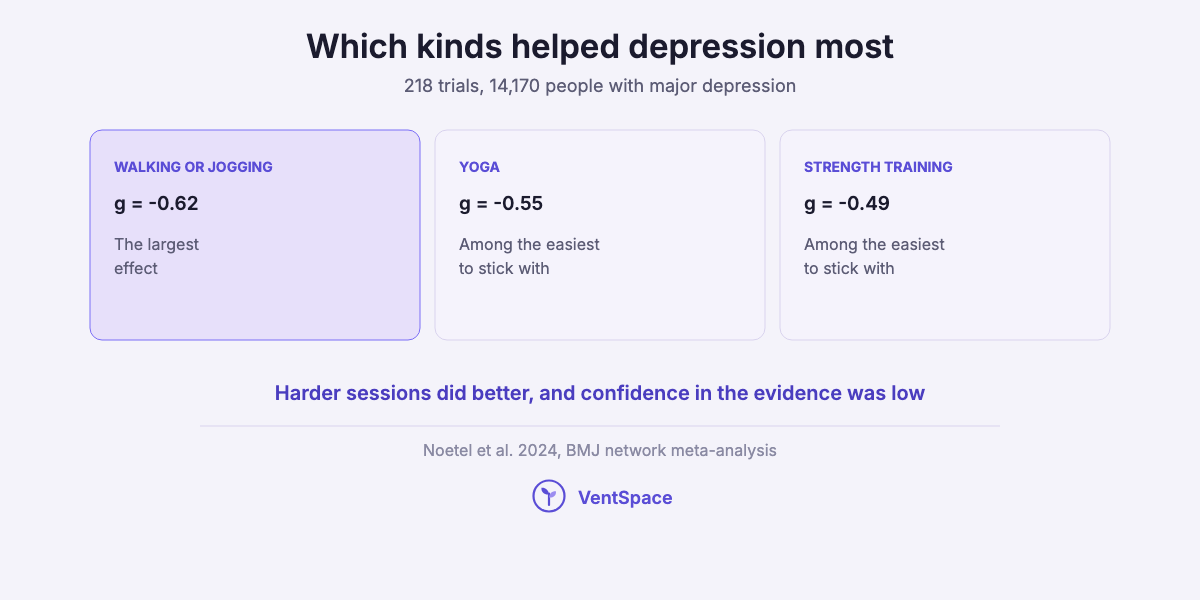
If we are already depressed, the question changes from prevention to treatment. The most detailed answer is a 2024 network meta-analysis in the BMJ, led by Michael Noetel, which compared kinds of exercise across 218 trials and 14,170 people with major depression. Against active control conditions, the effects were moderate for every kind that made the list:
| Kind of exercise | Effect on depression (Hedges’ g) |
|---|---|
| Walking or jogging | −0.62 |
| Yoga | −0.55 |
| Strength training | −0.49 |
| Mixed aerobic exercise | −0.43 |
| Tai chi or qigong | −0.42 |
The larger the negative number, the bigger the drop in symptoms. The effects grew with the intensity prescribed, and strength training and yoga were the best tolerated, meaning people were more likely to stick with them.
The authors are careful about the limits. Only one of the 218 studies met the strictest standard for low risk of bias, and their confidence in the results was low for walking or jogging and very low for the rest. They suggest these forms of exercise could be considered alongside psychotherapy and antidepressants. That is the right frame. Exercise belongs on the list of treatments a doctor might discuss with us, not in place of that conversation.
Anxiety
Anxiety has less research behind it than depression, but the direction is the same. In Singh’s umbrella review, physical activity reduced anxiety symptoms by a medium amount, almost identical in size to the effect on depression. The authors also note that fewer reviews addressed anxiety, which kept them from drawing firm conclusions about subgroups such as particular ages or conditions.
There is also a shorter-term effect. The US Physical Activity Guidelines for Americans list among the immediate benefits of physical activity that it can reduce anxiety, alongside lowering blood pressure. For many of us, that is the part we notice first: the edge comes off for a while after a brisk walk.
What exercise does not do is make anxiety go away for good, or replace treatment for an anxiety disorder. If worry or panic is shaping your days, it is worth talking to a doctor or therapist. Movement is something we can add while we do that, not a reason to wait.
We should also resist the idea that we must understand exactly how it works before we try it. The research we have loaded measures what happens to symptoms, not why. Many pages will tell you about brain chemicals and hormones. We have left those explanations out, because the trials do not depend on them and the confident versions are often ahead of the science.
Stress and everyday distress
Not everything that weighs on us has a diagnostic name. Psychological distress is the broad category researchers use for that heavy, frayed, too-much feeling that can come from work, money, caring for someone or just a long season of pressure.
In Singh’s umbrella review, distress showed the largest average effect of the three outcomes, with an effect size of −0.60 against usual care. That figure rests on fewer reviews than the depression result, so we hold it a little more loosely, but it points in a hopeful direction for the most common kind of struggle.
The same review found something that matters for anyone with limited time. The benefits were seen across many groups: healthy adults, people with diagnosed mental health conditions, people with chronic illnesses, and women who were pregnant or had recently given birth. We do not need to be unwell for exercise to help, and we do not need to be fit to begin.
It is worth adding the obvious caution. If our distress comes from something concrete, such as debt, an unsafe home or an impossible workload, a workout will not change the cause. It may make us a little steadier while we deal with it, and that is a legitimate reason to keep moving.
Sleep
Sleep and mood are tangled together, and exercise touches both. The US physical activity guidelines list better sleep quality among the immediate benefits of physical activity, and among the longer-term ones for adults they include a reduced risk of depression.
This matters because poor sleep is one of the things that makes everything else harder. On the days we sleep badly, we feel less like moving, and on the days we move less, we often sleep worse. Breaking into that loop from either side tends to help the other. If you want to start with sleep instead, our guide on how to be mentally healthy begins there, with a fixed wake-up time.
A practical note that many of us learn by trial and error: notice whether late, hard sessions leave you wired at bedtime. We have not found a study we trust enough to give a rule, so treat it as something to observe in your own week rather than a fact.
If your sleep has been poor for weeks despite good habits, that is a conversation for a doctor. Long-term insomnia has its own treatments, and exercise is not one of them on its own.
How you feel on the day
Many of us know the feeling of coming back from a walk lighter than we left. The guidelines recognize it: they describe immediate benefits from a single session, including reduced anxiety and better sleep that night.
But we should be precise about what the large reviews measured. Singh’s umbrella review deliberately excluded single bouts of exercise. Its findings on depression, anxiety and distress come from programs that ran for weeks. The cluster of research behind this page says the same thing in plainer words: the evidence for movement is for programs over weeks, not for one walk.
This is not a reason to dismiss the single walk. It is a reason to treat the good feeling afterward as a sign of what repetition could do, rather than as the whole of what exercise offers. One session can take the edge off an afternoon. A few weeks of sessions is where the trials found the larger changes.
There is an odd mercy in this. On a day when the walk does not lift anything, nothing has failed. The dose was never meant to work in a single afternoon. We keep going because the weeks are where the effect lives.
Anger
Here the popular advice and the evidence part company. Many of us have been told to go for a run, hit a bag or “burn off” anger. A 2024 meta-analysis by Sophie Kjærvik and Brad Bushman, covering 154 studies and 10,189 participants, tested exactly that.
Activities that calm the body, such as deep breathing, mindfulness and meditation, reduced anger and aggression, with an effect size of −0.63. Activities that raise arousal, such as hitting a bag, jogging and cycling, were ineffective overall, with an effect size of −0.02, which is close to zero. The authors put it plainly: their findings do not support the idea that venting anger or going for a run are effective ways to manage it.
This does not make exercise bad for angry people. A regular walk may still help our mood and sleep over weeks. It means that, in the moment of anger, a hard run is not the tool. Slowing down is. If you want to move, a slow walk while breathing steadily is closer to what the evidence supports than sprinting it off.
Well-being when nothing is wrong
Not everyone reading this is struggling. Some of us just want to feel more alive in an ordinary week. For that question, a 2026 network meta-analysis by Lowri Wilkie and colleagues pooled 183 randomized trials and 22,811 adults without diagnosed conditions.
Exercise, yoga, mindfulness, compassion training and single positive psychology exercises all improved well-being by a similar moderate amount, with no significant differences between them. The largest effect came from programs that combined exercise with a psychological approach, such as movement paired with mindfulness or another structured practice.
That finding is worth sitting beside the rest of this page. Exercise is one good door among several, not the only one, and it may work best when it is paired with something that helps us pay attention to how we feel. That is part of the thinking behind step 5 below.
The same analysis found that nature-based programs were not significantly better than control conditions, though the authors note the evidence there was limited and varied. So if you walk in a park, the walking is the part with the evidence behind it. The trees are a pleasant bonus, and we do not need to oversell them.
Quick Summary
Q: How does exercise improve mental health and emotional well-being?
A: Regular exercise reduces symptoms of depression, anxiety and psychological distress, and more active people have a lower risk of depression, even below the recommended amount. Walking or jogging, yoga and strength training had the best results for depression. Exercise can also improve sleep and mood on the day. It does not reduce anger in the moment, where calming activities work better.
Insight: Sophie Kjærvik and Brad Bushman, summarizing 154 studies in Clinical Psychology Review (2024): “These findings do not support the ideas that venting anger or going for a run are effective anger management activities. A more effective approach for managing anger is ‘turning down the heat’ or calming down by engaging in activities that decrease arousal.” Exercise and anger management are two different tools, and the common advice mixes them up.
Why we know this and still do not do it
Most of us already believe exercise is good for us. What stops us is rarely information. It is the gap between knowing and starting, which is widest exactly when we feel worst.
There is a cruelty in the timing. Low mood takes away energy, interest and the sense that anything will make a difference, which are exactly the things it takes to put on a pair of shoes and leave the house. So the person who would benefit most from moving is often the person who finds it hardest. If that is you, it is not a character flaw. It is one of the symptoms doing what symptoms do.
The research has its own version of this problem. The C4 record behind this page puts it bluntly: Singh’s umbrella review does not establish that telling someone to exercise produces exercise, and that is the actual failure point. The trials measure what happens to people taking part in an exercise program. Outside a trial, nobody hands us the program, so we have to build the structure ourselves.
One detail in the same review is consoling. The effects were larger in shorter programs. For depression, programs of twelve weeks or less had a median effect of −0.84, compared with −0.46 for programs of twelve to twenty-three weeks and −0.28 for those of twenty-four weeks or more. The authors read this as meaning that benefits can come from short-term programs and that intensive long-term ones are not required. We do not need to commit to a new identity. We need to commit to the next few weeks.
Sai, who writes this blog, put his own experience this way in an earlier guide:
From Sai, who writes this blog: what working out did for me (from his guide on being mentally healthy)
I have always felt more confident and secure when I work out. This especially helped when I had major anxiety about work and life. It was a game-changer for me.
When exercise is not enough. If low mood, worry or distress has lasted for weeks, or is making it hard to work, sleep or look after yourself, it is worth talking to a doctor or a therapist. Therapy is one option. For a lot of people it is the right one. If you take medication for your mental health, do not stop or change it on your own because you have started exercising. That conversation belongs with the person who prescribed it. Our guide on whether you need therapy can help you decide on a next step.
Quick Summary
Q: Why is it so hard to exercise when you feel depressed?
A: Low mood reduces energy, interest and the belief that anything will help, which are the things needed to start. That is a symptom, not a personal failing. Research found that shorter exercise programs, of twelve weeks or less, produced larger effects than longer ones, so committing to a few weeks of small sessions is a realistic way in. If low mood lasts, talk to a doctor or therapist.
Insight: Lowri Wilkie and colleagues, reporting 183 trials of well-being programs in Nature Human Behaviour (2026): “Combined exercise-psychological interventions produced the largest effect (standardized mean difference of 0.73, 95% confidence interval 0.27 to 1.20). Mindfulness, compassion, single positive psychology, yoga and exercise interventions demonstrated moderate, consistent effects.” Movement does more when something else is helping us notice what we feel.
So how much, and where do we begin?
How to use exercise for your mental health: five steps
“Now there are short and simple exercises which tire the body rapidly, and so save our time” · Seneca, Moral Letters to Lucilius, Letter 15 (trans. Richard Mott Gummere)
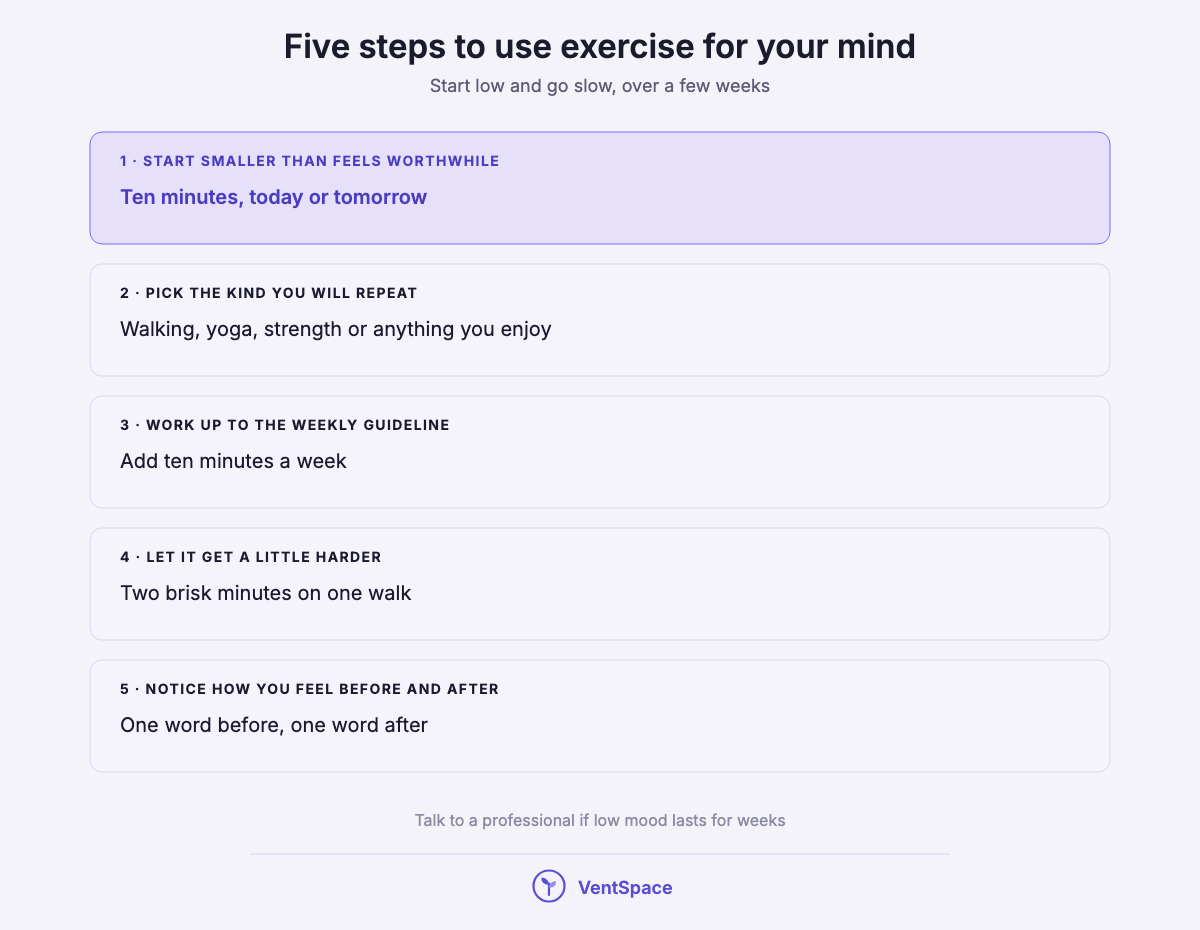
To use exercise for your mental health, start smaller than feels worthwhile, choose a kind you will repeat, build toward 150 minutes of moderate activity a week plus two days of strength work, let it get a little harder over time, and notice how you feel before and after. Seneca, writing nearly two thousand years ago, recommended short and simple exercises because they save time. The modern guidelines agree more than we might expect.
1. Start smaller than feels worthwhile
First action: walk for ten minutes today or tomorrow, at whatever pace feels possible. Put it in your calendar with a time.
The US guidelines open with a sentence that is easy to skip and worth rereading: “Some physical activity is better than none.” Their second edition also dropped the old rule that only bouts of ten minutes or more counted, so even shorter stretches of movement count toward your week.
The guidelines’ safety advice for inactive people is four words long: “start low and go slow.” Begin with lower-intensity activity and increase how often and how long you do it gradually. And remember the finding from earlier: half the recommended amount was already linked to an 18% lower risk of depression, with the steepest gains in the step from nothing to something.
Ask yourself:
- What is the smallest amount of movement I would not talk myself out of?
- When in my day is there already a gap of ten minutes?
- What usually stops me in the first five minutes, and can I remove it tonight?
- Could I attach a walk to something I already do, like a phone call?
This is allowed to feel too easy. Too easy is the point of a first week.
2. Pick the kind you will repeat
First action: write down two kinds of movement you have enjoyed at any point in your life, and choose one to try this week.
Singh’s review found that all modes of physical activity were effective, which means the best exercise is, in practice, the one we keep doing. Within that, the 2024 BMJ analysis gives a useful steer for depression: walking or jogging had the largest effect, followed by yoga and strength training, and yoga and strength training were the most acceptable, meaning people were least likely to drop out.
So if running has always felt like punishment, you are not stuck with it. A yoga class, a set of bodyweight exercises at home, a dance class, cycling to work or a brisk walk with a friend are all reasonable places to start. Choosing something with other people in it can help too, because a fixed time and a person expecting us is a kind of structure that is hard to build alone.
Ask yourself:
- What did I enjoy moving to as a child or a teenager?
- Do I prefer being alone or with other people when I exercise?
- Indoors or outdoors? Morning or evening?
- Which option needs the least equipment and the least travel?
There is no wrong answer here. The evidence is on the side of whichever one you will still be doing in a month.
3. Work up to the weekly guideline
First action: count the minutes of brisk movement you did last week, roughly, and write the number down. That is your starting point, not your score.
The Physical Activity Guidelines for Americans recommend that adults do 150 to 300 minutes of moderate-intensity aerobic activity a week, such as brisk walking, or 75 to 150 minutes of vigorous activity, or a mix of the two, preferably spread across the week. They also recommend muscle-strengthening activity on two or more days a week, working all the major muscle groups.
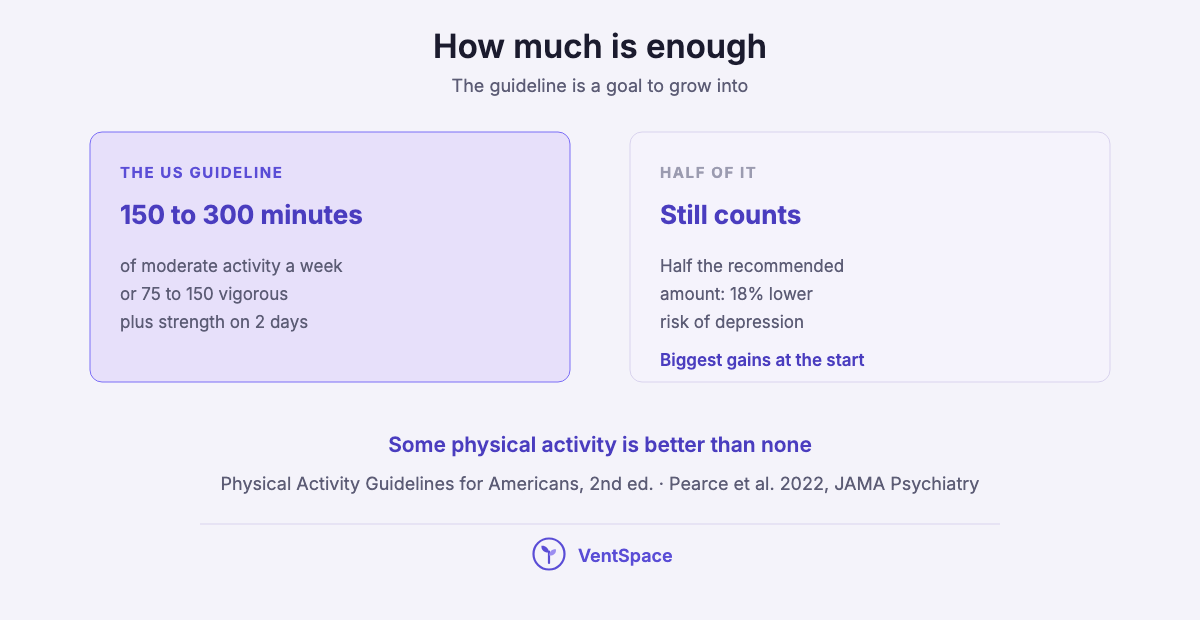
That can look like a lot written down. In practice, 150 minutes is about thirty minutes on five days, or a little over twenty minutes a day. Strength work can be as simple as push-ups against a wall, squats from a chair and carrying the groceries the long way. The guidelines say additional benefits continue beyond 300 minutes, but for mental health the Pearce findings suggest most of the gain comes well before that.
Ask yourself:
- How many minutes did I move last week, honestly?
- What would adding ten minutes a week look like for the next month?
- Which two days could hold a short strength session?
Build toward the number over weeks. Nobody is grading the first month.
4. Let it get a little harder over time
First action: on one of this week’s walks, pick up the pace for two minutes until talking takes a little effort. Then ease off again.
Both large reviews point the same way on intensity. Singh found that higher-intensity activity was associated with greater improvements in symptoms, and Noetel found that the effects on depression were proportional to the intensity prescribed. That does not mean every session should be hard. It means that, once the habit is in place, letting some sessions get a little more demanding is likely to help more than staying at the gentlest level forever.
The guidelines’ safety advice still applies. Increase gradually, choose activities that suit your current fitness, and if you have a heart condition or another chronic health condition, the guidelines say you should be under the care of a health care provider, so talk to them about what level is right for you.
Ask yourself:
- Which of my sessions could become a little brisker without becoming miserable?
- Would a hill, stairs or a slightly faster song do it?
- Do I need to talk to my doctor before I push harder?
Harder is a direction, not a demand. Some weeks will be gentle, and that is fine.
5. Notice how you feel before and after
First action: before your next session, write one word for how you feel. Afterward, write another. That is all.
This step turns exercise from a chore into information. Over a few weeks, the words build into a small record of what movement does for you in particular: which kinds lift your mood, which leave you flat, what time of day works, and how sleep follows. It also gives you something to look back on during the weeks when motivation dips and you have forgotten why you started. And it echoes the 2026 finding that exercise did best when it was paired with something that helped people pay attention.
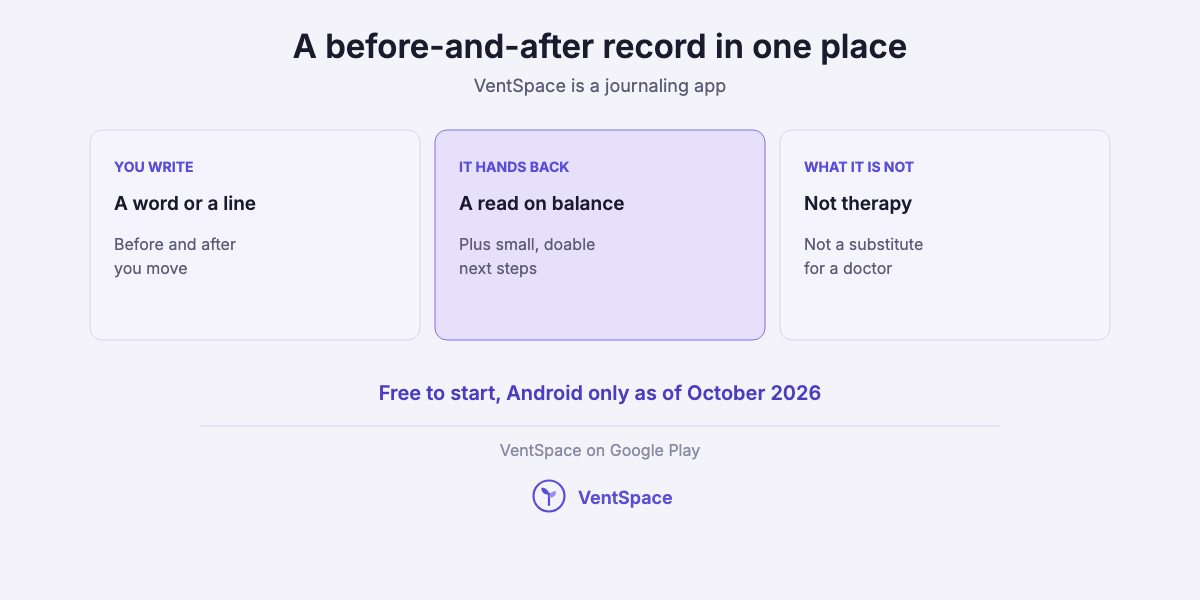
A notebook or the notes app on your phone is enough. If you want to see how your movement and your mood line up across weeks without sorting it yourself, VentSpace is a journaling app that turns what you write into a clear read on your life balance, plus small, doable next steps. It is free to start and Android only as of October 2026. Not on Android, or at a desk? VentSpace Live runs in your browser, free, with nothing to install. It is not therapy, and it does not replace the doctor’s conversation above. It is one way to keep the before-and-after record in one place.
Ask yourself:
- What word describes how I feel right now, before moving?
- What changed afterward, even slightly?
- Which kind of movement has helped my mood most this month?
There are no wrong words in this record. “Tired” and “the same” count as data too.
Quick Summary
Q: How much exercise do you need for mental health?
A: The US guidelines recommend 150 to 300 minutes of moderate activity a week, or 75 to 150 minutes of vigorous activity, plus muscle-strengthening on two days. But some activity is better than none: half the recommended amount was linked to an 18% lower risk of depression. Start small, choose a kind you enjoy, build up gradually and let some sessions get harder over time.
Insight: The Physical Activity Guidelines for Americans, second edition, on doing it safely: “Increase physical activity gradually over time to meet key guidelines or health goals. Inactive people should ‘start low and go slow’ by starting with lower intensity activities and gradually increasing how often and how long activities are done.” The advice for safety and the advice for a reluctant mind turn out to be the same.
Pulling it all together
The five steps describe one dose, built up over a few weeks. Step 1 gets you moving, step 2 makes it something you will repeat, step 3 gives it a target, step 4 makes it a little stronger, and step 5 shows you what it is doing.
Step 1 starts the dose. Committed action: put one ten-minute walk in your calendar for today or tomorrow.
Step 2 chooses the kind. Committed action: write down two kinds of movement you have enjoyed and pick one for this week.
Step 3 sets the size. Committed action: count last week’s minutes and add ten for next week.
Step 4 raises the strength. Committed action: speed up for two minutes on one walk this week.
Step 5 reads the effect. Committed action: write one word before and one word after your next session.
Quick Summary
Q: How do I start exercising for my mental health?
A: Begin with a short walk at a comfortable pace and put it in your calendar. Choose a kind of movement you enjoy, build slowly toward 150 minutes a week plus two strength sessions, and let some sessions get harder over time. Write down how you feel before and after. If low mood or anxiety lasts for weeks, talk to a doctor or therapist as well.
Insight: Matthew Pearce and colleagues, concluding their analysis of 191,130 adults in JAMA Psychiatry (2022): “This systematic review and meta-analysis of associations between physical activity and depression suggests significant mental health benefits from being physically active, even at levels below the public health recommendations.” The guideline is a goal to grow into, not a test to pass on the first week.
Questions people ask about exercise and mental health
Does going for a run help you burn off anger?
Not according to the best evidence. A 2024 meta-analysis of 154 studies found that activities that raise arousal, including jogging, cycling and hitting a bag, were ineffective at reducing anger overall, while calming activities such as deep breathing and meditation reduced it. Regular exercise may still help your mood over weeks, but in the moment of anger, slowing down works better than speeding up.
Can exercise replace therapy or antidepressants?
It should not be used that way. A large umbrella review found that the effects of exercise on depression and anxiety were comparable to or slightly greater than those seen for therapy and medication in other studies, but most of that evidence concerned mild-to-moderate symptoms, and the comparison was not head-to-head. The 2024 BMJ review suggests exercise be considered alongside therapy and antidepressants. Never stop or change medication without talking to your prescriber.
What is the best exercise for depression?
In a 2024 network meta-analysis of 218 trials, walking or jogging had the largest effect, followed by yoga and strength training, and harder sessions did better. Yoga and strength training were the easiest for people to stick with. The best choice for you is the one you will keep doing, because all kinds of physical activity showed benefits.
How long does it take for exercise to help your mental health?
The US guidelines list reduced anxiety and better sleep as immediate benefits of physical activity. The larger changes measured in trials came from programs that ran for weeks, and programs of twelve weeks or less showed the biggest average effects. Nobody can give you an exact date, but a few weeks of regular sessions is a fair test.
How much exercise do I need for my mental health?
The US guidelines recommend 150 to 300 minutes of moderate activity or 75 to 150 minutes of vigorous activity a week, plus strength training on two days. For depression risk, half that amount was already linked to an 18% lower risk compared with doing nothing, and the biggest gains came from the first small amounts.
Is it safe to start exercising if I am out of shape?
For almost everyone, yes, if you start gently. The US guidelines advise inactive people to “start low and go slow” and to increase activity gradually. If you have a heart condition or another chronic health condition, or you are pregnant, talk to your health care provider about what is right for you first.
In a nutshell
Exercise is not a personality we have to acquire. It is a dose we can take, in small amounts, starting this week.
Two things to take with you. First, the effect is real and the amount is smaller than we fear: medium-sized benefits in trials, and the biggest gains in the step from nothing to something. Second, the honest timeline: expect a few weeks of regular sessions before you can fairly judge it, and some of those weeks will feel like nothing is happening. That is the dose still working its way in, not a sign you are doing it wrong.
What is the smallest walk you could take tomorrow?
About this article

Written by
Sai Subramaniam
Founder, VentSpace
I write these guides because I have been where you are. I am working through my own hard seasons, and I share the things that actually helped me, so that anyone going through it has a steady companion close by instead of facing it alone. VentSpace is the app I built for exactly that: a journaling app that turns what you write into a clear read on your life balance, plus small, doable next steps toward feeling more like yourself.
This writing is honest and every claim is sourced, and it is not a substitute for professional care. If you are struggling, reaching out to a professional is a strong move, not a failure.
Explore VentSpaceTry VentSpace LiveHow this one was checked. Every factual claim traces to a named source, and the source is printed next to the claim rather than kept in a footnote. Quotes are pinned to the work they come from, with the year, the letter or the chapter where one exists. Where a widely repeated claim could not be traced, it was left out and the omission recorded. Where a figure is contested, both sides are printed.
No affiliate links, no paid placements, and nobody paid to appear here. Where we mention our own app, we say that it is ours, we state its limits, and we never position it as a substitute for care.
Reviewed: October 2026. Prices, platforms and product availability move quickly, and anything we could not verify at the time of writing is marked as unverified rather than turned into a number.
Corrections. If something here is wrong, we would rather know. Corrections are made in place, with a note saying what changed.